
If you’ve ever wondered which personality type makes the mbti ideal partner ranking list, science has some surprisingly clear answers. Research on personality and romantic satisfaction consistently points to 2 key traits — agreeableness and conscientiousness — as the strongest predictors of a fulfilling relationship. In this article, we rank all 16 MBTI types based on those findings, so you can understand what makes certain types naturally excel as romantic partners and where others may need to put in a little extra work.
Whether you’re looking for your perfect match or simply curious about your own love style, understanding MBTI romantic compatibility through a psychological lens can be genuinely eye-opening. Let’s dive into the science, then walk through each type — from the most naturally gifted partner down to types who need to be more intentional about their relationship skills.
Once again, personality researcher and author of Villain Encyclopedia, Tokiwa (@etokiwa999), will provide the explanation.
※We have developed the HEXACO-JP Personality Assessment! It has more scientific basis than MBTI. Tap below for details.

目次
- 1 The Science Behind MBTI Romantic Compatibility
- 2 MBTI Ideal Partner Ranking: Types 1 Through 4 (The Natural Partners)
- 3 MBTI Love Traits: Types 5 Through 8 (Enthusiastic but Evolving Partners)
- 4 MBTI Partner Ranking Science: Types 9 Through 12 (Capable but Emotionally Reserved)
- 5 MBTI Love Traits for All 16 Types: The Bottom 4 and Their Relationship Potential
- 6 Actionable Advice: How Any MBTI Type Can Become a Better Partner
- 7 Frequently Asked Questions
- 7.1 Which MBTI type is considered the most ideal romantic partner?
- 7.2 What personality traits does research link to relationship satisfaction?
- 7.3 Does being lower on the MBTI ideal partner ranking mean I’m a bad partner?
- 7.4 Which MBTI types are most compatible with each other in relationships?
- 7.5 Can T-type (Thinking) MBTI personalities be good romantic partners?
- 7.6 How does the MBTI F/T dimension affect love and emotional expression?
- 7.7 Is the MBTI reliable enough to use for relationship decisions?
- 8 Summary: Every Type Has Relationship Potential — Use Your Self-Knowledge Well
- 9 Scientific Background of the 16 Types
- 10 Scientific Background of the 16 Types
- 11 Try Taking the Proper Personality Test “HEXACO-JP”!
- 12 FAQ and Important Notes
The Science Behind MBTI Romantic Compatibility
To understand which MBTI types tend to make the best romantic partners, it helps to look at the psychological research on personality and relationship satisfaction. Psychologists frequently use a model called the “Big Five” (also known as OCEAN) to measure personality. This model breaks character down into 5 core dimensions: conscientiousness, agreeableness, extraversion, openness, and emotional stability. Interestingly, these 5 dimensions map fairly closely onto MBTI’s familiar letter categories — for example, the J/P axis aligns with conscientiousness, and the F/T axis aligns with agreeableness.
Research suggests that 2 of these traits stand out most strongly when it comes to romantic satisfaction:
- High agreeableness — People who are warm, empathetic, and considerate of others’ feelings tend to report significantly higher relationship satisfaction, both for themselves and their partners.
- High conscientiousness — People who are reliable, self-disciplined, and consistent tend to build more stable, trusting relationships over time.
In MBTI terms, this translates roughly to F-types (Feeling) and J-types (Judging) having a natural edge in romantic relationships. That doesn’t mean T-types or P-types are bad partners — it simply means they may need to be more deliberate about cultivating those qualities. With this framework in mind, let’s look at how all 16 MBTI types stack up in the ideal partner ranking.
MBTI Ideal Partner Ranking: Types 1 Through 4 (The Natural Partners)
The top 4 types in the mbti ideal partner ranking share a common thread: they combine strong empathy with reliable, committed behavior — the exact combination that research links most closely to relationship satisfaction. These types tend to prioritize their partner’s emotional well-being, communicate openly, and follow through on commitments. If you’re one of these types, you have a genuine psychological advantage in romance — though every type still has blind spots worth watching.
Rank 1 — ENFJ: The Devoted, Emotionally Intelligent Partner
ENFJ tends to rank as the single most naturally suited MBTI type for romantic partnership. ENFJs combine high agreeableness with strong conscientiousness — the exact pairing that research associates with the greatest relationship satisfaction. They are extraordinarily attuned to their partner’s emotions, often sensing unspoken needs before a word is said. Their warmth is genuine, their commitment is deep, and they express affection freely and consistently.
- Emotionally perceptive: ENFJs tend to pick up on subtle emotional shifts in their partner, allowing them to respond with care and sensitivity before small issues become big ones.
- Deeply reliable: They take promises seriously and typically follow through — a quality partners consistently report as one of the most important factors in long-term trust.
- Generous communicators: ENFJs express love verbally, physically, and through thoughtful acts — covering multiple “love languages” naturally.
The one area to watch: ENFJs can overextend themselves in giving, sometimes neglecting their own emotional needs until they hit burnout. Research on relationship longevity suggests that sustainable partnerships require both partners to feel nurtured. When ENFJs learn to receive love as gracefully as they give it, they become an almost ideal romantic partner.
Rank 2 — INFJ: Deep, Sincere, and Profoundly Loyal
INFJs bring an uncommon depth of emotional intelligence to relationships, making them one of the most sincerely devoted partners across all 16 types. Though introverted, they invest enormous emotional energy in the people they love. They seek genuine connection rather than surface-level romance, and they tend to be remarkably good at understanding their partner’s inner world.
- Rare empathic depth: INFJs don’t just sympathize — they tend to genuinely understand how their partner feels, which creates a powerful sense of being truly “seen.”
- Long-term commitment: INFJs typically approach relationships with serious intent and are unlikely to treat love casually.
- Quiet but powerful support: Even when not verbally expressive, INFJs show up consistently for their partners through actions and presence.
The key challenge for INFJs is an idealistic streak that can make them overly critical of real-world relationships when they fall short of an internal vision. Studies indicate that relationship satisfaction improves when partners focus on accepting each other’s present reality alongside their potential. When INFJs ground their idealism in everyday kindness, they sustain some of the most meaningful long-term bonds of any MBTI type.
Rank 3 — ESFJ: Warm, Consistent, and Wonderfully Reliable
ESFJs are among the most naturally relationship-oriented types, combining emotional warmth with a strong sense of duty toward the people they love. They put genuine effort into making their partner feel valued day-to-day — not just on special occasions. Their high conscientiousness means they typically honor commitments and work proactively to maintain relationship harmony.
- Emotionally expressive: ESFJs are comfortable showing affection openly, which tends to help partners feel secure and appreciated.
- Proactively caring: They pay attention to the small details — remembering preferences, noticing when something is off — in ways that build lasting trust.
- Stable and dependable: Their J-type conscientiousness means partners can count on them to show up, follow through, and maintain stability.
ESFJs may sometimes seek external validation a bit too eagerly, which can create tension if a partner isn’t verbally expressive. The healthiest ESFJs learn to distinguish between their own intrinsic self-worth and a partner’s moment-to-moment responsiveness. When ESFJs balance giving love generously with receiving it gracefully, they create relationships that feel both warm and stable.
Rank 4 — ISFJ: The Quietly Devoted, Steadfast Supporter
ISFJs may not make headlines for dramatic romantic gestures, but research-aligned traits like reliability, sensitivity, and genuine care make them one of the most practically ideal partners of any MBTI type. They derive real satisfaction from supporting the person they love, and they tend to be finely attuned to shifts in their partner’s emotional state.
- Attentive to emotional nuance: ISFJs notice when something feels “off” with their partner and tend to respond with quiet, practical care rather than grand gestures.
- Consistent and trustworthy: They honor promises and maintain routines that give relationships a stable, secure foundation.
- Selfless by nature: ISFJs genuinely enjoy nurturing their partner — though this can tip into self-neglect if left unchecked.
The most important growth area for ISFJs is learning to voice their own needs rather than silently tolerating dissatisfaction. Studies on relationship longevity consistently show that mutual, bidirectional communication of needs is critical. An ISFJ who combines their natural warmth with honest self-expression becomes one of the most genuinely comforting partners you can find.
MBTI Love Traits: Types 5 Through 8 (Enthusiastic but Evolving Partners)
The next 4 types bring genuine passion and emotional richness to relationships, but tend to require a bit more intentional effort to achieve the consistency that long-term love demands. These types score highly on agreeableness but may have a lower natural tendency toward conscientiousness — meaning their heart is clearly in it, though follow-through and stability can sometimes need deliberate cultivation.
Rank 5 — ENFP: The Joyful, Passionate Romantic
ENFPs bring an infectious enthusiasm to romance that few other types can match. They are extraordinarily expressive with their affection and have a talent for making their partner feel special, seen, and genuinely loved. Their natural curiosity means they stay engaged and interested in their partner’s inner world.
- Direct emotional expression: ENFPs rarely leave partners guessing — they communicate warmth and affection openly and frequently.
- Naturally optimistic: Their positive outlook tends to energize relationships and help both partners through difficult periods.
- Emotionally perceptive: Despite their extroverted nature, ENFPs are genuinely interested in understanding how their partner feels.
The growth area for ENFPs is consistency — their P-type preference can make sustained routine feel restrictive, and their tendency to chase novelty can occasionally lead to wavering commitment. ENFPs who pair their natural warmth with deliberate follow-through tend to build relationships that are both joyful and lasting.
Rank 6 — INFP: The Sincere, Deeply Feeling Idealist
INFPs approach love with a rare purity of intention — they don’t love casually or superficially, and their emotional depth can create a profound sense of connection for the right partner. They invest significant emotional energy in understanding their partner and tend to be genuinely, authentically loyal.
- Profound emotional investment: When an INFP loves, they love deeply — their partner typically feels genuinely cherished rather than simply liked.
- Empathic listeners: INFPs tend to make their partners feel heard and understood in an unusually complete way.
- Strong personal values: Their integrity means they rarely compromise on honesty or authenticity in relationships.
INFPs can be vulnerable to the gap between idealized expectations and real-world partnership, which may lead to periodic disappointment. They are also naturally sensitive and may withdraw when hurt rather than communicating directly. INFPs who practice flexible acceptance alongside their idealism tend to build partnerships of remarkable emotional depth.
Rank 7 — ESFP: The Warm, Fun-Loving, Affectionate Partner
ESFPs bring genuine warmth, spontaneous affection, and a natural ability to make their partner feel joyful simply by being present. Their social ease means they tend to handle the relational “everyday maintenance” — keeping things light, fun, and emotionally comfortable — quite naturally.
- Affectionate and present: ESFPs express love in the moment, through touch, humor, and quality time — making partners feel genuinely wanted.
- Emotionally accessible: They don’t tend to wall off their feelings, which generally makes communication easier and more authentic.
- Celebratory of their partner: ESFPs are typically enthusiastic cheerleaders for the person they love.
The challenge for ESFPs is that their P-type flexibility can sometimes read as inconsistency, and their emotional state can fluctuate in ways that create turbulence. When ESFPs pair their natural warmth and spontaneity with a conscious investment in long-term stability, they become genuinely delightful partners.
Rank 8 — ISFP: Gentle, Authentic, and Quietly Devoted
ISFPs love quietly but genuinely — their affection is expressed through consistent, thoughtful actions rather than bold declarations, and partners who recognize this tend to feel deeply cared for. They are naturally non-judgmental and create a safe emotional space for their partner to be themselves.
- Authentically themselves: ISFPs don’t perform love — what you see is what you get, and that honesty builds genuine trust.
- Gentle and non-confrontational: They tend to create calm, peaceful relationship environments rather than drama-filled dynamics.
- Quietly attentive: ISFPs notice and remember things that matter to their partner, expressing care through small but meaningful actions.
ISFPs can sometimes be too reserved about their feelings, which may lead partners to misread their emotional temperature. Practicing more direct verbal communication of affection and needs is the key growth area. An ISFP who learns to voice their inner world as clearly as they feel it becomes an unexpectedly moving and trustworthy partner.
MBTI Partner Ranking Science: Types 9 Through 12 (Capable but Emotionally Reserved)
Types ranked 9 through 12 share a tendency toward conscientiousness and reliability — qualities research associates with relationship stability — but they tend to score lower on natural agreeableness, meaning emotional warmth may need more deliberate cultivation. These types make loyal, dependable partners, but may sometimes feel emotionally distant to partners who need frequent verbal affirmation.
Rank 9 — ENTJ: The Driven, Decisive Partner Who Leads with Strength
ENTJs bring formidable energy and commitment to relationships — when they invest in a partner, they do so with the same conviction they bring to everything else. They tend to be decisive, protective, and reliably present. However, their natural leadership style can occasionally tip into controlling behavior in romantic contexts.
- Confident and action-oriented: ENTJs pursue and protect the people they love with notable conviction and follow-through.
- High standards (double-edged): They push both themselves and partners toward growth, which can be inspiring — or overwhelming.
- Strategic thinkers: ENTJs often plan for the relationship’s future with genuine intentionality.
ENTJs who consciously soften their directness with warmth and active listening tend to become powerfully attractive long-term partners.
Rank 10 — INTJ: The Strategic, Deeply Loyal Private Partner
INTJs are among the most quietly loyal types — once committed, they tend to remain so with remarkable consistency. They approach relationships thoughtfully and are unlikely to waste either their own or their partner’s time. Their challenge is that their emotional expression tends to be understated, which can leave partners feeling uncertain about where they stand.
- Intellectually engaging: INTJs tend to create relationships where both partners genuinely grow and challenge each other.
- Committed once invested: Their J-type conscientiousness translates to reliable, steady partnership over time.
- Private but sincere: Emotional expression may be restrained, but the underlying feelings are genuine and deep.
INTJs who practice verbalizing appreciation and affection — even when it feels unnecessary to them — report significantly better relationship outcomes.
Rank 11 — ESTJ: The Responsible, Dependable Anchor
ESTJs are among the most practically reliable partners you can find — they honor commitments, maintain stability, and take their responsibilities in relationships seriously. Their challenge is that they may prioritize practical reliability over emotional expressiveness, which can leave partners craving more warmth and vulnerability.
- Highly dependable: ESTJs keep their word and consistently show up — a quality that forms the bedrock of long-term trust.
- Structured and stable: They tend to build relationships on clear, shared values and practical commitments.
- Action-oriented care: ESTJs often express love through doing — providing, protecting, and solving problems — rather than through words.
ESTJs who learn to complement their natural reliability with more emotionally flexible communication tend to build deeply stable and satisfying long-term relationships.
Rank 12 — ISTJ: The Steady, Principled, Quietly Reliable Partner
ISTJs bring an almost old-fashioned sense of integrity to relationships — their word is their bond, and they take relational commitments seriously. Like ESTJs, they express care more through consistent action than verbal affirmation, which partners need to recognize and appreciate to feel fulfilled.
- Steadfast and principled: ISTJs rarely make promises they don’t intend to keep, and this consistency builds deep trust over time.
- Practically supportive: They show love through reliable help, structure, and dependable presence rather than romantic gestures.
- Deep but private feelings: Their emotional world is richer than it appears — the key is finding ways to surface it.
ISTJs who make a conscious effort to express affection verbally — even in small, simple ways — often find their relationships transform in surprising depth and warmth.
MBTI Love Traits for All 16 Types: The Bottom 4 and Their Relationship Potential
The final 4 types in this ranking tend to score lower on both agreeableness and conscientiousness as naturally expressed traits — but it’s critical to note that this reflects tendencies, not destiny. Each of these types has genuine strengths to bring to a relationship, and many individuals of these types become wonderful partners through self-awareness and intentional growth.
Rank 13 — ENTP: The Intellectually Stimulating, Freedom-Loving Partner
ENTPs are among the most intellectually stimulating partners of any MBTI type — conversations with them tend to be genuinely exciting, unpredictable, and mind-expanding. Their challenge is that their love of novelty and debate can occasionally work against the stable, consistent emotional environment many partners need.
- Mentally engaging: ENTPs bring creativity and fresh perspective to relationships, preventing stagnation.
- Adaptable and open: They tend not to be rigid about relationship structure, which can be liberating for the right partner.
- Warm beneath the debate: Despite their argumentative style, ENTPs often genuinely care about their partner’s well-being.
ENTPs who consciously invest in emotional consistency — even when it feels less exciting than novelty — tend to find their relationships deepen significantly over time.
Rank 14 — INTP: The Thoughtful, Analytically Honest Partner
INTPs tend to bring a quiet sincerity to relationships that is easy to underestimate — their loyalty, once given, is genuine and durable. Their primary challenge is that their strongly analytical orientation can make emotional expression feel awkward or even unnecessary to them, even when their partner deeply needs it.
- Intellectually honest: INTPs don’t play games or offer empty validation — their words carry genuine weight precisely because they’re carefully chosen.
- Calm under pressure: Their emotional steadiness can be a stabilizing force during relationship conflicts.
- Quietly loyal: Though reserved, INTPs who commit tend to do so genuinely and consistently.
INTPs who practice translating their internal feelings into simple, direct words of affirmation find that this single shift dramatically improves how connected their partners feel.
Rank 15 — ESTP: The Exciting, Action-First Spontaneous Partner
ESTPs are genuinely exciting people to be around — their energy, confidence, and social ease make them highly attractive initial partners. The challenge is that their strong preference for present-moment living can make long-term relational depth harder to sustain without deliberate effort.
- High energy and charisma: ESTPs bring excitement and momentum to relationships in ways few types match.
- Socially skilled: Their ease with people means they tend to handle shared social situations naturally and confidently.
- Action over words: They tend to show love through doing together rather than talking about feelings.
ESTPs who consciously prioritize emotional depth and consistency — choosing to invest in their partner’s inner world alongside their shared adventures — tend to build surprisingly solid, enduring relationships.
Rank 16 — ISTP: The Calm, Self-Sufficient, Action-Oriented Partner
ISTPs are far more devoted partners than they might initially appear — they simply express care through competence and quiet reliability rather than emotional display. They handle crises calmly, respect their partner’s independence, and rarely create unnecessary drama. The challenge is that their emotional minimalism can leave partners feeling disconnected or uncared for.
- Crisis-steady: ISTPs tend to remain calm and solution-focused during stressful relationship moments, which can be enormously stabilizing.
- Non-intrusive: They respect personal space and autonomy, which some partners experience as refreshing freedom.
- Loyal in action: Their love is expressed through showing up, fixing things, and being reliably present — even when silent.
ISTPs who practice expressing care in words — even briefly and simply — find that this small shift creates a dramatically deeper sense of emotional security for their partner.
Actionable Advice: How Any MBTI Type Can Become a Better Partner
Understanding your natural tendencies is only valuable if you use that knowledge to grow. Regardless of where your type falls in the mbti ideal partner ranking, the following evidence-backed strategies can meaningfully improve your relationship quality — starting today.
- If you’re a T-type (Thinking), practice naming emotions daily. Research suggests that simply labeling emotional states — even to yourself — increases empathic accuracy. Try saying “I feel proud of you” or “I was worried about you” once per day. Why it works: Feeling-type partners typically need verbal confirmation that they matter; action alone rarely satisfies this need fully.
- If you’re a P-type (Perceiving), create 2 or 3 “relationship anchors” — small, reliable rituals. This could be a good-morning message, a weekly dinner, or a predictable check-in. Why it works: Research on attachment security consistently shows that predictable, reliable behavior from a partner reduces anxiety and deepens trust, even if the routines are small.
- If you’re a J-type (Judging) who tends toward perfectionism, practice acceptance language. Instead of noting what your partner could do differently, try acknowledging what they did well first. Why it works: Studies on relationship satisfaction show that a ratio of approximately 5 positive interactions to every 1 critical one is associated with stable, happy long-term partnerships.
- If you’re an F-type who over-gives, schedule deliberate “self-care check-ins.” Ask yourself weekly: “What do I need this week that I haven’t asked for?” Why it works: Sustainable, long-term giving requires an inner reservoir that gets depleted without intentional replenishment. Partners of over-givers often prefer a partner who is genuinely well than one who is exhausted by sacrifice.
- All types benefit from asking the specific question: “How can I support you best right now?” This simple question acknowledges that your partner’s needs may differ from your assumptions. Why it works: Mismatched support (giving advice when comfort is needed, or giving comfort when practical help is needed) is a leading driver of relationship dissatisfaction across all MBTI types.
Frequently Asked Questions
Which MBTI type is considered the most ideal romantic partner?
Based on psychological research linking agreeableness and conscientiousness to relationship satisfaction, ENFJ tends to rank as the most naturally suited type for romantic partnership. ENFJs combine high emotional intelligence, genuine empathy, reliable commitment, and warm communication — the 4 traits most consistently linked to relationship satisfaction in both partners. That said, every MBTI type is capable of building deeply fulfilling relationships with self-awareness and intentional growth.
What personality traits does research link to relationship satisfaction?
Research on personality and romantic relationships consistently identifies 2 Big Five traits as most strongly associated with relationship satisfaction: agreeableness (warmth, empathy, consideration) and conscientiousness (reliability, self-discipline, follow-through). In MBTI terms, these roughly correspond to F-type (Feeling) and J-type (Judging) preferences. People who score high on both traits — in themselves and their partners — tend to report greater relationship satisfaction and longer relationship duration.
Does being lower on the MBTI ideal partner ranking mean I’m a bad partner?
Absolutely not. This ranking reflects statistical tendencies based on personality trait research — it is not a verdict on any individual’s worth or capacity as a partner. Types that rank lower (such as ISTP or ENTP) often have exceptional relational strengths — calm under pressure, intellectual stimulation, deep loyalty — that simply express themselves differently. The ranking is most useful as a starting point for self-reflection, not as a fixed judgment. Any type can become an outstanding partner through awareness and deliberate practice.
Which MBTI types are most compatible with each other in relationships?
MBTI romantic compatibility research suggests that shared values and complementary (rather than identical) traits often predict better long-term outcomes than simple type-matching. F-types (Feeling) and J-types (Judging) tend to find mutual satisfaction more easily due to their naturally high agreeableness and conscientiousness. However, compatibility research consistently shows that communication quality and shared values matter significantly more than type similarity or difference alone. Any 2 types can be highly compatible with sufficient mutual understanding.
Can T-type (Thinking) MBTI personalities be good romantic partners?
Yes — T-type personalities can absolutely be excellent romantic partners. While research suggests that F-types may have a natural advantage in emotional expression and empathy, T-types bring equally important strengths: calm problem-solving, intellectual honesty, stable reasoning during conflict, and a tendency not to project emotions onto situations. The key growth area for T-types in relationships is learning to express warmth verbally, even when it doesn’t feel necessary from their own perspective, since partners often need emotional affirmation as well as practical support.
How does the MBTI F/T dimension affect love and emotional expression?
The F (Feeling) vs. T (Thinking) dimension in MBTI relates to how a person naturally prioritizes emotional vs. logical considerations in decision-making. In romantic contexts, F-types tend to express affection more openly and frequently, respond more instinctively to their partner’s emotional state, and prioritize harmony in the relationship. T-types tend to express love through practical actions and problem-solving rather than verbal affirmation. Neither approach is inherently superior, but understanding the difference helps couples bridge the gap in how they give and receive love.
Is the MBTI reliable enough to use for relationship decisions?
MBTI is best used as a framework for self-reflection and mutual understanding rather than as a strict compatibility algorithm. While the personality dimensions it measures (extraversion, sensing/intuition, thinking/feeling, judging/perceiving) do correspond meaningfully to real psychological tendencies, individual variation within each type is substantial. Research suggests that using personality frameworks to spark conversations about needs, communication styles, and values tends to improve relationship quality — but making major relationship decisions based on type labels alone is not recommended.
Summary: Every Type Has Relationship Potential — Use Your Self-Knowledge Well
The mbti ideal partner ranking in this article is rooted in genuine psychological research: agreeableness and conscientiousness are the 2 traits most consistently linked to romantic satisfaction, and MBTI types that naturally express these qualities — ENFJ, INFJ, ESFJ, ISFJ — tend to have an easier starting point in love. But the most important takeaway is not where you rank — it’s what you do with that self-knowledge. Every single type, from Rank 1 to Rank 16, has authentic relational strengths and real growth edges. The types who build the most fulfilling relationships aren’t necessarily the ones who started with the “best” traits — they’re the ones who understood themselves clearly enough to grow intentionally. Now that you know where your natural tendencies lie, explore your specific type’s detailed love profile and discover the concrete steps that can help you become the partner you’re capable of being.
Scientific Background of the 16 Types
MBTI Overview
MBTI is a psychological theory that classifies personality into 16 types.
To begin with, MBTI is an abbreviation for Myers-Briggs Type Indicator.
MBTI classifies personality into 16 types by combining the following 4 indicators.
In other words, MBTI expresses one’s personality tendencies in 4 letters such as “ISTJ” or “ENFP”. There is a very famous similar system called 16personalities, but this is created by combining MBTI and Big Five.
Big Five Overview
One of the most prominent trait theories in personality psychology is the “Big Five”.
Big Five measures five traits: Openness, Conscientiousness, Extraversion, Agreeableness, and Neuroticism.
Also, while 16personalities and MBTI use type classification (e.g., either extraverted or introverted), a major difference is that Big Five evaluates traits on a continuous numerical scale (e.g., extraversion 3.5).
Furthermore, it has been studied for a long time, has many research papers, and extensive research has been conducted in other fields such as academic achievement, income, brain, and genetics. It can be said that Big Five has relatively stronger scientific backing.
Correlation Between MBTI, Big Five, and HEXACO
There are correlations between MBTI’s 4 indicators and Big Five’s 5 factors.
A representative study showing this correlation is the paper “The relationship between the revised NEO-Personality Inventory and the Myers-Briggs Type Indicator“.
According to this paper, the correlations between MBTI and Big Five are as follows.
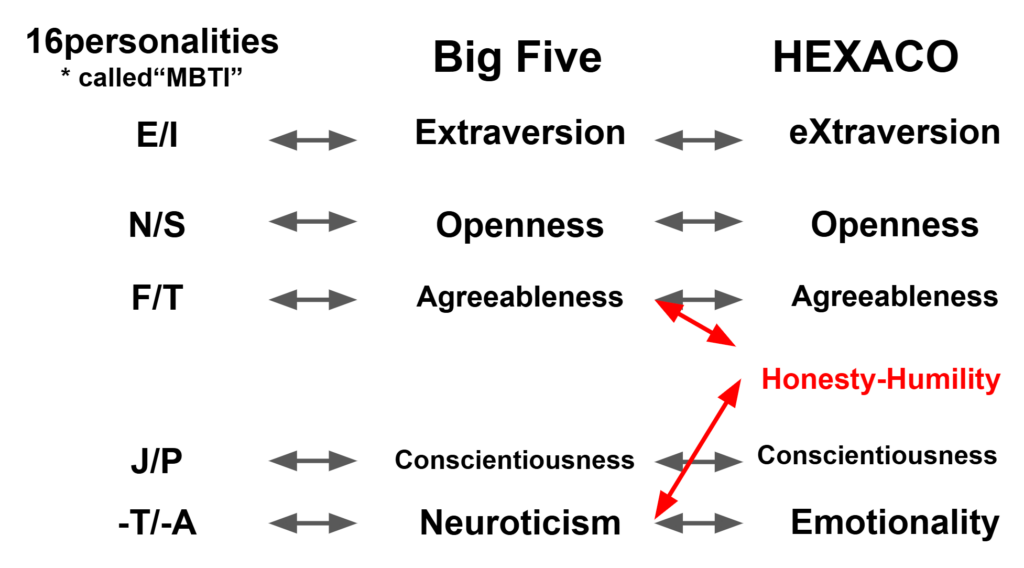
Also, in 16personalities, which was created with reference to MBTI and Big Five, neuroticism from Big Five is called “Identity“, and is classified as either Assertive or Turbulent.
On the far right is the relatively new personality assessment “HEXACO“. It is an improved version of Big Five with one additional indicator “Honesty-Humility”. Research on bullying and harassment perpetrators is active in HEXACO studies.
Since 16personalities and MBTI have weak scientific evidence, this article provides detailed explanations of 16personalities personality types based on their correlations with Big Five and HEXACO.
Scientific Background of the 16 Types
MBTI Overview
MBTI is a psychological theory that classifies personality into 16 types.
To begin with, MBTI is an abbreviation for Myers-Briggs Type Indicator.
MBTI classifies personality into 16 types by combining the following 4 indicators.
In other words, MBTI expresses one’s personality tendencies in 4 letters such as “ISTJ” or “ENFP”. There is a very famous similar system called 16personalities, but this is created by combining MBTI and Big Five.
Big Five Overview
One of the most prominent trait theories in personality psychology is the “Big Five”.
Big Five measures five traits: Openness, Conscientiousness, Extraversion, Agreeableness, and Neuroticism.
Also, while 16personalities and MBTI use type classification (e.g., either extraverted or introverted), a major difference is that Big Five evaluates traits on a continuous numerical scale (e.g., extraversion 3.5).
Furthermore, it has been studied for a long time, has many research papers, and extensive research has been conducted in other fields such as academic achievement, income, brain, and genetics. It can be said that Big Five has relatively stronger scientific backing.
Correlation Between MBTI, Big Five, and HEXACO
There are correlations between MBTI’s 4 indicators and Big Five’s 5 factors.
A representative study showing this correlation is the paper “The relationship between the revised NEO-Personality Inventory and the Myers-Briggs Type Indicator“.
According to this paper, the correlations between MBTI and Big Five are as follows.
Also, in 16personalities, which was created with reference to MBTI and Big Five, neuroticism from Big Five is called “Identity“, and is classified as either Assertive or Turbulent.
On the far right is the relatively new personality assessment “HEXACO“. It is an improved version of Big Five with one additional indicator “Honesty-Humility”. Research on bullying and harassment perpetrators is active in HEXACO studies.
Since 16personalities and MBTI have weak scientific evidence, this article provides detailed explanations of 16personalities personality types based on their correlations with Big Five and HEXACO.
Try Taking the Proper Personality Test “HEXACO-JP”!
While MBTI and 16personalities are popular as “gateways to knowing yourself,” experiencing a scientifically-backed personality test is the best way to truly understand your strengths and risks.
That’s where we recommend the HEXACO assessment available in Japanese: “HEXACO-JP“.
HEXACO-JP visualizes your personality tendencies numerically based on six factors: Honesty-Humility, Emotionality, Extraversion, Agreeableness, Conscientiousness, and Openness.
By simply answering straightforward questions, you can gain helpful insights for self-understanding, relationships, and workplace communication.
If you’re curious about “What type of person am I?”, start by taking HEXACO-JP and examine yourself from a scientific perspective.

FAQ and Important Notes
HEXACO results differ from 16personalities (commonly known as MBTI test) or MBTI (original)
- Personality is influenced by genetics and environment, so when the environment changes, responses also change (for example, emotional responses change when you’re tired, etc.). For more details on genetics, see here.
- There are variations in responses depending on age. For more details, see here.
- Type classification is based on whether each value is 3 or above, or below 3, so values close to 3 are more likely to change results depending on how questions are asked or the environment at the time. Please look at the numerical values rather than the type.
- For MBTI (original) and 16personalities (commonly known as MBTI test), it’s unclear how much statistical processing was done at the question design stage as no research papers can be found. On the other hand, papers on Big Five and HEXACO can be easily found, and this HEXACO-JP test is based on research papers.
- While there aren’t many research papers comparing MBTI and 16personalities with everyday behaviors (academic performance, income, etc.) or with the brain and genetics, there are numerous studies on Big Five and HEXACO.
- HEXACO is a variation of Big Five elements, so they are similar but distinct. HEXACO’s Honesty-Humility is extracted from Big Five’s Agreeableness and Neuroticism.
If you have any other questions, please contact us through our inquiry form.
Personality test results are merely “hints” for your life
As mentioned earlier, personality is influenced by genetics and environment. Due to genetic influence, there is a certain range of variation, but answers can vary to some extent depending on the environment.
Also, while Big Five and HEXACO research papers conduct correlation analyses with academic performance and income, the correlation coefficients are not as large as those in natural science experiments. Correlation coefficients range from -1 to 1, but most are around -0.4 to 0.4. Of course, there are higher ones too, but they’re not 0.8 or 0.9 – they’re relatively lower in comparison.
However, since there is various research available, please think of it as “more than fortune-telling, less than natural science.” I’m not 100% denying psychology or fortune-telling.

Writer & Supervisor: Eisuke Tokiwa
Personality Psychology Researcher / CEO, SUNBLAZE Inc.
As a child he experienced poverty, domestic abuse, bullying, truancy and dropping out of school — first-hand exposure to a range of social problems. He spent 10 years researching these issues and published Encyclopedia of Villains through Jiyukokuminsha. Since then he has independently researched the determinants of social problems and antisocial behavior (work, education, health, personality, genetics, region, etc.) and has published 2 peer-reviewed journal articles (Frontiers in Psychology, IEEE Access). His goal is to predict the occurrence of social problems. Spiky profile (WAIS-IV).
Expertise: Personality Psychology / Big Five / HEXACO / MBTI / Prediction of Social Problems
Researcher profiles: ORCID / Google Scholar / ResearchGate
Social & Books: X (@etokiwa999) / note / Amazon Author Page