
INFJ love personality traits are defined by an extraordinary depth of empathy, sincerity, and an almost fierce dedication to meaningful connection. If you identify as an INFJ — one of the rarest MBTI types, estimated to make up only about 1–2% of the general population — you likely approach romance very differently from most people. You don’t date casually. You invest deeply, feel intensely, and expect a relationship to be a true meeting of souls.
But that same intensity can be a double-edged sword. INFJs tend to hold impossibly high ideals, which sometimes leads to heartbreak or emotional exhaustion. This article explores the psychology behind INFJ romantic compatibility, the research that supports these patterns, and practical advice for building relationships that are both fulfilling and sustainable.
Once again, personality researcher and author of Villain Encyclopedia, Tokiwa (@etokiwa999), will provide the explanation.
※We have developed the HEXACO-JP Personality Assessment! It has more scientific basis than MBTI. Tap below for details.

目次
- 1 INFJ (The Advocate) Characteristics and Tendencies
- 2 INFJ Love Personality Traits: Are They the Ideal Partner?
- 3 The Psychology Behind INFJ Romantic Compatibility: What the Research Says
- 4 The INFJ Ideal Relationship: What They Truly Need
- 5 Try Taking the Proper Personality Test “HEXACO-JP”!
- 6 INFJ Relationship Strengths and Common Pitfalls to Watch
- 7 Scientific Background of the 16 Types
- 8 Practical Advice: How INFJs Can Build Healthier, Happier Relationships
- 9 FAQ and Important Notes
- 10 Frequently Asked Questions
- 10.1 What are the most defining INFJ love personality traits?
- 10.2 Who is most compatible with an INFJ in a romantic relationship?
- 10.3 Why do INFJs struggle in relationships despite being so empathetic?
- 10.4 What does an INFJ need to feel loved in a relationship?
- 10.5 How does INFJ empathy in love differ from other personality types?
- 10.6 Is it true that INFJs fall in love slowly?
- 10.7 What MBTI INFJ traits make them strong long-term partners?
- 11 Summary: Embracing Your INFJ Love Personality Traits
INFJ (The Advocate) Characteristics and Tendencies
INFJ is a type that combines insight and idealism.
They strive to deeply understand the feelings of others.
They value contributing to the growth of people and society.
They draw long-term visions and act with conviction.
The characteristics and tendencies of INFJ are as follows.
- They are sensitive to others’ emotions and have high empathy.
- They think deeply about abstract themes.
- They have a strong sense of purpose and pursue ideals.
- They prefer roles that support people behind the scenes.
- They value sincerity in human relationships.
On the other hand, they sometimes get tired because their ideals are too high.
They tend to bottle up emotions and easily feel lonely.
They may lack flexibility due to seeking perfection.
Having an attitude of relying on others lightens their heart.
INFJ gains trust through their sincere character.
They can deepen human relationships and create harmony.
Actions based on conviction become a power that guides those around them.
Connecting ideals to reality is their great strength.
INFJ Love Personality Traits: Are They the Ideal Partner?
Research suggests that INFJs possess many of the qualities that contribute to deeply satisfying romantic relationships. Their exceptionally high empathy means they can sense a partner’s emotional state before a single word is spoken. They take commitments seriously, value loyalty above almost everything else, and approach love as a long-term project rather than a fleeting experience. In short, INFJ relationship strengths are built on emotional intelligence and unwavering sincerity.
When we examine INFJ love personality traits more closely, 4 core patterns tend to emerge consistently:
- Profound empathy: INFJs tend to feel their partner’s joy and pain almost as their own, making them exceptionally nurturing and attentive companions.
- Unshakeable loyalty: Once an INFJ commits, they tend to honor that commitment with great consistency — they keep promises and show up even when it’s difficult.
- Perfectionistic idealism: INFJ partner expectations are often very high. They envision an ideal relationship and may feel quietly disappointed when reality falls short.
- Emotional internalization: INFJs frequently absorb stress without expressing it, which can build up over time and create internal conflict even in otherwise healthy relationships.
Compared to more extroverted types like ENFP or ESFJ, who tend to process emotions outwardly, INFJs typically work through their feelings internally before sharing them. This can sometimes be misread by partners as emotional distance. Understanding this difference is key to navigating INFJ empathy in love.
The takeaway: an INFJ can genuinely be the emotional anchor in a relationship — a partner who listens deeply and loves faithfully. But this only works sustainably when they learn to express their own needs openly rather than silently carrying the weight of both people’s emotions.
The Psychology Behind INFJ Romantic Compatibility: What the Research Says
To understand why INFJs tend to thrive — and sometimes struggle — in romance, it helps to look at the psychology of personality and relationship satisfaction. One of the most well-validated frameworks in modern psychology is the Big Five personality model, which breaks personality down into 5 dimensions: Conscientiousness, Agreeableness, Extraversion, Openness to Experience, and Emotional Stability (sometimes called Neuroticism, reversed).
Research consistently shows that 2 of these dimensions are especially predictive of romantic satisfaction:
- High Agreeableness: People who score high here are warm, cooperative, and highly attuned to others’ feelings — a description that maps closely onto the MBTI’s “F” (Feeling) dimension, which is central to the INFJ profile.
- High Conscientiousness: People with strong self-discipline and a tendency to follow through on commitments correlate strongly with the MBTI’s “J” (Judging) dimension — also a defining INFJ trait.
This alignment is meaningful. The research suggests that the same qualities — empathy, reliability, and emotional attentiveness — that define MBTI INFJ traits also happen to be the qualities most strongly linked to relationship satisfaction in the scientific literature. A meta-analysis referenced below examined data across multiple studies and found that partners high in both Conscientiousness and Agreeableness reported significantly higher levels of relationship satisfaction.
Reference study: Malouff, J. M. et al. (2010), The Five-Factor Model of personality and relationship satisfaction of intimate partners: A meta-analysis
The INFJ Ideal Relationship: What They Truly Need
For INFJs, the ideal relationship is not simply about romance — it is about finding a partner who engages with them at the level of values, vision, and inner life. Casual small talk and surface-level connections tend to feel draining rather than fulfilling to INFJs. They are drawn to partners who ask deep questions, share their sense of purpose, and create a space where vulnerability feels safe.
Studies on INFJ romantic compatibility suggest they tend to feel most fulfilled with partners who offer the following 3 qualities:
- Emotional safety: INFJs need to trust that their inner world — their fears, dreams, and complex feelings — will be received with care rather than judgment. Without this, they tend to withdraw emotionally.
- Intellectual depth: The INFJ ideal relationship almost always involves stimulating conversations about meaning, values, and the nature of things. Partners who can engage here forge a much stronger bond.
- Consistent respect for alone time: Despite being deeply loving, INFJs are introverts who recharge in solitude. A partner who understands and respects this need — rather than treating it as rejection — is essential for long-term harmony.
INFJs are sometimes compared to INTJs in this regard: both types value depth and long-term commitment. However, while INTJs tend to prioritize intellectual partnership above emotional attunement, INFJs need both in roughly equal measure. The emotional dimension is not optional for them — it is the foundation.
Try Taking the Proper Personality Test “HEXACO-JP”!
While MBTI and 16personalities are popular as “gateways to knowing yourself,” experiencing a scientifically-backed personality test is the best way to truly understand your strengths and risks.
That’s where we recommend the HEXACO assessment available in Japanese: “HEXACO-JP“.
HEXACO-JP visualizes your personality tendencies numerically based on six factors: Honesty-Humility, Emotionality, Extraversion, Agreeableness, Conscientiousness, and Openness.
By simply answering straightforward questions, you can gain helpful insights for self-understanding, relationships, and workplace communication.
If you’re curious about “What type of person am I?”, start by taking HEXACO-JP and examine yourself from a scientific perspective.
INFJ Relationship Strengths and Common Pitfalls to Watch
Understanding the gap between INFJ relationship strengths and their characteristic vulnerabilities is crucial for building lasting love. INFJs bring remarkable gifts to a partnership, but certain tendencies — if left unchecked — can quietly erode even the most promising relationship over time.
Here are the core strengths INFJs bring to a relationship:
- Deep listening: INFJs are naturally gifted at making their partners feel truly heard and understood — a quality that research consistently links to higher relationship satisfaction.
- Long-term vision: They tend to think about relationships in terms of years and decades, not weeks and months, which gives their partnerships a sense of stability and direction.
- Conflict resolution through empathy: Rather than attacking or withdrawing during disagreements, INFJs typically try to understand the emotional root of the conflict.
And here are 3 key pitfalls INFJs should actively watch for:
- Over-idealizing the partner: INFJ partner expectations can be so high that real people — with real flaws — feel like disappointments. Recognizing the difference between a healthy standard and an impossible ideal is essential.
- Suppressing personal needs: INFJs are so focused on their partner’s well-being that they often neglect their own. Over time, this creates resentment. Practicing assertive communication — stating needs clearly and kindly — prevents this buildup.
- Absorbing emotional pain without an outlet: Because INFJs internalize so much, they need conscious emotional release strategies: journaling, creative expression, therapy, or trusted friendships outside the relationship.
Scientific Background of the 16 Types
MBTI Overview
MBTI is a psychological theory that classifies personality into 16 types.
To begin with, MBTI is an abbreviation for Myers-Briggs Type Indicator.
MBTI classifies personality into 16 types by combining the following 4 indicators.
In other words, MBTI expresses one’s personality tendencies in 4 letters such as “ISTJ” or “ENFP”. There is a very famous similar system called 16personalities, but this is created by combining MBTI and Big Five.
Big Five Overview
One of the most prominent trait theories in personality psychology is the “Big Five”.
Big Five measures five traits: Openness, Conscientiousness, Extraversion, Agreeableness, and Neuroticism.
Also, while 16personalities and MBTI use type classification (e.g., either extraverted or introverted), a major difference is that Big Five evaluates traits on a continuous numerical scale (e.g., extraversion 3.5).
Furthermore, it has been studied for a long time, has many research papers, and extensive research has been conducted in other fields such as academic achievement, income, brain, and genetics. It can be said that Big Five has relatively stronger scientific backing.
Correlation Between MBTI, Big Five, and HEXACO
There are correlations between MBTI’s 4 indicators and Big Five’s 5 factors.
A representative study showing this correlation is the paper “The relationship between the revised NEO-Personality Inventory and the Myers-Briggs Type Indicator“.
According to this paper, the correlations between MBTI and Big Five are as follows.
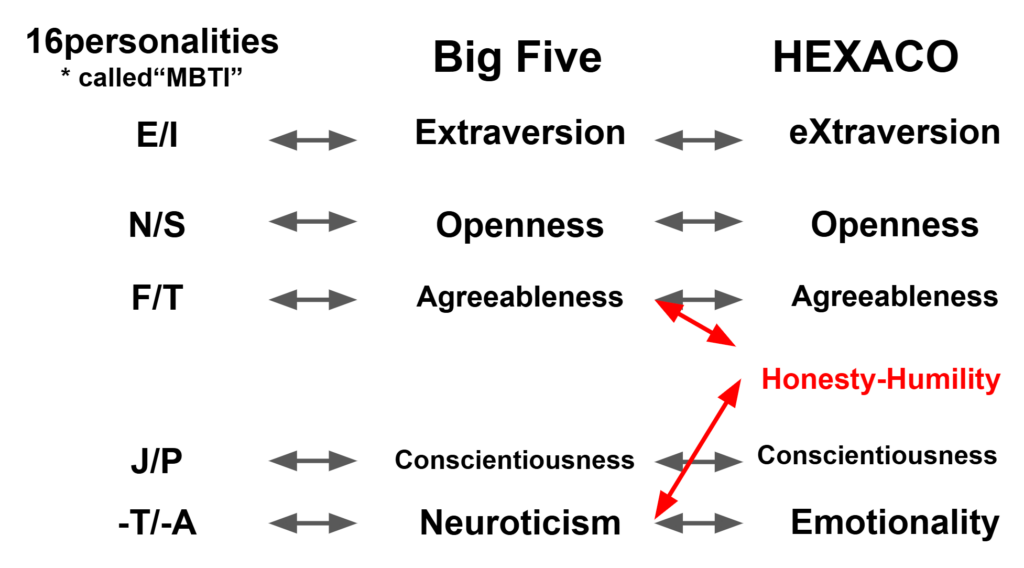
Also, in 16personalities, which was created with reference to MBTI and Big Five, neuroticism from Big Five is called “Identity“, and is classified as either Assertive or Turbulent.
On the far right is the relatively new personality assessment “HEXACO“. It is an improved version of Big Five with one additional indicator “Honesty-Humility”. Research on bullying and harassment perpetrators is active in HEXACO studies.
Since 16personalities and MBTI have weak scientific evidence, this article provides detailed explanations of 16personalities personality types based on their correlations with Big Five and HEXACO.
Practical Advice: How INFJs Can Build Healthier, Happier Relationships
The most important shift an INFJ can make in love is learning to give themselves the same compassion they so freely offer their partners. INFJ empathy in love is a genuine superpower, but it must be directed inward as well as outward to sustain a healthy relationship dynamic.
Here are 4 evidence-informed practices for INFJs navigating romantic relationships:
- Practice “needs disclosure” regularly: Once a week, share one thing you genuinely need from your partner — whether it’s more quiet evenings together or more verbal affirmation. This builds intimacy and prevents the silent accumulation of unmet needs. Why it works: Research on relationship communication consistently shows that expressing needs clearly reduces misunderstandings and increases mutual satisfaction.
- Audit your relationship ideals: Write down your top 5 expectations for a partner. Then honestly ask: which of these reflect genuine values, and which reflect a fantasy? Separating the two prevents chronic disappointment. How to practice: Revisit this list every 6 months as you grow together.
- Schedule intentional solitude: Protect at least 2 to 3 hours per week of genuine alone time — not passive scrolling, but restorative activities like reading, walking, or creating. Why it works: For INFJs, emotional regulation depends heavily on having adequate solitude. A depleted INFJ cannot show up fully for their partner.
- Seek a partner who asks questions: During early dating, notice whether a potential partner asks curious, open-ended questions about your inner world. This single behavior is one of the strongest early signals of INFJ romantic compatibility.

FAQ and Important Notes
HEXACO results differ from 16personalities (commonly known as MBTI test) or MBTI (original)
- Personality is influenced by genetics and environment, so when the environment changes, responses also change (for example, emotional responses change when you’re tired, etc.). For more details on genetics, see here.
- There are variations in responses depending on age. For more details, see here.
- Type classification is based on whether each value is 3 or above, or below 3, so values close to 3 are more likely to change results depending on how questions are asked or the environment at the time. Please look at the numerical values rather than the type.
- For MBTI (original) and 16personalities (commonly known as MBTI test), it’s unclear how much statistical processing was done at the question design stage as no research papers can be found. On the other hand, papers on Big Five and HEXACO can be easily found, and this HEXACO-JP test is based on research papers.
- While there aren’t many research papers comparing MBTI and 16personalities with everyday behaviors (academic performance, income, etc.) or with the brain and genetics, there are numerous studies on Big Five and HEXACO.
- HEXACO is a variation of Big Five elements, so they are similar but distinct. HEXACO’s Honesty-Humility is extracted from Big Five’s Agreeableness and Neuroticism.
If you have any other questions, please contact us through our inquiry form.
Personality test results are merely “hints” for your life
As mentioned earlier, personality is influenced by genetics and environment. Due to genetic influence, there is a certain range of variation, but answers can vary to some extent depending on the environment.
Also, while Big Five and HEXACO research papers conduct correlation analyses with academic performance and income, the correlation coefficients are not as large as those in natural science experiments. Correlation coefficients range from -1 to 1, but most are around -0.4 to 0.4. Of course, there are higher ones too, but they’re not 0.8 or 0.9 – they’re relatively lower in comparison.
However, since there is various research available, please think of it as “more than fortune-telling, less than natural science.” I’m not 100% denying psychology or fortune-telling.
Frequently Asked Questions
What are the most defining INFJ love personality traits?
The most defining INFJ love personality traits tend to be deep empathy, unwavering loyalty, and a strong preference for meaningful over casual connection. INFJs typically feel their partner’s emotions intensely, commit wholeheartedly once trust is established, and hold high ideals for what a relationship can be. They are also prone to internalizing stress and may struggle to express their own needs, which is an important area for personal growth in romantic contexts.
Who is most compatible with an INFJ in a romantic relationship?
INFJ romantic compatibility tends to be strongest with partners who value emotional depth, intellectual conversation, and genuine intimacy. Types like ENFP and INTJ are frequently cited as good matches — ENFPs bring warmth and spontaneity that balance the INFJ’s structured intensity, while INTJs share the INFJ’s love of depth and long-term thinking. That said, compatibility ultimately depends on individual communication styles and shared values more than personality type alone.
Why do INFJs struggle in relationships despite being so empathetic?
INFJs sometimes struggle in relationships precisely because their empathy runs so deep. They tend to absorb their partner’s emotions, which can lead to emotional exhaustion. They also set very high INFJ partner expectations — for themselves and their partners — which can result in quiet disappointment when reality doesn’t match their vision. Additionally, INFJs tend to suppress their own needs to prioritize their partner’s well-being, which can build resentment over time if not addressed directly.
What does an INFJ need to feel loved in a relationship?
INFJs tend to feel most loved when they experience emotional safety, intellectual connection, and consistent respect for their need for solitude. They need to feel that their inner world is genuinely valued — not just tolerated — by their partner. Acts of service and quality conversation tend to resonate more with INFJs than grand public gestures. Being truly listened to, without judgment, is often the most powerful way to show an INFJ they are loved.
How does INFJ empathy in love differ from other personality types?
INFJ empathy in love tends to be more perceptive and absorptive than that of most other types. While many feeling types (like ENFJ or ISFJ) are also highly empathetic, INFJs additionally use their intuition to sense emotional undercurrents that haven’t been expressed yet — sometimes picking up on a partner’s distress before the partner themselves is consciously aware of it. This makes them exceptionally attuned companions, but it also means they are particularly vulnerable to emotional overload.
Is it true that INFJs fall in love slowly?
Generally speaking, yes — INFJs tend to fall in love more deliberately than many other types. Because they value deep trust and authentic connection above superficial attraction, they typically take time to evaluate whether a potential partner truly aligns with their core values. However, once an INFJ does fall in love, the attachment tends to be profound and long-lasting. They are not likely to invest emotionally and then walk away casually.
What MBTI INFJ traits make them strong long-term partners?
Several MBTI INFJ traits make them particularly well-suited for long-term relationships. Their Conscientiousness (the “J” dimension) means they follow through on commitments and plan for the future. Their Feeling preference means they prioritize emotional harmony and their partner’s well-being. Their Intuition helps them anticipate problems before they escalate. Research linking high Agreeableness and Conscientiousness to relationship satisfaction suggests these same qualities give INFJs a strong foundation for building lasting love.

Writer & Supervisor: Eisuke Tokiwa
Personality Psychology Researcher / CEO, SUNBLAZE Inc.
As a child he experienced poverty, domestic abuse, bullying, truancy and dropping out of school — first-hand exposure to a range of social problems. He spent 10 years researching these issues and published Encyclopedia of Villains through Jiyukokuminsha. Since then he has independently researched the determinants of social problems and antisocial behavior (work, education, health, personality, genetics, region, etc.) and has published 2 peer-reviewed journal articles (Frontiers in Psychology, IEEE Access). His goal is to predict the occurrence of social problems. Spiky profile (WAIS-IV).
Expertise: Personality Psychology / Big Five / HEXACO / MBTI / Prediction of Social Problems
Researcher profiles: ORCID / Google Scholar / ResearchGate
Social & Books: X (@etokiwa999) / note / Amazon Author Page
Summary: Embracing Your INFJ Love Personality Traits
INFJs bring some of the most remarkable qualities to a romantic relationship — deep empathy, steadfast loyalty, and a genuine desire to understand and support their partner at a soul level. Research on personality and relationship satisfaction suggests that the core INFJ love personality traits, particularly their high empathy and commitment, are among the qualities most strongly associated with lasting romantic fulfillment. The key challenge for INFJs is learning to direct that same compassion inward: expressing needs openly, releasing impossible ideals, and protecting the emotional energy that makes them such extraordinary partners in the first place.
If you recognized yourself in any of these patterns — the deep idealism, the quiet self-sacrifice, the longing for true connection — take a moment to explore which of your INFJ relationship strengths you are already leveraging, and which areas still have room to grow. Understanding your own romantic blueprint is the first step toward the relationship you’ve always envisioned.