INTJ love personality traits reveal a fascinating paradox: one of the most logical, independent minds in the MBTI spectrum also harbors one of the deepest capacities for loyal, committed love. If you’ve ever wondered why INTJs seem emotionally distant yet fiercely devoted once they open up, personality psychology offers clear and compelling answers.
Understanding how INTJs approach romance isn’t just interesting trivia — it can meaningfully improve your relationships, whether you identify as an INTJ yourself or you’re in a relationship with one. Drawing on personality research, including studies on the Big Five model and relationship satisfaction, this article breaks down exactly what makes INTJ romantic tendencies so unique, and what you can do to make the most of them.
Once again, personality researcher and author of Villain Encyclopedia, Tokiwa (@etokiwa999), will provide the explanation.
※We have developed the HEXACO-JP Personality Assessment! It has more scientific basis than MBTI. Tap below for details.

目次
- 1 Characteristics and Tendencies of INTJ (The Architect)
- 2 What Are INTJ Love Personality Traits, Really?
- 3 What Personality Research Says About INTJ Compatibility
- 4 INTJ Emotional Intimacy: The Hidden Depth Behind the Reserved Exterior
- 5 INTJ Partner Strengths: What They Genuinely Bring to a Relationship
- 6 Actionable Advice: How INTJs Can Strengthen Their Romantic Relationships
- 7 Try Taking the Proper Personality Test “HEXACO-JP”!
- 8 Scientific Background of the 16 Types
- 9 Frequently Asked Questions
- 9.1 Are INTJs capable of deep romantic love?
- 9.2 What personality types are most compatible with INTJs in relationships?
- 9.3 Why do INTJs seem emotionally cold in relationships?
- 9.4 How do INTJs behave when they have a crush?
- 9.5 What are the biggest challenges in INTJ relationships?
- 9.6 Do INTJs fall in love quickly?
- 9.7 Can INTJs become more emotionally expressive in relationships?
- 10 FAQ and Important Notes
- 11 Summary: Understanding INTJ Love Personality Traits Opens the Door to Deeper Connection
Characteristics and Tendencies of INTJ (The Architect)
INTJs are types with excellent analytical and strategic abilities.
They plan things for the long term and persistently work toward achieving their goals.
They emphasize efficiency and are characterized by their aversion to waste.
They tend to stick to their own ideas and have a strong sense of independence.
INTJ thinking and behavior includes the following elements:
- They organize complex problems and solve them logically.
- They are skilled at making plans with future foresight.
- They generate new ideas from unique perspectives.
- In relationships, they seek deep connections.
- They prefer essential discussions over superficial conversations.
On the other hand, they may become isolated if they lack flexibility.
Disregarding others’ emotions can easily lead to misunderstandings.
They tend to prioritize results over personal relationships.
Therefore, it’s important to be mindful of cooperation.
INTJs with their calm analytical abilities and foresight
can achieve great results in learning, research, and planning.
With continued effort, they can also demonstrate leadership.
Make use of your strengths while respecting those around you.
What Are INTJ Love Personality Traits, Really?
INTJs are not naturally the “sweep-you-off-your-feet” romantic type, but research suggests they can become extraordinarily reliable and deeply committed partners. The INTJ personality type — Introverted, Intuitive, Thinking, Judging — tends to prioritize logic and long-term planning over spontaneous emotional expression. This doesn’t mean INTJs don’t feel love; it means they express it differently than most people expect.
In practice, INTJ relationships tend to follow a distinct pattern. Rather than grand romantic gestures or constant verbal affirmations, INTJs show love through consistency, loyalty, and deliberate action. They tend to research a partner’s interests, plan meaningful experiences, and honor commitments with near-perfect reliability. Studies in personality psychology suggest that these “Judging” and “Thinking” traits correspond closely to the Big Five dimensions of conscientiousness — a trait strongly linked to relationship stability.
Here are 4 core INTJ love personality traits that tend to show up in romantic contexts:
- Restrained emotional expression: INTJs often understate their feelings, which can leave partners feeling uncertain about where they stand — even when the INTJ is deeply invested.
- Preference for depth over breadth: Casual dating tends to feel meaningless to INTJs. They seek an intellectual and emotional bond that goes beyond surface-level attraction.
- Structured commitment: INTJs tend to approach relationships with the same planning mindset they apply to career or personal goals — setting expectations, honoring promises, and thinking long-term.
- Rational conflict resolution: Rather than emotional arguments, INTJs strongly prefer calm, logical discussions when disagreements arise. This can be a strength or a friction point depending on their partner’s style.
The key takeaway is that INTJs are not cold — they are selectively warm. Once an INTJ chooses you as a partner, that choice is rarely made lightly, and their loyalty tends to run exceptionally deep.
What Personality Research Says About INTJ Compatibility
Research on personality and relationship satisfaction suggests that the traits INTJs naturally possess — conscientiousness and openness — are genuinely valuable in long-term INTJ compatibility, but that emotional warmth (agreeableness) plays a critical balancing role.
Personality psychologists often use the Big Five model to study romantic relationships. This framework evaluates personality across 5 dimensions: conscientiousness, agreeableness, extraversion, openness to experience, and emotional stability (also called neuroticism, in its negative form). Research shows that people who score high in both agreeableness and conscientiousness tend to report the highest levels of relationship satisfaction.
Where does this leave INTJs? In MBTI terms, the “T” (Thinking) preference correlates loosely with lower agreeableness scores, while the “J” (Judging) preference correlates with higher conscientiousness. This means INTJs tend to bring structure, reliability, and follow-through to relationships — qualities partners deeply value — while potentially underdelivering on warmth, empathy signaling, and emotional availability.
This is supported by meta-analytic research on the Five-Factor Model and intimate partner satisfaction, which found that both partners’ agreeableness scores significantly predicted relationship quality. For INTJs, this suggests a clear developmental pathway: learning to express care in emotionally legible ways — without abandoning their rational core — is the single most impactful thing they can do to improve INTJ relationships.
In practical terms, INTJs who actively practice emotional acknowledgment (“I understand why that upset you”) alongside their natural logical problem-solving tend to report significantly more harmonious partnerships than those who lead purely with analysis.
INTJ Emotional Intimacy: The Hidden Depth Behind the Reserved Exterior
One of the most misunderstood aspects of INTJ emotional intimacy is that it exists in abundance — it simply doesn’t follow conventional scripts. Where many personality types build closeness through frequent social interaction and verbal emotional sharing, INTJs tend to build intimacy through shared intellectual exploration, mutual respect, and quiet, consistent presence.
Research in attachment psychology suggests that approximately 60–65% of adults have a secure attachment style, meaning they find it relatively natural to express vulnerability and seek comfort from partners. INTJs, with their strong preference for autonomy and self-sufficiency, may be more likely to develop what researchers call a “dismissive-avoidant” lean — not out of indifference, but out of a deeply ingrained habit of handling emotions independently.
This can create a specific dynamic in INTJ partnerships:
- Partners may feel shut out during stressful periods, precisely when the INTJ is most intensely processing their emotions internally.
- INTJs may feel overwhelmed by partners who need high levels of emotional reassurance, interpreting this as irrationality rather than a valid emotional need.
- Deep conversations about ideas, values, and future plans tend to feel far more connecting to INTJs than small talk or emotional venting — and this difference can cause friction if not openly discussed.
The constructive path forward involves recognizing that INTJ emotional intimacy is real and substantial — it just needs a different “language.” Partners who learn to engage INTJs on intellectual and value-based levels often find a level of depth and sincerity that is genuinely rare.
INTJ Partner Strengths: What They Genuinely Bring to a Relationship
Despite the challenges, INTJ partner strengths are substantial — and for the right person, they represent some of the most valuable qualities a romantic partner can offer. Understanding these strengths helps both INTJs and their partners appreciate what is already working well.
Here are the most consistently observed INTJ partner strengths in relationship research and psychological literature:
- Unwavering loyalty: INTJs do not enter relationships casually. When they commit, they tend to commit fully, and infidelity or betrayal is deeply contrary to their value system.
- Intellectual stimulation: INTJs naturally engage with ideas at a high level, making them consistently interesting partners for those who value intellectual discourse and personal growth.
- Problem-solving orientation: When a relationship faces practical challenges — finances, logistics, long-term planning — INTJs tend to step up with clear-headed, effective strategies.
- Respecting independence: Because INTJs value autonomy so highly themselves, they typically give partners generous space to pursue their own interests and development, avoiding the clingy or controlling dynamic seen in some other types.
- Long-term vision: INTJs are naturally oriented toward the future, making them partners who actively plan and build toward shared goals rather than drifting aimlessly.
For MBTI love traits overall, research consistently shows that partners who feel both respected and intellectually engaged report higher relationship satisfaction. INTJs tend to deliver strongly on both counts — making INTJ compatibility particularly high with types that value depth, honesty, and growth over surface-level romance.
Actionable Advice: How INTJs Can Strengthen Their Romantic Relationships
Awareness of INTJ love personality traits is only useful if it translates into concrete behavior. The following advice is grounded in personality psychology and is specifically tailored to how INTJs are wired — working with their nature rather than against it.
1. Practice “Translating” Your Logic Into Emotional Language
Why it works: Research on agreeableness and relationship satisfaction consistently shows that partners feel more loved when emotions are verbally acknowledged — not just efficiently managed. INTJs who make a deliberate effort to say “I care about how you’re feeling” alongside their natural problem-solving instinct tend to see immediate improvements in partner satisfaction.
How to practice: Before jumping to solutions in an emotional conversation, pause and say something that validates your partner’s feeling. Even a simple “That sounds really frustrating” before offering advice can make a measurable difference in how connected your partner feels.
2. Be Explicit About Your Commitment
Why it works: INTJs often assume their loyalty is obvious from their actions. But partners who need verbal reassurance will not automatically infer love from punctuality and planning. Explicitly stating your feelings — even occasionally — fills a genuine gap.
How to practice: Schedule (yes, INTJs can absolutely schedule emotional check-ins) a regular moment — weekly or monthly — to verbally express appreciation for your partner. Framing it as a structured habit makes it feel authentic to the INTJ mindset rather than forced.
3. Leverage Your Strengths Without Amplifying Your Blind Spots
Why it works: INTJs tend to over-optimize for logic and under-invest in emotional rituals (anniversaries, spontaneous affection, playfulness). Research on long-term couples shows that small, consistent positive gestures — not grand strategies — are what sustain emotional closeness over time.
How to practice: Keep doing what you’re great at — planning meaningful experiences, being reliable, engaging deeply in conversation. But add at least 1 small daily or weekly “emotional gesture” that your specific partner values, even if it doesn’t come naturally to you.
Try Taking the Proper Personality Test “HEXACO-JP”!
While MBTI and 16personalities are popular as “gateways to knowing yourself,” experiencing a scientifically-backed personality test is the best way to truly understand your strengths and risks.
That’s where we recommend the HEXACO assessment available in Japanese: “HEXACO-JP“.
HEXACO-JP visualizes your personality tendencies numerically based on six factors: Honesty-Humility, Emotionality, Extraversion, Agreeableness, Conscientiousness, and Openness.
By simply answering straightforward questions, you can gain helpful insights for self-understanding, relationships, and workplace communication.
If you’re curious about “What type of person am I?”, start by taking HEXACO-JP and examine yourself from a scientific perspective.
Scientific Background of the 16 Types
MBTI Overview
MBTI is a psychological theory that classifies personality into 16 types.
To begin with, MBTI is an abbreviation for Myers-Briggs Type Indicator.
MBTI classifies personality into 16 types by combining the following 4 indicators.
In other words, MBTI expresses one’s personality tendencies in 4 letters such as “ISTJ” or “ENFP”. There is a very famous similar system called 16personalities, but this is created by combining MBTI and Big Five.
Big Five Overview
One of the most prominent trait theories in personality psychology is the “Big Five”.
Big Five measures five traits: Openness, Conscientiousness, Extraversion, Agreeableness, and Neuroticism.
Also, while 16personalities and MBTI use type classification (e.g., either extraverted or introverted), a major difference is that Big Five evaluates traits on a continuous numerical scale (e.g., extraversion 3.5).
Furthermore, it has been studied for a long time, has many research papers, and extensive research has been conducted in other fields such as academic achievement, income, brain, and genetics. It can be said that Big Five has relatively stronger scientific backing.
Correlation Between MBTI, Big Five, and HEXACO
There are correlations between MBTI’s 4 indicators and Big Five’s 5 factors.
A representative study showing this correlation is the paper “The relationship between the revised NEO-Personality Inventory and the Myers-Briggs Type Indicator“.
According to this paper, the correlations between MBTI and Big Five are as follows.
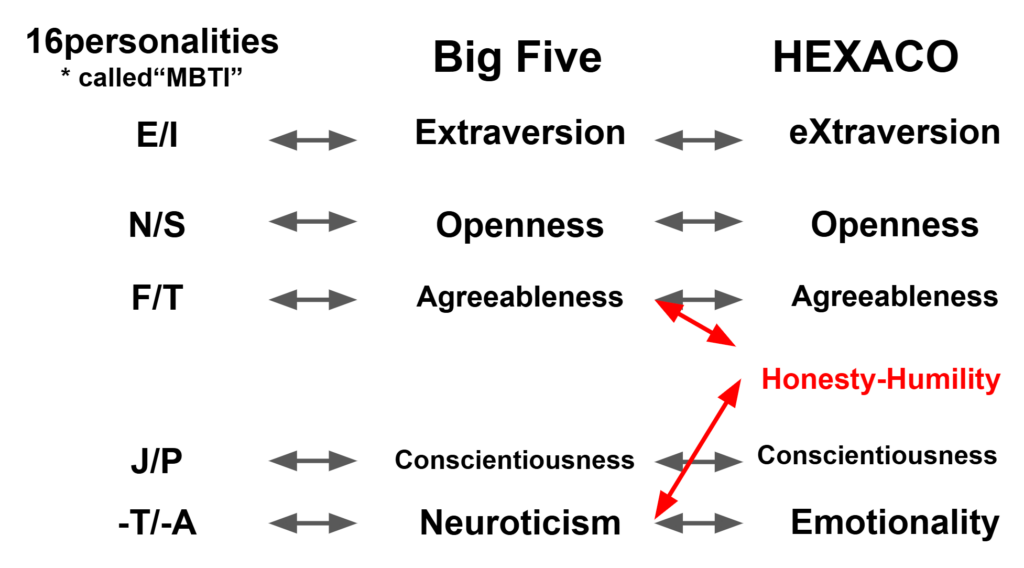
Also, in 16personalities, which was created with reference to MBTI and Big Five, neuroticism from Big Five is called “Identity“, and is classified as either Assertive or Turbulent.
On the far right is the relatively new personality assessment “HEXACO“. It is an improved version of Big Five with one additional indicator “Honesty-Humility”. Research on bullying and harassment perpetrators is active in HEXACO studies.
Since 16personalities and MBTI have weak scientific evidence, this article provides detailed explanations of 16personalities personality types based on their correlations with Big Five and HEXACO.
Frequently Asked Questions
Are INTJs capable of deep romantic love?
Yes — research and psychological profiles consistently suggest that INTJs are fully capable of deep, genuine romantic love. The difference is that they tend to express it through action, loyalty, and intellectual engagement rather than frequent verbal declarations or emotional displays. Partners who understand this communication style often describe INTJs as among the most sincere and devoted partners they’ve had. The depth is real; the expression is simply quieter than most people expect.
What personality types are most compatible with INTJs in relationships?
INTJ compatibility tends to be strongest with personality types that value intellectual depth, independence, and honest communication. Types like ENFP and ENTP are often cited because their intuitive creativity complements the INTJ’s strategic mindset, while their emotional warmth can balance the INTJ’s reserved nature. That said, personality research consistently emphasizes that shared values, communication quality, and mutual respect are stronger predictors of relationship success than any specific type pairing.
Why do INTJs seem emotionally cold in relationships?
INTJs tend to process emotions internally and privately, which can come across as coldness or indifference to partners who express emotions more openly. This is largely a communication style difference rather than a lack of caring. Personality psychology suggests that INTJs score lower on agreeableness-related expressiveness, meaning their warmth is genuine but not always visible without intentional effort. Understanding this difference is the first step toward bridging the emotional gap in INTJ relationships.
How do INTJs behave when they have a crush?
When an INTJ develops romantic feelings, they tend to become intensely observant and analytical about the person of interest — researching their values, interests, and compatibility before making any move. They are unlikely to flirt openly or drop obvious hints. Instead, they may initiate deep one-on-one conversations, offer thoughtful help, or find ways to be useful and present. Approximately 70% of their romantic signaling tends to be subtle enough that the other person may not even recognize it as interest.
What are the biggest challenges in INTJ relationships?
The most commonly reported challenges in INTJ relationships include: difficulty expressing vulnerability, a tendency to prioritize logic over emotional validation during conflicts, low tolerance for what they perceive as irrational behavior, and a strong need for personal space that partners may misread as disinterest. Research on Big Five personality traits suggests that consciously developing agreeableness — the willingness to prioritize a partner’s emotional needs — is the single most impactful growth area for INTJs seeking healthier romantic partnerships.
Do INTJs fall in love quickly?
Generally, no. INTJs tend to be highly selective and take considerable time before allowing themselves to fall in love. They typically evaluate a potential partner’s values, intellect, and long-term compatibility before committing emotionally. This slow, deliberate process means that when an INTJ does fall in love, the feeling is usually well-considered and enduring rather than impulsive. This stands in contrast to more feeling-oriented types who may fall in love quickly but also move on more rapidly.
Can INTJs become more emotionally expressive in relationships?
Yes — and research on personality development suggests that personality traits, while relatively stable, are not fixed. INTJs who are motivated and self-aware can meaningfully develop their emotional expressiveness over time. Strategies that tend to work well for INTJs include framing emotional expression as a learnable skill (rather than a personality flaw), practicing specific verbal phrases that acknowledge their partner’s feelings, and gradually building comfort with vulnerability through trusted, low-stakes moments. Growth in this area directly correlates with higher reported INTJ relationship satisfaction.

FAQ and Important Notes
HEXACO results differ from 16personalities (commonly known as MBTI test) or MBTI (original)
- Personality is influenced by genetics and environment, so when the environment changes, responses also change (for example, emotional responses change when you’re tired, etc.). For more details on genetics, see here.
- There are variations in responses depending on age. For more details, see here.
- Type classification is based on whether each value is 3 or above, or below 3, so values close to 3 are more likely to change results depending on how questions are asked or the environment at the time. Please look at the numerical values rather than the type.
- For MBTI (original) and 16personalities (commonly known as MBTI test), it’s unclear how much statistical processing was done at the question design stage as no research papers can be found. On the other hand, papers on Big Five and HEXACO can be easily found, and this HEXACO-JP test is based on research papers.
- While there aren’t many research papers comparing MBTI and 16personalities with everyday behaviors (academic performance, income, etc.) or with the brain and genetics, there are numerous studies on Big Five and HEXACO.
- HEXACO is a variation of Big Five elements, so they are similar but distinct. HEXACO’s Honesty-Humility is extracted from Big Five’s Agreeableness and Neuroticism.
If you have any other questions, please contact us through our inquiry form.
Personality test results are merely “hints” for your life
As mentioned earlier, personality is influenced by genetics and environment. Due to genetic influence, there is a certain range of variation, but answers can vary to some extent depending on the environment.
Also, while Big Five and HEXACO research papers conduct correlation analyses with academic performance and income, the correlation coefficients are not as large as those in natural science experiments. Correlation coefficients range from -1 to 1, but most are around -0.4 to 0.4. Of course, there are higher ones too, but they’re not 0.8 or 0.9 – they’re relatively lower in comparison.
However, since there is various research available, please think of it as “more than fortune-telling, less than natural science.” I’m not 100% denying psychology or fortune-telling.

Writer & Supervisor: Eisuke Tokiwa
Personality Psychology Researcher / CEO, SUNBLAZE Inc.
As a child he experienced poverty, domestic abuse, bullying, truancy and dropping out of school — first-hand exposure to a range of social problems. He spent 10 years researching these issues and published Encyclopedia of Villains through Jiyukokuminsha. Since then he has independently researched the determinants of social problems and antisocial behavior (work, education, health, personality, genetics, region, etc.) and has published 2 peer-reviewed journal articles (Frontiers in Psychology, IEEE Access). His goal is to predict the occurrence of social problems. Spiky profile (WAIS-IV).
Expertise: Personality Psychology / Big Five / HEXACO / MBTI / Prediction of Social Problems
Researcher profiles: ORCID / Google Scholar / ResearchGate
Social & Books: X (@etokiwa999) / note / Amazon Author Page
Summary: Understanding INTJ Love Personality Traits Opens the Door to Deeper Connection
INTJ love personality traits are defined by a quiet but powerful combination of loyalty, intellectual depth, long-term thinking, and reserved emotional expression. Research grounded in the Big Five model confirms that the conscientiousness and openness INTJs naturally bring to relationships are genuine assets — while also pointing clearly to emotional expressiveness as the area with the most growth potential. INTJs are not incapable of great love; they simply speak a different romantic language — one that becomes beautiful once understood.
Whether you’re an INTJ reflecting on your own romantic patterns, or a partner trying to understand the quiet, devoted person beside you, the most valuable next step is the same: look deeper than surface behavior. If this portrait of INTJ romantic tendencies resonated with you, explore your own personality profile to discover which of these traits are shaping your love life right now — and which strengths you may not yet be fully using.