ENTP love personality traits are defined by a craving for intellectual stimulation, spontaneous adventure, and a relationship dynamic that feels alive and ever-evolving. If you have ever fallen for someone who debates you passionately one moment and whisks you off on an unplanned road trip the next, there is a good chance you encountered an ENTP. Understanding how this personality type approaches romance — its genuine strengths, its recurring blind spots, and the specific conditions under which it truly thrives — can save both ENTPs and their partners a great deal of confusion.
This article draws on psychological research, including the well-established Big Five personality model, to give a clear, science-informed picture of ENTP relationships. Whether you identify as an ENTP yourself or are trying to connect more deeply with one, the insights below are designed to be immediately practical.
Once again, personality researcher and author of Villain Encyclopedia, Tokiwa (@etokiwa999), will provide the explanation.
※We have developed the HEXACO-JP Personality Assessment! It has more scientific basis than MBTI. Tap below for details.

目次
- 1 ENTP (The Debater) Characteristics and Tendencies
- 2 Core ENTP Love Personality Traits: The Romantic Adventurer
- 3 What Psychological Research Reveals About ENTP Compatibility
- 4 How ENTP Cognitive Functions Shape Romance
- 5 ENTP Personality in Love: 3 Key Strengths to Leverage
- 6 ENTP Compatibility: Who Tends to Be the Best Match?
- 7 Try Taking the Proper Personality Test “HEXACO-JP”!
- 8 Scientific Background of the 16 Types
- 9 FAQ and Important Notes
- 10 Frequently Asked Questions
- 10.1 What are the most common ENTP love personality traits in a relationship?
- 10.2 Are ENTPs good in romantic relationships?
- 10.3 What personality types are most compatible with ENTPs?
- 10.4 Why do ENTPs struggle with emotional expression in love?
- 10.5 Do ENTPs fall in love easily?
- 10.6 How can an ENTP build a long-lasting relationship?
- 10.7 What does the Big Five model say about ENTP relationship satisfaction?
- 11 Summary: Embracing the ENTP Approach to Love
ENTP (The Debater) Characteristics and Tendencies
ENTPs are types rich in creativity and adaptability.
They enjoy new challenges and act freely.
They like interacting with people and expand ideas through conversation.
They have the ability to flexibly respond to environmental changes.
The characteristics and tendencies of ENTPs are as follows:
- They generate innovative ideas with rich imagination.
- They enjoy debate and stimulate others.
- They quickly switch strategies according to situations.
- They seek new experiences and are not afraid of challenges.
- They expand human relationships and behave cheerfully.
On the other hand, results are interrupted when they lack concentration.
Goals become vague when planning skills are weak.
Their love of controversy can sometimes cause misunderstandings.
They can gain trust by being conscious of responsibility.
ENTPs make creativity and flexibility their greatest weapons.
They can pave innovative paths while involving others.
Free thinking is the driving force that creates new value.
Continued action leads to great success.
Core ENTP Love Personality Traits: The Romantic Adventurer
ENTPs tend to be electrifying partners who prioritize excitement and intellectual connection over security and routine. In the MBTI framework, ENTP stands for Extraverted, Intuitive, Thinking, and Perceiving. Each of those letters has a direct bearing on how this type behaves in a romantic context. The dominant cognitive function — Extraverted Intuition (Ne) — drives a constant hunger for new ideas, new experiences, and new ways of seeing the world. In love, this translates into a partner who keeps things fresh but can struggle when a relationship starts to feel predictable.
Research on personality and relationship dynamics suggests that the following patterns appear consistently in ENTP partnerships:
- Exceptional conversationalists — ENTPs tend to be witty, quick-thinking, and genuinely curious about their partner’s inner world, making early-stage dating feel effortless and exhilarating.
- Experience-driven bonding — Rather than expressing love through words of affirmation alone, ENTPs prefer to share novel experiences: new restaurants, spontaneous travel, unusual hobbies, or stimulating debates.
- Strong resistance to restriction — ENTPs typically dislike feeling monitored or controlled, and a partner who demands constant check-ins may trigger withdrawal behavior.
- Preference for lightness over depth of emotional display — While ENTPs feel emotions deeply, they are less likely than Feeling types to verbalize or demonstrate vulnerability on a regular basis.
In short, the ENTP in love is something like a romantic explorer — endlessly fascinating to be around, but requiring a partner who can match their pace and tolerate a certain degree of unpredictability. When both partners understand this dynamic, the relationship tends to feel energizing rather than exhausting.
What Psychological Research Reveals About ENTP Compatibility
Studies on the Big Five personality model indicate that the traits most strongly linked to relationship satisfaction — agreeableness and conscientiousness — are not the natural strengths of a typical ENTP. The Big Five model describes personality along 5 dimensions: Openness, Conscientiousness, Extraversion, Agreeableness, and Neuroticism (emotional instability). Research published by Malouff et al. (linked below) found through meta-analysis that individuals who score higher on agreeableness and conscientiousness tend to report significantly greater long-term relationship satisfaction — both for themselves and for their partners.
Mapping these findings onto MBTI language:
- Agreeableness roughly corresponds to the “F” (Feeling) preference in MBTI — types such as INFJ, ENFJ, or INFP tend to score higher here and report smoother emotional navigation in long-term partnerships.
- Conscientiousness roughly corresponds to the “J” (Judging) preference — types like INTJ or ISTJ tend to bring greater follow-through on commitments, which partners generally experience as reliability and security.
ENTPs, being Thinking and Perceiving types, may naturally score lower on both dimensions. This does not mean ENTPs are destined for relationship failure — far from it. It means that deliberately cultivating emotional attunement and reliability is the single highest-leverage investment an ENTP can make in their romantic life. The good news is that ENTPs’ Introverted Thinking (Ti) and Extraverted Feeling (Fe) — their tertiary and inferior cognitive functions — give them the raw material to develop exactly these qualities over time.
How ENTP Cognitive Functions Shape Romance
Understanding the 4 cognitive functions that drive ENTP behavior helps explain why this type can seem contradictory in love — brilliant but inconsistent, caring but emotionally guarded. Cognitive functions are the mental processes that different MBTI types prefer, and they operate in a specific stack that shapes how a person perceives and judges the world around them.
The ENTP cognitive function stack looks like this:
- Dominant — Extraverted Intuition (Ne): This is what makes ENTPs constantly generate new possibilities and get genuinely excited about where a relationship could go. It also contributes to boredom when a relationship stagnates.
- Auxiliary — Introverted Thinking (Ti): ENTPs analyze their feelings logically rather than simply experiencing them. They may need to “think through” an emotional situation before responding, which can read as coldness to more feeling-oriented partners.
- Tertiary — Extraverted Feeling (Fe): This function grows stronger with maturity. As ENTPs develop, they become noticeably more capable of reading the room, offering comfort, and expressing warmth — all traits that significantly improve ENTP relationships.
- Inferior — Introverted Sensing (Si): This weakest function means ENTPs can struggle with consistency, routine, and remembering the small details (anniversaries, follow-up texts) that many partners interpret as signs of care.
Practically speaking, an ENTP in a mature, developed state is a very different partner than an ENTP who is operating purely from their dominant function. Growth in the Fe and Si areas tends to close the gap between how much an ENTP loves their partner and how clearly that partner actually feels loved.
ENTP Personality in Love: 3 Key Strengths to Leverage
Rather than trying to become a different type, ENTPs build their best relationships by doubling down on 3 specific strengths while consciously compensating for their known blind spots. Each strength below includes a brief explanation of why it works and how to put it into practice.
1. Use Intellectual Curiosity as a Love Language
ENTPs show love by engaging deeply with a partner’s ideas, asking probing questions, and treating their partner as an intellectual equal. This is genuinely rare and deeply attractive to the right person. Why it works: Feeling truly understood and intellectually respected is one of the strongest predictors of relationship satisfaction across multiple studies. How to practice it: Make a habit of asking at least 1 deep, open-ended question per conversation — not to debate, but to understand.
The same restless creativity that can make ENTPs seem flighty is, when directed intentionally, a powerful relationship asset. Research on relationship satisfaction consistently highlights shared experiences as a major driver of long-term bonding. How to practice it: Propose at least 1 new shared activity each month — this keeps the relationship feeling fresh for the ENTP while simultaneously building the kind of accumulated history that creates emotional security for their partner.
3. Develop the Habit of Emotional Check-Ins
Because ENTPs tend to live in their heads, their partners can sometimes feel emotionally unseen. Setting a deliberate — even slightly mechanical at first — routine of asking “How are you actually feeling about us?” can have an outsized positive effect. Why it works: Agreeableness and emotional attunement, the very traits linked to high relationship satisfaction, can be practiced and strengthened over time, even if they do not come naturally.
ENTP Compatibility: Who Tends to Be the Best Match?
ENTPs tend to be most compatible with partners who can match their intellectual energy while also providing the emotional grounding that ENTPs themselves may lack. In MBTI compatibility discussions, INTJs and INFJs are frequently cited as strong matches for ENTPs — not because opposites attract in a simplistic sense, but because these types offer complementary cognitive strengths.
- INTJ partners typically offer the strategic depth and long-term commitment that ENTPs respect, and their shared Intuition allows for rich intellectual exchange. INTJs are less likely to be overwhelmed by ENTP debate-style communication.
- INFJ partners bring the emotional intelligence and warmth that can help ENTPs access and express their own Extraverted Feeling. INFJs are also Intuitive, meaning the two types can explore ideas together at a deep level.
- ENTP + ENTP pairings can be highly stimulating but may struggle with practical matters, emotional vulnerability, and long-term planning — areas where both individuals share the same blind spots.
It is worth noting that MBTI compatibility is a framework, not a rulebook. Approximately 70% of what determines relationship success relates to communication patterns and emotional skills rather than type pairing alone. An ENTP who has done the inner work of developing their feeling and sensing functions can build deeply fulfilling relationships with a wide range of personality types.
Try Taking the Proper Personality Test “HEXACO-JP”!
While MBTI and 16personalities are popular as “gateways to knowing yourself,” experiencing a scientifically-backed personality test is the best way to truly understand your strengths and risks.
That’s where we recommend the HEXACO assessment available in Japanese: “HEXACO-JP“.
HEXACO-JP visualizes your personality tendencies numerically based on six factors: Honesty-Humility, Emotionality, Extraversion, Agreeableness, Conscientiousness, and Openness.
By simply answering straightforward questions, you can gain helpful insights for self-understanding, relationships, and workplace communication.
If you’re curious about “What type of person am I?”, start by taking HEXACO-JP and examine yourself from a scientific perspective.
Scientific Background of the 16 Types
MBTI Overview
MBTI is a psychological theory that classifies personality into 16 types.
To begin with, MBTI is an abbreviation for Myers-Briggs Type Indicator.
MBTI classifies personality into 16 types by combining the following 4 indicators.
In other words, MBTI expresses one’s personality tendencies in 4 letters such as “ISTJ” or “ENFP”. There is a very famous similar system called 16personalities, but this is created by combining MBTI and Big Five.
Big Five Overview
One of the most prominent trait theories in personality psychology is the “Big Five”.
Big Five measures five traits: Openness, Conscientiousness, Extraversion, Agreeableness, and Neuroticism.
Also, while 16personalities and MBTI use type classification (e.g., either extraverted or introverted), a major difference is that Big Five evaluates traits on a continuous numerical scale (e.g., extraversion 3.5).
Furthermore, it has been studied for a long time, has many research papers, and extensive research has been conducted in other fields such as academic achievement, income, brain, and genetics. It can be said that Big Five has relatively stronger scientific backing.
Correlation Between MBTI, Big Five, and HEXACO
There are correlations between MBTI’s 4 indicators and Big Five’s 5 factors.
A representative study showing this correlation is the paper “The relationship between the revised NEO-Personality Inventory and the Myers-Briggs Type Indicator“.
According to this paper, the correlations between MBTI and Big Five are as follows.
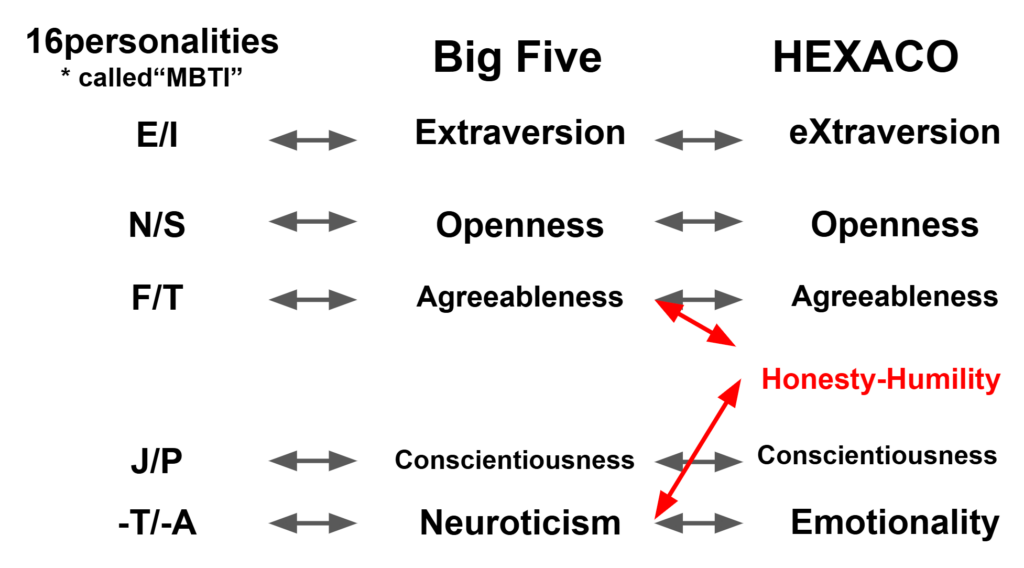
Also, in 16personalities, which was created with reference to MBTI and Big Five, neuroticism from Big Five is called “Identity“, and is classified as either Assertive or Turbulent.
On the far right is the relatively new personality assessment “HEXACO“. It is an improved version of Big Five with one additional indicator “Honesty-Humility”. Research on bullying and harassment perpetrators is active in HEXACO studies.
Since 16personalities and MBTI have weak scientific evidence, this article provides detailed explanations of 16personalities personality types based on their correlations with Big Five and HEXACO.

FAQ and Important Notes
HEXACO results differ from 16personalities (commonly known as MBTI test) or MBTI (original)
- Personality is influenced by genetics and environment, so when the environment changes, responses also change (for example, emotional responses change when you’re tired, etc.). For more details on genetics, see here.
- There are variations in responses depending on age. For more details, see here.
- Type classification is based on whether each value is 3 or above, or below 3, so values close to 3 are more likely to change results depending on how questions are asked or the environment at the time. Please look at the numerical values rather than the type.
- For MBTI (original) and 16personalities (commonly known as MBTI test), it’s unclear how much statistical processing was done at the question design stage as no research papers can be found. On the other hand, papers on Big Five and HEXACO can be easily found, and this HEXACO-JP test is based on research papers.
- While there aren’t many research papers comparing MBTI and 16personalities with everyday behaviors (academic performance, income, etc.) or with the brain and genetics, there are numerous studies on Big Five and HEXACO.
- HEXACO is a variation of Big Five elements, so they are similar but distinct. HEXACO’s Honesty-Humility is extracted from Big Five’s Agreeableness and Neuroticism.
If you have any other questions, please contact us through our inquiry form.
Personality test results are merely “hints” for your life
As mentioned earlier, personality is influenced by genetics and environment. Due to genetic influence, there is a certain range of variation, but answers can vary to some extent depending on the environment.
Also, while Big Five and HEXACO research papers conduct correlation analyses with academic performance and income, the correlation coefficients are not as large as those in natural science experiments. Correlation coefficients range from -1 to 1, but most are around -0.4 to 0.4. Of course, there are higher ones too, but they’re not 0.8 or 0.9 – they’re relatively lower in comparison.
However, since there is various research available, please think of it as “more than fortune-telling, less than natural science.” I’m not 100% denying psychology or fortune-telling.
Frequently Asked Questions
What are the most common ENTP love personality traits in a relationship?
ENTPs in relationships tend to be intellectually engaging, spontaneous, and highly entertaining partners. They typically show affection through stimulating conversation and shared adventures rather than through consistent verbal reassurance. Their most common challenges include a tendency toward boredom when routine sets in, difficulty expressing emotional vulnerability, and an occasional inclination to turn heartfelt conversations into debates. When they are aware of these patterns, ENTPs can be remarkably attentive and deeply loyal partners.
Are ENTPs good in romantic relationships?
ENTPs can be excellent romantic partners, though they require the right conditions. They tend to thrive in relationships that offer intellectual freedom, novelty, and a partner who does not interpret their need for space as rejection. Research on the Big Five model suggests that ENTPs may need to consciously develop agreeableness and consistency — traits not naturally prominent in their profile — to reach their full potential as long-term partners. With self-awareness and effort, ENTPs are often described by partners as uniquely stimulating and deeply committed.
What personality types are most compatible with ENTPs?
ENTPs tend to report strong compatibility with INTJ and INFJ types, as both offer the intellectual depth ENTPs crave while providing complementary emotional or structural qualities. INFJ partners in particular can help ENTPs connect with their own emotional landscape. That said, compatibility depends far more on mutual respect, communication skills, and willingness to grow than on type pairing alone. ENTPs can form fulfilling relationships with many different types when both partners are self-aware.
Why do ENTPs struggle with emotional expression in love?
This pattern is largely explained by ENTP cognitive functions. The dominant function — Extraverted Intuition — prioritizes ideas and possibilities, while the auxiliary function — Introverted Thinking — processes emotions analytically rather than spontaneously. The feeling function (Extraverted Feeling) sits in the tertiary position, meaning it is present but underdeveloped in younger or less self-aware ENTPs. As ENTPs mature and deliberately develop this function, emotional expression typically becomes noticeably more natural and consistent.
Do ENTPs fall in love easily?
ENTPs tend to become infatuated quickly — particularly with people who challenge them intellectually — but deep, lasting romantic attachment tends to develop more slowly. The initial excitement of a new connection feeds their dominant Extraverted Intuition, which thrives on novelty and potential. However, sustaining that interest through the inevitable settling-in phase of a long-term relationship requires the ENTP to actively invest in emotional depth, something that feels less instinctive but is absolutely learnable.
How can an ENTP build a long-lasting relationship?
Research on personality and relationship satisfaction points to 3 evidence-supported strategies for ENTPs: first, regularly create novel shared experiences to satisfy Ne while building emotional history; second, practice scheduled emotional check-ins to develop the Extraverted Feeling function; and third, work on consistency in small gestures — remembering meaningful dates, following through on plans — to address the natural weakness of their inferior Introverted Sensing. These are skills, not personality transplants, and ENTPs’ natural love of self-improvement makes them well-suited to developing them.
What does the Big Five model say about ENTP relationship satisfaction?
The Big Five model identifies agreeableness and conscientiousness as the 2 traits most consistently linked to high relationship satisfaction across multiple studies. ENTPs, as Thinking and Perceiving types, may naturally score lower on both dimensions compared to Feeling and Judging types. However, this does not predict unhappy relationships — it highlights specific growth areas. An ENTP who actively cultivates warmth, empathy, and follow-through can achieve relationship satisfaction levels comparable to naturally high scorers on those dimensions.
Summary: Embracing the ENTP Approach to Love
ENTP love personality traits present a genuinely compelling — if sometimes challenging — romantic profile. At their best, ENTPs bring wit, depth, creativity, and a contagious sense of possibility to their partnerships. At their most undeveloped, they can leave partners feeling emotionally unseen or perpetually kept at arm’s length. The gap between those 2 versions of the ENTP partner is not a matter of fundamental character — it is a matter of deliberate growth in emotional attunement, consistency, and vulnerability.
Psychological research suggests that the traits most strongly associated with lasting love — agreeableness and conscientiousness — can be cultivated through intentional practice, even by those who do not start with a natural advantage. For ENTPs, this is actually good news: self-improvement is one of the things they tend to enjoy most. If you recognize yourself in this profile, take the next step by exploring your specific cognitive function strengths and how to apply them in your closest relationship — you may find that the same mind that loves solving complex problems is perfectly equipped to build one of the most dynamic, rewarding partnerships imaginable.

Writer & Supervisor: Eisuke Tokiwa
Personality Psychology Researcher / CEO, SUNBLAZE Inc.
As a child he experienced poverty, domestic abuse, bullying, truancy and dropping out of school — first-hand exposure to a range of social problems. He spent 10 years researching these issues and published Encyclopedia of Villains through Jiyukokuminsha. Since then he has independently researched the determinants of social problems and antisocial behavior (work, education, health, personality, genetics, region, etc.) and has published 2 peer-reviewed journal articles (Frontiers in Psychology, IEEE Access). His goal is to predict the occurrence of social problems. Spiky profile (WAIS-IV).
Expertise: Personality Psychology / Big Five / HEXACO / MBTI / Prediction of Social Problems
Researcher profiles: ORCID / Google Scholar / ResearchGate
Social & Books: X (@etokiwa999) / note / Amazon Author Page