ISTP love personality traits reveal a unique, quiet kind of devotion — one built on calm reliability rather than dramatic romantic gestures. If you’ve ever wondered why the ISTP in your life shows love through actions rather than words, or why they seem to need both deep connection and personal freedom at the same time, psychological research offers some illuminating answers. This article breaks down exactly how ISTPs approach romance, what they need from a partner, and how understanding these tendencies can lead to more satisfying, lasting relationships.
ISTPの恋愛傾向 — or the romantic tendencies of the ISTP type — are grounded in their core personality: analytical, independent, and quietly sincere. Rather than sweeping declarations of love, ISTPs tend to express affection through consistent, practical support. Understanding this style is the first step toward building a genuinely fulfilling relationship with (or as) an ISTP.
Once again, personality researcher and author of Villain Encyclopedia, Tokiwa (@etokiwa999), will provide the explanation.
※We have developed the HEXACO-JP Personality Assessment! It has more scientific basis than MBTI. Tap below for details.

目次
- 1 Characteristics and Tendencies of ISTP (The Virtuoso)
- 2 What Are ISTP Love Personality Traits? A Core Overview
- 3 What Psychological Research Says About ISTP Relationship Compatibility
- 4 How ISTPs Express Love: The Introvert Love Style in Action
- 5 Try Taking the Proper Personality Test “HEXACO-JP”!
- 6 ISTP Partner Tendencies: Strengths and Potential Blind Spots
- 7 Scientific Background of the 16 Types
- 8 Actionable Advice for ISTPs and Their Partners
- 9 FAQ and Important Notes
- 10 Frequently Asked Questions
- 10.1 Are ISTPs good in romantic relationships?
- 10.2 What is the best romantic match for an ISTP?
- 10.3 Why do ISTPs struggle to express their feelings in love?
- 10.4 Do ISTPs fall in love easily?
- 10.5 How does an ISTP show they love someone?
- 10.6 What do ISTPs need from a partner to feel happy in a relationship?
- 10.7 Can ISTPs become more emotionally expressive in a relationship?
- 11 Summary: The Quiet Strength of ISTP Love Personality Traits
Characteristics and Tendencies of ISTP (The Virtuoso)
ISTP is a type with practical skills and flexible thinking.
They are realistic and skilled at analyzing things calmly.
They excel at handling tools and technology, and are action-oriented.
They are adaptable to change and can respond flexibly to situations.
The characteristics and tendencies of ISTP are as follows:
- They solve problems logically.
- They prefer to learn through hands-on experience.
- They make calm judgments even in crisis situations.
- They value freedom and dislike being constrained.
- They have an interest in technology and operations.
On the other hand, they may struggle with making plans.
Their limited emotional expression can sometimes lead to misunderstandings.
When their concentration breaks, they may lack continuity.
They can gain trust by being mindful of cooperation.
What Are ISTP Love Personality Traits? A Core Overview
ISTPs tend to be calm, observant partners who express love through action rather than emotion — and this makes them quietly powerful companions in a long-term relationship. The ISTP (Introverted, Sensing, Thinking, Perceiving) personality type is one of the 16 types identified in the Myers-Briggs Type Indicator (MBTI) framework. In romantic contexts, their combination of introversion and logical thinking shapes a love style that is steady, non-intrusive, and deeply practical.
Research suggests that ISTPs approach love much like they approach problems: methodically, with careful observation and minimal unnecessary drama. They tend to watch their partner closely, notice what is actually needed, and respond with tangible help rather than emotional reassurance. This isn’t coldness — it’s a different language of care.
Key ISTP love personality traits typically include:
- Reserved emotional expression: ISTPs tend to show love through what they do, not what they say. Fixing something that’s broken, showing up reliably, or quietly making a partner’s day easier are all forms of ISTP affection.
- Strong need for personal space: ISTPs value solitude for recharging, and they generally extend this same respect to their partners — they rarely smother or over-involve themselves.
- Non-interference style: Rather than controlling or directing a partner’s choices, ISTPs tend to give their partners wide autonomy, trusting them to manage their own lives.
- Crisis composure: When conflict or difficulty arises, ISTPs often stay calm and solution-focused, which can be an enormous stabilizing force in a relationship.
The potential downside is that emotionally expressive partners may sometimes interpret this reserved style as emotional distance or indifference. In reality, the ISTP’s affection is simply expressed differently. Learning to translate their actions into words — even occasionally — can dramatically deepen connection with a partner who needs verbal reassurance.
What Psychological Research Says About ISTP Relationship Compatibility
Research grounded in the Big Five personality model suggests that the traits most strongly linked to romantic satisfaction — high agreeableness and high conscientiousness — are not the areas where ISTPs naturally lead, which means they may need to be more intentional in these dimensions to maximize relationship quality.
The Big Five model is a widely respected psychological framework that describes personality along 5 dimensions: Conscientiousness, Agreeableness, Extraversion, Openness, and Emotional Stability (Neuroticism). Unlike MBTI, it is trait-based rather than type-based, but the 2 systems have meaningful overlaps that help us interpret ISTP relationship compatibility through a research lens.
Research published in peer-reviewed meta-analyses — including work examining personality and relationship satisfaction across intimate partnerships — consistently finds that:
- High agreeableness (warmth, empathy, cooperative behavior) is one of the strongest predictors of relationship satisfaction for both partners.
- High conscientiousness (reliability, self-discipline, follow-through) is also strongly associated with long-term romantic satisfaction.
In MBTI terms, these traits align most naturally with “F” (Feeling) types and “J” (Judging) types — neither of which is core to the ISTP profile. This does not mean ISTPs are destined for relationship struggles. It means they may benefit from consciously developing warmer communication habits and more structured follow-through on emotional commitments. Studies indicate that personality traits can shift meaningfully with awareness and intentional effort.
How ISTPs Express Love: The Introvert Love Style in Action
The ISTP introvert love style is defined by showing up consistently, solving real problems, and respecting their partner’s independence — rather than flooding the relationship with verbal affirmations or emotional intensity. Understanding this expression style is essential for anyone in a relationship with an ISTP, because misreading it as apathy can create unnecessary friction.
Psychologically, ISTPs tend to operate primarily through their dominant cognitive function of Introverted Thinking (Ti), supported by Extraverted Sensing (Se). This means they are highly tuned into the physical, real-world environment and prefer to process feelings internally. Rather than talking about emotions at length, they experience them privately and then act on them externally in practical ways.
In everyday relationship terms, this tends to look like:
- Acts of service as primary love language: An ISTP who repairs your car, researches solutions to your problems, or quietly handles a stressful logistical detail is communicating deep care in the only language that feels fully authentic to them.
- Quality time over quantity: ISTPs tend to prefer fewer, more focused interactions over constant togetherness. When they choose to spend time with you, it carries real weight.
- Loyalty expressed through reliability: They may not say “I love you” daily, but they will tend to show up exactly when it matters most — dependably and without drama.
- Respecting partner autonomy as a form of trust: When an ISTP doesn’t micromanage or control, that absence of interference is itself an expression of respect and trust in their partner.
For partners who feel loved through words of affirmation or frequent emotional check-ins, communicating this need clearly — and understanding the ISTP’s action-based approach — can bridge what might otherwise feel like an emotional gap. The ISTP’s quiet, steady love is real; it simply needs a shared translation.
Try Taking the Proper Personality Test “HEXACO-JP”!
While MBTI and 16personalities are popular as “gateways to knowing yourself,” experiencing a scientifically-backed personality test is the best way to truly understand your strengths and risks.
That’s where we recommend the HEXACO assessment available in Japanese: “HEXACO-JP“.
HEXACO-JP visualizes your personality tendencies numerically based on six factors: Honesty-Humility, Emotionality, Extraversion, Agreeableness, Conscientiousness, and Openness.
By simply answering straightforward questions, you can gain helpful insights for self-understanding, relationships, and workplace communication.
If you’re curious about “What type of person am I?”, start by taking HEXACO-JP and examine yourself from a scientific perspective.
ISTP Partner Tendencies: Strengths and Potential Blind Spots
ISTPs bring approximately 3 significant strengths to a romantic relationship — calm problem-solving, genuine respect for autonomy, and unwavering practical reliability — but they also carry at least 2 consistent blind spots that can quietly erode intimacy if left unaddressed.
Understanding both sides of the ISTP partner profile helps both ISTPs themselves and their partners navigate the relationship with greater clarity and compassion.
Core Strengths of the ISTP as a Partner
- Unshakeable calm in crisis: Research suggests that emotional stability in a partner is one of the most valued traits during stressful life events. ISTPs tend to excel here — they rarely panic, and their composed, analytical approach to problems can feel profoundly reassuring to partners who are more emotionally reactive.
- Deep respect for independence: ISTPs neither demand constant togetherness nor grow jealous of a partner’s personal pursuits. This creates a relationship environment where both people can genuinely thrive as individuals, which studies indicate is associated with higher long-term satisfaction.
- Consistent, trustworthy follow-through: When an ISTP commits to something, they tend to honor it — not because they are perfectionists, but because their sense of integrity is tied to doing what they say they will do.
Common Blind Spots to Watch
- Under-expressing emotions verbally: Because ISTPs process feelings internally and express them through action, partners who need regular verbal reassurance may feel emotionally undernourished. Research shows that perceived emotional responsiveness — the sense that a partner understands and values your feelings — is a key predictor of relationship satisfaction. ISTPs may need to consciously practice saying what they feel, even when it feels unnecessary to them.
- Difficulty with long-term planning in relationships: The “P” (Perceiving) preference in ISTPs means they tend to resist rigid structures, preferring to respond to life as it unfolds. This can clash with partners who find security in clear future plans, shared goals, or relationship milestones.
Scientific Background of the 16 Types
MBTI Overview
MBTI is a psychological theory that classifies personality into 16 types.
To begin with, MBTI is an abbreviation for Myers-Briggs Type Indicator.
MBTI classifies personality into 16 types by combining the following 4 indicators.
In other words, MBTI expresses one’s personality tendencies in 4 letters such as “ISTJ” or “ENFP”. There is a very famous similar system called 16personalities, but this is created by combining MBTI and Big Five.
Big Five Overview
One of the most prominent trait theories in personality psychology is the “Big Five”.
Big Five measures five traits: Openness, Conscientiousness, Extraversion, Agreeableness, and Neuroticism.
Also, while 16personalities and MBTI use type classification (e.g., either extraverted or introverted), a major difference is that Big Five evaluates traits on a continuous numerical scale (e.g., extraversion 3.5).
Furthermore, it has been studied for a long time, has many research papers, and extensive research has been conducted in other fields such as academic achievement, income, brain, and genetics. It can be said that Big Five has relatively stronger scientific backing.
Correlation Between MBTI, Big Five, and HEXACO
There are correlations between MBTI’s 4 indicators and Big Five’s 5 factors.
A representative study showing this correlation is the paper “The relationship between the revised NEO-Personality Inventory and the Myers-Briggs Type Indicator“.
According to this paper, the correlations between MBTI and Big Five are as follows.
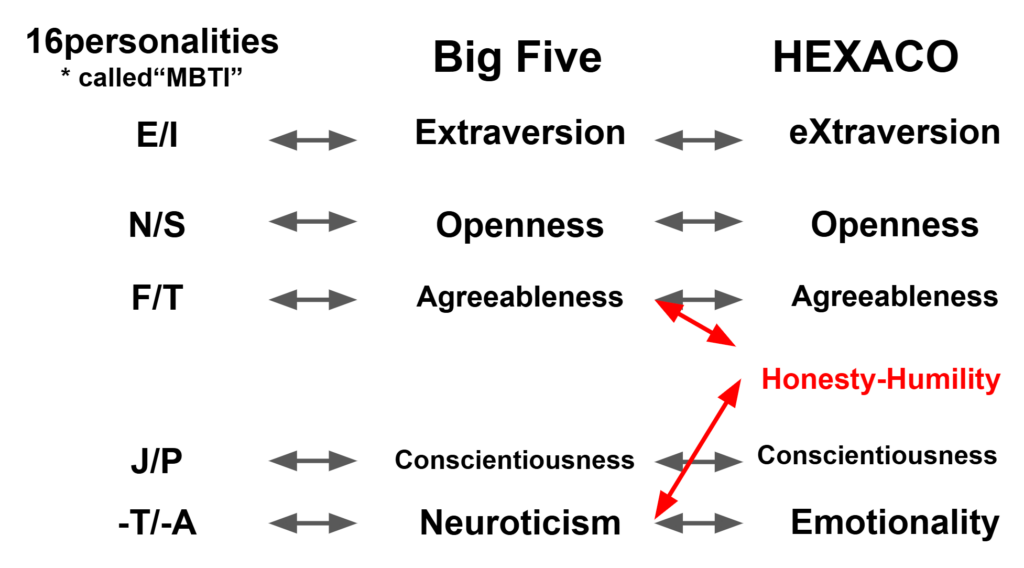
Also, in 16personalities, which was created with reference to MBTI and Big Five, neuroticism from Big Five is called “Identity“, and is classified as either Assertive or Turbulent.
On the far right is the relatively new personality assessment “HEXACO“. It is an improved version of Big Five with one additional indicator “Honesty-Humility”. Research on bullying and harassment perpetrators is active in HEXACO studies.
Since 16personalities and MBTI have weak scientific evidence, this article provides detailed explanations of 16personalities personality types based on their correlations with Big Five and HEXACO.
Actionable Advice for ISTPs and Their Partners
The most effective growth strategies for ISTPs in romance involve small, consistent behavioral shifts — not personality overhauls — and they work because they bridge the gap between the ISTP’s internal emotional world and their partner’s need for visible connection.
For ISTPs: Leverage Your Strengths, Stretch in Key Areas
- Name what you’re doing and why: When you perform an act of service, briefly verbalize the intention behind it. Instead of silently fixing the problem, try saying, “I sorted this out because I know it was stressing you.” This takes 5 extra seconds and dramatically increases the partner’s sense of being seen and valued. Research on emotional communication consistently shows that stated intent amplifies the impact of kind actions.
- Schedule check-ins, even briefly: ISTPs tend to thrive with structure they choose themselves. Try setting a once-weekly, low-pressure “relationship check-in” — even just 10 minutes — where both partners can share how they’re feeling. This satisfies the partner’s need for emotional connection without overwhelming the ISTP’s preference for independence.
- Practice saying “I love you” intentionally: Words of affirmation don’t have to be dramatic. Simply making them a consistent habit — on your own terms, at moments that feel genuine — can significantly raise your partner’s sense of emotional security.
For Partners of ISTPs: How to Receive ISTP Love
- Learn to read their actions as language: When your ISTP partner does something practical for you without being asked, treat it as the emotional statement it is. Acknowledging it (“I noticed you did that — thank you, it really means a lot”) reinforces the behavior and deepens the connection.
- Express your emotional needs directly: ISTPs tend to respond well to clear, logical requests. Rather than hoping they’ll “just know” you need more verbal affection, say specifically what would help: “I’d feel really connected if we could talk about how things are going between us once a week.” This gives them a concrete action to take — which is exactly how they operate best.
- Respect their need for solitude: Pressuring an ISTP for constant togetherness tends to produce the opposite effect — withdrawal. Trusting them with space, and then engaging fully when they return to connection, creates the cycle of healthy independence and intimacy that allows ISTPs to genuinely thrive in romance.

FAQ and Important Notes
HEXACO results differ from 16personalities (commonly known as MBTI test) or MBTI (original)
- Personality is influenced by genetics and environment, so when the environment changes, responses also change (for example, emotional responses change when you’re tired, etc.). For more details on genetics, see here.
- There are variations in responses depending on age. For more details, see here.
- Type classification is based on whether each value is 3 or above, or below 3, so values close to 3 are more likely to change results depending on how questions are asked or the environment at the time. Please look at the numerical values rather than the type.
- For MBTI (original) and 16personalities (commonly known as MBTI test), it’s unclear how much statistical processing was done at the question design stage as no research papers can be found. On the other hand, papers on Big Five and HEXACO can be easily found, and this HEXACO-JP test is based on research papers.
- While there aren’t many research papers comparing MBTI and 16personalities with everyday behaviors (academic performance, income, etc.) or with the brain and genetics, there are numerous studies on Big Five and HEXACO.
- HEXACO is a variation of Big Five elements, so they are similar but distinct. HEXACO’s Honesty-Humility is extracted from Big Five’s Agreeableness and Neuroticism.
If you have any other questions, please contact us through our inquiry form.
Personality test results are merely “hints” for your life
As mentioned earlier, personality is influenced by genetics and environment. Due to genetic influence, there is a certain range of variation, but answers can vary to some extent depending on the environment.
Also, while Big Five and HEXACO research papers conduct correlation analyses with academic performance and income, the correlation coefficients are not as large as those in natural science experiments. Correlation coefficients range from -1 to 1, but most are around -0.4 to 0.4. Of course, there are higher ones too, but they’re not 0.8 or 0.9 – they’re relatively lower in comparison.
However, since there is various research available, please think of it as “more than fortune-telling, less than natural science.” I’m not 100% denying psychology or fortune-telling.
Frequently Asked Questions
Are ISTPs good in romantic relationships?
ISTPs can be excellent long-term partners, though their style may not match what people expect romance to look like. They tend to be deeply loyal, calm under pressure, and highly respectful of their partner’s independence. Their emotional expression is typically more action-based than verbal, which means partners who understand this style often report feeling genuinely supported. With some intentional development in verbal communication, ISTPs tend to build stable and trustworthy relationships.
What is the best romantic match for an ISTP?
While MBTI compatibility is never absolute, ISTPs tend to connect well with partners who value independence, are comfortable with emotional restraint, and appreciate practical demonstrations of care. Types often cited as compatible include ESTJ, ENTJ, and ESFJ — partners whose structure or warmth can complement the ISTP’s flexibility and logic. The most important factor, however, is mutual understanding of each other’s emotional expression styles, regardless of type.
Why do ISTPs struggle to express their feelings in love?
ISTPs tend to process emotions internally through their dominant cognitive function of Introverted Thinking. Feelings are real and present for ISTPs, but they are experienced as private internal states rather than things to be narrated or performed. Verbal emotional expression can feel inefficient or even inauthentic to ISTPs, which is why they default to action. This is a cognitive preference, not emotional indifference — and it can shift meaningfully with practice and motivation.
Do ISTPs fall in love easily?
Research suggests ISTPs tend to be cautious and slow to fully commit emotionally. They typically observe a potential partner carefully over time before allowing themselves to become deeply attached. This measured approach is not disinterest — it reflects the ISTP’s need to build genuine trust before vulnerability. Once an ISTP does fall in love, however, their loyalty tends to be strong and lasting, and they are unlikely to abandon a relationship impulsively.
How does an ISTP show they love someone?
ISTPs typically show love through consistent acts of service, practical problem-solving on a partner’s behalf, reliable presence during difficult moments, and giving their partner meaningful space and trust. Physical affection may also be an important channel, given their Extraverted Sensing function. If an ISTP is rearranging their schedule, fixing your problems without being asked, or choosing to spend their limited social energy on you specifically, those are strong signals of genuine romantic investment.
What do ISTPs need from a partner to feel happy in a relationship?
ISTPs generally need 3 core things from a romantic partner: respect for their independence and solitude, freedom from excessive emotional demands or confrontational communication styles, and a partner who appreciates their practical contributions rather than dismissing them as emotionally insufficient. ISTPs also tend to flourish when their partner is self-sufficient and confident — they are drawn to people who have their own strong sense of identity and don’t require constant reassurance.
Can ISTPs become more emotionally expressive in a relationship?
Yes — research on personality development strongly suggests that traits like emotional expressiveness can grow with intentional effort and the right environment. ISTPs who are in a safe, low-pressure relationship and who genuinely want to connect more deeply with their partner can develop the habit of verbal emotional expression over time. Small, consistent steps — such as stating the intention behind kind actions or scheduling brief emotional check-ins — tend to be more effective for ISTPs than dramatic or sudden shifts in communication style.

Writer & Supervisor: Eisuke Tokiwa
Personality Psychology Researcher / CEO, SUNBLAZE Inc.
As a child he experienced poverty, domestic abuse, bullying, truancy and dropping out of school — first-hand exposure to a range of social problems. He spent 10 years researching these issues and published Encyclopedia of Villains through Jiyukokuminsha. Since then he has independently researched the determinants of social problems and antisocial behavior (work, education, health, personality, genetics, region, etc.) and has published 2 peer-reviewed journal articles (Frontiers in Psychology, IEEE Access). His goal is to predict the occurrence of social problems. Spiky profile (WAIS-IV).
Expertise: Personality Psychology / Big Five / HEXACO / MBTI / Prediction of Social Problems
Researcher profiles: ORCID / Google Scholar / ResearchGate
Social & Books: X (@etokiwa999) / note / Amazon Author Page
Summary: The Quiet Strength of ISTP Love Personality Traits
Understanding ISTP love personality traits means learning to read a different dialect of affection — one written in calm actions, unwavering reliability, and deep respect for a partner’s autonomy rather than in frequent declarations or emotional displays. Research grounded in the Big Five model suggests that ISTPs may benefit from consciously cultivating greater verbal warmth and emotional transparency, but their core strengths — composure, loyalty, and genuine respect for their partner — form an exceptionally solid foundation for lasting relationships. The quiet love an ISTP offers is real, steady, and built to last.
If this portrait of the ISTP resonated with you — whether you recognize yourself or your partner in these patterns — consider exploring your own MBTI profile more deeply. Discovering which of your personality traits are quietly shaping the way you love may be one of the most valuable things you can do for your relationships. See how your own personality type plays out in romance — and start understanding the love language you’ve been speaking all along.