INTP love personality traits may seem cool and detached on the surface, but beneath that calm exterior lies a deeply thoughtful, loyal, and intellectually driven approach to romance. If you’ve ever wondered why the INTP in your life seems emotionally reserved yet fiercely committed once they open up, the answer lies in how this personality type processes both logic and love simultaneously. This article breaks down the key romantic tendencies of INTPs, what the research says, and how both INTPs and their partners can build stronger, more fulfilling relationships.
Once again, personality researcher and author of Villain Encyclopedia, Tokiwa (@etokiwa999), will provide the explanation.
※We have developed the HEXACO-JP Personality Assessment! It has more scientific basis than MBTI. Tap below for details.

目次
- 1 INTP (The Logician) Characteristics and Tendencies
- 2 What Are INTP Love Personality Traits? An Overview
- 3 What Does Research Say About INTP Compatibility and Relationship Satisfaction?
- 4 INTP Emotional Expression in Relationships: Reading Between the Lines
- 5 INTP Love Personality Traits: Strengths to Leverage in Romance
- 6 Actionable Advice for INTPs and Their Partners
- 7 Try Taking the Proper Personality Test “HEXACO-JP”!
- 8 Scientific Background of the 16 Types
- 9 Frequently Asked Questions
- 9.1 Are INTPs capable of deep romantic love?
- 9.2 What MBTI types are most compatible with INTPs in relationships?
- 9.3 Why do INTPs struggle with emotional expression in romance?
- 9.4 How does an INTP show they love someone?
- 9.5 Do INTPs fall in love easily or slowly?
- 9.6 Can INTPs improve their relationship satisfaction?
- 9.7 Is the INTP personality type rare in relationships?
- 10 FAQ and Important Notes
- 11 Summary: Embracing the Quiet Depth of INTP Love
INTP (The Logician) Characteristics and Tendencies
INTP is a logical and inquisitive type.
They find joy in constructing theories.
They show strong interest in abstract concepts and complex challenges.
They tend to think freely and unconventionally.
INTP characteristics and behaviors can be organized as follows.
- They dig deep into ideas and theorize them.
- They demonstrate strong concentration in areas of interest.
- They flexibly change their thinking and generate new solutions.
- They tend to prioritize contemplation over socializing.
- They often enjoy the process of exploration more than finding the right answer.
On the other hand, they tend to prioritize thinking over action.
Plans may end without being materialized.
They express emotions less and tend to be distanced in human relationships.
Therefore, it’s important to be conscious of execution ability.
INTP can use originality and intellectual curiosity as their weapons.
They tend to demonstrate strengths in academic and technical fields.
They provide new perspectives with their flexible minds.
If they can give form to their thoughts, it leads to great achievements.
What Are INTP Love Personality Traits? An Overview
INTPs tend to “fall in love with their minds first” — analyzing their feelings before expressing them, which can make them appear distant even when they genuinely care. In the MBTI framework, INTPs (Introverted, Intuitive, Thinking, Perceiving) are defined by a dominant function of Introverted Thinking, meaning they prioritize internal logic and analysis in virtually every area of life — including romance.
Rather than acting on an emotional impulse, an INTP in a relationship tends to ask themselves questions like “Why do I feel this way?” or “Does this connection make rational sense?” This is not a sign of emotional coldness — it is simply how their cognitive wiring operates. Research in personality psychology suggests that individuals with a strong thinking preference often express love through actions and intellectual engagement rather than verbal affirmation or physical affection.
Key characteristics that define INTP love personality traits include:
- Reserved emotional expression: INTPs tend to show love subtly — through problem-solving for their partner, deep conversations, or quiet loyalty — rather than grand romantic gestures.
- Strong need for personal space: They value independence and tend to dislike overly clingy dynamics. A partner who respects solitude is often seen as highly attractive.
- Overthinking feelings: Because they analyze emotions intellectually, they may struggle to express affection spontaneously or naturally.
- Attraction to independent, intellectually stimulating partners: INTPs are often drawn to people who challenge their thinking and have their own passions and goals.
- Deep loyalty once committed: While slow to open up, INTPs who have genuinely bonded with a partner tend to remain sincerely devoted over the long term.
In short, INTPs are not incapable of deep love — they simply experience and communicate it differently from more emotionally expressive types. Understanding this distinction is the first step toward appreciating the unique depth an INTP brings to a relationship.
What Does Research Say About INTP Compatibility and Relationship Satisfaction?
Psychological research suggests that personality traits linked to agreeableness and conscientiousness — areas where INTPs may need deliberate development — are among the strongest predictors of relationship satisfaction. To understand this in context, it helps to look at the “Big Five” personality model, one of the most scientifically validated frameworks in psychology.
The Big Five model describes personality across 5 dimensions: Openness, Conscientiousness, Extraversion, Agreeableness, and Neuroticism (emotional stability). Studies indicate that individuals who score high in Agreeableness (warmth, empathy, cooperation) and Conscientiousness (reliability, self-discipline) tend to report the highest levels of relationship satisfaction — both in themselves and in their partners.
In MBTI terms, this pattern roughly maps to “F (Feeling)” and “J (Judging)” preferences — the opposite of the INTP’s natural “T (Thinking)” and “P (Perceiving)” style. This does not mean INTPs are destined for unhappy relationships. Rather, it highlights 2 specific growth areas worth focusing on:
- Building emotional responsiveness: Actively practicing empathy and validating a partner’s feelings — even when logic seems more relevant — can significantly improve relationship quality.
- Increasing follow-through and reliability: Conscientiousness involves showing up consistently. For the spontaneous, flexible INTP, this may mean making small but meaningful commitments and honoring them.
Research referenced on sunblaze.jp’s article on personality and ideal partners draws on a meta-analysis by Malouff et al. (2010), which examined the relationship between the Five-Factor Model of personality and intimate relationship satisfaction. The findings reinforced that conscientiousness and agreeableness were the most consistent predictors of a fulfilling romantic partnership.
The encouraging takeaway for INTPs: these traits are not fixed. They can be consciously developed, and INTPs — being naturally curious and growth-oriented — are often well-positioned to make these changes once they understand the “why” behind them.
INTP Emotional Expression in Relationships: Reading Between the Lines
One of the most commonly misunderstood aspects of INTP partner behavior is their emotional expression style — or apparent lack of it. Partners of INTPs sometimes report feeling like they are not loved or appreciated, even when the INTP is genuinely devoted. This gap between internal feeling and external communication is one of the central challenges in INTP relationships.
INTP emotional expression tends to be indirect. Rather than saying “I love you” frequently, an INTP might spend hours researching a solution to a problem their partner mentioned in passing, or remember an obscure detail their partner shared months ago. These are acts of care — they just require decoding.
There are roughly 3 key patterns in how INTPs typically express love:
- Intellectual engagement: Sharing interesting ideas, debating topics, and inviting a partner into their inner world of curiosity. For an INTP, intellectual intimacy is one of the highest forms of connection.
- Practical support: Quietly solving problems, researching information, or helping optimize something in their partner’s life. This is an INTP’s version of “acts of service.”
- Consistent presence (on their terms): While INTPs need solitude, they will carve out genuine time for someone they care about — even if it doesn’t look like conventional romance.
For partners of INTPs, learning to recognize these non-verbal signals of affection can make a significant difference. And for INTPs themselves, making a conscious effort to verbalize appreciation — even briefly — can bridge a large emotional gap with relatively little effort.
INTP Love Personality Traits: Strengths to Leverage in Romance
Despite their reputation for emotional detachment, INTPs bring several genuinely powerful strengths to romantic relationships that are worth recognizing and building on. When channeled effectively, these traits can make INTPs remarkably thoughtful and dedicated partners.
- Deep intellectual curiosity about their partner: INTPs are genuinely interested in understanding people at a deeper level. They tend to ask meaningful questions and remember what matters to their partner — a quality many people find deeply affirming.
- Honesty and authenticity: INTPs rarely play games or engage in manipulative behavior. What you see is largely what you get, which creates a foundation of trust in long-term relationships.
- Respect for autonomy: Because INTPs value their own independence so highly, they naturally extend the same freedom to their partners. They are unlikely to be controlling or possessive.
- Commitment to growth: Once an INTP identifies a specific weakness in their relationship behavior, they tend to approach fixing it with the same analytical energy they bring to other problems — making them genuinely coachable partners.
- Low-drama stability: INTPs tend to stay calm under pressure and avoid unnecessary conflict, which can make them grounding presences in emotionally charged situations.
The key for INTPs is to make their internal care visible. Their strengths are real — but they often remain invisible to a partner unless deliberately communicated. Small, consistent gestures of acknowledgment can translate an INTP’s inner devotion into something their partner can actually feel.
Actionable Advice for INTPs and Their Partners
Understanding INTP love personality traits is only useful if it leads to concrete changes in how relationships are navigated day to day. Here are evidence-informed strategies for both INTPs and those who love them.
For INTPs
- Practice naming emotions out loud: You don’t need to be emotionally effusive — but saying “I really valued our time together today” once in a while goes a long way. Start small and specific rather than trying to make sweeping declarations.
- Schedule intentional connection time: Because INTPs can lose themselves in solo projects, deliberately blocking time for their partner helps signal priority. Think of it as optimizing your relationship system — it works better with regular maintenance.
- Ask your partner about their emotional needs directly: INTPs are often more comfortable with explicit information than guessing. Simply asking “How can I show you I care?” removes ambiguity and gives you an actionable target.
- Resist the urge to “logic-fix” every emotional moment: Sometimes a partner needs to feel heard, not problem-solved. Practicing reflective listening — repeating back what your partner said before offering analysis — can dramatically improve emotional safety in the relationship.
For Partners of INTPs
- Look for love in the details: An INTP who remembers your coffee order, researches a topic you casually mentioned, or quietly fixes something that was bothering you is expressing deep care. Learn their language.
- Give them space without making it a conflict: Respecting an INTP’s need for solitude is not a rejection — it’s a precondition for them showing up fully when they are with you.
- Be direct about your emotional needs: INTPs respond well to clear, specific communication. “I need you to check in with me more during the week” is far more effective than hoping they’ll intuit it.
Try Taking the Proper Personality Test “HEXACO-JP”!
While MBTI and 16personalities are popular as “gateways to knowing yourself,” experiencing a scientifically-backed personality test is the best way to truly understand your strengths and risks.
That’s where we recommend the HEXACO assessment available in Japanese: “HEXACO-JP“.
HEXACO-JP visualizes your personality tendencies numerically based on six factors: Honesty-Humility, Emotionality, Extraversion, Agreeableness, Conscientiousness, and Openness.
By simply answering straightforward questions, you can gain helpful insights for self-understanding, relationships, and workplace communication.
If you’re curious about “What type of person am I?”, start by taking HEXACO-JP and examine yourself from a scientific perspective.
Scientific Background of the 16 Types
MBTI Overview
MBTI is a psychological theory that classifies personality into 16 types.
To begin with, MBTI is an abbreviation for Myers-Briggs Type Indicator.
MBTI classifies personality into 16 types by combining the following 4 indicators.
In other words, MBTI expresses one’s personality tendencies in 4 letters such as “ISTJ” or “ENFP”. There is a very famous similar system called 16personalities, but this is created by combining MBTI and Big Five.
Big Five Overview
One of the most prominent trait theories in personality psychology is the “Big Five”.
Big Five measures five traits: Openness, Conscientiousness, Extraversion, Agreeableness, and Neuroticism.
Also, while 16personalities and MBTI use type classification (e.g., either extraverted or introverted), a major difference is that Big Five evaluates traits on a continuous numerical scale (e.g., extraversion 3.5).
Furthermore, it has been studied for a long time, has many research papers, and extensive research has been conducted in other fields such as academic achievement, income, brain, and genetics. It can be said that Big Five has relatively stronger scientific backing.
Correlation Between MBTI, Big Five, and HEXACO
There are correlations between MBTI’s 4 indicators and Big Five’s 5 factors.
A representative study showing this correlation is the paper “The relationship between the revised NEO-Personality Inventory and the Myers-Briggs Type Indicator“.
According to this paper, the correlations between MBTI and Big Five are as follows.
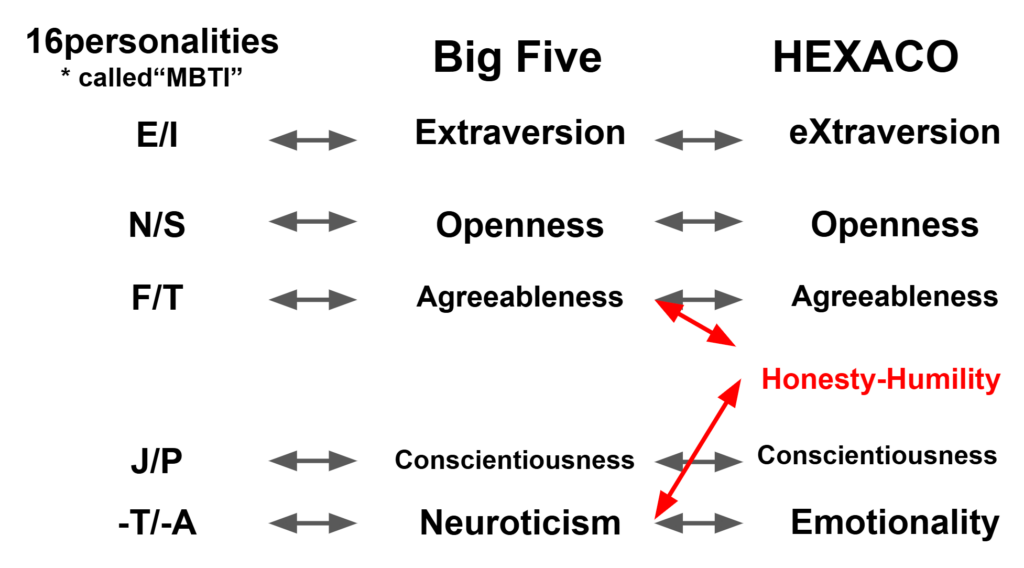
Also, in 16personalities, which was created with reference to MBTI and Big Five, neuroticism from Big Five is called “Identity“, and is classified as either Assertive or Turbulent.
On the far right is the relatively new personality assessment “HEXACO“. It is an improved version of Big Five with one additional indicator “Honesty-Humility”. Research on bullying and harassment perpetrators is active in HEXACO studies.
Since 16personalities and MBTI have weak scientific evidence, this article provides detailed explanations of 16personalities personality types based on their correlations with Big Five and HEXACO.
Frequently Asked Questions
Are INTPs capable of deep romantic love?
Yes — INTPs are fully capable of deep, lasting love. Their emotional expression simply tends to be quieter and more action-based than verbal. Research on introverted thinking types suggests they often experience intense internal loyalty and devotion toward partners they trust. The challenge is not a lack of feeling, but rather translating those internal feelings into forms their partner can recognize and feel. With self-awareness and practice, INTPs can become genuinely devoted and meaningful romantic partners.
What MBTI types are most compatible with INTPs in relationships?
INTPs tend to be most compatible with types that balance their analytical nature with warmth and social ease. Types like ENTJ, ENTP, and INFJ are commonly cited as strong matches. ENTJs and ENTPs share the INTP’s love of intellectual debate and big-picture thinking, while INFJs offer the emotional depth and insight that can draw out the INTP’s more vulnerable side. That said, INTP compatibility ultimately depends on individual communication styles and mutual willingness to grow — not type labels alone.
Why do INTPs struggle with emotional expression in romance?
INTPs are driven by Introverted Thinking as their dominant cognitive function, which means they naturally process the world through analysis and internal logic rather than emotion. This doesn’t mean they don’t feel — it means feelings pass through a rational filter before (or instead of) being expressed. Research on thinking-type personalities suggests this pattern is deeply wired, but not unchangeable. INTPs can develop greater emotional expressiveness through deliberate practice, especially when they understand the specific relational benefits of doing so.
How does an INTP show they love someone?
An INTP typically shows love through intellectual engagement, practical help, and consistent (if quiet) presence. Signs an INTP loves you include: remembering small details you’ve shared, spending hours researching something important to you, initiating deep one-on-one conversations, and carving out focused time despite their preference for solitude. These gestures may not look like conventional romance, but for an INTP, they represent significant emotional investment and should be recognized as such.
Do INTPs fall in love easily or slowly?
INTPs tend to fall in love slowly. Because they analyze their feelings before acting on them, the process of recognizing and accepting romantic attraction can take longer than for more emotionally spontaneous types. They may intellectually register interest in someone for weeks or months before acknowledging it as love. However, once an INTP does commit emotionally, they tend to be deeply loyal and long-term oriented — making the slower pace a worthwhile investment for the right partner.
Can INTPs improve their relationship satisfaction?
Absolutely. Studies on the Big Five personality model suggest that while core traits are relatively stable, behaviors associated with agreeableness and conscientiousness — the 2 strongest predictors of relationship satisfaction — can be consciously developed over time. For INTPs, this means practicing empathy, following through on small commitments, and making their internal care more externally visible. Because INTPs are highly growth-oriented when they understand the logic behind a change, they are often well-equipped to make meaningful improvements in their romantic lives.
Is the INTP personality type rare in relationships?
INTPs are one of the less common MBTI types, estimated to make up approximately 3–5% of the general population. In relationships, this rarity can make their dynamic feel unusual or difficult to understand without context. Partners of INTPs sometimes feel confused by their behavior simply because it doesn’t match more common emotional templates. Understanding INTP love personality traits specifically — rather than applying general relationship advice — tends to produce much better outcomes for both parties.

FAQ and Important Notes
HEXACO results differ from 16personalities (commonly known as MBTI test) or MBTI (original)
- Personality is influenced by genetics and environment, so when the environment changes, responses also change (for example, emotional responses change when you’re tired, etc.). For more details on genetics, see here.
- There are variations in responses depending on age. For more details, see here.
- Type classification is based on whether each value is 3 or above, or below 3, so values close to 3 are more likely to change results depending on how questions are asked or the environment at the time. Please look at the numerical values rather than the type.
- For MBTI (original) and 16personalities (commonly known as MBTI test), it’s unclear how much statistical processing was done at the question design stage as no research papers can be found. On the other hand, papers on Big Five and HEXACO can be easily found, and this HEXACO-JP test is based on research papers.
- While there aren’t many research papers comparing MBTI and 16personalities with everyday behaviors (academic performance, income, etc.) or with the brain and genetics, there are numerous studies on Big Five and HEXACO.
- HEXACO is a variation of Big Five elements, so they are similar but distinct. HEXACO’s Honesty-Humility is extracted from Big Five’s Agreeableness and Neuroticism.
If you have any other questions, please contact us through our inquiry form.
Personality test results are merely “hints” for your life
As mentioned earlier, personality is influenced by genetics and environment. Due to genetic influence, there is a certain range of variation, but answers can vary to some extent depending on the environment.
Also, while Big Five and HEXACO research papers conduct correlation analyses with academic performance and income, the correlation coefficients are not as large as those in natural science experiments. Correlation coefficients range from -1 to 1, but most are around -0.4 to 0.4. Of course, there are higher ones too, but they’re not 0.8 or 0.9 – they’re relatively lower in comparison.
However, since there is various research available, please think of it as “more than fortune-telling, less than natural science.” I’m not 100% denying psychology or fortune-telling.

Writer & Supervisor: Eisuke Tokiwa
Personality Psychology Researcher / CEO, SUNBLAZE Inc.
As a child he experienced poverty, domestic abuse, bullying, truancy and dropping out of school — first-hand exposure to a range of social problems. He spent 10 years researching these issues and published Encyclopedia of Villains through Jiyukokuminsha. Since then he has independently researched the determinants of social problems and antisocial behavior (work, education, health, personality, genetics, region, etc.) and has published 2 peer-reviewed journal articles (Frontiers in Psychology, IEEE Access). His goal is to predict the occurrence of social problems. Spiky profile (WAIS-IV).
Expertise: Personality Psychology / Big Five / HEXACO / MBTI / Prediction of Social Problems
Researcher profiles: ORCID / Google Scholar / ResearchGate
Social & Books: X (@etokiwa999) / note / Amazon Author Page
Summary: Embracing the Quiet Depth of INTP Love
INTP love personality traits are defined by intellectual depth, quiet loyalty, and a genuinely analytical approach to connection. While they may not always express romance in the ways society expects, INTPs are capable of sincere, lasting relationships — particularly when they understand their own patterns and actively work to make their inner devotion more visible to a partner. The research is clear: developing emotional responsiveness and consistency alongside their natural strengths can transform an INTP from a puzzling partner into an exceptionally thoughtful one. If you recognized yourself — or someone you love — in this description, explore your own MBTI profile to discover which relationship patterns are shaping your connections most right now.