ISFJ love personality traits are defined by one powerful quality above all others: a deep, selfless desire to care for the people they love. If you’ve ever wondered why some people seem almost effortlessly warm, reliable, and nurturing in relationships, there’s a good chance you’re thinking of an ISFJ. This MBTI type — often called “The Defender” — brings a rare combination of emotional sensitivity and quiet dedication to romantic partnerships that few other types can match.
This article draws on psychological research, including findings from the Big Five personality model, to explore how ISFJs behave in love, what makes them such cherished partners, and what they need to watch out for to avoid burning out emotionally. Whether you identify as an ISFJ or are in a relationship with one, the insights here can help you build something genuinely lasting.
Once again, personality researcher and author of Villain Encyclopedia, Tokiwa (@etokiwa999), will provide the explanation.
※We have developed the HEXACO-JP Personality Assessment! It has more scientific basis than MBTI. Tap below for details.

目次
- 1 Characteristics and Tendencies of ISFJ (The Protector)
- 2 ISFJ Love Personality Traits: Are They the Ideal Partner?
- 3 The Psychology Behind ISFJ Relationship Strengths
- 4 Scientific Background of the 16 Types
- 5 Try Taking the Proper Personality Test “HEXACO-JP”!
- 6 FAQ and Important Notes
- 7 ISFJ Romantic Compatibility: Who Do They Connect With Best?
- 8 The Selfless Love Pattern: ISFJ Strengths and Blind Spots
- 9 Actionable Advice: How ISFJs Can Build Healthier, Deeper Relationships
- 10 Frequently Asked Questions
- 10.1 What are the most defining ISFJ love personality traits?
- 10.2 How does an ISFJ show love in a relationship?
- 10.3 What are the biggest challenges for ISFJs in romantic relationships?
- 10.4 Which MBTI types are most compatible with ISFJs?
- 10.5 Does scientific research support the idea that ISFJs make great partners?
- 10.6 How can an ISFJ avoid emotional burnout in a relationship?
- 10.7 Is ISFJ selfless love a strength or a weakness?
- 11 Summary: The Quiet Power of ISFJ Love
Characteristics and Tendencies of ISFJ (The Protector)
ISFJ is a type with integrity and dedication.
They are skilled at supporting people and providing a sense of security.
They are practical, strong in practical work, and show thoughtful consideration.
They are characterized by their sense of responsibility and their attitude of supporting those around them from behind the scenes.
The characteristics and tendencies of ISFJ are as follows.
- They show consideration for others and act with kindness.
- They keep promises and build trust.
- They respond cautiously to environmental changes.
- They steadily handle practical work and daily tasks.
- They value harmony in human relationships.
On the other hand, they sometimes put themselves last too much.
They may be weak at self-assertion and suppress their opinions.
They tend to become tired easily when they continue to overexert themselves.
Valuing their own feelings leads to growth.
ISFJs are sincere, caring, and trusted.
Their attitude of supporting people is useful in organizations and families.
Their dedicated actions bring peace of mind to those around them.
It is important to deepen self-understanding while maintaining warmth.
ISFJ Love Personality Traits: Are They the Ideal Partner?
Among all 16 MBTI types, ISFJs are widely considered one of the most naturally suited to long-term, committed romantic relationships. Their core traits — sincerity, attentiveness, and a genuine desire to make others feel safe — translate directly into relationship strengths that many people spend years searching for in a partner.
Research on personality and romantic satisfaction consistently highlights 2 key traits that predict relationship happiness: agreeableness (being warm, cooperative, and empathetic) and conscientiousness (being dependable, organized, and self-disciplined). ISFJs tend to score highly on both dimensions, which helps explain why their partners often report feeling deeply secure and valued.
The following 4 characteristics tend to define how an ISFJ shows up in a romantic relationship:
- Exceptionally attuned to their partner’s emotions — ISFJs notice small shifts in mood, energy, and body language, allowing them to respond to a partner’s needs often before those needs are even spoken.
- Highly dependable and consistent — They keep promises, show up on time, and follow through on commitments. In a relationship, this creates a reliable emotional foundation that partners find deeply reassuring.
- Tendency to suppress their own feelings — Because ISFJs prioritize harmony, they may bottle up frustration or disappointment rather than address conflict directly, which can lead to quiet resentment over time.
- Prone to over-prioritizing their partner — ISFJs’ nurturing instinct can sometimes tip into self-sacrifice, where they consistently put their own needs last in an effort to keep their partner happy.
In essence, the ISFJ in love is like a steady, warm fire in a cold room — comforting and constant. The key challenge is ensuring that fire doesn’t burn itself out. When ISFJs learn to voice their own needs honestly, the relationship gains depth and becomes far more sustainable for both parties.
The Psychology Behind ISFJ Relationship Strengths
To understand why ISFJs excel in romantic relationships, it helps to look at the scientific framework that supports these observations. Personality psychologists use the Big Five model — also known as the OCEAN model — to measure personality across 5 broad dimensions: Openness, Conscientiousness, Extraversion, Agreeableness, and Neuroticism (emotional stability). This model is among the most widely validated tools in psychology for predicting real-world behavior.
Research suggests that the 2 Big Five dimensions most strongly linked to relationship satisfaction are:
- High Agreeableness — People who score highly here tend to be compassionate, cooperative, and trusting. Studies indicate they experience less conflict in relationships and are more likely to use constructive communication strategies.
- High Conscientiousness — People with this trait tend to be reliable, goal-oriented, and emotionally regulated. Their partners report feeling more secure because they can depend on them to be consistent.
In MBTI terms, these traits map closely onto the “F” (Feeling) and “J” (Judging) preferences — both core elements of the ISFJ personality. The “F” preference reflects a natural tendency to prioritize people’s feelings and values in decision-making, while the “J” preference reflects a preference for structure, planning, and follow-through.
A landmark meta-analysis by Malouff et al. (2010), The Five-Factor Model of Personality and Relationship Satisfaction of Intimate Partners, confirmed that partners who scored higher on conscientiousness and agreeableness reported significantly higher romantic satisfaction. This finding provides meaningful scientific grounding for what many people observe about ISFJs in real relationships: their personality architecture is genuinely well-suited to love.
Scientific Background of the 16 Types
MBTI Overview
MBTI is a psychological theory that classifies personality into 16 types.
To begin with, MBTI is an abbreviation for Myers-Briggs Type Indicator.
MBTI classifies personality into 16 types by combining the following 4 indicators.
In other words, MBTI expresses one’s personality tendencies in 4 letters such as “ISTJ” or “ENFP”. There is a very famous similar system called 16personalities, but this is created by combining MBTI and Big Five.
Big Five Overview
One of the most prominent trait theories in personality psychology is the “Big Five”.
Big Five measures five traits: Openness, Conscientiousness, Extraversion, Agreeableness, and Neuroticism.
Also, while 16personalities and MBTI use type classification (e.g., either extraverted or introverted), a major difference is that Big Five evaluates traits on a continuous numerical scale (e.g., extraversion 3.5).
Furthermore, it has been studied for a long time, has many research papers, and extensive research has been conducted in other fields such as academic achievement, income, brain, and genetics. It can be said that Big Five has relatively stronger scientific backing.
Correlation Between MBTI, Big Five, and HEXACO
There are correlations between MBTI’s 4 indicators and Big Five’s 5 factors.
A representative study showing this correlation is the paper “The relationship between the revised NEO-Personality Inventory and the Myers-Briggs Type Indicator“.
According to this paper, the correlations between MBTI and Big Five are as follows.
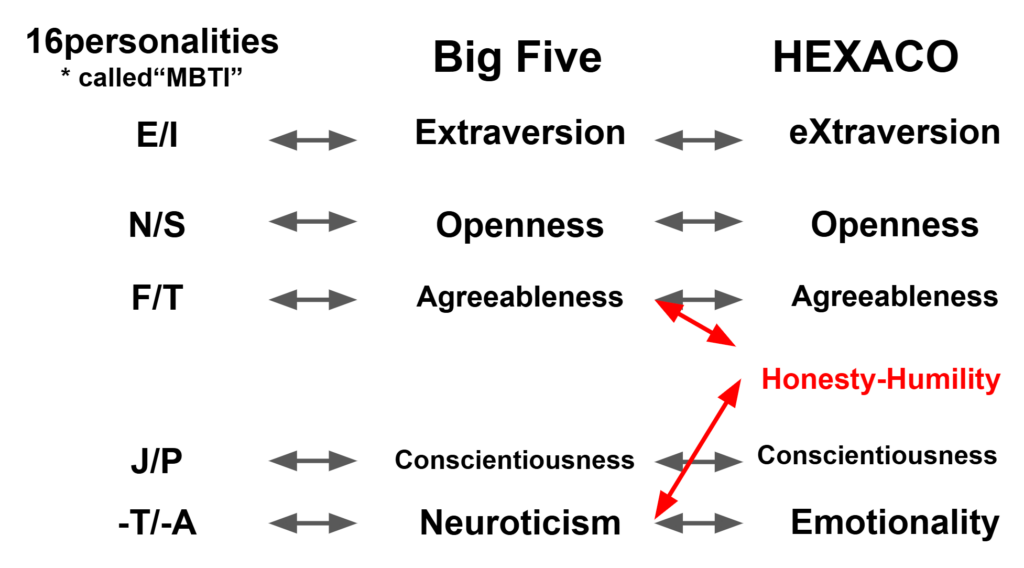
Also, in 16personalities, which was created with reference to MBTI and Big Five, neuroticism from Big Five is called “Identity“, and is classified as either Assertive or Turbulent.
On the far right is the relatively new personality assessment “HEXACO“. It is an improved version of Big Five with one additional indicator “Honesty-Humility”. Research on bullying and harassment perpetrators is active in HEXACO studies.
Since 16personalities and MBTI have weak scientific evidence, this article provides detailed explanations of 16personalities personality types based on their correlations with Big Five and HEXACO.
Try Taking the Proper Personality Test “HEXACO-JP”!
While MBTI and 16personalities are popular as “gateways to knowing yourself,” experiencing a scientifically-backed personality test is the best way to truly understand your strengths and risks.
That’s where we recommend the HEXACO assessment available in Japanese: “HEXACO-JP“.
HEXACO-JP visualizes your personality tendencies numerically based on six factors: Honesty-Humility, Emotionality, Extraversion, Agreeableness, Conscientiousness, and Openness.
By simply answering straightforward questions, you can gain helpful insights for self-understanding, relationships, and workplace communication.
If you’re curious about “What type of person am I?”, start by taking HEXACO-JP and examine yourself from a scientific perspective.

FAQ and Important Notes
HEXACO results differ from 16personalities (commonly known as MBTI test) or MBTI (original)
- Personality is influenced by genetics and environment, so when the environment changes, responses also change (for example, emotional responses change when you’re tired, etc.). For more details on genetics, see here.
- There are variations in responses depending on age. For more details, see here.
- Type classification is based on whether each value is 3 or above, or below 3, so values close to 3 are more likely to change results depending on how questions are asked or the environment at the time. Please look at the numerical values rather than the type.
- For MBTI (original) and 16personalities (commonly known as MBTI test), it’s unclear how much statistical processing was done at the question design stage as no research papers can be found. On the other hand, papers on Big Five and HEXACO can be easily found, and this HEXACO-JP test is based on research papers.
- While there aren’t many research papers comparing MBTI and 16personalities with everyday behaviors (academic performance, income, etc.) or with the brain and genetics, there are numerous studies on Big Five and HEXACO.
- HEXACO is a variation of Big Five elements, so they are similar but distinct. HEXACO’s Honesty-Humility is extracted from Big Five’s Agreeableness and Neuroticism.
If you have any other questions, please contact us through our inquiry form.
Personality test results are merely “hints” for your life
As mentioned earlier, personality is influenced by genetics and environment. Due to genetic influence, there is a certain range of variation, but answers can vary to some extent depending on the environment.
Also, while Big Five and HEXACO research papers conduct correlation analyses with academic performance and income, the correlation coefficients are not as large as those in natural science experiments. Correlation coefficients range from -1 to 1, but most are around -0.4 to 0.4. Of course, there are higher ones too, but they’re not 0.8 or 0.9 – they’re relatively lower in comparison.
However, since there is various research available, please think of it as “more than fortune-telling, less than natural science.” I’m not 100% denying psychology or fortune-telling.

Writer & Supervisor: Eisuke Tokiwa
Personality Psychology Researcher / CEO, SUNBLAZE Inc.
As a child he experienced poverty, domestic abuse, bullying, truancy and dropping out of school — first-hand exposure to a range of social problems. He spent 10 years researching these issues and published Encyclopedia of Villains through Jiyukokuminsha. Since then he has independently researched the determinants of social problems and antisocial behavior (work, education, health, personality, genetics, region, etc.) and has published 2 peer-reviewed journal articles (Frontiers in Psychology, IEEE Access). His goal is to predict the occurrence of social problems. Spiky profile (WAIS-IV).
Expertise: Personality Psychology / Big Five / HEXACO / MBTI / Prediction of Social Problems
Researcher profiles: ORCID / Google Scholar / ResearchGate
Social & Books: X (@etokiwa999) / note / Amazon Author Page
ISFJ Romantic Compatibility: Who Do They Connect With Best?
While ISFJs can form meaningful relationships with many personality types, certain pairings tend to bring out their best qualities and offer them the reciprocal care they quietly need. ISFJ romantic compatibility is highest with partners who appreciate emotional depth, value stability, and are willing to occasionally take the lead — since ISFJs can sometimes hesitate to assert themselves.
Types that research and community observation suggest tend to pair well with ISFJs include:
- ESFJ — Shares the same deep commitment to nurturing and tradition, creating a harmonious, mutual-care dynamic.
- ISTJ — Both types value reliability and loyalty highly, which builds a strong foundation of trust over time.
- ESTP or ENFP — These more spontaneous types can help ISFJs step outside their comfort zone and add excitement, provided the ISFJ’s need for emotional security is respected.
That said, compatibility is never determined by type alone. What ISFJs need most from any partner is genuine appreciation, emotional reciprocity, and clear communication — because without those elements, even a “compatible” pairing can leave an ISFJ feeling invisible and emotionally depleted.
The Selfless Love Pattern: ISFJ Strengths and Blind Spots
ISFJ selfless love is one of the most beautiful and most dangerous aspects of their romantic personality. On the positive side, it makes them extraordinarily giving partners who remember anniversaries, notice when something is wrong before being told, and create environments where their partners feel genuinely cared for. On the negative side, this same selflessness can become a source of quiet suffering if it goes unrecognized.
Here are the 3 key strengths and 3 common blind spots for ISFJs in love:
3 Core Relationship Strengths
- Emotional attunement — ISFJs pick up on subtle emotional cues, meaning partners rarely feel unseen or unheard.
- Steady loyalty — Once committed, ISFJs invest deeply and don’t give up easily. They tend to see relationships as something worth working on.
- Practical acts of care — Unlike some types who express love verbally, ISFJs often show love through action: cooking a favourite meal, remembering a small preference, or quietly solving a problem before it becomes one.
3 Blind Spots to Watch Out For
- Difficulty expressing dissatisfaction — ISFJs may endure unhappiness in silence for fear of upsetting their partner, allowing small issues to grow into larger ones.
- Susceptibility to one-sided relationships — Because they give so naturally, ISFJs can end up in dynamics where they provide most of the emotional labor without receiving enough in return.
- Taking on a caretaker identity — Over time, some ISFJs lose a sense of their own needs and desires, defining themselves almost entirely through their partner’s wellbeing.
Awareness of these blind spots is the first step toward addressing them. ISFJs don’t need to become less giving — they simply need to give to themselves with the same generosity they offer others.
Actionable Advice: How ISFJs Can Build Healthier, Deeper Relationships
Understanding ISFJ personality in relationships is valuable, but applying that understanding is what leads to real change. The following strategies are specifically designed for ISFJs who want to enjoy their natural relationship strengths without falling into common emotional traps.
- Practice expressing needs early and often. ISFJs tend to wait until frustration builds before speaking up. A more effective approach is making small, regular disclosures — even as simple as “I’ve been feeling a little overwhelmed lately.” This builds the habit of honest communication before emotions become critical. Why it works: Partners can’t meet needs they don’t know about, and early honesty prevents resentment from forming.
- Create a personal self-care ritual that isn’t about your partner. Whether it’s a weekly evening alone, a hobby that belongs entirely to you, or regular time with close friends, having a space that replenishes your emotional resources is essential. Why it works: ISFJs give from their emotional reserves. Without regular replenishment, those reserves run dry, leading to burnout and quiet bitterness.
- Ask for what you need instead of hoping it will be noticed. ISFJs are naturally observant, so they often assume their partners are too. Most aren’t — at least not to the same degree. Explicitly requesting gestures of appreciation or care isn’t needy; it’s mature communication. Why it works: Clear requests remove ambiguity and dramatically increase the likelihood of having needs met.
- Periodically evaluate whether the relationship feels reciprocal. Ask yourself honestly: does this person give back to me the way I give to them? If the answer is consistently “no,” that insight matters. Why it works: Relationships thrive on mutual investment. An ISFJ who recognizes an imbalance early can address it — or make informed decisions about whether to stay.
Frequently Asked Questions
What are the most defining ISFJ love personality traits?
ISFJs in love tend to be deeply attentive, loyal, and practically caring. They express affection through thoughtful actions — remembering details that matter to their partner, anticipating needs, and maintaining consistency in the relationship. Research suggests these traits align closely with high agreeableness and conscientiousness in the Big Five model, both of which are strongly linked to relationship satisfaction. The main challenge is that ISFJs may suppress their own needs, which can lead to emotional fatigue over time.
How does an ISFJ show love in a relationship?
ISFJs primarily show love through acts of service and quiet devotion rather than grand romantic gestures. They may prepare a meal their partner loves, remember a stressful event and check in afterward, or create a comfortable home environment. In MBTI terms, this reflects the “S” (Sensing) and “F” (Feeling) combination — a practical warmth that focuses on real, present-moment care. Partners who value consistency and thoughtfulness tend to find an ISFJ’s love style deeply fulfilling.
What are the biggest challenges for ISFJs in romantic relationships?
The most common challenge for ISFJs is the tendency to over-give at their own emotional expense. Because they dislike conflict and naturally prioritize their partner’s comfort, they may stay silent about their own dissatisfaction for too long. This can result in one-sided relationship dynamics or sudden emotional withdrawal that confuses their partner. Additionally, ISFJs may struggle to distinguish between healthy caregiving and an unhealthy caretaker identity where their own needs become invisible.
Which MBTI types are most compatible with ISFJs?
ISFJs tend to form especially strong bonds with types that appreciate loyalty and emotional depth. ESFJs share similar values around care and tradition, making for a naturally harmonious pairing. ISTJs offer the reliability and steadiness that ISFJs find deeply reassuring. More spontaneous types like ENFPs or ESTPs can also work well, providing complementary energy and new experiences — as long as the ISFJ’s need for emotional security is consistently honored in the relationship.
Does scientific research support the idea that ISFJs make great partners?
Yes, research supports several of the personality traits associated with ISFJs as predictors of relationship satisfaction. A meta-analysis on the Big Five personality model and intimate partner satisfaction found that high conscientiousness and agreeableness — traits that strongly overlap with the ISFJ profile — are among the most reliable predictors of romantic happiness. While MBTI itself is not the same as the Big Five, the overlap in trait descriptions makes these findings meaningfully relevant to understanding ISFJ relationship strengths.
How can an ISFJ avoid emotional burnout in a relationship?
The most effective strategy for ISFJs is to practice expressing their needs regularly rather than waiting until frustration becomes overwhelming. Building a personal self-care routine — time that is entirely for themselves — helps replenish the emotional reserves they give so freely. It also helps to periodically reflect on whether the relationship feels balanced and reciprocal. ISFJs don’t need to stop being caring; they need to extend that same care inward, treating their own wellbeing as equally important to their partner’s.
Is ISFJ selfless love a strength or a weakness?
ISFJ selfless love is genuinely both. As a strength, it creates a relationship environment where partners feel profoundly valued, seen, and supported — a quality many people deeply long for. As a potential weakness, unchecked selflessness can lead to emotional depletion, resentment, and a loss of personal identity within the relationship. The key is balance: ISFJs who learn to give generously while also receiving gracefully tend to build the most rewarding and enduring romantic partnerships.
Summary: The Quiet Power of ISFJ Love
ISFJ love personality traits represent something genuinely rare in the modern dating landscape: a personality that is naturally inclined toward steady, thoughtful, and deeply loyal love. Backed by psychological research linking their core traits to high relationship satisfaction, ISFJs have real advantages in building the kind of partnership that lasts. Their emotional attunement, dependability, and practical warmth create a foundation that most partners find both rare and irreplaceable.
At the same time, the ISFJ’s greatest gift — their capacity to put others first — is also the area that requires the most conscious attention. Learning to communicate needs clearly, maintain personal boundaries, and ensure the relationship feels genuinely reciprocal isn’t a betrayal of who ISFJs are. It’s what allows them to love sustainably and be loved deeply in return.
If you recognized yourself or someone you care about in these descriptions, take a moment to reflect on what this means for your relationships — and explore more about how your unique personality type shapes the way you connect, commit, and love.