
ESTP love personality traits are defined by bold action, magnetic charisma, and an unrelenting appetite for new experiences. If you’ve ever fallen for someone who swept you off your feet in the first five minutes and kept you guessing ever since, there’s a good chance they were an ESTP. Understanding how this personality type approaches romance — both its electrifying highs and its genuine challenges — can help you build a relationship that actually lasts.
In this article, we break down the psychology behind ESTP romance style, draw on research into personality and relationship satisfaction, and offer practical, evidence-informed advice. Whether you identify as an ESTP yourself or you’re partnering with one, the insights here are designed to be immediately useful.
Once again, personality researcher and author of Villain Encyclopedia, Tokiwa (@etokiwa999), will provide the explanation.
※We have developed the HEXACO-JP Personality Assessment! It has more scientific basis than MBTI. Tap below for details.

目次
- 1 Characteristics and Tendencies of ESTP (The Entrepreneur)
- 2 ESTP Love Personality Traits: Passionate, Direct, and Hard to Pin Down
- 3 What Psychology Research Says About ESTP Compatibility and Relationship Satisfaction
- 4 Try Taking the Proper Personality Test “HEXACO-JP”!
- 5 Scientific Background of the 16 Types
- 6 FAQ and Important Notes
- 7 ESTP in Relationships: Strengths That Make Them Unforgettable Partners
- 8 Challenges to Watch: Where ESTP Romance Style Can Create Friction
- 9 Actionable Advice: How ESTPs Can Build Lasting Love
- 10 Frequently Asked Questions
- 10.1 What are the most defining ESTP love personality traits?
- 10.2 Who is most compatible with an ESTP in relationships?
- 10.3 Do ESTPs fall in love quickly?
- 10.4 Why do ESTPs struggle with emotional intimacy?
- 10.5 Are ESTPs likely to cheat or be unfaithful?
- 10.6 What MBTI types are generally seen as ideal lovers in research?
- 10.7 Can ESTPs have long-term, stable relationships?
- 11 Summary: Embracing the Full Picture of ESTP Love
Characteristics and Tendencies of ESTP (The Entrepreneur)
ESTP is a type rich in action and adaptability.
They excel at making instant decisions and demonstrate their strength in practical situations.
They enjoy interacting with people and behave in a bright and active manner.
They don’t fear change and welcome new challenges.
The characteristics and tendencies of ESTP are as follows:
- They quickly grasp situations and act flexibly according to circumstances.
- They are sociable and have charm that attracts people.
- They prefer to learn from actual experiences.
- They can respond calmly even in crisis situations.
- They accumulate results through action.
On the other hand, they may become impulsive and lack planning.
They also tend to overly emphasize short-term results.
They may cause misunderstandings by prioritizing action over emotions.
Having an awareness of looking ahead brings stability.
ESTP adapts to many situations with execution ability and sociability.
Their attitude of enjoying challenges energizes those around them.
They can overcome difficulties with flexible responsiveness.
It is important to leverage their action-oriented nature to build long-term results.
ESTP Love Personality Traits: Passionate, Direct, and Hard to Pin Down
ESTPs tend to be captivating romantic partners, but they are not always the easiest ones to settle down with. The core tension in an ESTP’s love life comes from a personality built around stimulation and freedom. They are drawn to excitement, novelty, and real-world adventure — and that energy absolutely translates into romance. When an ESTP is interested in you, you’ll know: they are direct, expressive, and physically affectionate in ways that leave little room for doubt.
Research into sensing-dominant personality types suggests that ESTPs tend to prioritize present-moment enjoyment over long-term planning. In romantic contexts, this means they are highly attuned to chemistry, physical connection, and shared experiences — but may struggle with the slower, more routine-driven phases of a committed relationship. Studies on extraverted personality types also indicate that ESTPs tend to have a wide social circle, which can occasionally make a partner feel like one option among many rather than the priority.
Key ESTP love personality traits typically include the following:
- Bold, upfront affection — ESTPs tend to express love through actions rather than words, often planning experiences, solving problems, or showing up physically when it matters.
- A love of shared adventures — Romance for an ESTP is often built around doing things together: travel, sport, spontaneous plans, or anything that breaks the daily routine.
- Present-focus over future planning — They tend to prioritize how things feel right now over where things are heading in 5 years, which can be exhilarating early on but creates friction later.
- Discomfort with emotional intensity — Deep, prolonged emotional conversations can feel draining or unnecessary to an ESTP, even when their partner genuinely needs that connection.
- A tendency to pull back when feeling trapped — If a relationship starts to feel suffocating or overly routine, an ESTP may emotionally (or physically) withdraw rather than address it directly.
Importantly, this doesn’t mean ESTPs are shallow or uncaring. When an ESTP is genuinely committed, they become remarkably reliable, protective, and energizing partners. The key is that they tend to thrive when given a degree of autonomy and when the relationship itself remains dynamic and engaging.
What Psychology Research Says About ESTP Compatibility and Relationship Satisfaction
Personality psychology offers a useful lens for understanding why some ESTP relationships flourish and others stall out quickly. The most widely validated model in relationship research is the Big Five personality framework, which assesses 5 core dimensions: conscientiousness, agreeableness, extraversion, openness to experience, and emotional stability (also called neuroticism in reverse). Unlike MBTI, the Big Five has extensive empirical backing in predicting relationship outcomes.
Research consistently finds that the 2 traits most strongly linked to high relationship satisfaction are conscientiousness (reliability, self-discipline, follow-through) and agreeableness (empathy, cooperation, warmth). In MBTI terms, these traits map loosely onto “J” (Judging) and “F” (Feeling) preferences — neither of which is dominant in the typical ESTP profile, which skews toward T (Thinking) and P (Perceiving).
This is supported by the following foundational study: Malouff, J. M. et al. (2010), “The Five-Factor Model of personality and relationship satisfaction of intimate partners: A meta-analysis”. This meta-analysis found that partners who scored higher in conscientiousness and agreeableness reported significantly greater relationship satisfaction across multiple studies.
This doesn’t mean ESTPs are doomed in love — far from it. It does suggest that ESTPs who actively develop their more conscientious and empathetic side tend to report stronger, more lasting relationships. The good news: because ESTPs are highly action-oriented, behavioral change tends to come more naturally to them than to more introspective types.
Try Taking the Proper Personality Test “HEXACO-JP”!
While MBTI and 16personalities are popular as “gateways to knowing yourself,” experiencing a scientifically-backed personality test is the best way to truly understand your strengths and risks.
That’s where we recommend the HEXACO assessment available in Japanese: “HEXACO-JP“.
HEXACO-JP visualizes your personality tendencies numerically based on six factors: Honesty-Humility, Emotionality, Extraversion, Agreeableness, Conscientiousness, and Openness.
By simply answering straightforward questions, you can gain helpful insights for self-understanding, relationships, and workplace communication.
If you’re curious about “What type of person am I?”, start by taking HEXACO-JP and examine yourself from a scientific perspective.
Scientific Background of the 16 Types
MBTI Overview
MBTI is a psychological theory that classifies personality into 16 types.
To begin with, MBTI is an abbreviation for Myers-Briggs Type Indicator.
MBTI classifies personality into 16 types by combining the following 4 indicators.
In other words, MBTI expresses one’s personality tendencies in 4 letters such as “ISTJ” or “ENFP”. There is a very famous similar system called 16personalities, but this is created by combining MBTI and Big Five.
Big Five Overview
One of the most prominent trait theories in personality psychology is the “Big Five”.
Big Five measures five traits: Openness, Conscientiousness, Extraversion, Agreeableness, and Neuroticism.
Also, while 16personalities and MBTI use type classification (e.g., either extraverted or introverted), a major difference is that Big Five evaluates traits on a continuous numerical scale (e.g., extraversion 3.5).
Furthermore, it has been studied for a long time, has many research papers, and extensive research has been conducted in other fields such as academic achievement, income, brain, and genetics. It can be said that Big Five has relatively stronger scientific backing.
Correlation Between MBTI, Big Five, and HEXACO
There are correlations between MBTI’s 4 indicators and Big Five’s 5 factors.
A representative study showing this correlation is the paper “The relationship between the revised NEO-Personality Inventory and the Myers-Briggs Type Indicator“.
According to this paper, the correlations between MBTI and Big Five are as follows.
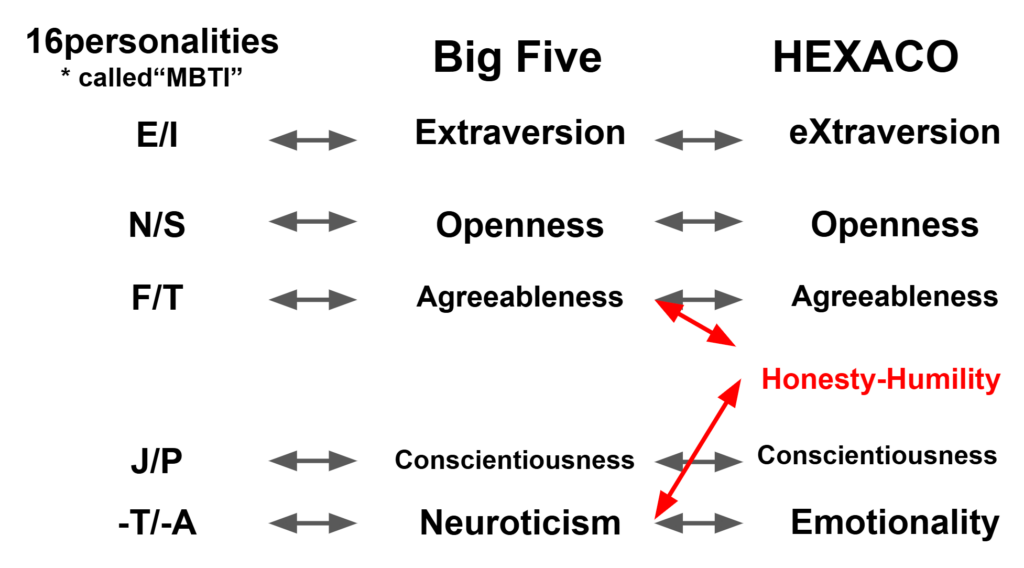
Also, in 16personalities, which was created with reference to MBTI and Big Five, neuroticism from Big Five is called “Identity“, and is classified as either Assertive or Turbulent.
On the far right is the relatively new personality assessment “HEXACO“. It is an improved version of Big Five with one additional indicator “Honesty-Humility”. Research on bullying and harassment perpetrators is active in HEXACO studies.
Since 16personalities and MBTI have weak scientific evidence, this article provides detailed explanations of 16personalities personality types based on their correlations with Big Five and HEXACO.

FAQ and Important Notes
HEXACO results differ from 16personalities (commonly known as MBTI test) or MBTI (original)
- Personality is influenced by genetics and environment, so when the environment changes, responses also change (for example, emotional responses change when you’re tired, etc.). For more details on genetics, see here.
- There are variations in responses depending on age. For more details, see here.
- Type classification is based on whether each value is 3 or above, or below 3, so values close to 3 are more likely to change results depending on how questions are asked or the environment at the time. Please look at the numerical values rather than the type.
- For MBTI (original) and 16personalities (commonly known as MBTI test), it’s unclear how much statistical processing was done at the question design stage as no research papers can be found. On the other hand, papers on Big Five and HEXACO can be easily found, and this HEXACO-JP test is based on research papers.
- While there aren’t many research papers comparing MBTI and 16personalities with everyday behaviors (academic performance, income, etc.) or with the brain and genetics, there are numerous studies on Big Five and HEXACO.
- HEXACO is a variation of Big Five elements, so they are similar but distinct. HEXACO’s Honesty-Humility is extracted from Big Five’s Agreeableness and Neuroticism.
If you have any other questions, please contact us through our inquiry form.
Personality test results are merely “hints” for your life
As mentioned earlier, personality is influenced by genetics and environment. Due to genetic influence, there is a certain range of variation, but answers can vary to some extent depending on the environment.
Also, while Big Five and HEXACO research papers conduct correlation analyses with academic performance and income, the correlation coefficients are not as large as those in natural science experiments. Correlation coefficients range from -1 to 1, but most are around -0.4 to 0.4. Of course, there are higher ones too, but they’re not 0.8 or 0.9 – they’re relatively lower in comparison.
However, since there is various research available, please think of it as “more than fortune-telling, less than natural science.” I’m not 100% denying psychology or fortune-telling.
ESTP in Relationships: Strengths That Make Them Unforgettable Partners
Despite the challenges, ESTPs bring a set of genuine relationship strengths that many other MBTI types simply cannot replicate. Their energy, resourcefulness, and commitment to living fully in the present moment can make daily life with an ESTP feel like a constant adventure. For partners who value excitement, independence, and authentic expression over structured emotional processing, an ESTP can be an extraordinarily fulfilling match.
Here are 4 core strengths that ESTPs tend to bring into romantic relationships:
- Crisis competence — ESTPs are often at their best when things go wrong. They tend to stay calm under pressure and take decisive action, which makes their partners feel protected and supported in difficult moments.
- Authenticity — ESTPs rarely play games or say what they don’t mean. Their directness, while occasionally blunt, builds a foundation of honesty that many partners deeply value over time.
- Physical presence and affection — ESTPs tend to be physically attentive and affectionate partners who express love through touch, quality time, and memorable shared experiences.
- Humor and social ease — Life with an ESTP is rarely boring. Their natural wit, social confidence, and love of fun tend to keep the relationship feeling light and energized, even during ordinary moments.
These strengths are most likely to shine in relationships where both partners feel free to be themselves — where there is mutual respect for independence alongside genuine affection.
Challenges to Watch: Where ESTP Romance Style Can Create Friction
Self-awareness about the friction points in ESTP romance style is arguably more valuable than celebrating the strengths. Because ESTPs tend to be highly confident and action-oriented, they may not always notice when their behavior is affecting their partner in negative ways — until significant damage has already been done.
Common relationship challenges for ESTPs include:
- Emotional avoidance — When a partner needs a deep emotional conversation, ESTPs may deflect with humor, pivot to problem-solving, or simply change the subject. Over time, this can leave a partner feeling unheard or emotionally abandoned.
- Commitment hesitation — ESTPs tend to resist being pinned down, whether that’s to plans, routines, or future milestones. This can feel non-committal to partners who value security and forward momentum.
- Boredom in stable phases — The early excitement of a new relationship tends to energize ESTPs. When the relationship settles into a comfortable routine, they may unconsciously (or consciously) seek stimulation elsewhere.
- Risk tolerance mismatches — ESTPs often make impulsive financial or lifestyle decisions that can create genuine stress for more risk-averse partners, particularly in long-term relationships.
Recognizing these patterns early — and communicating openly about them — is one of the most effective things an ESTP can do to protect a relationship they genuinely value.
Actionable Advice: How ESTPs Can Build Lasting Love
Because ESTPs are naturally action-oriented, the most effective relationship advice for this type is concrete and behavioral — not abstract or theoretical. Below are 4 evidence-informed strategies that tend to help ESTPs sustain healthy, satisfying partnerships over time.
- Schedule emotional check-ins deliberately. ESTPs don’t naturally gravitate toward emotional conversations, but research on relationship maintenance shows that regular, low-stakes emotional sharing significantly increases long-term satisfaction. Try setting aside even 10 minutes once a week to ask your partner how they’re feeling — and genuinely listen without jumping to fix anything.
- Build novelty into the committed relationship. If boredom is a threat, engineer against it proactively. Plan new experiences together regularly — travel, new hobbies, shared challenges — so the relationship itself continues to offer the stimulation ESTPs need. This works because it satisfies the ESTP’s novelty drive without requiring a new partner.
- Practice stating your feelings in words, not just actions. While ESTPs instinctively show love through behavior, many partners also need to hear it verbally. Work on translating your actions into language: “I planned this trip because I wanted to do something special for you” lands differently than just showing up with tickets.
- Develop your conscientiousness muscle gradually. Research suggests conscientiousness is one of the most learnable Big Five traits. Start small: follow through on 3 commitments this week, tell your partner in advance when plans change, and be consistent about the small promises you make. These micro-behaviors compound into a strong foundation of trust.

Writer & Supervisor: Eisuke Tokiwa
Personality Psychology Researcher / CEO, SUNBLAZE Inc.
As a child he experienced poverty, domestic abuse, bullying, truancy and dropping out of school — first-hand exposure to a range of social problems. He spent 10 years researching these issues and published Encyclopedia of Villains through Jiyukokuminsha. Since then he has independently researched the determinants of social problems and antisocial behavior (work, education, health, personality, genetics, region, etc.) and has published 2 peer-reviewed journal articles (Frontiers in Psychology, IEEE Access). His goal is to predict the occurrence of social problems. Spiky profile (WAIS-IV).
Expertise: Personality Psychology / Big Five / HEXACO / MBTI / Prediction of Social Problems
Researcher profiles: ORCID / Google Scholar / ResearchGate
Social & Books: X (@etokiwa999) / note / Amazon Author Page
Frequently Asked Questions
What are the most defining ESTP love personality traits?
ESTPs tend to be bold, physically affectionate, and highly present in their romantic relationships. They typically express love through action — planning experiences, solving problems, and showing up when things get hard — rather than through emotional language. However, they also tend to resist emotional depth, dislike routine, and may pull back when a relationship starts to feel restrictive. Research suggests that ESTPs who actively develop empathy and follow-through report significantly stronger long-term relationship satisfaction.
Who is most compatible with an ESTP in relationships?
ESTP compatibility tends to be strongest with partners who value independence, enjoy shared physical activities, and don’t need constant emotional processing to feel secure. Types that offer a grounding, calm energy — often Sensing-Judging types like ISTJ or ESTJ — can complement an ESTP’s spontaneity well. That said, compatibility research consistently shows that shared values and mutual communication style matter more than any specific MBTI pairing.
Do ESTPs fall in love quickly?
ESTPs tend to be fast movers in the early stages of romance. Their natural confidence, directness, and attraction to excitement mean they often pursue a romantic interest quickly and intensely. However, whether that initial intensity translates into deep, committed love depends significantly on how the relationship evolves. ESTPs are more likely to sustain romantic feelings when the relationship continues to feel dynamic, mutual, and free of excessive emotional pressure.
Why do ESTPs struggle with emotional intimacy?
ESTPs are dominant in Extraverted Sensing (Se), which orients them toward the external, physical world rather than the inner emotional landscape. Deep emotional conversations can feel abstract, draining, or even unnecessary to an ESTP — not because they don’t care, but because they tend to process experience through action rather than reflection. Studies on personality and emotional communication suggest this is a learnable skill: ESTPs who practice active listening and verbal emotional expression tend to close this gap over time.
Are ESTPs likely to cheat or be unfaithful?
No personality type is inherently more likely to be unfaithful, and this applies to ESTPs as well. However, because ESTPs tend to crave novelty and stimulation, they may be at higher risk of emotional or physical restlessness in relationships that have become stagnant or overly restrictive. Research suggests the most effective protective factor against infidelity across all types is active relationship investment — not personality type alone. ESTPs who deliberately nurture their relationship tend to remain committed.
What MBTI types are generally seen as ideal lovers in research?
Research linking the Big Five personality model to MBTI suggests that types high in agreeableness and conscientiousness — broadly corresponding to “F” and “J” preferences — tend to report higher relationship satisfaction scores on average. In MBTI terms, types like INFJ, ISFJ, and ESFJ are often cited in this context. However, it’s important to note that relationship quality is shaped by communication, shared values, and mutual effort far more than by personality type alone.
Can ESTPs have long-term, stable relationships?
Absolutely. ESTPs are fully capable of long-term, deeply satisfying relationships — particularly when they find a partner who respects their independence while offering genuine emotional warmth. The key factors tend to be self-awareness (recognizing their own avoidant tendencies), a willingness to grow in areas like emotional communication and consistency, and a relationship that continues to offer genuine engagement rather than monotony. Many ESTPs describe their most successful relationships as ones where both partners kept choosing each other actively, rather than coasting on habit.
Summary: Embracing the Full Picture of ESTP Love
Understanding ESTP love personality traits means holding two things at once: this type brings extraordinary energy, authenticity, and adventurous spirit to their relationships, and they also tend to face real, identifiable challenges around emotional depth, routine, and commitment. Neither side of that picture cancels the other out. Research suggests that the ESTPs who build the most fulfilling partnerships are those who lean into their natural strengths — directness, action, presence — while intentionally developing the areas that don’t come as naturally, particularly empathy and consistency. If you’ve just recognized yourself (or someone you love) in this profile, the most valuable next step isn’t to change who you are — it’s to understand yourself clearly enough to show up fully for the people who matter most. Explore how your specific personality type shapes the way you connect in love — and discover which traits are already working in your favor.