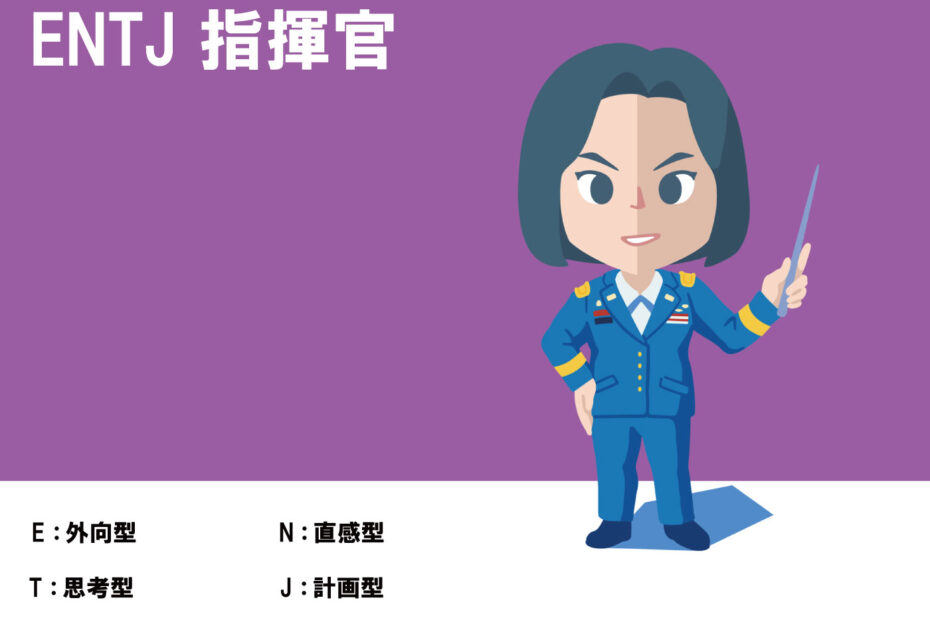
ENTJ love personality traits reveal a fascinating paradox: beneath the commanding, goal-driven exterior lies one of the most passionate and devoted partners in the MBTI spectrum. If you’ve ever wondered why ENTJs approach romance with the same intensity they bring to boardroom strategy, the answer lies in their core psychology — and understanding it can transform how they connect with others.
Research in personality psychology suggests that ENTJs, often called “The Commander,” carry their trademark decisiveness and vision into every relationship. However, this same drive for efficiency can sometimes cause them to overlook a partner’s emotional needs. This article breaks down the key ENTJ romantic behavior patterns, explores what science says about personality and relationship satisfaction, and offers practical guidance for ENTJs who want to build deeper, more fulfilling connections.
Once again, personality researcher and author of Villain Encyclopedia, Tokiwa (@etokiwa999), will provide the explanation.
※We have developed the HEXACO-JP Personality Assessment! It has more scientific basis than MBTI. Tap below for details.

目次
- 1 ENTJ (Commander) Characteristics and Tendencies
- 2 Core ENTJ Love Personality Traits: Strengths and Blind Spots
- 3 What Personality Science Says About ENTJ Romantic Behavior
- 4 ENTJ Ideal Match: Who Tends to Complement an ENTJ in Love?
- 5 Building ENTJ Emotional Intelligence: Practical Advice for Deeper Relationships
- 6 Try Taking the Proper Personality Test “HEXACO-JP”!
- 7 Scientific Background of the 16 Types
- 8 FAQ and Important Notes
- 9 Frequently Asked Questions
- 9.1 What are the most defining ENTJ love personality traits in a relationship?
- 9.2 Who is the ENTJ ideal match for a long-term relationship?
- 9.3 Do ENTJs fall in love quickly or take their time?
- 9.4 What is the biggest challenge ENTJs face in romantic relationships?
- 9.5 How does ENTJ emotional intelligence affect their relationships?
- 9.6 Are ENTJs controlling in romantic relationships?
- 9.7 Can ENTJs have a successful long-term romantic relationship?
- 10 Summary: Turning ENTJ Strengths Into Relationship Superpowers
ENTJ (Commander) Characteristics and Tendencies
ENTJs are types that excel in initiative and leadership.
They actively work to achieve their goals.
They are highly organized and have the ability to lead organizations and people.
They possess a strong will to move forward even when faced with difficulties.
The main characteristics and tendencies of ENTJs are as follows.
- They survey the whole picture and formulate efficient strategies.
- They have decisiveness and quickly move into action.
- They share goals and inspire those around them.
- They think logically and organize problems.
- They focus on results and make practical judgments.
On the other hand, if their assertions are too strong, they create friction.
If they disregard others’ emotions, they invite misunderstandings.
If they lack flexibility, they tend to receive pushback from those around them.
Being conscious of cooperation and consideration makes things smoother.
ENTJs combine leadership and execution ability.
They can calmly show direction even in difficult situations.
They enjoy challenges and open up new possibilities.
They will grow even further by utilizing their strengths while developing empathy.
Core ENTJ Love Personality Traits: Strengths and Blind Spots
ENTJs tend to be bold, direct, and deeply committed partners — but their leadership instincts can sometimes tip into controlling behavior. Understanding where their strengths end and their blind spots begin is the first step toward healthier ENTJ relationship compatibility.
At their best, ENTJs bring remarkable energy to romantic relationships. They are not passive daters — they identify someone they admire, form a clear intention, and pursue that connection with confidence. Their love expression tends to be straightforward and unambiguous, which many partners find refreshing. ENTJs also tend to be fiercely loyal once committed, treating the relationship almost like a long-term project they are determined to see succeed.
However, MBTI love personality research points to at least 4 recurring challenges specific to ENTJs in romance:
- Goal-oriented framing: ENTJs may unconsciously treat the relationship as a “milestone to achieve” rather than an evolving emotional experience, causing them to rush intimacy or skip the softer stages of bonding.
- Directness without sensitivity: Their honest communication style, while efficient, can feel blunt or dismissive to partners who need emotional validation before logical solutions.
- Over-leading: ENTJs naturally gravitate toward taking charge, but in romantic relationships this can feel like micromanagement or a lack of respect for a partner’s autonomy.
- Intellectual over emotional connection: ENTJs tend to be drawn to witty, independent partners, and may undervalue emotional warmth as a bonding tool — especially early in a relationship.
In short, the ENTJ partner traits that make them exciting and dependable can also create friction when emotional attunement is required. The good news is that these are learnable skills, not fixed limitations.
What Personality Science Says About ENTJ Romantic Behavior
A significant body of personality research suggests that emotional warmth and self-discipline — not just intellect — are the strongest predictors of long-term relationship satisfaction. For ENTJs, this finding carries a clear and actionable message.
One of the most widely used frameworks in relationship psychology is the Big Five personality model (also called OCEAN), which measures 5 core traits: Conscientiousness, Agreeableness, Extraversion, Openness, and Emotional Stability. Research shows that the partners who tend to report the highest relationship satisfaction are those who score high on Agreeableness (warmth, empathy, cooperation) and Conscientiousness (reliability, self-control, follow-through).
Mapping this onto MBTI terminology: Agreeableness closely mirrors the “F” (Feeling) preference, while Conscientiousness aligns with “J” (Judging). ENTJs are strong on Conscientiousness — their planning and reliability are genuine assets — but they tend to score lower on Agreeableness, since their “T” (Thinking) preference prioritizes logic over interpersonal harmony.
This is supported by the findings referenced in Malouff et al. (2010), The Five-Factor Model of personality and relationship satisfaction of intimate partners: A meta-analysis, which demonstrated that Conscientiousness and Agreeableness were the 2 most consistent predictors of romantic satisfaction across multiple studies. For ENTJs, this means their natural discipline is already working in their favor — but cultivating emotional intelligence is the missing piece that can elevate their ENTJ romantic behavior from impressive to truly fulfilling.
ENTJ Ideal Match: Who Tends to Complement an ENTJ in Love?
ENTJs generally thrive with partners who are intellectually confident, emotionally grounded, and capable of holding their own in a lively debate — but who also bring the emotional depth that ENTJs may find challenging to access on their own.
When considering ENTJ ideal match compatibility, a few key dynamics tend to emerge consistently. ENTJs are energized by partners who challenge them mentally. A partner who accepts every decision without question tends to bore an ENTJ over time. Intellectual sparring — respectful disagreement, big-picture conversations, and shared ambition — is often described by ENTJs as one of the most attractive qualities a partner can have.
At the same time, ENTJ relationship compatibility research suggests that ENTJs benefit significantly from partners with higher emotional expressiveness. Types like INFJ or INTJ are often cited as strong matches — not because opposites always attract, but because these types offer a complementary balance: INFJs bring deep empathy and vision, while INTJs share the ENTJ’s strategic mindset while providing a slightly softer interpersonal edge.
- Intellectual independence: Partners who have their own goals and opinions keep ENTJs engaged and prevent the relationship from becoming one-sided.
- Emotional expressiveness: A partner who can name and communicate feelings openly helps ENTJs develop their own emotional vocabulary over time.
- Resilience under pressure: ENTJs are high-energy and high-expectation — partners who can maintain their own stability during stressful periods tend to complement this type well.
- Shared vision: ENTJs are long-term thinkers. Partners who also think in terms of future goals and growth tend to create the most stable, exciting partnerships.
Building ENTJ Emotional Intelligence: Practical Advice for Deeper Relationships
The most transformative step an ENTJ can take in their love life is not finding the right partner — it is developing the emotional intelligence to be the right partner. Research consistently shows that ENTJ emotional intelligence can be deliberately cultivated, and the payoff in relationship quality is substantial.
Here are 3 evidence-informed strategies that ENTJs can begin practicing immediately:
- Practice reflective listening before problem-solving: When a partner shares a concern, ENTJs instinctively jump to solutions. Instead, try reflecting the emotion back first — “It sounds like you felt overlooked” — before offering any advice. Why it works: This signals emotional safety, which is the foundation of long-term trust. How to practice: Set a personal rule of at least 2 empathetic responses before introducing any analysis or solution.
- Schedule emotional check-ins as intentionally as meetings: ENTJs are calendar-driven. Use that strength — build in regular, distraction-free time to ask your partner how they are feeling about the relationship. Why it works: Consistency communicates care more powerfully than grand gestures. How to practice: A brief weekly conversation (approx. 15 minutes) where the agenda is feelings, not logistics.
- Reframe vulnerability as strategic strength: Many ENTJs resist emotional disclosure because it feels inefficient or risky. Research on relationship bonding suggests that reciprocal vulnerability is one of the fastest paths to deep intimacy. Why it works: Partners feel safer opening up when they see the ENTJ doing the same. How to practice: Share one genuine uncertainty or emotional reaction per week — not a performance, just honesty.
Try Taking the Proper Personality Test “HEXACO-JP”!
While MBTI and 16personalities are popular as “gateways to knowing yourself,” experiencing a scientifically-backed personality test is the best way to truly understand your strengths and risks.
That’s where we recommend the HEXACO assessment available in Japanese: “HEXACO-JP“.
HEXACO-JP visualizes your personality tendencies numerically based on six factors: Honesty-Humility, Emotionality, Extraversion, Agreeableness, Conscientiousness, and Openness.
By simply answering straightforward questions, you can gain helpful insights for self-understanding, relationships, and workplace communication.
If you’re curious about “What type of person am I?”, start by taking HEXACO-JP and examine yourself from a scientific perspective.
Scientific Background of the 16 Types
MBTI Overview
MBTI is a psychological theory that classifies personality into 16 types.
To begin with, MBTI is an abbreviation for Myers-Briggs Type Indicator.
MBTI classifies personality into 16 types by combining the following 4 indicators.
In other words, MBTI expresses one’s personality tendencies in 4 letters such as “ISTJ” or “ENFP”. There is a very famous similar system called 16personalities, but this is created by combining MBTI and Big Five.
Big Five Overview
One of the most prominent trait theories in personality psychology is the “Big Five”.
Big Five measures five traits: Openness, Conscientiousness, Extraversion, Agreeableness, and Neuroticism.
Also, while 16personalities and MBTI use type classification (e.g., either extraverted or introverted), a major difference is that Big Five evaluates traits on a continuous numerical scale (e.g., extraversion 3.5).
Furthermore, it has been studied for a long time, has many research papers, and extensive research has been conducted in other fields such as academic achievement, income, brain, and genetics. It can be said that Big Five has relatively stronger scientific backing.
Correlation Between MBTI, Big Five, and HEXACO
There are correlations between MBTI’s 4 indicators and Big Five’s 5 factors.
A representative study showing this correlation is the paper “The relationship between the revised NEO-Personality Inventory and the Myers-Briggs Type Indicator“.
According to this paper, the correlations between MBTI and Big Five are as follows.
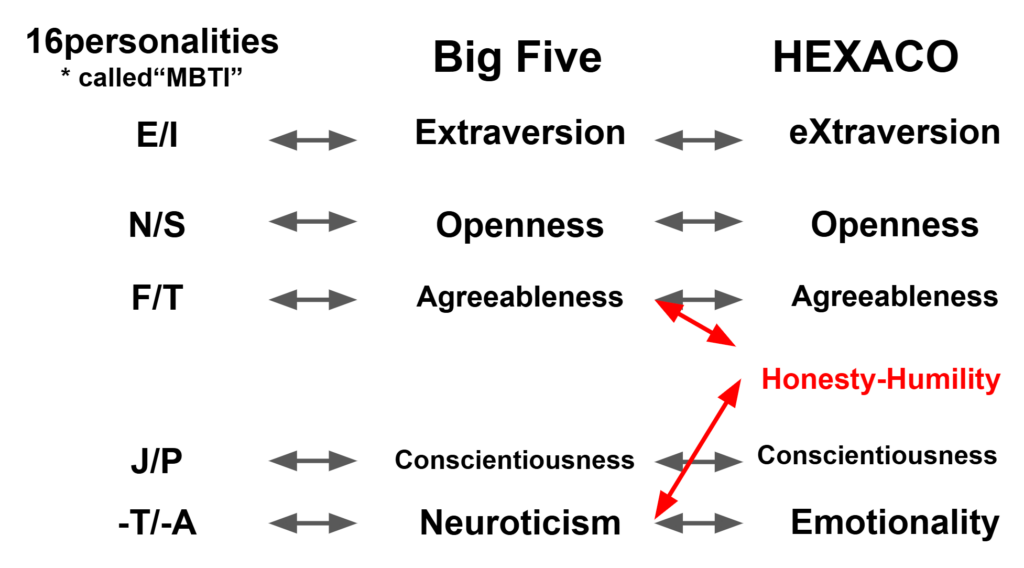
Also, in 16personalities, which was created with reference to MBTI and Big Five, neuroticism from Big Five is called “Identity“, and is classified as either Assertive or Turbulent.
On the far right is the relatively new personality assessment “HEXACO“. It is an improved version of Big Five with one additional indicator “Honesty-Humility”. Research on bullying and harassment perpetrators is active in HEXACO studies.
Since 16personalities and MBTI have weak scientific evidence, this article provides detailed explanations of 16personalities personality types based on their correlations with Big Five and HEXACO.

FAQ and Important Notes
HEXACO results differ from 16personalities (commonly known as MBTI test) or MBTI (original)
- Personality is influenced by genetics and environment, so when the environment changes, responses also change (for example, emotional responses change when you’re tired, etc.). For more details on genetics, see here.
- There are variations in responses depending on age. For more details, see here.
- Type classification is based on whether each value is 3 or above, or below 3, so values close to 3 are more likely to change results depending on how questions are asked or the environment at the time. Please look at the numerical values rather than the type.
- For MBTI (original) and 16personalities (commonly known as MBTI test), it’s unclear how much statistical processing was done at the question design stage as no research papers can be found. On the other hand, papers on Big Five and HEXACO can be easily found, and this HEXACO-JP test is based on research papers.
- While there aren’t many research papers comparing MBTI and 16personalities with everyday behaviors (academic performance, income, etc.) or with the brain and genetics, there are numerous studies on Big Five and HEXACO.
- HEXACO is a variation of Big Five elements, so they are similar but distinct. HEXACO’s Honesty-Humility is extracted from Big Five’s Agreeableness and Neuroticism.
If you have any other questions, please contact us through our inquiry form.
Personality test results are merely “hints” for your life
As mentioned earlier, personality is influenced by genetics and environment. Due to genetic influence, there is a certain range of variation, but answers can vary to some extent depending on the environment.
Also, while Big Five and HEXACO research papers conduct correlation analyses with academic performance and income, the correlation coefficients are not as large as those in natural science experiments. Correlation coefficients range from -1 to 1, but most are around -0.4 to 0.4. Of course, there are higher ones too, but they’re not 0.8 or 0.9 – they’re relatively lower in comparison.
However, since there is various research available, please think of it as “more than fortune-telling, less than natural science.” I’m not 100% denying psychology or fortune-telling.

Writer & Supervisor: Eisuke Tokiwa
Personality Psychology Researcher / CEO, SUNBLAZE Inc.
As a child he experienced poverty, domestic abuse, bullying, truancy and dropping out of school — first-hand exposure to a range of social problems. He spent 10 years researching these issues and published Encyclopedia of Villains through Jiyukokuminsha. Since then he has independently researched the determinants of social problems and antisocial behavior (work, education, health, personality, genetics, region, etc.) and has published 2 peer-reviewed journal articles (Frontiers in Psychology, IEEE Access). His goal is to predict the occurrence of social problems. Spiky profile (WAIS-IV).
Expertise: Personality Psychology / Big Five / HEXACO / MBTI / Prediction of Social Problems
Researcher profiles: ORCID / Google Scholar / ResearchGate
Social & Books: X (@etokiwa999) / note / Amazon Author Page
Frequently Asked Questions
What are the most defining ENTJ love personality traits in a relationship?
ENTJs tend to be decisive, loyal, and highly motivated partners who pursue romantic relationships with the same strategic energy they apply to professional goals. Their most defining traits in love include directness in expressing affection, a strong preference for intellectual connection, and a natural tendency to lead. However, they may also struggle with prioritizing emotional expression over logical efficiency, which can create distance if left unaddressed. Cultivating empathy and active listening typically leads to significantly stronger relationship outcomes for this type.
Who is the ENTJ ideal match for a long-term relationship?
ENTJs tend to be most compatible with partners who are intellectually confident, emotionally expressive, and capable of healthy disagreement. Types frequently cited as strong ENTJ ideal match options include INFJ and INTJ, as these personalities offer complementary emotional depth and shared visionary thinking. The most important quality in a partner for an ENTJ is not personality type per se, but the ability to maintain independence, communicate openly about feelings, and share long-term ambitions.
Do ENTJs fall in love quickly or take their time?
ENTJs tend to move relatively quickly once they identify a potential partner they find intellectually stimulating and worthy of their long-term vision. Because they are decisive by nature, they do not typically linger in ambiguity. However, deep emotional bonding — as opposed to initial attraction — may take longer, since ENTJs often need time and deliberate practice to build the vulnerability and empathy that sustain intimacy over years rather than months.
What is the biggest challenge ENTJs face in romantic relationships?
Research on personality and relationship satisfaction suggests that ENTJs’ most consistent challenge in romance is the gap between their strong Conscientiousness (planning, reliability) and relatively lower Agreeableness (empathy, emotional warmth). This means they may excel at the logistical and practical aspects of a relationship while underinvesting in the emotional and connective dimensions. Partners of ENTJs frequently report feeling unheard or dismissed during emotionally charged conversations, which is why developing reflective listening skills is considered especially important for this type.
How does ENTJ emotional intelligence affect their relationships?
ENTJ emotional intelligence has a measurable effect on relationship quality. ENTJs who actively develop their emotional awareness — through practices like reflective listening, scheduled check-ins, and intentional vulnerability — tend to report significantly more satisfying and stable partnerships than those who rely purely on logic and efficiency. Because ENTJs are high achievers by nature, framing emotional growth as a skill to master (rather than a weakness to overcome) tends to be the most effective motivational framing for this personality type.
Are ENTJs controlling in romantic relationships?
ENTJs can come across as controlling in relationships, though this behavior typically stems from their leadership instincts rather than a desire to dominate. They naturally gravitate toward organizing, optimizing, and directing — behaviors that serve them well professionally but can feel intrusive to romantic partners. Studies suggest that ENTJs who consciously practice asking for their partner’s input before deciding, and who celebrate their partner’s independent choices, are able to balance strong leadership with genuine respect for the other person’s autonomy.
Can ENTJs have a successful long-term romantic relationship?
Yes — ENTJs are well-positioned for long-term relationship success, particularly because their Conscientiousness trait (one of the top 2 predictors of relationship satisfaction according to personality research) is naturally high. Their commitment, follow-through, and ambition create a stable foundation for lasting partnerships. The primary variable is whether the ENTJ also develops emotional attunement alongside their strategic strengths. ENTJs who invest in both dimensions tend to build relationships that are not only enduring but genuinely deeply fulfilling for both partners.
Summary: Turning ENTJ Strengths Into Relationship Superpowers
Understanding ENTJ love personality traits is ultimately an invitation to integrate two powerful forces: the Commander’s natural drive and vision, and the emotional intelligence that transforms good partnerships into extraordinary ones. ENTJs bring rare qualities to romance — decisiveness, loyalty, intellectual depth, and an almost unstoppable will to make things work. Research suggests that when these strengths are paired with deliberate emotional growth, ENTJs have the potential to be among the most devoted and inspiring partners of any MBTI type.
The path forward is not about suppressing what makes an ENTJ powerful — it is about expanding the definition of what “effective” looks like in a relationship. If you recognize these patterns in yourself or someone you love, use what you’ve learned here to start one meaningful conversation differently. Explore your own MBTI love patterns and discover which relationship strengths you already have — and which ones are waiting to be unlocked.