
ESFJ love personality traits science reveals one of the most nurturing, emotionally generous relationship styles found anywhere in the MBTI framework. If you’ve ever wondered why ESFJs are so frequently described as the “ideal romantic partner,” the answer lies in a fascinating combination of deep empathy, conscientious care, and an almost instinctive ability to make the people they love feel truly seen and valued.
Drawing on psychological research — including studies rooted in the Big Five personality model — this article breaks down the science behind how ESFJs experience love, what makes their relationship style so distinctive, and what actionable steps they (and their partners) can take to build even more fulfilling connections.
Once again, personality researcher and author of Villain Encyclopedia, Tokiwa (@etokiwa999), will provide the explanation.
※We have developed the HEXACO-JP Personality Assessment! It has more scientific basis than MBTI. Tap below for details.

目次
- 1 Characteristics and Tendencies of ESFJ (The Consul)
- 2 What Makes ESFJ Love Personality Traits Science-Backed?
- 3 5 Core ESFJ Relationship Style Characteristics in Love
- 4 Scientific Background of the 16 Types
- 5 ESFJ Compatibility: Who Tends to Be a Good Match?
- 6 Try Taking the Proper Personality Test “HEXACO-JP”!
- 7 ESFJ Emotional Expression: Strengths and Blind Spots
- 8 FAQ and Important Notes
- 9 Actionable Advice for ESFJs in Romantic Relationships
- 10 Frequently Asked Questions
- 10.1 What are the most common ESFJ love personality traits?
- 10.2 Is the ESFJ personality type considered ideal in romantic relationships?
- 10.3 Who is most compatible with an ESFJ romantic partner?
- 10.4 What is the biggest challenge ESFJs face in love?
- 10.5 How does ESFJ emotional expression differ from other MBTI types?
- 10.6 What does Big Five personality science say about ESFJ love traits?
- 10.7 Can ESFJs learn to set boundaries without losing their warmth?
- 11 Summary: Embracing Your ESFJ Love Personality With Science and Self-Awareness
Characteristics and Tendencies of ESFJ (The Consul)
ESFJ is a type with cooperativeness and caring nature.
They are sensitive to people’s feelings and generous with warm support.
They value order and discipline, emphasizing stability.
They are characterized by their dedication to maintaining harmony in their surroundings.
The characteristics and tendencies of ESFJ are as follows.
- They are considerate of others and treat them kindly.
- They excel as supporters in teams and families.
- They value courtesy and manners.
- They are strong in practical matters and handle things realistically.
- They have the ability to smooth interpersonal relationships.
On the other hand, they may become exhausted from serving others too much.
They sometimes push themselves too hard trying to meet others’ expectations.
They are easily deeply hurt when criticized.
Being conscious of self-assertion leads to stability.
ESFJs gain trust through their sincerity and warmth.
They have the power to support people and bring harmony to their surroundings.
With a sense of responsibility, they can build stability in organizations and families.
It is important to cherish themselves while maintaining their kindness.
What Makes ESFJ Love Personality Traits Science-Backed?
Research rooted in the Big Five personality model suggests that people who score high in Agreeableness and Conscientiousness — two traits strongly associated with the ESFJ type — consistently report higher romantic satisfaction. A landmark meta-analysis by Malouff et al. examined data across multiple studies and found that these two dimensions were the strongest predictors of relationship contentment among intimate partners. In MBTI terms, these qualities map closely onto the “F” (Feeling) and “J” (Judging) preferences that define the ESFJ profile.
Agreeableness reflects a person’s tendency toward warmth, cooperation, and genuine concern for others’ well-being. Conscientiousness reflects reliability, self-discipline, and follow-through. ESFJs tend to express both in abundance — they plan thoughtful gestures, remember what matters to their partner, and show up consistently over time. This is not accidental charm; it is a deeply wired orientation toward relational harmony.
The scientific implication is significant: the ESFJ’s natural personality architecture is well-aligned with the conditions that research links to long-term romantic happiness — both for themselves and for the people they choose to love.
5 Core ESFJ Relationship Style Characteristics in Love
ESFJs tend to express love through consistent action, emotional attunement, and a sincere desire to create a safe, happy space for their partner. Understanding these 5 key tendencies helps both ESFJs and their partners build more conscious, rewarding relationships.
- They are gifted at making their partner feel special. ESFJs pay close attention to preferences, habits, and moods — and then act on that information. Whether it’s cooking a partner’s favorite meal after a hard day or remembering an offhand comment made weeks ago, this attentiveness is a hallmark of ESFJ romantic expression.
- They build sincere, trustworthy relationships. ESFJs are not casual daters by nature. They tend to invest deeply and take commitments seriously, which means partners often feel genuinely secure with them.
- They have a finely tuned emotional radar. ESFJs tend to pick up on subtle shifts in a partner’s mood with remarkable accuracy. This high empathy makes them responsive and supportive, especially during difficult times.
- They express love openly and verbally. Unlike some personality types who show affection through quiet acts alone, ESFJs also tend to vocalize their feelings — saying “I love you,” expressing appreciation, and checking in emotionally on a regular basis.
- They can become emotionally exhausted from over-accommodation. Because ESFJs are so tuned in to others’ reactions, they may suppress their own needs to keep the peace — a pattern that can lead to burnout or resentment if left unaddressed.
Taken together, these 5 traits paint a picture of a romantic partner who is deeply present, emotionally generous, and genuinely motivated by the happiness of the people they love — with one important caveat: sustainability requires balance.
Scientific Background of the 16 Types
MBTI Overview
MBTI is a psychological theory that classifies personality into 16 types.
To begin with, MBTI is an abbreviation for Myers-Briggs Type Indicator.
MBTI classifies personality into 16 types by combining the following 4 indicators.
In other words, MBTI expresses one’s personality tendencies in 4 letters such as “ISTJ” or “ENFP”. There is a very famous similar system called 16personalities, but this is created by combining MBTI and Big Five.
Big Five Overview
One of the most prominent trait theories in personality psychology is the “Big Five”.
Big Five measures five traits: Openness, Conscientiousness, Extraversion, Agreeableness, and Neuroticism.
Also, while 16personalities and MBTI use type classification (e.g., either extraverted or introverted), a major difference is that Big Five evaluates traits on a continuous numerical scale (e.g., extraversion 3.5).
Furthermore, it has been studied for a long time, has many research papers, and extensive research has been conducted in other fields such as academic achievement, income, brain, and genetics. It can be said that Big Five has relatively stronger scientific backing.
Correlation Between MBTI, Big Five, and HEXACO
There are correlations between MBTI’s 4 indicators and Big Five’s 5 factors.
A representative study showing this correlation is the paper “The relationship between the revised NEO-Personality Inventory and the Myers-Briggs Type Indicator“.
According to this paper, the correlations between MBTI and Big Five are as follows.
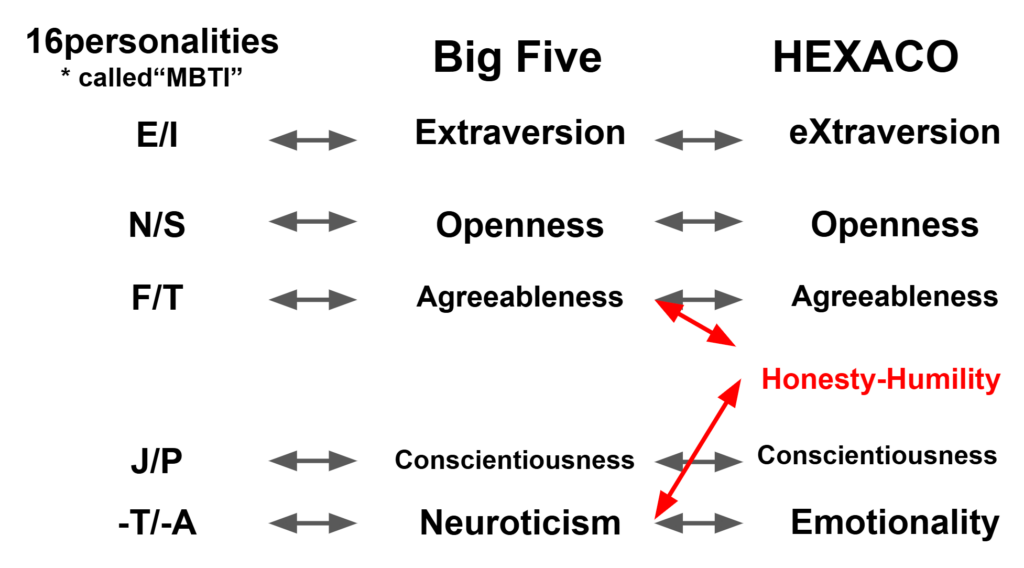
Also, in 16personalities, which was created with reference to MBTI and Big Five, neuroticism from Big Five is called “Identity“, and is classified as either Assertive or Turbulent.
On the far right is the relatively new personality assessment “HEXACO“. It is an improved version of Big Five with one additional indicator “Honesty-Humility”. Research on bullying and harassment perpetrators is active in HEXACO studies.
Since 16personalities and MBTI have weak scientific evidence, this article provides detailed explanations of 16personalities personality types based on their correlations with Big Five and HEXACO.
ESFJ Compatibility: Who Tends to Be a Good Match?
ESFJ compatibility tends to be strongest with partners who appreciate emotional openness, value commitment, and are willing to reciprocate care rather than simply receive it. Research on personality and relationship dynamics suggests that complementary — rather than identical — personality profiles often produce the most balanced partnerships.
ESFJs typically thrive alongside partners who offer stability and directness. Types that bring calm confidence and clear communication (such as ISFJ or ESTJ in MBTI terms) often complement the ESFJ’s warmth without overwhelming their emotional sensitivity. Conversely, highly avoidant or emotionally withholding partners may struggle to meet the ESFJ’s need for verbal affirmation and mutual engagement.
That said, compatibility is never purely a matter of type-matching. What matters most, research suggests, is whether both partners feel their core emotional needs are being acknowledged. For ESFJs, approximately 3 needs tend to be non-negotiable in a healthy relationship:
- Reciprocal appreciation — ESFJs give generously and need to feel that their efforts are noticed and valued.
- Emotional safety — They open up fully only when they trust that vulnerability won’t be dismissed or punished.
- Shared values around loyalty — Commitment and fidelity are foundational to how ESFJs define love itself.
Understanding these needs is as important for the ESFJ as it is for their partner — because recognizing what you require is the first step toward asking for it honestly.
Try Taking the Proper Personality Test “HEXACO-JP”!
While MBTI and 16personalities are popular as “gateways to knowing yourself,” experiencing a scientifically-backed personality test is the best way to truly understand your strengths and risks.
That’s where we recommend the HEXACO assessment available in Japanese: “HEXACO-JP“.
HEXACO-JP visualizes your personality tendencies numerically based on six factors: Honesty-Humility, Emotionality, Extraversion, Agreeableness, Conscientiousness, and Openness.
By simply answering straightforward questions, you can gain helpful insights for self-understanding, relationships, and workplace communication.
If you’re curious about “What type of person am I?”, start by taking HEXACO-JP and examine yourself from a scientific perspective.
ESFJ Emotional Expression: Strengths and Blind Spots
One of the most distinctive aspects of ESFJ emotional expression in romantic relationships is its visibility — ESFJs rarely love quietly. They tend to demonstrate affection through words, physical gestures, planned acts of service, and a near-constant awareness of whether their partner is happy. This level of emotional transparency is a genuine strength in building intimacy and trust.
However, the same sensitivity that makes ESFJs so attuned to others can become a vulnerability. Studies on people-pleasing behavior suggest that individuals with high Agreeableness sometimes struggle to set appropriate boundaries, prioritizing relational harmony over personal honesty. For ESFJs, this can manifest as:
- Saying “yes” when they mean “no” to avoid conflict
- Internalizing a partner’s bad mood as their own fault
- Suppressing legitimate grievances until they boil over
- Defining their own worth through their partner’s satisfaction
Awareness of these patterns is genuinely protective. ESFJs who practice honest self-expression — sharing their own needs and boundaries clearly — tend to build relationships that are not just warm but also durable and mutually fulfilling. Giving love is natural for ESFJs; learning to receive it gracefully is the growth edge.

FAQ and Important Notes
HEXACO results differ from 16personalities (commonly known as MBTI test) or MBTI (original)
- Personality is influenced by genetics and environment, so when the environment changes, responses also change (for example, emotional responses change when you’re tired, etc.). For more details on genetics, see here.
- There are variations in responses depending on age. For more details, see here.
- Type classification is based on whether each value is 3 or above, or below 3, so values close to 3 are more likely to change results depending on how questions are asked or the environment at the time. Please look at the numerical values rather than the type.
- For MBTI (original) and 16personalities (commonly known as MBTI test), it’s unclear how much statistical processing was done at the question design stage as no research papers can be found. On the other hand, papers on Big Five and HEXACO can be easily found, and this HEXACO-JP test is based on research papers.
- While there aren’t many research papers comparing MBTI and 16personalities with everyday behaviors (academic performance, income, etc.) or with the brain and genetics, there are numerous studies on Big Five and HEXACO.
- HEXACO is a variation of Big Five elements, so they are similar but distinct. HEXACO’s Honesty-Humility is extracted from Big Five’s Agreeableness and Neuroticism.
If you have any other questions, please contact us through our inquiry form.
Personality test results are merely “hints” for your life
As mentioned earlier, personality is influenced by genetics and environment. Due to genetic influence, there is a certain range of variation, but answers can vary to some extent depending on the environment.
Also, while Big Five and HEXACO research papers conduct correlation analyses with academic performance and income, the correlation coefficients are not as large as those in natural science experiments. Correlation coefficients range from -1 to 1, but most are around -0.4 to 0.4. Of course, there are higher ones too, but they’re not 0.8 or 0.9 – they’re relatively lower in comparison.
However, since there is various research available, please think of it as “more than fortune-telling, less than natural science.” I’m not 100% denying psychology or fortune-telling.
Actionable Advice for ESFJs in Romantic Relationships
Understanding your ESFJ love personality traits is only valuable if you can translate that understanding into concrete relationship habits. Below are 4 evidence-informed strategies tailored to the ESFJ’s unique profile — each one designed to amplify strengths and gently address blind spots.
- Schedule regular emotional check-ins with yourself, not just your partner. ESFJs are skilled at checking in on others but often neglect their own inner state. Setting aside even 10 minutes a week to ask “What do I actually need right now?” builds self-awareness that prevents emotional depletion. Why it works: You can’t pour from an empty cup — and sustainable love requires you to stay emotionally replenished.
- Practice stating a preference or need directly at least once per week. This can feel uncomfortable for ESFJs, who instinctively prioritize their partner’s preferences. Start small: choose a restaurant, suggest a weekend activity, or express an honest opinion when asked. Why it works: Healthy relationships are built on two authentic people — and partners generally feel more connected when they know the real you.
- Let your partner’s reassurance land. When a partner says “I love you” or offers a compliment, ESFJs sometimes deflect or immediately redirect attention back to the other person. Practicing the simple act of receiving — pausing, saying “thank you,” and letting it in — deepens genuine intimacy. Why it works: Reciprocal vulnerability is the engine of closeness.
- Distinguish between empathy and responsibility. ESFJs tend to absorb their partner’s emotions as if they were their own. Learning to say “I care about what you’re feeling, AND I recognize it’s not my emotion to fix” is both psychologically healthy and relationally mature. Why it works: Partners feel respected — not managed — when they’re given space to own their emotional experience.

Writer & Supervisor: Eisuke Tokiwa
Personality Psychology Researcher / CEO, SUNBLAZE Inc.
As a child he experienced poverty, domestic abuse, bullying, truancy and dropping out of school — first-hand exposure to a range of social problems. He spent 10 years researching these issues and published Encyclopedia of Villains through Jiyukokuminsha. Since then he has independently researched the determinants of social problems and antisocial behavior (work, education, health, personality, genetics, region, etc.) and has published 2 peer-reviewed journal articles (Frontiers in Psychology, IEEE Access). His goal is to predict the occurrence of social problems. Spiky profile (WAIS-IV).
Expertise: Personality Psychology / Big Five / HEXACO / MBTI / Prediction of Social Problems
Researcher profiles: ORCID / Google Scholar / ResearchGate
Social & Books: X (@etokiwa999) / note / Amazon Author Page
Frequently Asked Questions
What are the most common ESFJ love personality traits?
ESFJs in love tend to be warm, attentive, emotionally expressive, and deeply loyal. They typically show affection through both words and actions, pay close attention to their partner’s needs, and prioritize relationship harmony. Research linking high Agreeableness and Conscientiousness to romantic satisfaction suggests these traits give ESFJs a natural advantage in building stable, emotionally fulfilling partnerships — though balance and self-expression remain important for long-term health.
Is the ESFJ personality type considered ideal in romantic relationships?
ESFJs are frequently described as among the most nurturing and devoted romantic partners in the MBTI system. Their high empathy, reliability, and genuine investment in a partner’s happiness align well with what psychological research identifies as key predictors of relationship satisfaction. That said, “ideal” is subjective — compatibility also depends on individual needs, communication styles, and shared values rather than personality type alone.
Who is most compatible with an ESFJ romantic partner?
ESFJs tend to thrive with partners who are emotionally available, appreciative, and committed to the relationship. Types that offer calm stability and clear communication — such as ISFJ or ESTJ — are often cited as strong matches. However, personality compatibility is complex. What matters most is whether both people feel emotionally safe and mutually valued. An ESFJ’s 3 core needs — reciprocal appreciation, emotional safety, and shared loyalty — are more important indicators of compatibility than type labels alone.
What is the biggest challenge ESFJs face in love?
The most commonly reported challenge for ESFJs in relationships is over-accommodation — the tendency to suppress their own needs in order to keep their partner happy or avoid conflict. This people-pleasing pattern, while rooted in genuine care, can lead to emotional exhaustion and unspoken resentment over time. ESFJs who learn to express their own needs honestly and set healthy boundaries tend to build more sustainable, mutually satisfying relationships.
How does ESFJ emotional expression differ from other MBTI types?
ESFJs tend to express emotions more openly and verbally than many other types. Unlike introverted Feeling types (such as INFP or ISFP), who often process emotions internally, ESFJs generally share feelings outwardly and seek mutual emotional engagement. Compared to Thinking-dominant types, ESFJs place considerably more weight on emotional tone and relational warmth in their day-to-day interactions — particularly in romantic contexts where they prioritize their partner feeling loved and heard.
What does Big Five personality science say about ESFJ love traits?
The Big Five model — which measures personality across Openness, Conscientiousness, Extraversion, Agreeableness, and Neuroticism — provides scientific grounding for understanding ESFJ tendencies in love. Research indicates that high Agreeableness (warmth, cooperation, empathy) and high Conscientiousness (reliability, planning, follow-through) are the two strongest personality predictors of romantic relationship satisfaction. ESFJs tend to score notably high in both dimensions, which helps explain their reputation as devoted, trustworthy partners.
Can ESFJs learn to set boundaries without losing their warmth?
Yes — and doing so tends to make ESFJs even better partners, not less caring ones. Setting boundaries is not about withdrawing love; it’s about ensuring that love is sustainable. ESFJs who practice honest self-expression — sharing when they feel overwhelmed, stating preferences directly, and allowing themselves to receive care rather than only giving it — typically find that their relationships become more balanced, authentic, and deeply connected over time. Warmth and boundaries are not opposites; they are partners.
Summary: Embracing Your ESFJ Love Personality With Science and Self-Awareness
The science behind ESFJ love personality traits paints a compelling picture: this type brings genuine warmth, remarkable emotional intelligence, and a deep commitment to their partner’s well-being into every relationship they enter. Research rooted in the Big Five model consistently suggests that the qualities ESFJs naturally possess — high Agreeableness, strong Conscientiousness, and rich emotional expression — are among the most powerful predictors of long-term romantic satisfaction. The key growth opportunity for ESFJs lies not in becoming more giving, but in becoming more willing to receive: to express their own needs, hold appropriate boundaries, and trust that authentic self-expression strengthens rather than threatens the bonds they work so hard to build. If you’ve recognized your own ESFJ relationship patterns in this article, explore how your full personality profile shapes the way you love — and discover where your deepest relationship strengths truly lie.