ENFP love personality traits are defined by warmth, emotional expressiveness, and an almost magnetic ability to make partners feel genuinely seen and valued. If you or someone you care about identifies as an ENFP — the “Campaigner” personality type in the MBTI framework — understanding how these traits play out in romantic relationships can be a genuine game-changer. This article draws on psychological research, including the Big Five personality model and studies on relationship satisfaction, to give you a clear, science-informed picture of how ENFPs love, what makes them shine, and where they need to be intentional.
Whether you’re an ENFP yourself or you’re dating one, the insights below cover everything from their signature romantic strengths to practical advice for building a lasting relationship. Read on to discover the 5 core tendencies that shape ENFP romance — and what the research says about turning those tendencies into a deeply fulfilling partnership.
Once again, personality researcher and author of Villain Encyclopedia, Tokiwa (@etokiwa999), will provide the explanation.
※We have developed the HEXACO-JP Personality Assessment! It has more scientific basis than MBTI. Tap below for details.

目次
- 1 Characteristics and Tendencies of ENFP (The Campaigner)
- 2 ENFP Love Personality Traits: Are They Born Ideal Partners?
- 3 The Psychology Behind ENFP Romantic Compatibility: What the Research Shows
- 4 Try Taking the Proper Personality Test “HEXACO-JP”!
- 5 Scientific Background of the 16 Types
- 6 ENFP Emotional Expression in Relationships: Strengths and Blind Spots
- 7 ENFP Ideal Partner Traits: Who Brings Out the Best in an ENFP?
- 8 ENFP Relationship Strengths: Actionable Advice for a Lasting Love
- 9 FAQ and Important Notes
- 10 Frequently Asked Questions
- 10.1 What are the main ENFP love personality traits in a relationship?
- 10.2 Who is the ideal romantic partner for an ENFP?
- 10.3 Do ENFPs fall in love quickly?
- 10.4 What are the biggest relationship challenges for ENFPs?
- 10.5 How does ENFP emotional expression differ from other MBTI types in love?
- 10.6 Is it true that ENFPs get bored in long-term relationships?
- 10.7 How can ENFPs improve their long-term romantic relationships?
- 11 Summary: Embracing Your ENFP Love Personality Traits
Characteristics and Tendencies of ENFP (The Campaigner)
ENFPs are types overflowing with creativity and sociability.
They enjoy new experiences and value interactions with people.
They prefer to act freely with flexible thinking.
They brighten their surroundings with enthusiasm and energy.
The characteristics and tendencies of ENFPs are as follows:
- They are imaginative and come up with original ideas.
- They show interest in others and approach them in a friendly manner.
- They flexibly change their thinking according to the situation.
- They enjoy new challenges and take action.
- They encourage their surroundings with a positive atmosphere.
On the other hand, they struggle with maintaining concentration and their plans tend to become scattered.
They have intense emotional fluctuations and may sometimes appear unstable.
When they seek too much freedom, they may put off responsibilities.
They can demonstrate their abilities by focusing their goals.
ENFPs are passionate and have an attractive charm that draws people to them.
They can develop rich humanity through diverse experiences.
Their curiosity becomes the driving force that opens new paths.
If they continue their actions, it will lead to great results.
ENFP Love Personality Traits: Are They Born Ideal Partners?
Research suggests ENFPs tend to rank among the most naturally gifted romantic partners in the MBTI spectrum. Their defining qualities — high emotional expressiveness, genuine curiosity about others, and a playful enthusiasm for shared experiences — create an environment where a partner easily feels cherished. In psychological terms, ENFPs score high on traits associated with both extraversion and openness to experience, two dimensions that consistently correlate with relationship vitality.
What does this look like in everyday relationships? Here are 5 core ENFP love personality traits that tend to emerge most consistently:
- Emotionally open affection: ENFPs rarely suppress their feelings. They tend to say “I love you” freely, plan surprise gestures, and check in on their partner’s emotional state — often before their partner even realizes they need it.
- A talent for spotting strengths: ENFPs are natural encouragers. They have an almost instinctive ability to identify what is special about the person they love and reflect that back through genuine compliments and enthusiastic support.
- A love of shared adventure: Routine can feel suffocating to an ENFP. They thrive when a relationship involves novelty — new restaurants, spontaneous weekend trips, or even just trying a new board game together on a Tuesday night.
- Mood variability: The same emotional sensitivity that makes ENFPs so caring can also make them susceptible to emotional swings. A minor conflict can feel catastrophic in the moment, though ENFPs typically recover and reconnect quickly.
- Idealism about love: ENFPs tend to hold a vivid mental image of what a perfect relationship looks like. This can be deeply romantic, but it can also lead to disappointment if reality doesn’t match the dream.
The key takeaway is that ENFPs bring extraordinary energy and warmth to relationships, but that same intensity requires self-awareness to sustain. When curiosity and sincerity work together, ENFPs are capable of building some of the richest, most emotionally fulfilling partnerships of any personality type.
The Psychology Behind ENFP Romantic Compatibility: What the Research Shows
Understanding ENFP romantic compatibility becomes much clearer when we look at personality science — specifically the Big Five model and its relationship to love satisfaction. The Big Five (also called OCEAN) is a widely accepted psychological framework that describes personality along 5 dimensions: Openness, Conscientiousness, Extraversion, Agreeableness, and Neuroticism (emotional stability). While MBTI and the Big Five are distinct systems, they map onto each other in meaningful ways — and the research on Big Five traits in relationships offers valuable insight for ENFPs.
Studies consistently indicate that 2 Big Five dimensions are the strongest predictors of relationship satisfaction:
- Agreeableness — people who are warm, empathetic, and cooperative tend to report higher relationship satisfaction, both in themselves and in their partners.
- Conscientiousness — people who are reliable, organized, and self-disciplined tend to follow through on relationship commitments, which builds lasting trust.
In MBTI terms, these findings roughly align with the “F” (Feeling) and “J” (Judging) preferences. ENFPs are already strong on the “F” side — their deep empathy and emotional attunement mirror high agreeableness. However, as a “P” (Perceiving) type, ENFPs may naturally score lower on conscientiousness-related behaviors like planning, follow-through, and routine — precisely the qualities that help sustain long-term relationship satisfaction.
This research is supported by the meta-analysis conducted by Malouff et al. (2010), The Five-Factor Model of personality and relationship satisfaction of intimate partners, which found that conscientiousness and agreeableness were the 2 traits most reliably linked to romantic satisfaction across dozens of studies.
The practical implication for ENFPs: your emotional warmth is already a relationship superpower. The growth edge lies in building just enough structure and reliability to anchor that warmth in day-to-day life.
Try Taking the Proper Personality Test “HEXACO-JP”!
While MBTI and 16personalities are popular as “gateways to knowing yourself,” experiencing a scientifically-backed personality test is the best way to truly understand your strengths and risks.
That’s where we recommend the HEXACO assessment available in Japanese: “HEXACO-JP“.
HEXACO-JP visualizes your personality tendencies numerically based on six factors: Honesty-Humility, Emotionality, Extraversion, Agreeableness, Conscientiousness, and Openness.
By simply answering straightforward questions, you can gain helpful insights for self-understanding, relationships, and workplace communication.
If you’re curious about “What type of person am I?”, start by taking HEXACO-JP and examine yourself from a scientific perspective.
Scientific Background of the 16 Types
MBTI Overview
MBTI is a psychological theory that classifies personality into 16 types.
To begin with, MBTI is an abbreviation for Myers-Briggs Type Indicator.
MBTI classifies personality into 16 types by combining the following 4 indicators.
In other words, MBTI expresses one’s personality tendencies in 4 letters such as “ISTJ” or “ENFP”. There is a very famous similar system called 16personalities, but this is created by combining MBTI and Big Five.
Big Five Overview
One of the most prominent trait theories in personality psychology is the “Big Five”.
Big Five measures five traits: Openness, Conscientiousness, Extraversion, Agreeableness, and Neuroticism.
Also, while 16personalities and MBTI use type classification (e.g., either extraverted or introverted), a major difference is that Big Five evaluates traits on a continuous numerical scale (e.g., extraversion 3.5).
Furthermore, it has been studied for a long time, has many research papers, and extensive research has been conducted in other fields such as academic achievement, income, brain, and genetics. It can be said that Big Five has relatively stronger scientific backing.
Correlation Between MBTI, Big Five, and HEXACO
There are correlations between MBTI’s 4 indicators and Big Five’s 5 factors.
A representative study showing this correlation is the paper “The relationship between the revised NEO-Personality Inventory and the Myers-Briggs Type Indicator“.
According to this paper, the correlations between MBTI and Big Five are as follows.
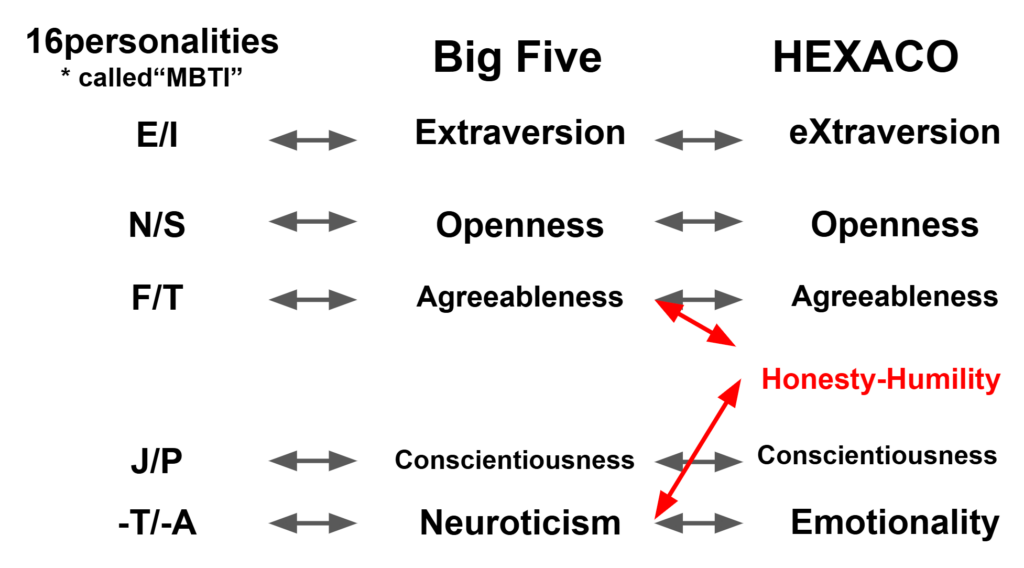
Also, in 16personalities, which was created with reference to MBTI and Big Five, neuroticism from Big Five is called “Identity“, and is classified as either Assertive or Turbulent.
On the far right is the relatively new personality assessment “HEXACO“. It is an improved version of Big Five with one additional indicator “Honesty-Humility”. Research on bullying and harassment perpetrators is active in HEXACO studies.
Since 16personalities and MBTI have weak scientific evidence, this article provides detailed explanations of 16personalities personality types based on their correlations with Big Five and HEXACO.
ENFP Emotional Expression in Relationships: Strengths and Blind Spots
ENFP emotional expression in relationships is one of their greatest assets — and, when unmanaged, one of their greatest vulnerabilities. ENFPs feel deeply and communicate that depth freely. In a healthy relationship, this creates an atmosphere of psychological safety where both partners feel free to be authentic. Partners of ENFPs often report feeling unusually “seen” and understood, which is a powerful foundation for intimacy.
However, the same emotional intensity can tip into patterns that strain relationships. Research on emotional regulation suggests that individuals who experience emotions very intensely — a profile that fits many ENFPs — benefit significantly from learning to pause before reacting in conflict situations. Without this pause, small misunderstandings can escalate quickly, leaving partners feeling overwhelmed or walking on eggshells.
There are approximately 3 emotional blind spots ENFPs should be especially aware of:
- Excitement fading after the honeymoon phase: ENFPs are drawn to novelty. Once initial excitement settles, some ENFPs unconsciously interpret the calmer, deeper phase of love as a sign that something is wrong — when in fact it signals healthy, maturing attachment.
- Overcommitting emotionally: ENFPs can pour so much energy into a partner’s needs that they neglect their own emotional replenishment, leading to eventual burnout or resentment.
- Difficulty with conflict resolution: ENFPs typically dislike confrontation. They may avoid necessary difficult conversations, which causes small tensions to accumulate rather than be resolved.
Recognizing these blind spots is the first step to managing them. The goal is not to suppress ENFP emotional expressiveness — which would rob the relationship of one of its most beautiful qualities — but to channel it with a little more intentionality.
ENFP Ideal Partner Traits: Who Brings Out the Best in an ENFP?
While ENFPs can form meaningful connections with many personality types, certain ENFP ideal partner traits emerge consistently across relationship research and community observations. The ideal partner for an ENFP is not necessarily someone identical to them — in fact, opposites can complement beautifully — but someone who balances their strengths while sharing their core values.
Based on personality compatibility frameworks and the Big Five research, ENFPs tend to thrive with partners who offer the following qualities:
- Emotional security and stability: A partner with strong emotional regulation helps anchor an ENFP during their own emotional swings, creating a safe base from which the ENFP can explore and grow.
- Intellectual curiosity: ENFPs are idea-lovers. A partner who engages with big questions, enjoys stimulating conversation, and approaches the world with curiosity will keep an ENFP deeply engaged over the long term.
- Respect for independence: ENFPs need space to pursue their interests, maintain friendships, and recharge their creative energy. A partner who trusts this need — rather than interpreting it as lack of commitment — allows the ENFP to return to the relationship with full enthusiasm.
- Gentle groundedness: A partner who brings some structure and follow-through to the relationship can complement the ENFP’s more spontaneous nature, creating a balanced dynamic where both partners’ needs are met.
- Authentic warmth: ENFPs are highly attuned to authenticity. They are drawn to partners who express genuine emotion rather than performing what they think they “should” feel.
In terms of MBTI romantic compatibility, ENFPs are often cited as pairing especially well with INTJ and INFJ types — personalities that offer depth, vision, and a complementary structure — though any combination can work beautifully with mutual respect and communication.
ENFP Relationship Strengths: Actionable Advice for a Lasting Love
Knowing your ENFP relationship strengths is only valuable if you put them to work. Below are 4 evidence-informed strategies specifically tailored to ENFPs who want to build a relationship that is not just exciting at the start, but genuinely fulfilling over years and decades.
1. Schedule Novelty Intentionally
Why it works: Research on relationship maintenance consistently shows that couples who regularly engage in novel, exciting activities together report higher long-term satisfaction — a phenomenon sometimes called the “self-expansion model” of love. For ENFPs, this aligns perfectly with their natural wiring.
How to practice it: Rather than waiting for spontaneity to strike, block out one “adventure date” per month. Even something as simple as exploring a new neighborhood counts. Planning it removes the pressure of constant improvisation while keeping the relationship feeling alive.
2. Build Small Consistency Habits
Why it works: As the Malouff et al. research indicates, conscientiousness — the ability to follow through reliably — is one of the top predictors of relationship satisfaction. ENFPs do not need to overhaul their personality; they just need a few reliable anchors.
How to practice it: Choose 2 or 3 small, repeatable gestures — a good-morning text, a weekly check-in conversation, remembering to follow up on something your partner mentioned. Consistency in small things signals deep commitment.
3. Name the Transition from Infatuation to Deep Love
Why it works: Relationship psychology distinguishes between passionate love (intense, early-stage) and companionate love (warm, stable, long-term). Both are real and valuable. ENFPs who understand this distinction are far less likely to misread the natural evolution of their relationship as a problem to fix.
How to practice it: When the initial rush settles, have an honest conversation with your partner about what “mature love” means to both of you. Reframe depth and comfort as an achievement, not a loss.
4. Practice the Pause Before Conflict Conversations
Why it works: Emotional regulation research suggests that even a brief pause — as short as 20 minutes — before addressing a conflict reduces reactivity and increases the likelihood of a constructive outcome.
How to practice it: When you feel emotionally flooded during a disagreement, give yourself permission to say: “I care about this and I want to talk it through — can we revisit it in 20 minutes?” This protects both partners and models emotional maturity.

FAQ and Important Notes
HEXACO results differ from 16personalities (commonly known as MBTI test) or MBTI (original)
- Personality is influenced by genetics and environment, so when the environment changes, responses also change (for example, emotional responses change when you’re tired, etc.). For more details on genetics, see here.
- There are variations in responses depending on age. For more details, see here.
- Type classification is based on whether each value is 3 or above, or below 3, so values close to 3 are more likely to change results depending on how questions are asked or the environment at the time. Please look at the numerical values rather than the type.
- For MBTI (original) and 16personalities (commonly known as MBTI test), it’s unclear how much statistical processing was done at the question design stage as no research papers can be found. On the other hand, papers on Big Five and HEXACO can be easily found, and this HEXACO-JP test is based on research papers.
- While there aren’t many research papers comparing MBTI and 16personalities with everyday behaviors (academic performance, income, etc.) or with the brain and genetics, there are numerous studies on Big Five and HEXACO.
- HEXACO is a variation of Big Five elements, so they are similar but distinct. HEXACO’s Honesty-Humility is extracted from Big Five’s Agreeableness and Neuroticism.
If you have any other questions, please contact us through our inquiry form.
Personality test results are merely “hints” for your life
As mentioned earlier, personality is influenced by genetics and environment. Due to genetic influence, there is a certain range of variation, but answers can vary to some extent depending on the environment.
Also, while Big Five and HEXACO research papers conduct correlation analyses with academic performance and income, the correlation coefficients are not as large as those in natural science experiments. Correlation coefficients range from -1 to 1, but most are around -0.4 to 0.4. Of course, there are higher ones too, but they’re not 0.8 or 0.9 – they’re relatively lower in comparison.
However, since there is various research available, please think of it as “more than fortune-telling, less than natural science.” I’m not 100% denying psychology or fortune-telling.

Writer & Supervisor: Eisuke Tokiwa
Personality Psychology Researcher / CEO, SUNBLAZE Inc.
As a child he experienced poverty, domestic abuse, bullying, truancy and dropping out of school — first-hand exposure to a range of social problems. He spent 10 years researching these issues and published Encyclopedia of Villains through Jiyukokuminsha. Since then he has independently researched the determinants of social problems and antisocial behavior (work, education, health, personality, genetics, region, etc.) and has published 2 peer-reviewed journal articles (Frontiers in Psychology, IEEE Access). His goal is to predict the occurrence of social problems. Spiky profile (WAIS-IV).
Expertise: Personality Psychology / Big Five / HEXACO / MBTI / Prediction of Social Problems
Researcher profiles: ORCID / Google Scholar / ResearchGate
Social & Books: X (@etokiwa999) / note / Amazon Author Page
Frequently Asked Questions
What are the main ENFP love personality traits in a relationship?
ENFPs tend to express love openly and enthusiastically, often through affirmations, spontaneous gestures, and deep conversation. They are naturally empathetic, quick to notice what their partner needs emotionally, and strongly motivated to create shared joy. The main challenge is that their emotional intensity and love of novelty can make the quieter, more stable phases of a long-term relationship feel less exciting — which requires conscious reframing rather than avoidance.
Who is the ideal romantic partner for an ENFP?
ENFPs tend to thrive with partners who offer emotional stability, intellectual engagement, and respect for personal freedom. In MBTI terms, INTJ and INFJ types are frequently cited as strong matches because they provide depth and complementary structure. However, compatibility ultimately depends less on type labels and more on whether both partners share core values and communicate openly. Any type can be an ideal partner for an ENFP with mutual understanding and effort.
Do ENFPs fall in love quickly?
ENFPs tend to form emotional connections rapidly and can feel intensely drawn to someone very early in a relationship. This reflects their high openness and emotional sensitivity rather than impulsiveness. However, research on attachment styles suggests that the speed of falling in love does not reliably predict long-term satisfaction. ENFPs benefit from allowing attraction to deepen naturally over time rather than treating the early rush of feelings as the only valid form of love.
What are the biggest relationship challenges for ENFPs?
The 3 most commonly reported challenges for ENFPs in relationships are: (1) difficulty maintaining excitement once the honeymoon phase ends, (2) a tendency to avoid conflict rather than address it directly, and (3) inconsistency in follow-through on commitments. Importantly, these are tendencies, not fixed traits — ENFPs who develop even moderate skills in emotional regulation and reliability report significantly higher relationship satisfaction according to personality and relationship research.
How does ENFP emotional expression differ from other MBTI types in love?
Compared to Thinking types (T) or Judging types (J), ENFPs are generally far more verbally and physically expressive with affection. They are also more likely to prioritize emotional connection over practical considerations when evaluating a relationship. Compared to INFPs — who share the same core values but are more introverted — ENFPs tend to express their feelings outwardly and seek shared social experiences, rather than processing love primarily in an internal, reflective way.
Is it true that ENFPs get bored in long-term relationships?
This is a common concern, and there is some basis to it — ENFPs’ high openness and need for stimulation means that purely routine relationships can feel stifling. However, research indicates that long-term relationship satisfaction for ENFPs is strongly predicted by the depth of emotional intimacy and the presence of ongoing growth, rather than constant novelty. ENFPs who invest in building genuine depth with a partner typically report that long-term love becomes more, not less, fulfilling over time.
How can ENFPs improve their long-term romantic relationships?
The most effective strategies for ENFPs in long-term relationships include: intentionally scheduling novel shared experiences, building 2 to 3 small but consistent daily or weekly rituals, learning to distinguish the healthy evolution of passionate love into companionate love, and practicing a brief emotional pause before conflict discussions. These approaches are grounded in relationship psychology and directly address the specific areas where ENFPs tend to face their greatest challenges.
Summary: Embracing Your ENFP Love Personality Traits
ENFPs bring something rare and genuinely beautiful to romantic relationships: the ability to make a partner feel truly known, celebrated, and inspired. Their ENFP love personality traits — emotional openness, enthusiastic affection, and a deep belief in the potential of the people they love — are grounded in real psychological strengths backed by personality research. The path to a lasting, deeply satisfying relationship for ENFPs is not about suppressing what makes them wonderful. It is about complementing that warmth with just enough consistency and emotional self-awareness to let the relationship deepen over time. If today’s article helped you understand yourself or a loved one a little more clearly, your next step is waiting: explore which specific MBTI love patterns apply to your relationship style, and use that self-knowledge to love more intentionally.