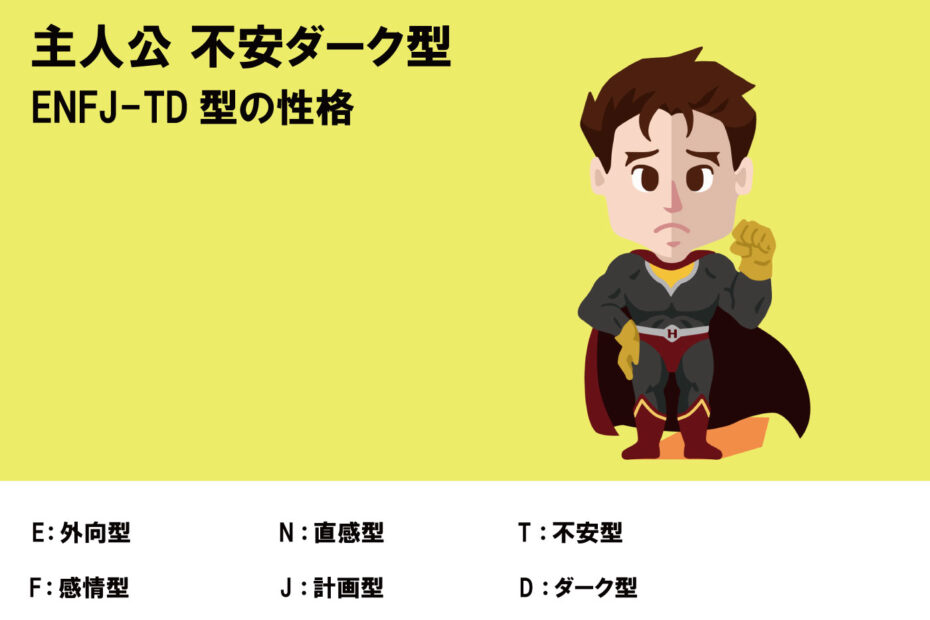
Do you have experience wanting to lead the people around you while at the same time feeling anxious wondering “Do I really have leadership qualities?”
If so, you might be ENFJ-TD.
ENFJ-TDs are people who have a natural talent for guiding others while harboring anxiety deep in their hearts.
For example, after proposing a brilliant idea in a team meeting, you can’t sleep because you’re wondering “What does everyone think?”
You might relate to such experiences.
Even though you appear confident to others, internally you constantly doubt your own judgment.
That’s the characteristic of ENFJ-TD.
In this article, we’ll help you understand your complex and sensitive inner nature and share ways to leverage those traits.
You’ll surely find parts where you think “This is about me.”
Once again, personality researcher and author of Villain Encyclopedia, Tokiwa (@etokiwa999), will provide the explanation.
※We have developed the HEXACO-JP Personality Assessment! It has more scientific basis than MBTI. Tap below for details.

目次
- 1 Overview of HEXACO
- 2 Characteristics of ENFJ-TD
- 3 Strengths and Weaknesses of ENFJ-TD
- 4 ENFJ-TD Romantic Relationship Tendencies and Improvement Strategies
- 5 ENFJ-TD Friendship Tendencies and Improvement Strategies
- 6 ENFJ-TD Parenting Tendencies and Improvement Strategies
- 7 ENFJ-TD Career Tendencies and Improvement Strategies
- 8 ENFJ-TD Work Tendencies and Improvement Strategies
- 9 Compatible Types for ENFJ-TD
- 10 ENFJ-TD Summary
- 11 FAQや注意点
- 12 補足
Overview of HEXACO
What is HEXACO
A new model that can help you understand your personality more deeply is “HEXACO.”
This model analyzes human personality through 6 elements.
It reveals aspects that weren’t visible with conventional personality analysis.
The 6 letters H・E・X・A・C・O each represent different personality traits.
The 6 elements are as follows:
- H: Honesty-Humility
- E: Emotionality
- X: eXtraversion
- A: Agreeableness
- C: Conscientiousness
- O: Openness
The wonderful thing about this model is that it can carefully analyze your complex personality.
Rather than simple classification, it allows understanding of the profound aspects of human nature.
Particularly, the addition of the new perspective of “Honesty-Humility” has enabled more precise analysis.
You’ll see a clearer overall picture of who you are as a person.
64 Classifications by HEXACO
By dividing each of the 6 elements into high and low, you can classify personalities into as many as 64 types. It’s a system that can capture even the subtle differences in your personality.
- H: Honesty-Humility
- High → Light (L: Light)
- Low → Dark (D: Dark)
- E: Emotionality
- High → Turbulent Type (T: Turbulence)
- Low → Assertive Type (A: Assertiveness)
- X: eXtraversion
- High → Extrovert Type (E: Extrovert)
- Low → Introvert Type (I: Introvert)
- A: Agreeableness
- High → Feeling Type (F: Feeling)
- Low → Thinking Type (T: Thinking)
- C: Conscientiousness
- High → (J: Judging)
- Low → (P: Prospecting)
- O: Openness
- High → Intuitive Type (N: iNtuitive)
- Low → Sensing Type (S: Sensor)
By combining these, even the subtle differences in your personality can be expressed. Now, let’s see what characteristics you have if you’re ENFJ-TD!
What is ENFJ-T (Protagonist・Turbulent Type)?
Perhaps you’ve had this kind of experience?
When chosen as a team leader, along with feelings of joy, anxiety rushes over you thinking “Am I really okay for this?”
That’s the characteristic of ENFJ-T.
- Strong sense of social responsibility and idealism
- Sensitivity to others’ expectations
- High empathy and insight
- Anxiety about leadership
- Continuous desire for self-improvement
You likely feel a deep sense of mission in guiding people.
But at the same time, you often have doubts about your judgment and abilities.
This is not a weakness, but rather a manifestation of your caution and sense of responsibility.
In relationships, you value deep connections with others above all else.
However, you react more sensitively than most to criticism or disappointed expressions from others.
This very sensitivity is also an element that makes you an excellent leader.
Characteristics of ENFJ-TD
Characteristic ①: “Passionate Leadership”
You have a mysterious power to move people’s hearts.
Imagine a presentation scenario.
When you begin to speak, the listeners’ expressions change, and they lean forward to listen intently.
Do you remember such scenes?
This is your natural leadership.
However, after the presentation ends, you may become anxious thinking “Should I have explained that part in more detail?”
This very anxiety becomes the driving force that pushes you to even greater heights.
Your leadership has the following characteristics:
- Guidance utilizing empathy
- Clear vision presentation
- Emphasis on teamwork
However, your passion for achieving goals is sometimes so strong that you may not be particular about methods.
You tend to think “if the results are good, the process doesn’t matter,” but this can create problems later on.
In other words, you are a passionate leader, but controlling that passion is the key to your growth.
Characteristic ②: “Empathy and Support for Others”
You detect changes in people’s hearts like a radar.
Even when a friend says they’re “fine,” you notice from their expression and tone of voice that “they’re actually feeling down.”
Haven’t you had countless such experiences?
This sensitivity is your great strength.
However, after devoting yourself to someone, you may become anxious thinking “Was I being meddlesome?” or “Maybe I did something unnecessary.”
This self-critical aspect is also characteristic of you.
Your empathy and support have the following characteristics:
- Active listening
- Providing appropriate advice
- Implementing practical support
However, under the pretext of helping others, you sometimes actually try to have your own way.
Your strong desire of “I want this person to become like this” sometimes leads to excessive intervention in others’ lives.
Ultimately, your deep empathy is a wonderful talent, but respecting others’ autonomy is also important.
Characteristic ③: “Ethical Conflict and Anxiety”
In your heart, ideals and reality are constantly at war.
For example, suppose there’s a problem that could be easily solved by using slightly dishonest methods to improve your team’s performance.
In such times, doesn’t the part of you that thinks “it can’t be helped if it’s for everyone” clash with the part that thinks “this isn’t right”?
This inner conflict may keep you worrying until late at night.
Repeatedly questioning yourself “Was this really the right thing to do?” is also characteristic of you.
Examples of conflicts and anxieties you face:
- Anguish over the gap between ideals and reality
- Excessive caution when making decisions
- Fear of not being able to meet others’ expectations
This conflict certainly becomes a source of stress, but it’s also an important element that makes you grow.
Your attitude of trying to do your best when there are no perfect answers is precisely your value.
In essence, while you struggle between ideals and reality, you gain human depth through that very conflict.
Strengths and Weaknesses of ENFJ-TD
Strengths of ENFJ-TD
Your words have a special power to move people’s hearts.
When team morale is down, just one word from you can change the atmosphere.
You’ve probably experienced such moments.
This isn’t mere coincidence, but a natural talent you possess.
Also, precisely because you tend to feel anxious, you can notice subtle changes in others.
This sensitivity may sometimes feel like a burden, but it’s actually a great strength.
Your main strengths are as follows:
- Excellent leadership that guides people
- Deep empathy and insight
- Strong will toward achieving goals
Furthermore, you excel at generating creative ideas that aren’t bound by existing frameworks.
You have the flexibility to think “normally we’d do it this way, but there must be a better method.”
This creativity often becomes the key to breaking through difficult situations.
In other words, you are a valuable existence that inspires people and opens up new possibilities.
Weaknesses of ENFJ-TD
You tend to become your own harshest critic.
Even when you achieve excellent results, you blame yourself thinking “it’s still not enough” or “I could have done better.”
Does this sound familiar to you?
This perfectionism can sometimes exhaust you.
Also, you tend to think that “some unreasonableness is inevitable for good results.”
While this mindset might bring short-term success, it risks damaging trust relationships in the long run.
The weaknesses you should be mindful of include:
- Being overly influenced by others’ opinions
- Self-depletion due to perfectionism
- Tendency to justify means by the ends
Furthermore, you tend to put your own emotions aside and devote yourself too much to others.
You often think “as long as everyone is happy, my own situation doesn’t matter,” but this can lead to burnout.
Taking care of yourself is also a responsibility toward those around you.
In conclusion, while your passion is wonderful, the challenge is to utilize it in a balanced way.
ENFJ-TD Romantic Relationship Tendencies and Improvement Strategies
ENFJ-TD Romance Tendencies
Your romance is like an architectural project where you design your partner’s life together.
When you hear about your partner’s dreams and goals, you seriously think about “how to make them achievable.”
Don’t you tend to choose places and experiences for dates that help your partner grow?
This devoted affection gives your partner a deep sense of security.
However, you probably worry “Did I say something wrong?” just because a message reply is delayed.
This sensitivity is also an expression of your loving nature.
Your characteristics in romance are as follows:
- Actively supporting your partner’s growth
- Pursuing ideal relationships
- Seeking deep bonds
However, while thinking “it’s for their sake,” you sometimes try to make your partner conform to your ideals.
While this comes from love, it can sometimes feel suffocating to your partner.
In other words, your romance is passionate and deep, but harmony with your partner’s autonomy is key.
When Problems Arise in Romance and Improvement Strategies
In romance, you tend to prioritize your partner over yourself too much.
When your partner is busy, you cancel all your plans to support them.
You even change your hobbies to match your partner’s preferences.
Have you had such experiences?
While this devoted attitude is beautiful, it also risks losing yourself.
Also, you might overanalyze your partner’s casual words or attitudes and worry alone.
You end up thinking late into the night, “Was there some dissatisfaction in the way they said that?”
You must sometimes get tired of such thoughts.
Improvement strategies for romance include:
- Balancing self-assertion
- Honestly expressing anxious feelings
- Respecting your partner’s autonomy
What’s particularly important is “not trying to change your partner.”
While your affection is wonderful, accepting your partner as they are is also a form of love.
Healthy relationships are born from places where both can be themselves.
In essence, it’s important to cherish the boundaries between yourself and your partner while maintaining your characteristic loving nature.
ENFJ-TD Friendship Tendencies and Improvement Strategies
Friendship Tendencies
Don’t people who want to discuss their problems somehow always gather around you?
When you’re talking with friends at a cafe, it somehow becomes a life consultation session.
Isn’t this an everyday occurrence for you?
This is thanks to your special capacity for acceptance and insight.
When friends are feeling down, you don’t just comfort them but think through concrete solutions together.
But you might also feel anxious afterward wondering “Was I being too meddlesome?”
This very worry speaks to the depth of your thoughtfulness.
Your characteristics in friendships are as follows:
- Actively deepening interactions
- Wholeheartedly supporting friends’ growth
- Emphasizing group harmony
However, when friends succeed, you might inwardly think “that’s thanks to my advice.”
This isn’t a bad thing, but it can sometimes create subtle power dynamics in friendships.
In other words, while you are a dependable person for your friends, maintaining equal relationships is a challenge.
When Friendships Become Problematic and Improvement Strategies
Because you care so much about your friends, you tend to give advice saying “you should do it this way.”
When a friend is about to make a wrong choice, you can’t stay silent.
You explain in detail with good intentions, but have you ever experienced a reaction from the other person saying “you didn’t need to go that far?”
In these moments, you are deeply hurt and blame yourself thinking “I said something unnecessary again.”
Also, you sometimes get exhausted from observing your friends’ reactions too closely.
“Were they cold today?” “Did I say something that bothered them?” You end up worrying alone.
This sensitivity sometimes becomes a burden for you.
Improvement strategies for friendships are as follows:
- Respect the other person’s boundaries
- Manage your own anxiety appropriately
- Prioritize listening over giving advice
What’s especially important is seeing friends not as “people who need help” but as “equal partners.”
When the other person is troubled, try asking “do you want someone to listen, or do you want advice?” before offering solutions.
This small consideration should greatly change the quality of your relationships.
In essence, while keeping your kindness intact, you can build deeper friendships by respecting the other person’s pace and choices.
ENFJ-TD Parenting Tendencies and Improvement Strategies
Parenting Tendencies
You are a parent who sensitively notices even small changes in your child.
You can somehow tell what happened today from your child’s expression when they come home from school.
Have you experienced this?
This intuitive ability becomes a great strength in parenting.
When your child tries to challenge something new, you will support them more enthusiastically than anyone else.
However, when things don’t go well, you think so hard about “how to make it work” that you sometimes rob your child of their own trial and error.
This excess due to deep affection is common.
Your parenting characteristics are as follows:
- Respect your child’s individuality
- Are passionate about education
- Value family bonds
However, your feeling of “for this child’s sake” is sometimes so strong that you prioritize your own judgment over your child’s will.
This is behavior that comes from love, but it may also hinder your child’s independence.
In other words, while you are a loving parent, fostering your child’s autonomy is an important challenge.
When Parenting Becomes Problematic and Improvement Strategies
Because you worry so much about your child’s future, you tend to get ahead of them too much.
When your child fights with friends, you want to immediately teach them how to resolve it.
When they’re stuck on homework, you give too many hints and end up solving it yourself.
Do any of these sound familiar?
These are common patterns that occur precisely because your feelings for your child are so strong.
Also, from the pressure of “having to be a good parent,” you sometimes demand too much perfection.
You compare with other children and worry “Is my child okay?” or doubt your own parenting methods.
This tendency to worry sometimes corners you.
Improvement strategies in parenting are as follows:
- Respect your child’s autonomy
- View failure as part of learning and watch over them
- Don’t aim to be a perfect parent
What’s especially important is having the attitude of “thinking together” rather than “immediately giving answers” when your child is in trouble.
Try asking questions like “What do you think you should do?” or “I would think this way, but what about you?”
This can foster your child’s own ability to think.
In essence, while your love remains unchanged, it’s important to create an environment where your child can grow on their own.
ENFJ-TD Career Tendencies and Improvement Strategies
Career Tendencies
Aren’t you known as someone who is “easy to consult” at work?
During lunch break, colleagues come to your desk one after another to start consulting about work troubles and interpersonal relationships.
Before you know it, break time is over – this probably happens often.
This is a manifestation of your natural human strength.
When chosen as a project leader, you accept the role thinking about the entire team, even while feeling anxious wondering “Am I really the right person for this?”
Then you seriously think about how to utilize each member’s strengths.
This strong sense of responsibility is your great charm.
The characteristics of your career are as follows:
- Demonstrate leadership
- Support people’s growth
- Engage in creative problem-solving
However, you sometimes skip formal procedures by focusing too much on producing results.
While you tend to think “some rule-breaking is inevitable if we prioritize efficiency,” this can become a problem later.
In other words, while you excel at the power to move people, harmonizing with organizational rules is also an important challenge.
When Problems Arise in Career and Improvement Strategies
You tend to lose sight of your own limits by dedicating yourself too much to others.
When colleagues ask “Please handle this matter too,” you can’t refuse.
For the growth of your subordinates, you end up helping with work they should be doing themselves.
Haven’t you had such experiences?
You tend to end up in situations where you’re working overtime until late at night every day.
Also, even after a successful presentation, you can’t help but worry “Could I have explained that part better?”
Even when people around you say “It was perfect,” you can’t convince yourself.
This perfectionism sometimes causes you suffering.
Career improvement strategies are as follows:
- Improve self-management abilities
- Properly evaluate your own achievements
- Respect organizational rules
What’s particularly important is having the courage to say “NO.”
Taking on everything is not responsibility.
By understanding your own capacity and focusing on truly important work, you can produce greater results.
In essence, it’s important to aim for sustainable career development while maintaining your characteristic dedicated attitude.
ENFJ-TD Work Tendencies and Improvement Strategies
Work Tendencies
You are like a natural catalyst that improves the workplace atmosphere.
When team motivation is down, the atmosphere changes just by you cheerfully speaking up.
When newcomers are in trouble, you naturally extend a helping hand.
You probably remember such scenes.
This human strength is your greatest weapon.
When advancing projects, you value not just data and numbers, but the feelings of the people involved.
You worry “Won’t the people on site be troubled by this change?” or think “How will customers feel?” considering the other party’s position.
This empathy leads to high-quality work.
Your characteristics at work are as follows:
- Unite teams toward common goals
- Sensitively perceive colleagues’ and customers’ needs
- Generate creative ideas
However, you sometimes proceed without obtaining formal approval due to prioritizing speed.
While you tend to think “I’ll report it later” or “If the results are good, there’s no problem,” this can sometimes create friction within the organization.
In other words, while you have the power to advance work through human charm, consideration for procedural aspects is also necessary.
When Problems Arise at Work and Improvement Strategies
Don’t you sometimes find yourself unable to complete tasks because you think “It should be possible to do better”?
While creating materials, even though they’re 95% complete, you feel “there are still missing parts” and continue making corrections late into the night.
Just before the deadline, you think of new ideas and try to incorporate them.
You’ve probably had such experiences.
This perfectionism sometimes hinders efficiency.
Also, when you see team members in trouble, you want to help even if it means putting your own work aside.
Thinking “It would be faster if I did it,” you end up taking on work that should be growth opportunities for subordinates.
This kindness can sometimes delay the growth of the entire team.
Work improvement strategies are as follows:
- Aim for appropriate goal setting
- Consider meeting deadlines as part of quality
- Comply with organizational rules
What’s particularly important is developing the habit of “submitting at 80% completion and improving based on feedback.”
Rather than striving for perfection alone, it’s more effective to collaborate as a team to enhance quality.
Also, by not neglecting procedures and following appropriate processes as an organizational member, you can build long-term trust.
In essence, maintaining your human charm while balancing efficiency and discipline is the key to success.
Compatible Types for ENFJ-TD
Compatible Types: People with N
Don’t you feel a special affinity for people you can discuss future possibilities with?
Sitting in a café with friends, getting excited about topics like “What will the world be like in five years?” or “How will society change when this technology becomes widespread?”
Those moments might be the most fulfilling for you.
Intuitive types (N) naturally understand this aspect of you.
Especially with INFJs and INTJs, you’ll often feel a deep spiritual connection.
They respond seriously to your ideas with “That’s an interesting perspective.”
You get resonance at an essential level, not just superficial conversation.
Reasons for good compatibility with N types:
- Can share abstract concepts
- Can stimulate each other’s creativity
- Can envision long-term visions together
However, you need to be careful not to end up with just idealistic theories.
To realize wonderful ideas, realistic action plans are also important.
While stimulating each other, it’s crucial to build grounded relationships.
In other words, while you can understand each other deeply with N types, it’s important to nurture relationships without forgetting balance.
Compatible Types: People with D
When you’re hesitating thinking “I wonder if this is really okay?”, isn’t there someone who encourages you saying “It’s fine, let’s try it”?
Those are the Dark types (D).
Their realistic and action-oriented attitude sometimes becomes your salvation.
When you’re running toward your ideals, they show you feasible paths.
In relationships with ESTJs and ENTJs, you can learn from each other’s leadership styles.
When you think “I want to value people’s feelings,” they give advice like “Efficiency is also important.”
You might initially be confused by the differences in values, but gradually you’ll come to recognize each other’s strengths.
Reasons for good compatibility with D types:
- Can learn realistic perspectives
- Can establish concrete strategies for achieving goals
- Can complement each other’s weaknesses
However, you may clash due to differences in values.
When they act with a “results-focused” approach, you may feel that “the process is also important.”
The key to deepening the relationship is to view such differences as “learning opportunities” and respect each other.
In essence, you can learn practical skills and decisiveness from D types, building valuable relationships that lead to your own growth.
ENFJ-TD Summary
If you felt “This is about me” while reading this article, it’s not a coincidence.
ENFJ-TD is a complex personality type that has wonderful talent for guiding people while harboring inner anxieties.
Your warm heart and insight are definitely healing and encouraging the people around you.
But sometimes you might feel like you’re losing sight of your own worth.
That’s also a characteristic trait of yours.
Let’s review your main characteristics once more:
- Passionate leadership
- Deep empathy and support for others
- Struggle between ideals and reality
These characteristics might sometimes feel like a burden.
But by taking care of yourself and learning appropriate distance, you can live more easily.
Your anxieties and uncertainties, including everything, make up the unique existence that is you.
In conclusion, ENFJ-TD is a special existence that gives light to people, and you yourself deserve to live surrounded by that light.

FAQや注意点
HAXACOの結果と、16personalities(通称MBTI診断)やMBTI(本家)と結果が変わる
- 性格は遺伝と環境の影響を受けるため、環境が変われば回答も変わります(例、疲れてると情動性が変化するなど)。遺伝について詳しくはこちら。
- 年齢次第で回答のブレがあります。詳しくはこちら。
- タイプ分類は各数値が3以上、3未満で行っているため、3に近い値だと、質問の聞き方やその時の環境次第で結果が変わりやすくなります。タイプよりも数値を見てください。
- MBTI(本家)や16personalities(通称MBTI診断)は質問設計の段階でどの程度統計的な処理をしているか論文が見当たらないため不明確です。一方で、ビッグファイブやHEXACOはそういった論文が簡単に見つかりますし、今回のHEXACO-JP診断は論文ベースです。
- MBTIや16personalitiesは普段の行動(学力・年収など)や、脳・遺伝などとの比較した研究論文があまり多くない一方で、ビッグファイブやHEXACOは数多く存在します。
- そもそもHEXACOはビッグファイブの要素の変形なので似て非なるものです。HEXACOの正直・謙虚さは、ビッグファイブの協調性と神経症傾向から抽出されています。下記「補足」参考。
その他にもご質問があれば運営者のトキワ(@etokiwa999)までご連絡ください。
性格診断の結果はあくまで人生の「ヒント」まで
先にも書きましたが、性格は遺伝と環境の影響を受けます。遺伝の影響で、ブレ幅は一定ですが、環境次第である程度答えがブレます。
またビッグファイブやHEXACOの研究論文では学力や年収などと相関分析をしていますが、自然科学の実験ほど大きな相関係数ではありません。相関係数は最小-1、最大1ですが、だいたい-0.4~0.4ほどが多いです。もちろん高いものもあります。0.8や0.9ではなく、それに比べたら低いです。
ただそれでも様々な研究はありますので、「占い以上、自然科学未満」と思ってください。心理学や占いを100%否定しているわけではありません。
補足
16personalities(通称MBTI診断)の概要
16personalities(16タイプ性格診断)は、MBTI(Myers-Briggs Type Indicator)とビッグファイブをベースにして作られています。
厳密には16personalitiesとMBTIは別物なのです。
MBTIは、ユングの心理学的類型論を基に開発された性格診断ツールです。
16personalitiesはMBTIの4つの指標(E外向-I内向、S感覚-N直観、T思考-F感情、J判断-P知覚)を採用しつつ、アイデンティティ(AとT)という指標の追加、独自の質問項目・評価基準を設けています。
この性格診断の良いところとしては、韓国アイドルが広めたり、恋愛マッチングアプリでも使われたりするなど、とても有名で、回答数がとても多いことにあります。それを利用して分析して論文として公開すれば信頼性は高いかもしれません。
ただし、悪いところとしては、科学的な裏付けが弱いところがあります。査読付き論文の数が少ない、統計処理の方法が不明確、性格と学力・収入・脳機能・遺伝的要因などとの関連性について十分な根拠が提示されていない、などが理由です。
MBTI(本家)の概要
MBTIは性格を16タイプに分類する心理学の理論です。
そもそもMBTIとは、マイヤーズ・ブリッグス・タイプ・インジケーター(Myers-Briggs Type Indicator)の略称です。
MBTIでは、以下の4つの指標を組み合わせて性格を16タイプに分類します。
- 外向性(Extraversion)か内向性(Introversion)
- 感覚(Sensing)か直観(iNtuition)
- 思考(Thinking)か感情(Feeling)
- 判断(Judging)か知覚(Perceiving)
つまり、MBTIでは自分の性格傾向を「ISTJ」や「ENFP」などの4文字で表現するのです。
16personalitiesよりは論文は存在しますが、ビッグファイブやHEXACOほど頑健な研究結果が出ているわけではありません。
ビッグファイブの概要
性格心理学において最も有力な特性理論の一つが「ビッグファイブ(Big Five)」です。
ビッグファイブは、開放性、誠実性、外向性、協調性、神経症傾向の5つの特性を測定します。
また、16personalitiesやMBTIはタイプ分類(例、外向的か内向的かのどちらか)を用いるのに対して、ビッグファイブが特性を連続的な数値で評価する(例、外向性3.5)点も大きな違いです。
さらに、古くから研究されており、論文数も多く、学力や所得、脳や遺伝など、他の分野でも多くの研究が行われています。ビッグファイブの方が比較的、科学的な裏付けが強いと言えます。
MBTI・ビッグファイブ・HEXACOの相関関係
MBTIの4指標とビッグファイブの5因子には相関関係があります。
この相関を示した代表的な研究に、「The relationship between the revised NEO-Personality Inventory and the Myers-Briggs Type Indicator」という論文があります。
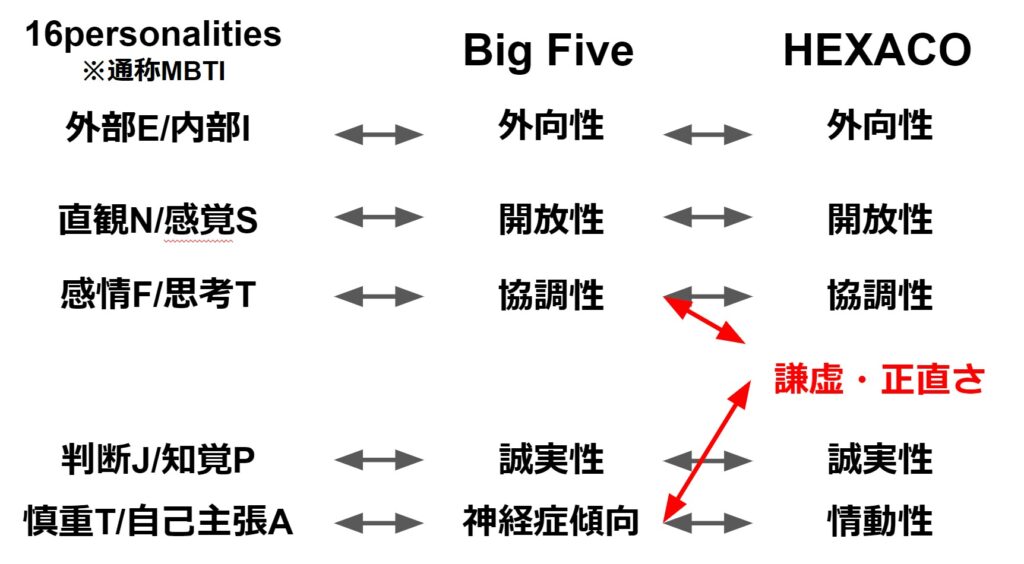
また、MBTI(本家)とビッグファイブを参考にして作られた16personalities(通称MBTI診断)では、ビッグファイブの神経症傾向が「アイデンティティ」と呼ばれており、自信(Assertive)か、慎重(Turbulent)かで分類されています。
これらの関係をまとめたのが以下の図です。
一番右には、比較的新しい性格診断である「HEXACO(ヘキサコ)」があります。ビッグファイブに1つ指標「正直・謙虚さ」を加えて改良され、ダーク特性(倫理観)が分かるようになりました。
今回のHEXACO-JP性格診断では16personalitiesの5文字に加えて、ダークD/ライトLを付けてより詳細に分析できるようにしています。

Writer & Supervisor: Eisuke Tokiwa
Personality Psychology Researcher / CEO, SUNBLAZE Inc.
As a child he experienced poverty, domestic abuse, bullying, truancy and dropping out of school — first-hand exposure to a range of social problems. He spent 10 years researching these issues and published Encyclopedia of Villains through Jiyukokuminsha. Since then he has independently researched the determinants of social problems and antisocial behavior (work, education, health, personality, genetics, region, etc.) and has published 2 peer-reviewed journal articles (Frontiers in Psychology, IEEE Access). His goal is to predict the occurrence of social problems. Spiky profile (WAIS-IV).
Expertise: Personality Psychology / Big Five / HEXACO / MBTI / Prediction of Social Problems
Researcher profiles: ORCID / Google Scholar / ResearchGate
Social & Books: X (@etokiwa999) / note / Amazon Author Page