
Have you ever heard the term HEXACO?
This is a new model that represents human personality through 6 elements. You’ve probably thought about your own personality before.
“What kind of person am I?” “Why do I act this way?” It’s natural to have such questions.
The HEXACO model might provide hints to answer such questions.
This model represents personality through six elements: Honesty-Humility, Emotionality, eXtraversion, Agreeableness, Conscientiousness, and Openness.
By understanding these elements, you can get to know yourself and the people around you more deeply.
By learning HEXACO, you’ll become able to understand the reasons behind your own and others’ behaviors. This helps in building better relationships and contributing to personal growth.
Now, let’s explore the world of HEXACO together!
Once again, personality researcher and author of Villain Encyclopedia, Tokiwa (@etokiwa999), will provide the explanation.
※We have developed the HEXACO-JP Personality Assessment! It has more scientific basis than MBTI. Tap below for details.

The video version of this article is available here!
目次
- 1 HEXACO Overview
- 2 The 6 Elements of HEXACO
- 3 Dark Traits Revealed by HEXACO’s Honesty-Humility
- 4 Various Things That Correlate with HEXACO
- 4.1 Intelligence Level Revealed by HEXACO
- 4.2 Academic Achievement Level Revealed by HEXACO
- 4.3 Work Performance and Income as Revealed by HEXACO
- 4.4 Friend Compatibility as Revealed by HEXACO
- 4.5 Understanding Health Benefits through HEXACO
- 4.6 The Relationship Between HEXACO and Genetics
- 4.7 The Relationship Between HEXACO and Neuroscience
- 5 Utilizing HEXACO Personality Assessment
- 6 Finally
HEXACO Overview
What is HEXACO
“HEXACO” is a relatively new personality model compared to the Big Five.
It represents human personality through 6 elements.
It derives from the 6 letters H・E・X・A・C・O.
Each letter represents a personality trait.
Specifically, it includes the following elements:
- H: Honesty-Humility
- E: Emotionality
- X: eXtraversion
- A: Agreeableness
- C: Conscientiousness
- O: Openness
This model can analyze personality in detail.
It’s superior to the traditional Big Five model.
A new element called Honesty-Humility has been added.
This enables more detailed personality analysis.
HEXACO is gaining attention in the field of psychology.
It’s being utilized in personality research and recruitment.
It helps understand individual behavioral and thinking tendencies.
It can also be applied to improving human relationships.
In essence, HEXACO is a new model that represents personality through 6 elements. It includes the distinctive element of Honesty-Humility and helps understand human personality in greater detail.
History and Background of HEXACO
The HEXACO model was born in the 2000s.
Canadian researchers were central to its development.
They developed the existing Big Five model further.
They sought to understand personality from a new perspective.
The development process was as follows:
- Conducted lexical research in multiple languages
- Discovered elements that couldn’t be explained by conventional models
- Added a new factor called Honesty-Humility
HEXACO’s characteristic is its cross-cultural universality.
The same tendencies were observed across various languages.
This increased the model’s reliability.
Additionally, HEXACO responds to the needs of modern society.
It’s said to be useful for predicting ethical behavior.
It’s also gaining attention in business and educational settings.
The emergence of HEXACO has evolved personality research.
We can now understand finer differences in personality.
It’s expected as a new tool for understanding humans.
In other words, HEXACO is a new personality model developed in the 2000s. Born from multilingual research, it enables more detailed personality analysis by adding the new element of Honesty-Humility.
Differences Between HEXACO and Big Five
HEXACO is an evolved version of the Big Five model.
The biggest difference is the number of elements.
Big Five has 5, HEXACO has 6.
HEXACO adds “Honesty-Humility”.
The main differences are as follows:
- Addition of Honesty-Humility
- Change in the definition of Agreeableness
- Adjustment of the scope of Neuroticism (Emotionality)
Honesty-Humility provides a new perspective. It becomes an indicator for measuring ethical behavior and sincerity.
The definition of Agreeableness has also changed slightly. It refers to a narrower range than in the Big Five.
Emotionality has also been adjusted. It differs slightly from Neuroticism in the Big Five.
Extraversion, conscientiousness, and openness are almost the same as the Big Five.
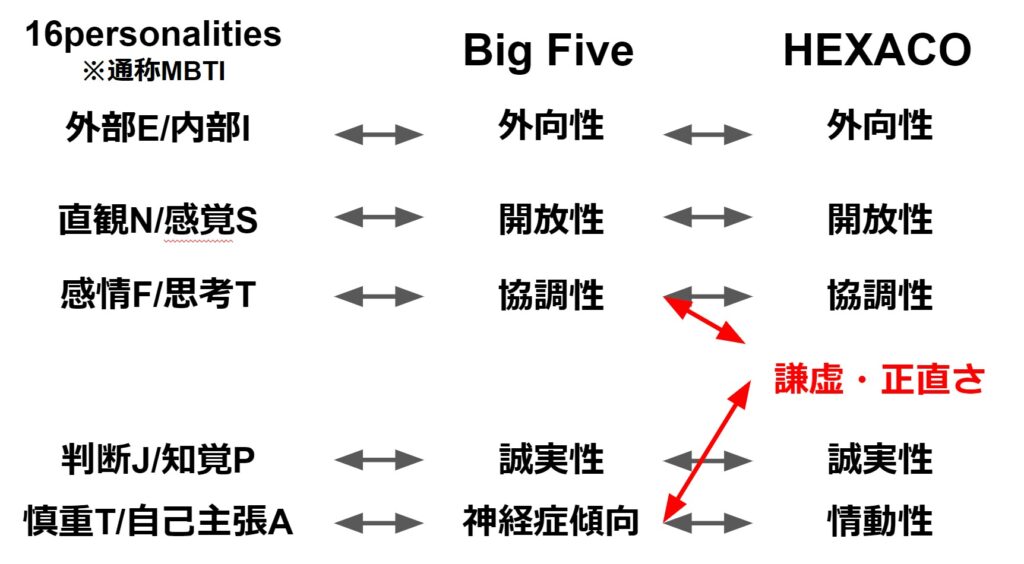
16personalities (commonly known as the MBTI test) is based on the Big Five, and there is a correlation between the Big Five and the original MBTI. The following diagram summarizes this relationship. However, since MBTI lacks strong scientific backing, we recommend the Big Five or HEXACO.
The 6 Elements of HEXACO
Honesty-Humility
Honesty-Humility is a distinctive element of HEXACO.
This element represents a person’s ethics.
People with high scores are sincere and humble.
Conversely, people with low scores are self-centered.
The characteristics of Honesty-Humility are as follows:
- Sincerity
- Fairness
- Modesty
- Lack of materialism
People high in this element don’t lie.
They don’t deceive or exploit others.
They also don’t exaggerate their abilities.
They don’t obsess over money or status.
On the other hand, people who score low tend to act dishonestly.
They try to manipulate others for their own benefit.
They tend to overestimate themselves.
They seek luxurious lifestyles and high status.
Honesty-Humility greatly affects social life.
It can influence the quality of interpersonal relationships.
It also relates to workplace evaluations.
This element doesn’t exist in other personality models.
Therefore, HEXACO has a unique perspective.
It allows for a deeper understanding of human personality.
Conscientiousness
Conscientiousness is a trait that emphasizes responsibility and order.
People with high scores are planned and methodical.
They work enthusiastically on tasks and assignments.
Conversely, people with low scores are laid-back.
The main characteristics of conscientiousness are as follows:
- Self-discipline
- Diligence
- Prudence
- Perfectionism
People high in conscientiousness are punctual.
They make plans and act efficiently.
They pay attention to details and proceed carefully.
They fear failure and make cautious judgments.
On the other hand, people who score low lack planning skills.
They don’t act until deadlines approach.
They don’t worry about details and proceed roughly.
They sometimes make impulsive judgments.
Conscientiousness is related to academic and work performance.
People with higher scores tend to achieve better results.
It’s also associated with healthy lifestyle habits.
However, excessively high conscientiousness also requires attention.
Too much perfectionism can cause stress.
It may also lead to a lack of flexibility.
Emotionality
Emotionality represents emotional richness and intensity of reactions.
People with high scores have rich emotional expression.
They tend to easily feel anxiety and stress.
Conversely, people with low scores are calm and collected.
The main characteristics of emotionality are as follows:
- Anxiety
- Fear
- Dependence
- Emotional vulnerability
People high in emotionality tend to worry.
They easily feel anxious even about small things.
They tend to seek help from others.
They have intense emotional ups and downs and are easily hurt.
On the other hand, people who score low are calm.
They are strong against stress and can respond calmly.
They have strong independence and don’t rely on others.
They rarely become emotional and give a tough impression.
Emotionality is related to mental health.
When too high, it increases the risk of anxiety disorders and depression.
However, moderate emotionality enhances empathy.
Also, emotionality affects interpersonal relationships.
People with high scores value emotional connections.
People with low scores emphasize rational judgment.
However, there are no superior or inferior levels of emotionality.
Depending on the situation, both can become strengths.
It is important to maintain balance.
Extraversion
Extraversion is a trait that represents sociability and activity.
People with high scores enjoy socializing with others.
They are energetic and take action proactively.
Conversely, people with low scores are quiet and introverted.
The main characteristics of extraversion are as follows:
- Sociability
- Liveliness
- Assertiveness
- Optimism
People high in extraversion enjoy talking to others.
They enjoy parties and large gatherings.
They express their opinions clearly.
They have bright and positive personalities.
On the other hand, people low in extraversion value their alone time.
They prefer quiet environments and dislike crowds.
They are modest and avoid standing out.
They tend to be cautious and think deeply about things.
Extraversion also affects career choices.
People high in extraversion are suited for jobs involving interaction with people, such as sales or entertainment.
People low in extraversion excel at jobs requiring concentration, such as research or technical work.
Additionally, extraversion is related to stress coping methods.
People high in extraversion relieve stress by talking to others.
People low in extraversion relax by enjoying hobbies alone.
However, there are no superior or inferior levels of extraversion.
It is important to make use of each person’s strengths.
It would be good to be able to respond flexibly according to the situation.
Agreeableness
Agreeableness is a trait that emphasizes relationships with others.
People with high scores are compassionate.
They prefer to cooperate with others.
Conversely, people with low scores are strongly self-assertive.
The main characteristics of agreeableness are as follows:
- Tolerance
- Flexibility
- Patience
- Empathy
People high in agreeableness consider others’ feelings.
They avoid conflict and prefer peace.
They respect others’ opinions and respond flexibly.
They want to help people in trouble.
On the other hand, people low in agreeableness stick to their own opinions.
They don’t mind conflicting with others.
They tend to prioritize their own interests.
They may be insensitive to others’ emotions.
Agreeableness greatly affects teamwork.
People high in agreeableness are good at group work.
People low in agreeableness are likely to demonstrate leadership.
Additionally, agreeableness is related to the quality of relationships.
People high in agreeableness tend to build lasting friendships.
People low in agreeableness tend to have more short-term relationships.
However, problems also arise when agreeableness is too high.
They cannot express their own opinions and are prone to stress.
Moderate self-assertion is also necessary.
Openness
Openness represents attitudes toward new experiences and ideas.
People with high scores are very curious.
They seek new ideas and experiences.
Conversely, people with low scores prefer familiar things.
The main characteristics of openness are as follows:
- Imagination
- Aesthetic sense
- Intellectual curiosity
- Adventurous spirit
People high in openness are creative.
They are interested in arts and culture.
They want to absorb knowledge from various fields.
They enjoy adventure and stimulating experiences.
On the other hand, people low in openness are realistic. They value traditions and customs. They choose familiar things over new ones. They prefer stable environments.
Openness is related to learning ability. People high in openness are good at absorbing new knowledge. People low in openness are skilled at developing practical abilities.
Additionally, openness affects career choices. People high in openness are suited to be artists or researchers. People low in openness are well-suited for clerical or technical work.
Openness is also related to life satisfaction. People high in openness tend to enjoy various experiences. People low in openness find happiness in stable lives.
However, there are no superior or inferior levels of openness. It is important to make use of each person’s strengths. It would be good to be able to respond flexibly according to the situation.
Dark Traits Revealed by HEXACO’s Honesty-Humility
What is the “Dark Triad” Revealed by HEXACO?
The Dark Triad consists of personality traits that lead to problematic behavior. It has a deep relationship with HEXACO’s honesty-humility dimension. When honesty-humility is low, the Dark Triad tends to be high. This relationship has gained attention in psychology.
The Dark Triad consists of the following three traits:
- Psychopathy
- Machiavellianism
- Narcissism
Psychopathy represents a lack of empathy. People with this trait cannot understand others’ emotions and exhibit cold behavior. They also have little sense of guilt and antisocial tendencies.
Machiavellianism is the tendency to manipulate others. People use others for their own benefit. They can be described as strategic and cunning.
Narcissism is a state of strong self-love. People overestimate themselves and seek special treatment. They are sensitive to others’ evaluations and vulnerable to criticism.
These traits cause problems in the workplace and human relationships. They can also be a cause of power harassment. They are also said to be related to criminal behavior.
However, having high Dark Triad traits is not necessarily bad. They may sometimes be related to leadership and creativity. What’s important is self-awareness and appropriate control.
Light Triad: The Opposite of Dark Triad
The Light Triad consists of traits that are the polar opposite of the Dark Triad. It has a strong correlation with HEXACO’s honesty-humility. When honesty-humility is high, the Light Triad also tends to be high. This concept has gained attention in positive psychology.
The Light Triad consists of the following three traits:
- Kantianism
- Humanism
- Faith in humanity
Kantianism emphasizes moral behavior. It treats others not as means but as ends. It values ethical judgment.
Humanism respects human value. It values individual dignity and rights. It has a human-centered way of thinking.
Faith in humanity believes in people’s goodness. It trusts others and takes a cooperative attitude. It builds good relationships in society.
These traits help build healthy human relationships. They also lead to cooperation in the workplace and social contribution. They also have a positive impact on mental health.
The Light Triad is a relatively new concept. Further research is expected in the future. It may be the key to increasing individual and social happiness.
Various Things That Correlate with HEXACO
Intelligence Level Revealed by HEXACO
Intelligence and HEXACO are related.
Particularly, openness and emotionality are important. The higher the openness, the higher the intelligence tends to be. Conversely, when emotionality is high, intelligence tends to be lower.
The relationship between HEXACO and intelligence is as follows:
- Openness: Positive correlation
- Emotionality: Negative correlation
- Other traits: Weak correlation or no correlation
People with high openness have strong curiosity. They actively absorb new knowledge. They are also good at abstract thinking. These characteristics lead to high intelligence.
On the other hand, people with high emotionality are prone to anxiety. They are weak to stress and tend to have decreased concentration. This affects intelligence test results.
Other traits are not much related to intelligence. However, conscientiousness is related to academic performance. Diligence leads to good grades.
The relationship between intelligence and personality is complex. Even if there is correlation, it’s not causation. Other factors such as environment and experience are also important.
Also, there are various types of intelligence. HEXACO is mainly related to general intelligence. The relationship with other types of intelligence, such as emotional intelligence, is still being researched.
Academic Achievement Level Revealed by HEXACO
HEXACO traits are also related to academic ability. In particular, conscientiousness, openness, and agreeableness are important. The higher these are, the higher the academic ability tends to be. They influence academic performance and learning ability.
The relationship between HEXACO and academic ability is as follows:
- Conscientiousness: Strong positive correlation
- Openness: Moderate positive correlation
- Agreeableness: Weak positive correlation
- Other traits: Weak correlation or no correlation
People with high conscientiousness study in a planned manner. They meet deadlines and complete assignments properly. They also have high concentration and can endure long hours of studying. These characteristics lead to high academic ability.
People with high openness are interested in new knowledge. They enjoy learning various fields. They also understand abstract concepts easily. This helps in acquiring broad academic abilities.
People with high agreeableness are good at group learning. They also have good relationships with teachers and students. Learning environments are easily established, leading to improved academic performance.
However, academic ability is not determined solely by personality. Effort, environment, and educational methods are also important. Learning methods adapted to individual aptitudes are effective.
Also, the definition of academic ability varies. Not just test scores, but practical skills are also important.
Work Performance and Income as Revealed by HEXACO
HEXACO traits are related to job success. In particular, extraversion, openness, and conscientiousness are important. The higher these are, the higher the income tends to be. They also affect job performance.
The relationship between HEXACO and work is as follows:
- Extraversion: Positive correlation with income
- Openness: Positive correlation with income
- Conscientiousness: Strong positive correlation with job performance
- Honesty-Humility: Negative correlation with power harassment
People with high extraversion can easily expand their networks. They also have high communication skills and are suited for sales. These characteristics lead to high income.
People with high openness are suited for creative work. They generate new ideas and find innovative solutions. This tends to be highly valued in high-income occupations.
People with high conscientiousness complete their work reliably. They have a strong sense of responsibility and meet deadlines. They also have strong trust from supervisors and are likely to be promoted.
On the other hand, people with low honesty-humility are prone to power harassment. This is related to traits called the Dark Triad. It causes deterioration in workplace relationships.
However, job success is not determined solely by personality. Skills, experience, and luck are also important factors. Also, the traits required vary by industry and occupation.
Furthermore, job satisfaction must also be considered. Even with high income, one might be unhappy in work that doesn’t suit their personality. It’s important to understand your own traits and choose suitable occupations.
Friend Compatibility as Revealed by HEXACO
HEXACO traits also influence compatibility with friends. In particular, openness and honesty-humility are important. People with similar traits are more likely to become friends. This is exactly as the saying “birds of a feather flock together” suggests.
The relationship between HEXACO and friend compatibility is as follows:
- Openness: Good compatibility with friends who share common interests
- Honesty-Humility: Good compatibility with friends who can build trust relationships
- Extraversion: Good compatibility with active friends
- Agreeableness: Good compatibility with gentle friends
People with high openness can share new experiences together. They get excited about various topics and can give each other intellectual stimulation. They can build deep friendships through discussions about hobbies and arts.
People with high honesty-humility build honest relationships. They trust each other and can nurture friendships with a sense of security. These tend to become long-lasting friendships.
People with high extraversion have good compatibility with active friends. They go to parties together and enjoy sports. They can build energetic relationships.
People with high agreeableness have good compatibility with gentle friends. They avoid conflicts and build relationships where they care for each other. They can enjoy comfortable friendships.
However, compatibility is not determined solely by personality. Common experiences and values are also important. Also, friends with different personalities can provide new perspectives.
Furthermore, friendships change over time. Relationships also change according to each other’s growth and environmental changes. It’s important to nurture friendships with a flexible attitude.
Understanding Health Benefits through HEXACO
HEXACO traits are also related to health status. Particularly, Extraversion, Honesty-Humility, Agreeableness, and Conscientiousness are important. These traits influence mental health and health behaviors. They are also indirectly related to physical health.
The relationship between HEXACO and health is as follows:
- Extraversion: Strong positive correlation with mental health
- Honesty-Humility: Positive correlation with healthy lifestyle habits
- Agreeableness: Positive correlation with stress coping ability
- Conscientiousness: Strong positive correlation with healthy behavior
- Emotionality: Negative correlation with physical health
People with high extraversion are less likely to develop depression. They have many social connections and experience positive emotions. This leads to good mental health.
People with high conscientiousness maintain healthy lifestyle habits. They engage in regular exercise, health checkups, and balanced eating. This leads to long-term health maintenance.
On the other hand, people with high emotionality are more prone to stress. They experience much anxiety and worry, which can sometimes manifest as physical symptoms. This has a negative impact on physical health.
However, health is not determined by personality alone. Genetics, environment, and lifestyle habits also play major roles. There are also significant individual differences, so generalizations cannot be made.
To live a healthy life, it is important to understand your personality traits and find health management methods that suit them. It is also good to seek professional advice when necessary.
The Relationship Between HEXACO and Genetics
HEXACO traits have genetic influences. This fact has been discovered through twin studies and adoption studies. However, environmental factors cannot be ignored. The interaction between genetics and environment is involved in personality formation.
The relationship between HEXACO and genetics is as follows:
- All traits have some degree of heritability
- The degree of genetic influence varies by trait
- Environmental factors also play important roles
- There are gene-environment interactions
According to research, approximately 40-60% of HEXACO traits are influenced by genetics. This means the remaining 40-60% is due to environmental factors. This proportion varies slightly by trait.
Genetic influences are not only direct. Genes can also influence personality through interactions with the environment. This is called “gene-environment interaction.”
For example, when a person with certain genes is placed in a specific environment, that trait may be expressed more strongly.
However, genetics does not completely determine personality. Even identical twins with the same genes can have different personalities. This shows that individual experiences and choices are important.
Research in the field of epigenetics is also advancing. This studies phenomena where gene expression changes due to environment. New insights may be gained from this field in the future.
The Relationship Between HEXACO and Neuroscience
HEXACO traits are related to brain structure and function. This relationship has been revealed through brain imaging research. Each trait is linked to specific brain regions. This demonstrates the biological foundation of personality.
The relationship between HEXACO and neuroscience is as follows:
- Extraversion: Related to reward system activation
- Emotionality: Related to amygdala reactivity
- Conscientiousness: Related to prefrontal cortex activity
- Openness: Related to default mode network
- Agreeableness: Related to social cognition regions
- Honesty-Humility: Related to moral judgment regions
For example, people with high extraversion have strong reward system activation. They have high reactivity to the neurotransmitter dopamine. This leads to positive emotions and sociability.
However, the relationship between brain and personality is bidirectional. Personality can also influence brain structure and function. For example, there is research showing that meditation habits change brain structure.
Utilizing HEXACO Personality Assessment
If You Want to Change Your Personality
HEXACO traits can be changed to some extent. While it’s difficult to completely change them, gradual improvement is possible. Self-understanding and conscious effort are the keys to change. However, rapid changes are not realistic.
Methods for changing personality are as follows:
- Deepen self-understanding
- Set specific goals
- Create new habits
- Change your environment
- Receive professional support
First, it’s important to accurately understand your own personality. Take the HEXACO test to learn about your traits. Please objectively analyze your strengths and weaknesses.
By changing your environment, your personality may also change. It’s good to start new hobbies or experience different cultures. However, sudden environmental changes may also cause stress.
If it’s difficult, consult with professionals such as psychological counselors. Methods like cognitive behavioral therapy may help with personality improvement.
However, personality change takes time. It’s important to proceed slowly without rushing. Also, aim for change while respecting the core parts of yourself.
How to Take the HEXACO Test and FAQ
We have introduced the HEXACO personality diagnosis so far, but you may have various questions and concerns. Common questions include:
- How long does the HEXACO test take?
- The 60-question version takes about 10 minutes. However, if you want to conduct a deeper self-analysis, you may spend a little more time. You can take it here.
- How can the test results be utilized?
- By comparing the high and low levels of the six factors with various research, we understand individual behavioral patterns and personality tendencies. They can be used as a reference for the workplace, personal relationships, and self-improvement.
- How can I access the test?
- The HEXACO personality diagnosis is mainly provided online, and you can access and take it from designated websites. You can take it here.
- Is the reliability and validity of the test scientifically supported?
- Yes, the HEXACO personality diagnosis was developed based on many scientific studies, and its reliability and validity are internationally recognized. It is at least more valid than 16personalities or MBTI.
- Is an expert needed to interpret the results?
- The results are provided in a form that is easy to understand even for individuals, but if you want deeper analysis or specific applications, it is beneficial to receive support from psychology experts.
- How specific is the feedback based on test results?
- Test results include detailed explanations and personal feedback related to scores for each dimension, showing specific behavioral guidelines and areas for improvement.
If you have any others, please let us know.
Finally
The HEXACO personality diagnosis is a scientific tool for evaluating individual personalities across six different dimensions and gaining a deep understanding of personal behaviors and tendencies.
This test can be useful for various purposes such as improving self-understanding, improving human relationships, and appropriate role placement in the workplace.
It can also be applied in various fields such as education and business, contributing not only to individual growth but also to the growth and efficiency of entire organizations.
However, there are also some limitations such as cultural bias and respondent subjectivity, so it’s necessary to interpret test results while being aware of these factors.
The HEXACO test can maximize its value when used as one means for self-growth and in combination with other assessment tools.
If you continue to be interested in the HEXACO personality diagnosis, please try taking the test here.

Writer & Supervisor: Eisuke Tokiwa
Personality Psychology Researcher / CEO, SUNBLAZE Inc.
As a child he experienced poverty, domestic abuse, bullying, truancy and dropping out of school — first-hand exposure to a range of social problems. He spent 10 years researching these issues and published Encyclopedia of Villains through Jiyukokuminsha. Since then he has independently researched the determinants of social problems and antisocial behavior (work, education, health, personality, genetics, region, etc.) and has published 2 peer-reviewed journal articles (Frontiers in Psychology, IEEE Access). His goal is to predict the occurrence of social problems. Spiky profile (WAIS-IV).
Expertise: Personality Psychology / Big Five / HEXACO / MBTI / Prediction of Social Problems
Researcher profiles: ORCID / Google Scholar / ResearchGate
Social & Books: X (@etokiwa999) / note / Amazon Author Page