
Understanding MBTI compatibility across all 16 types can genuinely transform the way you approach relationships — whether romantic, platonic, or professional. Rather than leaving chemistry to chance, the Myers-Briggs Type Indicator offers a structured lens through which you can anticipate how different personalities tend to interact, communicate, and occasionally clash. This article breaks down compatibility patterns for every one of the 16 MBTI personality types, grounded in psychological research and cognitive function theory, so you can use these insights as a practical starting point — not a final verdict — for building stronger connections.
That said, it is important to approach MBTI compatibility with measured expectations. Research suggests that personality similarity — especially in traits like openness to experience and honesty-humility — tends to predict relationship satisfaction more reliably than any single type-matching formula. MBTI is a useful map, but the territory of real human relationships is always more nuanced. With that balanced perspective in mind, let’s explore what the research and the framework actually tell us.
Once again, personality researcher and author of Villain Encyclopedia, Tokiwa (@etokiwa999), will provide the explanation.
※We have developed the HEXACO-JP Personality Assessment! It has more scientific basis than MBTI. Tap below for details.

目次
- 1 What Is MBTI and How Does It Relate to Compatibility?
- 2 MBTI Compatibility All 16 Types: The Analyst Group (NT Types)
- 3 MBTI Compatibility All 16 Types: The Diplomat Group (NF Types)
- 4 MBTI Personality Type Compatibility: The Sentinel Group (SJ Types)
- 5 MBTI Relationship Compatibility: The Explorer Group (SP Types)
- 6 Actionable Advice: How to Use MBTI Compatibility Insights Effectively
- 7 Frequently Asked Questions
- 7.1 Which MBTI types are most compatible with each other overall?
- 7.2 Is MBTI compatibility scientifically proven?
- 7.3 Can opposite MBTI types be compatible in romantic relationships?
- 7.4 What MBTI types make the best friends?
- 7.5 How does cognitive function theory affect MBTI compatibility?
- 7.6 What is the difference between MBTI and 16Personalities in terms of compatibility?
- 7.7 Should I use MBTI to decide who to date or befriend?
- 8 Summary: What MBTI Compatibility Across All 16 Types Actually Tells Us
What Is MBTI and How Does It Relate to Compatibility?
The 4 Dimensions of MBTI Explained
MBTI classifies personality into 16 types using 4 binary dimensions rooted in Carl Jung’s psychological theory. Each dimension represents a spectrum of how people prefer to direct their energy, process information, make decisions, and organize their lives. The combination of these 4 preferences produces a 4-letter type code — for example, ENFP or ISTJ — that serves as a personality shorthand.
- Extraversion (E) vs. Introversion (I): Where you direct your energy — outward toward people and action, or inward toward thoughts and reflection.
- Intuition (N) vs. Sensing (S): How you gather information — through abstract patterns and possibilities (N), or through concrete facts and direct experience (S).
- Feeling (F) vs. Thinking (T): How you make decisions — guided by values and interpersonal impact (F), or by logic and objective analysis (T).
- Judging (J) vs. Perceiving (P): How you organize your world — with structure and planning (J), or with flexibility and spontaneity (P).
These 4 dimensions combine into 16 distinct profiles. While MBTI is widely popular and genuinely useful for self-reflection, it is worth noting that its scientific foundations are considered weaker than other frameworks like the Big Five or HEXACO. Personality traits also shift over time through personal growth and life experience, so no type label should be treated as fixed or absolute.
What Research Says About MBTI and Relationship Compatibility
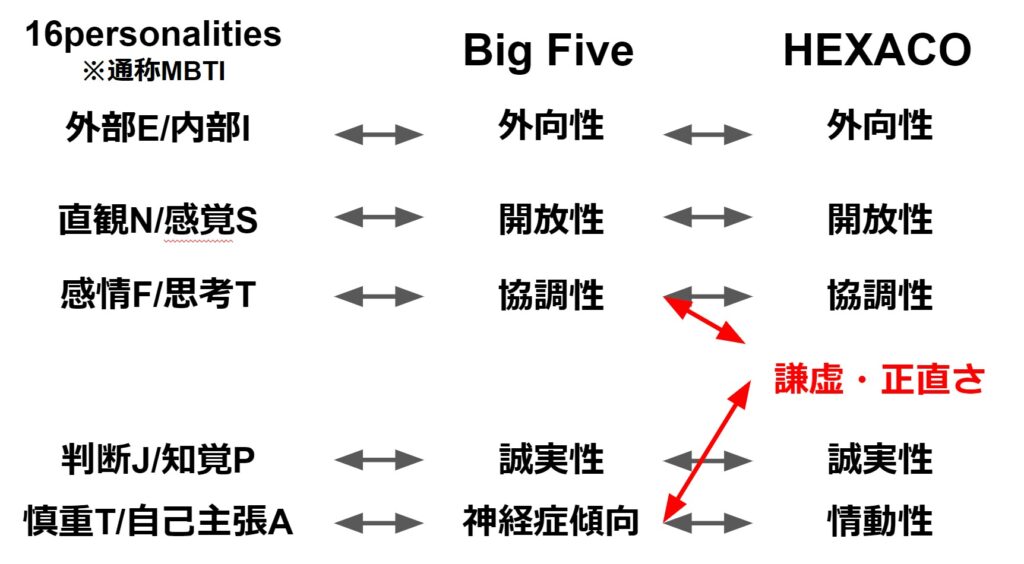
Research using the HEXACO personality model suggests that similarity in openness and honesty-humility tends to predict stronger compatibility between individuals. A study on personality similarity among well-acquainted people found that people who score similarly on these 2 dimensions tend to report higher relationship quality. Since HEXACO’s openness dimension closely mirrors MBTI’s Intuition (N) scale, and HEXACO’s honesty-humility dimension shows overlap with MBTI’s Feeling (F) scale, this gives us a scientifically informed reason to expect that N-N and F-F pairings may tend to harmonize well.
Similarly, research exploring the correlation between the NEO Personality Inventory and the MBTI confirms meaningful overlaps: Extraversion (E) maps strongly onto Big Five Extraversion, Intuition (N) aligns with Openness to Experience, Feeling (F) correlates with Agreeableness, and Judging (J) mirrors Conscientiousness. This table summarizes the key correlations:
| Correlation Table | E | I | N | S | F | T | J | P |
| Extraversion | Strong + | Strong − | + | − | ||||
| Openness | + | − | Strong + | Strong − | − | + | ||
| Agreeableness | + | Strong − | ||||||
| Conscientiousness | − | + | Strong + | Strong − | ||||
| Neuroticism | − | + | − | + | + | − |
The practical takeaway is this: people who share the same N/S preference and the same F/T preference tend to experience smoother communication and deeper mutual understanding. This does not mean that cross-preference relationships are doomed — quite the opposite. Different types can and do form deeply rewarding relationships, but they may need to invest more consciously in understanding each other’s perspective.
MBTI Compatibility All 16 Types: The Analyst Group (NT Types)
The 4 Analyst types — INTJ, INTP, ENTJ, and ENTP — all share the NT (Intuitive-Thinking) combination, and research-informed patterns suggest they tend to form their strongest bonds within this cluster. These types are united by a love of abstract reasoning, intellectual challenge, and logical problem-solving. When 2 NT types connect, conversations tend to feel energizing rather than draining, and disagreements are more likely to be treated as intellectual exercises than emotional confrontations.
INTJ Compatibility: Best Matches and Potential Friction Points
INTJ — known as “The Architect” — tends to be most compatible with types that share the N and T dimensions. INTJs are strategic, independent, and highly analytical. They value competence and long-term vision above almost everything else, which means they thrive with partners who can keep up with complex thinking and respect their need for autonomy.
- INTJ + INTJ: Exceptionally aligned in values, vision, and communication style. The main risk is parallel independence — both may retreat too deeply into their own plans without enough emotional connection.
- INTJ + INTP: Complementary analytical strengths. INTPs bring theoretical creativity that INTJs can channel into executable strategies.
- INTJ + ENTJ: A powerful pairing with shared ambition. ENTJs provide the social momentum that INTJs often prefer to avoid.
- INTJ + ENTP: Stimulating and intellectually rich. ENTPs challenge INTJs with unconventional ideas, pushing growth on both sides.
Types that prioritize Sensing (S) or Feeling (F) — such as ESFJ or ISFP — may find communication with INTJs more effortful, as their approaches to information and decision-making differ significantly. However, these pairings can offer INTJs valuable perspective on emotional intelligence and present-moment awareness, areas where INTJs often benefit from growth.
INTP Compatibility: Best Matches and Growth Opportunities
INTP — “The Logician” — tends to mesh best with types that share a preference for abstract thinking (N) and logical reasoning (T). INTPs are drawn to ideas over social rituals, which means they often feel most at ease with partners who value intellectual honesty and don’t require constant emotional reassurance.
- INTP + INTP: A meeting of minds that can be deeply fulfilling, though both may struggle to initiate emotional vulnerability.
- INTP + INTJ: INTJs provide the decisiveness and structure that INTPs sometimes lack, while INTPs offer fresh theoretical angles.
- INTP + ENTP: High creative synergy. ENTPs energize INTPs socially while sharing the same love of idea exploration.
- INTP + ENTJ: ENTJs push INTPs to act on their ideas rather than endlessly refining them — a productive tension.
Relationships with SF types can challenge INTPs to develop empathy and practical grounding. While these pairings require more intentional effort, they can result in well-rounded personal growth for the INTP.
ENTJ Compatibility: Leadership Dynamics and Best Pairings
ENTJ — “The Commander” — tends to gravitate toward types that match their strategic mindset and tolerance for direct, logic-driven communication. ENTJs are among the most goal-oriented of all 16 types, and they tend to respect partners who can challenge them intellectually rather than defer to their authority.
- ENTJ + ENTJ: Powerful but potentially combative. Both partners need to cultivate mutual respect for each other’s vision.
- ENTJ + INTJ: One of the most productive pairings. INTJs provide depth and caution; ENTJs provide momentum and social reach.
- ENTJ + ENTP: Energetic and expansive. ENTPs bring creativity; ENTJs bring execution — a natural division of strengths.
- ENTJ + INTP: INTPs offer nuanced analysis that helps ENTJs avoid rushing past important details in their drive for results.
ENTJs may sometimes come across as overly directive, particularly with Feeling-dominant types. Interactions with INFP or ISFJ personalities can teach ENTJs the value of emotional attunement and slower, more consensus-driven decision-making.
ENTP Compatibility: Debate, Discovery, and Connection
ENTP — “The Debater” — tends to connect most naturally with types who enjoy intellectual sparring, rapid idea generation, and a flexible approach to life. ENTPs are energized by novelty and tend to find routine stifling, which means they often thrive with partners who match their mental agility.
- ENTP + ENTP: Brilliantly stimulating, though both may struggle to commit to finishing projects or plans.
- ENTP + INTP: INTPs provide the depth and precision that ENTPs sometimes race past in their enthusiasm.
- ENTP + ENTJ: High-energy partnership with strong goal alignment and complementary strengths.
- ENTP + INTJ: ENTJs help ENTPs channel their ideas into concrete outcomes — a relationship that can produce remarkable results.
ENTPs may benefit enormously from relationships with NF types, who can gently redirect ENTP energy toward emotionally meaningful goals rather than pure intellectual exercise.
MBTI Compatibility All 16 Types: The Diplomat Group (NF Types)
The 4 Diplomat types — INFJ, INFP, ENFJ, and ENFP — share the NF (Intuitive-Feeling) combination, and they tend to form their deepest, most emotionally resonant connections within this group. NF types are driven by meaning, values, and a desire to understand the inner lives of others. When 2 NF types connect, conversations quickly move past surface-level pleasantries into territory that feels genuinely meaningful to both people.
INFJ — “The Advocate” — is one of the rarest types, and tends to seek connections defined by depth, authenticity, and shared ideals. INFJs are highly empathic and perceptive, which means they are often drawn to partners who can engage meaningfully rather than superficially.
- INFJ + INFJ: Profound mutual understanding, though both partners may need to ensure they also voice needs rather than silently absorbing each other’s emotions.
- INFJ + ENFJ: ENFJs bring warmth and social confidence that complement INFJ’s more reserved depth.
- INFJ + INFP: Both types value authenticity and meaning, creating a relationship with rich emotional texture.
- INFJ + ENFP: ENFPs inspire INFJs to step outside their inner world more frequently, bringing joy and spontaneity.
Relationships with ST types may feel pragmatically misaligned to INFJs at first, but they can offer grounding in practical reality — an area where idealistic INFJs sometimes benefit from a counterbalance.
INFP Compatibility: Idealism, Creativity, and Emotional Resonance
INFP — “The Mediator” — tends to thrive in relationships built on shared values, emotional honesty, and creative expression. INFPs are among the most idealistic of all 16 types, and they tend to seek partners who see the world through a similarly values-driven lens.
- INFP + INFP: Deeply aligned emotionally and creatively, though both partners may need to actively work on resolving conflict rather than avoiding it.
- INFP + ENFP: ENFPs bring enthusiasm and social energy that help draw INFPs out of their inner world in a gentle, affirming way.
- INFP + INFJ: Both share a deep commitment to meaning and integrity, forming a quietly powerful bond.
- INFP + ENFJ: ENFJs provide the warmth and decisive action that complement INFPs’ reflective, values-based nature.
INFPs who interact with ST types may initially feel misunderstood, but these relationships can teach INFPs valuable skills in setting boundaries and communicating needs clearly and concisely.
ENFJ Compatibility: Charisma, Care, and Meaningful Leadership
ENFJ — “The Protagonist” — tends to connect most strongly with types that share a commitment to human development and emotional depth. ENFJs are natural community builders who are energized by helping others grow, and they tend to seek partners who share that orientation toward meaning and relationship.
- ENFJ + ENFJ: Extraordinarily warm and mutually supportive, though both may need to ensure they prioritize their own needs alongside those of others.
- ENFJ + INFJ: INFJs provide the quiet depth and thoughtful reflection that balance ENFJ’s outward-facing energy beautifully.
- ENFJ + ENFP: Both are enthusiastic, people-focused, and values-driven — a naturally energizing combination.
- ENFJ + INFP: INFPs offer ENFJs a creative, deeply personal perspective that enriches their tendency toward big-picture thinking.
ENFJs may sometimes over-extend themselves to meet others’ expectations. Relationships with more analytically oriented types — such as INTJ or INTP — can help ENFJs develop the habit of checking in with their own internal compass before responding to external demands.
ENFP Compatibility: Curiosity, Connection, and Creative Chemistry
ENFP — “The Campaigner” — tends to form the most natural bonds with types who match their enthusiasm for ideas, people, and possibilities. ENFPs are imaginative, spontaneous, and deeply people-oriented — they light up around partners who can engage both emotionally and intellectually.
- ENFP + ENFP: Explosively creative and fun, though both may need to consciously build in routines and follow-through habits.
- ENFP + INFP: INFPs provide the reflective depth that helps ENFPs slow down and connect more meaningfully.
- ENFP + ENFJ: A values-aligned pairing with complementary energy levels — ENFJs help ENFPs channel enthusiasm into purposeful action.
- ENFP + INFJ: INFJs offer ENFPs a quiet, insightful partner who helps them develop greater self-awareness and focus.
ENFPs who connect with ST types may initially feel constrained by more structured, literal communication styles, but they can develop greater consistency and follow-through from these interactions over time.
MBTI Personality Type Compatibility: The Sentinel Group (SJ Types)
The 4 Sentinel types — ISTJ, ISFJ, ESTJ, and ESFJ — all combine Sensing (S) with Judging (J), which gives them a shared orientation toward reliability, structure, and concrete experience. These types tend to value tradition, clear responsibilities, and proven methods. Within this group, compatibility tends to be high because they share a fundamental respect for order and a practical, present-focused approach to life.
ISTJ Compatibility: Reliability, Structure, and Mutual Respect
ISTJ — “The Logistician” — tends to be most compatible with types that share a Sensing (S) and Thinking (T) preference, as these individuals communicate in the same fact-based, efficient language. ISTJs are among the most dependable of all 16 types, and they tend to form their best relationships with partners who share their respect for commitment and practicality.
- ISTJ + ISTJ: Highly stable and reliable, with a shared understanding of duty and responsibility. The relationship may benefit from intentional moments of spontaneity to prevent becoming overly routine.
- ISTJ + ESTJ: Both types are organized and action-oriented, forming a productive partnership with clear role alignment.
- ISTJ + ISTP: Shared logic-first thinking and a low need for social performance make this a comfortable, low-maintenance pairing.
- ISTJ + ESTP: ESTs provide energy and adaptability that can broaden ISTJ’s social range while still speaking the same concrete language.
Interactions with NF types can encourage ISTJs to develop greater emotional expression and openness to unconventional approaches — areas where growth can meaningfully improve their relationships over time.
ISFJ — “The Defender” — tends to connect most naturally with types that combine Sensing (S) and Feeling (F), as these individuals share ISFJs’ emphasis on care, loyalty, and concrete acts of support. ISFJs are among the most attentive and devoted partners in the 16-type system, and they thrive when their thoughtfulness is both recognized and reciprocated.
- ISFJ + ISFJ: Exceptionally considerate of each other’s needs, with a shared commitment to stability and care. Communication about personal needs may need active encouragement, as both tend to prioritize others first.
- ISFJ + ESFJ: A warm and socially harmonious pairing, with ESFJs bringing the outward-facing energy that complements ISFJs’ quieter nurturing.
- ISFJ + ISFP: Both share emotional sensitivity and a love of concrete, sensory experience — an artistically and personally enriching combination.
- ISFJ + ESFP: ESFPs bring liveliness and spontaneity into ISFJs’ lives in a way that feels joyful rather than overwhelming.
ISFJs may benefit from relationships with NT types, who can gently encourage ISFJs to prioritize their own needs and think more strategically about their long-term personal goals.
ESTJ — “The Executive” — tends to form the strongest bonds with types that share a preference for Sensing (S) and Thinking (T), as these individuals approach life with the same organized, results-oriented mindset. ESTJs are natural leaders who respect competence and directness, and they tend to thrive with partners who bring similar levels of reliability and follow-through.
- ESTJ + ESTJ: Highly effective as a team, with clear mutual expectations. Both partners benefit from consciously making time for emotional connection beyond task completion.
- ESTJ + ISTJ: A grounded, efficient pairing with complementary energy levels — ISTJs provide depth of focus while ESTJs provide social momentum.
- ESTJ + ESTP: Both types are action-focused and pragmatic, creating a dynamic and productive partnership.
- ESTJ + ISTP: ISTPs offer technical problem-solving skills and calm under pressure, traits that ESTJs genuinely respect.
ESTJs may sometimes overlook the emotional dimensions of relationships. Engaging with ISFJ or ESFJ types — who prioritize feelings alongside facts — can help ESTJs develop greater sensitivity and interpersonal finesse.
ESFJ Compatibility: Community, Harmony, and Reciprocal Care
ESFJ — “The Consul” — tends to be most compatible with types that share Sensing (S) and Feeling (F), as these individuals share ESFJs’ deep investment in people, relationships, and community harmony. ESFJs are among the most socially attuned types in the MBTI system, and they flourish in relationships where their warmth and generosity are actively appreciated and returned.
- ESFJ + ESFJ: Naturally harmonious, with a shared language of care and social engagement. Both partners should be mindful of reinforcing each other’s tendency to avoid difficult conversations.
- ESFJ + ISFJ: ISFJs provide the quiet, dependable loyalty that ESFJs genuinely cherish, while ESFJs bring social energy and practical support.
- ESFJ + ESFP: Both types are warm, people-focused, and present-oriented — a naturally enjoyable pairing.
- ESFJ + ISFP: ISFPs offer ESFJs a creative, gently introspective perspective that balances ESFJ’s external focus.
ESFJs may occasionally over-prioritize others’ expectations at the expense of their own. Relationships with NT types can encourage ESFJs to practice self-advocacy and to evaluate situations more analytically when needed.
MBTI Relationship Compatibility: The Explorer Group (SP Types)
The 4 Explorer types — ISTP, ISFP, ESTP, and ESFP — all combine Sensing (S) with Perceiving (P), giving them a shared love of real-world experience, adaptability, and living in the present moment. These types tend to value freedom, action, and authenticity over long-term planning or abstract theorizing. Within this group, compatibility tends to be natural because all 4 types communicate in a concrete, immediate language and resist feeling boxed in by rigid structures.
ISTP Compatibility: Practical Thinking and Quiet Connection
ISTP — “The Virtuoso” — tends to connect best with types that share an SP orientation or a broader ST preference, as these individuals understand and respect ISTP’s need for independence and practical focus. ISTPs are masters of hands-on problem-solving and tend to show affection through action rather than words — a communication style that feels natural with similarly grounded types.
- ISTP + ISTP: A low-drama, mutually respectful pairing. Both partners need to ensure they also create space for emotional check-ins rather than defaulting entirely to side-by-side activity.
- ISTP + ESTP: ESTs bring social energy and adaptability that complement ISTPs’ quiet competence — a natural, easygoing dynamic.
- ISTP + ISTJ: Shared logic and practicality create a stable foundation, with ISTJs providing structure that ISTPs occasionally need.
- ISTP + ESTJ: ESTJs’ organizational drive can channel ISTPs’ skills productively, as long as both respect each other’s autonomy.
ISTPs who engage with NF types may find themselves developing greater emotional expression and long-term vision — 2 areas where personal growth can deepen the quality of all their relationships.
ISFP — “The Adventurer” — tends to thrive in relationships where there is genuine emotional attunement, a shared appreciation for beauty and experience, and a relaxed approach to life. ISFPs are quietly intense in their values and feelings, and they tend to feel most comfortable with partners who don’t pressure them into rigid plans or emotional performances.
- ISFP + ISFP: Artistically rich and emotionally resonant. Both partners may benefit from actively practicing direct communication about needs and preferences.
- ISFP + ESFP: ESFPs bring warmth, social liveliness, and a sense of fun that ISFPs genuinely enjoy without feeling overwhelmed.
- ISFP + ISFJ: ISFJs provide gentle loyalty and practical care that ISFPs deeply appreciate, while ISFPs offer creative freshness.
- ISFP + ESFJ: ESFJs’ warmth and attentiveness create a nurturing environment where ISFPs can feel safe and seen.
Relationships with NT types can challenge ISFPs to articulate their values more explicitly and think more systemically — skills that can open up new dimensions of self-expression for them.
ESTP — “The Entrepreneur” — tends to be most compatible with types that share a taste for action, practical thinking, and spontaneous engagement with the world. ESTPs are energetic and perceptive, with a natural talent for reading situations quickly and responding decisively — qualities that tend to be appreciated by similarly grounded, action-oriented types.
- ESTP + ESTP: High-energy and exciting, with a natural mutual understanding. Both partners benefit from also building in moments of reflection and longer-term planning.
- ESTP + ISTP: ISTPs offer the technical depth and quiet focus that complement ESTPs’ energetic, broad-ranging engagement.
- ESTP + ESTJ: A highly productive pairing with shared pragmatism and a results-oriented mindset.
- ESTP + ISTJ: ISTJs provide structure and follow-through that help ESTPs convert their rapid-fire energy into sustainable results.
ESTPs who engage with more strategically oriented types — such as INTJ or INFJ — can develop valuable habits of longer-term planning and emotional self-awareness, counterbalancing their natural tendency toward impulsive action.
ESFP Compatibility: Joy, Generosity, and Living in the Moment
ESFP — “The Entertainer” — tends to connect most naturally with types that share their warmth, love of people, and spontaneous approach to life. ESFPs are among the most socially generous of all 16 types — they bring energy and joy into relationships and tend to thrive with partners who can match their enthusiasm for shared experiences.
- ESFP + ESFP: Vibrant, celebratory, and deeply warm. Both partners benefit from occasionally slowing down to discuss future plans and deeper values.
- ESFP + ISFP: ISFPs offer ESFPs the quiet emotional depth and creative sensitivity that give their relationship meaningful texture.
- ESFP + ESFJ: A naturally harmonious pairing, with shared values around people, care, and community.
- ESFP + ISFJ: ISFJs provide the steady, reliable warmth that ESFPs genuinely appreciate as a grounding counterbalance.
ESFPs who form relationships with strategic types — such as INTJ or INFJ — can develop valuable perspective on long-term planning and the deeper significance of their choices, which tends to make their naturally rich lives even more purposeful.
Actionable Advice: How to Use MBTI Compatibility Insights Effectively
Knowing compatibility tendencies across the 16 types is only valuable if you translate that knowledge into conscious, consistent relationship behavior. Here are 5 research-informed strategies for using MBTI insights productively:
- Use type knowledge to interpret, not judge. When a partner communicates differently from you, try framing the difference through a type lens before assuming bad intent. For example, a Thinking type’s blunt feedback likely isn’t cruelty — it’s their default mode of respect. Understanding this can defuse dozens of misunderstandings before they escalate. How to practice: Before reacting to a communication style that frustrates you, ask: “Is this likely a type difference rather than a character flaw?”
- Lean into your shared dimensions first. If you and a partner share the N/S preference, start conversations on topics that naturally engage that shared mode — abstract ideas for NN pairs, concrete plans for SS pairs. Shared language builds trust faster. How to practice: Identify 1 dimension you share with someone important to you and make it a regular conversation topic.
- Treat difference as a growth opportunity, not a compatibility red flag. Research suggests that cross-type relationships can be highly satisfying when both partners approach differences with curiosity. An INTJ who learns emotional attunement from an INFP partner develops a richer, more complete personality. How to practice: Name 1 trait your partner has that you lack, and actively observe how they express it.
- Go beyond MBTI when assessing long-term fit. For a more scientifically robust self-understanding, also consider taking a Big Five or HEXACO assessment. These instruments have stronger empirical support and provide continuous trait scores rather than binary type labels, giving you a more nuanced picture. How to practice: Take a validated Big Five assessment and compare its results to your MBTI type to identify nuances in your own personality profile.
- Communicate your needs explicitly rather than assuming type predicts everything. Even 2 INFJs with seemingly identical profiles will have different life histories, attachment styles, and communication preferences. MBTI is a starting hypothesis, not a complete biography. How to practice: Share your MBTI type with someone close to you and discuss together which aspects feel accurate and which don’t — this conversation itself builds understanding.
Frequently Asked Questions
Which MBTI types are most compatible with each other overall?
Research-informed patterns suggest that types sharing the same middle 2 letters — the N/S and F/T dimensions — tend to experience the smoothest compatibility. For example, NT types (INTJ, INTP, ENTJ, ENTP) tend to pair well together, as do NF types (INFJ, INFP, ENFJ, ENFP), SF types, and ST types. This is because shared information-processing and decision-making styles reduce everyday friction in communication. However, cross-group pairings can and do thrive with mutual effort and understanding.
Is MBTI compatibility scientifically proven?
MBTI compatibility is not scientifically proven in a rigorous sense. MBTI itself has been criticized for limited test-retest reliability and a lack of peer-reviewed research compared to frameworks like the Big Five or HEXACO. That said, studies using these related models do support the general principle that personality similarity — especially in openness and values alignment — tends to predict better relationship outcomes. MBTI compatibility patterns are best understood as useful tendencies rather than reliable predictions.
Can opposite MBTI types be compatible in romantic relationships?
Yes, opposite or very different MBTI types can absolutely form successful romantic relationships. While similar types may communicate more naturally from the start, differences between types can create complementary strengths — for example, an organized J type balancing a spontaneous P type’s flexibility with structure. Research on relationship satisfaction tends to emphasize factors like mutual respect, effective communication, and shared core values as more predictive of long-term success than type similarity alone.
What MBTI types make the best friends?
Friendship compatibility in MBTI tends to follow similar patterns to romantic compatibility — people sharing the N/S and F/T dimensions often report the most natural, low-maintenance friendships. NF types (such as INFP and ENFJ) tend to form deeply meaningful friendships centered on shared values. NT types (such as ENTP and INTJ) often bond through intellectual exchange. SF and ST types typically build friendships around shared activities and practical mutual support. That said, many of the most enriching friendships span different type groups.
How does cognitive function theory affect MBTI compatibility?
Cognitive function theory goes deeper than the 4-letter MBTI code by examining the specific mental processes — such as Introverted Intuition (Ni) or Extraverted Feeling (Fe) — that each type uses and in what order. From this perspective, compatibility is shaped by how well 2 people’s function stacks interact. For example, an INFJ (lead Ni, auxiliary Fe) and an ENFP (lead Ne, auxiliary Fi) share an intuitive orientation but process it differently, creating both fascination and occasional misunderstanding. Cognitive function analysis is a more nuanced lens than simple type-matching.
What is the difference between MBTI and 16Personalities in terms of compatibility?
MBTI (Myers-Briggs Type Indicator) and 16Personalities are related but distinct tools. 16Personalities uses MBTI’s 4 core dimensions but adds a 5th axis — Assertive (A) vs. Turbulent (T) identity — and uses its own proprietary questions and scoring. For compatibility purposes, both frameworks use the same 4-letter type codes, so the compatibility patterns described in this article apply broadly to both. However, neither has the same scientific rigor as Big Five or HEXACO assessments, which are more extensively peer-reviewed.
Should I use MBTI to decide who to date or befriend?
Using MBTI as a primary filter for selecting romantic partners or friends is not recommended. Personality type is one of many factors that influence relationship quality — attachment style, communication habits, life goals, and emotional maturity tend to be equally or more important. MBTI is best used as a tool for self-reflection and for understanding existing relationships more deeply, rather than as a screening criterion before relationships even begin. The most meaningful connections often develop through shared experience rather than type-matching.
Summary: What MBTI Compatibility Across All 16 Types Actually Tells Us
Understanding MBTI compatibility across all 16 types gives you a genuinely useful framework for anticipating where connections will feel effortless and where they will require intentional bridging. The core pattern is consistent and research-supported: people who share the N/S dimension tend to communicate more naturally, and people who share the F/T dimension tend to align more closely in values and decision-making. This means NT-NT, NF-NF, SF-SF, and ST-ST pairings tend to have a natural head start — but head starts are not guarantees, and different-type relationships built on mutual respect and curiosity can be just as rewarding, or more so.
- Types sharing the same N/S and F/T preferences tend to experience smoother day-to-day compatibility.
- NT types (INTJ, INTP, ENTJ, ENTP) tend to pair most naturally with each other in intellectual and professional contexts.
- NF types (INFJ, INFP, ENFJ, ENFP) tend to form their deepest emotional bonds within the Diplomat group.
- SJ types (ISTJ, ISFJ, ESTJ, ESFJ) connect through shared values of reliability, structure, and care.
- SP types (ISTP, ISFP, ESTP, ESFP) bond most naturally through shared experience, action, and flexibility.
- Cross-type relationships require more conscious communication but can produce remarkable personal growth for both people.
- MBTI is a useful starting map — not a final verdict — and works best alongside more scientifically validated tools like Big Five or HEXACO.
The most important truth about compatibility — MBTI-informed or otherwise — is that it is built rather than found. Personality type tells you where to look for common ground; what you do with that common ground is entirely up to you. If this overview of all 16 types has sparked curiosity about your own relational patterns, take the next step: reflect on which type grouping resonates most with your actual experience of connection, and use that insight to invest more intentionally in the relationships that matter most to you.

Writer & Supervisor: Eisuke Tokiwa
Personality Psychology Researcher / CEO, SUNBLAZE Inc.
As a child he experienced poverty, domestic abuse, bullying, truancy and dropping out of school — first-hand exposure to a range of social problems. He spent 10 years researching these issues and published Encyclopedia of Villains through Jiyukokuminsha. Since then he has independently researched the determinants of social problems and antisocial behavior (work, education, health, personality, genetics, region, etc.) and has published 2 peer-reviewed journal articles (Frontiers in Psychology, IEEE Access). His goal is to predict the occurrence of social problems. Spiky profile (WAIS-IV).
Expertise: Personality Psychology / Big Five / HEXACO / MBTI / Prediction of Social Problems
Researcher profiles: ORCID / Google Scholar / ResearchGate
Social & Books: X (@etokiwa999) / note / Amazon Author Page