
Extraversion is one of the important personality traits that shows how people behave in social environments and interact with others.
In the HEXACO model and Big Five, the trait of “extraversion” represents an individual’s sociability, activity level, and richness of emotional expression.
This article delves deeply into how extraversion affects individual behavior and interpersonal relationships, as well as its psychological and genetic background.
Furthermore, we will understand the differences between extraversion and introversion, and explore the unique values and functions that each personality type possesses.
We will also examine methods for enhancing extraversion and its effects in the workplace and society.
By understanding how deeply personality is involved in our behavior and choices, we provide insights for living a more fulfilling life.
Once again, personality researcher and author of Villain Encyclopedia, Tokiwa (@etokiwa999), will provide the explanation.
※We have developed the HEXACO-JP Personality Assessment! It has more scientific basis than MBTI. Tap below for details.

目次
Basic Understanding of Extraversion
What is Extraversion?
This is a characteristic of sociable and active personality. People with this personality enjoy interacting with others and excel in active situations. People with high extraversion have the following characteristics:
- High sociability: Can easily make friends with many people.
- Active: Enjoys new activities and challenges.
- Rich emotional expression: Clearly shows emotions of joy, anger, sorrow, and pleasure.
This trait plays an important role in an individual’s social life. They often take leadership in groups. They also often have a positive influence on those around them.
People with these characteristics often have many friends and enjoy life. Extraversion demonstrates its strengths through interactions with people.
Main Characteristics of Extraversion
Such people are energetic and good at interacting with others. They often brighten their surroundings and have an energetic presence. The main characteristics that extraverted people possess are as follows:
- High communication skills: Enjoy dialogue with people.
- Strong self-assertion: Clearly express their opinions.
- Optimistic: Often have a positive way of thinking.
These characteristics show how they behave in social environments. They tend to become central figures in groups and have the power to lead others.
Therefore, they often take on leadership roles.
Understanding the characteristics of extraversion helps to facilitate relationships and communication with such people.
Position of Extraversion in the HEXACO Model
In the HEXACO model, extraversion is considered one of the major personality traits.
In this model, extraversion is an indicator that represents a person’s sociability and activity level. The position of extraversion in the HEXACO model is as follows:
- Social confidence: Can behave confidently in front of people.
- Active lifestyle: Prefers to be constantly doing something.
- Emotional expression: Tends to express emotions outwardly.
This personality trait greatly influences an individual’s interpersonal relationships and career choices.
For example, in jobs that involve a lot of interaction with people, such as sales or management positions, people with high extraversion are said to be more likely to succeed.
Extraversion plays an important role in the HEXACO model, and its characteristics are utilized in human relationships and career choices.
For those who want to know the HEXACO model in more detail, please also see the following article. You can also take the HEXACO psychological test from here.
Relationship with E and I in MBTI
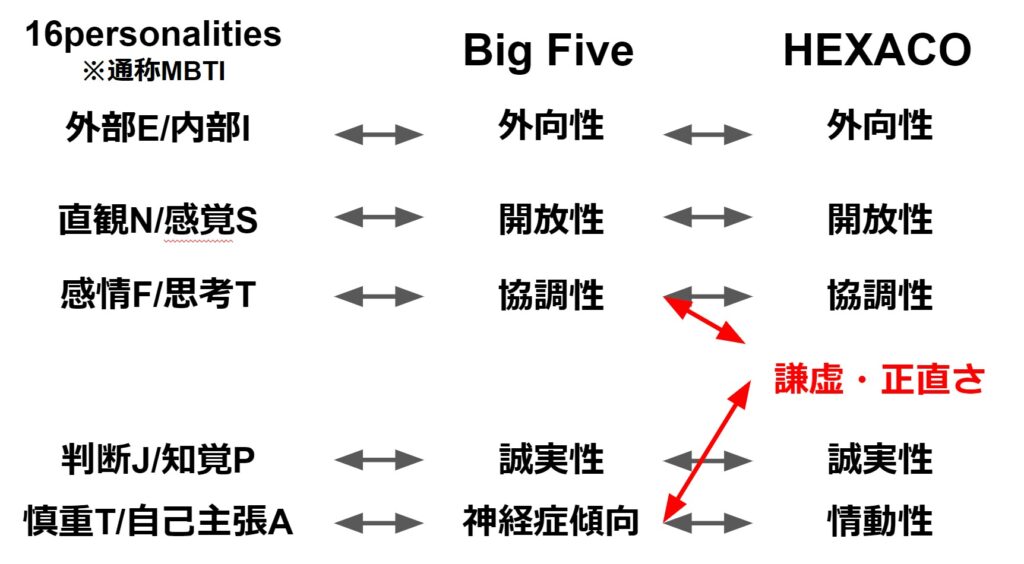
There are papers suggesting correlations between the academically trusted Big Five and MBTI, which classifies personality into 16 types. The main correlations are as follows:
| Correlation Table | E | I | N | S | F | T | J | P |
| Extraversion | Strong positive | Strong negative | Positive | Negative | ||||
| Openness | Positive | Negative | Strong positive | Strong negative | Negative | Positive | ||
| Agreeableness | Positive | Strong negative | ||||||
| Conscientiousness | Negative | Positive | Strong positive | Strong negative | ||||
| Neuroticism | Negative | Positive | Negative | Positive | Positive | Negative |
As can be seen from this, there is a possibility that the extraversion of Big Five and HEXACO correlates with MBTI’s E and I. When summarized in a figure, it looks as follows.
Psychological Aspects of Extraversion
The Relationship Between Extraversion and Emotions
People with high extraversion actively express their emotions. They don’t hide their feelings and often share their emotions with others through social interactions. The relationship between extraversion and emotions manifests in the following ways:
- Emotional openness: They honestly express their feelings.
- Abundance of positive emotions: They generally tend to feel positive emotions more easily.
- Emotional contagion: They transmit their emotions to others and influence them.
Due to this characteristic, extraverted people can easily deepen relationships with others and strengthen social connections. With their brightness, they often attract other people and create a harmonious atmosphere.
Understanding the relationship between extraversion and emotions helps improve the quality of human relationships and leads to a richer social life.
Mental Benefits of Extroversion
Extroversion brings many benefits to psychological health. People with this personality trait also have advantages when dealing with stress. The benefits that extroversion provides to mental health are as follows:
- Utilization of social support: Having many friends and acquaintances makes it easier to receive support.
- High self-efficacy: Having confidence in one’s abilities and actively tackling challenges.
- Stress resilience: Easily releasing stress through interactions with people.
Due to these advantages, extroverted people generally have less psychological stress and tend to have higher life satisfaction. They constantly receive new stimulation through social activities.
Understanding the impact of extroversion on psychological health is key for individuals to lead happy and fulfilling lives.
Extroversion and Stress Coping Methods
Extroverted people have effective methods for managing stress.
They are highly social and tend to relieve stress through interactions with people. The relationship between extroversion and stress coping can be seen as follows:
- Participation in social activities: Being active in group activities and social events.
- Proactive problem-solving: Responding positively when facing problems.
- Ease of seeking emotional support: Being able to seek help from others when needed.
These coping methods help maintain mental health by reducing negative impacts even in stressful situations.
Extroverted people value connections with others even during difficult times, which becomes a great strength in stress management.
Understanding the impact of extroversion on stress coping is important for maintaining physical and mental health.
Extroversion and Genetic Factors
Research on the Heritability of Extroversion
Extroversion is a personality trait strongly influenced by genetic elements.
Research indicates that the heritability of extroversion is quite high. The genetic background of this personality trait includes the following points:
- Similarity within families: Transmission of traits from highly extroverted parents to children.
- Genetic influence: Specific genes contribute to the expression of extroversion.
- Gene-environment interaction: Environment can bring out genetic traits.
Although genetic factors are significant, environment also influences the development of extroversion.
For example, a social family environment can further strengthen extroversion.
Understanding the heritability of extroversion is an important element in exploring the mechanisms of personality formation.
Genetics and Environment: Factors That Shape Extroversion
Extroversion is shaped not only by genetics but also by environment.
The development of this personality trait involves both innate genetic elements and the environment in which one grows up. The main factors that shape extroversion are as follows:
- Influence of nurturing environment: Homes and schools where social activities are encouraged.
- Cultural background: Extroversion is more likely to be fostered in cultures that value sociability.
- Personal experiences: Successful social experiences give confidence and strengthen extroversion.
These environmental factors influence individuals to acquire social skills and develop extroversion.
As a result, genetics and environment influence each other to create extroverted characteristics.
Understanding the role of genetics and environment in the formation of extroversion is important for recognizing the diversity of individuality.
Correlation Between Extroversion and Other Genetic Traits
Extroversion is also related to other genetic traits. Research has shown that this personality trait correlates with specific genes.
The correlation between extroversion and other genetic traits includes the following examples:
- Emotional regulation: Highly extroverted people often have genetic traits related to emotional regulation abilities.
- Risk-taking tendencies: Also correlated with traits that make one prone to adventurous behavior.
- Reward dependence: Relationship with traits of high sensitivity to rewards.
These correlations indicate that extraversion does not exist in isolation, but is complexly linked with many other psychological traits.
Since extraverted people often possess these related traits as well, it is understood that their behavior and reactions are multifaceted.
Understanding the correlation between extraversion and other genetic traits helps in deeply understanding the complexity of personality.
The Relationship Between Extraversion and the Brain
The Relationship Between Extraversion and Brain Function
Extraversion is deeply related to the activity of specific regions in the brain.
Recent research has confirmed that the brains of extraverted people show significant blood flow and activity in specific areas. The relationship between extraversion and brain function is as follows:
- High reward sensitivity: People with high extraversion have a mesolimbic dopamine system that is sensitive to rewards, which supports their high sociability.
- Activity in the anterior cingulate and prefrontal cortex: These regions are involved in social judgment and planning, and are particularly active in extraverted people.
- Amygdala reactivity: Extraverted people show stronger responses to emotional stimuli.
These brain activity patterns show how extraverted people function effectively in social situations. Their brains actively respond to interpersonal interactions and new experiences, which leads to extraverted behavior.
Understanding the relationship between extraversion and brain function is very important in exploring the biological foundations of personality. This knowledge helps elucidate the mechanisms of individual behavior and personality formation.
How Extraversion Affects the Brain
The brains of people with high extraversion particularly respond to social situations.
This is because various regions of the brain increase their activity in response to social stimuli. The effects of extraversion on the brain are observed as follows:
- Processing of social information: High ability to efficiently process social information.
- Pursuit of emotional rewards: Tendency to seek rewards from enjoyable social activities.
- Reduced stress response: Effects of stress reduction through social activities are observed.
These characteristics help explain why extraverted people are comfortable in social settings.
Also, these brain responses form part of the reason why they actively seek interactions with people.
Understanding how extraversion affects the brain is key to understanding the neuroscientific aspects of human sociability.
The Brain Science of Extraversion from Recent Research
The characteristics of extraversion are also supported by recent brain science research.
These studies reveal that there are distinctive patterns in the brain function and structure of people with high extraversion. The latest findings in the brain science of extraversion are shown as follows:
- The role of neurotransmitters: Neurotransmitters like dopamine are active, promoting sociability.
- Brain network activity: High integration of brain networks in social situations.
- Specific activity in brain regions: Specific brain regions, especially the frontal lobe, play an important role in supporting social behavior.
These scientific findings deepen our understanding of how extraverted people demonstrate their social characteristics.
Also, these findings lead our understanding of the neural foundations of social behavior to new dimensions.
Recent research on the brain science of extraversion is essential for elucidating the biological basis of personality.
Comparison Between Introversion and Extraversion
Basic Characteristics of Introversion
Introversion is a quiet and introspective personality trait.
Introverted people, compared to extraverted people, tend to value solitary time and prefer small groups or one-on-one interactions rather than large crowds. The basic characteristics of introversion are as follows:
- High independence: Values their own space and time.
- Deep thinking: Enjoys pondering thoughts.
- Emotional expression restraint: Often keeps emotions inside.
Due to these traits, introverted people perform best in quiet, highly concentrated environments.
Also, they commonly place particular value on deep conversations and meaningful relationships.
Understanding introversion shows how diverse individual personalities can be.
Differences Between Introversion and Extroversion
Introversion and extroversion are positioned at both ends of the personality spectrum.
Introverted people generally tend to be quiet, focused, and deeply thoughtful.
On the other hand, extroverted people are sociable, energetic, and emotionally expressive. The main differences between introversion and extroversion are as follows.
- Preference for social environments: Introverts prefer quiet environments, while extroverts prefer lively environments.
- Source of energy: Introverts gain energy from alone time, while extroverts gain energy from interaction with others.
- Range of interpersonal relationships: Introverts prefer a few close relationships, while extroverts enjoy relationships with a wide range of people.
Understanding these differences is important for knowing how individuals function optimally.
Understanding personality helps in choosing environments and activities that suit each individual.
Understanding the differences between introversion and extroversion leads to respecting individual differences and leveraging each person’s strengths.
Complementarity of Introversion and Extroversion
Introversion and extroversion are personality traits that complement each other.
Introverted people have deep insight and planning abilities, while extroverted people excel at energy and building human relationships. This complementarity of personalities manifests in the following ways.
- Teamwork: Introverted people deepen ideas, while extroverted people expand them.
- Leadership: Different types of leadership complement each other.
- Problem solving: Approaches from different perspectives are possible.
Through this complementarity, when people with various personalities work together, they can approach problems from a more balanced perspective and find more creative and effective solutions.
Understanding the complementarity of introversion and extroversion is key to leveraging individual strengths and improving the performance of the entire group.
Methods to Enhance Extroversion
Methods to Promote Extroversion in Daily Life
There are many ways to promote extroversion in daily life.
By incorporating these methods, you can naturally enhance social skills and extroverted characteristics. The methods for promoting extroversion in daily life are as follows.
- Participating in social activities: Actively participate in group activities and events.
- Meeting new people: Having interactions with people from different backgrounds.
- Improving communication skills: Learning and practicing effective communication techniques.
Through these activities, it becomes possible to build relationships with others with confidence.
Additionally, placing oneself in social environments naturally cultivates extroversion and has the effect of expanding human relationships.
Promoting extroversion in daily life also contributes to personal social fulfillment.
Training to Enhance Extroversion
Training methods to enhance extroversion are specifically designed.
These training methods help people improve their self-expression and social skills. The main methods of training to enhance extroversion are as follows.
- Role play: Practice interpersonal skills through role play in various social scenarios.
- Public speaking: Start with small gatherings and gradually practice speaking in front of larger audiences.
- Assertiveness training: Learn how to express your opinions clearly yet politely.
These training methods help reduce anxiety and build confidence in social situations.
Through continuous practice, extroverted characteristics naturally improve, and a positive attitude is sustained in daily interpersonal relationships.
Conducting training to enhance extroversion becomes a step toward self-growth and social success.
Psychological Approaches to Improve Extroversion
Psychological approaches to improve extroversion promote change from within.
This approach deepens self-awareness and naturally promotes social behavior. Psychological approaches to improving extroversion include the following:
- Positive self-suggestion: Daily use of positive words to enhance self-efficacy.
- Cognitive Behavioral Therapy (CBT): Managing anxiety in social situations and forming more proactive thought patterns.
- Mindfulness meditation: Focusing on the present moment and approaching social situations while maintaining inner calm.
By using these techniques, even people with introverted tendencies can strengthen extroverted characteristics and reduce psychological barriers to social activities.
Through continuous practice, it becomes possible to build more open and proactive human relationships.
Psychological approaches to improving extroversion are effective for building self-growth and social confidence.
Social Impact of Extroversion
Benefits of Extroversion in the Workplace
Extroversion brings many benefits in the workplace.
Extroverted people naturally excel in communication and networking within teams. The benefits of extroversion in the workplace are expressed as follows:
- Improved teamwork: As natural communicators, they facilitate the flow of information within teams.
- Enhanced leadership: Naturally high ability to motivate and guide people.
- Networking skills: Building extensive networks within the industry and expanding opportunities.
These characteristics directly contribute to enhancing productivity and cooperation in the workplace.
Additionally, extroverted people often actively tackle new projects and challenges, promoting team innovation.
Understanding the benefits of extroversion in the workplace leads to improved performance for the entire organization.
Social Interaction and Extroversion
Extroversion facilitates social interaction and enriches human relationships.
Extroverted people enjoy contact with others and can build strong human relationships through this process. The relationship between social interaction and extroversion is explained as follows:
- Approachability: Extroverted people can easily become close to new people.
- Emotional sharing: They openly express emotions and often share feelings with others.
- Active sociability: They frequently participate in and actively engage with social events and gatherings.
Due to these characteristics, extroverted people tend to naturally become central figures in social settings and can have connections with many people.
Additionally, these social skills help expand an individual’s social support network and promote mental health.
Understanding the relationship between social interaction and extroversion is key to improving an individual’s social success.
The Impact of Extroversion on Leadership
Extroversion has a significant impact on the quality of leadership.
Highly extroverted people often naturally fulfill leadership roles, and their energetic personality becomes the driving force that pulls teams and organizations forward.
The impact of extroversion on leadership includes the following points:
- Enhanced communication: Promoting open communication with team members and increasing transparency.
- Improved motivation: Inspiring other members and boosting the morale of the entire team.
- Decisiveness: Making quick and effective decisions by leveraging high sociability.
These characteristics are essential for fulfilling an effective role as a leader.
Extroverted leaders are expected to demonstrate their leadership skills especially in challenging projects or difficult situations.
Understanding the impact of extroversion on leadership improves the quality of leadership and contributes to organizational success.
In Conclusion
Extraversion is a personality trait that plays an important role in individual success and happiness.
In this article, we have explored a wide range of topics, from basic understanding of extraversion to psychological aspects, genetic factors, and brain correlations.
We have also examined how each personality type is complementary through comparison with introversion. We have also explained in detail methods for enhancing extraversion and its impact in the workplace and society.
By utilizing this information, you can deepen your self-understanding and make the most of your own personality traits.
This knowledge will also be useful when building relationships with others.
Let’s understand the strengths of both extraversion and introversion, and aim for balanced interpersonal relationships and personal growth.

Writer & Supervisor: Eisuke Tokiwa
Personality Psychology Researcher / CEO, SUNBLAZE Inc.
As a child he experienced poverty, domestic abuse, bullying, truancy and dropping out of school — first-hand exposure to a range of social problems. He spent 10 years researching these issues and published Encyclopedia of Villains through Jiyukokuminsha. Since then he has independently researched the determinants of social problems and antisocial behavior (work, education, health, personality, genetics, region, etc.) and has published 2 peer-reviewed journal articles (Frontiers in Psychology, IEEE Access). His goal is to predict the occurrence of social problems. Spiky profile (WAIS-IV).
Expertise: Personality Psychology / Big Five / HEXACO / MBTI / Prediction of Social Problems
Researcher profiles: ORCID / Google Scholar / ResearchGate
Social & Books: X (@etokiwa999) / note / Amazon Author Page