Do you know about the ENFJ-T type?
This is one of the indicators that represents personality, and it has a significant impact on our behavior and way of thinking.
In this article, we will explain in detail what characteristics ENFJ-T people have, including aspects of health, work, and interpersonal relationships.
By understanding your own and others’ personalities well, it may lead to better communication and self-understanding.
Please read this while comparing it with your own and your friends’ personalities.
Once again, personality researcher and author of Villain Encyclopedia, Tokiwa (@etokiwa999), will provide the explanation.
※We have developed the HEXACO-JP Personality Assessment! It has more scientific basis than MBTI. Tap below for details.

目次
- 1 Scientific Background of ENFJ-T (Protagonist – Turbulent)
- 2 Scientific Explanation of ENFJ-T (Protagonist – Turbulent Type)
- 2.1 Engaging in Healthy Behaviors
- 2.2 Tend to Get Along Well with People Who Have Both N and F Traits
- 2.3 Making New Friends
- 2.4 High Academic Performance
- 2.5 Effective Online Learning Outcomes
- 2.6 Relatively high possibility of having high intelligence IQ
- 2.7 Spirituality
- 2.8 Neurotic tendencies may decrease when receiving psychotherapy
- 2.9 Have many friends on social media
- 2.10 Post updates and photos on social media, with many emotional posts in particular
- 2.11 When using social media, communicate through likes and encouraging comments
- 2.12 Likely to actively gather information on social media
- 2.13 Engage in altruistic activities such as volunteering
- 2.14 Properly follow infection control measures such as hand washing
- 2.15 Having a certain number on a team improves team balance, even better when with introverted people
- 2.16 Common among athletes, especially champion-level athletes, but even more common when neuroticism is low
- 2.17 In the case of children, there is a possibility of being gifted
- 2.18 Common among HSPs
- 2.19 Excessive perfectionism
- 2.20 Prefer salty, sour, and fatty foods due to stress
- 2.21 Preference for fast food, ice cream, chocolate, cocoa, meat, biscuits, cake, and cookies
- 2.22 Health-conscious preference for vegetables, dairy products, and nuts; even more health-conscious when neuroticism is low
- 2.23 Prone to smoking
- 2.24 In the case of men, prone to becoming cheated-on husbands
- 2.25 Prone to hoarding behavior
- 2.26 Common Among Cyberbullying Victims
- 2.27 Mindfulness Practice Reduces Neuroticism
- 2.28 Engaging in Emotion-Focused Coping
- 2.29 Attempts Relatively Calm Risk Management but High Neuroticism Creates Risk Bias
- 2.30 Prevalent in Kyushu and Metropolitan Areas of Japan
- 2.31 Schwartz Values: Stimulation, Self-Direction, Universalism, Benevolence
- 2.32 Particular About Fashion
- 2.33 Investment Behavior: Herd Behavior (Easily Influenced by Others’ Actions and Words)
- 3 Finally
Scientific Background of ENFJ-T (Protagonist – Turbulent)
Overview of MBTI
MBTI is a psychological theory that classifies personalities into 16 types.
To begin with, MBTI is an abbreviation for Myers-Briggs Type Indicator.
MBTI classifies personalities into 16 types by combining the following four indicators.
In other words, MBTI expresses your personality tendencies in four letters such as “ISTJ” or “ENFP”. There is the very famous 16personalities which is similar, but this is different from MBTI.
Overview of Big Five
One of the most influential trait theories in personality psychology is the “Big Five.”
Big Five measures five traits: Openness, Conscientiousness, Extraversion, Agreeableness, and Neuroticism.
Also, a major difference is that while 16personalities and MBTI use type classification (e.g., either extraverted or introverted), Big Five evaluates traits as continuous numerical values (e.g., Extraversion 3.5).
Furthermore, it has been studied for a long time with many published papers, and extensive research has been conducted in other fields such as academic ability, income, brain, and genetics. Big Five can be said to have relatively stronger scientific backing.
Correlation Between MBTI, Big Five, and HEXACO
There are correlations between MBTI’s 4 indicators and Big Five’s 5 factors.
A representative study showing this correlation is the paper “The relationship between the revised NEO-Personality Inventory and the Myers-Briggs Type Indicator.”
According to this paper, the correlations between MBTI and Big Five are as follows.
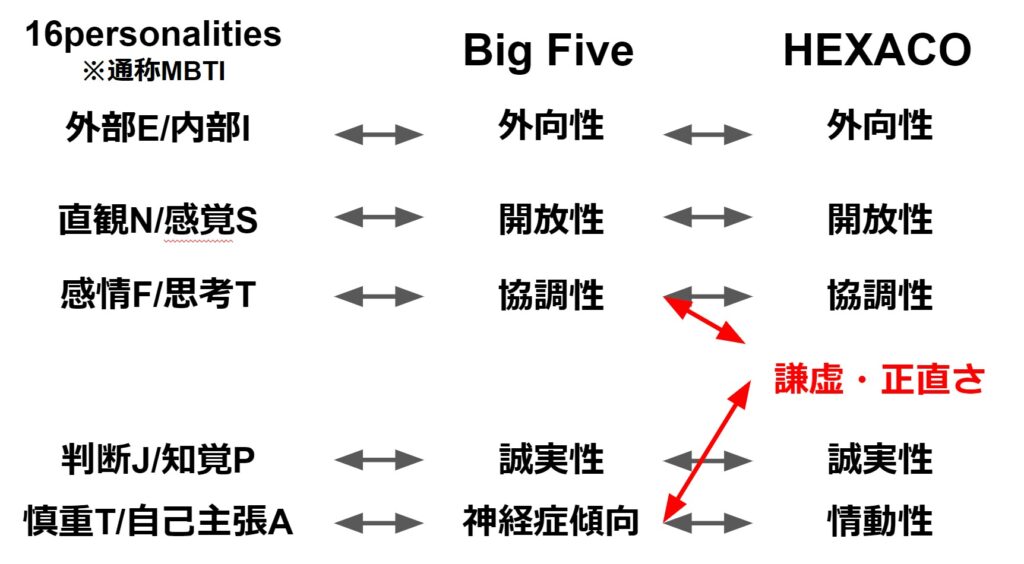
Also, in 16personalities, which was created based on MBTI and Big Five, the neuroticism of Big Five is called “Identity,” and is classified as either Assertive or Turbulent.
On the far right is the relatively new personality assessment “HEXACO.” It is an improvement on Big Five with the addition of one indicator: “Honesty-Humility.”
This article will provide detailed explanations of 16personalities personality types based on these correlations.
Since these are originally Big Five and HEXACO studies, if you want to understand personality more scientifically than MBTI or 16personalities, please try this HEXACO personality assessment.
What is ENFJ-T (Protagonist – Turbulent)?
ENFJ-T is a type with high Extraversion (E), high Openness (N), high Agreeableness (F), high Conscientiousness (J), and high Neuroticism (T) in Big Five. Characteristics:
- Strong sense of social responsibility and idealism
- Sensitivity to others’ expectations
- High empathy and insight
- Anxiety about leadership
- Continuous desire for self-improvement
They feel a strong sense of mission in guiding and supporting people. However, they often have doubts about their own abilities and decisions.
In interpersonal relationships, they value deep connections and harmony, but may react sensitively to criticism or disappointment from others. They tend to feel stressed by change and uncertainty, but this also becomes a driving force for growth and improvement of skills in supporting others.
Scientific Explanation of ENFJ-T (Protagonist – Turbulent Type)
Engaging in Healthy Behaviors
ENFJ-T type individuals tend to have high agreeableness (F) and conscientiousness (J). This leads to personality traits that make it easier to maintain healthy lifestyle habits. ENFJ-T people tend to care not only about their own health but also about the health of those around them.
They consciously try to incorporate healthy habits such as regular exercise, balanced diet, and adequate sleep. However, due to their high neuroticism (-T), they may also worry excessively about their health.
For maintaining health, it’s important not to forget that moderate relaxation is also essential.
Please see this article for more details.
Tend to Get Along Well with People Who Have Both N and F Traits
ENFJ-T type individuals possess both intuition (N) and feeling (F) characteristics. Therefore, they naturally attract and tend to build deep friendships with people who have similar N and F traits.
ENFJ-T people are imaginative, highly sensitive, and excel at understanding others’ emotions. With people who have similar traits, they often share common values and interests, making it easy to build mutually understanding relationships.
However, it’s also important to interact with diverse people. Interacting with people of different personality types provides good opportunities to learn new perspectives and ways of thinking.
Please see this article for more details.
Making New Friends
ENFJ-T type individuals are good at meeting new people and making friends due to their high extraversion (E). They tend to be sociable, personable, and enjoy communicating with others.
ENFJ-T people often naturally find themselves at the center of social circles, attracting those around them with their warm personality and empathy. They adapt easily to new environments and situations, and are characterized by their ability to quickly bond with people they meet for the first time.
However, due to their high neuroticism (-T), they may sometimes feel anxious about relationships. It’s important to cherish their own pace while enjoying new encounters.
Please see this article for more details.
High Academic Performance
ENFJ-T type individuals possess intuition (N), feeling (F), and judging (J) characteristics, and these traits may lead to high learning abilities.
ENFJ-T people excel at understanding the essence of things and are good at creative thinking. They also have high emotional understanding, so they are likely to excel in humanities and social sciences.
They also possess the ability to be methodical and steadily accumulate efforts toward goals. However, since they can be perfectionist, it’s sometimes important to have flexibility.
It can be said that their enthusiasm and effort toward learning leads to high academic performance.
Please see this article for more details.
Effective Online Learning Outcomes
ENFJ-T type individuals possess intuition (N) and judging (J) characteristics, and these traits tend to be effective in online learning.
ENFJ-T people are good at understanding new concepts and abstract ideas, and tend to have high self-learning abilities. They are also methodical and have high self-management skills, so they can efficiently proceed with learning even in the highly flexible environment of online learning.
However, due to their extraversion (E) trait of preferring interaction with people, incorporating online group work and discussions may further enhance learning effectiveness.
Please see this article for more details.
Relatively high possibility of having high intelligence IQ
ENFJ-T type individuals possess intuitive (N) characteristics, which may be associated with high IQ. Intuitive thinking helps with complex problem-solving and understanding abstract concepts.
ENFJ-T people excel at recognizing patterns and grasping things from a big-picture perspective. They are also skilled at creative thinking and generating new ideas.
However, IQ is only one aspect of intelligence, and the emotional intelligence (EQ) and social intelligence that ENFJ-T people possess are also important elements of comprehensive intelligence.
By maintaining intellectual curiosity and engaging in learning across various fields, they can further develop their abilities.
Please see this article for more details.
Spirituality
ENFJ-T type individuals possess intuitive (N) and feeling (F) characteristics, which tend to connect easily with spiritual tendencies.
ENFJ-T people tend to deeply contemplate the meaning and purpose of life and seek connections with something beyond themselves. Being imaginative and highly sensitive, they value spiritual experiences and intuitive insights.
They also often place importance on deep bonds and harmony with others and show interest in the welfare of humanity as a whole. This tendency leads to feeling connections with a greater existence.
However, maintaining balance with the real world is also important. By balancing spiritual exploration with daily life, they can lead a more fulfilling life.
Please see this article for more details.
Neurotic tendencies may decrease when receiving psychotherapy
ENFJ-T type individuals are classified as “Turbulent” with high neurotic tendencies (-T). When people of this type receive psychotherapy, their neurotic tendencies may potentially decrease.
ENFJ-T people have strong sensitivity and tend to easily feel stress and anxiety. Through psychotherapy, they can deepen their self-understanding and learn stress management techniques.
Also, while ENFJ-T people are sensitive to others’ needs and tend to be self-sacrificing, they can learn how to establish healthy boundaries through psychotherapy.
By leveraging their feeling (F) characteristics and enhancing their self-insight abilities, they have a high possibility of achieving a more stable mental state.
Please see this article for more details.
ENFJ-T type individuals have high extroversion (E), so they tend to actively interact on social networking services (SNS) and have many friends.
ENFJ-T people have high communication abilities and display attractive personalities even online. Also, due to their strong interest in others, they actively try to interact on social media.
Their feeling (F) characteristics give them the ability to build deep human relationships even online. However, due to their high neurotic tendencies (-T), they may feel excessive stress from human relationships on social media.
It’s important to enjoy social media while maintaining appropriate distance. Don’t forget to balance with real-life human relationships too.
Please see this article for more details.
ENFJ-T type individuals have high extroversion (E) and neurotic tendencies (-T), so they tend to be active in posting on social media, with particularly many emotional content posts.
ENFJ-T people have strong desires for self-expression and prefer sharing their experiences and emotions with others. They frequently post updates and photos on social media, actively broadcasting their daily lives and emotional states.
Due to their feeling (F) characteristics, they tend to make many emotional posts about joy, sadness, and other feelings. Also, due to their high neurotic tendencies (-T), posts about stress and anxiety can sometimes be seen.
However, attention to privacy protection and appropriateness of post content is necessary. It’s important to consider the impact of emotional posts and sometimes make calm judgments.
Please see this article for more details.
People with ENFJ-T type, due to their strong extroversion (E) and feeling (F) traits, tend to engage in active and warm communication when using social media.
ENFJ-T individuals enjoy frequently giving “likes” to others’ posts and leaving encouraging comments. Their empathy and consideration for others are reflected in such behaviors.
Particularly when friends or acquaintances are in difficult situations or reporting joyful events, they immediately show supportive reactions.
However, due to their high neuroticism (-T), they can sometimes be overly sensitive to others’ reactions. It’s important to maintain your own pace while enjoying positive communication.
For more details, please see this article.
People with ENFJ-T type, due to their strong intuition (N) trait, tend to actively gather information through social media.
ENFJ-T individuals have strong curiosity for new knowledge and perspectives, and prefer to utilize social media as an information source. They are interested in information across a wide range of fields, including trends, social issues, and cultural topics.
They also learn much through others’ opinions and personal experiences, actively absorbing knowledge from discussions on social media and shared articles.
However, it’s also important to verify the reliability of information. By not forgetting critical thinking and developing habits to evaluate information from multiple perspectives, more effective information gathering becomes possible.
For more details, please see this article.
Engage in altruistic activities such as volunteering
People with ENFJ-T type, due to their strong extroversion (E) and feeling (F) traits, tend to actively participate in altruistic activities such as volunteering.
ENFJ-T individuals have high empathy for others and strong interest in social contribution. They find joy in using their abilities and time to do something for others or society.
Meeting new people through volunteer activities and building meaningful relationships is also attractive to them. They also feel fulfilled by being able to contribute to society in concrete ways.
However, they sometimes tend to be overly self-sacrificing, so it’s important to balance this with their own needs. It’s crucial to continue social contribution in a sustainable way while taking adequate rest.
For more details, please see this article.
Properly follow infection control measures such as hand washing
People with ENFJ-T type, due to their high conscientiousness (J), tend to properly follow preventive behaviors such as hand washing as infection control measures.
ENFJ-T individuals have a strong sense of responsibility and prioritize protecting the health of themselves and those around them. They sincerely accept infection prevention guidelines and reliably practice recommended measures such as hand washing, mask wearing, and maintaining social distance.
Also, out of consideration for others, they pay careful attention not to become a source of infection. Their high neuroticism (-T) sometimes leads to excessive worry, but this can also result in thorough infection control measures.
However, moderate relaxation is also important. Let’s aim for balanced measures based on accurate information.
For more details, please see this article.
Having a certain number on a team improves team balance, even better when with introverted people
People with ENFJ-T type, due to their strong feeling (F) and judging (J) traits, tend to play important roles in teams and improve overall balance.
ENFJ-T individuals have excellent communication skills and empathy, promoting harmony among team members. They can sensitively perceive others’ emotions and play a role in easing conflicts.
Also, due to their planning and organizational abilities, they contribute effectively toward achieving team goals. Particularly when cooperating with introverted people, the extroversion (E) of ENFJ-T and the deep thinking ability of introverted people work complementarily, creating even better balance.
However, sometimes they may hold back on self-assertion too much, so it’s important to appropriately express your own opinions as well.
For more details, please see this article.
Common among athletes, especially champion-level athletes, but even more common when neuroticism is low
People with the ENFJ-T type have characteristics of extroversion (E), feeling (F), and judging (J), and these traits tend to be commonly found among athletes, especially champion-level athletes.
ENFJ-T individuals excel at teamwork and have characteristics that make it easy for them to demonstrate leadership. They also have a high ability to systematically build up efforts toward goals. These characteristics work advantageously for achieving success in the sports world.
Particularly when neuroticism (-T) is low, they are strong under pressure and have high mental stability, which is why they are more commonly found among champion-level athletes.
However, since they also have perfectionist tendencies, it’s sometimes important to maintain flexibility. By balancing appropriate relaxation and concentration, they can demonstrate even better performance.
For more details, please see this article.
In the case of children, there is a possibility of being gifted
Children with the ENFJ-T type can be said to have a relatively high possibility of being gifted (intellectually talented children) due to their strong intuition (N) characteristics.
ENFJ-T children tend to excel in abstract thinking and creativity, with a high ability to understand complex concepts. Additionally, due to their feeling (F) characteristics, they often possess high empathy and emotional intelligence, which are also features of giftedness.
Furthermore, due to their judging (J) characteristics, they also have a high ability to act systematically toward goals and may demonstrate precocious organizational skills.
However, whether someone is gifted requires appropriate evaluation by specialists. Also, even if gifted, it’s important not to forget that each child has their own individuality and to provide support tailored to individual needs.
For more details, please see this article.
Common among HSPs
People with the ENFJ-T type can be said to have a relatively high possibility of being HSP (Highly Sensitive Person) due to their high intuition (N) and neuroticism (-T).
ENFJ-T individuals tend to be sensitive to environmental stimuli and have a high ability to detect subtle changes and nuances. This overlaps greatly with HSP characteristics.
Additionally, due to their feeling (F) characteristics, they have a high ability to sensitively perceive others’ emotions and atmosphere, which is also one of the features of HSP.
However, being HSP doesn’t necessarily mean having high neuroticism. By understanding HSP traits and managing oneself appropriately, these characteristics can be utilized as strengths.
By valuing your own pace and taking appropriate rest, you can maintain a better state.
For more details, please see this article.
Excessive perfectionism
People with the ENFJ-T type may show strong perfectionist tendencies due to their high conscientiousness (J). Particularly, since their neuroticism (-T) is also high, this perfectionism may be further strengthened.
ENFJ-T individuals set high goals and work diligently to achieve them. However, sometimes these standards can become unrealistically high, leading them to make overly strict demands on themselves and others.
While this perfectionism can lead to high achievements in work and academics, it also increases the risk of excessive stress, anxiety, and burnout syndrome.
Taking balance is important. By recognizing your limits and accepting the concept of “good enough,” you can lead a healthier and more sustainable life. Remember that sometimes it’s important not to seek perfection too much.
For more details, please see this article.
Prefer salty, sour, and fatty foods due to stress
People with the ENFJ-T type are classified as “cautious types” with high neuroticism (-T), so they may have a tendency to prefer salty, sour, and fatty foods under stress.
ENFJ-T individuals have strong sensitivity and characteristics that make them prone to feeling stress. Under stress, the body tends to seek comfort food, and they become particularly drawn to foods high in salt, acidity, and fat.
While these foods have the effect of temporarily improving mood, they can potentially lead to health problems in the long term.
As a stress management method, it’s important to find healthy alternatives. For example, exercise, practicing relaxation techniques, and having time for hobbies may be effective.
Additionally, it’s important to aim for a balanced diet and be conscious of making healthy food choices even during stressful times.
For more details, please see this article.
People with ENFJ-T personality type tend to prefer stimulating and flavorful foods such as fast food and sweets due to their extroverted (E) and intuitive (N) characteristics.
ENFJ-T individuals tend to seek new experiences and stimulation, which is reflected in their food preferences. They are easily attracted to the convenience of fast food and the immediate satisfaction provided by sweets such as ice cream, chocolate, and cake.
Additionally, due to their sociable nature, they tend to prefer meals and snacks that they often enjoy together with friends and family.
However, it’s important not to forget about health considerations. While enjoying these foods, it’s essential to maintain a balanced diet. By sometimes choosing healthy alternatives and making creative adjustments, you can achieve a balance between taste and health.
Please see this article for more details.
Health-conscious preference for vegetables, dairy products, and nuts; even more health-conscious when neuroticism is low
People with ENFJ-T personality type tend to be health-conscious and prefer nutritionally rich foods such as vegetables, dairy products, and nuts due to their high conscientiousness (J).
ENFJ-T individuals have high self-management abilities and pay attention to their diet for long-term health maintenance. They consciously try to incorporate body-beneficial foods such as nutrient-rich vegetables, calcium from dairy products, and high-quality fats and proteins from nuts.
Particularly when neuroticism (-T) is low, the tendency to be even more health-conscious becomes stronger. This is because with less stress and anxiety, they can make healthier choices more calmly.
However, it’s also important to maintain flexibility sometimes. Rather than pursuing a perfect diet too intensely, it’s important to maintain balance by occasionally enjoying favorite foods.
A healthy diet has positive effects not only on physical health but also on mental well-being. By practicing it consistently, you can lead a more fulfilling life.
Please see this article for more details.
Prone to smoking
People with ENFJ-T personality type may have a tendency to smoke due to their high extroversion (E) and neuroticism (-T).
ENFJ-T individuals may start smoking as a means of stress relief in social situations or seeking connections with others. Also, due to high neuroticism, they may easily rely on smoking as a means to alleviate stress and anxiety.
Due to their extroverted nature, they may sometimes find smoking attractive as a way to communicate with others.
However, the adverse health effects of smoking are widely known. It’s important for ENFJ-T individuals to leverage their high health consciousness and find healthy stress-relief methods instead of smoking.
For example, we recommend achieving stress relief and relaxation through healthier methods such as exercise, meditation, and hobby time. If you’re considering quitting smoking, receiving professional support can also be effective.
Please see this article for more details.
In the case of men, prone to becoming cheated-on husbands
ENFJ-T men are classified as “cautious types” with high neuroticism (-T), so they may have a higher possibility of being cheated on under specific circumstances.
ENFJ-T men have strong sensitivity and sometimes worry excessively about their partner’s feelings. This can cause them to become overly dependent on their partner or, conversely, to keep too much distance.
Additionally, their perfectionist tendencies may lead them to have excessively high expectations for themselves and their partners, which can also affect relationships.
However, this is merely a general tendency, and individual behavior and relationships are influenced by many factors. To build healthy relationships, open communication, mutual understanding, and building trust are important.
By deepening self-awareness and cherishing dialogue with partners, you can build stronger and more stable relationships. When necessary, receiving professional support such as counseling may also be effective.
Please see this article for more details.
Prone to hoarding behavior
People with ENFJ-T personality type may be prone to hoarding behavior under specific circumstances due to their high intuition (N) and neuroticism (-T).
ENFJ-T individuals have the ability to sensitively detect future possibilities and potential risks. This can lead to behavior where they try to secure more supplies than necessary during crisis situations or highly uncertain environments.
Additionally, due to high neuroticism, they are prone to feeling anxiety and stress, and may try to resolve this through securing supplies.
However, such behavior can have negative effects on society as a whole. It’s important to calmly analyze the situation and avoid hoarding more than necessary.
Instead, we recommend finding more constructive coping methods such as proper information gathering and preparation, and building cooperative relationships with the community. It would also be effective to face your own anxieties and learn techniques to manage them in healthy ways.
Please see this article for more details.
Common Among Cyberbullying Victims
ENFJ-T type individuals, due to their intuition (N), feeling (F), and judging (J) traits combined with high neuroticism (-T), may be more susceptible to becoming victims of cyberbullying.
ENFJ-T individuals tend to be highly sensitive and react sensitively to others’ words and actions. They are likely to take negative comments or criticism online seriously and may suffer significant psychological damage as a result.
Additionally, their tendency to value harmony with others may weaken their self-assertion, making it difficult to properly deal with bullying situations.
Due to their perfectionist tendencies, even minor criticism may easily damage their self-esteem.
The following measures are effective for protecting oneself from cyberbullying:
- Properly manage privacy settings
- Block inappropriate comments or messages
- Consult with trusted individuals
- Seek professional support when necessary
It’s also important to enhance self-esteem and learn stress management techniques. Building psychological resilience to avoid being overly influenced by negative online behavior is crucial.
Please see this article for more details.
Mindfulness Practice Reduces Neuroticism
ENFJ-T type individuals are classified as “Turbulent” with high neuroticism (-T), but mindfulness practice may help reduce this tendency.
ENFJ-T individuals are highly sensitive and prone to feeling stress and anxiety. Mindfulness is a practice that focuses awareness on the present moment and cultivates a non-judgmental, accepting attitude. This allows them to distance themselves from excessive worry and anxiety.
In particular, the intuitive (N) and feeling (F) traits of ENFJ-T work well with mindfulness practice. They can utilize their introspective nature to deepen self-understanding.
Regular mindfulness meditation and conscious awareness practice in daily life may improve stress tolerance and overall mental health.
However, effects vary among individuals, and consistent practice is important. Consider seeking professional guidance when necessary.
Please see this article for more details.
Engaging in Emotion-Focused Coping
ENFJ-T type individuals, due to their feeling (F) trait and high neuroticism (-T), tend to use emotion-focused coping as a stress management strategy.
Emotion-focused coping is a method of dealing with stressful situations by focusing on the emotions generated by the situation rather than trying to change the situation itself.
ENFJ-T individuals have high emotional understanding and tend to value emotions in themselves and others. Therefore, in stressful situations, they try to cope by expressing emotions or seeking emotional support from others.
For example:
- Confiding concerns to friends or family
- Writing in a diary to organize emotions
- Practicing meditation or relaxation techniques
- Expressing emotions through artistic activities
This method is particularly effective for situations that are difficult to change. However, balance with problem-solving coping is also important. We recommend developing both skills so you can choose appropriate coping methods according to the situation.
Attempts Relatively Calm Risk Management but High Neuroticism Creates Risk Bias
ENFJ-T type individuals tend to attempt relatively calm risk management due to their high conscientiousness (J), but at the same time, their high neuroticism (-T) may make them oversensitive to risks.
ENFJ-T individuals are planful and try to take forward-looking actions. This is an advantageous trait for risk management. Additionally, their intuitive (N) trait likely gives them a high ability to detect potential risks.
However, due to high neuroticism, they tend to overestimate risks or worry unnecessarily. This can introduce bias into their risk assessments.
For balanced risk management:
- Make judgments based on objective data and facts
- Actively seek opinions from others
- Learn from past experiences and set appropriate risk tolerance levels
- Acquire stress management techniques and maintain calm judgment
By consciously practicing these methods, more effective risk management will become possible. Consider seeking advice from professionals when necessary.
Please see this article for more details.
Prevalent in Kyushu and Metropolitan Areas of Japan
ENFJ-T type people, with their traits of extraversion (E), intuition (N), and feeling (F), tend to be commonly found in specific regions of Japan such as Kyushu and metropolitan areas.
This tendency may arise from the interaction between regional culture and social environment with personality traits. For example:
- Kyushu: The culture that values warm human relationships and deep emotional connections tends to align well with ENFJ-T’s empathy and interest in others.
- Metropolitan areas: The diverse and dynamic environment is compatible with ENFJ-T’s openness to new experiences (N) and high adaptability.
However, this is a general tendency, and individual differences and other factors have significant influence. Additionally, the reasons for different distributions of personality traits by region are thought to involve a complex interplay of various factors including culture, history, and economics.
For those interested in the relationship between regional characteristics and personality traits, exploring research in psychology and sociology might be fascinating.
Please see this article for more details.
Schwartz Values: Stimulation, Self-Direction, Universalism, Benevolence
ENFJ-T type people tend to value “stimulation,” “self-direction,” “universalism,” and “benevolence” in Schwartz’s theory of values.
- Stimulation: From their extraversion (E) and intuition (N) traits, they tend to seek new experiences and challenges.
- Self-direction: From their judging (J) trait, they value self-determination and independence.
- Universalism: Their intuition (N) trait leads them to pursue broad perspectives and universal truths.
- Benevolence: From their feeling (F) trait, they value compassion for others and the welfare of society as a whole.
These values greatly influence the actions and decisions of ENFJ-T individuals. For example, they will find joy in taking on new projects (stimulation), acting based on their beliefs (self-direction), addressing social issues (universalism), and helping others (benevolence).
However, the priority of these values may change depending on individual experiences and environment. It is important to deepen self-understanding and identify values that are truly important to you.
Please see this article for more details.
Particular About Fashion
ENFJ-T type people tend to be particular about their fashion due to their extraversion (E) and intuition (N) traits.
ENFJ-T individuals often value fashion as a means of self-expression. Their creativity and aesthetic sense are reflected in their fashion choices. Additionally, due to their social nature, they tend to be conscious of others’ impressions and choose appropriate clothing for different situations.
Specifically:
- They are sensitive to trends and actively adopt new styles
- They pay attention to color use and accessories to express their individuality
- They are conscious of TPO (time, place, occasion) and strive for situation-appropriate coordination
- They express their authenticity while not forgetting consideration for others
However, due to high neuroticism (-T), they may sometimes feel excessive stress about clothing choices. It is important to maintain an appropriate sense of relaxation while valuing authenticity.
While fashion is one form of self-expression, it is not everything. We recommend enjoying fashion while not forgetting that inner charm and humanity are more important.
Please see this article for more details.
Investment Behavior: Herd Behavior (Easily Influenced by Others’ Actions and Words)
ENFJ-T type people may be prone to herd behavior in investment actions (tendency to be easily influenced by others’ actions and words) due to their high extraversion (E) and neuroticism (-T).
ENFJ-T characteristics:
- Social and sensitive to others’ opinions
- Prone to making emotional decisions
- Easily heightened anxiety and worry
These characteristics can influence investment behavior, and the following tendencies may be observed:
- Easily influenced by surrounding investment trends
- Sensitive reaction to market atmosphere and rumors
- Prone to experiencing FOMO (Fear of Missing Out)
- Overly sensitive reaction to short-term market fluctuations
Such tendencies can sometimes lead to irrational investment decisions.
As countermeasures:
- Clarify investment fundamentals and your own investment strategy
- Practice objective analysis that is not swayed by emotions
- Maintain a long-term perspective
- Understand the importance of diversified investment
- Seek professional advice when necessary
By paying attention to these points, you can achieve more stable investment behavior. It is important to deepen self-awareness and understand how your personality traits influence investment decisions.
For more details, please see this article.
Finally
ENFJ-T type people have an extroverted, highly empathetic, and imaginative personality. They are good at getting along with everyone and often demonstrate leadership.
They like to take on new challenges and can understand people’s feelings well.
However, they also have aspects of seeking perfection too much and being prone to stress.
While they take care of their health, they sometimes turn to sweets. They like SNS and value connections with friends.
The tendencies introduced are originally from Big Five and HEXACO research, so if you want to know your personality more scientifically than MBTI or 16personalities, please try this HEXACO personality test.

Writer & Supervisor: Eisuke Tokiwa
Personality Psychology Researcher / CEO, SUNBLAZE Inc.
As a child he experienced poverty, domestic abuse, bullying, truancy and dropping out of school — first-hand exposure to a range of social problems. He spent 10 years researching these issues and published Encyclopedia of Villains through Jiyukokuminsha. Since then he has independently researched the determinants of social problems and antisocial behavior (work, education, health, personality, genetics, region, etc.) and has published 2 peer-reviewed journal articles (Frontiers in Psychology, IEEE Access). His goal is to predict the occurrence of social problems. Spiky profile (WAIS-IV).
Expertise: Personality Psychology / Big Five / HEXACO / MBTI / Prediction of Social Problems
Researcher profiles: ORCID / Google Scholar / ResearchGate
Social & Books: X (@etokiwa999) / note / Amazon Author Page