
Have you ever heard the term “Openness”?
This personality trait is one of the important elements that shape our personality, and it shows how open we are to new things.
It is also one element of the Big Five and HEXACO personality models, and is said to have a significant impact on our daily lives, career choices, and human relationships.
In this article, we will delve into what specific characteristics it has and how it affects our lives.
By learning about this personality trait and deepening self-understanding, you will be able to approach new challenges with confidence.
Now, let’s explore the world of openness together.
Once again, personality researcher and author of Villain Encyclopedia, Tokiwa (@etokiwa999), will provide the explanation.
※We have developed the HEXACO-JP Personality Assessment! It has more scientific basis than MBTI. Tap below for details.

目次
What is “Openness” in HEXACO?
Basic Definition of Openness
Openness is a personality trait that makes one receptive to new experiences and ideas.
This includes several elements:
- Curiosity toward novel ideas
- Interest in different cultures and values
- Open attitude toward art and adventure
People with high levels usually enjoy taking on new challenges. They are often creative and have diverse hobbies and interests.
Conversely, people with low levels tend to not like new changes very much. This is because they prefer familiar things and environments they are accustomed to.
This trait also affects daily choices and human relationships. Openness is a very important element in understanding an individual’s personality.
Characteristics of People with High Openness
People with high levels are very curious about new things. Their general characteristics are listed below:
- Active toward new ideas and activities
- Deep understanding of different cultures and ways of thinking
- High interest in art, music, and literature
Due to these characteristics, people with high levels can be active in diverse environments. They are good at sharing different perspectives with people around them and finding new solutions.
Additionally, they generally tend not to fear change and enjoy challenges. They are also said to be suited for creative work or research positions.
High openness promotes flexible and creative thinking and contributes to personal growth.
Characteristics of People with Low Openness
People with low levels tend to have strong resistance to new things. The general traits they show are as follows:
- Prefer familiar methods and environments
- Cautious or passive toward change
- Indifferent or rejective toward different cultures and new ideas
People with low levels may feel anxious in environments with many changes because they value stability. They respect existing rules and traditions and prefer to follow them.
They also have greater trust in known things rather than new ones. Such characteristics are often effective, especially in conservative professions or roles.
Relationship with MBTI’s N and S
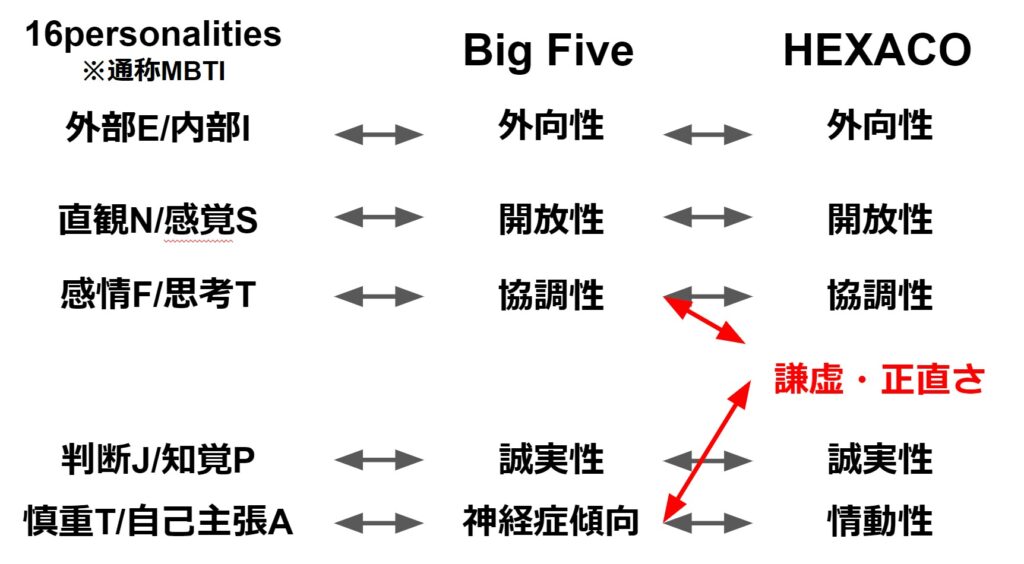
There are papers suggesting a relationship between the academically trusted Big Five and MBTI, which classifies personality into 16 types. The main correlations are as follows.
| Correlation Table | E | I | N | S | F | T | J | P |
| Extraversion | Strong Positive | Strong Negative | Positive | Negative | ||||
| Openness | Positive | Negative | Strong Positive | Strong Negative | Negative | Positive | ||
| Agreeableness | Positive | Strong Negative | ||||||
| Conscientiousness | Negative | Positive | Strong Positive | Strong Negative | ||||
| Neuroticism | Negative | Positive | Negative | Positive | Positive | Negative |
As you can see from this, there is a possibility that the openness in Big Five and HEXACO correlates with N and S in MBTI. This can be summarized in the following diagram.
Relationship between “Openness” and Intelligence
How openness affects intelligence
People with high levels of this trait generally tend to have high intelligence quotient (IQ). The relationship with intelligence is as follows:
- High creative problem-solving abilities
- Strong motivation for learning and quick absorption of new knowledge
- Deep understanding and easier grasp of complex concepts
These characteristics work particularly advantageously in academic environments and research positions.
People with high openness have an open attitude toward new ideas and theories, and by exploring them, they broaden their knowledge.
They can view things from multiple perspectives, which can often lead to better insights and discoveries.
Openness is a factor that promotes intellectual growth and improves the efficiency of learning and research.
Intellectual Curiosity and Its Impact on Learning
Intellectual curiosity promotes the acquisition of new knowledge and skills. The specific effects of this curiosity on learning are as follows:
- Having deep interest and enthusiasm for learning content
- Enjoying new questions and discoveries during the learning process
- Being open to diverse learning methods and approaches
These characteristics help create an effective learning environment. People with high intellectual curiosity don’t just memorize information, but think about how they can apply it.
They often learn self-directedly and set their own learning directions. This approach can greatly improve learning efficiency.
Intellectual curiosity is an important element that makes learning richer and more effective, supporting continuous growth.
Connection to Creativity
It is a personality trait that strengthens creative thinking and ideas.
The relationship between openness and creativity can be seen in the following points:
- Ability to come up with new ideas and solutions
- Freedom of thought that goes beyond conventional frameworks
- Active participation in artistic or innovative projects
People with this high trait can think about things in new ways without being bound by existing methods or approaches.
They often integrate different perspectives and generate unique solutions. Additionally, deep understanding and interest in arts and culture lead them to creative activities.
The strong connection to creativity becomes a source of innovative thinking and ideas.
Genetic Background of “Openness”
What is the Heritability of Openness
This trait is known to be partly influenced by genetic factors.
Points related to heritability are shown below:
- Part of openness is due to heredity
- Studies of identical twins support this
- However, environment also greatly influences overall personality formation
Due to genetic background, openness may show similar tendencies within families. However, individual experiences and the environment in which one is raised are also essential for personality development.
Such interactions between genetics and environment create diversity in individual personalities.
The heritability of openness is an important element in understanding how personality is formed.
Genes that Influence Openness
Openness is partially determined by heredity.
According to research, twin studies show that the heritability of this personality trait is about 60%.
Therefore, genes contribute greatly to the formation of openness.
Let’s look at genetic factors specifically:
- Identical twins with the same genes have similar openness scores even when raised in different environments.
- Genetic influence creates differences in individuals’ positivity toward new experiences and creativity.
Furthermore, the connection with brain function cannot be overlooked.
People with high openness have active specific brain regions, particularly the prefrontal cortex.
This region is responsible for creative thinking and planning.
Such correlations between genetic background and brain function provide clues for understanding how the personality trait of openness is formed.
Interaction Between Genetics and Environment
In the development of openness, not only genetics but also environment plays an important role.
This interaction has the following aspects:
- Family environment and education strengthen or suppress genetic tendencies
- Cross-cultural experiences and social interactions shape openness
- Stressful environments can sometimes have negative effects on the development of openness
Childhood experiences and the quality of education during the developmental process greatly influence the degree of openness.
Support and encouragement from parents and teachers help children gain the courage to challenge new things.
Additionally, the more exposure to social diversity one has, the higher the tendency for openness to increase.
The Relationship Between “Openness” and the Brain
How Openness Affects the Brain
People with high levels of this trait tend to have increased activity in specific brain regions.
The brain-related effects of openness include the following points:
- High activity in the prefrontal cortex
- Efficient processing of new information
The prefrontal cortex is involved in complex thinking and decision-making processes, and activation of this region is associated with an open attitude toward new ideas.
Additionally, people with high neuroplasticity have enhanced learning and memory formation, allowing them to acquire new skills more effectively.
This enables people with high openness to have the ability to flexibly respond to new environments and unknown situations.
The impact of openness on the brain is directly related to an individual’s learning ability and creativity.
Research on the Relationship Between Openness and Brain Function
Latest neuroscience research reveals how openness affects specific brain functions.
Related research results are shown below:
- Relationship with brain information processing speed
- Correlation with emotional regulation ability
- Activation of brain regions governing creative thinking
These studies show that people with high openness can process new information more quickly and manage emotions well.
Additionally, activation of brain regions involved in creative thinking is considered to be directly related to openness.
This improves the ability of people with high openness to solve problems from different perspectives.
Brain function research helps deepen our understanding of human cognition and behavior.
Which Parts of the Brain Are Involved in Openness
The frontal lobe and temporal lobe are particularly deeply involved in openness.
The roles of these brain regions are summarized below:
- Frontal lobe: Decision-making, planning, regulation of social behavior
- Temporal lobe: Language comprehension, emotional processing, memory formation
The frontal lobe is the center that governs adaptation to new information and situations. When this functions actively, people can actively engage in new ideas and challenges.
The temporal lobe plays an important role in processing information obtained from new experiences and understanding emotions related to them.
The activity of these brain regions is directly related to the characteristics of openness and is one of the factors that creates personality diversity.
Methods to Enhance Openness
Strategies to Improve Openness in Daily Life
Actively participating in new experiences and activities improves openness.
Specific methods are as follows:
- Participate in events from different cultures
- Read books in unfamiliar fields or take courses
- Challenge yourself with new hobbies or sports
These activities expand one’s perspective and increase opportunities to encounter new ideas and values.
Additionally, interaction with people from different backgrounds is a great help in learning to accept each other’s differences.
By enhancing openness in this way, it becomes possible to flexibly respond to new environments and situations.
Regularly enhancing openness contributes to individual growth and improved ability to adapt to society.
Effects of Training and Habits
Regular mental training and habits can effectively improve openness.
Habits for enhancing openness include the following:
- Read news from different sources daily
- Regularly engage in creative activities (drawing, writing, etc.)
- Incorporate meditation and thought exploration into daily life
These activities foster mental flexibility and enhance the ability to consider things from various perspectives.
For example, reading news from different sources leads to reducing bias and gaining a broader perspective.
Creative activities promote creative thinking by giving form to new ideas.
Training and habits to increase openness can be incorporated into daily life to help you grow into a more flexible and tolerant person.
Balance with Other HEXACO Elements
Openness interacts with other HEXACO personality elements to form an individual’s overall personality profile.
The importance of balance with other elements is shown below:
- Balance with honesty: Being adventurous while maintaining reliability
- Balance with emotional stability: Enjoying new experiences while controlling emotions
- Balance with agreeableness: Valuing self-expression while seeking harmony with others
Such balance helps individuals adapt both socially and personally.
For example, people with high openness may enjoy taking on new challenges, but if honesty is low, they may lack reliability.
Also, if they can control their emotions, they can respond calmly even in uncertain situations.
The balance between openness and other HEXACO elements is important for living a more effective and satisfying life.
For those who want to know the HEXACO model in more detail, please also see the following article. You can also take the HEXACO psychology test here.
Social Significance of “Openness”
The Impact of Openness on Career Choices
People high in this trait tend to pursue creative or social careers.
Specific impacts on career choices are shown below:
- Careers requiring creativity, such as artists and writers
- Careers with frequent human interaction, such as social welfare and education
- Research positions and fields involving technological innovation
People high in this trait are open to new ideas and approaches, and can easily adapt to non-traditional careers and environments.
They have little resistance to accepting change and have the ability to find new solutions amid uncertainty.
Such traits are skills particularly sought after in rapidly evolving industries and creative fields.
Understanding the impact of openness on career choices is very beneficial for determining career direction.
The Role of Openness in Social Life
Openness promotes adaptation and cooperation in diverse social environments.
The impact on social life is shown below.
- Ability to accept different cultures and values
- Flexible response to new social situations
- Improvement of communication and cooperation
People with high openness are curious about new ideas and different perspectives, and can accept differences of opinion with others.
This enables them to build effective communication with people from various backgrounds.
Additionally, a cooperative attitude contributes to the success of teamwork and collaborative projects.
Openness is the key to enjoying a rich and diverse social life.
Human Relationships and Openness
People with high openness help enrich human relationships and deepen mutual understanding.
The effects of openness in human relationships are shown below:
- Active attitude toward meeting new people
- Tolerance for different opinions and values
- Promotion of deep dialogue and emotional connections
People high in this trait maintain an open attitude in communication with others.
This makes it easier to understand others’ opinions and emotions, leading to deeper relationships.
Additionally, by enjoying interactions with various people, they can build broader networks.
Openness is extremely important for building trust and understanding in human relationships.
In Conclusion
In this article, we delved deep into “openness,” one of the HEXACO personality model traits.
This trait is an important personality characteristic that shows receptiveness to new experiences and ideas.
People high in this trait are rich in creativity and can flexibly adapt to different cultures and new environments. On the other hand, people low in this trait prefer stable environments and take a cautious stance toward change.
We found that it is closely related to intelligence and creativity, and has a significant impact on learning and career choices.
Moreover, in social life and human relationships, it serves as a key to enhancing communication and cooperation, and building rich interpersonal relationships.
Understanding openness and gaining a deeper understanding of one’s own and others’ personalities contributes not only to personal growth but also to effective social participation.
Focusing on this personality trait and consciously enhancing openness in daily life will be a step toward living a more fulfilling life.

Writer & Supervisor: Eisuke Tokiwa
Personality Psychology Researcher / CEO, SUNBLAZE Inc.
As a child he experienced poverty, domestic abuse, bullying, truancy and dropping out of school — first-hand exposure to a range of social problems. He spent 10 years researching these issues and published Encyclopedia of Villains through Jiyukokuminsha. Since then he has independently researched the determinants of social problems and antisocial behavior (work, education, health, personality, genetics, region, etc.) and has published 2 peer-reviewed journal articles (Frontiers in Psychology, IEEE Access). His goal is to predict the occurrence of social problems. Spiky profile (WAIS-IV).
Expertise: Personality Psychology / Big Five / HEXACO / MBTI / Prediction of Social Problems
Researcher profiles: ORCID / Google Scholar / ResearchGate
Social & Books: X (@etokiwa999) / note / Amazon Author Page