
Honesty-Humility is an indispensable personality trait for building a society where people trust and respect each other.
This trait also reflects the ability to speak honestly and to value others beyond one’s own interests.
In daily life, as well as in human relationships at work and home, having honesty and humility creates healthier and more supportive human relationships.
However, when this important trait is low, various problems can arise.
Human relationships may become shallow, or trust may not be established.
In this article, we will explain in detail the importance of honesty and humility and specific methods for enhancing it.
By introducing approaches that anyone can undertake, including self-development approaches, education and training, and small daily practices, we will help you aim for better human relationships and society.
Once again, personality researcher and author of Villain Encyclopedia, Tokiwa (@etokiwa999), will provide the explanation.
※We have developed the HEXACO-JP Personality Assessment! It has more scientific basis than MBTI. Tap below for details.

目次
- 1 What is Honesty and Humility?
- 2 Characteristics of Honesty-Humility
- 3 The Impact of Honesty-Humility
- 4 Psychological and Biological Foundations of Honesty and Humility
- 5 Measurement and Evaluation of Honesty-Humility
- 6 Honesty-Humility and the Dark Triad
- 7 Ways to Enhance Honesty-Humility
- 8 In Conclusion
What is Honesty and Humility?
Definition of Honesty and Humility
A trait that shows honesty and humble attitude toward others.
This trait is characterized by suppressing self-centered behavior and valuing fairness.
Therefore, it becomes easier to build trusting relationships with others.
This trait includes the following elements:
- Honesty: An attitude that values speaking the truth.
- Fairness: A mindset that seeks to maintain justice with others.
- Humility: Not overestimating one’s abilities or achievements.
Additionally, honesty and humility play important roles in human relationships and social life.
Next, let’s look at how this trait is positioned psychologically.
By understanding this trait, you can enhance the quality of human relationships.
Psychological Background of Honesty and Humility
Honesty and humility is a personality trait deeply related to human social behavior.
This trait greatly influences how individuals interact with others.
Specifically, it promotes altruistic behavior and fair judgment.
This personality trait is explained from the following psychological aspects:
- Altruism: Prioritizing others’ interests over one’s own interests.
- Self-control: Suppressing one’s desires or interests and choosing the right action.
These elements influence how individuals behave in society.
Moreover, these psychological traits are also important in interpersonal relationships in various situations.
Now, let’s also look at the positioning of honesty and humility in the HEXACO model.
Honesty and humility is an essential element for individual social success.
By cultivating this personality trait, it becomes possible to build better human relationships.
Position in the HEXACO Model
In the HEXACO model, honesty and humility occupies an important position as one of the six personality traits.
This model is an extension of the traditional Big Five theory and captures broader aspects of personality.
Honesty and humility plays a central role especially in ethical behavior and interpersonal relationships.
Let’s focus on the following points regarding how this trait is treated within the model:
- Ethics: Promotes behavior aligned with social norms and ethics.
- Interpersonal respect: Values respecting and treating others equally.
- Self-transcendence: An attitude that considers greater benefits beyond personal interests.
These elements influence individual behavior and judgment criteria while also relating to other traits in the HEXACO model.
Next, let’s look in detail at what characteristics people with high honesty and humility possess.
Honesty and humility is indispensable for building trustworthy human relationships.
Understanding and cultivating this trait within oneself will open the path to social success.
For those who want to know more details about the HEXACO model, please also see the following article. You can also take the HEXACO psychological test from here.
Relationship with MBTI’s Four Indicators
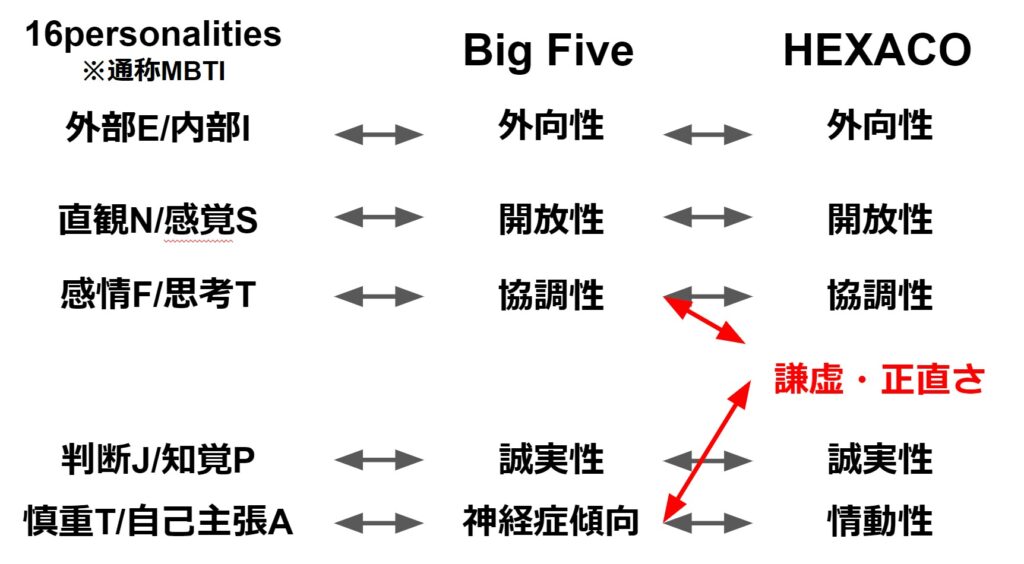
There are papers suggesting relationships between the academically trusted Big Five and MBTI, which classifies personalities into 16 types. The main correlations are as follows:
| Correlation Table | E | I | N | S | F | T | J | P |
| Extraversion | Strong Positive | Strong Negative | Positive | Negative | ||||
| Openness | Positive | Negative | Strong Positive | Strong Negative | Negative | Positive | ||
| Agreeableness | Positive | Strong Negative | ||||||
| Conscientiousness | Negative | Positive | Strong Positive | Strong Negative | ||||
| Neuroticism | Negative | Positive | Negative | Positive | Positive | Negative |
As can be seen here, it shows that each indicator of the Big Five and each indicator of MBTI may be related.
Additionally, parts of Big Five’s agreeableness and parts of neuroticism are related to the “Honesty-Humility” factor in HEXACO. This can be summarized in the following diagram:
Characteristics of Honesty-Humility
Traits of People with High Honesty-Humility
People with high honesty-humility are highly trusted by others and are evaluated as having high cooperativeness.
They do not overestimate themselves, respect others’ opinions, and maintain a fair attitude.
Such people have less friction in interpersonal relationships and increase reliability within groups.
Here are some of those characteristics:
- Reliability: Known for keeping promises and obligations.
- Humility: Treats their own success modestly and acknowledges others’ contributions.
- Fairness: Maintains a fair attitude in any situation.
These characteristics are highly valued in many social and workplace environments.
Additionally, people with high honesty-humility are often expected to take on leadership roles.
Next, let’s look at the characteristics of people with low honesty-humility.
High honesty-humility builds the path to good human relationships and success.
Understanding and incorporating these characteristics leads to personal growth.
Characteristics of People with Low Honesty-Humility
People with low honesty-humility are often self-centered and tend to exploit others.
They prioritize their own interests and frequently disregard the feelings and interests of others.
Such characteristics can cause problems in interpersonal relationships and social situations.
The following characteristics are observed in people with low honesty-humility:
- Self-centeredness: Prioritizing one’s own desires and goals over others.
- Manipulativeness: Attempting to achieve one’s goals by skillfully manipulating others.
- Arrogance: Overestimating one’s abilities or status and looking down on others.
These characteristics make it particularly prone to conflicts with other members in environments where teamwork is required.
Moreover, these behaviors can lead to deteriorated relationships and loss of trust in the long term.
When honesty-humility is low, it may correspond to the “Dark Triad,” which we will introduce later.
Understanding people with low honesty-humility is the first step in taking countermeasures.
This will help improve healthier interpersonal relationships and workplace environments.
Next, we will explore the relationship between honesty-humility and other personality traits.
The Relationship Between Honesty-Humility and Other Personality Traits
Honesty-humility is closely related to other personality traits and forms an individual’s overall personality profile.
This trait is particularly strongly linked with conscientiousness and agreeableness in HEXACO.
Honest and humble people usually have a strong sense of duty and tend to value harmony with others.
The main personality traits related to honesty-humility are shown below:
- Conscientiousness: The trait of being highly responsible and acting in a planned manner.
- Agreeableness: The tendency to actively cooperate with others and avoid conflict.
- Openness: Receptiveness to new ideas and different perspectives.
Through interactions with these traits, honesty-humility is more deeply understood, making it possible to predict behavior in social contexts.
Additionally, these traits also influence how individuals cope with stress and interpersonal problems.
Next, we will explore the impact of honesty-humility in interpersonal relationships.
Understanding the relationship between honesty-humility and other personality traits enables more effective relationship building.
This knowledge helps with personal growth and improvement in social life.
The Impact of Honesty-Humility
The Impact of Honesty-Humility in Interpersonal Relationships
Honesty-humility plays a very important role in building trust and respect in interpersonal relationships.
People with this trait are highly trusted by others and can easily maintain healthy relationships with few conflicts.
Furthermore, they often take on roles as mediators or facilitators of reconciliation.
The specific impacts of honesty-humility in interpersonal relationships are as follows:
- Building trust: Through honest communication, it becomes easier to gain trust from others.
- Avoiding conflicts: By restraining oneself and respecting others’ positions, unnecessary confrontations are avoided.
- Promoting reconciliation: A fair and humble attitude facilitates reconciliation during conflicts.
These effects are important in various social situations such as family life, workplace environments, and friendships.
Next, let’s focus on the effects of honesty-humility in the workplace.
Honesty-humility becomes the foundation for building healthy and sustainable relationships.
By cultivating this trait, all human relationships will become more fulfilling.
The Effects of Honesty-Humility in the Workplace
Honesty-humility in the workplace has the effect of enhancing team cooperation and productivity.
People with this trait are valued as trusted leaders or effective team members.
They have a fair and sincere attitude and can build good relationships with those around them.
Let’s look at the main benefits that honesty-humility brings in the workplace:
- Cooperative workplace environment: An attitude of respecting and supporting others fosters a cooperative atmosphere.
- Efficient decision-making: More efficient decision-making becomes possible through fair and transparent processes.
- Improved trust: By consistently acting with integrity, trust from supervisors and colleagues deepens.
These effects boost workplace morale and contribute to overall productivity improvement.
Furthermore, an honest and humble attitude also works favorably for long-term career development in the workplace.
Next, we will explore in detail the impact on social credibility.
Honesty and humility in the workplace are essential for sustainable success and building human relationships.
By acquiring this trait, it becomes possible to make valuable contributions in any work environment.
Impact on Social Credit
Honesty and humility are indispensable traits for building an individual’s social credit.
People with this trait are easily trusted by others and become trustworthy individuals.
Social credit becomes the driving force that enhances an individual’s reputation and trustworthiness, attracting many opportunities.
The improvement of social credit brought about by honesty and humility has the following impacts:
- Building strong trust relationships: Sincere and fair behavior strengthens trust from others.
- Formation of good reputation: It becomes the foundation for building a positive reputation.
- Expansion of broad networks: Being seen as highly reliable deepens relationships with various people.
These effects contribute to broadening an individual’s social and professional prospects.
Next, let’s delve into the psychological and biological foundations of honesty and humility.
Social credit greatly influences the quality of an individual’s achievements and relationships.
Psychological and Biological Foundations of Honesty and Humility
Psychological and Biological Foundations of Honesty and Humility
Influenced by both psychological factors and biological mechanisms.
This personality trait is also related to specific brain regions and genetic elements, causing individual differences.
Understanding the impact of biological factors on personality formation is important for understanding personality diversity.
The foundations of honesty and humility include the following elements:
- Brain mechanisms: Specific brain regions like the prefrontal cortex are involved in ethical judgment and self-control.
- Genetic factors: Some personality traits have been shown to be influenced genetically.
- Developmental psychology: Personality formation is also shaped by social environments from an early stage.
These factors provide clues to explain how the traits of honesty and humility develop and how they differ individually.
Next, let’s look more closely at genetic and environmental factors.
Understanding the personality traits of honesty and humility helps explore the factors behind individual behavior and judgment.
This makes it possible to understand the behavior of oneself and others more deeply and take appropriate countermeasures.
Genetic Factors and Environmental Factors
The traits of honesty and humility are formed by both genetic and environmental factors.
Personality is partly due to heredity, but experiences during individual growth also have a significant impact.
Understanding this dual influence deepens insights into personality development.
Let’s consider the following points about how heredity and environment work:
- Genetic preset: Certain personality traits exist as tendencies from birth.
- Influence of nurturing environment: Environments such as home, school, and society shape personality.
- Individual experiences: Life events and experiences have unique influences on personality.
By combining these elements, individual personalities develop in unique ways.
Next, let’s explore in detail the formation of honesty and humility during developmental stages.
Understanding genetic and environmental factors is important for accepting personality diversity and properly evaluating individual differences.
This makes better support and intervention possible for individuals and groups.
Formation of Honesty and Humility in Developmental Stages
The traits of honesty and humility begin to form from early stages of life.
Childhood experiences and education from parents have a significant impact on the development of this personality trait.
Appropriate role models and education in childhood build the foundation for nurturing honesty and humility.
Let’s look closely at the factors that influence the formation of honesty and humility in developmental stages:
- Role models in the family: Behavior shown by parents and siblings shapes children’s behavioral patterns.
- Social interactions: Relationships with friends and teachers teach social norms and values.
- Cultural background: Cultural expectations and traditions also influence personality development.
These factors help children learn through social interactions and develop self-awareness and consideration for others.
Next, let’s see how honesty and humility are useful in interpersonal relationships and the workplace.
Early nurturing of honesty and humility contributes to long-term social success and individual happiness.
This promotes the building of healthy human relationships and personal growth.
Measurement and Evaluation of Honesty-Humility
Methods for Measuring Honesty-Humility
Various psychological tests and questionnaires are used to measure this trait.
These tools help quantitatively assess individual personality traits.
Precise measurement not only enhances individual self-awareness but is also important for research and clinical evaluation.
The main methods for measuring honesty-humility are shown below:
- Self-report questionnaires: Questionnaires for individuals to evaluate their own personality.
- Observation-based assessment: Evaluation based on behaviors observed by others.
- Psychological tests: Tests including situational judgment and ethical dilemmas.
These methods are often used in combination because each captures personality traits from different perspectives.
Next, let’s delve into the reliability and validity of these assessment tools.
The use of accurate measurement tools is essential for deeply understanding honesty-humility traits and developing appropriate personal development strategies.
This makes self-improvement efforts more effective.
Reliability and Validity of Assessment Tools
The reliability and validity of tools for evaluating honesty-humility depend on their accuracy and consistency.
Psychological assessment tools need to be developed based on strict scientific standards.
Accurate evaluation is important not only for deepening individual self-understanding but also for improving the quality of psychotherapy and educational programs.
The main characteristics of assessment tools are as follows:
- Reliability: The tool’s ability to provide consistent results.
- Validity: Whether the tool accurately measures the intended traits.
- Applicability: The tool’s applicability to people with various cultural and background differences.
These elements ensure that assessment tools are fair and effective for a wide range of people.
Next, we will examine how to interpret data using these tools and how that information is utilized.
Appropriate development and use of assessment tools is necessary to support individual and group psychological health and deepen understanding of honesty-humility.
This enables more effective personal and social interventions.
Self-Assessment Methods in Daily Life
Methods for evaluating one’s honesty-humility in daily life are based on self-observation and reflection.
By reflecting on daily actions and decisions, individuals can gain deep understanding of their personality traits.
This process provides concrete clues for self-improvement.
The specific steps for conducting self-assessment are as follows:
- Keeping a journal: Record daily actions, decisions, and accompanying emotions.
- Reflecting on behavior: Through reflection, evaluate which actions demonstrated honesty-humility.
- Seeking feedback: Use feedback from family and friends to deepen self-awareness.
These activities enhance self-awareness while contributing to personal growth.
Next, let’s consider the long-term benefits that this self-assessment brings.
Daily self-assessment clarifies one’s behavioral patterns and leads to sustainable self-improvement.
This strengthens the foundation for building more honest and humble interpersonal relationships.
Honesty-Humility and the Dark Triad
What is the Dark Triad
The Dark Triad refers to three personality traits: narcissism, Machiavellianism, and psychopathy.
These are generally considered socially undesirable traits that can negatively impact interpersonal relationships.
Each trait demonstrates tendencies toward self-centered and manipulative behavior.
Let’s look in detail at each trait of the Dark Triad:
- Narcissism: Strong self-love with a tendency to prioritize oneself over others.
- Machiavellianism: Ability to skillfully manipulate others and will use any means for self-interest.
- Psychopathy: Characterized by lack of emotion and may engage in impulsive and irresponsible behavior.
These traits have various impacts on individual behavior and relationships, often causing conflict and problems.
Next, let’s delve into how people with low honesty-humility demonstrate these traits.
Understanding the Dark Triad helps in recognizing and addressing problematic behaviors in individuals and organizations.
This enables the construction of healthier interpersonal relationships and organizational cultures.
*Additionally, “sadism” is sometimes added to call it the Dark Tetrad.
Risks of Low Honesty-Humility
Low honesty-humility carries both personal and social risks.
When this trait is lacking, it becomes difficult to build trust in relationships and workplace environments.
Additionally, it may lead to prioritizing competition with others and frequently causing conflicts and confrontations.
The following are potential problems that may arise from low honesty-humility:
- Relationship problems: Building relationships with others becomes difficult, which may lead to isolation.
- Trust issues in the workplace: Unable to gain trust from colleagues and supervisors, career opportunities may be limited.
- Ethical issues: Self-centered behavior may cause situations where ethical questions arise.
These problems become factors that hinder an individual’s social and professional success in the long term.
Next, let’s consider countermeasures to mitigate these risks.
Understanding the risks of low honesty-humility helps in building healthier individual growth and society.
By taking appropriate countermeasures, we can prevent these problems and move in a better direction both as individuals and as a society.
Dark Triad Traits and Countermeasures
Methods to address Dark Triad traits are extremely important for individuals and society.
It is necessary to understand the problems these personality traits bring and respond appropriately.
In particular, countermeasures are required to prevent problems in interpersonal relationships and the workplace.
The main methods for establishing countermeasures are as follows:
- Raising awareness: Recognizing problematic behaviors and understanding their impact.
- Educational programs: Conducting education about narcissism, Machiavellianism, and psychopathy.
- Counseling: Addressing the causes of problematic behaviors through individual counseling.
These methods help individuals reflect on their own behavior and make improvements.
Furthermore, it is possible to develop specific strategies to reduce the negative effects of these personality traits.
Next, let’s look at how these countermeasures contribute to improving individual behavior.
By effectively addressing Dark Triad traits, healthy relationships and workplace environments are promoted.
This is expected to realize a more harmonious society.
Ways to Enhance Honesty-Humility
Self-Development Approaches
Self-development is effective for enhancing honesty-humility.
Consciously paying attention to one’s own behavior and thoughts leads to improvement of this personality trait.
By practicing specific self-development methods, the quality of daily life improves.
Specific methods to promote self-development are as follows:
- Goal setting: Setting specific goals for one’s own behavior.
- Meditation and reflection: Looking back on daily events and evaluating one’s own behavior.
- Reading and learning: Reading books and articles related to honesty and humility to deepen knowledge.
These activities enhance self-awareness and support the process of self-improvement.
Next, let’s consider how these self-development methods can be incorporated into daily life.
Regular practice of self-development enhances the quality of honesty-humility and contributes to improvement in relationships.
This enriches relationships not only with oneself but also with people around you.
Promotion Through Education and Training
Education and training play important roles in improving honesty-humility.
By utilizing these methods, individuals and groups can understand this personality trait and effectively cultivate it.
Educational programs and workshops provide practical skills and promote behavioral change.
Methods to promote honesty-humility through education and training include the following:
- Conducting workshops: Providing interactive sessions focused on honesty-humility.
- Role-playing: Deepening understanding and skills by simulating appropriate behavior according to situations.
- Feedback and coaching: Providing immediate feedback on participants’ behavior and pointing out areas for improvement.
These activities provide opportunities for participants to observe and correct their own behavior.
Next, let’s look at how these educational activities bring about specific results.
Enhancing honesty-humility through education and training contributes to individual growth and improves the ethical standards of society as a whole.
These efforts are essential for fostering a culture of trust and cooperation in organizations and society.
Small Daily Practice Examples
Small practices are very effective for incorporating honesty-humility into daily life.
Through daily actions, you can naturally acquire this personality trait.
By practicing specific examples, awareness of your own behavior increases.
Let’s list some examples of small practices you can try in daily life:
- Expressing gratitude: Daily expressing feelings of gratitude toward people around you.
- Maintaining a humble attitude: Not boasting about your own success and recognizing others’ contributions.
- Provide honest feedback: Offer constructive and sincere feedback to those around you.
These actions help shape individual character and build trusting relationships with others.
Furthermore, these practices also contribute to raising the ethical standards of society as a whole.
By accumulating small daily practices, you can naturally develop honesty and humility.
This promotes self-growth and makes it possible to build more fulfilling human relationships.
In Conclusion
Through this article, you were able to learn in detail about the value of honesty and humility and methods for improving them.
Honesty and humility are important elements that not only enhance individual happiness but also deepen trusting relationships with others and promote harmony in society as a whole.
Cultivating these traits through self-development, education and training, and small daily practices has a positive impact not only on yourself but also on the people around you.
While efforts to enhance honesty and humility cannot be achieved overnight, by practicing step by step, your character will surely grow and you will be able to live a more fulfilling life.
We hope that the knowledge and practical methods provided in this article will be useful in your daily life and help you build richer human relationships.
By cherishing honesty and humility, we hope that a society of trust and respect will spread.

Writer & Supervisor: Eisuke Tokiwa
Personality Psychology Researcher / CEO, SUNBLAZE Inc.
As a child he experienced poverty, domestic abuse, bullying, truancy and dropping out of school — first-hand exposure to a range of social problems. He spent 10 years researching these issues and published Encyclopedia of Villains through Jiyukokuminsha. Since then he has independently researched the determinants of social problems and antisocial behavior (work, education, health, personality, genetics, region, etc.) and has published 2 peer-reviewed journal articles (Frontiers in Psychology, IEEE Access). His goal is to predict the occurrence of social problems. Spiky profile (WAIS-IV).
Expertise: Personality Psychology / Big Five / HEXACO / MBTI / Prediction of Social Problems
Researcher profiles: ORCID / Google Scholar / ResearchGate
Social & Books: X (@etokiwa999) / note / Amazon Author Page