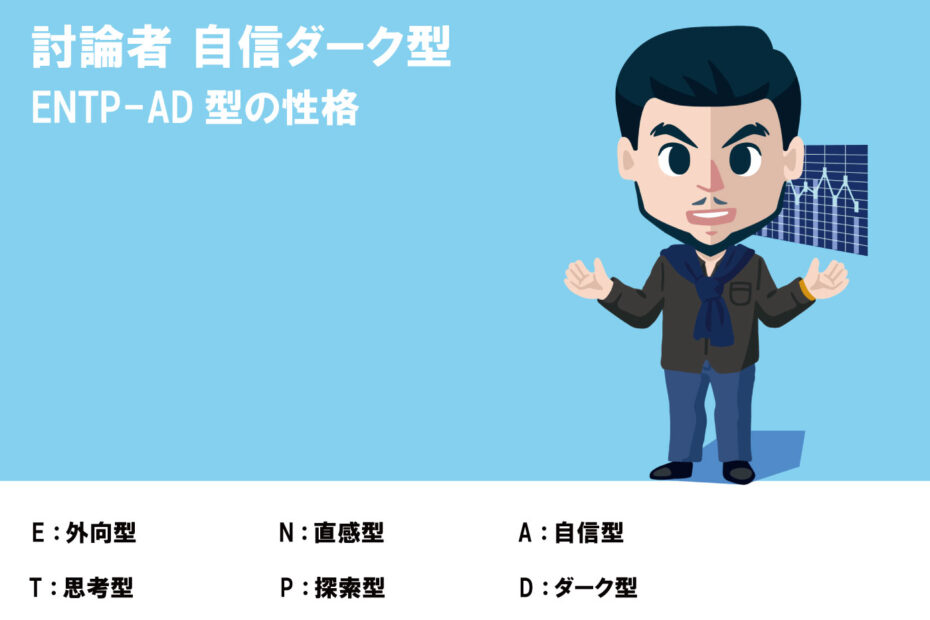
Do new ideas constantly pop into your head, making you question existing frameworks?
ENTP-AD is an intellectual explorer with such innovative thinking.
You may have experienced wondering “Why this method?” in meetings, or thinking “Is that really true?” about things considered common sense.
This article deeply explores the mental world of the ENTP-AD type, revealing the reasons behind the thought patterns and behaviors you experience daily.
Whether you feel you might be this type, or think you know someone like this, you’ll surely make new discoveries.
Would you like to explore the fascinating inner world of ENTP-AD together?
Once again, personality researcher and author of Villain Encyclopedia, Tokiwa (@etokiwa999), will provide the explanation.
※We have developed the HEXACO-JP Personality Assessment! It has more scientific basis than MBTI. Tap below for details.

目次
- 1 Overview of HEXACO
- 2 Characteristics of ENTP-AD
- 3 Strengths and Weaknesses of ENTP-AD
- 4 ENTP-AD’s Romantic Relationship Tendencies and Improvement Strategies
- 5 ENTP-AD’s Friendship Tendencies and Improvement Strategies
- 6 ENTP-AD Parenting Tendencies and Improvement Strategies
- 7 ENTP-AD Career Trends and Improvement Strategies
- 8 ENTP-AD Work Trends and Improvement Strategies
- 9 Compatible Types for ENTP-AD
- 10 ENTP-AD Summary
- 11 FAQや注意点
- 12 補足
Overview of HEXACO
What is HEXACO
The HEXACO model is a new door to understanding personality.
Haven’t you also wondered “Why do I think this way?”
HEXACO unravels the human mind through 6 elements.
Each of these 6 letters has deep meaning:
- H: Honesty-Humility
- E: Emotionality
- X: eXtraversion
- A: Agreeableness
- C: Conscientiousness
- O: Openness
By adding the important aspect of “Honesty-Humility” that couldn’t be captured by traditional personality assessments, more precise self-understanding has become possible.
It’s like finding an important missing piece in the complex puzzle of personality.
HEXACO’s 64 Classifications
Classification into 64 types based on high and low levels of each of the 6 elements. Specifically, as follows.
- H: Honesty-Humility
- High → Light (L: Light)
- Low → Dark (D: Dark)
- E: Emotionality
- High → Turbulent type (T: Turbulence)
- Low → Assertive type (A: Assertiveness)
- X: eXtraversion
- High → Extrovert type (E: Extrovert)
- Low → Introvert type (I: Introvert)
- A: Agreeableness
- High → Feeling type (F: Feeling)
- Low → Thinking type (T: Thinking)
- C: Conscientiousness
- High → (J: Judging)
- Low → (P: Prospecting)
- O: Openness
- High → Intuitive type (N: iNtuitive)
- Low → Sensor type (S: Sensor)
These are connected like 16personalities to express types.
Let’s introduce the various types!
What’s the difference from ENTP-A (Debater・Assertive type)?
ENTP-A is a type with high extraversion (E), high openness (N), low agreeableness (T), low conscientiousness (P), and low neuroticism (A) in the Big Five.
- Creative and innovative thinking
- High adaptability and flexibility
- Enjoys logical debates
- Confident adventurous spirit
- High stress tolerance
They enjoy generating new ideas and sharing them with others.
They solve problems using critical thinking and improvisational skills.
In interpersonal relationships, they seek intellectual stimulation and prefer active discussions.
They welcome change and challenges, constantly exploring new possibilities.
They are resilient to stress and view failures positively as learning opportunities.
Characteristics of ENTP-AD
Characteristic ①: “Intellectually Curious Logical Thinker”
Have you ever been reading one book in a library and found yourself curious about 10 related books?
ENTP-AD is exactly that kind of explorer with infinite intellectual curiosity.
For them, learning is as natural as breathing.
This mental activity manifests in the following ways:
- The sensation of ideas connecting one after another in their mind
- Thought patterns where the question “Why?” never stops
- The joy of unraveling complex problems
You may have experienced wanting to suggest “But shouldn’t we consider this from a different angle?” in meetings where everyone is rushing to conclusions.
This is not a contrarian personality, but rather an expression of pure curiosity to discern the essence of things.
In fact, ENTP-AD finds great joy in discovering truth through discussion.
Sometimes they may start arguing from positions they don’t completely believe in.
This is not to trouble others, but an expression of intellectual honesty wanting to explore all possibilities.
In essence, the ENTP-AD mind is constantly filled with the desire to understand “deeper and broader.”
Characteristic ②: “Confident and Optimistic Problem Solver”
When facing difficult situations, don’t you sometimes feel “things will work out somehow”?
ENTP-AD is like someone who enjoys finding strategies to conquer the game of life.
For them, problems are puzzles to be solved.
This optimistic attitude manifests in the following situations:
- The moment they answer “Let’s try it” to projects deemed “impossible”
- The thinking that views failure positively as “one more piece of data”
- The mindset that welcomes risks as “new possibilities”
You may have experienced being surprisingly calm in situations where others around you were worried.
This is not irresponsibility, but rather deep trust in your abilities and conviction that situations can be improved.
Moreover, ENTP-AD is not bound by conventional solution methods.
They value the thinking “But what about this approach?” more than “This is how it’s always been done.”
This flexibility is the source of their problem-solving abilities.
As a result, ENTP-AD uses confidence and creativity as weapons to carve out paths even when others around them are about to give up.
Characteristic ③: “Innovative Thinking Beyond Existing Frameworks”
Don’t you sometimes wonder “Why is this considered common sense?”
ENTP-AD is like a bird trying to fly freely from the invisible cage of social conventions.
They don’t feel comfortable being bound by the word “normal.”
This free thinking appears as the following characteristics:
- Natural questioning of fixed ideas about “how things should be”
- An attitude that explores the logic behind morals and customs
- The courage to calmly approach even taboo topics
You may have experienced feeling unsatisfied with reasons like “because everyone says so” and wanting to think things through for yourself.
This is not a rebellious personality, but an honest attitude seeking truth.
In fact, ENTP-AD doesn’t get flustered even when facing ethical dilemmas.
Rather, they try to uncover the complex structures hidden within.
They sometimes provide new perspectives on the boundaries between “right” and “wrong.”
However, this comes not from irresponsibility, but from constructive motivation to find better answers.
ENTP-AD’s innovative thinking can become an important force for advancing the times.
Strengths and Weaknesses of ENTP-AD
Strengths of ENTP-AD
Have you experienced moments when ideas are born in your mind like fireworks?
ENTP-AD’s greatest charm lies in their creative thinking power.
They are masters of creating chemical reactions of thought.
This talent shines in various everyday situations:
- Natural charisma that inspires teams
- The ability to explain complex situations in an understandable way
- Adaptability that doesn’t fear change but rather enjoys it
You have surely felt joy when explaining difficult concepts to friends and seeing them understand with an “I see!”
That is ENTP-AD’s innate talent for simplifying complex things.
Also, the mindset of feeling “this looks interesting!” even when thrown into new environments is a trait many people envy.
In today’s rapidly changing society, this flexibility becomes the greatest weapon.
ENTP-AD spends their days as if exploring new stages in the RPG game of life.
As a result, ENTP-AD is a modern knight who possesses three powerful weapons: creativity, adaptability, and communication skills.
Weaknesses of ENTP-AD
Have you ever experienced not noticing that the other person was hurt while you were in the heat of an argument?
ENTP-AD’s passionate love for debate can sometimes leave the hearts of those around them behind.
It’s like an explorer who becomes so absorbed in intellectual adventure that they lose sight of their companions.
The situations where this trait becomes problematic are as follows:
- Moments when they prioritize logic over the other person’s emotions
- Tendency to jump on new ideas and abandon previous projects
- Habit of being absorbed in big visions and dismissing detailed work
You may have experienced people around you saying “starting something new again…”
This is not because they are easily bored, but rather a manifestation of a positive desire to constantly pursue better possibilities.
However, it is also true that this trait can potentially overwhelm those around them.
Also, being poor at detailed work is the flip side of having the talent for a broad perspective.
Because they excel at surveying the entire forest, it becomes difficult to pay attention to each individual tree.
This is not a flaw, but rather evidence of having a special perspective.
In essence, ENTP-AD’s weaknesses are the result of their excellent strengths sometimes going too far.
ENTP-AD’s Romantic Relationship Tendencies and Improvement Strategies
ENTP-AD’s Romantic Tendencies
Have you ever experienced becoming so absorbed in conversation with a lover that you lost track of time?
For ENTP-AD, romance is like an intellectual dialogue between hearts.
They tend to seek partners as discussion partners in life.
This view of romance manifests in the following characteristics:
- Longing for a partner they can talk with until late at night
- Desire to explore new worlds together
- Preference for surprises over routines
You may have had the experience of talking about “what if” scenarios with your lover, only to find that hours had passed and it was suddenly morning.
ENTP-AD is strongly attracted to partners who provide such intellectual stimulation.
On the other hand, it’s more natural for them to suddenly suggest “Let’s go somewhere different today!” rather than having the same pattern of dates every day.
This behavior stems from pure feelings of wanting to enrich their relationship together, not from wanting to trouble their partner.
However, they also have difficulty expressing emotions in words.
They might feel more natural saying “I discover new things when I’m with you” rather than “I love you.”
As a result, ENTP-AD’s romance becomes a special journey-like experience filled with intellectual curiosity and adventurous spirit.
When Problems Arise in Romance and Improvement Strategies
Have you ever experienced making your partner even sadder by asking “Why do you feel that way?” when they were feeling down?
ENTP-AD sometimes forgets to empathize with their partner’s heart due to their good intention of wanting to provide logical solutions.
It’s like a situation where a doctor focuses more on the cause of the illness than on the patient’s pain.
The challenges they easily face in romance are as follows:
- The need to ask “Are you okay?” and show support before asking “Why?”
- The attitude of cherishing this moment rather than worrying about the future
- Recognizing situations where kindness is needed more than being right
To develop emotional empathy, it’s important to first have the mindset of “accepting” rather than trying to “understand” your partner’s feelings.
Words like “I don’t really understand your feelings, but you seem to be suffering” can sometimes resonate more than logical solutions.
Also, if you feel anxious about long-term relationships, try discussing this honestly with your partner.
By sincerely expressing feelings like “I want to be free, but I also want to cherish our relationship,” you might find a comfortable distance that works for both of you.
Sometimes stopping the discussion and quietly holding your partner’s hand can be sufficient expression of love.
Non-verbal expressions of love should also be enjoyable for ENTP-AD as one of their new discoveries.
ENTP-AD’s Friendship Tendencies and Improvement Strategies
Friendship Tendencies
Have you ever experienced talking with a friend at a café and realizing it had turned into a philosophical discussion?
For ENTP-AD, friendships are a place for special chemical reactions where they provide intellectual stimulation to each other.
They see friends as companions who help solve the big puzzle of life together.
This view of friendship manifests in the following ways:
- Interest in interacting with experts from different fields
- Deep conversations that start with “Why do you think that?”
- A longing for relationships that stimulate each other’s growth
You’ve probably experienced a special sense of fulfillment when you and a friend had one of those conversations that started with “Actually, I’ve never told anyone this before, but…”
ENTP-AD values this kind of deep emotional exchange above all else.
They also prefer free relationships without mutual constraints.
Rather than meeting on a fixed day each week, it feels more natural to suddenly reach out saying “I have an interesting story, want to meet up?”
This isn’t about neglecting the other person, but rather an expression of thoughtfulness in wanting to respect each other’s autonomy.
As a result, ENTP-AD’s friendships become deep and free bonds based on high-quality intellectual exchange and mutual respect.
When Friendships Become Problematic and Improvement Strategies
Have you ever experienced ruining the atmosphere by responding to a friend’s opinion with “But isn’t that logically flawed?”
ENTP-AD’s sharp intelligence can sometimes become a blade that hurts friends’ feelings.
Like a surgeon’s scalpel – precise but capable of causing pain if used incorrectly.
Points to be mindful of in friendships include:
- Distinguishing between debate settings and emotional support settings
- Making an effort to understand the other person’s position before criticizing
- Being conscious of maintaining relationships through regular contact
When a friend is venting, they may not necessarily be seeking solutions.
Words of empathy like “That must have been difficult” can sometimes heal a friend’s heart more than any logical advice.
Also, especially when you’re absorbed in new interests, make a conscious effort to stay in touch with old friends.
Even a simple message like “How have you been lately?” can provide reassurance that they haven’t been forgotten.
Sometimes saying “Your opinion is interesting too” to acknowledge the other person’s values can create an atmosphere of dialogue rather than debate.
Remember that in friendships, mutual understanding is more important than winning or losing.
ENTP-AD Parenting Tendencies and Improvement Strategies
Parenting Tendencies
Have you ever noticed yourself asking your child “Why do you think that?”
ENTP-AD parents tend to treat their children as little philosophers.
For them, parenting feels like an intellectual project of nurturing future thinkers.
This parenting style has the following characteristics:
- A serious approach to children’s “why?” questions
- Educational methods that explain the reasons for rules and encourage thinking
- A positive perspective that views failures as learning opportunities
You’ve probably experienced wanting to research together rather than simply brushing off when your child asked “Why is the sky blue?”
ENTP-AD parents value their child’s curiosity above all else.
Even when saying “no,” they try to explain “why not” until the child understands.
While this is a time-consuming approach, it’s also an excellent way to develop the child’s critical thinking skills.
They try to build a relationship like a master nurturing a small apprentice.
As a result, ENTP-AD parenting becomes education that emphasizes intellectual curiosity and independence, maximizing the child’s potential.
When Parenting Becomes Problematic and Improvement Strategies
Have you ever found yourself saying “Why are you crying? Try to explain the reason” when your child was crying?
ENTP-AD’s logical approach sometimes leaves the child’s pure emotions behind.
It’s like trying to become a doctor of the heart but overlooking the pain of the patient who is your child.
Points to be careful about in parenting include:
- The warmth of hugging your child first before logic
- The importance of showing consistent love even when interests shift
- The patience to match your child’s pace
To empathize with your child’s emotions, start by showing empathy with “That must have been hard” before asking for reasons.
For children, having their feelings understood is most important of all.
Explanations and solutions can wait until after the child has calmed down.
Also, even when absorbed in new projects, make sure to keep promises made to your child.
The sense of security that “Dad (Mom) doesn’t forget about me even when busy” contributes to the child’s emotional stability.
Sometimes it’s important to simply look up at the sky together with your child or walk hand in hand.
Don’t forget that silent expressions of love nourish the child’s heart just as much as verbal education.
ENTP-AD Career Trends and Improvement Strategies
Career Trends
Have you ever looked at your company’s existing methods and thought “There has to be a better way…”?
For ENTP-ADs, their career is like a grand experimental field for implementing their ideas into the world.
They wish to change society for the better, even if just a little, through their work.
This career perspective manifests in the following ways:
- Startup spirit that creates something from nothing
- Creative thinking that combines knowledge from different industries
- Role as a visionary who inspires teams
You’ve probably thought “It would be interesting to combine this industry with that industry.”
ENTP-ADs find great joy in creating new value that transcends existing boundaries.
They also prefer to gain various experiences throughout their career rather than staying in one field.
This isn’t indecisiveness, but rather an expression of their growth desire to acquire multifaceted perspectives.
It feels like collecting various pieces to understand the complete picture of life’s big puzzle.
As a result, ENTP-AD careers become innovative and meaningful paths that pursue creativity, diversity, and influence.
When Problems Arise in Career and Improvement Strategies
Have you ever had the experience of coming up with a brilliant idea, only to be captivated by another idea before realizing the first one?
ENTP-AD’s rich creativity sometimes causes “idea traffic jams.”
It’s like being in an art museum where your eyes move to the next artwork before you can thoroughly appreciate one painting.
The challenges they tend to face in their careers include:
- Persistence to continue executing plans even after making them
- Collaborative communication that considers colleagues’ emotions
- Careful attention that doesn’t neglect detailed tasks
To build long-term success, it’s important to first gain experience completing one project to the end.
Break down big goals into small steps and celebrate each achievement.
The accumulation of small successes like “I accomplished this much today” nurtures persistence.
Also, in relationships with team members, make time to listen carefully to others before conveying your ideas.
Starting with questions like “What do you think?” can help build dialogical relationships.
If you’re not good at detailed work, partnering with someone who excels at it is one approach.
Through role division where you draw the vision and your partner realizes it, you can leverage each other’s strengths.
ENTP-AD Work Trends and Improvement Strategies
Work Trends
Have you felt the exhilaration of proposing ideas in meetings?
For ENTP-ADs, work is like a stage where they can showcase their creativity.
They don’t just complete tasks, but pour their passion into creating new value.
This attitude toward work manifests as the following characteristics:
- Innovative project planning that starts with “What if”
- Original solutions that combine different perspectives
- Influence that boosts the entire team’s motivation
You’ve probably had the experience of being inspired by others’ ideas in brainstorming sessions and coming up with even better ideas.
ENTP-ADs perform best in environments where such intellectual chemical reactions occur.
They also prefer work with constant new challenges rather than monotonous tasks.
They find great fulfillment in situations where “today I can tackle a different problem than yesterday.”
They approach work with the same feeling as challenging a new stage in a puzzle game.
As a result, ENTP-AD’s work becomes energetic and innovative, full of creativity and intellectual stimulation.
When Problems Arise at Work and Improvement Strategies
Have you ever experienced wanting to change your project because new ideas came to mind even though the deadline was approaching?
The creative mind of ENTP-AD sometimes collides with realistic constraints.
It’s like a situation where an artist pursues a perfect work so much that they can’t make it in time for the exhibition date.
Points to be careful about at work are as follows:
- Awareness to prioritize “completion” over “perfection”
- Attitude to recognize the roles and contributions of team members
- Continuity to build long-term trust relationships
To meet deadlines, it’s effective to decide on a line of “no more changes beyond this point” at the beginning of the project.
Even when new ideas come up, make notes of them for the next project, and focus on completing the original plan this time.
Also, make time to listen to team members’ suggestions, not just your own ideas.
A single phrase like “That’s an interesting perspective” can greatly change the entire team’s motivation.
For detailed work, create checklists and develop the habit of completing them one by one reliably.
By focusing on both big visions and small tasks, you can produce results with higher completion quality.
Compatible Types for ENTP-AD
Compatible Types with N Included
Have you ever experienced someone listening to you with sparkling eyes saying “And then? And then?”
For ENTP-AD, N-type people become the best intellectual partners.
It’s like finding companions who speak the same language, allowing you to feel deep understanding and empathy.
This compatibility is demonstrated in the following situations:
- Infinite exploration of possibilities starting from “what if” conversations
- Deep discussions that reach the essence, not just surface level
- Creative chemistry that develops each other’s ideas
You too have probably felt special joy when discussing abstract concepts and the other person understood by saying “I see, so that means…”
N-type people naturally understand ENTP-AD’s complex thought processes and help develop them further.
Also, since both types are more interested in the “future” than the “present,” it’s easy to share long-term visions.
Partners who can discuss dreams like “we might be able to do this kind of thing in five years” are irreplaceable for ENTP-AD.
As a result, the combination of ENTP-AD and N-type can build an ideal relationship that stimulates each other’s intellectual curiosity.
Compatible Types with D Included
Have you ever met someone who immediately takes action saying “Let’s make that happen!” after hearing your ideas?
The combination of ENTP-AD and D-type is the strongest combination that bridges ideals and reality.
It’s like an architect and builder joining hands, creating a mutually complementary relationship.
The strength of this combination appears in the following situations:
- Execution power to convert visions into concrete action plans
- Effective role division that utilizes each other’s strengths
- Driving force to keep moving forward even in difficult situations
When you express dreams saying “it would be wonderful if we could do this,” D-type people will suggest realistic plans saying “let’s think about how to make it happen.”
This execution power is what transforms ENTP-AD’s ideas into tangible results.
Also, while both types demonstrate leadership, they don’t clash easily because their styles are different.
A natural division of labor tends to emerge where ENTP-AD shows direction and D-type takes concrete command.
As a result, ENTP-AD and D-type become an ideal partnership that fuses creativity and execution power to produce great results.
ENTP-AD Summary
If voices saying “Why?” “What if?” “But…” are echoing in your heart, that might be the essence of ENTP-AD.
They have an innovative thinking engine powered by intellectual curiosity.
They are people who constantly explore new possibilities and have the courage to think beyond existing frameworks.
Let’s look back at ENTP-AD’s brilliant characteristics once more:
- Endless intellectual curiosity
- Optimistic confidence to overcome difficulties
- Innovative thinking power unconstrained by common sense
On the other hand, there are also growth points to be mindful of:
- Recognizing situations where emotions are more important than logic
- The persistence to see ideas through to completion
- Cooperation skills to maintain harmony with those around you
These challenges are not flaws, but opportunities for growth to express your wonderful talents more effectively.
By deepening your understanding of emotions, you can become a leader who resonates with more people’s hearts.
By developing planning skills, you’ll be able to reliably turn your ideas into reality.
By nurturing cooperation skills, you’ll be able to maximize the power of the entire team.
If you are an ENTP-AD, don’t forget that your creative and free-thinking approach is exactly the gift this world needs.
You don’t need to be perfect.
You can grow little by little while cherishing who you are.
Ultimately, ENTP-AD is someone with special talents who holds the potential to change the world for the better.

FAQや注意点
HAXACOの結果と、16personalities(通称MBTI診断)やMBTI(本家)と結果が変わる
- 性格は遺伝と環境の影響を受けるため、環境が変われば回答も変わります(例、疲れてると情動性が変化するなど)。遺伝について詳しくはこちら。
- 年齢次第で回答のブレがあります。詳しくはこちら。
- タイプ分類は各数値が3以上、3未満で行っているため、3に近い値だと、質問の聞き方やその時の環境次第で結果が変わりやすくなります。タイプよりも数値を見てください。
- MBTI(本家)や16personalities(通称MBTI診断)は質問設計の段階でどの程度統計的な処理をしているか論文が見当たらないため不明確です。一方で、ビッグファイブやHEXACOはそういった論文が簡単に見つかりますし、今回のHEXACO-JP診断は論文ベースです。
- MBTIや16personalitiesは普段の行動(学力・年収など)や、脳・遺伝などとの比較した研究論文があまり多くない一方で、ビッグファイブやHEXACOは数多く存在します。
- そもそもHEXACOはビッグファイブの要素の変形なので似て非なるものです。HEXACOの正直・謙虚さは、ビッグファイブの協調性と神経症傾向から抽出されています。下記「補足」参考。
その他にもご質問があれば運営者のトキワ(@etokiwa999)までご連絡ください。
性格診断の結果はあくまで人生の「ヒント」まで
先にも書きましたが、性格は遺伝と環境の影響を受けます。遺伝の影響で、ブレ幅は一定ですが、環境次第である程度答えがブレます。
またビッグファイブやHEXACOの研究論文では学力や年収などと相関分析をしていますが、自然科学の実験ほど大きな相関係数ではありません。相関係数は最小-1、最大1ですが、だいたい-0.4~0.4ほどが多いです。もちろん高いものもあります。0.8や0.9ではなく、それに比べたら低いです。
ただそれでも様々な研究はありますので、「占い以上、自然科学未満」と思ってください。心理学や占いを100%否定しているわけではありません。
補足
16personalities(通称MBTI診断)の概要
16personalities(16タイプ性格診断)は、MBTI(Myers-Briggs Type Indicator)とビッグファイブをベースにして作られています。
厳密には16personalitiesとMBTIは別物なのです。
MBTIは、ユングの心理学的類型論を基に開発された性格診断ツールです。
16personalitiesはMBTIの4つの指標(E外向-I内向、S感覚-N直観、T思考-F感情、J判断-P知覚)を採用しつつ、アイデンティティ(AとT)という指標の追加、独自の質問項目・評価基準を設けています。
この性格診断の良いところとしては、韓国アイドルが広めたり、恋愛マッチングアプリでも使われたりするなど、とても有名で、回答数がとても多いことにあります。それを利用して分析して論文として公開すれば信頼性は高いかもしれません。
ただし、悪いところとしては、科学的な裏付けが弱いところがあります。査読付き論文の数が少ない、統計処理の方法が不明確、性格と学力・収入・脳機能・遺伝的要因などとの関連性について十分な根拠が提示されていない、などが理由です。
MBTI(本家)の概要
MBTIは性格を16タイプに分類する心理学の理論です。
そもそもMBTIとは、マイヤーズ・ブリッグス・タイプ・インジケーター(Myers-Briggs Type Indicator)の略称です。
MBTIでは、以下の4つの指標を組み合わせて性格を16タイプに分類します。
- 外向性(Extraversion)か内向性(Introversion)
- 感覚(Sensing)か直観(iNtuition)
- 思考(Thinking)か感情(Feeling)
- 判断(Judging)か知覚(Perceiving)
つまり、MBTIでは自分の性格傾向を「ISTJ」や「ENFP」などの4文字で表現するのです。
16personalitiesよりは論文は存在しますが、ビッグファイブやHEXACOほど頑健な研究結果が出ているわけではありません。
ビッグファイブの概要
性格心理学において最も有力な特性理論の一つが「ビッグファイブ(Big Five)」です。
ビッグファイブは、開放性、誠実性、外向性、協調性、神経症傾向の5つの特性を測定します。
また、16personalitiesやMBTIはタイプ分類(例、外向的か内向的かのどちらか)を用いるのに対して、ビッグファイブが特性を連続的な数値で評価する(例、外向性3.5)点も大きな違いです。
さらに、古くから研究されており、論文数も多く、学力や所得、脳や遺伝など、他の分野でも多くの研究が行われています。ビッグファイブの方が比較的、科学的な裏付けが強いと言えます。
MBTI・ビッグファイブ・HEXACOの相関関係
MBTIの4指標とビッグファイブの5因子には相関関係があります。
この相関を示した代表的な研究に、「The relationship between the revised NEO-Personality Inventory and the Myers-Briggs Type Indicator」という論文があります。
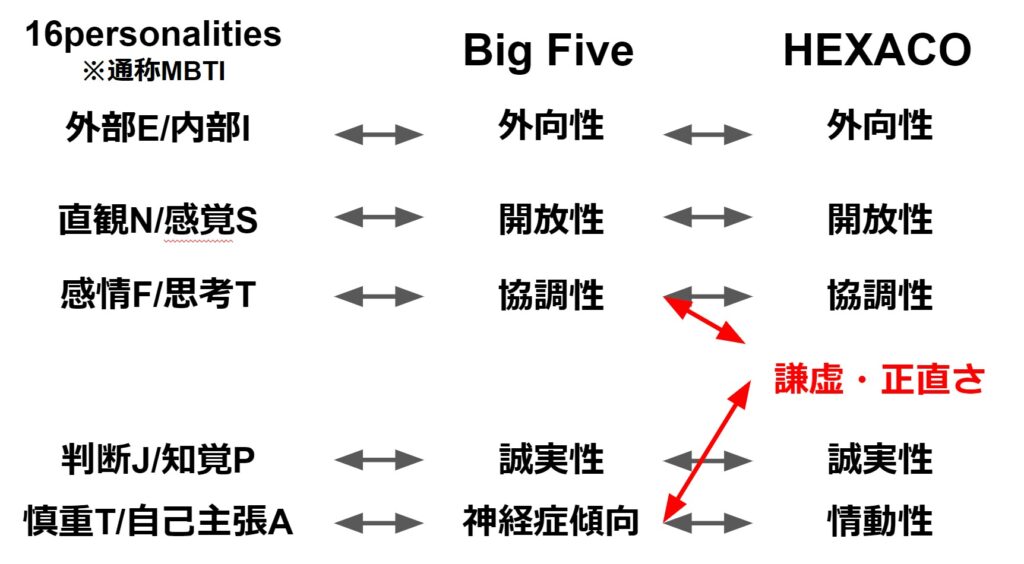
また、MBTI(本家)とビッグファイブを参考にして作られた16personalities(通称MBTI診断)では、ビッグファイブの神経症傾向が「アイデンティティ」と呼ばれており、自信(Assertive)か、慎重(Turbulent)かで分類されています。
これらの関係をまとめたのが以下の図です。
一番右には、比較的新しい性格診断である「HEXACO(ヘキサコ)」があります。ビッグファイブに1つ指標「正直・謙虚さ」を加えて改良され、ダーク特性(倫理観)が分かるようになりました。
今回のHEXACO-JP性格診断では16personalitiesの5文字に加えて、ダークD/ライトLを付けてより詳細に分析できるようにしています。

Writer & Supervisor: Eisuke Tokiwa
Personality Psychology Researcher / CEO, SUNBLAZE Inc.
As a child he experienced poverty, domestic abuse, bullying, truancy and dropping out of school — first-hand exposure to a range of social problems. He spent 10 years researching these issues and published Encyclopedia of Villains through Jiyukokuminsha. Since then he has independently researched the determinants of social problems and antisocial behavior (work, education, health, personality, genetics, region, etc.) and has published 2 peer-reviewed journal articles (Frontiers in Psychology, IEEE Access). His goal is to predict the occurrence of social problems. Spiky profile (WAIS-IV).
Expertise: Personality Psychology / Big Five / HEXACO / MBTI / Prediction of Social Problems
Researcher profiles: ORCID / Google Scholar / ResearchGate
Social & Books: X (@etokiwa999) / note / Amazon Author Page