Do you know about the ENTP-A type?
This is one of the indicators that represents personality, and it has a major impact on our behavior and way of thinking.
In this article, we will explain in detail what characteristics ENTP-A people have, including aspects of health, work, and interpersonal relationships.
By getting to know your own and others’ personalities well, it may lead to better communication and self-understanding.
Please read this while comparing it to your own and your friends’ personalities.
Once again, personality researcher and author of Villain Encyclopedia, Tokiwa (@etokiwa999), will provide the explanation.
※We have developed the HEXACO-JP Personality Assessment! It has more scientific basis than MBTI. Tap below for details.

目次
- 1 Scientific Background of ENTP-A (Debater・Assertive Type)
- 2 Scientific Explanation of ENTP-A (The Debater – Assertive Type)
- 2.1 Lucky
- 2.2 Tend to get along well with people who have both N and T
- 2.3 Making new friends
- 2.4 Relatively high possibility of having high IQ
- 2.5 Have many friends on social media
- 2.6 Posting updates and photos on social media
- 2.7 Likely to actively gather information on social media
- 2.8 High learning goal orientation (setting goals and learning in work)
- 2.9 In children, there may be giftedness
- 2.10 Prone to leaving jobs or resigning
- 2.11 Preference for fast food, ice cream, chocolate, cocoa, meat, biscuits, cakes, and cookies
- 2.12 Tendency to hold Social Dominance Orientation (SDO) beliefs
- 2.13 Susceptible to workplace bullying
- 2.14 Common among cyberbullying perpetrators
- 2.15 Possibility of narcissism or psychopathy
- 2.16 Common among monster employees
- 2.17 Relatedness needs in self-determination theory are easily satisfied
- 2.18 Take high risks, less likely to regret failures
- 2.19 Common in Japan’s Hokuriku region and metropolitan areas
- 2.20 Schwartz’s values: Power, Achievement, Hedonism, Stimulation, Self-direction
- 2.21 Particular about clothing
- 3 In conclusion
Scientific Background of ENTP-A (Debater・Assertive Type)
Overview of MBTI
MBTI is a psychological theory that classifies personality into 16 types.
MBTI is an abbreviation for Myers-Briggs Type Indicator.
MBTI classifies personality into 16 types by combining the following 4 indicators.
In other words, MBTI expresses one’s personality tendencies with 4 letters such as “ISTJ” or “ENFP”. There is the very famous 16personalities that is similar, but this is different from MBTI.
Overview of Big Five
One of the most influential trait theories in personality psychology is the “Big Five.”
Big Five measures five traits: Openness, Conscientiousness, Extraversion, Agreeableness, and Neuroticism.
Also, while 16personalities and MBTI use type classification (e.g., either extroverted or introverted), Big Five evaluates traits with continuous numerical values (e.g., extraversion 3.5), which is a major difference.
Furthermore, it has been studied for a long time, has many research papers, and extensive research has been conducted in other fields such as academic ability, income, brain, and genetics. Big Five can be said to have relatively stronger scientific backing.
Correlation between MBTI, Big Five, and HEXACO
There is a correlation between MBTI’s 4 indicators and Big Five’s 5 factors.
A representative study showing this correlation is the paper “The relationship between the revised NEO-Personality Inventory and the Myers-Briggs Type Indicator“.
According to this paper, the correlation between MBTI and Big Five is as follows.
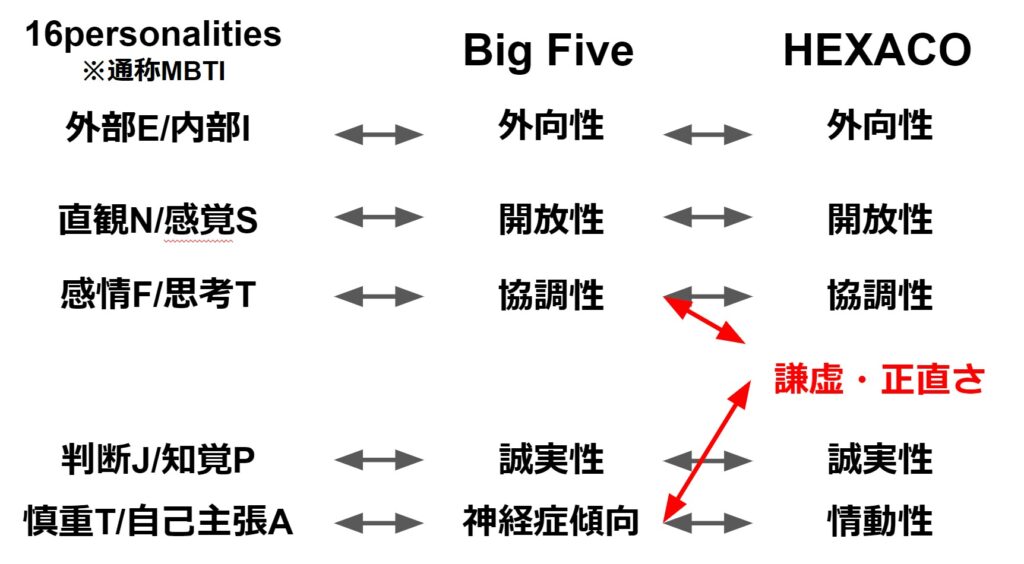
Also, in 16personalities, which was created with reference to MBTI and Big Five, the neuroticism of Big Five is called “Identity” and is classified as either Assertive or Turbulent.
On the far right is “HEXACO“, which is a relatively new personality assessment. It is an improvement on Big Five by adding one indicator: “Honesty-Humility”.
This article will provide detailed explanations of 16personalities personality types based on these correlations.
Since this is originally research on Big Five and HEXACO, if you want to know your personality more scientifically than MBTI or 16personalities, please try this HEXACO personality assessment.
What is ENTP-A (Debater・Assertive Type)?
ENTP-A is a type with high Extraversion (E), high Openness (N), low Agreeableness (T), low Conscientiousness (P), and low Neuroticism (A) in Big Five.
- Creative and innovative thinking
- High adaptability and flexibility
- Enjoys logical debates
- Confident adventurous spirit
- High stress tolerance
They enjoy generating new ideas and sharing them with others. They solve problems using critical thinking and improvisational skills. In interpersonal relationships, they seek intellectual stimulation and prefer lively discussions. They welcome change and challenges, constantly exploring new possibilities. They are resilient to stress and view failures positively as learning opportunities.
Scientific Explanation of ENTP-A (The Debater – Assertive Type)
Lucky
ENTP-A type individuals tend to be blessed with good luck due to their extroverted (E) and intuitive (N) personality, combined with low neuroticism (-A). In the Big Five, this indicates high extraversion, high openness, and low neuroticism. These characteristics make them skilled at actively discovering new opportunities and utilizing them effectively.
Additionally, they are resilient to stress and can maintain a positive attitude even in difficult situations, so they are often seen by others as “lucky people.” However, this is not merely luck alone, but rather their personality traits creating favorable opportunities.
Please see this article for more details.
Tend to get along well with people who have both N and T
ENTP-A type individuals tend to have intuitive (N) and logical (T) thinking.
In the Big Five, this indicates high openness and low agreeableness. People with these traits easily find common ground with those who also have intuitive and logical thinking, and can enjoy deep conversations and exchanges of ideas.
ENTP-A individuals prefer to explore new ideas and concepts and tend to enjoy logical discussions.
Therefore, they easily share intellectual stimulation with NT types and build relationships where they enhance each other’s thinking.
Please see this article for more details.
Making new friends
ENTP-A type individuals are skilled at making new friends due to their extroverted (E) personality. In the Big Five, this indicates high extraversion. They are sociable and tend to gain energy from interacting with people.
ENTP-A individuals are curious and have a wealth of topics, so they can continue enjoyable conversations even with people they meet for the first time. They also have high adaptability to new environments and situations, allowing them to meet people in various contexts and build friendly relationships.
This trait is a significant advantage not only for personal relationships but also for expanding business and social networks.
Please see this article for more details.
Relatively high possibility of having high IQ
ENTP-A type individuals have a relatively high possibility of having high intelligence quotient (IQ) due to their intuitive (N) nature and low neuroticism (-A). In the Big Five, this indicates high openness and low neuroticism.
These traits are often associated with abstract thinking and complex problem-solving abilities. ENTP-A individuals excel at quickly understanding new information and using it creatively. Additionally, their resilience to stress and ability to think calmly may also be related to high IQ.
However, IQ is only one aspect of intelligence, and the talents and abilities of ENTP-A individuals may be expressed in diverse forms that cannot be measured by IQ tests alone.
Please see this article for more details.
ENTP-A type individuals tend to have many friends on social media due to their extroverted (E) personality. In the Big Five, this indicates high extraversion. They are sociable and tend to actively enjoy interactions online as well.
ENTP-A individuals are interested in meeting new people and easily build extensive networks on social media. Additionally, their curious nature promotes connections with people from various backgrounds.
These traits are significant advantages in online community formation and networking, enabling them to build beneficial relationships both personally and professionally.
Please see this article for more details.
People with the ENTP-A type, due to their extraverted (E) and intuitive (N) personality, tend to actively post their updates and photos on social media. In the Big Five, this indicates high extraversion and openness.
They enjoy self-expression and find joy in sharing new ideas and experiences with others. ENTP-A individuals prefer to express their lives and thoughts creatively, and social media becomes the perfect platform for this.
Moreover, their posts are not merely daily reports but often contain original perspectives and insights. This makes it easier to generate interesting dialogues and interactions with followers.
Please see this article for more details.
People with the ENTP-A type, due to their intuitive (N) personality, are highly likely to actively gather information through social media. In the Big Five, this indicates high openness. They tend to constantly seek new knowledge and perspectives.
For ENTP-A individuals, social media is a rich information source and an excellent tool for obtaining the latest information and diverse opinions on various topics. They enjoy not only receiving information but also analyzing it and adding their own interpretations.
Additionally, their curious nature encourages interest in information from a wide range of fields, which leads to broadening their knowledge. Information gathering through social media can greatly contribute to the learning and growth of ENTP-A individuals.
Please see this article for more details.
High learning goal orientation (setting goals and learning in work)
People with the ENTP-A type, due to their intuitive (N) and logical (T) thinking, tend to have high learning goal orientation. In the Big Five, this indicates high openness and low agreeableness. They excel at setting clear goals in work and advancing their learning toward those goals.
ENTP-A individuals have strong interest in acquiring new knowledge and skills and value self-growth. They prefer challenging goals and tend to enjoy the learning process necessary to achieve them.
Additionally, their logical thinking helps in establishing effective learning strategies. They can systematically learn the knowledge and skills necessary for goal achievement and apply them to practice.
This characteristic becomes a major advantage in career development and professional improvement, potentially leading to the professional success of ENTP-A individuals.
Please see this article for more details.
In children, there may be giftedness
Children with the ENTP-A type, due to their intuitive (N) personality, may be gifted (intellectually talented children). In the Big Five, this indicates high openness. These children often possess high intellectual curiosity and creativity.
ENTP-A children may excel at quickly understanding complex concepts and generating original ideas. They enjoy abstract thinking and tend to constantly ask “why” questions, seeking deep understanding.
Additionally, their extraverted personality (E) leads to actively expressing their thoughts and enjoying intellectual dialogue with others. These characteristics overlap significantly with traits commonly seen in gifted children.
However, it’s important to note that determining giftedness requires comprehensive evaluation by specialists and cannot be judged solely by MBTI type.
Please see this article for more details.
Prone to leaving jobs or resigning
People with the ENTP-A type, due to their extraverted (E), intuitive (N), and logical (T) personality, tend to be prone to leaving jobs or resigning. In the Big Five, this indicates high extraversion and openness, and low agreeableness.
ENTP-A individuals constantly seek new challenges and growth opportunities, tending to desire change rather than being satisfied with the status quo. Their logical thinking enables them to coolly analyze whether their current workplace environment and job content align with their expectations and goals.
Additionally, their extraverted personality tends to embrace rather than fear new environments and encounters with new people. Therefore, they may make decisions to leave their current workplace relatively easily in pursuit of better opportunities or places for self-realization.
However, this is not necessarily a negative trait and may lead to career diversity and growth.
Please see this article for more details.
People with ENTP-A type, due to their extroverted (E) and intuitive (N) personality, tend to prefer foods such as fast food, ice cream, chocolate, cocoa, meat, biscuits, cakes, and cookies. In the Big Five, this indicates high extroversion and openness.
These foods often provide immediate satisfaction and pleasure, which aligns with ENTP-A individuals’ nature of seeking stimulation. They enjoy exploring new tastes and textures, and these foods offer diverse flavors.
Additionally, their extroverted personality increases opportunities to enjoy meals with friends and colleagues, and these foods are often chosen in such social settings.
However, this is a general tendency, and it may vary depending on individual preferences and health considerations. ENTP-A individuals can also understand the importance of a balanced diet and make healthy choices.
For more details, please see this article.
Tendency to hold Social Dominance Orientation (SDO) beliefs
People with ENTP-A type, due to their logical (T) thinking, tend to be prone to Social Dominance Orientation (SDO) beliefs. In the Big Five, this indicates low agreeableness.
SDO refers to the tendency to accept and sometimes support hierarchies and inequalities in society.
ENTP-A individuals, who value logical thinking, tend to prioritize the efficiency and functionality of social systems. This can sometimes lead to viewing social hierarchies and inequalities as necessary evils.
However, this is a general tendency and can vary greatly depending on individual values and experiences. ENTP-A individuals can also understand the importance of equality and justice and take positions supporting them.
For more details, please see this article.
Susceptible to workplace bullying
People with ENTP-A type, due to their extroverted (E), intuitive (N), and logical (T) personality, may be susceptible to workplace bullying. In the Big Five, this indicates high extroversion and openness, and low agreeableness.
ENTP-A individuals tend to actively propose new ideas and challenge existing methods. This can sometimes create friction with conservative colleagues or supervisors. Additionally, their logical and direct communication style may sometimes make others uncomfortable.
Furthermore, the extroverted personality of ENTP-A individuals tends to attract attention from others, which may make them targets of jealousy or resentment. Their original thinking and behavior may also clash with existing workplace order and customs.
However, this doesn’t mean there’s something wrong with them. Rather, in workplace environments that value diversity and innovation, ENTP-A characteristics become great strengths. Preventing workplace bullying requires improving organizational culture as a whole and promoting mutual understanding.
For more details, please see this article.
Common among cyberbullying perpetrators
People with ENTP-A type, due to their logical (T) and improvisational (P) personality, may be prone to becoming cyberbullying perpetrators. In the Big Five, this shows tendencies toward low agreeableness and low conscientiousness.
Their improvisational personality increases the possibility of posting provocative comments without sufficient consideration. Their intellectual curiosity and argumentative nature may sometimes be expressed in aggressive forms.
However, this doesn’t mean that all ENTP-A individuals become cyberbullying perpetrators. Many ENTP-A people engage in constructive online communication with self-awareness and empathy for others.
For more details, please see this article.
Possibility of narcissism or psychopathy
People with ENTP-A type may show tendencies toward narcissism or psychopathy due to their characteristics. In the Big Five, this indicates high extroversion and openness, low agreeableness, and low neuroticism.
ENTP-A individuals are confident, seek intellectual stimulation, and prefer to challenge social norms. These characteristics may sometimes manifest as narcissistic self-centeredness or psychopathic lack of empathy.
Their logical (T) and improvisational (P) personality may lead to prioritizing theory over emotion and being prone to impulsive behavior. Additionally, low neuroticism (-A) may manifest as insensitivity to others’ emotions and social impacts.
For more details, please see this article.
Common among monster employees
People with ENTP-A type may sometimes engage in behaviors that are called “monster employees” due to their logical (T) and improvisational (P) personality. In the Big Five, they tend to show low agreeableness and low conscientiousness.
ENTP-A individuals prefer to challenge existing rules and customs and tend to strongly assert their own ideas. This can sometimes lead to conflicts with supervisors and colleagues. Additionally, their improvisational nature may lead to lack of planning and delayed deadlines.
Their logical thinking tends to prioritize efficiency and results over emotional considerations, which may create friction with other employees. They also continuously propose new ideas, but may lack attention to detail when implementing them.
However, with the right environment and guidance, ENTP-A’s creativity and innovation can be a great advantage for organizations. Understanding their characteristics and utilizing them appropriately is important.
Please see this article for more details.
Relatedness needs in self-determination theory are easily satisfied
People with ENTP-A type tend to easily satisfy relatedness needs in self-determination theory due to their extraverted (E) and low neuroticism (-A) traits. In the Big Five, they show high extraversion and low neuroticism.
ENTP-A individuals are sociable and tend to enjoy interaction with people. They excel at meeting new people and building deep relationships. Their open personality also facilitates relationship building with diverse groups of people.
Low neuroticism means relatively little stress or anxiety in interpersonal relationships, which contributes to building healthy relationships. They can confidently interact with others and maintain good human relationships.
Additionally, the intellectual curiosity of ENTP-A individuals promotes stimulating dialogue and shared experiences with others, which further satisfies their relatedness needs.
Please see this article for more details.
Take high risks, less likely to regret failures
People with ENTP-A type tend to take high risks due to their intuitive (N) and improvisational (P) personality, and are characterized by being less likely to regret failures. In the Big Five, they show high openness and low conscientiousness.
ENTP-A individuals are strongly attracted to new possibilities and opportunities, and are not afraid to venture into unknown territories. Their creative thinking generates approaches and ideas that differ from conventional ones, and they have the courage to implement them.
Additionally, their improvisational personality tends to value intuitive judgment over careful planning, which can lead to high-risk decisions.
However, they are also skilled at viewing failure as a learning opportunity, and even when risks result in failure, they can positively view it as fuel for future success.
Low neuroticism (-A) is also a factor that reduces regret and self-blame after failure. They tend to accept failure not as a personal flaw but as part of the growth process.
Please see this article for more details.
Common in Japan’s Hokuriku region and metropolitan areas
People with ENTP-A type tend to be commonly found in Japan’s Hokuriku region and metropolitan areas due to their extraverted (E), intuitive (N), and logical (T) personality. Regional culture and economic characteristics may influence this distribution.
The Hokuriku region is known as an area with a good balance of tradition and innovation, which may be an environment where ENTP-A’s creativity and logical thinking can be easily utilized.
On the other hand, metropolitan areas are rich in diversity and tend to welcome new ideas and challenges, making them well-suited to ENTP-A’s extraverted and innovative personality.
Please see this article for more details.
Schwartz’s values: Power, Achievement, Hedonism, Stimulation, Self-direction
People with ENTP-A type tend to value power, achievement, hedonism, stimulation, and self-direction in Schwartz’s value theory. These values are closely related to ENTP-A’s extraverted (E), intuitive (N), logical (T), and improvisational (P) personality traits.
The values of power and achievement reflect ENTP-A’s logical thinking and strong motivation toward goal achievement. They value social status and personal success, placing importance on proving their abilities.
The values of hedonism and stimulation show ENTP-A’s openness to new experiences and adventurous spirit. They dislike boredom and constantly seek intellectual and sensory stimulation.
The value of self-direction represents ENTP-A’s independence and creativity. They value freedom of their own thoughts and actions and do not like being constrained by others.
These values greatly influence the decision-making and actions of ENTP-A individuals and may also be reflected in their career choices and life goal setting.
Please see this article for more details.
Particular about clothing
ENTP-A type people tend to be particular about their clothing due to their extroverted (E) and intuitive (N) personality. In the Big Five, this indicates high extroversion and openness.
ENTP-A individuals often value clothing as a means of self-expression. Their creativity and innovation can manifest as a unique fashion sense. They are also skilled at social impression management and place importance on choosing appropriate clothing for different situations.
Their extroverted personality leads to a tendency to favor eye-catching clothing or unique items that can serve as conversation starters. At the same time, their logical thinking (T) may be reflected in fashion choices that consider the balance between functionality and beauty.
For ENTP-A people, clothing is not merely a matter of appearance, but an important means of expressing their identity and values. They constantly show interest in new trends and original styles, tending to enjoy fashion by adding their own interpretation.
Please see this article for more details.
In conclusion
ENTP-A type people have very unique and attractive characteristics.
They are extroverted and skilled at generating new ideas. They can also think logically and have the ability to respond flexibly to situations.
This type of person is good at making friends and is active in social media interactions.
They enjoy learning and tend to work hard toward their goals. However, they sometimes engage in high-risk behaviors.
ENTP-A people have a good balance between creativity and logic, and hold many possibilities.
By leveraging their strengths while being mindful of their weaknesses, a wonderful future surely awaits them.
The tendencies introduced are originally from Big Five and HEXACO research, so if you want to understand personality more scientifically than MBTI or 16personalities, please try this HEXACO personality test.

Writer & Supervisor: Eisuke Tokiwa
Personality Psychology Researcher / CEO, SUNBLAZE Inc.
As a child he experienced poverty, domestic abuse, bullying, truancy and dropping out of school — first-hand exposure to a range of social problems. He spent 10 years researching these issues and published Encyclopedia of Villains through Jiyukokuminsha. Since then he has independently researched the determinants of social problems and antisocial behavior (work, education, health, personality, genetics, region, etc.) and has published 2 peer-reviewed journal articles (Frontiers in Psychology, IEEE Access). His goal is to predict the occurrence of social problems. Spiky profile (WAIS-IV).
Expertise: Personality Psychology / Big Five / HEXACO / MBTI / Prediction of Social Problems
Researcher profiles: ORCID / Google Scholar / ResearchGate
Social & Books: X (@etokiwa999) / note / Amazon Author Page