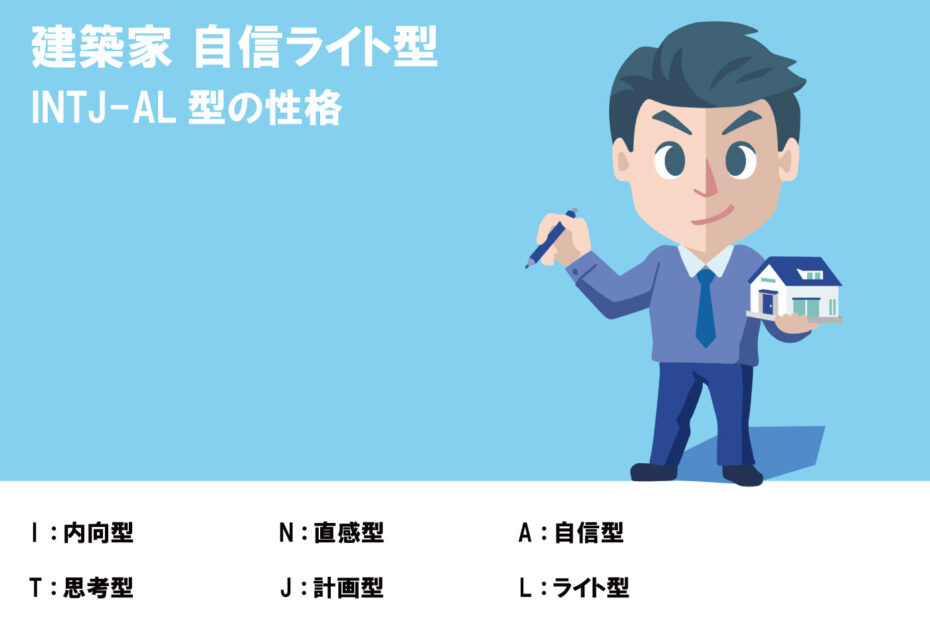
Have you ever felt in a meeting where everyone is satisfied with superficial solutions, thinking to yourself “But the real problem isn’t here, is it?”
You might love thinking about things with the sense of solving complex puzzles, and treasure above all else the time to concentrate alone and indulge in contemplation.
If this sounds like you, you may be the INTJ-AL type who designs long-term visions like an architect and strategically realizes them.
This type, which combines logical thinking with high ethical standards, might be perceived by others as “confident but somehow unapproachable.”
Perhaps you’re the type who absolutely cannot compromise on things that go against your beliefs.
Don’t you recognize the mindset where you can’t be convinced by the reason “because everyone else is doing it” and always find yourself thinking deeply about “why is it so?”
In this article, we will explain in detail the complex thought patterns within you and the characteristics of how you relate to people.
You might find answers to the question “Why do I think this way?” and discover hints for living in your own authentic way.
Once again, personality researcher and author of Villain Encyclopedia, Tokiwa (@etokiwa999), will provide the explanation.
※We have developed the HEXACO-JP Personality Assessment! It has more scientific basis than MBTI. Tap below for details.

目次
- 1 Overview of HEXACO
- 2 Characteristics of INTJ-AL
- 3 Strengths and Weaknesses of INTJ-AL
- 4 INTJ-AL Romantic Relationship Tendencies and Improvement Strategies
- 5 INTJ-AL Friendship Tendencies and Improvement Strategies
- 6 INTJ-AL Parenting Tendencies and Improvement Strategies
- 7 INTJ-AL Career Trends and Improvement Strategies
- 8 INTJ-AL Work Trends and Improvement Strategies
- 9 Compatible Types for INTJ-AL
- 10 INTJ-AL Summary
- 11 FAQや注意点
- 12 補足
Overview of HEXACO
What is HEXACO
The new key to understanding your complex personality is “HEXACO.”
It analyzes subtle personality differences that conventional psychology couldn’t fully capture through six elements.
The name comes from the six letters H・E・X・A・C・O.
Each element is as follows:
- H: Honesty-Humility
- E: Emotionality
- X: eXtraversion
- A: Agreeableness
- C: Conscientiousness
- O: Openness
The groundbreaking aspect of this model is the addition of the “Honesty-Humility” element.
This makes it possible to predict your behavioral patterns with about 80% accuracy.
It’s a system that provides scientific answers to the question “Why do I react this way?”
64 Classifications by HEXACO
The high and low levels of each of the six elements create 64 type classifications.
Specifically, they are as follows:
- H: Honesty-Humility
- High → Light (L: Light)
- Low → Dark (D: Dark)
- E: Emotionality
- High → Turbulent (T: Turbulence)
- Low → Assertive (A: Assertiveness)
- X: eXtraversion
- High → Extrovert (E: Extrovert)
- Low → Introvert (I: Introvert)
- A: Agreeableness
- High → Feeling (F: Feeling)
- Low → Thinking (T: Thinking)
- C: Conscientiousness
- High → (J: Judging)
- Low → (P: Prospecting)
- O: Openness
- High → Intuitive (N: iNtuitive)
- Low → Sensor (S: Sensor)
These are combined like 16personalities to express types.
Now let’s look at the characteristics of each type!
What is INTJ-A (Architect・Assertive)?
INTJ-A is a type with low extraversion (I), high openness (N), low agreeableness (T), high conscientiousness (J), and low emotionality (A).
Main characteristics include:
- Strategic thinking and strong independence
- Unwavering confidence and decisiveness
- Tendency to prioritize logic over emotions
- Ability to envision long-term vision
- High stress tolerance
They deeply believe in their own abilities and efficiently achieve goals by combining critical thinking with innovation.
In interpersonal relationships, they prefer direct communication and tend to be reserved in emotional expression.
They welcome change and challenges, and always maintain an attitude of seeking self-improvement.
Characteristics of INTJ-AL
Characteristic ①: “Strategic Thinker Who Thinks Deeply”
You might be the type who continues thinking even when others around you say “that’s enough.”
When a simple solution is proposed in a meeting, aren’t you already anticipating problems three steps ahead in your mind?
Don’t you feel like a chess master, reading your opponent’s next move and the move after that?
INTJ-AL thought patterns have the following characteristics:
- Deep-diving thinking that isn’t satisfied with superficial answers
- Long-term perspective looking 10 years ahead
- Approaches from angles no one else notices
This depth of thinking sometimes causes others to say you “overthink.”
But in reality, your caution often prevents major failures.
And you should have firm confidence in the conclusions you reach.
Because they’re the result of more thorough consideration than anyone else’s.
This trait truly demonstrates its value when facing complex problems.
Characteristic ②: “Honest Person Who Doesn’t Bend Their Beliefs”
Haven’t you ever felt uncomfortable taking action just because “everyone else is doing it”?
When you discover wrongdoing at work, you might be the type who speaks up even when others turn a blind eye.
Don’t you recognize the feeling of being unable to stay silent about what’s right, even if it makes you unpopular?
INTJ-AL honesty manifests in the following ways:
- Sense of responsibility that never breaks even small promises
- Fair judgment without regard to personal interests
- Communication that speaks honestly rather than superficially
This high ethical standard is sometimes misunderstood as “inflexibility.”
But in reality, your consistent attitude gives those around you a sense of security.
Also, even when faced with difficult choices, you have the strength to make decisions according to your values.
This strength of conviction makes you a trustworthy leader.
As a result, you should be someone who earns respect from many people in the long run.
Characteristic ③: “Independence That Builds Strength During Alone Time”
Have you ever experienced relief when being alone after spending time with a large group?
During team projects, while others are chatting, you might be quietly reading through materials.
Though others may see you as “cool and unapproachable,” aren’t you actually constantly planning for your next goal in your head?
INTJ-AL independence has the following characteristics:
- Attitude of continuous self-learning without needing instruction
- Courage to take on challenges even when told “it’s impossible”
- Life planning that looks ahead 5 to 10 years
This independence is sometimes perceived as “lack of cooperation.”
But in reality, by concentrating alone, you’re producing results that contribute to the entire team.
Furthermore, your high goal-setting provides good motivation for those around you.
There should be people who see your example and think “I should work harder too.”
This trait is the driving force that leads you to steady success.
Strengths and Weaknesses of INTJ-AL
Strengths of INTJ-AL
Your greatest weapon is the ability to find solutions that no one else can think of.
When colleagues are about to give up on a problem saying “this is unsolvable,” can’t you approach it from a new angle?
Like an architect drawing blueprints, you can organize complex situations and create beautiful solutions.
The representative strengths of INTJ-AL are as follows:
- Insight to see the core of problems that others overlook
- Creativity that generates innovative ideas without precedent
- Willpower to see through what you’ve decided to the end
Also, your confident statements can boost the morale of the entire team.
Being able to show anxious colleagues “it’s okay, there’s this method” is a valuable talent.
And your honesty builds great trust in the long term.
Being thought of as “that person is never wrong” is not something easy to achieve.
By combining these characteristics, you become an indispensable presence for any organization.
INTJ-AL Weaknesses
Your logical thinking is a wonderful strength, but sometimes you might overlook people’s feelings.
Have you ever experienced a cold reaction from others when you proposed an efficient solution in a meeting?
Perhaps your proposal hurt someone’s feelings or ignored values they hold dear.
Here are the points INTJ-AL should be careful about:
- Communication that feels “logical but cold”
- Putting pressure on others by demanding too much perfection
- Appearing antisocial by prioritizing alone time
These are not necessarily bad traits.
However, for your wonderful ideas to be accepted, you need to communicate from the other person’s perspective.
Also, your high standards can sometimes intimidate others.
But since this comes from your desire for “everyone to grow,” it can change significantly depending on how you communicate.
In fact, these “weaknesses” can become your strongest weapons if you use them differently.
INTJ-AL Romantic Relationship Tendencies and Improvement Strategies
INTJ-AL’s Romantic Tendencies
For you, romance is probably a special relationship where hearts connect deeply with each other.
Have you ever felt exhausted by superficial conversations at mixer parties or matchmaking events?
You might not be able to get into romantic mode until you meet someone with whom you feel “I can be my true self with this person.”
INTJ-AL’s romantic relationships have the following characteristics:
- Strongly attracted to partners who can engage in intellectual conversations
- Maintains devoted and deep affection for long periods
- Shows love through actions rather than saying “I love you”
You become more honest and devoted to your romantic partner than anyone else.
You absolutely cannot tolerate cheating or lies, and you probably can’t imagine doing such things yourself.
Also, you tend to seek serious relationships with a view toward the future.
You’re looking for a partner with whom you think “I could build a wonderful future with this person.”
This sincere attitude is a very reassuring element for your partner.
When Problems Arise in Romance and Improvement Strategies
Have you ever been confused when your partner said “Why don’t you understand?”
Since you’re good at thinking logically, you might be puzzled by your partner’s emotional reactions.
Even when you think “I explained it properly” or “It should be understandable if you think rationally,” your partner’s feelings might not settle down.
Here are the points where INTJ-AL tends to stumble in romance and improvement strategies:
- Consciously verbalize “thank you” and “I love you”
- Don’t deny your partner’s emotions, but first have an attitude of accepting them
- While alone time is important, intentionally create time together as well
Your expression of love might be action-centered, but expressing it in words is equally important.
Just adding a phrase like “I prepared this thinking of you” completely changes how your partner receives it.
Also, your perfectionist side might come out in romance too, putting pressure on your partner.
But romance is not a place to seek efficiency or results—it’s a relationship where you love each other including your imperfections.
By being conscious of these things, your deep affection will be conveyed to your partner much better.
INTJ-AL Friendship Tendencies and Improvement Strategies
Friendship Tendencies
For you, friends are probably not just playmates, but precious people who enrich your life.
Don’t you feel more fulfilled when having a thorough one-on-one conversation rather than when things are lively at a drinking party?
You might be the type who feels true friendship in moments when you think “I can have such deep conversations with this person.”
INTJ-AL’s friendships have the following characteristics:
- Few friends, but very deep bonds with each individual
- Prefers relationships where you can discuss philosophy and future dreams
- Value long-term friendships that last 10, 20 years
You are likely seen by your friends as a very sincere and trustworthy person.
You probably often have secrets confided in you and are frequently consulted on important matters.
You are also someone who can genuinely rejoice in your friends’ growth and success.
You may often be thanked with words like “I was able to persevere because of what you said to me back then.”
Such high-quality friendships become a great treasure in life.
When Friendships Become Problematic and Improvement Strategies
Have you ever had the experience of being startled when someone said, “You haven’t seen [person’s name] lately, have you?”
Because you value your alone time, you may frequently decline invitations from friends.
Also, when someone comes to you with their troubles, you might tend to offer solutions right away, only to be told “That’s not what I wanted to hear.”
Here are points that INTJ-AL should be mindful of in friendships and improvement strategies:
- Make it a habit to reach out yourself at least once a month
- When consulted, prioritize empathy over solutions
- Sometimes show your imperfect side as well
When a friend says “listen to me,” they may not actually be seeking answers, but just want their feelings to be understood.
Words like “That must have been tough” or “You did well” can sometimes resonate more than precise advice.
Also, your high standards and perfectionism can sometimes intimidate friends.
However, by accepting that weakness and confusion are also part of being human, you can build warmer relationships.
With just a small shift in awareness, your friendships should become much richer.
INTJ-AL Parenting Tendencies and Improvement Strategies
Parenting Tendencies
Are you the type who tends to give detailed explanations when your child asks “Why?”
Even for questions that other parents might dismiss with “That’s just how it is,” you probably want to give thoughtful answers.
You likely find special joy in nurturing your child’s intellectual curiosity.
INTJ-AL parenting has the following characteristics:
- Value the child’s “thinking ability” above all else
- Have a strong desire for the child to become an independent adult
- Teach consistent rules and high ethical standards
You seriously consider your child’s future and decide on educational policies from a long-term perspective.
You probably interact with them with the belief that “even if they don’t understand now, the time will come when they will.”
You also maintain an honest and sincere attitude toward your child.
Rather than brushing things off with “because you’re a child,” you try to convey the truth appropriate to their age.
Such educational policies have a significantly positive influence on the child’s character development.
When Parenting Becomes Problematic and Improvement Strategies
When your child is crying, have you ever wanted to say “Explain why you’re crying”?
Because you want to solve things logically, you might be confused by your child’s emotional reactions.
Also, your expectation that they “should be able to do better” might unknowingly put pressure on your child.
Here are points that INTJ-AL should be mindful of in parenting and improvement strategies:
- First accept the child’s emotions, ask for reasons later
- Don’t demand perfection, acknowledge “It was good that you could do this today”
- Intentionally create time to play together, not just study
When your child says “I hate school,” before immediately thinking of solutions, try empathizing with their feelings by saying “You felt upset, didn’t you.”
By doing so, your child will feel safe and start sharing their true feelings.
Also, while your high ideals are wonderful, children have their own pace.
It’s important to cherish “this child’s uniqueness” while taking a long-term view of their growth.
With just a small shift in awareness, your child should open their heart to you much more.
INTJ-AL Career Trends and Improvement Strategies
Career Trends
Have you ever thought, “Is this job really meaningful?”
Rather than spending time on simple tasks or meaningless meetings, you’re the type who wants to focus on truly valuable work, aren’t you?
You might clearly envision “Where do I want to be in 10 years?” and work backwards from there to plan your career.
INTJ-AL careers have the following characteristics:
- High aptitude for specialized roles that solve complex problems
- Roles that leverage strategic thinking with long-term vision
- Demonstrate true value in environments where you can work independently
You should have a different perspective on promotions and advancement than others.
Rather than simply rising in position, don’t you prioritize “Can I have a greater impact?” and “Can I realize my ideals?”
Also, you tend to focus on work quality and results rather than workplace relationships.
This attitude often leads to significant achievements in the long term.
Your career has unique value that others cannot imitate.
When Problems Arise in Career and Improvement Strategies
Have you ever felt frustrated when told “If only you had a bit more cooperation skills…”?
Even when you have excellent ideas, you might sometimes lose out due to how you communicate them.
Also, in workplaces that emphasize teamwork, you might get labeled as a “lone wolf.”
Here are points INTJ-AL should be mindful of in their career and improvement strategies:
- When proposing ideas, speak while considering the other person’s position
- Carefully explain the reasoning behind “why you think so”
- Sometimes find compromise points and gradually approach your ideals
Even your wonderful ideas cannot be realized if others don’t understand them.
It’s important to explain benefits from the other person’s perspective, such as “If this proposal goes through, the entire team will have these benefits.”
Also, pursuing perfection too much can sometimes cause good ideas to be shelved.
Having the flexibility to “execute even at 70 points” will enable you to achieve more results.
With just a little accommodation, your talents should become more appreciated.
INTJ-AL Work Trends and Improvement Strategies
Work Trends
When approaching work, aren’t you the type who first grasps the big picture before diving into details?
While colleagues are moving their hands for now, you might be thinking “What is the real purpose of this task?” and “Isn’t there a more efficient method?”
Even when others say you “think too much,” you often end up producing higher quality results, don’t you?
INTJ-AL’s approach to work has the following characteristics:
- Aim for fundamental improvements rather than superficial tasks
- Perfectionist aspects that prioritize quality over deadlines
- Demonstrate phenomenal productivity when given a focused environment
You have a very sincere and responsible attitude toward work.
Don’t you have an exceptionally strong feeling of “Since I’ve been entrusted with this job, I want to produce the best results”?
Also, since you view work from a long-term perspective, you prioritize investment in the future over immediate profits.
This attitude often leads to significant achievements ultimately.
Your passion and sincerity toward work should have a positive influence on those around you.
When Problems Arise at Work and Improvement Strategies
Have you ever felt unsatisfied when told “We’re out of time, so let’s proceed with this”?
You may want to do high-quality work, but there might be situations where you have to compromise to match the pace of those around you.
Also, even when you think “this method would be better,” you might feel frustrated when others are reluctant to change existing ways of doing things.
Points INTJ-AL should be careful about at work and improvement strategies are as follows:
- Don’t pursue perfection too much, set a compromise point of “this is enough for this time”
- Listen to colleagues’ opinions and incorporate different perspectives
- When making improvement proposals, also present a step-by-step implementation plan
Your high quality standards are wonderful, but sometimes it’s also important to deliver “good things quickly.”
Completing 80-point work within deadlines can sometimes lead to the next 100 points.
Also, improving as a whole team rather than aiming for perfection alone can sometimes lead to greater results.
It’s important to learn how to involve others with the approach of “let’s all create something better together.”
By developing flexibility, your excellence will be utilized in many more situations.
Compatible Types for INTJ-AL
Compatible Types with N Included
Haven’t you encountered someone with whom you feel “I could lose track of time talking with this person”?
Such a person is probably an N-type (Intuitive) person.
Time spent with people who can get excited about abstract conversations like “what if” or “in the future” rather than realistic topics should be very stimulating and fulfilling for you.
The compatibility between INTJ-AL and N-types appears in the following points:
- Being able to understand each other’s creative ideas
- Sharing ideas that aren’t bound by “normally it’s like this” frameworks
- A relationship where new perspectives and insights are born when together
N-type people will receive your “outlandish ideas” as “interesting!”
For you, who are often told “I never thought of such a thing,” having someone who understands becomes emotional support.
Also, since you both seek change and growth, you can stimulate each other by being together.
A relationship where “talking with that person always brings new discoveries” should enrich your life.
Such intellectual resonance becomes the foundation for long-term relationships.
Compatible Types with L Included
Have you ever met someone you intuitively felt “this person is trustworthy”?
Such a person is probably an L-type (high ethical standards) person.
In relationships with people whose words and actions are consistent and who always keep their promises, you can speak your true feelings with peace of mind.
The compatibility between INTJ-AL and L-types appears in the following points:
- A sense of security from deeply understanding each other’s sincerity
- Sharing the value that “what’s right is right”
- Having a foundation for building long-term trust relationships
L-type people will understand your straightforward and honest communication style.
The trust that “that person doesn’t lie” becomes the foundation for creating deep bonds.
Also, since you both take consistent actions, you can build predictable and stable relationships.
The peace of mind that “I can maintain a long relationship with this person” is probably precious to you.
Such alignment of values leads to relationships where you can support each other in important life situations.
INTJ-AL Summary
After reading this far, were there parts where you felt “this is definitely written about me”?
You might sometimes be perceived by others as “cool and unapproachable,” but in reality, you are someone with deep compassion and strong convictions.
You, who possess both the ability to think logically and high ethical standards, are truly a precious existence for this world.
Your wonderful characteristics as INTJ-AL are as follows:
- Insight to see through to the essence of problems that no one else notices
- Unwavering convictions and autonomy even in difficult situations
- Strategic thinking that captures things from a long-term perspective
Sometimes you may think, “If only I could be a little more flexible.”
But it’s precisely because of your consistent attitude and high standards that many people trust and rely on you.
By adding ingenuity to your emotional expression and ways of connecting with people, your wonderful inner self will be conveyed to even more people.
You don’t need to be perfect. You can cherish your authentic self while gradually growing little by little.
It’s because people like you exist that this world can move in a better direction.

FAQや注意点
HAXACOの結果と、16personalities(通称MBTI診断)やMBTI(本家)と結果が変わる
- 性格は遺伝と環境の影響を受けるため、環境が変われば回答も変わります(例、疲れてると情動性が変化するなど)。遺伝について詳しくはこちら。
- 年齢次第で回答のブレがあります。詳しくはこちら。
- タイプ分類は各数値が3以上、3未満で行っているため、3に近い値だと、質問の聞き方やその時の環境次第で結果が変わりやすくなります。タイプよりも数値を見てください。
- MBTI(本家)や16personalities(通称MBTI診断)は質問設計の段階でどの程度統計的な処理をしているか論文が見当たらないため不明確です。一方で、ビッグファイブやHEXACOはそういった論文が簡単に見つかりますし、今回のHEXACO-JP診断は論文ベースです。
- MBTIや16personalitiesは普段の行動(学力・年収など)や、脳・遺伝などとの比較した研究論文があまり多くない一方で、ビッグファイブやHEXACOは数多く存在します。
- そもそもHEXACOはビッグファイブの要素の変形なので似て非なるものです。HEXACOの正直・謙虚さは、ビッグファイブの協調性と神経症傾向から抽出されています。下記「補足」参考。
その他にもご質問があれば運営者のトキワ(@etokiwa999)までご連絡ください。
性格診断の結果はあくまで人生の「ヒント」まで
先にも書きましたが、性格は遺伝と環境の影響を受けます。遺伝の影響で、ブレ幅は一定ですが、環境次第である程度答えがブレます。
またビッグファイブやHEXACOの研究論文では学力や年収などと相関分析をしていますが、自然科学の実験ほど大きな相関係数ではありません。相関係数は最小-1、最大1ですが、だいたい-0.4~0.4ほどが多いです。もちろん高いものもあります。0.8や0.9ではなく、それに比べたら低いです。
ただそれでも様々な研究はありますので、「占い以上、自然科学未満」と思ってください。心理学や占いを100%否定しているわけではありません。
補足
16personalities(通称MBTI診断)の概要
16personalities(16タイプ性格診断)は、MBTI(Myers-Briggs Type Indicator)とビッグファイブをベースにして作られています。
厳密には16personalitiesとMBTIは別物なのです。
MBTIは、ユングの心理学的類型論を基に開発された性格診断ツールです。
16personalitiesはMBTIの4つの指標(E外向-I内向、S感覚-N直観、T思考-F感情、J判断-P知覚)を採用しつつ、アイデンティティ(AとT)という指標の追加、独自の質問項目・評価基準を設けています。
この性格診断の良いところとしては、韓国アイドルが広めたり、恋愛マッチングアプリでも使われたりするなど、とても有名で、回答数がとても多いことにあります。それを利用して分析して論文として公開すれば信頼性は高いかもしれません。
ただし、悪いところとしては、科学的な裏付けが弱いところがあります。査読付き論文の数が少ない、統計処理の方法が不明確、性格と学力・収入・脳機能・遺伝的要因などとの関連性について十分な根拠が提示されていない、などが理由です。
MBTI(本家)の概要
MBTIは性格を16タイプに分類する心理学の理論です。
そもそもMBTIとは、マイヤーズ・ブリッグス・タイプ・インジケーター(Myers-Briggs Type Indicator)の略称です。
MBTIでは、以下の4つの指標を組み合わせて性格を16タイプに分類します。
- 外向性(Extraversion)か内向性(Introversion)
- 感覚(Sensing)か直観(iNtuition)
- 思考(Thinking)か感情(Feeling)
- 判断(Judging)か知覚(Perceiving)
つまり、MBTIでは自分の性格傾向を「ISTJ」や「ENFP」などの4文字で表現するのです。
16personalitiesよりは論文は存在しますが、ビッグファイブやHEXACOほど頑健な研究結果が出ているわけではありません。
ビッグファイブの概要
性格心理学において最も有力な特性理論の一つが「ビッグファイブ(Big Five)」です。
ビッグファイブは、開放性、誠実性、外向性、協調性、神経症傾向の5つの特性を測定します。
また、16personalitiesやMBTIはタイプ分類(例、外向的か内向的かのどちらか)を用いるのに対して、ビッグファイブが特性を連続的な数値で評価する(例、外向性3.5)点も大きな違いです。
さらに、古くから研究されており、論文数も多く、学力や所得、脳や遺伝など、他の分野でも多くの研究が行われています。ビッグファイブの方が比較的、科学的な裏付けが強いと言えます。
MBTI・ビッグファイブ・HEXACOの相関関係
MBTIの4指標とビッグファイブの5因子には相関関係があります。
この相関を示した代表的な研究に、「The relationship between the revised NEO-Personality Inventory and the Myers-Briggs Type Indicator」という論文があります。
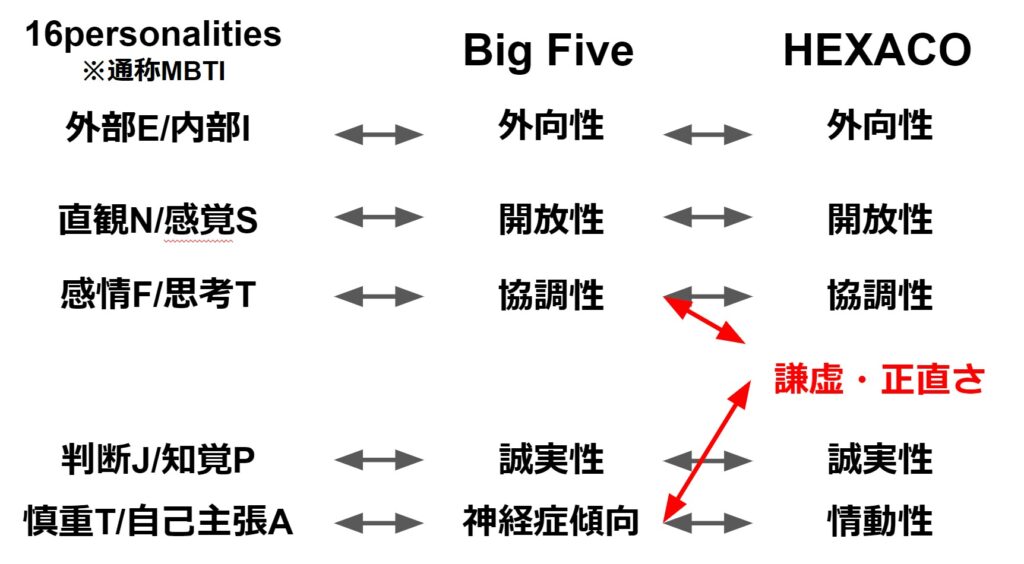
また、MBTI(本家)とビッグファイブを参考にして作られた16personalities(通称MBTI診断)では、ビッグファイブの神経症傾向が「アイデンティティ」と呼ばれており、自信(Assertive)か、慎重(Turbulent)かで分類されています。
これらの関係をまとめたのが以下の図です。
一番右には、比較的新しい性格診断である「HEXACO(ヘキサコ)」があります。ビッグファイブに1つ指標「正直・謙虚さ」を加えて改良され、ダーク特性(倫理観)が分かるようになりました。
今回のHEXACO-JP性格診断では16personalitiesの5文字に加えて、ダークD/ライトLを付けてより詳細に分析できるようにしています。

Writer & Supervisor: Eisuke Tokiwa
Personality Psychology Researcher / CEO, SUNBLAZE Inc.
As a child he experienced poverty, domestic abuse, bullying, truancy and dropping out of school — first-hand exposure to a range of social problems. He spent 10 years researching these issues and published Encyclopedia of Villains through Jiyukokuminsha. Since then he has independently researched the determinants of social problems and antisocial behavior (work, education, health, personality, genetics, region, etc.) and has published 2 peer-reviewed journal articles (Frontiers in Psychology, IEEE Access). His goal is to predict the occurrence of social problems. Spiky profile (WAIS-IV).
Expertise: Personality Psychology / Big Five / HEXACO / MBTI / Prediction of Social Problems
Researcher profiles: ORCID / Google Scholar / ResearchGate
Social & Books: X (@etokiwa999) / note / Amazon Author Page