Do you know about the INTJ-A type?
This is one of the indicators that represents personality, and it has a major influence on our behavior and way of thinking.
In this article, we will explain in detail what characteristics INTJ-A people have, including aspects of health, work, and relationships.
Understanding your own personality and that of those around you may lead to better communication and self-understanding.
Please read this while comparing it to your own personality and that of your friends.
Once again, personality researcher and author of Villain Encyclopedia, Tokiwa (@etokiwa999), will provide the explanation.
※We have developed the HEXACO-JP Personality Assessment! It has more scientific basis than MBTI. Tap below for details.

目次
- 1 Scientific Background of INTJ-A (Architect, Assertive)
- 2 Scientific Explanation of INTJ-A (Architect – Assertive Type)
- 2.1 Good Physical Health
- 2.2 Easily Build Good Relationships with People Who Have Both N and T Traits
- 2.3 Effective at Online Learning
- 2.4 Most Likely to Have High IQ
- 2.5 Likely to Actively Gather Information on Social Media
- 2.6 Properly Maintain Social Distance for Infection Prevention
- 2.7 Properly performing hand washing and other infection control measures
- 2.8 High work competence and performance
- 2.9 High learning goal orientation (setting goals and learning at work)
- 2.10 Common among scientists, particularly high in creativity
- 2.11 Common among writers/editors, artists/creators, counselors/therapists
- 2.12 In the case of children, there is a possibility of being gifted
- 2.13 Perfectionism pursued to excess
- 2.14 Pay attention to health and prefer vegetables, dairy products, and nuts
- 2.15 Tend to hold Social Dominance Orientation (SDO) ideologies
- 2.16 Possibility of Machiavellianism
- 2.17 Tend to have relatively higher annual income
- 2.18 Relatively High Self-Esteem
- 2.19 Don’t Regret Easily Even When Risks Fail, Perform Cool Risk Management
- 2.20 Common in Japan’s Hokuriku Region
- 2.21 Preference for Simple or Practical Clothing
- 3 Finally
Scientific Background of INTJ-A (Architect, Assertive)
Overview of MBTI
MBTI is a psychological theory that classifies personality into 16 types.
To begin with, MBTI is an abbreviation for Myers-Briggs Type Indicator.
MBTI classifies personality into 16 types by combining the following four indicators.
In other words, MBTI expresses one’s personality tendencies with four letters such as “ISTJ” or “ENFP”. A very famous similar system is 16personalities, but this is different from MBTI.
Overview of Big Five
One of the most influential trait theories in personality psychology is the “Big Five.”
The Big Five measures five traits: Openness, Conscientiousness, Extraversion, Agreeableness, and Neuroticism.
Also, while 16personalities and MBTI use type classification (e.g., either extroverted or introverted), a major difference is that Big Five evaluates traits as continuous numerical values (e.g., extraversion 3.5).
Furthermore, it has been researched for a long time, with many papers published, and extensive research has been conducted in other fields such as academic ability, income, brain, and genetics. Big Five can be said to have relatively stronger scientific backing.
Correlations between MBTI, Big Five, and HEXACO
There are correlations between the 4 MBTI indicators and the 5 Big Five factors.
A representative study showing this correlation is the paper titled “The relationship between the revised NEO-Personality Inventory and the Myers-Briggs Type Indicator.”
According to this paper, the correlations between MBTI and Big Five are as follows.
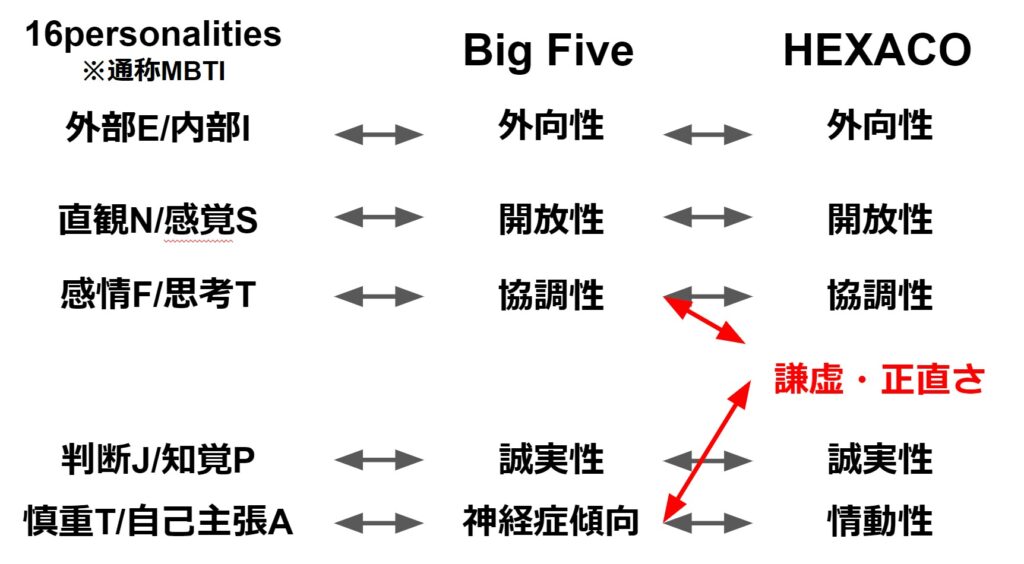
Also, in 16personalities, which was created with reference to MBTI and Big Five, neuroticism from Big Five is called “Identity,” classified as either Assertive or Turbulent.
On the far right is “HEXACO,” a relatively new personality assessment. It was improved by adding one indicator, “Honesty-Humility,” to Big Five.
Based on these correlations, this article will provide detailed explanations of 16personalities personality types.
Since the original research was on Big Five and HEXACO, if you want to understand your personality more scientifically than with MBTI or 16personalities, please try this HEXACO personality assessment.
What is INTJ-A (Architect, Assertive)?
INTJ-A is a type with low extraversion (I), high openness (N), low agreeableness (T), high conscientiousness (J), and low neuroticism (A) from Big Five. Characteristics include:
- Strong strategic thinking and independence
- Confident decision-making ability
- Prioritizes logic over emotion
- Possesses long-term vision
- High stress tolerance
They have high self-efficacy and believe in their abilities. They combine critical thinking with innovation to achieve goals efficiently. In interpersonal relationships, they prefer direct communication and are reserved in emotional expression. They welcome change and challenges, always aiming for self-improvement.
Scientific Explanation of INTJ-A (Architect – Assertive Type)
Good Physical Health
INTJ-A people tend to have high conscientiousness and low neuroticism. This means they are planned, self-controlled, and resilient to stress. Therefore, they tend to manage their health in a planned manner and are less likely to suffer from stress-induced health problems.
INTJ-A people approach their health logically and strive for efficient health management. They are likely to maintain healthy lifestyles including regular exercise and balanced diet.
However, as they also have perfectionist tendencies, they may need to be careful not to become overly obsessed with health management.
For more details, please see this article.
Easily Build Good Relationships with People Who Have Both N and T Traits
INTJ-A people tend to have low openness and agreeableness. Therefore, they have good compatibility with NT types who similarly prefer logical thinking and are interested in new ideas.
INTJ-A tend to enjoy deep discussions and intellectual conversations. With NT types, they can easily build relationships where they stimulate each other’s thinking and gain new discoveries and insights.
However, they may struggle with emotional communication, so conscious effort may be needed to build balanced human relationships.
For more details, please see this article.
Effective at Online Learning
INTJ-A people tend to have high openness and high conscientiousness. This means they are curious about new knowledge and experiences and have an attitude of approaching learning in a planned manner.
Self-management ability is important in online learning, and INTJ-A excel in this aspect. They can efficiently progress in learning at their own pace, logically organize new information, and understand it deeply.
Also, being able to access a wide range of information through the internet is suitable for satisfying INTJ-A’s intellectual curiosity.
For more details, please see this article.
Most Likely to Have High IQ
INTJ-A people tend to have high openness and low extraversion. They also have low neuroticism. These characteristics are said to be associated with high IQ.
INTJ-A are skilled at analyzing complex problems and finding logical solutions. They excel at abstract thinking and conceptual understanding, and likely have a high ability to quickly absorb new information and connect it with existing knowledge.
However, IQ is only one aspect of intelligence, and other abilities are also important. INTJ-A people can acquire well-balanced abilities by also developing emotional and interpersonal skills.
For more details, please see this article.
Likely to Actively Gather Information on Social Media
INTJ-A people tend to have high openness. This means they have strong curiosity about new information and knowledge.
Social media becomes a place where INTJ-A can efficiently collect diverse information. They will search for in-depth information about fields of interest, track expert opinions, and keep up with the latest trends.
However, since INTJ-A also tend to have low extraversion, they are more likely to focus on information gathering and observation rather than active posting on social media. They also tend to critically analyze collected information and verify its reliability.
For more details, please see this article.
Properly Maintain Social Distance for Infection Prevention
INTJ-A individuals tend to have low extroversion. This means they value alone time and have little resistance to maintaining physical distance from others.
Social distancing as an infection control measure can be practiced relatively naturally by INTJ-As. Since they prefer logical thinking, they tend to understand the necessity of measures based on scientific evidence and implement them appropriately.
Additionally, INTJ-As are highly planful, so they excel at creating action plans to avoid crowds. However, the important balance is not completely avoiding contact with people, but maintaining necessary interactions while keeping appropriate distance.
Please see this article for more details.
Properly performing hand washing and other infection control measures
INTJ-A individuals tend to have high conscientiousness. This means they have a strong sense of responsibility and tend to firmly follow rules and regulations.
Hand washing and mask wearing as infection control measures will likely be recognized as important habits by INTJ-As. They tend to understand the scientific basis of these measures, learn effective methods, and implement them reliably.
Additionally, since INTJ-As are highly planful, they will also prepare infection control supplies when going out and establish disinfection routines after returning home. However, since they also have perfectionist tendencies, it’s important to maintain balance to avoid becoming overly anxious.
Please see this article for more details.
High work competence and performance
INTJ-A individuals tend to have high conscientiousness and low neuroticism. This means they have planned and efficient work habits and stress-resistant personalities.
INTJ-As excel in logical thinking and analytical skills, and are good at solving complex problems. They also likely have high ability to develop long-term strategic perspectives and achieve goals efficiently.
Furthermore, they have perfectionist tendencies, so they pursue high-quality work. However, they may sometimes face challenges with teamwork and emotional communication, so by consciously developing these skills, they can achieve even higher performance.
Please see this article for more details.
High learning goal orientation (setting goals and learning at work)
INTJ-A individuals tend to have high openness and low agreeableness. This means they have strong curiosity toward new knowledge and experiences, and strong independence.
INTJ-As have strong interest in self-growth and skill improvement, and tend to set clear learning goals in their work. They find joy in enhancing their value through acquiring new skills and expanding knowledge.
They also likely have high ability to plan their growth from a long-term perspective and systematically advance their learning. However, by also paying attention to cooperation with others and emotional learning, more balanced growth can be expected.
Please see this article for more details.
Common among scientists, particularly high in creativity
INTJ-A individuals tend to have high openness, low agreeableness, and low extroversion. These characteristics are related to aptitude as scientists.
INTJ-As excel in logical thinking and analytical skills, and are good at solving complex problems. They also have strong curiosity toward new ideas and concepts, and likely have high ability to generate creative solutions.
INTJ-As, who have strong independence and prefer to think deeply alone, are suited for scientific discovery and constructing innovative theories. However, in team research activities, it’s important to consciously polish communication skills.
Please see this article for more details.
Common among writers/editors, artists/creators, counselors/therapists
INTJ-A individuals tend to have low extroversion. This means they value inner thoughts and creativity, and tend to prefer working alone with concentration.
As writers and editors, INTJ-As can leverage their logical sentence structure and deep insight. As artists and creators, their original ideas and perfectionist attitude will enhance the quality of their work.
As counselors and therapists, their objective analytical skills and problem-solving abilities are utilized. However, since emotional communication is also important in these professions, INTJ-As may need to consciously develop these skills.
Please see this article for more details.
In the case of children, there is a possibility of being gifted
INTJ-A children tend to have high openness. This means they have strong intellectual curiosity and may be quick to understand abstract thinking and complex concepts.
INTJ-A type children may possess vocabulary and knowledge inappropriate for their age, or engage in mature conversations and thinking. They may also show deep interest in specific fields and acquire surprising knowledge and skills in those areas.
However, even when there is a possibility of being gifted, it is necessary to pay attention to emotional and social development as well. It is important to understand INTJ-A characteristics while supporting balanced growth.
Please see this article for more details.
Perfectionism pursued to excess
INTJ-A people tend to have high conscientiousness. This means they set high standards and have a strong will to achieve them.
INTJ-A tend to seek perfection in all aspects of their work and life. They are particular about details and spare no effort to achieve the best results. This attitude becomes the driving force for producing high-quality outcomes.
However, when perfectionism goes too far, it can also lead to stress, dissatisfaction, and burnout syndrome. It is important for INTJ-A to develop the flexibility to find appropriate compromise points while pursuing perfection.
Please see this article for more details.
Pay attention to health and prefer vegetables, dairy products, and nuts
INTJ-A people tend to have high conscientiousness. This means they have high self-management abilities and tend to maintain healthy lifestyles.
INTJ-A tend to logically analyze health information and pursue optimal dietary habits. They actively incorporate nutritious foods such as vegetables, dairy products, and nuts, and strive for balanced meals.
They are also likely to deeply research the health benefits and nutrients of these foods and optimize their diet according to their constitution and goals. However, due to their perfectionist tendencies, care is needed not to feel too stressed about their diet.
Please see this article for more details.
Tend to hold Social Dominance Orientation (SDO) ideologies
INTJ-A people tend to have low agreeableness. This means they value individual ability and competence and may be prone to accepting social hierarchies.
Social Dominance Orientation (SDO) is the tendency to accept and maintain superior-inferior relationships between social groups. INTJ-A, preferring logical thinking, may be prone to valuing social order and efficiency and holding meritocratic views.
However, this tendency varies greatly among individuals and does not apply to all INTJ-A. INTJ-A also have the ability to critically examine how society should be based on their own values and ethics.
It is important to recognize that social fairness and consideration for others are also important, and to maintain a balanced perspective.
Please see this article for more details.
Possibility of Machiavellianism
INTJ-A people tend to have high openness, low agreeableness, and low neuroticism. These characteristics may be associated with Machiavellianism (the tendency to use any means necessary to achieve goals).
INTJ-A excel at strategic thinking and have the ability to devise efficient methods for achieving long-term goals. They also tend to be less influenced by emotions and analyze situations calmly.
These characteristics can sometimes lead to behaviors such as manipulating others or prioritizing self-interest. However, many INTJ-A also possess high ethical standards and can direct their Machiavellian tendencies in constructive directions.
Please see this article for more details.
Tend to have relatively higher annual income
INTJ-A people tend to have high openness, high conscientiousness, and low neuroticism. These characteristics may be associated with career success and high income.
INTJ-A excels in logical thinking and strategic planning, with a high ability to solve complex problems. They also have a strong drive for continuous self-improvement and learning, which tends to lead them to build expertise and steadily advance their careers.
Furthermore, leadership abilities and creativity in generating innovative ideas can also be strengths of INTJ-A. However, please remember that high income is influenced by various factors including individual effort and environment.
For more details, please see this article.
Relatively High Self-Esteem
People with INTJ-A tend to have low neuroticism. This means they are emotionally stable and can act with confidence.
INTJ-A tends to trust their own abilities and judgment, with high self-efficacy. They also have confidence in their logical thinking and problem-solving abilities, believing they can handle difficult situations calmly.
Furthermore, because they have a strong drive for continuous self-improvement, they can easily feel their own growth, which leads to improved self-esteem. However, it’s important to cultivate healthy self-esteem based on personal growth and values rather than comparison with others.
For more details, please see this article.
Don’t Regret Easily Even When Risks Fail, Perform Cool Risk Management
People with INTJ-A tend to have high openness, high conscientiousness, and low neuroticism. These traits affect their risk management and response to failure.
INTJ-A tends to analyze situations logically and carefully consider risks and benefits. Since they make decisions after sufficient information gathering and planning, they tend not to regret easily even when they fail.
Also, being emotionally stable, they can objectively view failures as learning opportunities. Rather than completely avoiding risks, they have the ability to manage them coolly and take calculated risks when necessary.
For more details, please see this article.
Common in Japan’s Hokuriku Region
People with INTJ-A tend to have low agreeableness. This indicates individualistic tendencies and strong independence.
The tendency for many INTJ-A types to be found in Japan’s Hokuriku region is an interesting observation. Regional culture, climate, and historical background may influence personality formation. The harsh climate of Hokuriku and traditional craftsmanship culture might be related to INTJ-A characteristics.
However, caution is needed when generalizing this tendency. Individual differences are significant, and further research is needed regarding why personality type distribution differs by region.
For more details, please see this article.
Preference for Simple or Practical Clothing
People with INTJ-A tend to have high openness and low extraversion. These traits also influence their clothing preferences.
INTJ-A often prefers simple and practical clothing because they tend to value efficiency and functionality. For them, clothing is often viewed as a tool for achieving goals rather than a means of self-expression.
They also tend to choose high-quality items that can be used long-term rather than pursuing unnecessary decorations or trends. However, there are exceptions based on personal preferences and situations, and they also make appropriate clothing choices according to time, place, and occasion.
For more details, please see this article.
Finally
People with INTJ-A type are quick thinkers who excel at logical thinking. They love learning new things and tend to work hard by making plans toward their goals.
They prefer working alone with concentration and are good at solving complex problems.
They are also systematic about health and learning, and likely to achieve high effectiveness in online learning as well. However, they may seek perfection too much, so it’s important to sometimes relax.
In relationships, they tend to get along well with people who think logically like themselves. However, they may struggle with emotional communication.
By leveraging your strengths while gradually improving your weak areas, wonderful possibilities will surely open up.
The tendencies introduced are originally from Big Five and HEXACO research, so if you want to know your personality more scientifically than MBTI or 16personalities, please try this HEXACO personality test.

Writer & Supervisor: Eisuke Tokiwa
Personality Psychology Researcher / CEO, SUNBLAZE Inc.
As a child he experienced poverty, domestic abuse, bullying, truancy and dropping out of school — first-hand exposure to a range of social problems. He spent 10 years researching these issues and published Encyclopedia of Villains through Jiyukokuminsha. Since then he has independently researched the determinants of social problems and antisocial behavior (work, education, health, personality, genetics, region, etc.) and has published 2 peer-reviewed journal articles (Frontiers in Psychology, IEEE Access). His goal is to predict the occurrence of social problems. Spiky profile (WAIS-IV).
Expertise: Personality Psychology / Big Five / HEXACO / MBTI / Prediction of Social Problems
Researcher profiles: ORCID / Google Scholar / ResearchGate
Social & Books: X (@etokiwa999) / note / Amazon Author Page