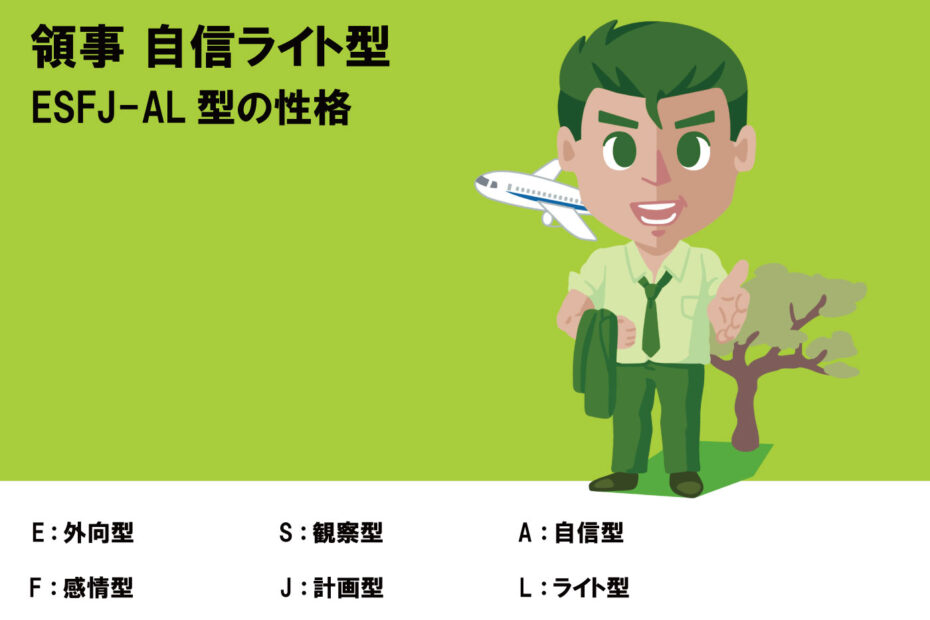
Do you relate to the personality type ESFJ-AL?
You may value relationships with people above all else and feel a desire to maintain harmony around you.
And while you have confidence in your values, don’t you wish to always be sincere?
Let’s explore your inner self together today.
In this article, we’ll discuss in detail the characteristics of ESFJ-AL and tendencies in love and work.
There may be moments when you feel “this is about me.”
We hope this can serve as an opportunity to understand yourself and your loved ones more deeply.
Once again, personality researcher and author of Villain Encyclopedia, Tokiwa (@etokiwa999), will provide the explanation.
※We have developed the HEXACO-JP Personality Assessment! It has more scientific basis than MBTI. Tap below for details.

目次
- 1 Overview of HEXACO
- 2 Characteristics of ESFJ-AL
- 3 Strengths and Weaknesses of ESFJ-AL
- 4 ESFJ-AL Relationship Tendencies and Improvement Strategies
- 5 ESFJ-AL Friendship Tendencies and Improvement Strategies
- 6 ESFJ-AL Parenting Tendencies and Improvement Strategies
- 7 ESFJ-AL Career Tendencies and Improvement Strategies
- 8 ESFJ-AL Work Tendencies and Improvement Strategies
- 9 Compatible Types with ESFJ-AL
- 10 ESFJ-AL Summary
- 11 FAQや注意点
- 12 補足
Overview of HEXACO
What is HEXACO
There is “HEXACO” as a new method for understanding personality.
This expresses human personality through six elements.
The letters H・E・X・A・C・O each represent different aspects of personality.
Your personality might also be explained through this combination.
The six elements are as follows:
- H: Honesty-Humility
- E: Emotionality
- X: eXtraversion
- A: Agreeableness
- C: Conscientiousness
- O: Openness
This model helps you understand your complex personality more deeply.
It reveals aspects that weren’t visible in conventional personality analysis.
The addition of the new perspective of “Honesty-Humility” has enabled more accurate analysis.
You can use it as a new mirror to deepen your understanding of yourself.
64 Classifications by HEXACO
Each of the six elements is classified into 64 types based on high or low levels. Specifically, they are as follows.
- H: Honesty-Humility
- High → Light (L: Light)
- Low → Dark (D: Dark)
- E: Emotionality
- High → Turbulent Type (T: Turbulence)
- Low → Assertive Type (A: Assertiveness)
- X: eXtraversion
- High → Extroverted Type (E: Extrovert)
- Low → Introverted Type (I: Introvert)
- A: Agreeableness
- High → Feeling Type (F: Feeling)
- Low → Thinking Type (T: Thinking)
- C: Conscientiousness
- High → (J: Judging)
- Low → (P: Prospecting)
- O: Openness
- High → Intuitive Type (N: iNtuitive)
- Low → Sensing Type (S: Sensor)
By combining these, your personality type becomes clear. Now let’s introduce the various types!
What is ESFJ-A (Consul・Assertive Type)?
ESFJ-A is a type with high extraversion (E), low openness (S), high agreeableness (F), high conscientiousness (J), and low emotionality (A).
- Strong empathy and sociability
- High sense of responsibility and reliability
- Practical support abilities
- Confident communication
- Emphasis on harmony and tradition
If you sensitively perceive the feelings of those around you and want to support them in practical ways, you may be this type.
You likely value social harmony and have a desire to create a stable environment.
In relationships, you prioritize compassion and sincerity above all else, and should feel a strong desire to actively contribute to your community.
While you are cautious about change, you can adapt flexibly when you understand it’s necessary.
Characteristics of ESFJ-AL
Characteristic ①”You find meaning in life through connections with people”
Do you perhaps feel more energized when you’re with people rather than when you’re alone?
Have you experienced naturally taking on the role of bringing people together at parties or gatherings?
When you make promises, you likely feel a strong sense of responsibility that “I absolutely must keep this.”
You might recognize these characteristics in yourself:
- You can’t leave someone alone when they’re in trouble
- You value teamwork above all else
- You take responsibility for what you decide until the very end
- You feel that rules everyone can agree on are important
Furthermore, you likely have confidence in your own judgment.
Positive feelings of “it will surely be okay” often win over anxious feelings.
And you should feel strong resistance to lying or deceiving people.
This inner strength leads to trust from those around you.
Characteristic ②”You find comfort in traditional approaches”
Do you sometimes feel more attracted to methods that have been loved throughout time rather than new trends?
You might be the one who values family gatherings and annual events, suggesting “let’s do it the same way this year too.”
At work, you likely feel confused when rules suddenly change.
What you value might be something like this:
- The warmth of time spent with the whole family
- The beauty of polite behavior
- Clear role division within organizations
- Customs passed down through generations
You likely feel pride in protecting these values.
Even if called “old-fashioned,” you understand the wisdom and warmth within them.
Your feelings about valuing fairness and righteousness should also be particularly strong.
This attitude supports the stability and unity of your community.
Characteristic ③”You have inner conviction and a moral compass”
When faced with decisions, are you someone who, despite hesitation, can ultimately hold the conviction that “this is right”?
Even when others around you are upset, you likely become the presence that maintains calm and reassures everyone.
And you’re probably the type who can’t overlook things that aren’t right.
You might have these characteristics within you:
- A positive feeling of “I’ll be okay”
- Decisiveness when confused
- Sharp intuition about “this isn’t right”
- Kindness that puts others’ feelings first
This combination of confidence and ethics makes you a natural leader.
At the same time, being able to make fair and trustworthy judgments is also a great strength.
People around you should respect this balanced attitude of yours.
As a result, you become an indispensable presence in building a healthy community.
Strengths and Weaknesses of ESFJ-AL
Strengths of ESFJ-AL
Isn’t your greatest charm the warm power to unite people’s hearts?
When the atmosphere in a group becomes tense, doesn’t it naturally become harmonious when you appear?
Also, you’re often trusted by others with thoughts like “if we leave it to that person, it’ll be fine.”
Here are your wonderful strengths:
- Conversational skills that empathize with others’ hearts
- The ability to organize and proceed with things properly
- Detailed consideration and thoughtfulness
- The ability to find realistic and helpful solutions
Furthermore, your confident attitude likely gives those around you a sense of security.
Your sincere actions born from high moral standards are also reasons why you gain people’s trust.
Due to these characteristics, you should naturally take on leadership roles both at work and in your community.
As a result, you become someone many people rely on.
Weaknesses of ESFJ-AL
Do you perhaps sometimes feel resistance to changing “the usual way of doing things”?
When you hear new ideas, you might think “but isn’t the way we’ve always done it more reliable?”
Also, you might get hurt more than necessary when criticized.
Here are the points you sometimes worry about:
- Anxiety about departing from familiar methods
- Strong expectations that “everyone should be the same”
- The desire to avoid conflict
- The pressure of “I must do this perfectly”
Additionally, when your confidence becomes too strong, you might unconsciously impose your thoughts on others.
High moral standards can sometimes lead to a harsh view of others.
These are not bad things at all, but rather expressions of your sense of responsibility.
With just a little awareness, you should be able to develop a more flexible and understanding attitude.
ESFJ-AL Relationship Tendencies and Improvement Strategies
ESFJ-AL Romance Tendencies
In romance, you likely have strong feelings of “I want to build a future with this person.”
You might be the type to seriously think about your future together shortly after starting to date.
You notice even small changes in your partner and often ask, “Is something bothering you?”
Your romantic style is probably something like this:
- Wishing for your partner’s happiness as if it were your own
- Thinking concretely about “marriage” and “family”
- Valuing the relationship between your partner and friends/family
- Wanting to create special anniversaries and traditions just for the two of you
Furthermore, your leadership likely manifests in romantic relationships as well.
Due to your high integrity, you should strive to build relationships free from cheating or lies.
These characteristics allow you to nurture warm relationships filled with security.
As a result, you have a high possibility of achieving long-lasting, highly satisfying romances.
When Romance Becomes Problematic and Improvement Strategies
Do you sometimes put pressure on your partner by drawing too much of an “ideal lover image” in your mind?
When your partner acts differently than expected, you might feel confused thinking “Why?”
You may also have experienced situations where something you did with good intentions for your partner turned out to be unwanted interference.
Have you ever been troubled in situations like these:
- Feeling like you want to restrict your partner’s free time
- Assumptions about “this is how love should be expressed”
- Being unable to speak your true feelings due to wanting to avoid fights
- Tendency to rely too much on your partner
For improvement, start by accepting your partner’s “differences” as individuality.
Also, before conveying your expectations to your partner, consider whether “this is my hope” or “this is for my partner.”
Creating an atmosphere where you can both share your true feelings with peace of mind is also important.
With this awareness, you can build more natural and deep loving relationships.
ESFJ-AL Friendship Tendencies and Improvement Strategies
Friendship Tendencies
Aren’t you the type who remembers friends’ birthdays and small anniversaries and plans surprises?
You probably naturally take on the role of calling out “Let’s all get together!” and deepening group bonds.
When friends are troubled, you might not be able to help but think of solutions together with them.
Your friendships probably have characteristics like these:
- Building bonds thinking “I can trust this friend”
- Loving to plan events everyone can enjoy
- Carefully maintaining relationships with longtime friends
- Longing for friendships that will continue 10 or 20 years from now
Furthermore, your leadership naturally manifests in friendships as well.
Due to your high integrity, you should maintain an attitude of never betraying your friends.
These characteristics make you loved as a “reliable friend” by those around you.
As a result, you can build rich human relationships with deep connections to many people.
When Friendships Become Problematic and Improvement Strategies
Don’t you sometimes worry too much about your friends and end up interfering?
You might have had the sad experience of being distanced by someone after saying “I said that thinking of that person,” with good intentions.
Also, when opinions divide within a group, your feelings of “everyone get along” might sometimes be too strong.
Have you ever been confused in situations like these:
- When you feel “Is that really okay?” about a friend’s way of life
- Doubting the friendship itself when criticized
- Forcing yourself to maintain group harmony
- Feeling like you’re the only one being considerate
For improvement, it’s important to first recognize your friends’ choices as “their individuality.”
Also, try practicing accepting thoughts and values different from yours as “diversity.”
Maintaining appropriate distance and respecting your friends’ independence is also important.
With this awareness, you can build healthier friendships that mutually elevate each other.
ESFJ-AL Parenting Tendencies and Improvement Strategies
Parenting Tendencies
Aren’t you the type who wants to carefully watch over each step of your child’s growth and keep records of it?
You probably notice sensitively even small changes, saying “Today they were able to do ○○.”
Also, you surely want to teach manners and etiquette carefully so that your child can get along well in society.
Your parenting might have these characteristics:
- Expressing “I love you” through words and actions
- Emphasizing the importance of establishing daily life rhythms
- Desire to raise a child who can get along well with others
- Passion for family time and creating memories
Furthermore, your confidence and sense of responsibility will likely be demonstrated in your parenting as well.
Due to your high integrity, you should approach your child with a sincere and consistent attitude.
These characteristics enable you to create an environment that gives children a sense of security and confidence.
As a result, you can build a warm home that supports your child’s healthy growth.
When Parenting Becomes Problematic and Improvement Strategies
Don’t you sometimes have such a strong desire to protect your child from danger that you end up taking away opportunities for challenges?
You might find yourself getting ahead of things, thinking “It’s dangerous if they fall” or “It would be pitiful if they fail.”
Also, the expectation to “be a good child” can sometimes put pressure on the child.
Have you ever been confused in situations like these:
- Struggling between your child’s “I want to try” and safety concerns
- The feeling of not wanting them to fail versus the necessity of growth
- Strong expectations to be “just like everyone else”
- How to deal with a child going through their rebellious phase
For improvement, it’s important to first accept your child’s individuality and interests as “their unique qualities.”
Also, keep in mind that small failures are opportunities for growth.
It’s also effective to listen to your child’s opinions and understand each other’s feelings through dialogue.
With this awareness, you’ll be able to nurture your child’s independence and confidence through your parenting.
ESFJ-AL Career Tendencies and Improvement Strategies
Career Tendencies
When choosing a job, don’t you prioritize “being able to help people”?
When asked in interviews “Why did you choose this job?”, you probably often talk about “connections with people.”
You also likely have a tendency to seek environments where you can work stably long-term.
Your career choices might have these characteristics:
- Work where you can enjoy interactions with customers and colleagues
- Environments where teams work together to achieve goals
- Career paths leading to becoming a leader or mentor
- Workplaces where you can make meaningful contributions to society
Furthermore, your confidence and sense of responsibility will likely be major assets in your career as well.
Due to your high integrity, you’re someone who easily gains trust from colleagues and supervisors.
These characteristics give you a high potential to play a central role in organizations.
As a result, you should be able to build a career that offers both stability and growth.
When Career Becomes Problematic and Improvement Strategies
When new technologies or systems are introduced, don’t you sometimes feel “Isn’t our current way sufficient?”
There are probably times when you feel it’s difficult to keep up in rapidly changing industries.
You might also sacrifice yourself too much trying to meet the expectations of colleagues and subordinates.
Have you ever had career concerns like these:
- Choosing stability over new challenges
- Anxiety about not being able to come up with innovative ideas
- Difficulty balancing work and personal life
- Exhausting yourself by demanding perfection
For improvement, start by having curiosity about new learning and experiences.
It’s also important to take time to reexamine your values and what you really want to do.
Taking adequate rest and thinking about your career from a long-term perspective is also crucial.
With this awareness, you’ll be able to achieve more fulfilling career development.
ESFJ-AL Work Tendencies and Improvement Strategies
Work Tendencies
You’re often relied upon in the workplace with people thinking “When in trouble, let’s consult ○○.” aren’t you?
In meetings, you probably listen to everyone’s opinions and volunteer to play the mediator role.
You also always meet deadlines and approach work with the responsibility of “leave this job to me.”
Your work style might have these characteristics:
- Sensitive to changes in colleagues’ health and condition
- Good at schedule management and organization
- Skilled at building trust with customers
- Committed to reliable and careful work
Furthermore, your leadership will naturally manifest in your work as well.
Due to your high integrity, you should make fair and trustworthy judgments in any situation.
These traits have earned you recognition from colleagues and supervisors as “someone who can be trusted with responsibility.”
As a result, you have become an indispensable presence in your organization.
When Problems Arise at Work and Improvement Strategies
Don’t you sometimes feel anxious about departing from “the usual way of doing things”?
When asked for an innovative approach in a new project, you might feel confused.
Also, in pursuit of perfection, you may overreact to even minor mistakes.
Have you ever been troubled in these work situations:
- Creative solutions don’t come to mind easily
- You get discouraged when hearing critical opinions
- It’s difficult to set priorities
- It’s painful to witness conflicts within the team
For improvement, start by taking interest in diverse opinions and new ideas.
Also, try practicing the mindset that “the best you can do now” is sufficient even if it’s not perfect.
Creating time to learn new skills and knowledge to broaden your perspective is also effective.
With this awareness, you’ll be able to work more flexibly and creatively.
Compatible Types with ESFJ-AL
Compatible Types: People with S
Don’t you feel a sense of security when you’re with realistic people who value the “now”?
Time spent with partners who can enjoy concrete, practically useful conversations rather than abstract discussions will feel comfortable.
You and S-type people can connect deeply in these ways:
- The joy of building a “stable daily life” together
- The pleasure of setting achievable goals together
- A heart that cherishes long-standing customs and traditions
- The satisfaction of finding realistic solutions
Furthermore, your confidence and moral sense will beautifully harmonize with the steadiness of S-types.
You should be able to understand and support each other’s efforts, building a mutually supportive relationship.
These commonalities will naturally create a cooperative relationship based on trust.
As a result, you can nurture stable bonds over the long term.
Compatible Types: People with L
When talking with sincere and honest people, don’t you feel “I can be genuine with this person”?
Partners with whom you can build relationships without lies or pretense are probably special to you.
You and L-type people can connect at these deep levels:
- Shared values about “doing the right thing”
- Jointly feeling responsibility toward society
- A heart that values fairness and integrity above all
- A relationship where you can naturally show compassion for others
Additionally, your sociability and organizational skills will make the integrity of L-types shine even brighter.
You should be able to deeply understand and respect each other’s values, building such a relationship.
These commonalities will nurture bonds filled with trust and understanding.
As a result, you can build wonderful relationships where you elevate each other and grow together.
ESFJ-AL Summary
If you are an ESFJ-AL, you are a warm presence that shines through connections with others.
Being sociable and responsible, with both confidence and high moral standards, you are likely a reliable presence for those around you.
You genuinely value relationships with people and naturally act to maintain social harmony.
Let’s take a moment to reflect on your wonderful characteristics:
- Conversational skills and coordination abilities that empathize with others’ hearts
- Thoughtful consideration and warm compassion
- Reliability of “taking responsibility to the end”
- Action-oriented approach and sincerity backed by confidence
On the other hand, it’s also important to sometimes be conscious of flexibility and not demand too much perfection.
By accepting diverse values and taking time for self-reflection, you can grow even further.
By maintaining balance while cherishing your authentic self, your life will become richer.
As a result, even more smiles will bloom around you.

FAQや注意点
HAXACOの結果と、16personalities(通称MBTI診断)やMBTI(本家)と結果が変わる
- 性格は遺伝と環境の影響を受けるため、環境が変われば回答も変わります(例、疲れてると情動性が変化するなど)。遺伝について詳しくはこちら。
- 年齢次第で回答のブレがあります。詳しくはこちら。
- タイプ分類は各数値が3以上、3未満で行っているため、3に近い値だと、質問の聞き方やその時の環境次第で結果が変わりやすくなります。タイプよりも数値を見てください。
- MBTI(本家)や16personalities(通称MBTI診断)は質問設計の段階でどの程度統計的な処理をしているか論文が見当たらないため不明確です。一方で、ビッグファイブやHEXACOはそういった論文が簡単に見つかりますし、今回のHEXACO-JP診断は論文ベースです。
- MBTIや16personalitiesは普段の行動(学力・年収など)や、脳・遺伝などとの比較した研究論文があまり多くない一方で、ビッグファイブやHEXACOは数多く存在します。
- そもそもHEXACOはビッグファイブの要素の変形なので似て非なるものです。HEXACOの正直・謙虚さは、ビッグファイブの協調性と神経症傾向から抽出されています。下記「補足」参考。
その他にもご質問があれば運営者のトキワ(@etokiwa999)までご連絡ください。
性格診断の結果はあくまで人生の「ヒント」まで
先にも書きましたが、性格は遺伝と環境の影響を受けます。遺伝の影響で、ブレ幅は一定ですが、環境次第である程度答えがブレます。
またビッグファイブやHEXACOの研究論文では学力や年収などと相関分析をしていますが、自然科学の実験ほど大きな相関係数ではありません。相関係数は最小-1、最大1ですが、だいたい-0.4~0.4ほどが多いです。もちろん高いものもあります。0.8や0.9ではなく、それに比べたら低いです。
ただそれでも様々な研究はありますので、「占い以上、自然科学未満」と思ってください。心理学や占いを100%否定しているわけではありません。
補足
16personalities(通称MBTI診断)の概要
16personalities(16タイプ性格診断)は、MBTI(Myers-Briggs Type Indicator)とビッグファイブをベースにして作られています。
厳密には16personalitiesとMBTIは別物なのです。
MBTIは、ユングの心理学的類型論を基に開発された性格診断ツールです。
16personalitiesはMBTIの4つの指標(E外向-I内向、S感覚-N直観、T思考-F感情、J判断-P知覚)を採用しつつ、アイデンティティ(AとT)という指標の追加、独自の質問項目・評価基準を設けています。
この性格診断の良いところとしては、韓国アイドルが広めたり、恋愛マッチングアプリでも使われたりするなど、とても有名で、回答数がとても多いことにあります。それを利用して分析して論文として公開すれば信頼性は高いかもしれません。
ただし、悪いところとしては、科学的な裏付けが弱いところがあります。査読付き論文の数が少ない、統計処理の方法が不明確、性格と学力・収入・脳機能・遺伝的要因などとの関連性について十分な根拠が提示されていない、などが理由です。
MBTI(本家)の概要
MBTIは性格を16タイプに分類する心理学の理論です。
そもそもMBTIとは、マイヤーズ・ブリッグス・タイプ・インジケーター(Myers-Briggs Type Indicator)の略称です。
MBTIでは、以下の4つの指標を組み合わせて性格を16タイプに分類します。
- 外向性(Extraversion)か内向性(Introversion)
- 感覚(Sensing)か直観(iNtuition)
- 思考(Thinking)か感情(Feeling)
- 判断(Judging)か知覚(Perceiving)
つまり、MBTIでは自分の性格傾向を「ISTJ」や「ENFP」などの4文字で表現するのです。
16personalitiesよりは論文は存在しますが、ビッグファイブやHEXACOほど頑健な研究結果が出ているわけではありません。
ビッグファイブの概要
性格心理学において最も有力な特性理論の一つが「ビッグファイブ(Big Five)」です。
ビッグファイブは、開放性、誠実性、外向性、協調性、神経症傾向の5つの特性を測定します。
また、16personalitiesやMBTIはタイプ分類(例、外向的か内向的かのどちらか)を用いるのに対して、ビッグファイブが特性を連続的な数値で評価する(例、外向性3.5)点も大きな違いです。
さらに、古くから研究されており、論文数も多く、学力や所得、脳や遺伝など、他の分野でも多くの研究が行われています。ビッグファイブの方が比較的、科学的な裏付けが強いと言えます。
MBTI・ビッグファイブ・HEXACOの相関関係
MBTIの4指標とビッグファイブの5因子には相関関係があります。
この相関を示した代表的な研究に、「The relationship between the revised NEO-Personality Inventory and the Myers-Briggs Type Indicator」という論文があります。
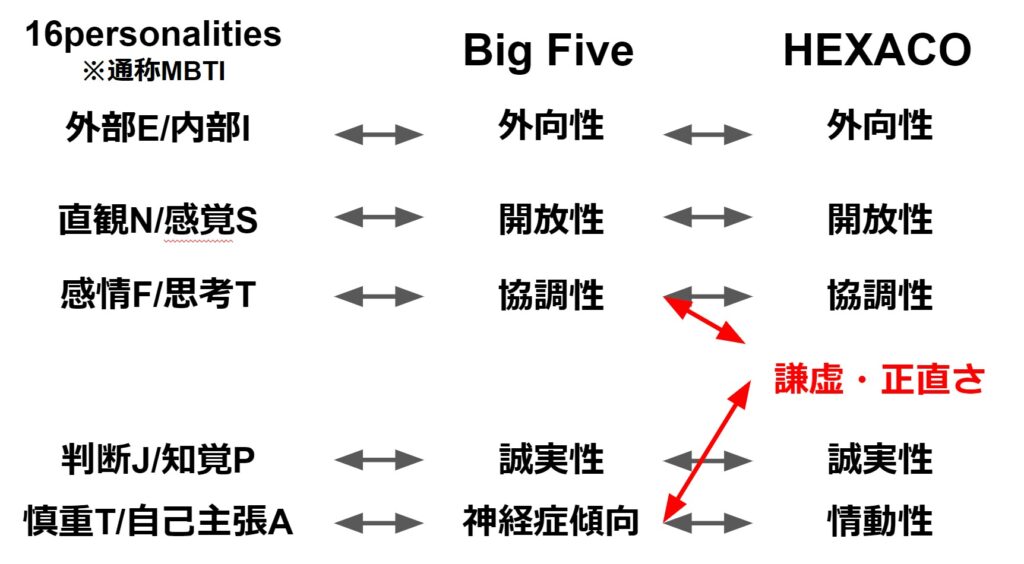
また、MBTI(本家)とビッグファイブを参考にして作られた16personalities(通称MBTI診断)では、ビッグファイブの神経症傾向が「アイデンティティ」と呼ばれており、自信(Assertive)か、慎重(Turbulent)かで分類されています。
これらの関係をまとめたのが以下の図です。
一番右には、比較的新しい性格診断である「HEXACO(ヘキサコ)」があります。ビッグファイブに1つ指標「正直・謙虚さ」を加えて改良され、ダーク特性(倫理観)が分かるようになりました。
今回のHEXACO-JP性格診断では16personalitiesの5文字に加えて、ダークD/ライトLを付けてより詳細に分析できるようにしています。

Writer & Supervisor: Eisuke Tokiwa
Personality Psychology Researcher / CEO, SUNBLAZE Inc.
As a child he experienced poverty, domestic abuse, bullying, truancy and dropping out of school — first-hand exposure to a range of social problems. He spent 10 years researching these issues and published Encyclopedia of Villains through Jiyukokuminsha. Since then he has independently researched the determinants of social problems and antisocial behavior (work, education, health, personality, genetics, region, etc.) and has published 2 peer-reviewed journal articles (Frontiers in Psychology, IEEE Access). His goal is to predict the occurrence of social problems. Spiky profile (WAIS-IV).
Expertise: Personality Psychology / Big Five / HEXACO / MBTI / Prediction of Social Problems
Researcher profiles: ORCID / Google Scholar / ResearchGate
Social & Books: X (@etokiwa999) / note / Amazon Author Page