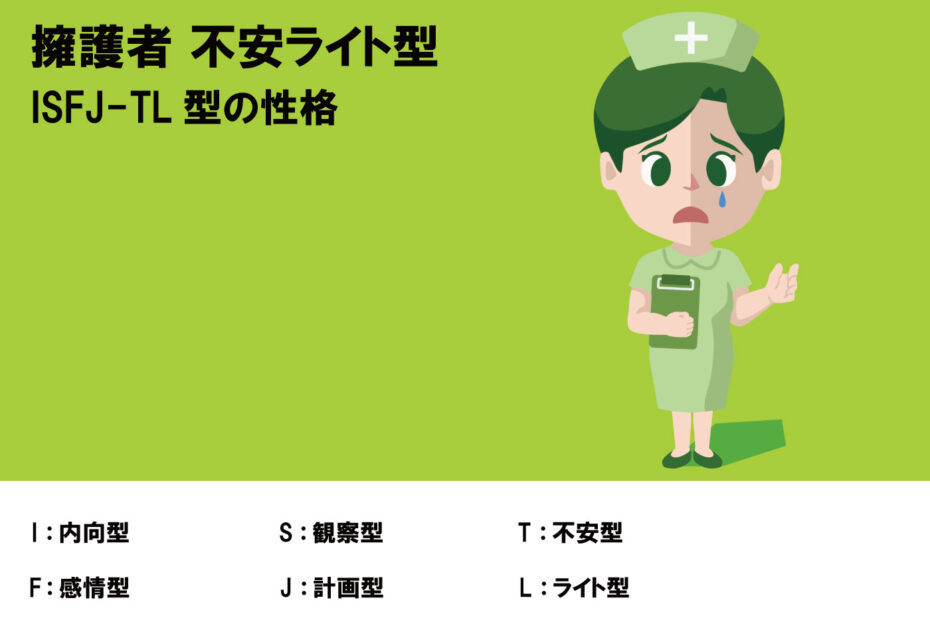
Don’t you feel joy from the bottom of your heart when you devote yourself to someone?
Perhaps you might be the ISFJ-TL type.
Even while thinking “I’m the only one being considerate again…”, you still feel fulfilled when you see the smiles of people around you.
Do you have any experience like this?
As an ISFJ-TL, you are a very precious person with meticulous care and high ethical standards.
But sometimes, you may become exhausted from putting your own feelings aside too much.
In this article, we will explain in detail about your beautiful characteristics and the difficulties you sometimes feel in life.
You should find hints for living true to yourself.
Would you like to understand yourself more deeply together?
Once again, personality researcher and author of Villain Encyclopedia, Tokiwa (@etokiwa999), will provide the explanation.
※We have developed the HEXACO-JP Personality Assessment! It has more scientific basis than MBTI. Tap below for details.

目次
- 1 Overview of HEXACO
- 2 Characteristics of ISFJ-TL
- 3 Strengths and Weaknesses of ISFJ-TL
- 4 ISFJ-TL Romantic Relationship Tendencies and Improvement Strategies
- 5 ISFJ-TL Friendship Tendencies and Improvement Strategies
- 6 ISFJ-TL Parenting Tendencies and Solutions
- 7 ISFJ-TL Career Tendencies and Solutions
- 8 ISFJ-TL Work Tendencies and Improvement Strategies
- 9 Types Compatible with ISFJ-TL
- 10 Summary of ISFJ-TL
- 11 FAQや注意点
- 12 補足
Overview of HEXACO
What is HEXACO
There is a new method that allows you to understand your personality more accurately.
That is the “HEXACO” model.
It reveals aspects that were not visible in conventional personality assessments.
HEXACO consists of six elements:
- H: Honesty-Humility
- E: Emotionality
- X: eXtraversion
- A: Agreeableness
- C: Conscientiousness
- O: Openness
The groundbreaking point of this model is the addition of the “Honesty-Humility” element.
It can also measure your tendency to trust people and value fairness.
This allows for a deeper understanding of your personality.
64 Classifications by HEXACO
Each of the six elements is classified into 64 types based on high and low scores. Specifically:
- H: Honesty-Humility
- High → Light (L)
- Low → Dark (D)
- E: Emotionality
- High → Turbulence (T)
- Low → Assertiveness (A)
- X: eXtraversion
- High → Extrovert (E)
- Low → Introvert (I)
- A: Agreeableness
- High → Feeling (F)
- Low → Thinking (T)
- C: Conscientiousness
- High → (J: Judging)
- Low → (P: Prospecting)
- O: Openness
- High → Intuitive (N)
- Low → Sensor (S)
These are connected like 16personalities to express types. Now let’s introduce each type!
What is ISFJ-T (Defender・Cautious Type)?
ISFJ-T is a type with low extraversion (I), low openness (S), high agreeableness (F), high conscientiousness (J), and high neuroticism (T) in the Big Five. Characteristics:
- Strong empathy and compassion
- Perfectionism and self-criticism
- Sensitivity to others’ needs
- Stress from uncertainty
- Values tradition and stability
They are very sensitive to others’ needs and find joy in providing support in practical ways. However, they often feel anxious about their abilities and decisions. They pay attention to details and set high standards, but they also fear not being able to achieve them.
In interpersonal relationships, they value harmony and stability, but are sensitive to criticism or rejection from others. They easily feel stress from change and uncertainty, but this also becomes the driving force for growth and improving their skills in supporting others.
Characteristics of ISFJ-TL
Characteristic ① “A sincere and devoted heart”
Don’t you feel true joy when serving others?
When friends are in trouble, when family members are worried.
You want to support the people you care about, even if it means putting yourself second.
Sincere and devoted people like you have these characteristics:
- It’s physically impossible to break promises
- You fear hurting others’ feelings more than anything
- You have a constitution that can’t ignore people in trouble
But sometimes, you might feel this way:
“Is my effort enough?” “Isn’t there more I could do?”
Your perfectionism actually stems from deep love.
Also, you have the strength to stick to what you believe is right.
Even when you’re about to be swayed by others, you listen to your inner voice.
That consistent attitude becomes emotional support for many people.
In other words, your devoted nature is an irreplaceable gift to this world.
Characteristic ② “Sensitivity that detects easily overlooked changes”
Don’t you notice when a friend’s expression is just slightly clouded?
You worry, “Did something unpleasant happen?”
Small changes that others don’t notice appear vividly to your eyes.
Your delicate sensitivity is demonstrated in these situations:
- Instantly detecting a colleague’s “unusually tired face”
- Immediately noticing room rearrangements or new hairstyles
- Accurately remembering procedures and sequences after seeing them once
However, this excellent sensitivity can sometimes become a burden.
There are nights when you can’t sleep because trivial things bother you.
You might blame yourself, thinking “Am I the only one who worries about such things?”
But your sense of fairness and desire for accuracy are noble.
Your inability to overlook mistakes or injustice is a manifestation of your sincerity.
Even if others sometimes say you’re “too perfectionist,” that’s what makes you who you are.
Your delicate consideration becomes warm support for many people.
Characteristic ③ “A heart that cherishes unchanging values”
Family annual events and items you’ve loved for years.
Don’t you feel deep attachment to such “unchanging things”?
You prefer trusted, familiar things over new ones.
The traditions and stability you cherish include things like:
- Family time spent in the same place every year
- “Unspoken rules” that have been passed down in the workplace
- Favorite brands you’ve used for years
It’s natural to feel anxious when facing new environments or sudden changes.
“The old way was fine, so why change it?”
You don’t need to blame yourself for thinking that way.
Your conservative stance is actually indispensable for social stability.
Your desire to maintain rules and order supports organizations.
Even if you’re sometimes called “inflexible,” your consistency is the source of trust.
You, who continue to protect unchanging values, are a precious lighthouse in a chaotic world.
Strengths and Weaknesses of ISFJ-TL
Strengths of ISFJ-TL
“I can safely rely on this person for anything” – aren’t you thought of this way by those around you?
Your greatest weapon is that unwavering reliability.
Your figure of keeping promises and fulfilling responsibilities is deeply engraved in many people’s hearts.
Let’s reconfirm the wonderful strengths you possess:
- Empathy that picks up on feelings others don’t put into words
- Perseverance that doesn’t give up until the end even in difficult situations
- Kindness that feels others’ pain as your own
Also, your memory is truly amazing.
Friends’ birthdays, favorite foods, things they dislike.
You remember such fine details and can show consideration naturally.
And above all, your sense of justice is pure and powerful.
When you see unfair situations, you can’t stay silent.
That courage to protect those in weak positions is proof of true strength.
These strengths are precious talents you were born with.
Weaknesses of ISFJ-TL (Actually Misunderstood Strengths)
“Can’t sleep again because you’re worrying too much…” Have you ever spent nights like this?
Many of the traits you consider shortcomings are actually expressions of deep love.
However, sometimes that kindness ends up causing you pain.
Challenges you tend to face and their true meaning:
- Avoiding confrontation → Expression of a peace-loving heart
- Putting your own feelings aside → Deep compassion for others
- Demanding too much perfection → Manifestation of strong sense of responsibility
Taking on work because you can’t say “no” is also part of who you are.
But if you burn out, you won’t be able to support the people you care about.
Taking care of yourself is also a form of love for others.
Also, your adherence to rules may be called “stubborn.”
But that’s proof of your consistent values.
In a chaotic world, it’s because people like you exist that order is maintained.
Your “shortcomings” are actually beautiful qualities that the world needs.
ISFJ-TL Romantic Relationship Tendencies and Improvement Strategies
ISFJ-TL Romantic Tendencies
Memorizing your partner’s favorite music, preparing warm tea when they look tired.
Your love life is deep and calm like a quiet lake.
Even without flashiness, it’s filled with feelings of truly wanting to cherish your partner.
Your romantic style has these beautiful characteristics:
- Observational skills that don’t miss even subtle changes in your partner
- A pure heart where the concept of cheating doesn’t exist
- Sense of responsibility that seriously considers future family life
But sometimes, you can’t help but worry about every word your partner says.
“Did those words have some meaning?”
Because your love is deep, your anxiety becomes greater too.
Also, you can’t easily give up on relationships with people you’ve once loved.
Even when there are problems, you believe “we can surely resolve this” and continue to endure.
That faithfulness is beautiful, but sometimes it’s necessary to protect yourself too.
Your love is the warmest place of comfort for your partner.
When Problems Arise in Romance and Improvement Strategies
“My feelings don’t matter anyway” – aren’t you enduring while thinking this?
Your kindness is beautiful, but it can become one-sided.
True love must be a relationship where both people can be happy.
Common problem patterns and improvement methods that suit you:
- Problem: Becoming too dependent on your partner and losing yourself
Improvement: Create time for yourself once a week to do things you enjoy - Problem: Fearing change and letting the relationship become stagnant
Improvement: Try going to new places together once a month
In trying too hard to understand your partner’s feelings, you may rely too much on speculation.
Assumptions like “they must be thinking this” can create misunderstandings.
Try practicing the courage to ask directly “What do you think?”
Also, in pursuing ideal relationships, you may suffer from the gap with reality.
Perfect romance doesn’t exist.
What’s important is having an attitude of walking together while enjoying each other’s growth.
Your love is beautiful enough as it is. Have confidence and cherish your own feelings too.
ISFJ-TL Friendship Tendencies and Improvement Strategies
Friendship Tendencies
For you, friends are like treasures in life, aren’t they?
Rather than many acquaintances, a few friends you can trust from your heart.
You must feel true joy in building such deep connections.
Wonderful qualities you demonstrate in friendships:
- Reliability to take any secret to the grave
- Empathy that takes your friends’ troubles as if they were your own
- Loyalty that remains unchanged even after decades
When a friend seems down, you quietly offer warm coffee before saying anything.
Such thoughtful consideration from you has healed many people’s hearts.
But sometimes, you worry so much about your friends that you can’t sleep at night.
Also, breaking promises with friends is unthinkable to you.
No matter how tired you are, no matter how difficult the situation.
That sincerity becomes the foundation for nurturing long-term friendships.
People who can have a friend like you are truly fortunate.
When Friendships Become Problematic and Solutions
Do you ever worry “Am I always the one reaching out again? Maybe they find me annoying?”
You give so much of yourself for friends that you end up exhausted.
In such times, setting healthy boundaries is also a form of love.
Common situations in friendships and gentle solutions:
- Problem: Unable to express opinions to friends, harboring frustration
Solution: Practice communicating feelings in the form of “This is how I feel” - Problem: Can’t refuse requests, losing personal time
Solution: Offer alternatives like “I can’t right now, but I could help next week”
Fear of conflict can lead to turning a blind eye to important issues.
But true friendship sometimes deepens when we’re honest with each other.
Conversations that begin with “I want to talk because I care” will surely get through.
You might also set expectations too high for friends and end up disappointed.
But everyone has their own different values and circumstances.
Rather than seeking perfect friends, cultivate the warmth to accept imperfections too.
Your kindness already comes through clearly. Please treat yourself as a precious friend too.
ISFJ-TL Parenting Tendencies and Solutions
Parenting Tendencies
You react sensitively to even your child’s small cough, checking repeatedly for fever.
Your love wraps around your child like a warm blanket.
For your child’s happiness, you put yourself second without hesitation.
Loving characteristics that appear in your parenting:
- Carefully maintaining daily meals and sleep routines
- Creating a warm atmosphere where the whole family can relax
- Sensitivity to detect even small changes in your child’s emotions
Getting absorbed in creating photo albums documenting your child’s growth.
Adding little messages to handmade lunch boxes.
Such detailed expressions of love are your unique parenting style.
But thinking too much about your child’s future can cause nighttime anxiety.
“Will this child be okay?” “Is my parenting approach right?”
Because your love runs so deep, worries are endless.
Children raised wrapped in your love will surely grow up to have warm hearts.
When Parenting Becomes Problematic and Solutions
Do you ever feel “It’s too painful to see this child get hurt”?
Because of love, you end up overprotecting your child.
But sometimes children need opportunities to learn from small failures too.
Problems that tend to arise from deep love and how to find balance:
- Problem: Getting ahead of situations so the child won’t fall
Solution: Create time for the child to challenge themselves while watching from nearby - Problem: Imposing your values as if they’re natural
Solution: Ask “Mom thinks this way, but how do you feel?”
Being too sensitive to changes in your child’s expression can lead to overreacting to trivial things.
Sometimes such parental worry becomes a burden for the child.
Take a deep breath and ask yourself, “Is this really something to worry about right now?”
You might also put too much pressure on them by demanding good grades and proper behavior.
While recognizing your child’s efforts is important, failures are also nourishment for growth.
Try directing words like “You did your best” toward the process rather than the results.
Your love is already reaching your child sufficiently. It’s okay not to be a perfect parent.
ISFJ-TL Career Tendencies and Solutions
Career Tendencies
Have you ever chosen a profession thinking “I want to do work that helps people”?
You prioritize fulfillment and stability over high salary.
You are an indispensable presence in society.
Characteristics of professions where you can shine:
- Medical and welfare fields where you directly interact with patients and clients
- Educational settings where you watch over children’s growth
- Administrative and secretarial roles that support organizations from behind the scenes
Working accurately according to manuals is not a burden for you.
Rather, having established procedures gives you a sense of security.
However, when you hear the words “new system implementation,” you might feel a little depressed.
Also, when you witness misconduct or unfair treatment in the workplace, you will feel strong stress.
“Why is this kind of thing allowed?” – this sense of justice disturbs your heart.
It is in an environment with trustworthy supervisors and colleagues that you can truly demonstrate your abilities.
It is because there are honest workers like you that organizations function healthily.
When Problems Arise in Career and Improvement Strategies
Have you ever felt anxious thinking “I got offered a promotion, but can I really do it?”
Your fear of change causes you to pass up growth opportunities.
But you have more potential than you think you do.
Common career challenges and ways to progress step by step:
- Problem: Avoiding new challenges and maintaining the status quo
Improvement strategy: Set three small goals and try to achieve one each month - Problem: Difficulty promoting your own achievements
Improvement strategy: Develop a habit of reporting results with specific numbers in weekly or monthly reports
You can’t refuse work requests from colleagues, so your own tasks get pushed to the back burner.
Sometimes your kindness backfires and ends up causing trouble for others.
Try practicing accepting requests with conditions like “I can help until ○ o’clock today.”
Even when you have doubts about workplace relationships or systems, it takes courage to speak up.
But constructive suggestions are often welcomed.
Try thinking from the perspective of “making things better for everyone.”
Your honesty and sense of responsibility will surely be recognized someday. Continue walking forward with confidence.
ISFJ-TL Work Tendencies and Improvement Strategies
Work Tendencies
You always complete work one week before the deadline and check it multiple times.
Your careful work style should give the entire team a sense of security.
You’re probably often told “We can count on ○○-san.”
Valuable strengths you demonstrate in the workplace:
- Sharp eye for finding mistakes and sense of responsibility to carefully correct them
- Stability that supports the organization’s foundation by following rules
- Antenna that quickly detects when customers or colleagues are in trouble
You’re thoughtful about organizing materials used in meetings and preparing for the next time.
You have the kindness to quietly support new employees when they’re struggling.
However, you may sometimes spend more time than necessary pursuing perfection.
Also, you absolutely want to avoid disrupting the workplace atmosphere.
Even if you have opinions, you’d rather stay quiet than rock the boat.
Are you keeping valuable ideas locked away in your heart?
Your serious and honest attitude is the most precious asset an organization can have.
When Problems Arise at Work and Improvement Strategies
Have you ever experienced getting a stomachache when you heard “a new system is being implemented”?
Familiar methods feel the most secure.
But you’re also worried about being left behind by changing times, right?
Common workplace challenges and ways to overcome them in your own style:
- Problem: Feeling resistant to new technology implementation
Improvement strategy: Take notes on how to use it and gradually get used to it starting with small features - Problem: Holding back from speaking even when you have good ideas
Improvement strategy: First consult with a trustworthy supervisor via email or proposal document
When you see a colleague in trouble, you can’t leave them alone, and before you know it, your own work is piling up.
Helping that started from kindness can sometimes end up causing trouble for the entire team.
Try cooperating with time limits like “until ○ o’clock today.”
Even when you notice workplace inefficiency or irrationality, pointing it out feels heavy.
But if your motivation is “for everyone’s sake,” it will surely be accepted.
Start by consulting with someone you trust.
Adapting to change is something you’ll definitely get used to if you proceed at your own pace.
Types Compatible with ISFJ-TL
Compatible Types: People with S
Isn’t there someone you feel “I feel at ease talking with this person”?
Surely, that person is also a realistic and caring S type like you.
Especially with ESFJ (Extraverted Feeling with Sensing), the compatibility is perfectly in sync like twins.
Reasons why ESFJ and you are attracted to each other:
- Same priority of putting others’ feelings first
- Sharing the value that “traditional methods are best”
- Naturally matching attitude of valuing teamwork
Also, ISFP (Artist type)’s free thinking complements your steadiness.
When you’re worrying “Will it be okay?”, ISFP encourages you saying “It’ll surely work out.”
In such a relationship, each other’s balance is maintained.
With ESTJ (Executive type), work compatibility is outstanding.
You firmly support ESTJ’s leadership.
However, ESTJ’s overly direct way of speaking might sometimes hurt your feelings.
The charm of being with S types is that you can build deep trust relationships as fellow people who value reality.
Compatible Types: People with L
Meeting someone you can truly think “This person is really trustworthy” from the heart is precious.
With fellow honest and humble L type people, such deep connections are born.
Especially with INFJ-L (Idealist), you can understand each other at a soul level.
Parts where INFJ-L and you resonate:
- Empathy to feel others’ pain as your own
- Cherishing sincere relationships without lies or falsehood above all
- Pure desire to make the world a better place
ENFJ-L (Educator type)’s sociability gently draws out your introverted side.
When together, you’ll discover a more proactive version of yourself.
With the common passion of supporting people, you can elevate each other.
With INTJ-L (Architect type), you can respect each other’s sincerity.
INTJ-L’s logical approach may sometimes confuse you.
But the underlying feeling of “wanting to do the right thing” is the same.
As people with honest and humble hearts, you can build beautiful relationships without pretense.
Summary of ISFJ-TL
Reading this far, there were probably many parts where you felt “This is exactly me.”
Someone like you, an ISFJ-TL, is an irreplaceable existence for this world.
You support many people’s hearts with your thoughtfulness and sense of responsibility.
Let’s reconfirm the beautiful qualities you possess:
- Pure heart that genuinely wishes for others’ happiness
- Consistency in protecting unchanging values
- Sensitivity that notices details easily overlooked
Family, friends, lovers, colleagues.
All people involved with you must have experienced being saved by your warmth.
But sometimes, it’s necessary to have the courage to say “No” or to cherish your own feelings.
At work, you’re trusted by many people for your accuracy and thoroughness.
New challenges may be scary, but you can surely overcome them.
You can accept change at your own pace, and that’s perfectly fine.
Your “tendency to worry” and “perfectionism” are actually expressions of love.
Instead of blaming yourself, be proud of that kindness.
However, don’t forget to show compassion to yourself as well.
You, as an ISFJ-TL, are an existence that is deep like a quiet lake and heals people like a warm fireplace.

FAQや注意点
HAXACOの結果と、16personalities(通称MBTI診断)やMBTI(本家)と結果が変わる
- 性格は遺伝と環境の影響を受けるため、環境が変われば回答も変わります(例、疲れてると情動性が変化するなど)。遺伝について詳しくはこちら。
- 年齢次第で回答のブレがあります。詳しくはこちら。
- タイプ分類は各数値が3以上、3未満で行っているため、3に近い値だと、質問の聞き方やその時の環境次第で結果が変わりやすくなります。タイプよりも数値を見てください。
- MBTI(本家)や16personalities(通称MBTI診断)は質問設計の段階でどの程度統計的な処理をしているか論文が見当たらないため不明確です。一方で、ビッグファイブやHEXACOはそういった論文が簡単に見つかりますし、今回のHEXACO-JP診断は論文ベースです。
- MBTIや16personalitiesは普段の行動(学力・年収など)や、脳・遺伝などとの比較した研究論文があまり多くない一方で、ビッグファイブやHEXACOは数多く存在します。
- そもそもHEXACOはビッグファイブの要素の変形なので似て非なるものです。HEXACOの正直・謙虚さは、ビッグファイブの協調性と神経症傾向から抽出されています。下記「補足」参考。
その他にもご質問があれば運営者のトキワ(@etokiwa999)までご連絡ください。
性格診断の結果はあくまで人生の「ヒント」まで
先にも書きましたが、性格は遺伝と環境の影響を受けます。遺伝の影響で、ブレ幅は一定ですが、環境次第である程度答えがブレます。
またビッグファイブやHEXACOの研究論文では学力や年収などと相関分析をしていますが、自然科学の実験ほど大きな相関係数ではありません。相関係数は最小-1、最大1ですが、だいたい-0.4~0.4ほどが多いです。もちろん高いものもあります。0.8や0.9ではなく、それに比べたら低いです。
ただそれでも様々な研究はありますので、「占い以上、自然科学未満」と思ってください。心理学や占いを100%否定しているわけではありません。
補足
16personalities(通称MBTI診断)の概要
16personalities(16タイプ性格診断)は、MBTI(Myers-Briggs Type Indicator)とビッグファイブをベースにして作られています。
厳密には16personalitiesとMBTIは別物なのです。
MBTIは、ユングの心理学的類型論を基に開発された性格診断ツールです。
16personalitiesはMBTIの4つの指標(E外向-I内向、S感覚-N直観、T思考-F感情、J判断-P知覚)を採用しつつ、アイデンティティ(AとT)という指標の追加、独自の質問項目・評価基準を設けています。
この性格診断の良いところとしては、韓国アイドルが広めたり、恋愛マッチングアプリでも使われたりするなど、とても有名で、回答数がとても多いことにあります。それを利用して分析して論文として公開すれば信頼性は高いかもしれません。
ただし、悪いところとしては、科学的な裏付けが弱いところがあります。査読付き論文の数が少ない、統計処理の方法が不明確、性格と学力・収入・脳機能・遺伝的要因などとの関連性について十分な根拠が提示されていない、などが理由です。
MBTI(本家)の概要
MBTIは性格を16タイプに分類する心理学の理論です。
そもそもMBTIとは、マイヤーズ・ブリッグス・タイプ・インジケーター(Myers-Briggs Type Indicator)の略称です。
MBTIでは、以下の4つの指標を組み合わせて性格を16タイプに分類します。
- 外向性(Extraversion)か内向性(Introversion)
- 感覚(Sensing)か直観(iNtuition)
- 思考(Thinking)か感情(Feeling)
- 判断(Judging)か知覚(Perceiving)
つまり、MBTIでは自分の性格傾向を「ISTJ」や「ENFP」などの4文字で表現するのです。
16personalitiesよりは論文は存在しますが、ビッグファイブやHEXACOほど頑健な研究結果が出ているわけではありません。
ビッグファイブの概要
性格心理学において最も有力な特性理論の一つが「ビッグファイブ(Big Five)」です。
ビッグファイブは、開放性、誠実性、外向性、協調性、神経症傾向の5つの特性を測定します。
また、16personalitiesやMBTIはタイプ分類(例、外向的か内向的かのどちらか)を用いるのに対して、ビッグファイブが特性を連続的な数値で評価する(例、外向性3.5)点も大きな違いです。
さらに、古くから研究されており、論文数も多く、学力や所得、脳や遺伝など、他の分野でも多くの研究が行われています。ビッグファイブの方が比較的、科学的な裏付けが強いと言えます。
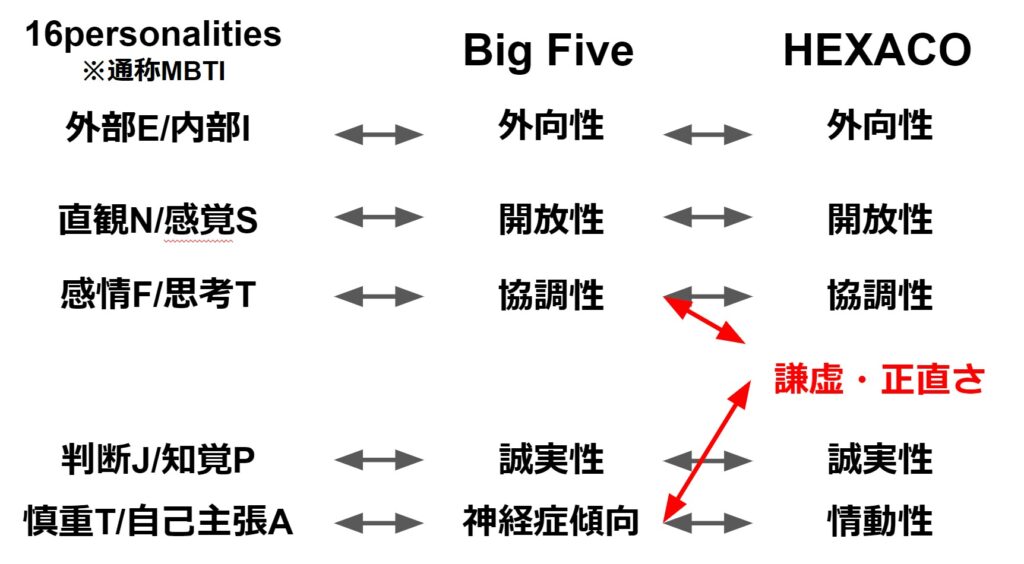
MBTI・ビッグファイブ・HEXACOの相関関係
MBTIの4指標とビッグファイブの5因子には相関関係があります。
この相関を示した代表的な研究に、「The relationship between the revised NEO-Personality Inventory and the Myers-Briggs Type Indicator」という論文があります。
また、MBTI(本家)とビッグファイブを参考にして作られた16personalities(通称MBTI診断)では、ビッグファイブの神経症傾向が「アイデンティティ」と呼ばれており、自信(Assertive)か、慎重(Turbulent)かで分類されています。
これらの関係をまとめたのが以下の図です。
一番右には、比較的新しい性格診断である「HEXACO(ヘキサコ)」があります。ビッグファイブに1つ指標「正直・謙虚さ」を加えて改良され、ダーク特性(倫理観)が分かるようになりました。
今回のHEXACO-JP性格診断では16personalitiesの5文字に加えて、ダークD/ライトLを付けてより詳細に分析できるようにしています。

Writer & Supervisor: Eisuke Tokiwa
Personality Psychology Researcher / CEO, SUNBLAZE Inc.
As a child he experienced poverty, domestic abuse, bullying, truancy and dropping out of school — first-hand exposure to a range of social problems. He spent 10 years researching these issues and published Encyclopedia of Villains through Jiyukokuminsha. Since then he has independently researched the determinants of social problems and antisocial behavior (work, education, health, personality, genetics, region, etc.) and has published 2 peer-reviewed journal articles (Frontiers in Psychology, IEEE Access). His goal is to predict the occurrence of social problems. Spiky profile (WAIS-IV).
Expertise: Personality Psychology / Big Five / HEXACO / MBTI / Prediction of Social Problems
Researcher profiles: ORCID / Google Scholar / ResearchGate
Social & Books: X (@etokiwa999) / note / Amazon Author Page