
Personality development is not just about self-improvement — it is one of the most scientifically grounded tools for solving real-world relationship problems. Whether you feel drained by workplace dynamics, struggle to make friends as an adult, or simply find interpersonal communication exhausting, research suggests that understanding your own personality traits can resolve approximately 70% of relationship friction before it even begins. This guide breaks down the psychology behind human connections and offers practical, trait-based strategies to help you build relationships that actually work for you.
Personality psychology is the scientific study of individual behavioral patterns and thinking tendencies. Far from being abstract theory, it offers a concrete framework — most notably the Big Five personality traits (also known as the Five-Factor Model) — that explains why some relationships feel effortless while others are chronically exhausting. By the end of this article, you will understand your own relational style more clearly and know exactly which strategies align with your character.
Once again, personality researcher and author of Villain Encyclopedia, Tokiwa (@etokiwa999), will provide the explanation.
※We have developed the HEXACO-JP Personality Assessment! It has more scientific basis than MBTI. Tap below for details.

目次
- 1 How Personality Traits Shape Your Relationships
- 2 Personality Types and Relationship Patterns: A Science-Based Overview
- 3 How to Make Friends as an Adult: What the Science Actually Says
- 4 When Relationships Drain You: Personality-Based Recovery Strategies
- 5 Building Communication Skills Through Your Personality Strengths
- 6 Solitude vs. Isolation: Why Extraversion Is Not the Goal
- 7 Actionable Advice: Leveraging Your Personality for Better Relationships
- 8 Frequently Asked Questions
- 8.1 Can personality development actually improve my relationships, or is personality fixed?
- 8.2 Is it normal to want to reset or withdraw from all your relationships at once?
- 8.3 Do introverted people have worse social skills or fewer friends than extraverts?
- 8.4 How does social anxiety relate to personality traits?
- 8.5 Can adults really form deep friendships, or does that only happen when you’re young?
- 8.6 What is the difference between a character disorder and a difficult personality?
- 8.7 How does the HEXACO model differ from the Big Five, and does it matter for relationships?
- 9 Summary: Use What You Know About Yourself to Build Better Connections
- 10 Related Articles
- 11 Try Taking the Proper Personality Test “HEXACO-JP”!
- 12 Scientific Background of the 16 Types
- 13 FAQ and Important Notes
How Personality Traits Shape Your Relationships
Research suggests that roughly 70% of interpersonal problems can be traced back to a mismatch between personality traits rather than deliberate ill intent. This means most relationship stress is not personal — it is structural. When two people with fundamentally different trait profiles interact without awareness of those differences, misunderstanding is almost inevitable.
Personality psychology — specifically models like the Big Five personality traits and the HEXACO model — provides a scientific lens for analyzing why certain interactions feel smooth and others feel like friction. The Big Five dimensions are Openness, Conscientiousness, Extraversion, Agreeableness, and Neuroticism (often abbreviated as OCEAN). The HEXACO model adds a sixth dimension: Honesty-Humility, which turns out to be particularly relevant in predicting relationship quality and trustworthiness.
Consider a simple example: a highly extraverted person thrives on frequent social contact and wide networks. An introverted person, by contrast, tends to invest deeply in a small number of close relationships and finds large social gatherings draining rather than energizing. Neither profile is flawed — but when these two types interact without understanding each other’s needs, the extrovert may feel rejected and the introvert may feel overwhelmed. The gap is not in character, it is in awareness.
- Value misalignment — Different personality traits naturally produce different priorities, leading to recurring disagreements that feel personal but are often structural.
- Mismatched communication styles — Some people process information externally (talking it through), while others need internal reflection first; clashing here causes frequent frustration.
- Differing stress responses — High-neuroticism individuals tend to react intensely to conflict, while low-neuroticism individuals may appear indifferent, creating a cycle of escalation and withdrawal.
- Varying needs for closeness — The desired level of emotional intimacy differs significantly across personality types, and unspoken expectations cause the most damage.
Understanding these 4 core sources of interpersonal tension is the starting point for meaningful personality development. Once you can name the mechanism behind a conflict, you can address it systematically rather than emotionally.
Personality Types and Relationship Patterns: A Science-Based Overview
Studies based on personality type frameworks indicate that each personality profile generates a predictable pattern of relational strengths and vulnerabilities. Recognizing your own pattern is not about putting yourself in a box — it is about understanding why certain social situations consistently drain or energize you, so you can make informed choices rather than reactive ones.
Research drawing on both the Big Five and type-based models (such as the 16-type framework used in various personality assessments) consistently shows that personality types relationships follow identifiable patterns. For example, individuals who score high on introversion and analytical thinking tend to prefer logical debate and structured conversation. When placed in highly emotional or improvisational social environments, they tend to become cognitively fatigued much faster than their extraverted counterparts.
Similarly, people who score high on Agreeableness and Extraversion tend to prioritize social harmony. When paired with someone who scores low on Agreeableness — someone who is blunt, competitive, or dismissive of others’ emotions — they are likely to feel dismissed or lonely, even within an active social life. This mismatch is one of the most common sources of social anxiety relief research: simply knowing that the discomfort has a structural cause (not a personal failure) significantly reduces anxiety.
- Introverted types — Build fewer but deeper relationships; surface-level socializing feels performative and costly rather than rewarding.
- Extraverted types — Seek broad social networks and frequent interaction; isolation, even briefly, can feel disorienting.
- Thinking-dominant types — Prioritize logic and objectivity; emotional conversations without clear resolution tend to feel unproductive.
- Feeling-dominant types — Prioritize harmony and empathy; transactional or cold interactions feel fundamentally unsafe.
The critical insight here is that no personality type is inherently problematic. Difficulties arise when individuals try to suppress their natural patterns to fit external expectations. Sustainable relationship health begins with accepting your own profile and learning to communicate it clearly to others.
How to Make Friends as an Adult: What the Science Actually Says
Research suggests that forming a close friendship as an adult requires approximately 200 hours of shared experience — a figure that surprises most people but makes intuitive sense when you consider how friendships actually develop. Unlike school environments that automatically generate daily contact, adult life requires deliberate, intentional social investment.
From a personality psychology perspective, the most effective adult friendship strategy is not about being more outgoing — it is about creating the right conditions for your specific trait profile to flourish. Forcing yourself into high-stimulation social events when you are introverted, for example, tends to generate exhaustion rather than connection. Instead, research points to a 3-stage process that works across personality types:
Stage 1 — Create regular contact opportunities. Join hobby groups, professional learning communities, or recurring volunteer activities. The key is consistency: studies indicate that weekly contact (or more frequent) significantly accelerates the bonding process compared to sporadic meetings. Stage 2 — Deepen mutual understanding. Move conversations from surface topics (weather, work) toward values, interests, and personal experiences. This transition is where actual friendship begins. Stage 3 — Build reciprocal trust. Gradually introduce vulnerability — asking for advice, sharing a difficulty, or simply admitting uncertainty. This is the phase where acquaintances become genuine friends.
- Shared activities over forced socializing — Common hobbies provide natural conversation topics and reduce the pressure of “making an impression.”
- Consistent contact rhythm — Ideally once a week or more; the 200-hour threshold is much harder to reach with monthly meetups.
- Gradual topic depth — Progress from surface-level exchanges to personal values and lived experiences over time.
- Respect for individual pace — Understanding that introverted friends may need longer to open up prevents misreading silence as disinterest.
Adult friendship formation tends to succeed not because someone becomes a “better” social performer, but because they design their social environment to align with their natural personality. This is personality development in its most practical form.
When Relationships Drain You: Personality-Based Recovery Strategies
Survey data suggests that approximately 80% of chronic relationship fatigue stems from a mismatch between a person’s trait profile and their social environment — not from the relationships themselves being inherently toxic. This distinction matters enormously, because the solution to a mismatch is adjustment, not escape.
“Relationship reset” — the impulse to temporarily withdraw from social contact to recover psychological energy — is a well-documented behavioral pattern, particularly among individuals who score high on introversion or neuroticism. Far from being antisocial, this behavior tends to be a form of healthy self-regulation. The problem arises only when temporary withdrawal becomes permanent isolation, which research consistently links to negative health outcomes.
For individuals with high Neuroticism scores (one of the Big Five personality traits), a smaller but stable set of relationships tends to be more sustainable than a wide social network. Trying to maintain many friendships simultaneously can exceed their emotional processing capacity, leading to chronic fatigue. Understanding this is not a limitation — it is a design specification for building a social life that actually holds up long-term. This awareness is central to effective interpersonal communication and overall wellbeing.
- Audit your trait profile honestly — Identify whether you lean introverted or extraverted, and how high your Neuroticism and Agreeableness scores tend to be.
- Identify specific energy drains — Pinpoint which relationships or social contexts reliably leave you depleted (large groups, conflict-heavy dynamics, people-pleasing situations).
- Set adaptive boundaries — Boundaries are not walls; they are calibrations. Define what level of social contact feels sustainable, then communicate it without guilt.
- Schedule restorative solitude — Especially for introverted types, regular alone time is not a luxury; it is a maintenance requirement for social health.
Feeling drained by social interaction is not a character flaw. It is a signal that your current social environment may not match your trait profile. Responding to that signal with self-awareness rather than self-criticism is one of the most important moves in personal personality development.
Building Communication Skills Through Your Personality Strengths
Research indicates that approximately 65% of people who describe themselves as poor communicators are actually using communication strategies that conflict with their own personality traits — not communicating badly, but communicating inauthentically. There is no single universal communication style that works for everyone. Sustainable improvement comes from identifying and amplifying your natural strengths.
From a Big Five perspective, each trait profile offers distinct communication assets. People high in Agreeableness tend to be naturally gifted listeners — a foundational skill in building trust. Rather than forcing themselves into assertive or debate-oriented roles, these individuals can leverage deep listening to create the kind of psychological safety that makes others open up. People high in Openness often excel at introducing novel topics, creative framings, and imaginative perspectives that keep conversations engaging.
Introverted individuals often perform better in one-on-one conversations than in group settings. Preparing a few thoughtful topics or questions in advance — rather than trying to improvise in fast-moving group discussions — allows them to contribute meaningfully without the anxiety of real-time improvisation. Extroverted individuals, by contrast, tend to excel in the warm-up phase of social interaction: their natural ease with small talk and ability to energize a room is a genuine and transferable skill in team and networking contexts.
- Introverted communicators — Prepare topics in advance; prioritize deep one-on-one dialogues over large group settings where spontaneity is required.
- Extroverted communicators — Use natural warmth and energy to open conversations; be mindful of monopolizing airtime with higher-introversion partners.
- High-Agreeableness communicators — Develop active listening as a signature skill; this builds trust faster than most assertive communication techniques.
- High-Openness communicators — Introduce creative ideas and unconventional angles; this makes interactions memorable and stimulating for both parties.
Improving interpersonal communication does not require becoming someone you are not. It requires identifying the 2 or 3 communication strengths your personality already offers, then deliberately deploying them in the right contexts. This approach produces faster and more durable results than trying to fix perceived weaknesses.
Solitude vs. Isolation: Why Extraversion Is Not the Goal
Research consistently distinguishes between solitude — a chosen, restorative state of being alone — and isolation, which is an involuntary or fear-driven withdrawal from social life. These two states produce opposite psychological outcomes, yet they are frequently confused, both by individuals themselves and by the people around them.
Contemporary culture tends to over-value extraversion. Social confidence, large friend groups, and constant connectivity are often presented as markers of psychological health. However, studies suggest that between approximately 30% and 50% of the population leans introverted — meaning that a significant portion of people are regularly being measured against a social standard that is simply incompatible with their natural personality profile. This creates unnecessary shame around what is, in reality, a healthy and functional trait configuration.
Healthy solitude is characterized by voluntary choice, self-awareness, and productive inner activity — reading, reflection, creative work, or simply recharging. It is a form of social anxiety relief in the sense that it removes the pressure of constant social performance without severing connection. Unhealthy isolation, by contrast, is driven by avoidance, fear, or hopelessness, and it tends to narrow rather than deepen self-understanding over time. The distinction is in the emotional quality of the experience, not the amount of time spent alone.
- Use solitude for self-understanding — Regular reflection time builds the self-knowledge that makes all other relationships easier to navigate.
- Prioritize quality over quantity in relationships — Research suggests that 3 to 5 deep relationships tend to produce more life satisfaction than a broad but shallow social network.
- Resist external social scripts — The right number of friends, the right level of sociability, and the right amount of alone time is individual, not universal.
- Know the warning signs of isolation — Declining interest in activities you used to enjoy, persistent loneliness despite adequate contact, or active avoidance of people you care about warrant attention.
The goal of personality-informed relationship work is not to become more extraverted — it is to build a social life that genuinely fits the person you actually are. That, in itself, is one of the most meaningful forms of personality development available to any adult.
Actionable Advice: Leveraging Your Personality for Better Relationships
Knowing your personality profile is only valuable if it translates into concrete behavioral changes. The following strategies are designed to be immediately applicable, regardless of where you fall on the Big Five spectrum.
1. Map Your Social Energy Budget
Track which social interactions leave you feeling energized and which leave you depleted over the course of one week. Why it works: This creates an empirical basis for boundary-setting, removing the guilt often associated with saying no. How to practice: Keep a brief daily note (3 sentences is enough) rating your energy before and after major social interactions. Patterns will emerge within 7 to 10 days.
2. Align Your Social Investments with Your Trait Strengths
If you score high on Agreeableness, invest in relationships where listening and emotional support are valued. If you score high on Openness, seek out communities centered around learning, creativity, or exploration. Why it works: You are more likely to contribute meaningfully and feel genuinely appreciated in environments that reward your natural traits. How to practice: Identify 1 or 2 communities or social contexts that align with your dominant traits and commit to showing up consistently for at least 8 weeks.
3. Practice Transparent Communication About Your Needs
One of the most underused relationship skills is simply telling people how you work best. Saying “I need a day to think before I respond to big decisions” or “I find large parties draining — can we meet one-on-one instead?” prevents the misreadings that generate most interpersonal conflict. Why it works: It removes ambiguity and signals self-awareness, both of which increase relational trust. How to practice: Start with one low-stakes relationship and name one concrete preference. Build from there.
4. Watch for Character Disorder Patterns in Recurring Conflicts
A character disorder refers to a persistent, inflexible pattern of behavior and inner experience that causes significant distress or functional impairment — and it is importantly distinct from ordinary personality variation. If you notice that the same destructive dynamic repeats across multiple relationships regardless of your adjustments, it may be worth consulting a professional. Why it works: Early identification prevents years of accumulated damage. How to practice: Look for patterns — not isolated incidents — and distinguish between situations where the problem shifts when your behavior does, versus situations where nothing you do seems to change the dynamic.
Frequently Asked Questions
Can personality development actually improve my relationships, or is personality fixed?
Research suggests that while core personality traits show moderate stability over time, specific behaviors, communication habits, and self-awareness can all be meaningfully developed. The Big Five personality traits are not rigid ceilings — they describe tendencies, not destinies. Studies on behavioral activation and intentional practice indicate that targeted efforts to adjust how you express certain traits (not suppress them) can lead to measurable improvements in relationship satisfaction within weeks to months.
Is it normal to want to reset or withdraw from all your relationships at once?
The urge to “relationship reset” — temporarily pulling back from all social contact — is a widely reported experience and tends to be a normal stress response, particularly for individuals high in introversion or neuroticism. Short withdrawal periods of 1 to 2 weeks can support psychological recovery. However, if the impulse recurs frequently or is accompanied by persistent low mood or hopelessness, it may signal something worth exploring with a mental health professional rather than managing alone.
No — introversion describes where a person derives energy, not their social competence. Introverted individuals often develop exceptionally refined social skills precisely because they invest deeply in fewer relationships. Research on friendship satisfaction suggests that the quality and depth of friendships predicts wellbeing more reliably than the total number of friends. Introverts tend to excel in one-on-one conversations, deep listening, and sustained loyalty — all of which are highly valued social qualities.
Social anxiety tends to correlate with higher scores on Neuroticism and lower scores on Extraversion in the Big Five model, though the relationship is not deterministic. Many introverted people do not experience social anxiety, and some extraverted people do. Understanding your trait profile can provide meaningful social anxiety relief by reframing repeated social exhaustion as a structural mismatch rather than personal failure — which research suggests reduces shame and increases motivation to engage strategically rather than avoid entirely.
Can adults really form deep friendships, or does that only happen when you’re young?
Research consistently confirms that deep adult friendships are entirely achievable, though they require more intentional effort than youth friendships that form through automatic daily proximity. Studies suggest approximately 200 hours of shared experience are needed to cross from acquaintance into genuine friend territory. This threshold is reachable through regular weekly contact over the course of several months. The key variable is consistency of contact, not age.
What is the difference between a character disorder and a difficult personality?
A difficult personality refers to traits that create friction in specific contexts but do not impair functioning broadly. A character disorder, by contrast, is a clinically significant pattern of inner experience and behavior that is pervasive, inflexible, and causes substantial distress or impairment across multiple life domains. The key distinction is pervasiveness and functional impact — not simply being hard to get along with. If you suspect a character disorder is affecting your relationships, professional assessment provides much more reliable clarity than self-diagnosis.
How does the HEXACO model differ from the Big Five, and does it matter for relationships?
The HEXACO model expands on the Big Five by adding a sixth dimension: Honesty-Humility, which captures traits like sincerity, fairness, and avoidance of manipulation. Research suggests this dimension is particularly predictive of relationship quality and trust. Individuals who score high on Honesty-Humility tend to form more stable, reciprocal relationships and are less likely to engage in exploitative or deceptive interpersonal behavior. For anyone trying to assess compatibility or understand recurring betrayal dynamics, the HEXACO model offers meaningful additional resolution compared to the standard Big Five alone.
Summary: Use What You Know About Yourself to Build Better Connections
Relationship difficulties are rarely random. Research consistently shows they follow patterns rooted in personality trait mismatches, unmet communication needs, and the friction between different social energy styles. The good news is that all of these are learnable, mappable, and adjustable — once you have the right framework. The Big Five personality traits, the HEXACO model, and type-based approaches all offer scientifically grounded tools for understanding why your relationships look the way they do and what specifically you can do to improve them. Most importantly, genuine personality development does not mean becoming someone else — it means becoming a more self-aware, strategically adaptive version of who you already are. If the ideas in this article resonated with you, a useful next step is to explore which of your own personality traits are already working in your favor in social situations — and start building from there.
Related Articles
- Job Crafting: What Personality Types Thrive at Redesigning Work and Relationships?
- How to Improve SEL (Social and Emotional Learning): The RULER Framework Explained
- What Personality Traits Are Behind High Communication Ability? Research Explained
- How Personality Shapes the Way You Handle Conflict: Research Breakdown
- How Children Develop Social-Emotional Skills: Research-Based Methods Explained
- How Parent-Adolescent Conflict Affects Depression in Young People: Latest Research
- What Personality Types Are More Likely to Social Loaf? Research Explained
- What Is Empathy? 4 Science-Based Methods to Strengthen It
- Using a Workbook to Build Humility and Improve Relationships: Research Explained
- Behavioral Activation to Improve Extraversion, Conscientiousness, and Emotionality: Research Explained
- The Erie Study: How Friends Influence Your Voting Choices More Than Media
- How Consistent Effort Changes Extraversion, Conscientiousness, and Emotionality: Research Explained
- How Apps Can Change Extraversion, Conscientiousness, and Emotionality: Research Explained
- How Political Trust Shapes Election Outcomes: Research Overview
- Does Social Connection at Work Boost Productivity? Research on the Value of Downtime
- What Kind of People Are Most Influenced by Friends, and in What Ways? Latest Research
- Is There a Link Between Workplace Connection and Performance? Research on Likable Colleagues
- Dark Empaths: Research on People Who Feel Empathy Yet Act Aggressively
- OECD Reveals the Link Between Personality and Ability: What Personality Assessments Show
- What Determines Young People’s Health? Parents, Friends, Inequality, and More — Research Explained
- Children’s EQ: How SEL (Social and Emotional Learning) Works — Research Explained
- What Personality Traits Do Gifted Children Share? Are They Really Less Social?
- Does Personality Type Change How You Use Social Media? Good Habits vs. Bad Habits
- Do Personality Types Differ in How They Make Friends and How Satisfied They Are? Research Explained
- Social Class Is Shaped by Friends, Location, and Hobbies: Research Explained
- Can Social Capital Increase Your Future Income? Research Explained
- Lower Agreeableness, Higher Income? A Comparative Study by Gender Explained
- The Relationship Between Happiness and Friendship — Numbers, Frequency, and More: Research Explained
- What Personality Traits Do Friends Share? How to Find Highly Compatible People
- Emotional Intelligence in Dark Personalities: Can People Who Harass Others Still Feel Empathy? Research Explained
Try Taking the Proper Personality Test “HEXACO-JP”!
While MBTI and 16personalities are popular as “gateways to knowing yourself,” experiencing a scientifically-backed personality test is the best way to truly understand your strengths and risks.
That’s where we recommend the HEXACO assessment available in Japanese: “HEXACO-JP“.
HEXACO-JP visualizes your personality tendencies numerically based on six factors: Honesty-Humility, Emotionality, Extraversion, Agreeableness, Conscientiousness, and Openness.
By simply answering straightforward questions, you can gain helpful insights for self-understanding, relationships, and workplace communication.
If you’re curious about “What type of person am I?”, start by taking HEXACO-JP and examine yourself from a scientific perspective.
Scientific Background of the 16 Types
MBTI Overview
MBTI is a psychological theory that classifies personality into 16 types.
To begin with, MBTI is an abbreviation for Myers-Briggs Type Indicator.
MBTI classifies personality into 16 types by combining the following 4 indicators.
In other words, MBTI expresses one’s personality tendencies in 4 letters such as “ISTJ” or “ENFP”. There is a very famous similar system called 16personalities, but this is created by combining MBTI and Big Five.
Big Five Overview
One of the most prominent trait theories in personality psychology is the “Big Five”.
Big Five measures five traits: Openness, Conscientiousness, Extraversion, Agreeableness, and Neuroticism.
Also, while 16personalities and MBTI use type classification (e.g., either extraverted or introverted), a major difference is that Big Five evaluates traits on a continuous numerical scale (e.g., extraversion 3.5).
Furthermore, it has been studied for a long time, has many research papers, and extensive research has been conducted in other fields such as academic achievement, income, brain, and genetics. It can be said that Big Five has relatively stronger scientific backing.
Correlation Between MBTI, Big Five, and HEXACO
There are correlations between MBTI’s 4 indicators and Big Five’s 5 factors.
A representative study showing this correlation is the paper “The relationship between the revised NEO-Personality Inventory and the Myers-Briggs Type Indicator“.
According to this paper, the correlations between MBTI and Big Five are as follows.
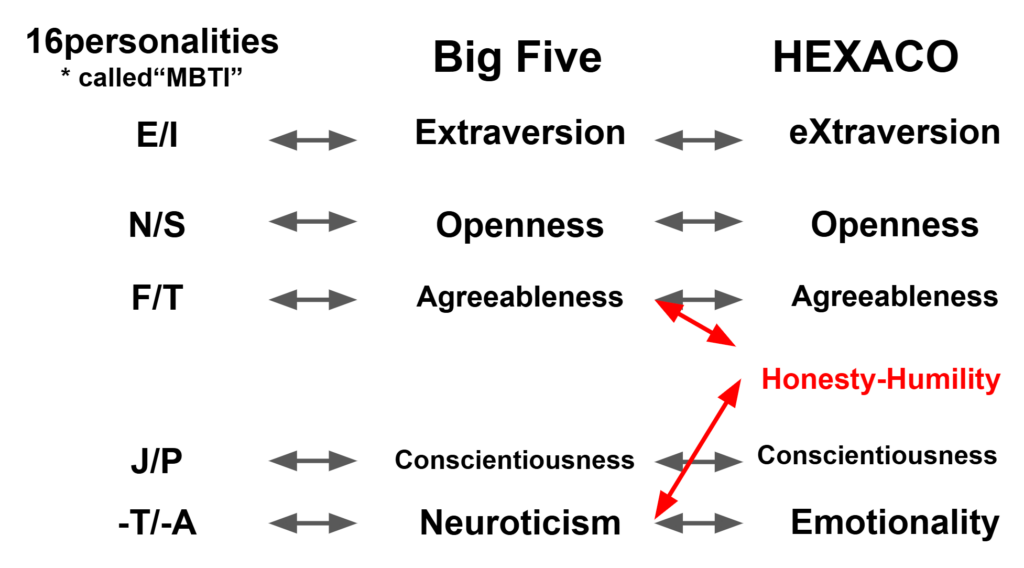
Also, in 16personalities, which was created with reference to MBTI and Big Five, neuroticism from Big Five is called “Identity“, and is classified as either Assertive or Turbulent.
On the far right is the relatively new personality assessment “HEXACO“. It is an improved version of Big Five with one additional indicator “Honesty-Humility”. Research on bullying and harassment perpetrators is active in HEXACO studies.
Since 16personalities and MBTI have weak scientific evidence, this article provides detailed explanations of 16personalities personality types based on their correlations with Big Five and HEXACO.

FAQ and Important Notes
HEXACO results differ from 16personalities (commonly known as MBTI test) or MBTI (original)
- Personality is influenced by genetics and environment, so when the environment changes, responses also change (for example, emotional responses change when you’re tired, etc.). For more details on genetics, see here.
- There are variations in responses depending on age. For more details, see here.
- Type classification is based on whether each value is 3 or above, or below 3, so values close to 3 are more likely to change results depending on how questions are asked or the environment at the time. Please look at the numerical values rather than the type.
- For MBTI (original) and 16personalities (commonly known as MBTI test), it’s unclear how much statistical processing was done at the question design stage as no research papers can be found. On the other hand, papers on Big Five and HEXACO can be easily found, and this HEXACO-JP test is based on research papers.
- While there aren’t many research papers comparing MBTI and 16personalities with everyday behaviors (academic performance, income, etc.) or with the brain and genetics, there are numerous studies on Big Five and HEXACO.
- HEXACO is a variation of Big Five elements, so they are similar but distinct. HEXACO’s Honesty-Humility is extracted from Big Five’s Agreeableness and Neuroticism.
If you have any other questions, please contact us through our inquiry form.
Personality test results are merely “hints” for your life
As mentioned earlier, personality is influenced by genetics and environment. Due to genetic influence, there is a certain range of variation, but answers can vary to some extent depending on the environment.
Also, while Big Five and HEXACO research papers conduct correlation analyses with academic performance and income, the correlation coefficients are not as large as those in natural science experiments. Correlation coefficients range from -1 to 1, but most are around -0.4 to 0.4. Of course, there are higher ones too, but they’re not 0.8 or 0.9 – they’re relatively lower in comparison.
However, since there is various research available, please think of it as “more than fortune-telling, less than natural science.” I’m not 100% denying psychology or fortune-telling.

Writer & Supervisor: Eisuke Tokiwa
Personality Psychology Researcher / CEO, SUNBLAZE Inc.
As a child he experienced poverty, domestic abuse, bullying, truancy and dropping out of school — first-hand exposure to a range of social problems. He spent 10 years researching these issues and published Encyclopedia of Villains through Jiyukokuminsha. Since then he has independently researched the determinants of social problems and antisocial behavior (work, education, health, personality, genetics, region, etc.) and has published 2 peer-reviewed journal articles (Frontiers in Psychology, IEEE Access). His goal is to predict the occurrence of social problems. Spiky profile (WAIS-IV).
Expertise: Personality Psychology / Big Five / HEXACO / MBTI / Prediction of Social Problems
Researcher profiles: ORCID / Google Scholar / ResearchGate
Social & Books: X (@etokiwa999) / note / Amazon Author Page