
Political trust and voter turnout are more deeply connected than most people realize — and a sweeping meta-analysis of 61 studies and approximately 3.6 million data points now gives us the clearest picture yet of just how much that connection matters. If you have ever switched off a political news segment thinking “nothing ever changes anyway,” you are not alone — but research suggests that quiet feeling of distrust may be quietly shaping elections, policy attitudes, and even public health outcomes across entire societies.
For decades, political scientists have warned that declining trust in government threatens the health of democracy itself. Yet surprisingly few studies had tested that claim with large-scale, rigorous data. A landmark piece of political trust research, published in the journal Political Behavior in 2024 and conducted at the University of Southampton, changed that. By pooling 329 individual findings from 61 separate studies, the analysis produced a comprehensive, number-driven answer to the question: does political trust actually matter? This article unpacks what the researchers found — and what it means for everyday citizens.
Once again, personality researcher and author of Villain Encyclopedia, Tokiwa (@etokiwa999), will provide the explanation.
※We have developed the HEXACO-JP Personality Assessment! It has more scientific basis than MBTI. Tap below for details.

目次
- 1 What Is Political Trust — and Why Has Its Decline Alarmed Researchers?
- 2 Political Trust and Voter Turnout: What the Data Actually Show
- 3 Political Trust and Policy Attitudes: How Institutional Confidence Shapes What We Support
- 4 Political Trust and Crisis Compliance: When Institutional Confidence Is Tested Most
- 5 What Citizens and Policymakers Can Actually Do With This Information
- 6 Frequently Asked Questions
- 6.1 What exactly is political trust?
- 6.2 How does political trust affect voter turnout?
- 6.3 Does low political trust make people vote for populist or anti-establishment parties?
- 6.4 Does political trust influence opinions on specific policies like climate or immigration?
- 6.5 What was the strongest effect found between political trust and behavior?
- 6.6 Can we say that political trust causes these behavioral changes?
- 6.7 Do these findings apply globally, or mainly to Western countries?
- 7 Summary: Political Trust and Voter Turnout Are Linked — But the Story Is More Nuanced Than You Might Expect
What Is Political Trust — and Why Has Its Decline Alarmed Researchers?
Defining Political Trust as an Institutional Concept
Political trust is broadly defined as the degree to which citizens believe that their government, parliament, politicians, and political parties will act in the public interest. It is, at its core, a form of institutional trust — confidence not just in a single individual, but in the system of governance as a whole. Researchers typically measure it by asking people whether they trust the government, the legislature, or political leaders, and sometimes by combining scores across all of these into a single index. Because the concept is measured in many slightly different ways across different studies, the precise boundaries of “political trust” can feel a little fuzzy — but the underlying idea is consistent: do citizens feel that those who govern them are competent, honest, and working for the common good?
This definition matters because trust in a specific charismatic leader is not the same thing as trust in a democratic institution. Research suggests these 2 forms of confidence can pull in very different directions, which is one reason why the concept deserves careful, nuanced analysis rather than sweeping generalizations.
The Difference Between Low Trust and Active Distrust
A growing body of scholarship argues that the absence of trust and the presence of active distrust are not the same emotional state — and that conflating them can lead to misleading conclusions. Low trust is closer to a “wait and see” posture: the citizen is neither fully committed nor actively hostile. Active distrust, by contrast, involves a strong conviction that political institutions are corrupt, incompetent, or malicious. Think of the difference between a student who is simply unsure about a new teacher’s methods and a student who is convinced that teacher is deliberately unfair. Both may disengage from class participation, but for very different reasons — and with potentially very different consequences for how they behave over time.
Most large-scale surveys still measure only one end of this spectrum, capturing trust rather than distrust as a separate construct. That means the nuances of deeply cynical political attitudes may not yet be fully visible in the existing data — an important limitation to keep in mind when interpreting the findings below.
Why Trust Is Not Automatically a Good Thing
Political trust tends to be framed as a civic virtue, but research also reveals a more complicated picture. High trust in government can make citizens more receptive to official communications — a clear advantage during a public health emergency. But it can also make people less likely to question authority, less alert to genuine abuses of power, and in some cases more vulnerable to misinformation delivered by trusted figures. Studies on conspiracy thinking have shown that strong personal loyalty to a political leader can, paradoxically, fuel belief in unverified narratives promoted by that leader. In other words, trust directed at institutions tends to support democratic norms, while trust placed narrowly in charismatic individuals can sometimes undermine them. This dual nature is one reason why the meta-analysis examined multiple outcomes — voting, policy preferences, and compliance behavior — rather than treating trust as uniformly positive or negative.
Political Trust and Voter Turnout: What the Data Actually Show
The Direct Link Between Political Trust and Voter Turnout
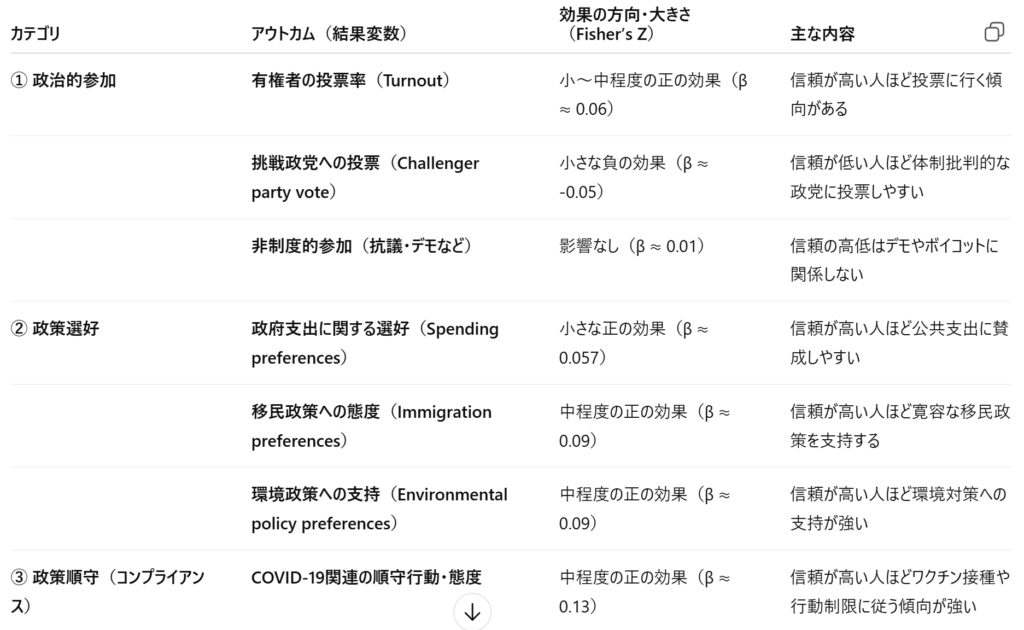
The meta-analysis found a small but consistent positive relationship between political trust and voter turnout, with an average effect size of approximately 0.06. In plain language: people who express higher levels of trust in political institutions tend to be somewhat more likely to cast a ballot. This finding is meaningful because it runs counter to one popular theory — the idea that high trust breeds complacency, making satisfied citizens less motivated to show up on election day. The data suggest the opposite is true: trust appears to function as a quiet motivator for civic engagement, nudging people toward participation rather than passive contentment.
To put the effect size in perspective, an r of 0.06 is modest. Political participation is shaped by dozens of voter turnout factors — education level, age, social networks, interest in specific candidates, ease of access to polling stations, and more. Political trust is one piece of a large puzzle, not the whole picture. But dismissing a consistent signal of this size across millions of respondents would also be a mistake.
- Higher trust → higher conventional participation: Citizens who believe their government is working reasonably well are more inclined to engage with that system through established channels, including voting.
- Lower trust → withdrawal or “exit”: When trust erodes, research suggests many people respond not by becoming louder protesters but by quietly disengaging — staying home on election day rather than marching in the streets.
- Effect size is small, not zero: An r of ~0.06 represents a real, replicable pattern across 61 studies and roughly 3.6 million observations. It is not a statistical accident.
Low Political Trust and Votes for Challenger Parties
When trust falls, citizens do not simply stop voting — many redirect their votes toward parties that explicitly challenge the political establishment, with the meta-analysis finding a relationship of approximately −0.05 between trust and support for such “challenger” parties. A challenger party, in this context, is any political organization that positions itself as an outsider — promising to disrupt or dismantle the existing order rather than govern within it. The negative sign on the correlation is intuitive: the less faith you have in the current system, the more appealing a party that promises radical change becomes.
This pattern has real-world implications. It helps explain why surges in populist, anti-establishment, or protest-vote parties tend to coincide with periods of declining institutional confidence. The meta-analytic evidence suggests this is not merely a media narrative — it reflects a statistically consistent behavioral tendency across many different countries and electoral systems.
Exit, Voice, and the Quiet Withdrawal of Disengaged Citizens
Political scientists have long distinguished between 2 basic responses to dissatisfaction: “exit” (withdrawing from the system) and “voice” (speaking out to change it). The meta-analytic findings suggest that declining political trust is more strongly associated with exit behavior than with voice behavior. In other words, citizens who lose faith in government are more likely to stop participating in conventional democratic processes than they are to become actively vocal critics or protesters. This is a sobering finding for democratic theory, because a democracy populated by disengaged, silent citizens is arguably more vulnerable than one populated by vocal, demanding — if skeptical — ones.
Political Trust and Policy Attitudes: How Institutional Confidence Shapes What We Support
Environmental Policy Support and Political Trust
Research indicates that citizens with higher levels of political trust are more likely to support government-led environmental policies, with the meta-analysis finding a relationship of approximately 0.09 — putting it in the small-to-medium range. Environmental policy — covering climate action, emissions regulations, and conservation programs — tends to require citizens to delegate significant decision-making authority to the government. Trusting that the government will use that authority wisely and fairly appears to make people more comfortable extending it. The logic is intuitive: if you believe a referee is honest, you are more willing to accept their calls, even the ones that cost you something personally.
This relationship has practical consequences. Governments trying to build public support for ambitious climate legislation may find that rebuilding institutional trust is as important as communicating the science — because even citizens who understand the environmental case for action may resist policies administered by institutions they do not trust.
Immigration Policy Attitudes and Institutional Trust
A similar effect size of approximately 0.09 emerged for immigration policy, with higher political trust associated with more accepting attitudes toward immigration and refugee policy. Immigration is one of the most contentious policy areas in contemporary democracies, and public attitudes toward it are shaped by a complex mix of economic concerns, cultural identity, and perceptions of national security. The meta-analytic finding suggests that institutional trust functions as a moderating influence: people who believe the government is capable of managing immigration effectively and fairly tend to hold more relaxed views on the issue, while those who distrust institutions may perceive immigration as a threat that an incompetent or corrupt government cannot handle.
Government Spending and the Role of Trust as a Cognitive Shortcut
Political trust also showed a modest positive relationship with support for government spending, with an effect size of approximately 0.057. This finding makes sense when you consider how most people actually form opinions on complex fiscal policy. Budgets, tax rates, and public expenditure decisions involve enormous technical complexity — few citizens have the time or expertise to evaluate them in detail. Research suggests that political trust acts as a “cognitive shortcut”: when people trust the government, they are more willing to assume that public money will be used competently and in the public interest, making them more receptive to proposals for expanded spending. When trust is low, the default assumption shifts toward waste, corruption, or mismanagement — making fiscal expansion a harder sell regardless of its technical merits.
- Environmental policy (~0.09): Trust enables citizens to delegate authority on complex long-term issues.
- Immigration policy (~0.09): Trust reduces threat perception and increases confidence in the government’s capacity to manage inflows fairly.
- Government spending (~0.057): Trust acts as a shortcut, reducing the assumption of waste or misuse of public funds.
- Crisis policy (~0.13): The largest effect in the dataset — trust in government translates most powerfully into compliance during emergencies.
Political Trust and Crisis Compliance: When Institutional Confidence Is Tested Most
The Strongest Effect: Trust and Pandemic Compliance
Among all the outcomes examined in the meta-analysis, compliance with public health measures during infectious disease outbreaks showed the strongest relationship with political trust, with an effect size of approximately 0.13 — placing it squarely in the small-to-medium range. Pandemic-era behaviors such as adhering to lockdown rules, wearing masks in public spaces, and accepting vaccination recommendations were all more common among citizens who expressed higher levels of trust in their governments. This is not surprising in principle — official public health guidance is only as effective as people’s willingness to follow it, and that willingness appears to be meaningfully shaped by how much they trust the source of the guidance.
What makes this finding particularly valuable is its potential policy relevance. Governments that have invested in building genuine institutional trust over time appear to have a real — if modest — advantage when they need citizens to act collectively and quickly in response to a crisis. Trust built during calm periods pays dividends when emergencies arrive.
The Scale of the Evidence: 61 Studies, 329 Results, ~3.6 Million Observations
The credibility of any meta-analysis rests heavily on the breadth and quality of the studies it synthesizes, and by those measures this research is genuinely impressive. The researchers pooled data from 61 peer-reviewed studies, extracting 329 individual effect-size estimates and working with an underlying dataset of approximately 3.6 million survey responses. To make results comparable across studies that used different measurement scales and methodologies, all effect sizes were converted to a common metric before analysis. The sheer scale of the data means that the overall patterns are unlikely to be statistical noise — when a relationship appears consistently across dozens of independent studies and millions of respondents, it deserves to be taken seriously, even when the individual effect sizes are modest.
Critical Limitation: Geographic Bias Toward Western Democracies
Approximately 78% of the data in the meta-analysis came from Western European and North American democracies — a significant geographic skew that limits how confidently the findings can be generalized to the rest of the world. Political institutions, cultural norms around authority and civic duty, and the historical relationship between citizens and government vary enormously across regions. It is entirely plausible that the relationship between political trust and election behavior looks quite different in Southeast Asia, sub-Saharan Africa, or Latin America, where democratic institutions may be younger, weaker, or organized along very different principles. Researchers acknowledge this gap, and future work that deliberately samples from a more diverse range of political contexts will be essential for determining how universal these findings really are.
Critical Limitation: Most Studies Are Cross-Sectional
Roughly 77% of the studies in the meta-analysis used cross-sectional survey designs — meaning they measured both trust and outcomes at a single point in time, making it impossible to establish definitively that trust causes the behaviors observed rather than the reverse. It is entirely plausible, for example, that successfully voting in an election makes someone feel more connected to and trusting of political institutions — rather than that pre-existing trust caused them to vote. Only about 6% of the included studies used experimental designs capable of testing causal claims more rigorously. This does not invalidate the meta-analytic findings, but it does mean the relationship between political participation and trust should be understood as a consistent correlation, not a proven one-way causal chain — at least for now.
What Citizens and Policymakers Can Actually Do With This Information
Understanding what research says about political trust is more than an academic exercise — it has practical implications for anyone who cares about how democratic societies function. Here are the key takeaways and what they suggest for action:
For Citizens: Recognize Trust as One Legitimate Input Among Many
Research suggests that your level of political trust genuinely influences how you engage with democracy — but it is only 1 of many factors that shape civic behavior. Feeling skeptical about government is neither a character flaw nor a civic duty in itself; what matters is whether that skepticism translates into informed engagement or passive withdrawal. Studies indicate that low trust is most dangerous when it leads to exit rather than voice — when people simply stop participating instead of demanding better. If you notice yourself becoming disengaged, consider whether that disengagement is serving your values or undermining them. Even a modest increase in political participation across a large population can shift electoral outcomes and policy directions in meaningful ways.
- Stay engaged even when skeptical: Healthy skepticism toward institutions is compatible with — and may even strengthen — democratic participation. Voting while critical of all available options is still more effective than not voting at all.
- Distinguish institution from individual: Research suggests that trust in democratic institutions and trust in particular leaders are different things. You can distrust a specific government without writing off the entire system.
- Understand the “cognitive shortcut” effect: Knowing that trust influences your policy preferences through mental shortcuts can help you slow down and evaluate specific proposals on their merits rather than defaulting to blanket acceptance or rejection based on who is proposing them.
For Policymakers: Trust-Building Is a Long-Term Infrastructure Investment
The finding that political trust correlates most strongly with pandemic compliance behavior — effect size ~0.13 — carries a clear implication for governance: institutional credibility built during ordinary times translates into public cooperation during emergencies. Governments that cut corners on transparency, fail to deliver on commitments, or communicate inconsistently during calm periods may find that citizens are far less willing to follow their guidance when a genuine crisis demands collective action. This is not merely a communications problem — it is a governance problem. Policies that are perceived as fair, competent, and honest tend to generate the kind of institutional trust that pays forward into future crises.
- Invest in competence and consistency: Trust research consistently shows that perceived competence and reliability are among the strongest predictors of institutional confidence. Delivering on commitments — even small ones — builds the reservoir of trust that larger asks will draw upon.
- Communicate openly about uncertainty: Counterintuitively, admitting what is unknown tends to preserve institutional trust better than projecting false certainty that later collapses. Citizens can handle nuance better than many politicians assume.
- Design policies to feel fair: Research on institutional trust suggests that procedural fairness — the perception that decisions are made through legitimate, impartial processes — matters as much as outcomes. People will accept unfavorable outcomes more readily when they believe the process was honest.
Frequently Asked Questions
What exactly is political trust?
Political trust is defined as the degree to which citizens believe that government institutions — including parliaments, political parties, and elected officials — are competent, honest, and acting in the public interest. It is a form of institutional trust distinct from personal trust between individuals. Research measures it through survey questions asking respondents how much confidence they have in specific political bodies, and it is considered a foundational element of democratic stability and civic engagement.
How does political trust affect voter turnout?
Studies indicate a small but consistent positive relationship between political trust and voter turnout, with a meta-analytic effect size of approximately 0.06. This means people with higher institutional trust tend to be somewhat more likely to vote. Importantly, the data do not support the idea that high trust breeds complacency — on the contrary, trust appears to encourage participation. When trust declines, research suggests citizens are more likely to disengage quietly rather than channel dissatisfaction into increased electoral activity.
Does low political trust make people vote for populist or anti-establishment parties?
Research suggests yes, with a relationship of approximately −0.05 between political trust and support for so-called “challenger” parties — those that explicitly oppose the existing political order. This is a small but consistent finding across multiple studies: citizens who have lost confidence in mainstream institutions tend to be more receptive to parties promising radical disruption. This pattern helps explain observed surges in populist party support during periods of declining institutional trust in several Western democracies.
Does political trust influence opinions on specific policies like climate or immigration?
Yes. The meta-analysis found effect sizes of approximately 0.09 for both environmental policy support and immigration attitudes, meaning higher trust is associated with more favorable views toward government-led climate action and more accepting attitudes toward immigration. Research suggests trust functions as a cognitive shortcut: because most people cannot evaluate complex policies in technical detail, they rely on confidence in the policymaking institution itself. Distrust tends to generate skepticism toward government-proposed solutions regardless of their specific merits.
What was the strongest effect found between political trust and behavior?
The strongest relationship in the entire meta-analysis — approximately 0.13 — was between political trust and compliance with public health measures during infectious disease outbreaks such as the COVID-19 pandemic. This finding suggests that institutional trust plays a particularly important role during emergencies, when governments need citizens to act quickly and collectively based on official guidance. It implies that trust accumulated during normal times functions as a resource that governments can draw upon when urgent cooperation is most needed.
Can we say that political trust causes these behavioral changes?
Not definitively, based on current evidence. Approximately 77% of the studies in the meta-analysis used cross-sectional designs — measuring trust and behavior at the same point in time — which makes it impossible to establish causal direction. It is equally plausible that participating in civic life increases trust, rather than that pre-existing trust drives participation. Only about 6% of included studies used experimental methods capable of testing causality. The consistent correlations are meaningful and worth taking seriously, but researchers and readers alike should treat them as associations rather than proven cause-and-effect relationships.
Do these findings apply globally, or mainly to Western countries?
The geographic coverage of the meta-analysis is heavily skewed toward Western Europe and North America, with approximately 78% of the data coming from those regions. This is a significant limitation. Political institutions, cultural attitudes toward authority, and the historical relationship between citizens and government differ considerably across regions. The findings are most reliably applicable to established Western democracies, and research suggests that replicating this analysis with data from Asia, Latin America, and Africa would be valuable for understanding how universal — or context-specific — these patterns really are.

Writer & Supervisor: Eisuke Tokiwa
Personality Psychology Researcher / CEO, SUNBLAZE Inc.
As a child he experienced poverty, domestic abuse, bullying, truancy and dropping out of school — first-hand exposure to a range of social problems. He spent 10 years researching these issues and published Encyclopedia of Villains through Jiyukokuminsha. Since then he has independently researched the determinants of social problems and antisocial behavior (work, education, health, personality, genetics, region, etc.) and has published 2 peer-reviewed journal articles (Frontiers in Psychology, IEEE Access). His goal is to predict the occurrence of social problems. Spiky profile (WAIS-IV).
Expertise: Personality Psychology / Big Five / HEXACO / MBTI / Prediction of Social Problems
Researcher profiles: ORCID / Google Scholar / ResearchGate
Social & Books: X (@etokiwa999) / note / Amazon Author Page
Summary: Political Trust and Voter Turnout Are Linked — But the Story Is More Nuanced Than You Might Expect
The most important takeaway from this large-scale analysis is also one of the most reassuring for anyone who has felt paralyzed by political cynicism: political trust matters, but it does not determine everything. Across 61 studies and approximately 3.6 million data points, researchers found consistent evidence that institutional trust is associated with higher voter turnout (effect ~0.06), greater support for government policies on the environment, immigration, and public spending (effects ranging from ~0.057 to ~0.09), and — most powerfully — greater compliance with public health guidance during crises (effect ~0.13). These are real patterns, not statistical mirages. At the same time, the effects are modest: political trust is 1 factor among many that shape how citizens behave and what they believe. It is not a silver bullet, and its absence is not an automatic death sentence for democratic participation.
What this research ultimately reveals is that the quiet feeling of “does any of this actually matter?” — a feeling that many people recognize — is not politically neutral. It shapes how likely you are to vote, which parties you find appealing, and how willing you are to follow shared rules when cooperation matters most. Before you dismiss that feeling as irrelevant background noise, it is worth pausing to ask: how much do I actually trust the institutions that govern my life, and is that level of trust — or distrust — working for or against the kind of society I want to live in? Reflecting on your own relationship with political trust and voter turnout is one of the most concrete first steps anyone can take toward more informed, intentional civic participation.