
Want to improve self-awareness and build more fulfilling relationships? Understanding how your personality shapes your love life may be one of the most powerful steps you can take. Psychology research consistently suggests that specific personality traits — the way we think, feel, and respond under stress — play a major role in who we are attracted to, how we behave in relationships, and whether those relationships last. Far from being a guessing game, relationship compatibility can be explored through well-established scientific frameworks that reveal patterns most people never notice on their own.
This article takes a comprehensive look at the psychology of love and marriage through the lens of personality science. Drawing on insights from the Big Five personality model, HEXACO personality theory, attachment style research, and love psychology, we’ll unpack what makes couples last, why relationships sometimes fail, and how understanding your own traits can help you make smarter, more compassionate choices in love.
Once again, personality researcher and author of Villain Encyclopedia, Tokiwa (@etokiwa999), will provide the explanation.
※We have developed the HEXACO-JP Personality Assessment! It has more scientific basis than MBTI. Tap below for details.

目次
- 1 What Personality Traits Actually Influence Love and Marriage?
- 2 How the Big Five Personality Traits Shape Your Romantic Style
- 3 The Science of Relationship Compatibility: What Long-Lasting Couples Have in Common
- 4 Attachment Style and Personality: The Hidden Blueprint of Your Love Life
- 5 When Love Isn’t Working: A Personality Psychology Approach to Relationship Challenges
- 6 Personality and Marriage: What Science Says About Long-Term Compatibility
- 7 Actionable Advice: How to Use Personality Science to Improve Self and Your Relationships
- 7.1 1. Take a Validated Personality Assessment — and Be Honest
- 7.2 2. Share Your Profile with Your Partner (or Potential Partner)
- 7.3 3. Work on Your Attachment Style Intentionally
- 7.4 4. Align on Core Values Before Over-Analyzing Personality Scores
- 7.5 5. Treat Personality as a Starting Point, Not a Verdict
- 8 Frequently Asked Questions
- 8.1 Can people with opposite personalities have a successful relationship?
- 8.2 If a personality test shows poor compatibility, should I end the relationship?
- 8.3 Does high neuroticism put someone at a disadvantage in love?
- 8.4 Is it worth taking a personality test before getting married?
- 8.5 Does personality change with age, and how does that affect long-term relationships?
- 8.6 Which personality framework is most useful for understanding relationship compatibility?
- 8.7 What is the most important personality trait for a successful marriage?
- 9 Related Articles
- 10 Summary: Personality Science as a Path to Better Love
- 11 Try Taking the Proper Personality Test “HEXACO-JP”!
- 12 Scientific Background of the 16 Types
- 13 FAQ and Important Notes
What Personality Traits Actually Influence Love and Marriage?
Research suggests that 5 core personality dimensions — collectively known as the Big Five — have a deep and measurable impact on how people behave in romantic relationships. Personality traits are defined as relatively stable patterns of thought, emotion, and behavior that tend to persist across time and situations. In the context of love psychology, these traits shape everything from how we approach a first date to how we handle conflict years into a marriage.
One of the most important findings in personality and marriage research is that emotional stability — the opposite of what psychologists call “neuroticism” — is strongly linked to relationship longevity. People who manage stress and negative emotions well tend to create a safer, more predictable environment for their partners. Similarly, agreeableness, which reflects warmth and cooperative tendencies, is closely associated with the kind of deep emotional bonding that sustains long-term partnerships.
It’s also worth noting that personality is not fixed from birth. Studies indicate that roughly 50% of our personality is shaped by genetic factors, while the remaining 50% is influenced by our upbringing, experiences, and environment. This means that personality — and therefore relationship dynamics — can change, and that fact is important to keep in mind whenever you use personality assessments in a romantic context.
- Extraversion: A tendency toward sociability and energetic engagement with the world. Research suggests approximately 25% of people score high on this dimension, which influences dating style and how partners prefer to spend time together.
- Agreeableness: Reflects warmth, empathy, and a cooperative attitude toward others — a key ingredient in building emotional intimacy.
- Conscientiousness: Captures a person’s sense of responsibility, self-discipline, and goal-directedness. Tends to be closely tied to relationship reliability and follow-through.
- Neuroticism: Describes how strongly someone reacts to stress, anxiety, and negative emotions. Higher scores are linked to more frequent relationship conflicts and emotional insecurity.
- Openness to Experience: Reflects curiosity, creativity, and flexibility — traits that influence how couples explore life together and adapt to change.
Understanding these 5 dimensions gives both individuals and couples a powerful vocabulary for discussing differences without judgment. Rather than labeling a partner as “too sensitive” or “too distant,” personality science offers a more nuanced, compassionate framework for seeing those differences as understandable — and often workable — variations in human nature.
How the Big Five Personality Traits Shape Your Romantic Style
By mapping your own Big Five profile, you can gain an objective and surprisingly accurate picture of your personal dating and relationship tendencies. Each trait creates a distinct pattern of romantic behavior, and recognizing those patterns is a meaningful first step toward improving both self-understanding and relationship quality.
People high in extraversion tend to pursue romantic connections actively — they enjoy social settings, are comfortable with early disclosure, and often move quickly in the early stages of dating. In contrast, those lower in extraversion typically prefer to build intimacy gradually, favoring depth of connection over breadth of social experience. Neither style is superior; they simply call for different paces and approaches in a relationship.
Conscientiousness deserves special attention here. Research indicates that couples in which both partners score high on conscientiousness maintain long-term relationships at roughly 80% the rate over 3 or more years compared to lower-scoring couples. This may be because conscientious individuals tend to honor commitments, plan ahead, and take their partner’s needs seriously — all behaviors that stabilize a partnership over time.
- High Extraversion: Favors active social dating, enjoys meeting new people, and tends to be openly expressive about feelings early on.
- Low Extraversion: Prefers fewer but deeper connections, values meaningful one-on-one time, and communicates with care and intention.
- High Agreeableness: Prioritizes the partner’s feelings, seeks harmony, and is highly empathetic — though sometimes at the cost of asserting their own needs.
- Low Agreeableness: Tends to value equal standing in the relationship, is direct about preferences, and may push back more readily during disagreements.
- High Conscientiousness: Plans dates thoughtfully, honors promises, and approaches the relationship with a long-term mindset.
- High Neuroticism: May experience anxiety about the relationship more frequently, benefits greatly from emotional reassurance and a steady, supportive partner.
Those high in openness to experience often deepen their bond by sharing novel adventures — art exhibitions, travel, new cuisines, or intellectually stimulating conversations. Meanwhile, individuals lower on this dimension tend to flourish in the steady rhythms of daily life together, finding security and warmth in familiarity and routine. Both styles can produce rich, lasting relationships when partners understand and respect each other’s preferences rather than trying to change them.
The Science of Relationship Compatibility: What Long-Lasting Couples Have in Common
Studies suggest that the happiest, most enduring couples strike a balance between personality similarity and complementarity — they share core values while bringing different strengths to the relationship. Contrary to the popular idea that “opposites attract” — or the equally common belief that partners must be nearly identical — the research points toward a more nuanced picture.
Perhaps the single most consistent predictor of relationship satisfaction is alignment in values, not personality scores. Research indicates that couples who share similar priorities in life — around family, finances, personal growth, or spirituality — tend to maintain strong, positive relationships even when their personalities differ significantly. For example, 2 partners can be deeply compatible with one being introverted and the other extroverted, as long as they agree on what matters most in building a life together.
Communication style is another critical factor. When partners approach emotional expression or problem-solving differently, what determines relationship quality is not the difference itself but the ability to recognize and adapt to it. In fact, studies suggest that approximately 70% of couples who seek relationship counseling list communication as the primary challenge — which also means it’s an area where targeted effort can produce dramatic improvements.
- Value alignment: Agreement on major life priorities in roughly 85% or more of key areas tends to act as a strong anchor for the relationship during difficult times.
- Emotional support: Partners who understand each other’s neuroticism levels and provide appropriate reassurance report significantly higher relationship satisfaction.
- Shared growth orientation: Couples who actively learn and develop together — personally, professionally, or intellectually — tend to maintain connection more effectively over the long term.
- Constructive conflict resolution: The ability to address disagreements without contempt or stonewalling is one of the strongest predictors of relationship health.
- Mutual respect for differences: Treating the other person’s personality traits as valid expressions of who they are, rather than problems to be fixed, appears consistently in thriving long-term couples.
It’s also important to remember that personality itself is not static. Research shows that conscientiousness tends to increase with age, meaning that a partner who seems disorganized or non-committal at 22 may be a very different person at 32 or 42. Long-lasting couples often describe their relationship as a continuous process of rediscovering each other — and that openness to change is itself one of the most powerful relationship assets any couple can cultivate.
Attachment Style and Personality: The Hidden Blueprint of Your Love Life
Attachment style is a relationship pattern that forms in early childhood and continues to shape adult romantic bonds in powerful, often unconscious ways. In love psychology, attachment style refers to the internal model a person develops — through early experiences with caregivers — for how safe, available, and trustworthy others can be expected to be in close relationships.
Attachment theory identifies 4 main styles in adults. The secure style, found in approximately 60% of the population, is associated with comfortable intimacy, healthy independence, and a balanced approach to both closeness and distance. People with a secure attachment style tend to feel confident that they are worthy of love and that their partner is reliably available.
The anxious style, seen in roughly 20% of people, is characterized by a strong need for reassurance and a heightened sensitivity to any sign of distance or disapproval from a partner. The avoidant style, present in approximately 15% of adults, involves discomfort with emotional closeness and a tendency to prioritize independence — often as a way to protect against perceived vulnerability. The disorganized or fearful style, found in around 5% of people, combines a desire for closeness with a deep fear of it, leading to inconsistent relationship behavior that can be confusing for both partners.
- Secure attachment: Tends to correlate with higher agreeableness and lower neuroticism in Big Five terms — a combination that supports stable, satisfying relationships.
- Anxious attachment: Often associated with high neuroticism and elevated extraversion, reflecting an intense need for emotional connection and validation.
- Avoidant attachment: Frequently linked to lower agreeableness and lower extraversion, suggesting a preference for self-sufficiency and emotional distance.
- Disorganized attachment: Tends to show inconsistent patterns across personality dimensions, reflecting the internal conflict between wanting and fearing intimacy.
Understanding your own attachment style — and your partner’s — can be transformative. For instance, when someone with an avoidant style pulls back emotionally, it can feel like rejection to an anxious-attachment partner. But that withdrawal is typically not a sign of diminished love; it reflects a deeply ingrained need for self-protection. When both partners understand this dynamic, they can respond with empathy rather than escalation, breaking cycles that might otherwise damage or end the relationship. This kind of self-knowledge is one of the most direct ways to genuinely improve self and relational wellbeing.
When Love Isn’t Working: A Personality Psychology Approach to Relationship Challenges
Many recurring relationship difficulties can be traced back to a lack of objective self-awareness about one’s own personality patterns — and the good news is that this is something anyone can actively work to improve self-awareness around. Personality and marriage research suggests that most relationship problems are not fundamentally about incompatibility, but about unexamined patterns that, once recognized, become far more manageable.
High neuroticism is one of the most commonly discussed challenges in love psychology. Studies suggest that approximately 30% of people score notably high on this dimension, and those individuals may find themselves repeatedly worrying about their partner’s feelings, misreading neutral behaviors as rejection, or amplifying minor conflicts into major crises. Importantly, high neuroticism is not a life sentence in relationships — it is a trait that responds well to awareness, skill-building, and, in some cases, professional support.
Low agreeableness presents a different set of challenges. People on this end of the spectrum may either over-accommodate their partner (suppressing their own needs to keep the peace) or consistently push back in ways that feel aggressive or dismissive. In both cases, learning balanced, assertive communication can significantly shift the dynamic and open space for genuine mutual understanding.
- Build self-knowledge first: Use a validated personality assessment to identify your actual trait profile, not just how you want to see yourself. Honest self-appraisal is the foundation of any real change.
- Develop emotional regulation skills: Techniques from cognitive behavioral therapy (CBT), mindfulness, and emotional intelligence training can help high-neuroticism individuals manage stress responses before they damage the relationship.
- Practice perspective-taking communication: Before reacting, try to articulate your partner’s likely experience of the same situation. This simple habit can dramatically reduce misunderstandings.
- Clarify what you actually need: Many relationship conflicts stem from unspoken expectations. Getting clear on your own values and relationship needs — and expressing them directly — is far more productive than hoping a partner will figure it out.
- Examine recurring patterns: If the same type of conflict keeps appearing across different relationships, that’s a signal that the pattern may be rooted in your own personality or attachment style — not just in bad luck with partners.
A CBT-inspired reframing exercise that research suggests is particularly effective: when a distressing thought arises (e.g., “My partner hasn’t responded — they must be angry with me”), deliberately generate at least 2 alternative explanations (e.g., “They may be in a meeting” or “Their phone might be on silent”). Practicing this kind of cognitive flexibility consistently tends to reduce anxiety, improve communication, and increase overall relationship satisfaction over time.
Personality and Marriage: What Science Says About Long-Term Compatibility
When it comes to marriage specifically, personality compatibility requires a longer-term lens than dating — daily stress management, financial cooperation, and shared life planning become the real tests of how well two personality profiles fit together. Research into personality and marriage consistently highlights a handful of traits and combinations that tend to predict marital success.
Conscientiousness stands out as the single personality trait most strongly associated with marital stability. Studies indicate that married couples where both partners score high on conscientiousness show divorce rates approximately 40% lower than the general population. The reasoning is straightforward: conscientious individuals tend to honor their commitments, contribute reliably to shared responsibilities, and invest consistent effort into the relationship — all of which build the kind of trust that sustains a marriage through difficult periods.
Neuroticism, when both partners score very high, does tend to create ongoing friction in marriage — but the picture is more nuanced than simply “avoid high-neuroticism partners.” Research suggests that in approximately 65% of successful long-term marriages, 1 partner’s higher emotional reactivity is offset by the other’s greater stability, creating a complementary dynamic rather than a problematic one.
- Financial management: High conscientiousness in at least 1 partner tends to correlate with better household financial planning, reducing a major source of marital conflict.
- Parenting alignment: A combination of high agreeableness and moderate openness seems particularly well-suited to cooperative, adaptable parenting.
- Stress response compatibility: Understanding each other’s neuroticism levels helps partners build appropriate mutual support systems — rather than inadvertently making each other’s anxiety worse.
- Social life balance: Differences in extraversion can be navigated effectively through deliberate role allocation (e.g., one partner handles social engagements while the other manages quieter domestic needs).
- Life transition adaptability: Higher openness to experience tends to help couples navigate major changes — job shifts, relocations, health challenges — more flexibly and with less resentment.
One often-overlooked dimension is the simple fact that people change. Research consistently shows that agreeableness and conscientiousness both tend to rise with age, while neuroticism typically decreases. This means that a couple who experiences friction in their late twenties may find that the same relationship feels far more harmonious in their late thirties or forties — not because circumstances changed, but because their personalities matured in complementary directions. Viewing marriage as a long-term developmental journey, rather than a fixed compatibility puzzle, aligns far more closely with what the science actually shows.
Actionable Advice: How to Use Personality Science to Improve Self and Your Relationships
Knowing your personality profile is only valuable if you translate that knowledge into concrete behaviors. The following strategies are drawn from personality and relationship psychology and are designed to help you leverage your strengths, navigate your challenges, and build more satisfying connections — whether you are single, dating, or in a long-term partnership.
1. Take a Validated Personality Assessment — and Be Honest
The Big Five (also sometimes referenced in the extended HEXACO personality model, which adds a Honesty-Humility dimension) is the most research-backed framework for understanding personality in relationship contexts. Taking a validated assessment with genuine self-honesty — rather than answering in the way you wish you were — gives you actionable data. Why it works: You can only change patterns you can see clearly. How to practice: After completing an assessment, write down 3 specific relationship behaviors that your results help explain — both positive ones to build on and challenging ones to work with.
Discussing personality results together can open productive conversations that might otherwise never happen. Why it works: It creates a shared, non-blaming language for differences that may have previously caused silent resentment. How to practice: Frame the conversation around curiosity rather than evaluation — “I found out I tend to score high on neuroticism; does that match what you’ve noticed? How can we handle that better together?”
3. Work on Your Attachment Style Intentionally
Attachment style is not fixed. Research strongly suggests that people can shift from insecure attachment patterns toward greater security through self-awareness, therapeutic support, and consistent positive relationship experiences. Why it works: Anxious and avoidant patterns generate much of the most painful friction in romantic relationships — reducing them improves the relationship for both partners. How to practice: Identify your attachment style, then research its specific triggers. For anxious types, practice tolerating brief uncertainty before seeking reassurance. For avoidant types, practice small acts of deliberate emotional disclosure.
4. Align on Core Values Before Over-Analyzing Personality Scores
Personality compatibility is valuable context, but value alignment is the foundation. Why it works: Research indicates that shared values predict relationship satisfaction more consistently than personality similarity alone. How to practice: Create a short list of your 5 most non-negotiable life values and share them explicitly with a partner — do not assume they are obvious. Discuss both where you align and where you differ, and explore whether the differences are bridgeable.
5. Treat Personality as a Starting Point, Not a Verdict
One of the most important insights from personality science is that traits describe tendencies, not destinies. Why it works: Framing your personality as a working draft — rather than a permanent definition — keeps you open to growth and prevents the self-fulfilling prophecy of “this is just who I am.” How to practice: Each month, identify 1 personality-related behavior you want to practice changing and track your progress concretely. Even small, consistent shifts in behavior can, over time, shift the underlying trait itself.
Frequently Asked Questions
Can people with opposite personalities have a successful relationship?
Yes — research suggests that personality opposites can absolutely build healthy, lasting relationships. What matters most is not whether personalities match but whether partners share core values and are willing to understand each other’s differences. In fact, studies indicate that moderate personality differences can be a genuine asset, introducing complementary strengths and keeping the relationship dynamic. An extroverted and an introverted partner, for example, can balance each other effectively when both respect the other’s needs and boundaries.
If a personality test shows poor compatibility, should I end the relationship?
No — personality assessments are tools for self-understanding, not relationship verdicts. A “low compatibility” result reflects current trait profiles, not fixed futures. Personality can and does change with experience, effort, and maturity. What matters far more than any test result is whether both partners are genuinely willing to understand each other, communicate openly, and grow together. Use a poor compatibility score as a starting point for conversation, not a reason to give up on a relationship that may hold real value.
Does high neuroticism put someone at a disadvantage in love?
Not necessarily. High neuroticism does present real challenges in relationships — such as heightened anxiety and a greater sensitivity to conflict — but it also comes with genuine strengths, including deep empathy, emotional expressiveness, and a strong capacity for intimacy. The key is building self-awareness around your emotional triggers and developing practical coping strategies. Pairing with a more emotionally stable partner can also create a complementary dynamic, and research shows that neuroticism tends to decrease naturally with age.
Is it worth taking a personality test before getting married?
Taking a personality assessment before marriage can be genuinely useful — not as a pass/fail compatibility check, but as a structured way to deepen mutual understanding. Results can help couples anticipate areas where friction is likely to arise and have proactive conversations about how to handle those situations together. The value is not in the scores themselves but in the discussions they generate. Ultimately, the decision to marry should rest on love, shared values, and a genuine commitment to each other’s growth — not on any single diagnostic tool.
Does personality change with age, and how does that affect long-term relationships?
Yes — personality does shift gradually over a lifetime. Research consistently shows that agreeableness and conscientiousness tend to increase with age, while neuroticism generally decreases. These are positive trends for romantic relationships: partners tend to become more cooperative, more reliable, and emotionally steadier over time. Couples who feel mismatched in their twenties sometimes find that their relationship improves significantly by their thirties or forties as both individuals mature. Taking a long-term view of personality development is a realistic and hopeful approach to relationship compatibility.
Which personality framework is most useful for understanding relationship compatibility?
The Big Five is considered the gold standard for research-backed personality assessment in relationship contexts. It has extensive empirical support and covers the dimensions most relevant to love and marriage, including conscientiousness, agreeableness, and neuroticism. The HEXACO personality model extends this framework with a Honesty-Humility dimension, which also has interesting implications for trust in relationships. While tools like the MBTI can offer useful self-reflection, the Big Five and HEXACO have stronger scientific foundations. Combining a Big Five assessment with an attachment style evaluation provides the most comprehensive picture.
What is the most important personality trait for a successful marriage?
Research points consistently to conscientiousness as the single personality trait most predictive of long-term marital success. Conscientious individuals tend to be reliable, follow through on commitments, plan ahead, and invest consistent effort in the relationship — all of which build the trust and stability that marriage requires over decades. Studies suggest that couples in which both partners are high in conscientiousness show divorce rates roughly 40% lower than average. That said, no single trait guarantees a successful marriage — value alignment and communication skills matter just as much.
Related Articles
- Marriage heritability is approximately 60%! Divorce is approximately 30%! Research explained
- Marriage may be worth over 10 million yen in monetary terms — research introduction
- The relationship between reading and personality — who reads self-help and romance books?
- Genetic factors in adult attachment are approximately 40%! Research explained
- Personalities that tend to develop romantic relationships — explained with research
- How to change your personality through life planning — income and romance explained
- What personality makes an ideal partner? More accurate than love horoscopes
- Research on married couples’ personalities — what personality is best for love and marriage?
- Personalities more or less likely to get married — research explained
- What personality is prone to love addiction? Scientifically explained
- Personalities prone to divorce — how to avoid marrying the wrong person
- MBTI love compatibility: romantic tendencies and compatibility by all 16 types
- MBTI love diagnosis: romantic tendencies and compatibility across 16 types explained
- IQ and sexual orientation revealed in large-scale research — the sexual orientation of high-IQ individuals
- Analyzing romantic tendencies through personality assessment: scientifically grounded characteristics by 16 types
- ESFP-T and a romance-oriented personality: scientifically explained
- ISTP-AD (Virtuoso · Confident Dark): romance, work, and more explained
- ESFJ-TD (Consul · Anxious Dark): romance, work, and more explained
- INFJ-AL (Advocate · Confident Light): romance, work, and more explained
- ENTP-AD (Debater · Confident Dark): romance, work, and more explained
- ESTJ-TL (Executive · Anxious Light): romance, work, and more explained
- ESFP-AD (Entertainer · Confident Dark): romance and more explained
- ISFP-TD (Adventurer · Anxious Dark): romance, work, and more explained
- ISFJ-TL (Defender · Anxious Light): romance, work, and more explained
- ESFP-TD (Entertainer · Anxious Dark): romance and more explained
- ESFP-TL (Entertainer · Anxious Light): romance and more explained
- ESFP-AL (Entertainer · Confident Light): romance and more explained
- ESTP-TD (Entrepreneur · Anxious Dark): romance, work, and more explained
- ESTP-AD (Entrepreneur · Confident Dark): romance, work, and more explained
- ESTP-TL (Entrepreneur · Anxious Light): romance, work, and more explained
Summary: Personality Science as a Path to Better Love
Understanding the psychology behind relationship compatibility is not about reducing love to a formula — it’s about giving yourself the clearest possible view of who you are, what you need, and how you show up for others. The Big Five personality model, HEXACO personality dimensions, and attachment style research all point toward the same essential insight: lasting relationships are built not on perfect compatibility scores, but on self-awareness, honest communication, and a genuine commitment to growth. Whether you score high on conscientiousness or tend toward neuroticism, whether your attachment style is secure or anxious — every profile carries both strengths to build on and patterns to work through. The most meaningful thing you can do for your love life is also the most meaningful thing you can do for yourself: commit to understanding who you genuinely are, and keep choosing to grow. If you’re ready to take that next step, explore your own personality profile and see which of your traits are quietly shaping your relationship patterns right now.
Try Taking the Proper Personality Test “HEXACO-JP”!
While MBTI and 16personalities are popular as “gateways to knowing yourself,” experiencing a scientifically-backed personality test is the best way to truly understand your strengths and risks.
That’s where we recommend the HEXACO assessment available in Japanese: “HEXACO-JP“.
HEXACO-JP visualizes your personality tendencies numerically based on six factors: Honesty-Humility, Emotionality, Extraversion, Agreeableness, Conscientiousness, and Openness.
By simply answering straightforward questions, you can gain helpful insights for self-understanding, relationships, and workplace communication.
If you’re curious about “What type of person am I?”, start by taking HEXACO-JP and examine yourself from a scientific perspective.
Scientific Background of the 16 Types
MBTI Overview
MBTI is a psychological theory that classifies personality into 16 types.
To begin with, MBTI is an abbreviation for Myers-Briggs Type Indicator.
MBTI classifies personality into 16 types by combining the following 4 indicators.
In other words, MBTI expresses one’s personality tendencies in 4 letters such as “ISTJ” or “ENFP”. There is a very famous similar system called 16personalities, but this is created by combining MBTI and Big Five.
Big Five Overview
One of the most prominent trait theories in personality psychology is the “Big Five”.
Big Five measures five traits: Openness, Conscientiousness, Extraversion, Agreeableness, and Neuroticism.
Also, while 16personalities and MBTI use type classification (e.g., either extraverted or introverted), a major difference is that Big Five evaluates traits on a continuous numerical scale (e.g., extraversion 3.5).
Furthermore, it has been studied for a long time, has many research papers, and extensive research has been conducted in other fields such as academic achievement, income, brain, and genetics. It can be said that Big Five has relatively stronger scientific backing.
Correlation Between MBTI, Big Five, and HEXACO
There are correlations between MBTI’s 4 indicators and Big Five’s 5 factors.
A representative study showing this correlation is the paper “The relationship between the revised NEO-Personality Inventory and the Myers-Briggs Type Indicator“.
According to this paper, the correlations between MBTI and Big Five are as follows.
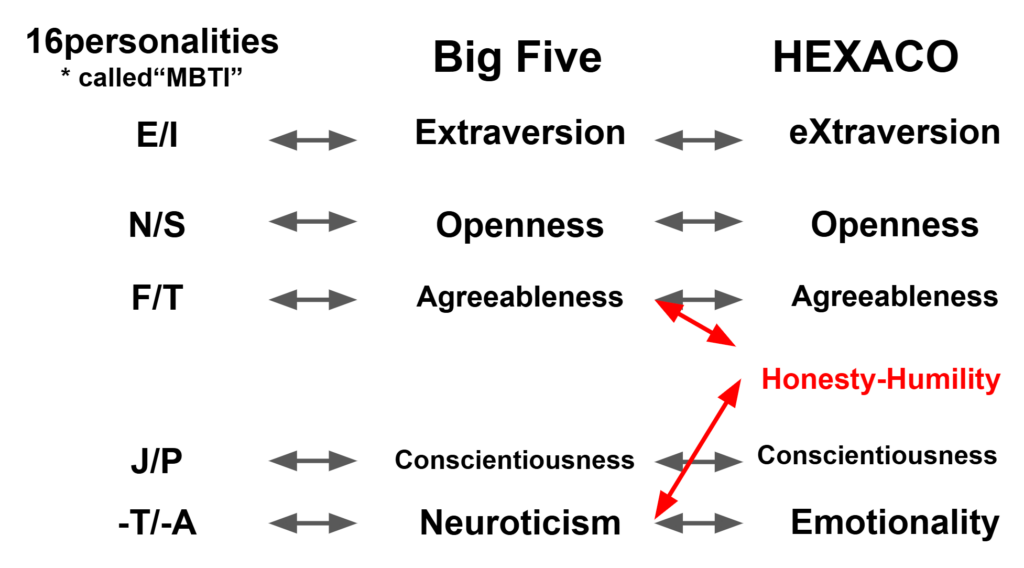
Also, in 16personalities, which was created with reference to MBTI and Big Five, neuroticism from Big Five is called “Identity“, and is classified as either Assertive or Turbulent.
On the far right is the relatively new personality assessment “HEXACO“. It is an improved version of Big Five with one additional indicator “Honesty-Humility”. Research on bullying and harassment perpetrators is active in HEXACO studies.
Since 16personalities and MBTI have weak scientific evidence, this article provides detailed explanations of 16personalities personality types based on their correlations with Big Five and HEXACO.

FAQ and Important Notes
HEXACO results differ from 16personalities (commonly known as MBTI test) or MBTI (original)
- Personality is influenced by genetics and environment, so when the environment changes, responses also change (for example, emotional responses change when you’re tired, etc.). For more details on genetics, see here.
- There are variations in responses depending on age. For more details, see here.
- Type classification is based on whether each value is 3 or above, or below 3, so values close to 3 are more likely to change results depending on how questions are asked or the environment at the time. Please look at the numerical values rather than the type.
- For MBTI (original) and 16personalities (commonly known as MBTI test), it’s unclear how much statistical processing was done at the question design stage as no research papers can be found. On the other hand, papers on Big Five and HEXACO can be easily found, and this HEXACO-JP test is based on research papers.
- While there aren’t many research papers comparing MBTI and 16personalities with everyday behaviors (academic performance, income, etc.) or with the brain and genetics, there are numerous studies on Big Five and HEXACO.
- HEXACO is a variation of Big Five elements, so they are similar but distinct. HEXACO’s Honesty-Humility is extracted from Big Five’s Agreeableness and Neuroticism.
If you have any other questions, please contact us through our inquiry form.
Personality test results are merely “hints” for your life
As mentioned earlier, personality is influenced by genetics and environment. Due to genetic influence, there is a certain range of variation, but answers can vary to some extent depending on the environment.
Also, while Big Five and HEXACO research papers conduct correlation analyses with academic performance and income, the correlation coefficients are not as large as those in natural science experiments. Correlation coefficients range from -1 to 1, but most are around -0.4 to 0.4. Of course, there are higher ones too, but they’re not 0.8 or 0.9 – they’re relatively lower in comparison.
However, since there is various research available, please think of it as “more than fortune-telling, less than natural science.” I’m not 100% denying psychology or fortune-telling.

Writer & Supervisor: Eisuke Tokiwa
Personality Psychology Researcher / CEO, SUNBLAZE Inc.
As a child he experienced poverty, domestic abuse, bullying, truancy and dropping out of school — first-hand exposure to a range of social problems. He spent 10 years researching these issues and published Encyclopedia of Villains through Jiyukokuminsha. Since then he has independently researched the determinants of social problems and antisocial behavior (work, education, health, personality, genetics, region, etc.) and has published 2 peer-reviewed journal articles (Frontiers in Psychology, IEEE Access). His goal is to predict the occurrence of social problems. Spiky profile (WAIS-IV).
Expertise: Personality Psychology / Big Five / HEXACO / MBTI / Prediction of Social Problems
Researcher profiles: ORCID / Google Scholar / ResearchGate
Social & Books: X (@etokiwa999) / note / Amazon Author Page