MBTI and Big Five are representative indicators for understanding personality.
Some of you may worry about your own personality or feel uncertain about how to interact with others.
At such times, understanding personality traits can serve as a clue to understanding yourself and others.
MBTI is a method of classifying personality based on four scales, dividing into 16 types.
On the other hand, Big Five captures individual differences through five personality traits. These two indicators are based on different theories, but it has become clear that they actually have a close relationship.
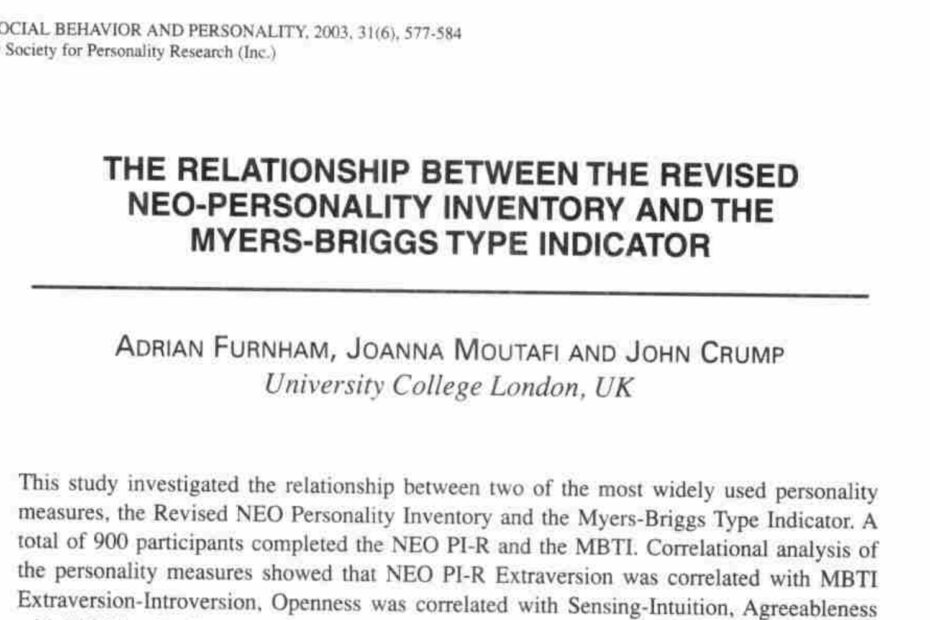
For example, the study “The relationship between the revised NEO-Personality Inventory and the Myers-Briggs Type Indicator” reports the relationship between MBTI and Big Five.
Therefore, this article will provide an easy-to-understand explanation of the overview, relationships, and application methods of MBTI and Big Five.
By deepening your understanding of personality, you will gain hints for building better relationships with others while valuing your own individuality.
Once again, personality researcher and author of Villain Encyclopedia, Tokiwa (@etokiwa999), will provide the explanation.
※We have developed the HEXACO-JP Personality Assessment! It has more scientific basis than MBTI. Tap below for details.

目次
- 1 Overview of MBTI and Big Five
- 2 The Relationship Between MBTI and Big Five Revealed Through Research
- 2.1 Research Purpose and Methods for MBTI and Big Five Relationships
- 2.2 Participant Attributes
- 2.3 Correlation Between MBTI and Big Five
- 2.4 The Relationship between Extraversion and Introversion (EI)
- 2.5 Relationship between Sensing and Intuition (SN)
- 2.6 Relationship between Thinking and Feeling (TF)
- 2.7 Relationship between Judging and Perceiving (JP)
- 2.8 Relationship between Neuroticism and MBTI
- 2.9 MBTI and Big Five: Relationships between Subscales
- 3 Characteristics of MBTI and Big Five Subscales
- 4 What the Overlap Between MBTI and Big Five Suggests
- 5 Benefits of Utilizing MBTI and Big Five
- 6 In Conclusion
Overview of MBTI and Big Five
Basic Characteristics of MBTI
This is a personality assessment tool developed based on Jung’s psychological type theory.
It consists of four scales (Extraversion-Introversion, Sensing-Intuition, Thinking-Feeling, Judging-Perceiving).
Each scale represents two opposing traits, indicating an individual’s preferences and tendencies.
Below is an overview of the four MBTI scales.
- Extraversion (E) and Introversion (I): The direction of energy flow
- Sensing (S) and Intuition (N): Methods of information gathering
- Thinking (T) and Feeling (F): Criteria for decision-making
- Judging (J) and Perceiving (P): Approach methods to the external world
MBTI shows 16 personality types through combinations of the four scales.
- INTJ (Architect), INTP (Logician), ENTJ (Commander), ENTP (Debater)
- INFJ (Advocate), INFP (Mediator), ENFJ (Protagonist), ENFP (Campaigner)
- ISTJ (Logistician), ISFJ (Defender), ESTJ (Executive), ESFJ (Consul)
- ISTP (Virtuoso), ISFP (Adventurer), ESTP (Entrepreneur), ESFP (Entertainer)
Each type has unique characteristics, allowing understanding of an individual’s strengths, weaknesses, and preferences.
MBTI can be said to be a widely used personality assessment tool for deepening self-understanding and understanding of others.
Basic Characteristics of Big Five
Big Five is a theory that captures personality traits in five dimensions and is based on empirical research.
The five traits are neuroticism, extraversion, openness, agreeableness, and conscientiousness.
Each trait represents the following tendencies.
- Neuroticism: Emotional stability and tolerance for anxiety
- Extraversion: Sociability, assertiveness, liveliness
- Openness: Intellectual curiosity, creativity, flexibility
- Agreeableness: Kindness, cooperative attitude, compassion
- Conscientiousness: Sense of responsibility, planning ability, self-control
Big Five captures personality as continuous dimensions, allowing quantitative evaluation of individual differences.
Additionally, each trait is composed of multiple sub-scales, enabling more detailed understanding of personality.
Big Five is a representative theory in personality psychology and is utilized in a wide range of research and applications.
Common Points Between MBTI and Big Five
MBTI and Big Five share the common point of being scales for understanding personality.
Both aim to capture characteristic tendencies of individuals and seek to clarify the structure of personality.
The following common points can also be observed.
- Capturing personality from multiple dimensions
- Emphasizing individual differences
- Based on empirical data
- Having broad application fields
However, MBTI and Big Five differ in their theoretical backgrounds and measurement methods.
By understanding the characteristics of each scale, we can capture personality from a more multifaceted perspective.
Furthermore, utilizing these two approaches gave birth to “16personalities,” which many people have tested. As introduced below, 16personalities is not MBTI, but rather leans more toward Big Five.
Differences Between MBTI and Big Five
The most significant difference between these two lies in their theoretical backgrounds for understanding personality.
While MBTI is based on Jung’s psychological type theory, Big Five is a theory derived from empirical research.
Additionally, the following differences can be noted:
- Personality classification method (Type theory vs. Trait theory)
- Number of measurement scales (4 scales vs. 5 scales)
- Expression method of measurement results (Discrete vs. Continuous)
- Main application purpose (Self-understanding vs. Research & evaluation)
Additionally, while MBTI is widely popular among the general public, Big Five is frequently used in academic research as a psychological scale.
Considering these differences, it can be said that MBTI and Big Five capture personality from different angles.
It is important to understand the characteristics of both and select the appropriate scale according to the purpose.
Recognizing the differences between MBTI and Big Five will broaden our understanding of personality.
The Relationship Between MBTI and Big Five Revealed Through Research
Research Purpose and Methods for MBTI and Big Five Relationships
Many studies have been conducted to clarify the relationship between MBTI and Big Five.
The purpose of these studies is to clarify the following points:
- Correlation relationships between each scale of MBTI and Big Five
- Theoretical overlaps and differences between both
- The role of both in understanding personality
As research methods, the following approaches are mainly used:
- Personality assessment through questionnaires
- Statistical analysis (correlation analysis, factor analysis, etc.)
- Meta-analysis (integration of multiple research results)
Through these studies, the relationship between MBTI and Big Five has gradually become clearer.
Correlation relationships between both scales and theoretical overlaps have been demonstrated.
It is expected that the role of both in understanding personality will become clearer through continued research in the future.
Participant Attributes
The study examining the relationship between MBTI and Big Five involved 900 participants.
The attributes of participants are as follows:
- Gender: 717 males, 183 females
- Age: 23-64 years old (average 42 years old)
- Cultural background: British adults
- Occupation: People who received evaluations from a business psychology consulting company
This study used a relatively large-scale sample, including a wide age range of adults.
However, there is a bias in the gender ratio of participants, with males comprising the majority.
Also, since the cultural background is limited to Britain, caution is needed when generalizing to other cultural regions.
Regarding participants’ occupations, there may be a bias toward a specific group.
It is necessary to consider that these attribute biases may have influenced the research results.
To better understand the relationship between MBTI and Big Five, studies targeting participants with more diverse attributes in terms of gender ratio, cultural background, and occupation are desired.
Correlation Between MBTI and Big Five
Research results revealed that certain correlations exist between the scales of MBTI and Big Five.
The main correlations are as follows:
| Correlation Table | E | I | N | S | F | T | J | P |
| Extraversion | Strong Positive | Strong Negative | Positive | Negative | ||||
| Openness | Positive | Negative | Strong Positive | Strong Negative | Negative | Positive | ||
| Agreeableness | Positive | Strong Negative | ||||||
| Conscientiousness | Negative | Positive | Strong Positive | Strong Negative | ||||
| Neuroticism | Negative | Positive | Negative | Positive | Positive | Negative |
These correlations suggest theoretical overlap between the two frameworks.
However, the strength of correlations varies by scale, and they do not completely match.
Since MBTI and Big Five capture personality from different angles, the correlations can be understood as partial.
Understanding the correlations between both will broaden your understanding of personality.
The Relationship between Extraversion and Introversion (EI)
MBTI’s Extraversion (E) and Introversion (I) have been shown to have strong relationships with Big Five Extraversion.
MBTI Extraversion has a positive correlation (0.71) with Big Five Extraversion, while Introversion has a negative correlation (-0.72).
This relationship is thought to reflect the following characteristics.
- Direction of energy (external world vs. internal world)
- Degree of sociability and activity
- Responsiveness to stimulation
However, while MBTI’s extraversion and introversion emphasize the direction of energy, Big Five extraversion emphasizes behavioral aspects such as sociability and activity.
It’s important to understand the relationship between both while considering these differences.
The concepts of extraversion in MBTI and Big Five partially overlap while each having their own unique meanings.
By understanding the relationship between both, you can gain a deeper understanding of the characteristics of extraversion and introversion.
Relationship between Sensing and Intuition (SN)
MBTI’s Sensing (S) and Intuition (N) have been shown to correlate with Big Five Openness.
Sensing has a negative correlation (-0.66) with Big Five Openness, while Intuition has a positive correlation (0.64).
This relationship is thought to reflect the following characteristics:
- Methods of information gathering (concrete vs abstract)
- Attitude toward new experiences (cautious vs proactive)
- Degree of creativity and imagination
However, while MBTI’s Sensing and Intuition focus on methods of information gathering, Big Five Openness encompasses broader traits such as intellectual curiosity and creativity.
It is important to understand this difference when grasping the relationship between the two.
MBTI and Big Five concepts of Sensing/Intuition and Openness partially overlap while maintaining their own unique meanings.
By considering the relationship between the two, we can gain a deeper understanding of information processing and creativity characteristics.
Relationship between Thinking and Feeling (TF)
MBTI’s Thinking (T) and Feeling (F) have been shown to correlate with Big Five Agreeableness.
Thinking has a negative correlation (-0.41) with Big Five Agreeableness, while Feeling has a positive correlation (0.28).
This relationship is thought to reflect the following characteristics:
- Criteria for decision-making (logic vs values)
- Attitude in interpersonal relationships (objective vs empathetic)
- Degree of emotional expression (restrained vs rich)
However, while MBTI’s Thinking and Feeling focus on criteria for decision-making, Big Five Agreeableness encompasses broader traits such as kindness and compassion.
It is important to understand this difference when grasping the relationship between the two.
MBTI and Big Five concepts of Thinking/Feeling and Agreeableness partially overlap while maintaining their own unique meanings.
By considering the relationship between the two, we can gain a deeper understanding of decision-making and interpersonal relationship characteristics.
Relationship between Judging and Perceiving (JP)
MBTI’s Judging (J) and Perceiving (P) have been shown to correlate with Big Five Conscientiousness.
Judging has a positive correlation (0.46) with Big Five Conscientiousness, while Perceiving has a negative correlation (-0.46).
This relationship is thought to reflect the following characteristics:
- Approach to the external world (planned vs flexible)
- Regularity and orderliness of behavior
- Attitude toward goal achievement
However, while MBTI’s Judging and Perceiving focus on approaches to the external world, Big Five Conscientiousness encompasses broader traits such as responsibility and self-control.
It is important to understand this difference when grasping the relationship between the two.
MBTI and Big Five concepts of Judging/Perceiving and Conscientiousness partially overlap while maintaining their own unique meanings.
By considering the relationship between the two, we can gain a deeper understanding of behavioral patterns and goal achievement characteristics.
Relationship between Neuroticism and MBTI
Big Five Neuroticism has been shown to have a weak relationship with MBTI Extraversion (E) and Introversion (I).
Neuroticism has a negative correlation (-0.3) with MBTI Extraversion and a positive correlation (0.31) with Introversion.
This relationship is thought to reflect the following characteristics:
- Emotional stability and tolerance for anxiety
- Stress coping methods (extraverted vs introverted)
- Self-evaluation tendencies (positive vs negative)
However, the relationship between Neuroticism and MBTI is weaker compared to relationships between other scales.
This is thought to be because MBTI aims to capture normal personality variations, while Neuroticism represents emotional instability.
Although the relationship between the two is limited, it may be meaningful in understanding emotional characteristics.
The relationship between Neuroticism and MBTI suggests a connection between personality and emotional health.
By considering the relationship between the two, we may be able to gain a deeper understanding of individual emotional characteristics.
MBTI and Big Five: Relationships between Subscales
The relationship between MBTI and Big Five has also been examined in more detail at the subscale level.
Not only correlations between scales, but also relationships between subscales have been clarified.
For example, the following relationships have been reported:
- MBTI Extraversion: Positive correlation with Big Five Extraversion subscales (sociability, activity level, etc.)
- MBTI Introversion: Positive correlation with Big Five Neuroticism subscales (self-consciousness, depression, etc.)
- MBTI Intuition: Positive correlation with Big Five Openness subscales (fantasy, aesthetic sensitivity, etc.)
- MBTI Feeling: Positive correlation with Big Five Agreeableness subscales (altruism, tolerance, etc.)
- MBTI Assessment: Positive correlation with Big Five conscientiousness subscales (orderliness, cautiousness, etc.)
By examining the relationships between subscales, the theoretical overlap between the two becomes clearer.
Additionally, useful information for understanding detailed personality characteristics can be obtained.
The relationships between MBTI and Big Five subscales promote multifaceted understanding of personality.
By considering relationships at the subscale level, individual personality traits can be grasped more precisely.
Characteristics of MBTI and Big Five Subscales
Neuroticism Subscales
Big Five neuroticism is composed of the following 6 subscales.
- Anxiety: The degree of anxiety when facing stress or difficult situations
- Hostility: Tendency to easily feel anger and frustration
- Depression: Tendency to easily experience sadness and dejection
- Self-consciousness: Tendency to feel embarrassed or nervous in front of others
- Impulsivity: Tendency to be unable to control desires and act impulsively
- Vulnerability: Tendency to be weak to stress and easily panic
These subscales capture emotional instability and vulnerability from multiple perspectives.
People with high neuroticism tend to easily experience anxiety and depression, and have low stress tolerance.
On the other hand, people with low neuroticism are emotionally stable and can be said to have high stress coping ability.
Neuroticism subscales play an important role in understanding individual emotional characteristics in detail.
By grasping the balance of subscales, clues for promoting emotional health and adaptability might be obtained.
Extraversion Subscales
Big Five extraversion is composed of the following 6 subscales.
- Warmth: Tendency to show intimacy and affection toward others
- Gregariousness: Tendency to enjoy interacting with people and being sociable
- Assertiveness: Tendency to express one’s opinions and demonstrate leadership
- Activity: Tendency to act actively and energetically
- Excitement-seeking: Degree of adventurous spirit seeking stimulating experiences
- Positive emotions: Tendency to easily experience positive emotions
These subscales represent various aspects of extraversion.
People with high extraversion tend to be sociable and active, and easily experience positive emotions.
On the other hand, people with low extraversion tend to be introverted and reserved, preferring quiet environments.
Extraversion subscales play an important role in understanding individual sociability and energy levels.
By grasping the balance of subscales, hints for optimizing interpersonal relationships and behavioral styles might be obtained.
Openness Subscales
Big Five openness is composed of the following 6 subscales.
- Fantasy: Tendency to have rich imagination and enjoy indulging in fantasies
- Aesthetics: High appreciation and sensitivity toward art and beauty
- Feelings: Tendency to value one’s emotions and have rich emotional experiences
- Actions: Tendency to prefer new activities and experiences
- Ideas: Tendency to have strong intellectual curiosity and enjoy philosophical thinking
- Values: Tendency to accept new values without being bound by existing values
These subscales capture diverse manifestations of openness.
People with high openness are creative and curious, open to new experiences.
On the other hand, people with low openness tend to be traditional and conventional, valuing stability.
Openness subscales play an important role in understanding individual intellectual interests and flexibility.
By grasping the balance of subscales, clues for enhancing creativity and adaptability might be obtained.
Agreeableness Subscales
Big Five agreeableness is composed of the following 6 subscales.
- Trust: Tendency to trust others and consider them honest
- Straightforwardness: Tendency to be honest and express one’s thoughts frankly
- Altruism: Tendency to act for others and willingly help them
- Compliance: Tendency to avoid conflict and show cooperative attitude
- Modesty: Tendency to be humble and not boast about one’s abilities
- Tolerance: An attitude of accepting the opinions and actions of others
These subscales represent various aspects of agreeableness.
People high in agreeableness tend to be compassionate and value harmony with others.
On the other hand, people low in agreeableness tend to be self-centered and competitive.
The subscales of agreeableness play an important role in understanding individual interpersonal relationship styles and social attitudes.
By understanding the balance of subscales, you may gain insights for building smooth human relationships.
Conscientiousness Subscales
Big Five conscientiousness consists of the following six subscales:
- Competence: Tendency to have confidence in one’s abilities and act effectively
- Order: Tendency to prefer organization and proceed systematically
- Dutifulness: Strong sense of responsibility and tendency to keep promises
- Achievement Striving: Tendency to set high goals and spare no effort
- Self-Discipline: Tendency to suppress impulses and act in a planned manner
- Deliberation: Tendency to think carefully before acting and avoid risks
These subscales capture the multifaceted characteristics of conscientiousness.
People high in conscientiousness tend to have a strong sense of responsibility and high self-discipline.
On the other hand, people low in conscientiousness tend to be impulsive and lack planning.
The subscales of conscientiousness play an important role in understanding individual goal achievement styles and behavioral patterns.
By understanding the balance of subscales, you may gain clues for enhancing productivity and reliability.
What the Overlap Between MBTI and Big Five Suggests
Comprehensive Approach to Personality Understanding
The overlap between MBTI and Big Five suggests the importance of a comprehensive approach to personality understanding.
The relationship between the two suggests the following points:
- Multifaceted characteristics of personality: The relationship between the two shows that personality has multifaceted characteristics.
- Theoretical consistency: The relationship between the two can be said to support the consistency of personality theory.
- Complementary role in personality understanding: The two capture different aspects of personality and play complementary roles.
The overlap between MBTI and Big Five suggests the importance of incorporating multiple perspectives in personality understanding.
Rather than relying on a single theory or scale, combining multiple theories and scales would enable more comprehensive personality understanding.
A comprehensive approach to personality understanding makes it possible to capture individual characteristics more deeply.
The overlap between MBTI and Big Five suggests the importance of multifaceted perspectives in personality understanding.
Possibility of Integrating Research Results
The overlap between MBTI and Big Five suggests the possibility of integrating research results using both.
By considering the relationship between the two, the following benefits can be expected:
- Integration of knowledge: By integrating research results using both, knowledge about personality is accumulated.
- Theoretical development: By exploring the relationship between the two, further development of personality theory can be expected.
- Practical application: By integrating knowledge from both, practical applications of personality understanding will be promoted.
The overlap between MBTI and Big Five suggests that integrating research results using both would be meaningful.
By integrating research results using different theories and scales, the knowledge system about personality would become richer.
Integration of research results is expected to contribute to theoretical and practical development of personality understanding.
The overlap between MBTI and Big Five suggests the importance of interdisciplinary approaches in personality research.
Strengths and Weaknesses of Both Scales
The overlap between MBTI and Big Five highlights the strengths and weaknesses of both scales.
By considering the relationship between the two, the following points become clear:
- MBTI strengths: Enables typological understanding of personality and is easy to apply practically.
- MBTI weaknesses: Difficult to capture personality continuity and lacks empirical support.
- Big Five strengths: Can capture personality continuity and is based on empirical research.
- Big Five weaknesses: Difficult to understand personality typologically and not easy to apply practically.
The overlap between MBTI and Big Five makes it possible to understand the characteristics of both scales relatively.
By recognizing the strengths and weaknesses of both, the role of both scales in personality understanding will become clearer.
The strengths and weaknesses of both scales suggest the need for a multifaceted approach in personality understanding.
The overlap between MBTI and Big Five suggests the possibility that the characteristics of both scales complement each other.
Appropriate Use of Personality Assessment
The overlap between MBTI and Big Five provides suggestions about the appropriate use of personality assessment.
By considering the relationship between the two, it is important to pay attention to the following points:
- Purpose of assessment: Clarify the purpose of personality assessment and select appropriate scales.
- Interpreting results: Appropriately interpret evaluation results and understand individual characteristics from multiple perspectives.
- Limitations of evaluation: Recognize the limitations of personality evaluation and avoid excessive generalizations.
- Ethical considerations: Pay attention to the handling of evaluation results and respect individual rights.
The overlap between MBTI and Big Five provides guidelines for appropriately utilizing personality evaluation.
By considering the purpose and limitations of evaluation and combining multiple scales, more appropriate personality understanding becomes possible.
The appropriate utilization of personality evaluation is essential for leveraging individual characteristics and supporting personal growth.
The overlap between MBTI and Big Five provides important insights for considering the appropriate utilization methods of personality evaluation.
Benefits of Utilizing MBTI and Big Five
Deepening Self-Understanding
By utilizing MBTI and Big Five, you can deepen your self-understanding.
Using both scales can provide the following benefits.
- Multifaceted understanding of personality: By combining both scales, you can understand your personality from multiple perspectives.
- Recognition of strengths and weaknesses: By grasping your personality traits, you can recognize your strengths and weaknesses.
- Promotion of self-acceptance: By understanding and accepting your characteristics, self-acceptance is promoted.
By utilizing MBTI and Big Five, your understanding of yourself deepens.
Self-understanding plays an important role in promoting individual growth and adaptation.
Self-understanding using both scales will serve as a foundation for expressing your true self and aiming for self-realization.
By utilizing MBTI and Big Five, you can deepen your self-understanding and face yourself.
Communication Improvement
By utilizing MBTI and Big Five, communication improvement can be expected.
Using both scales provides the following benefits.
- Promotion of understanding others: By understanding others’ personality traits, it becomes easier to put yourself in their shoes.
- Adjustment of communication style: Based on your own and others’ personality traits, you can adjust your communication style.
- Smoothing interpersonal relationships: By understanding and respecting personality differences, interpersonal relationships become smoother.
By utilizing MBTI and Big Five, communication with others improves.
Understanding and accepting personality differences is essential for building good human relationships.
Communication improvement using both scales will lead to enhancing individual social adaptability.
By utilizing MBTI and Big Five, you can smooth communication with others and build good relationships.
Application to Career Selection
By utilizing MBTI and Big Five, you can apply them to career selection.
Using both scales can provide the following benefits.
- Understanding aptitude: By understanding your personality traits, it becomes easier to grasp your aptitude.
- Guidance for career choice: Based on the relationship between personality traits and occupations, you can obtain guidance for career choice.
- Direction for career development: You can find the direction for career development that leverages your characteristics.
By utilizing MBTI and Big Five, you can select a career that suits you.
Considering the compatibility between personality and occupation is important for enhancing satisfaction in professional life.
Career selection using both scales will lead to maximizing individual abilities.
By utilizing MBTI and Big Five, you can build a career that is true to yourself and aim for self-realization in work.
Application to Team Building
By utilizing MBTI and Big Five, you can apply them to team building.
Using both scales provides the following benefits.
- Understanding member characteristics: By understanding team members’ personality traits, you can grasp individual characteristics.
- Optimizing role distribution: Based on members’ characteristics, you can optimize role distribution.
- Improving teamwork: By leveraging personality diversity and utilizing each other’s strengths, teamwork improves.
By utilizing MBTI and Big Five, effective team building becomes possible.
Understanding and respecting members’ personality traits is essential for enhancing team unity.
Team building using both scales will lead to enhancing organizational productivity and creativity.
By utilizing MBTI and Big Five, you can create teams where members with diverse personalities cooperate and demonstrate high performance.
In Conclusion
In this article, we have explained the overview, relationships, and methods of utilizing MBTI and Big Five.
Understanding your own personality traits is the first step to deepening self-understanding and expressing your true self.
Additionally, understanding others’ personalities helps facilitate smooth communication and build good interpersonal relationships.
In career choices and team building as well, considering personality characteristics can enhance individual and organizational performance.
However, personality assessment results are merely for reference and are not absolute. Personality is multifaceted and complex, and it is not appropriate to judge based on just one scale.
The MBTI introduced this time, and 16personalities which was created utilizing both MBTI and Big Five, are both personality assessments that have been heavily criticized academically. Let’s be careful not to take them too seriously.
It is important to skillfully utilize MBTI and Big Five while facing yourself and cooperating with others.

Writer & Supervisor: Eisuke Tokiwa
Personality Psychology Researcher / CEO, SUNBLAZE Inc.
As a child he experienced poverty, domestic abuse, bullying, truancy and dropping out of school — first-hand exposure to a range of social problems. He spent 10 years researching these issues and published Encyclopedia of Villains through Jiyukokuminsha. Since then he has independently researched the determinants of social problems and antisocial behavior (work, education, health, personality, genetics, region, etc.) and has published 2 peer-reviewed journal articles (Frontiers in Psychology, IEEE Access). His goal is to predict the occurrence of social problems. Spiky profile (WAIS-IV).
Expertise: Personality Psychology / Big Five / HEXACO / MBTI / Prediction of Social Problems
Researcher profiles: ORCID / Google Scholar / ResearchGate
Social & Books: X (@etokiwa999) / note / Amazon Author Page