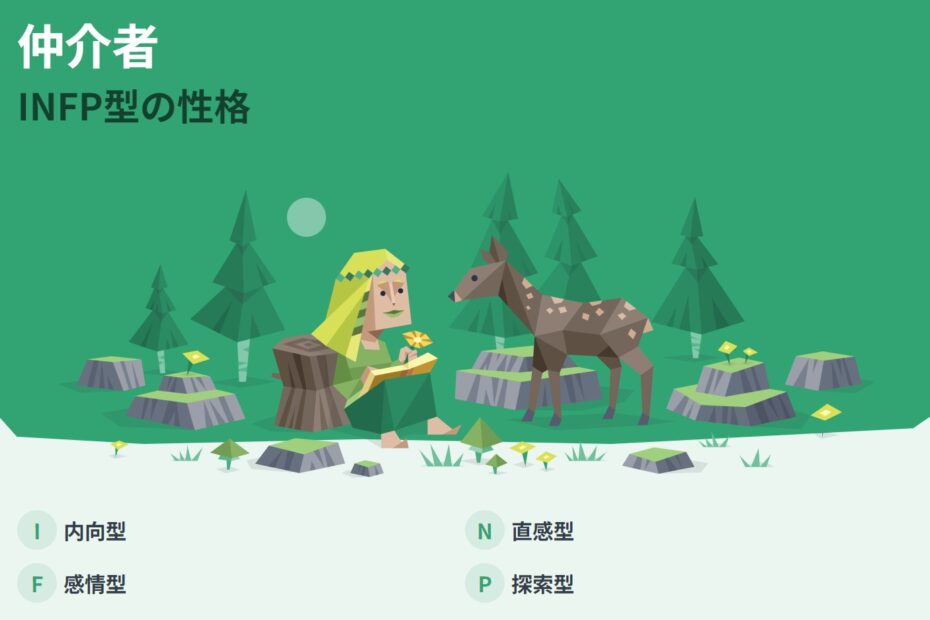
INFP (Mediator) is one of the personality types indicated by the personality assessment called 16personalities.
People with this personality type have introverted, intuitive, feeling, and perceiving characteristics.
INFPs value their inner world and are rich in imagination and creativity.
They are also sensitive to others’ emotions and are characterized by high empathy.
On the other hand, they also have weaknesses in dealing with practical problems and controlling emotions.
INFPs can lead a spiritually rich life by valuing their authenticity while living with compassion and understanding for others.
This article will explain in detail the characteristics, strengths, weaknesses, and tendencies in love and work of INFPs.
Furthermore, we will also introduce compatibility with other personality types and coping methods for troubles that INFPs face.
To understand yourself and the personalities of people around you more deeply, please use this as a reference.
Once again, personality researcher and author of Villain Encyclopedia, Tokiwa (@etokiwa999), will provide the explanation.
※We have developed the HEXACO-JP Personality Assessment! It has more scientific basis than MBTI. Tap below for details.

*This article is written based on a translation of the 16personalities official English page.
The video version of this article is available here!
目次
- 1 Strengths and Weaknesses of INFP (Mediator)
- 2 INFP (Mediator) A and T Types
- 3 INFP (Mediator) Romantic Relationship Tendencies and Improvement Strategies
- 4 INFP (Mediator) Friendship Tendencies and Improvement Strategies
- 5 INFP (Mediator) Parenting Tendencies and Improvement Strategies
- 6 INFP (Mediator) Career Tendencies and Improvement Strategies
- 7 INFP (Mediator) Work Tendencies and Improvement Strategies
- 8 INFP (Mediator) Compatible Types
- 9 INFP (Mediator) Summary
- 10 Supplement
- 10.1 The bad aspects of 16personalities: “Weak scientific backing”
- 10.2 The good aspects of 16personalities: “Large amount of response data and fame”
- 10.3 Differences between 16personalities and other personality tests: “MBTI”
- 10.4 Differences between 16personalities and Other Personality Tests “Big Five”
- 10.5 Differences between 16personalities and Other Personality Tests “HEXACO”
Strengths and Weaknesses of INFP (Mediator)
Strengths of INFP (Mediator)
The greatest strength of this type is deep empathy and rich imagination.
INFPs can deeply understand others’ emotions and interact with compassion.
They are also rich in creativity and have a unique worldview.
Among other things, INFP strengths include the following:
- Idealistic with high ethical standards
- Strong independence and values authenticity
- Flexible and adaptable to change
- Good at finding the good qualities in people
INFPs can utilize these strengths to empathize with people’s hearts and contribute to creating a better world.
Acting according to their own values and showing compassion for others are characteristics that should be respected by many people.
The creativity and flexibility that INFPs possess become the power to generate new ideas and respond to difficult situations.
Weaknesses of INFP (Mediator)
The weaknesses of this type are unrealistic idealism and emotional tendencies.
INFPs may suffer from the gap between reality due to having ideals that are too high.
Also, they are easily swayed by their own emotions and may find objective judgment difficult.
Among other things, INFP weaknesses include the following:
- Sensitive to criticism and prone to self-denial
- Poor at interpersonal relationships and tends to isolate
- Indecisive and lacks decisiveness
- Poor at dealing with practical problems
To overcome these weaknesses, INFPs need to control their emotions and develop realistic thinking.
It is also important to increase self-esteem and actively communicate with others.
By clarifying priorities and honing decision-making skills, they can become more practical in their actions.
When INFPs understand their weaknesses and work to improve them, it not only leads to personal growth but also enhances their ability to adapt to society.
INFP (Mediator) A and T Types
INFP-A (Assertive)
Idealistic harmonizer. Confidently expresses their values and tries to make the world better through creative methods. Highly sensitive and deeply understands others’ emotions.
Strong independence and values living according to their own beliefs. Rich in imagination and excels at artistic expression. Open-minded and enjoys exploring new ideas and possibilities.
Introspective and constantly pursues self-growth. Seeks deep bonds with others but also values their own time. Has strong interest in social justice and does not hesitate to speak up for the weak.
For details, please see this article.
INFP-T (Turbulent)
Idealistic harmonizer but tends to be prone to self-doubt. Creative and highly sensitive, but may also doubt their own abilities and worth.
Deeply understands others’ emotions but may be overwhelmed by their own emotions. Has strong independence but may also be easily influenced by others’ opinions.
Rich in imagination but may struggle to reconcile with the real world. Open-minded but may take time to make decisions.
They are introspective and pursue self-growth, but can be overly self-critical. They seek deep bonds but tend to feel anxious in relationships.
INFP (Mediator) Romantic Relationship Tendencies and Improvement Strategies
Romantic Tendencies
INFP (Mediator) has strong idealistic tendencies in romance and tends to seek the perfect partner.
They have a tendency to visualize an ideal partner in their mind and seek someone who matches that image.
Also, since INFPs value deep emotional connections, they cannot be satisfied with superficial relationships.
The characteristics of INFPs in romance include the following:
- They try to deeply understand their partner’s inner self
- They struggle to express their own emotions
- They tend to lose themselves by adapting too much to their partner
- They sometimes turn away from realistic problems
For INFPs, it’s important to balance their ideals with reality in romance.
They need to accept not only their partner’s good aspects but also their realistic aspects.
It’s also important to honestly express their feelings and deepen communication.
When Romance Becomes Problematic and Improvement Strategies
When INFPs experience problems in romance, they are often suffering from the gap between ideals and reality.
They may seek too perfect a partner and cannot accept their real partner’s flaws.
They may also suppress their emotions, leading to communication deficits with their partner.
The problems INFPs face in romance include the following:
- Having excessive expectations of their partner and becoming disappointed
- Being unable to communicate their emotions to their partner
- Prioritizing their partner’s feelings too much and sacrificing themselves
- Escaping from realistic problems
To improve these problems, it’s first important to recognize the gap between your ideals and reality.
Try not to idealize your partner and accept them as they are.
Practicing expressing your emotions in words is also effective.
It’s important to have open discussions with your partner and understand each other’s feelings.
It’s essential to face realistic problems and find concrete solutions.
When INFPs balance their ideals with reality and build healthy communication with their partner, they can establish fulfilling romantic relationships.
INFP (Mediator) Friendship Tendencies and Improvement Strategies
Friendship Tendencies
INFP (Mediator) tends to seek friends with whom they can deeply empathize.
They desire relationships where hearts connect rather than superficial associations.
When INFPs find friends who empathize with their values, they will be bound by strong bonds.
Also, INFPs excel at listening to friends’ concerns and become good advisors.
The characteristics of INFP friendships include the following:
- They cherish a small number of close friends
- They try to deeply understand their friends’ emotions
- It takes time for them to open up about their inner selves
- They try to support and encourage their friends’ growth
For INFPs, it’s important to express their emotions in friendships.
By opening their hearts and deepening bonds with friends, they can build more fulfilling relationships.
It’s also important to respect and accept the diversity of friends.
When Friendships Become Problematic and Improvement Strategies
When INFPs experience problems in friendships, they often feel isolated because they cannot express their emotions.
Since they struggle to open up about their inner selves, distance can develop between them and their friends.
They may also over-analyze their friends’ words and actions, making relationships complicated.
The problems INFPs face in friendships include the following:
- Being unable to communicate their emotions to friends
- Not knowing how to interact with friends
- Over-interpreting friends’ words and actions
- Feeling a gap between their ideal and actual friendships
To improve these issues, it’s important to first practice verbalizing your emotions.
By expressing emotions, mutual understanding with friends deepens.
Also, it’s important to establish clear boundaries regarding how you interact with friends.
Try not to have excessive expectations and strive to view your friends’ words and actions objectively.
It’s also necessary to accept real friendships as they are and recognize the gap with your ideals.
By developing skills for INFPs to express their emotions honestly and build healthy relationships with friends, they can establish better friendships.
INFP (Mediator) Parenting Tendencies and Improvement Strategies
Parenting Tendencies
INFP (Mediator) tends to be loving in parenting and respect children’s individuality.
They empathize with children’s emotions and show empathetic understanding.
INFPs will encourage children’s creativity and value free expression.
They also emphasize moral values and consider it important to nurture compassion in children.
INFP parenting characteristics include the following:
- Accept and try to understand children’s emotions
- Value recognizing and nurturing children’s individuality
- Support children’s growth through creative activities
- Provide moral guidance and nurture compassion
It’s important for INFPs to take a consistent approach in parenting.
While respecting children’s autonomy, it’s also necessary to interact with them with a firm attitude when needed.
Also, it’s important not to shoulder parenting difficulties alone and to seek support from those around you.
When Parenting Becomes Problematic and Improvement Strategies
When INFPs have problems with parenting, it’s often because they struggle with behavioral management of children due to their difficulty with practical responses.
They may lack consistency in rules and discipline due to focusing too much on accepting children’s emotions.
They may also be unable to respond appropriately to children when influenced by their own emotions.
Problems that INFPs face in parenting include the following:
- Lack of consistency in children’s behavioral management
- Difficulty controlling their own emotions
- Weakness in practical problem-solving
- Feeling a gap between parenting ideals and reality
To improve these issues, it’s important to clarify parenting principles.
It’s important to establish consistent rules for children and stick to them.
Also, develop skills to control your emotions and be able to respond calmly.
For practical problem-solving, it’s necessary to learn specific methods.
It’s required to recognize the gap between ideal parenting and reality and find balance.
By establishing parenting principles and honing emotional control and practical response skills, INFPs can practice more effective parenting.
INFP (Mediator) Career Tendencies and Improvement Strategies
Career Tendencies
INFP (Mediator) tends to pursue careers that align with their values.
They are often attracted to work with social significance or moral purpose.
INFPs are drawn to fields where they can demonstrate creativity or work that helps people.
They also tend to prefer environments with high degrees of freedom where they can work at their own pace.
INFP career characteristics include the following:
- Seek work that aligns with their values
- Attracted to creative work or work that helps people
- Prefer working styles with high degrees of freedom
- Value work-life balance
It’s important for INFPs to clarify their career vision.
Understanding their strengths and values and finding work that can utilize them will be important.
It’s also necessary to consider practical aspects and balance them with stability.
When Careers Become Problematic and Improvement Strategies
When INFPs have career problems, it’s often because they’re troubled by the gap between ideals and reality.
They may feel stressed when their ideal work differs from actual job content.
They may also face workplace difficulties due to their weakness in dealing with practical problems or adjusting interpersonal relationships.
Problems that INFPs face in their careers include the following:
- Gap between ideal work and actual work reality
- Weakness in practical problem-solving
- Difficulty adjusting interpersonal relationships
- Working in a job that doesn’t utilize one’s strengths
To improve these problems, it’s important to first realistically reassess your career vision.
Balance ideals with reality and set achievable goals.
It’s also important to acquire problem-solving skills and learn practical coping methods.
Regarding interpersonal relationship adjustment, you need to polish your communication skills and build constructive relationships.
To find work that utilizes your strengths, it’s necessary to conduct self-analysis and review your career direction.
When INFPs have a realistic career vision and improve their problem-solving and interpersonal relationship skills, they will be able to build a more fulfilling career.
INFP (Mediator) Work Tendencies and Improvement Strategies
Work Tendencies
INFP (Mediators) tend to demonstrate creativity and empathy in their work.
They excel at generating ideas and creating innovation. They can also understand colleagues’ emotions and build good interpersonal relationships.
This type values finding meaning in their work and feels fulfilled by jobs that contribute to society.
INFP work characteristics include the following:
- Skilled at generating creative ideas
- Can understand colleagues’ emotions and build good relationships
- Value work meaning and social contribution
- Prefer environments where they can work at their own pace
It’s important for INFPs to find work that utilizes their strengths. It’s also important to devise work methods so they can work at their own pace in environments where they can demonstrate creativity and empathy.
Additionally, they need to find meaning in their work and choose duties that align with their values.
When Problems Arise at Work and Improvement Strategies
When INFPs experience problems at work, it’s often because they struggle with details and practical issues, which hinders work progress.
While they excel at generating ideas, they may experience difficulties when moving to the execution stage.
They may also be influenced by their emotions, making objective judgment difficult. Problems that INFPs face at work include the following:
- Struggle with details and practical problem-solving
- Difficulty executing ideas
- Being influenced by emotions, unable to make objective judgments
- Struggle with routine work and administrative tasks
To improve these problems, it’s important to first clarify work priorities and create realistic plans.
When executing ideas, it’s important to set specific action steps and proceed steadily.
It’s also necessary to control emotions and develop self-management skills to enable objective judgment.
For routine work and administrative tasks, they need to learn efficient methods and overcome their reluctance.
When INFPs clarify work priorities, create realistic action plans, and improve self-management skills, they will be able to work more productively and fulfillingly.
INFP (Mediator) Compatible Types
Compatible Types, People with N Included
INFP (Mediators) tend to be compatible with people who have N (Intuition) included. People with dominant N are interested in abstract concepts and possibilities, and excel at generating innovative ideas.
Since INFPs are also rich in creativity and imagination, they can share common interests with people who have dominant N. The following types can be said to be compatible with INFPs:
- ENFP (Campaigner): Can share creativity and passion
- INFJ (Advocate): Can share deep insight and idealism
- INTJ (Architect): Can share intellectual curiosity and originality
- ENTP (Debater): Can explore new ideas and possibilities
INFPs can build stimulating and fulfilling relationships by working together with people who have dominant N on creative projects and sharing deep insights.
You can open up new possibilities by leveraging each other’s imagination and intuition.
Compatible types, people with F included
INFP (Mediator) tends to be compatible with people who include F (Feeling). People with dominant F value emotions and are good at cherishing human relationships. Since INFPs also have rich sensitivity and empathy, they can share values with F-dominant people. The following types can be said to be compatible with INFPs.
- ISFJ (Protector): Can share compassion and devotion
- ESFJ (Consul): Can share consideration for others and cooperativeness
- ENFJ (Protagonist): Can share idealism and emphasis on human relationships
- ENFP (Campaigner): Can share sensitivity and creativity
INFPs can build warm and fulfilling relationships by sharing emotions and deepening human connections with F-dominant people.
You can achieve deeper understanding and mutual support by leveraging each other’s sensitivity and empathy. However, since INFPs and F-dominant people tend to be easily influenced by emotions, it’s important to maintain objectivity and balance with each other.
INFP (Mediator) Summary
INFP (Mediator) is someone with a rich sensitivity, creativity, and idealistic personality. They have deep insight and empathy, and are skilled at understanding people’s emotions.
They value living based on their own values and seek meaningful work and human relationships.
On the other hand, they also have weaknesses in dealing with practical problems and controlling emotions.
INFPs can live more fulfilling lives by leveraging their strengths and improving their weaknesses.
It’s important to choose environments where they can demonstrate creativity and empathy, and to build work and human relationships at their own pace.
It’s also important to acquire practical problem-solving skills and learn methods to control emotions.
INFPs can live rich and fulfilling lives by valuing their authenticity while living with compassion and understanding for others.
Listening to their inner voice and making choices based on their values is the most important thing for INFPs.
Supplement
The bad aspects of 16personalities: “Weak scientific backing”
16personalities (16-type personality test) can be said to have challenges in terms of scientific evidence.
First, there are few peer-reviewed papers, and academic backing is insufficient.
Also, questions remain about the statistical processing methods.
The point of classifying traits into types rather than continuous numerical values is also problematic from the perspective of scientific validity.
Furthermore, the current situation is that sufficient evidence has not been provided regarding the relationship between personality and academic ability, income, brain function, genetic factors, etc.
The good aspects of 16personalities: “Large amount of response data and fame”
On the other hand, 16personalities (16-type personality test) also has significant advantages.
The first is that it has accumulated vast response data. Since many people participate in 16personalities diagnostics, the reliability of the data might be high.
Also, Korean idols have answered and spread it, and it’s attracting attention in dating matching apps, so it has penetrated quite widely among general people.
This point can be said to be an advantage of the 16personalities personality test compared to other personality tests.
Differences between 16personalities and other personality tests: “MBTI”
16personalities (16-type personality test) is created based on MBTI (Myers-Briggs Type Indicator) and the Big Five.
Strictly speaking, 16personalities and MBTI are different things.
MBTI is a personality assessment tool developed based on Jung’s psychological typology theory.
16personalities adopts MBTI’s four indicators (E Extraversion-I Introversion, S Sensing-N Intuition, T Thinking-F Feeling, J Judging-P Perceiving) while adding Identity (A and T) indicators and establishing unique question items and evaluation criteria.
However, it shares the same weak scientific backing as 16personalities, such as the lack of solid foundation for dichotomous classifications.
Differences between 16personalities and Other Personality Tests “Big Five”
The Big Five is one of the most prominent trait theories in personality psychology.
The Big Five measures five traits: openness, conscientiousness, extraversion, agreeableness, and neuroticism.
Additionally, while the Big Five evaluates traits with continuous numerical values (e.g., extraversion 3.5), 16personalities and MBTI use type classifications (e.g., either extraverted or introverted), which is also a major difference.
Furthermore, it has been studied for a long time with many research papers, and extensive research has been conducted in other fields such as academic performance, income, brain studies, and genetics. The Big Five can be said to have relatively stronger scientific backing.
As a reference, there are also papers showing the correlation between the four elements of the Big Five and MBTI.
Differences between 16personalities and Other Personality Tests “HEXACO”
HEXACO (HEXACO Personality Inventory) is a six-dimensional personality model that extends the Big Five.
HEXACO measures six traits: honesty-humility, emotionality, extraversion, agreeableness, conscientiousness, and openness.
By adding the dimension of honesty-humility to the Big Five, it aims to capture a broader range of personality traits, such as dark (and bright) personality traits.
Like the Big Five, this model can also be said to have relatively stronger scientific backing compared to 16personalities and MBTI, with a larger number of research papers.

Writer & Supervisor: Eisuke Tokiwa
Personality Psychology Researcher / CEO, SUNBLAZE Inc.
As a child he experienced poverty, domestic abuse, bullying, truancy and dropping out of school — first-hand exposure to a range of social problems. He spent 10 years researching these issues and published Encyclopedia of Villains through Jiyukokuminsha. Since then he has independently researched the determinants of social problems and antisocial behavior (work, education, health, personality, genetics, region, etc.) and has published 2 peer-reviewed journal articles (Frontiers in Psychology, IEEE Access). His goal is to predict the occurrence of social problems. Spiky profile (WAIS-IV).
Expertise: Personality Psychology / Big Five / HEXACO / MBTI / Prediction of Social Problems
Researcher profiles: ORCID / Google Scholar / ResearchGate
Social & Books: X (@etokiwa999) / note / Amazon Author Page