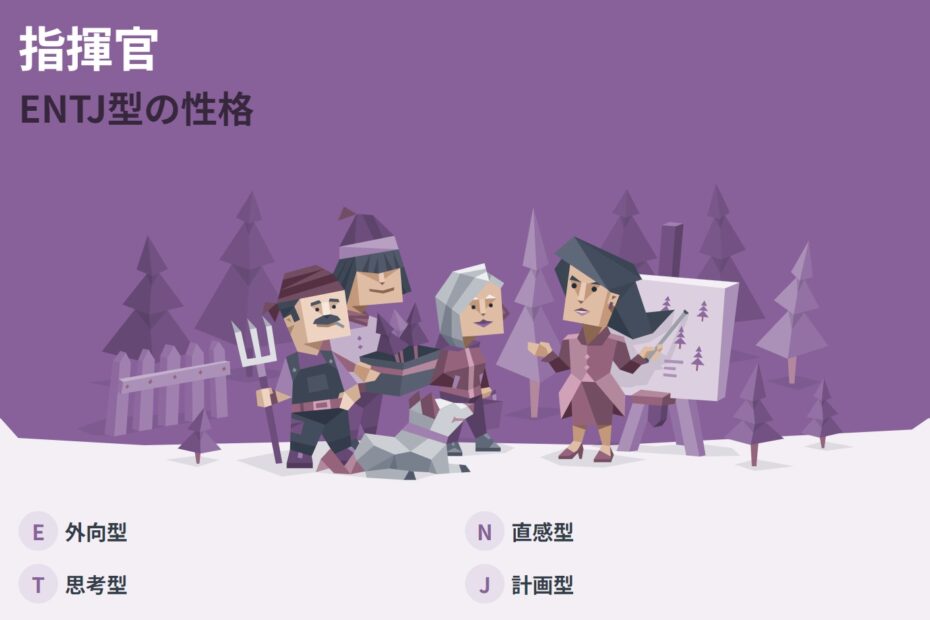
Do you know the personality type called ENTJ (Commander)? It’s one of the 16personalities (16-type personality test).
They are natural-born leaders with strong will and excellent strategic thinking.
Setting high goals and efficiently moving things forward is a characteristic of ENTJs.
Moreover, they have strong intellectual curiosity and are always trying to absorb new knowledge.
In other words, ENTJs are like engines that drive society.
But even they have things they’re not good at. That is emotional interaction.
ENTJs place such emphasis on logical thinking that it’s difficult for them to understand others’ feelings.
Thus, ENTJs have great strengths as well as weaknesses that need to be overcome.
This time, we will explain the characteristics of ENTJs in detail.
Let’s explore their personality from various aspects such as romance, work, and human relationships.
You should be able to see the charm and challenges of ENTJs.
Once again, personality researcher and author of Villain Encyclopedia, Tokiwa (@etokiwa999), will provide the explanation.
※We have developed the HEXACO-JP Personality Assessment! It has more scientific basis than MBTI. Tap below for details.

*This article is written based on translations from the 16personalities official English website.
The video version of this article is available here!
目次
- 1 ENTJ (Commander) Strengths and Weaknesses
- 2 ENTJ (Commander) A and T Types
- 3 ENTJ (Commander) Romantic Relationship Tendencies and Improvement Strategies
- 4 ENTJ (Commander) Friendship Tendencies and Improvement Strategies
- 5 ENTJ (Commander) Parenting Tendencies and Improvement Strategies
- 6 ENTJ (Commander) Career Tendencies and Improvement Strategies
- 7 ENTJ (Commander) Work Tendencies and Improvement Strategies
- 8 ENTJ (Commander) Compatible Types
- 9 ENTJ (Commander) Summary
- 10 Supplement
- 10.1 The bad aspects of 16personalities: “Weak scientific backing”
- 10.2 The good aspects of 16personalities: “Large number of responses (data) and fame”
- 10.3 Differences between 16personalities and other personality assessments: “MBTI”
- 10.4 Differences between 16personalities and other personality tests: “Big Five”
- 10.5 Differences between 16personalities and other personality tests: “HEXACO”
ENTJ (Commander) Strengths and Weaknesses
ENTJ Strengths
The greatest strength of this type is their high efficiency and problem-solving ability.
They excel at finding optimal methods to achieve goals.
They also have the following characteristics:
- Excellent strategic thinking ability
- Can demonstrate leadership
- Full of confidence
- Have strong willpower
- Energetic and active
With these traits, ENTJs can face difficult situations without giving up.
Additionally, they have the power to involve others and guide them toward goals.
In this way, ENTJs can excel in all situations with their high abilities and strong leadership as weapons.
In essence, the strengths of ENTJs can be said to be their power to efficiently advance things and lead those around them.
ENTJ Weaknesses
The greatest weakness of ENTJs is their lack of emotional consideration.
They tend to dismiss others’ emotions because they place too much emphasis on rationality.
They also have the following characteristics:
- Stubborn and domineering
- Poor at emotional expression
- Tend to look down on others
- Lack patience
- Prone to arrogance
Due to these traits, ENTJs may have problems in interpersonal relationships.
Furthermore, because they try to push through their own opinions, they may sometimes face backlash from those around them.
In other words, the weaknesses of ENTJs can be said to be emotional immaturity and dogmatic attitudes.
However, these weaknesses can be improved with self-awareness and effort.
If ENTJs can have a humble attitude and listen to others’ opinions, they should be able to build better human relationships.
ENTJ (Commander) A and T Types
ENTJ-A (Assertive Type)
Charismatic leaders. They lead organizations toward big goals with confident attitudes, pulling those around them. They excel in logical thinking and strategic planning, emphasizing efficiency and results.
They are decisive and take swift action. They are ambitious and constantly aim for self-improvement. They have critical thinking skills and enjoy debates.
They tend to prioritize reason over emotion, but this can sometimes create friction in interpersonal relationships. They don’t fear change and welcome new ideas and challenges. They have a strong sense of responsibility and always keep their promises.
For details, please see this article.
ENTJ-T (Turbulent Type)
They have the qualities of charismatic leaders but also have self-critical aspects. They have the ability to guide organizations toward big goals, but sometimes feel anxious about their own judgments.
They excel in logical thinking and strategic planning, but may hesitate to make decisions due to seeking perfection. They are ambitious and aim for self-improvement, but may lose confidence through comparisons with others.
I possess critical thinking and enjoy debates, but sometimes I lack confidence in my own opinions. While I don’t fear change, I sometimes feel anxious about whether I can adapt to new situations.
ENTJ (Commander) Romantic Relationship Tendencies and Improvement Strategies
Romantic Tendencies
ENTJs tend to display leadership even in romantic relationships.
They pursue their ideal relationship and take active steps to achieve it.
Additionally, their romantic style has the following characteristics:
- Goal-oriented and systematic
- Support their partner’s growth
- Seek stimulating relationships
- Enthusiastic about self-improvement
- Have high expectations for their partner
In this way, ENTJs take romance seriously and aim to build ideal relationships.
They try to promote not only their own growth but also their partner’s growth.
In other words, for ENTJs, romance is a relationship where both parties can elevate each other.
However, their high ideals and expectations may sometimes put pressure on their partner.
ENTJs may not sufficiently consider their partner’s feelings in their pursuit of their ideals.
When Romance Becomes Problematic and Improvement Strategies
ENTJs encounter problems in romance when emotional misunderstandings occur.
They may dismiss their partner’s emotions due to their emphasis on logical thinking.
Specifically, problems are likely to arise in the following situations:
- Not respecting their partner’s opinions
- Dismissing emotional expression
- Imposing their own ideals
- Criticizing their partner’s words and actions
- Refusing to compromise
To improve such problems, ENTJs need to deepen their emotional understanding.
For this purpose, it’s important to empathize with and understand their partner’s feelings.
Even when opinions differ, an attitude of respecting the other person’s emotions is required.
It’s also important for ENTJs not to be too attached to their ideals and pride.
Sometimes making compromises and maintaining a flexible approach should lead to stability in romantic relationships.
In essence, many of the problems ENTJs face in romance stem from emotional immaturity.
If they can learn to think from their partner’s perspective and develop a caring heart, they should be able to build better romantic relationships.
ENTJ (Commander) Friendship Tendencies and Improvement Strategies
Friendship Tendencies
ENTJs tend to seek intellectual stimulation in friendships as well.
They prefer friends who are highly motivated like themselves and with whom they can have deep discussions.
Additionally, their friendships have the following characteristics:
- Interact with a sense of purpose
- Support each other’s growth
- Exchange opinions frankly
- Enjoy intellectual discussions
- Struggle with emotional exchanges
In this way, ENTJs value growing together with friends and try to build intellectual relationships.
They also demand the same high standards from their friends as they do from themselves.
In other words, for ENTJs, ideal friends are those with whom they can mutually improve themselves.
However, their high standards may sometimes burden their friends.
ENTJs may unconsciously distance themselves from friends who don’t meet their standards.
When Friendships Become Problematic and Improvement Strategies
ENTJs encounter problems in friendships when they dismiss emotional exchanges.
They may not fully understand their friends’ emotions due to their preference for logical discussions.
Specifically, problems are likely to arise in the following situations:
- Not seriously listening to friends’ concerns
- Not providing emotional support
- Imposing their own opinions
- Not respecting friends’ values
- Takes a dominating attitude
To improve these problems, ENTJs need to deepen their understanding of the emotional aspects.
For this, it is important to empathize with friends’ feelings and show compassion.
Even when opinions don’t align, an attitude of respecting the other person’s emotions is required.
Additionally, it’s important for ENTJs not to become too fixated on their own standards.
By recognizing the diversity of friends and maintaining flexible responses, this should lead to stable friendships.
In essence, many of the problems ENTJs face in friendships stem from emotional immaturity.
If they can learn to think from the other person’s perspective and develop a compassionate heart, they will be able to build better friendships.
ENTJ (Commander) Parenting Tendencies and Improvement Strategies
Parenting Tendencies
ENTJs also tend to emphasize efficiency and rationality in parenting.
They aim to maximize their children’s abilities and approach parenting strategically.
Additionally, their parenting style has the following characteristics.
- Respects children’s independence
- Stimulates intellectual curiosity
- Sets high goals
- Values discipline and order
- Limited emotional involvement
In this way, ENTJs focus on promoting children’s growth and development, trying to create an ideal educational environment.
And they also place high expectations on their children.
In other words, for ENTJs, parenting can be said to be a process of maximizing children’s potential.
However, their high standards may sometimes put pressure on children.
ENTJs, in their pursuit of efficiency, may not adequately consider children’s emotions.
When Parenting Becomes Problematic and Improvement Strategies
ENTJs face problems in parenting when there is insufficient emotional support for children.
They tend to overlook children’s emotional needs while emphasizing intellectual education.
Specifically, problems are likely to arise in the following situations.
- Not listening to children’s concerns
- Dismissing emotional expression
- Having excessively high expectations
- Not respecting children’s individuality
- Taking a dominating attitude
To improve these problems, ENTJs need to deepen their understanding of children’s emotional aspects.
For this, it is important to empathize with children’s feelings and show compassion.
Even if it differs from their own ideals, an attitude of recognizing children’s individuality is required.
Additionally, it’s important for ENTJs not to become too fixated on efficiency.
By having flexibility in the parenting process and adapting to the child’s pace, this should lead to good parent-child relationships.
In essence, many of the problems ENTJs face in parenting stem from insufficient consideration of emotional aspects.
If they can think from the child’s perspective and interact with love, they will be able to practice better parenting.
ENTJ (Commander) Career Tendencies and Improvement Strategies
Career Tendencies
ENTJs also tend to set high goals and strive forward in career development.
They seek environments where they can maximize their abilities and try to demonstrate leadership.
Additionally, their career perspective has the following characteristics.
- Make strategic plans
- Take on difficult challenges
- Emphasize efficiency
- Set high goals
- Pursue self-growth
In this way, ENTJs actively develop their careers and try to lead ideal professional lives.
And they constantly aim for higher levels, continuing to refine their abilities.
In other words, for ENTJs, career can be said to be a means of self-realization.
However, their high ambitions may sometimes create friction with those around them.
ENTJs, in their obsession with achieving goals, may sometimes dismiss others’ opinions.
When Careers Become Problematic and Improvement Strategies
ENTJs face problems in their careers when they have difficulty building interpersonal relationships.
They tend to neglect emotional exchanges with colleagues and supervisors due to their emphasis on efficiency.
Specifically, problems are likely to arise in the following situations.
- Not respecting others’ opinions
- Disregarding teamwork
- Taking an excessively domineering attitude
- Lacking emotional consideration
- Underestimating others’ abilities
To improve these problems, ENTJs need to develop their interpersonal skills.
For this purpose, it’s important to listen to others’ opinions and act with cooperation.
Even if efficiency is somewhat compromised, an attitude that values teamwork will be required.
It’s also important for ENTJs not to be too obsessed with their own goals.
By maintaining flexibility in the career process and cooperating with others, it should lead to greater achievements.
In short, many of the problems ENTJs face in their careers stem from a lack of interpersonal skills.
If they can learn to think from others’ perspectives and act cooperatively, they will be able to build better careers.
ENTJ (Commander) Work Tendencies and Improvement Strategies
Work Tendencies
ENTJs tend to set high goals and demonstrate leadership in their work as well.
They seek environments where they can fully utilize their abilities and try to carry out their duties efficiently.
Their work style also has the following characteristics.
- Making strategic plans
- Actively tackling problem-solving
- Setting high standards
- Emphasizing results
- Not neglecting self-improvement
In this way, ENTJs approach work with a sincere attitude and try to create an ideal workplace environment. And they constantly set high goals and continue to improve their abilities.
In other words, for ENTJs, work is both a means of self-realization and an opportunity for growth.
However, their high standards may sometimes put pressure on colleagues and subordinates. ENTJs may neglect others’ emotions in their pursuit of efficiency.
When Problems Occur at Work and Improvement Strategies
ENTJs face problems at work when they lack cooperation with others. In their pursuit of their ideals, they may not respect the opinions of colleagues and subordinates. Specifically, problems are likely to arise in the following situations.
- Not accepting others’ opinions
- Disregarding teamwork
- Lacking emotional consideration
- Neglecting subordinate development
- Taking a domineering attitude
To improve these problems, ENTJs need to enhance their cooperation with others. For this purpose, it’s important to listen to colleagues’ and subordinates’ opinions and respond with a flexible attitude.
Even if it differs from their own ideals, an attitude that respects diverse opinions will be required. It’s also important for ENTJs not to be too obsessed with efficiency.
By emphasizing cooperation with others in the work process and putting effort into human resource development, it should lead to a better workplace environment.
In short, many of the problems ENTJs face at work stem from a lack of interpersonal skills. If they can learn to think from others’ perspectives and act cooperatively, they will be able to demonstrate better work performance.
ENTJ (Commander) Compatible Types
Compatible Types, People with N
ENTJs are compatible with people who have strong intuitive (N) tendencies. They prefer abstract thinking and excel at generating new ideas.
For ENTJs, these types of people are stimulating presences with whom they can build mutually enhancing relationships. Specifically, they are compatible with the following types of people.
- INTJ (Architect)
- ENTP (Debater)
- INTP (Logician)
- INFJ (Advocate)
These types of people have vigorous intellectual curiosity and deep insight, just like ENTJs. Therefore, they can work together with ENTJs on new projects and enjoy abstract discussions.
In other words, people with strong N tendencies can be said to be optimal partners who fulfill ENTJ’s intellectual curiosity.
However, since both have strong opinions, they may sometimes clash. It is important for ENTJs and people with strong N tendencies to respect each other’s opinions.
Compatible types, people with T included
ENTJs are compatible with people who have strong thinking (T) tendencies.
They excel at analyzing things logically and making objective judgments.
For ENTJs, these types of people are reliable partners with whom they can build mutually stimulating relationships.
Specifically, they are compatible with the following types:
- INTJ (Architect)
- ISTP (Virtuoso)
- ESTP (Entrepreneur)
- INTP (Logician)
These types of people, like ENTJs, value rational thinking and tend to solve problems efficiently.
Therefore, they can work with ENTJs to develop strategies and tackle complex challenges.
In other words, people with strong T tendencies can be said to be optimal partners who fulfill ENTJ’s intellectual curiosity.
However, since both emphasize logical thinking, emotional consideration may sometimes be lacking.
It is important for ENTJs and people with strong T tendencies to pay attention to each other’s emotions as well.
ENTJ (Commander) Summary
This type possesses high intelligence and strong will, and excels at demonstrating leadership.
They proceed strategically and march forward toward high goals. They are also proactive in self-improvement and constantly aim to enhance their abilities.
On the other hand, ENTJs tend to lack emotional consideration or have low cooperation with others.
They may neglect human relationships in their pursuit of efficiency. To overcome these challenges, ENTJs need to improve their interpersonal skills.
By listening to others’ opinions and valuing emotional exchange, they should be able to build better human relationships.
It is also important for ENTJs not to be too obsessed with their ideals. Sometimes having flexibility and cooperating with others can achieve greater results.
In essence, ENTJs have wonderful abilities to push forward toward goals with the power of intelligence and will.
And by acquiring emotional understanding and interpersonal skills, they can grow even further.
Supplement
The bad aspects of 16personalities: “Weak scientific backing”
16personalities (16-type personality assessment) can be said to face challenges in terms of scientific evidence.
First, there are few peer-reviewed papers, and academic backing is insufficient.
Also, questions remain about the statistical processing methods.
The point of classifying traits into types rather than continuous numerical values is also problematic from the perspective of scientific validity.
Furthermore, the current situation is that sufficient evidence has not been presented regarding the relationships between personality and academic ability, income, brain function, genetic factors, etc.
The good aspects of 16personalities: “Large number of responses (data) and fame”
On the other hand, 16personalities (16-type personality assessment) also has major advantages.
The first is that it has accumulated vast response data. Since many people participate in 16personalities assessments, the reliability of the data may possibly be high.
Also, it has penetrated quite well among the general public, with Korean idols taking and promoting it, and receiving attention on dating matching apps.
This point can be said to be an advantageous aspect of the 16personalities personality assessment compared to other personality assessments.
Differences between 16personalities and other personality assessments: “MBTI”
16personalities (16-type personality assessment) was created based on MBTI (Myers-Briggs Type Indicator) and the Big Five.
Strictly speaking, 16personalities and MBTI are different things.
MBTI is a personality assessment tool developed based on Jung’s psychological typology.
16personalities adopts the four MBTI indicators (E Extroversion-I Introversion, S Sensing-N Intuition, T Thinking-F Feeling, J Judging-P Perceiving) while adding the Identity (A and T) indicator and establishing unique question items and evaluation criteria.
However, it shares the same weak scientific foundation as 16personalities, including the lack of solid evidence for the dichotomous approach.
Differences between 16personalities and other personality tests: “Big Five”
The Big Five is one of the most influential trait theories in personality psychology.
The Big Five measures five traits: Openness, Conscientiousness, Extroversion, Agreeableness, and Neuroticism.
Another major difference is that while the Big Five evaluates traits on a continuous numerical scale (e.g., Extroversion 3.5), 16personalities and MBTI use type classifications (e.g., either extroverted or introverted).
Furthermore, it has been researched for much longer, has a larger number of papers, and extensive research has been conducted in other fields including academic performance, income, brain studies, and genetics. The Big Five can be said to have relatively stronger scientific backing.
For reference, there also exists a paper showing the correlation between the four elements of the Big Five and MBTI.
Differences between 16personalities and other personality tests: “HEXACO”
HEXACO (HEXACO Personality Inventory) is a six-dimensional personality model that extends the Big Five.
HEXACO measures six traits: Honesty-Humility, Emotionality, Extroversion, Agreeableness, Conscientiousness, and Openness.
By adding the Honesty-Humility dimension to the Big Five, it attempts to capture a broader range of personality traits, including the dark (and bright) aspects of personality.
Like the Big Five, this model can also be said to have relatively stronger scientific backing compared to 16personalities and MBTI, with a larger number of research papers.

Writer & Supervisor: Eisuke Tokiwa
Personality Psychology Researcher / CEO, SUNBLAZE Inc.
As a child he experienced poverty, domestic abuse, bullying, truancy and dropping out of school — first-hand exposure to a range of social problems. He spent 10 years researching these issues and published Encyclopedia of Villains through Jiyukokuminsha. Since then he has independently researched the determinants of social problems and antisocial behavior (work, education, health, personality, genetics, region, etc.) and has published 2 peer-reviewed journal articles (Frontiers in Psychology, IEEE Access). His goal is to predict the occurrence of social problems. Spiky profile (WAIS-IV).
Expertise: Personality Psychology / Big Five / HEXACO / MBTI / Prediction of Social Problems
Researcher profiles: ORCID / Google Scholar / ResearchGate
Social & Books: X (@etokiwa999) / note / Amazon Author Page