
Hello! Have you ever heard of the term “MBTI”?
MBTI stands for “Myers-Briggs Type Indicator,” and it’s a psychological assessment tool for understanding your personality.
Actually, MBTI has both supporters and critics.
For example, there are criticisms that classifying personalities into 16 types is unreasonable.
However, this doesn’t mean that MBTI is completely useless.
It can be effectively utilized as one tool for understanding your personality.
So, in this article, we’ll provide a detailed explanation of MBTI.
We’ll explain the characteristics and mechanisms of MBTI, its advantages and disadvantages, and how to use it appropriately in an easy-to-understand way, so please read to the end!
Once again, personality researcher and author of Villain Encyclopedia, Tokiwa (@etokiwa999), will provide the explanation.
※We have developed the HEXACO-JP Personality Assessment! It has more scientific basis than MBTI. Tap below for details.

※As mentioned later in the article, the famous 16personalities (16 Type Personality Test) is based on MBTI and Big Five, making it different from MBTI and Big Five. This is explained below.
目次
- 1 What is MBTI
- 2 The Four Indicators of MBTI
- 3 The 16 MBTI Types
- 3.1 ISTJ (Cautious and Responsible Realist)
- 3.2 ISFJ (Devoted and Caring Protector)
- 3.3 INFJ (Insightful Idealist)
- 3.4 INTJ (Creative and Strategic Thinker)
- 3.5 ISTP (Cool and Adaptable Problem Solver)
- 3.6 ISFP (Flexible and Artistic Free Spirit)
- 3.7 INFP (Idealistic and Passionate Mediator)
- 3.8 INTP (Innovative and Logical Inventor)
- 3.9 ESTP (Bold and Practical Adventurer)
- 3.10 ESFP (Free-spirited and Charming Performer)
- 3.11 ENFP (Enthusiastic and Creative Free Thinker)
- 3.12 ENTP (The Witty and Innovative Inventor)
- 3.13 ESTJ (The Efficient and Practical Administrator)
- 3.14 ESFJ (Sociable and Caring Caretaker)
- 3.15 ENFJ (Charismatic and Caring Leader)
- 3.16 ENTJ (Bold and Imaginative Leader)
- 4 Academic Evaluation of MBTI
- 5 How to Use MBTI
- 6 Differences from Other Personality Tests
- 7 Finally
What is MBTI
Basic Concepts of MBTI
It’s a method that classifies human personality into 16 types.
This diagnostic method helps understand people’s ways of thinking and behavior patterns.
The purpose of MBTI is to deepen self-understanding and understanding of others.
This diagnostic method judges personality based on the following four axes:
- Extraversion and Introversion
- Sensing and Intuition
- Thinking and Feeling
- Judging and Perceiving
The combination of these creates 16 personality types. MBTI shows each person’s strengths and weaknesses.
It also helps improve communication. It can be applied to human relationships in workplaces and schools.
By knowing your personality type, you can see the direction for growth. Understanding others’ types makes it easier to build cooperative relationships.
History and Developers of MBTI
MBTI was created in the United States in the 1940s.
The developers were mother and daughter Katharine Briggs and Isabel Myers.
They focused on the theories of psychologist Carl Jung. Jung’s “Psychological Types” became the foundation of MBTI.
Briggs and Myers thought about putting this theory into practical use.
Their goal was to find ways to utilize people’s individuality. During World War II, the development of this diagnostic method began.
The initial purpose was to assess women’s aptitudes. During wartime, many women began working in new workplaces.
In 1956, it was republished as the “Myers-Briggs Type Indicator.”
Since then, it has become widely used around the world. It’s utilized in business settings and educational environments.
Research by psychology experts continues.
Currently, improvements in MBTI accuracy and expansion of its application range continue to progress.
In other words, MBTI is a diagnostic method supported by long history and extensive research.
The Four Indicators of MBTI
Extraversion (E) and Introversion (I)
Extraversion and Introversion indicate the direction of energy.
First, extraverted people gain energy from the outside world.
On the other hand, introverted people recharge through internal activities.
The characteristics of extraversion are as follows:
- Social and enjoys talking with people
- Active and enjoys going out
- Seeks new experiences and stimulation
The characteristics of introversion are:
- Values alone time
- Prefers deep thinking and introspection
- Prefers small group interactions
However, this is not simply a distinction between being “social” or “shy.”
Rather, it’s a difference in where one gains energy.
Extraverted types refresh themselves by talking with people.
Introverted types become energized by facing themselves in quiet environments.
Sensing (S) and Intuition (N)
Sensing and Intuition represent differences in how information is gathered.
First, sensing types value concrete information obtained through the five senses.
On the other hand, intuitive types focus on overall impressions and possibilities.
The characteristics of sensing types are as follows:
- Think in realistic and practical ways
- Pay attention to details
- Value past experiences
The characteristics of intuitive types are as follows:
- Imaginative and creative
- Have a big-picture perspective
- Interested in future possibilities
Sensing types carefully observe “here and now” situations.
Intuitive types think about “what the situation means.”
Sensing types make judgments based on facts and figures.
Intuitive types are skilled at finding patterns and connections.
Thinking (T) and Feeling (F)
Thinking and Feeling show differences in decision-making methods.
First, thinking types make judgments based on logical analysis.
On the other hand, feeling types value personal values and human relationships.
The characteristics of thinking types are as follows:
- Value objective data
- Value fairness
- Emphasize efficiency and results
The characteristics of feeling types are as follows:
- Sensitive to people’s feelings
- Value harmony
- Make judgments based on personal values
Thinking types analyze problems logically.
Feeling types consider the impact that problems have on people.
Thinking types pursue “what is right.”
Feeling types value “what is good.”
Both approaches have their respective advantages.
Judging (J) and Perceiving (P)
Judging and Perceiving represent ways of dealing with the external world.
First, judging types prefer to make plans and proceed with things in an organized manner.
On the other hand, perceiving types are skilled at adapting flexibly to situations.
The characteristics of judging types are as follows:
- Make plans in advance
- Value meeting deadlines
- Make decisions quickly
The characteristics of perceiving types are as follows:
- Respond with flexibility and adaptability
- Continue to explore new information and options
- Tend to postpone decisions
Judging types seek certainty.
Perceiving types prefer to keep possibilities open.
Judging types act efficiently to achieve goals.
Perceiving types are good at seizing unexpected opportunities.
The 16 MBTI Types
ISTJ (Cautious and Responsible Realist)
ISTJ types are known as reliable practitioners.
People of this type value order and tradition.
They have a strong sense of responsibility and always try to keep their promises.
ISTJ characteristics are as follows:
- Pay attention to details
- Think about things logically
- Value rules and procedures
They prefer to proceed with work using established methods.
They trust proven methods over new ideas.
ISTJs have quiet and calm personalities.
However, when necessary, they take a resolute attitude.
Their strengths lie in certainty and reliability.
On the other hand, it may take time for them to adapt to changes.
ISTJs often excel in the following professions:
- Accountant
- Police officer
- Military personnel
People of this type demonstrate their abilities in stable environments.
They make long-term plans and steadily execute them.
In other words, ISTJs are the cornerstone of organizations.
ISFJ (Devoted and Caring Protector)
ISFJ types excel at being attentive to their surroundings.
People of this type are sensitive to the needs of others.
They have a strong sense of responsibility and value keeping their promises.
ISFJ characteristics are as follows:
- Compassionate
- Practical and realistic
- Patient
They find joy in supporting people.
Through careful attention, they make the people around them comfortable.
ISFJs have quiet and modest personalities.
However, they act devotedly for their loved ones.
Their strengths lie in reliability and a caring heart.
On the other hand, they tend to put their own needs last.
ISFJs often excel in the following professions:
- Nurse
- Teacher
- Social worker
People of this type demonstrate their abilities in stable environments.
They value traditions and customs and try to preserve them.
In other words, ISFJs are important beings who maintain social harmony.
INFJ (Insightful Idealist)
INFJ types are idealists with deep insight.
People of this type believe in human potential.
They find joy in helping others grow.
INFJ characteristics are as follows:
- Creative and imaginative
- Intuitive and insightful
- Sincere and idealistic
They have a strong interest in making the world a better place.
They excel at seeing through to the essence of complex problems.
INFJs have quiet and introspective personalities.
However, they sometimes take passionate action for their beliefs.
Their strengths lie in deep understanding and creativity.
On the other hand, they sometimes struggle with compromising with the real world.
INFJs often excel in the following professions:
- Counselor
- Writer
- Human Resources Manager
People of this type want to engage in meaningful work.
They have long-term vision and work toward it.
In other words, INFJs become catalysts for bringing transformation to society.
INTJ (Creative and Strategic Thinker)
INTJ types are strategists with sharp analytical abilities.
People of this type excel at solving complex problems.
They have exceptional ability to generate creative ideas.
INTJ characteristics are as follows:
- Logical and analytical
- Strong independence
- Have high goals
They enjoy devising new systems and theories.
They view things from a long-term perspective and make plans.
INTJs are introverted and self-sufficient personalities.
However, they take active action to realize their ideas.
Their strengths lie in strategic thinking and innovation.
On the other hand, they sometimes lack consideration for others’ emotions.
INTJs often excel in the following professions:
- Scientist
- Engineer
- Management Consultant
People of this type seek intellectual challenges.
They value efficiency and excellence, constantly aiming for improvement.
In other words, INTJs become sources of innovative ideas.
ISTP (Cool and Adaptable Problem Solver)
ISTP types are known as practical problem solvers.
People of this type are good at understanding how things work.
They have the ability to respond calmly even in crisis situations.
ISTP characteristics are as follows:
- Adaptable
- Adventurous spirit
- Capable of logical thinking
They prefer to learn by doing hands-on work.
They tend to value practice over theory.
ISTPs are highly independent and value freedom.
However, when necessary, they cooperate to tackle problem solving.
Their strengths lie in flexible responsiveness and technical skills.
On the other hand, they may struggle with making long-term plans.
ISTPs often excel in the following professions:
- Mechanic
- Pilot
- Firefighter
People of this type seek stimulating experiences.
They quickly master how to use new technology and tools.
In other words, ISTPs are specialists in practical problem solving.
ISFP (Flexible and Artistic Free Spirit)
ISFP types are known as sensitive, artistic individuals.
People of this type value beauty and harmony.
They cherish the present moment and feel the joy of living.
The characteristics of ISFP are as follows:
- Highly creative
- Compassionate
- Flexible
They act based on trusting their senses and intuition.
They prefer to learn from actual experience rather than theory.
ISFPs have quiet and modest personalities.
However, they sometimes express themselves through artistic expression.
Their strengths lie in aesthetic sense and empathic ability.
On the other hand, they may struggle with making long-term plans.
ISFPs often excel in the following professions:
- Artist
- Designer
- Musician
People of this type perform best in free environments.
They are sensitive to others’ emotions and value harmony with their surroundings.
In other words, ISFPs are beings who bring beauty and harmony to the world.
INFP (Idealistic and Passionate Mediator)
INFP types are known as passionate people who pursue ideals.
People of this type have deep internal values.
They believe in others’ potential and enjoy supporting their growth.
The characteristics of INFP are as follows:
- Imaginative
- Compassionate
- Adaptable
They act based on their beliefs.
They are skilled at understanding and empathizing with others’ feelings.
INFPs have introverted and quiet personalities.
However, they act enthusiastically for important values.
Their strengths lie in creativity and deep insight.
On the other hand, they may struggle with practical application in the real world.
INFPs often excel in the following professions:
- Writer
- Counselor
- Interpreter
People of this type seek meaningful work.
They respect individuality and help others achieve self-realization.
In other words, INFPs are bridge-builders who connect with people’s hearts.
INTP (Innovative and Logical Inventor)
INTP types are known as creative problem solvers.
People of this type are good at understanding complex theories and concepts.
They generate new ideas and analyze them logically.
The characteristics of INTP are as follows:
- Strong intellectual curiosity
- Capable of logical thinking
- Original
They enjoy questioning existing concepts.
They explore new possibilities and construct unique theories.
INTPs have introverted and quiet personalities.
However, they engage enthusiastically in discussions about topics of interest.
Their strengths lie in analytical ability and creative thinking.
On the other hand, they may struggle with routine administrative tasks.
INTPs often excel in the following professions:
- Programmer
- Mathematician
- Philosopher
This type of person seeks intellectual stimulation.
They find joy in solving complex problems.
In other words, INTPs become sources of innovative ideas.
ESTP (Bold and Practical Adventurer)
ESTP types are known as action-oriented adventurers.
This type of person prefers to live the present moment to the fullest.
They can respond calmly even in crisis situations and take immediate action.
ESTP characteristics are as follows:
- Active
- Realistic
- Adaptable
They value practice over theory.
They tend to seek new experiences and stimulating activities.
ESTPs are sociable and energetic personalities.
They are skilled at entertaining people around them and livening up the atmosphere.
Their strengths lie in responsiveness and problem-solving abilities.
On the other hand, they may struggle with long-term planning.
ESTPs often excel in the following professions:
- Entrepreneur
- Police officer
- Athlete
This type of person seeks freedom and stimulation.
They respond flexibly to situations and find effective solutions.
In other words, ESTPs are experts in practical problem-solving.
ESFP (Free-spirited and Charming Performer)
ESFP types are known as socializers who enjoy life.
This type of person tries to enjoy the present moment to the fullest.
They find joy in interacting with people and entertaining those around them.
ESFP characteristics are as follows:
- Sociable
- Optimistic
- Flexible
They prefer to learn from experience.
They tend to take a practical approach rather than theoretical.
ESFPs are bright and lively personalities.
They are skilled at attracting people’s attention and livening up the atmosphere.
Their strengths lie in adaptability and communication skills.
On the other hand, they may struggle with long-term planning.
ESFPs often excel in the following professions:
- Actor
- Sales representative
- Event planner
This type of person seeks freedom and fun.
They prefer to gain new experiences through interaction with people.
In other words, ESFPs are beings who give vitality to those around them.
ENFP (Enthusiastic and Creative Free Thinker)
ENFP types are known as passionate idea people.
This type of person prefers to explore new possibilities.
They gain stimulation from interaction with people and generate creative ideas.
ENFP characteristics are as follows:
- Imaginative
- Enthusiastic
- Adaptable
They are skilled at finding patterns and connections.
They consider diverse options and propose innovative solutions.
ENFPs are extroverted and energetic personality types.
They are good at encouraging people and bringing out their potential.
Their strengths lie in creativity and communication skills.
On the other hand, they can sometimes become scattered in attention to details.
ENFPs often excel in the following professions:
- Journalist
- Psychological counselor
- Marketer
People of this type seek meaningful work.
They generate new ideas through interactions with people.
In other words, ENFPs are catalysts that bring about creative transformation.
ENTP (The Witty and Innovative Inventor)
The ENTP type is known as creative problem solvers.
People of this type are skilled at generating new ideas.
They challenge existing concepts and propose innovative solutions.
ENTP characteristics are as follows:
- Strong intellectual curiosity
- Capable of logical thinking
- Adaptable
They analyze complex problems and find original solutions.
They view things from multiple perspectives and explore new possibilities.
ENTPs are sociable and debate-loving personality types.
They exchange ideas and seek intellectual stimulation.
Their strengths lie in creativity and analytical skills.
On the other hand, they can sometimes become scattered in attention to details.
ENTPs often excel in the following professions:
- Entrepreneur
- Consultant
- Lawyer
People of this type seek intellectual challenges.
They generate new ideas and think about ways to realize them.
In other words, ENTPs become the source of innovative ideas.
ESTJ (The Efficient and Practical Administrator)
The ESTJ type is known as organizational leaders.
People of this type value order and efficiency.
They set clear goals and take action to achieve them.
ESTJ characteristics are as follows:
- Strong sense of responsibility
- Practical
- Decisive
They value established methods and procedures.
They make plans and steadily put them into action.
ESTJs are extroverted and confident personality types.
They are skilled at bringing organizations together and efficiently leading them to goal achievement.
Their strengths lie in management skills and execution ability.
On the other hand, they can sometimes be conservative toward new ideas.
ESTJs often excel in the following professions:
- Business executive
- Military personnel
- Administrator
People of this type seek clear structure and rules.
They find joy in fulfilling responsibilities and producing expected results.
In other words, ESTJ is a key presence in organizations.
ESFJ (Sociable and Caring Caretaker)
ESFJ types are known as compassionate supporters.
People of this type are sensitive to the needs of others.
They find joy in creating harmonious environments.
ESFJ characteristics are as follows:
- Cooperative
- Strong sense of responsibility
- Practical
They enjoy taking care of people.
They value traditions and customs and strive to maintain social harmony.
ESFJs have extroverted and sociable personalities.
They excel at bringing people together and achieving goals through cooperation.
Their strengths lie in interpersonal skills and organizational abilities.
On the other hand, they tend to avoid criticism and conflict.
ESFJs often excel in the following professions:
- Teacher
- Nurse
- Social worker
People of this type seek approval from others.
They find joy in doing things for people and take a service-oriented attitude.
In other words, ESFJs are important presences that maintain social harmony.
ENFJ (Charismatic and Caring Leader)
ENFJs have extroverted and passionate personalities.
They excel at encouraging people and drawing out their potential.
Their strengths lie in leadership and interpersonal skills.
On the other hand, they sometimes take criticism too personally.
ENFJs often excel in the following professions:
- Educator
- HR manager
- Politician
People of this type seek meaningful work.
They find joy in supporting people’s growth and contributing to society.
In other words, ENFJs are influential presences that guide people.
ENTJ (Bold and Imaginative Leader)
ENTJ types are known as strategic leaders.
People of this type excel at envisioning big visions.
They create plans to achieve goals efficiently.
ENTJ characteristics are as follows:
- Decisive
- Capable of logical thinking
- Ambitious
They survey entire organizations and create long-term strategies.
They analyze problems and find effective solutions.
ENTJs have confident, extroverted personalities.
They excel at leading people and motivating them toward goal achievement.
Their strengths lie in leadership and strategic thinking.
On the other hand, they sometimes lack consideration for others’ emotions.
ENTJs often excel in the following professions:
- Executive
- Entrepreneur
- Consultant
People of this type seek challenging goals.
I find joy in efficiently producing results and leading organizations to success.
In other words, ENTJs are leaders who drive organizational transformation.
Academic Evaluation of MBTI
Reliability and Validity of MBTI
The evaluation of MBTI is a subject of debate in the academic world.
While this personality assessment method has both supporters and critics, critics are relatively more numerous.
Various studies have been conducted on its reliability and validity.
The main points of discussion regarding MBTI reliability are as follows:
- Test reproducibility
- Consistency of results
- Stability of measurement
Regarding validity, the following points are discussed:
- Scientific nature of theoretical foundation
- Predictive power in real life
- Relationship with other personality theories
- There are both papers stating no correlation and papers stating correlation with the Big Five (a scientifically trusted personality assessment) that will be introduced later.
Many researchers question the reliability of MBTI. When the same person takes it at different times, the results may change.
There are also criticisms that the boundaries of type classification are ambiguous. It is considered insufficient as a scientific personality assessment method.
Criticisms and Challenges of MBTI
MBTI has several important criticisms and challenges.
Questions have been raised about the scientific basis of this personality assessment method.
Many of the criticisms are directed at the theoretical foundation and implementation methods.
The main criticisms of MBTI are as follows:
- Problems with binary classification
- Lack of statistical support
- Possibility of cultural bias
The following challenges are also pointed out:
- Insufficient consideration of individual change and growth
- Excessive dependence in the workplace
- Risk of self-fulfilling prophecy effects
In other words, MBTI is a tool that should be handled carefully.
How to Use MBTI
Using MBTI in Romance
MBTI may be helpful in understanding romantic relationships.
Knowing your partner’s personality type can improve communication.
However, it’s dangerous to judge compatibility based on MBTI alone.
The key points for using MBTI in romance are as follows:
- Deepening self-understanding
- Understanding your partner’s characteristics
- Adjusting communication styles
Specifically, the following applications can be considered:
- Predicting your partner’s preferences and values
- Avoiding potential conflicts
- Understanding and respecting your partner’s strengths
MBTI can help you accept each other’s differences.
For example, in the case of an introverted and extroverted couple, they can understand each other’s needs.
Also, by knowing the differences between feeling and thinking types, they can respect each other’s decision-making methods.
Applying MBTI in Friendships
MBTI can potentially help deepen friendships.
By understanding your friend’s personality type, you can build better relationships.
However, it’s important not to view MBTI too rigidly.
The benefits of applying MBTI to friendships include the following:
- Promoting mutual understanding
- Improving communication
- Respecting individuality
Specific ways to utilize it include:
- Recognizing and leveraging your friend’s strengths
- Avoiding potential misunderstandings
- Enjoying each other’s differences
MBTI can help reduce conflicts with friends.
For example, if you’re Judging and Perceiving type friends, you can understand differences in how you make plans.
Also, by knowing the difference between Sensing and Intuitive types, you can enjoy diverse perspectives.
Utilizing MBTI in Child-Rearing
MBTI can help deepen understanding between parents and children in child-rearing.
By knowing your child’s personality type, you can understand appropriate ways to interact with them.
However, respecting your child’s individuality is most important.
The benefits of utilizing MBTI in child-rearing include the following:
- Understanding your child’s strengths
- Improving communication
- Understanding learning styles
Specific ways to utilize it include:
- Suggesting play methods suited to your child’s preferences
- Setting up learning environments suited to your child’s characteristics
- Understanding the thinking behind your child’s behavior
MBTI can potentially help improve parent-child relationships.
For example, with an introverted child, you can understand the importance of alone time.
Also, with a feeling-type child, you can recognize the importance of emotional expression.
Career Choice and MBTI
MBTI can potentially serve as a reference for career choice.
By knowing your personality type, you can see careers that suit your aptitude.
However, deciding your career based on MBTI alone is dangerous.
The benefits of utilizing MBTI in career choice include the following:
- Deepening self-understanding
- Understanding suitable job types
- Understanding work style tendencies
Specific ways to utilize it include:
- Exploring careers that match your personality type
- Understanding workplace environment preferences
- Considering career paths
MBTI can help you find work that suits you.
For example, extroverted people might be suited to jobs with lots of interaction with people.
Also, intuitive types might have aptitude for creative work.
Utilizing MBTI in the Workplace
MBTI can potentially help improve human relationships in the workplace.
By understanding the personality types of colleagues and supervisors, you can build cooperative relationships.
However, caution is required when using MBTI in the workplace.
The benefits of utilizing MBTI in the workplace are as follows:
- Improved teamwork
- Better communication
- Leveraging individual strengths
Specific application methods include the following:
- Reference for team formation
- Adjusting leadership styles
- Optimizing task assignments
MBTI has the potential to help improve workplace atmosphere.
For example, decision-making is improved by balancing thinking and feeling types.
Additionally, project management becomes more efficient by leveraging the characteristics of judging and perceiving types.
Differences from Other Personality Tests
Comparison between 16personalities and MBTI
The famous “16personalities (16 Personality Types Test)” and MBTI are actually different.
Specifically, there are the following differences:
- 16personalities is based on “MBTI” and “Big Five”
- This is written in the “Our Approach” section of “Our Theory” on the 16personalities English page
- The neuroticism dimension of the Big Five is added as Identity (the final A and T) in 16personalities
- 16personalities provides more detailed personality descriptions
- MBTI has an official certification system
16personalities uses more approachable expressions. For example, it gives names like “Adventurer” and “Mediator” to each type.
Also, 16personalities can be taken online for free.
On the other hand, MBTI emphasizes interpretation by professionals. It aims for deeper self-understanding and understanding of others.
However, there is debate about the scientific evidence for both.
Differences between Big Five and MBTI
Big Five and MBTI are personality theories with different approaches.
Specifically, there are the following differences:
- Big Five measures five traits continuously
- MBTI classifies into 16 types using four axes
- Big Five is more academically supported
Big Five measures the following five traits:
- Openness
- Conscientiousness
- Extraversion
- Agreeableness
- Neuroticism
In contrast, MBTI judges personality using four axes.
Big Five perceives individual differences as continuous (e.g., extraversion 3.8 points).
On the other hand, MBTI takes a dichotomous approach (e.g., E or I).
This Big Five is based on statistical methods and is considered more scientific.
However, there are also research papers suggesting correlations between Big Five and MBTI. Combined with HEXACO, which will be introduced next, the following relationships may exist.
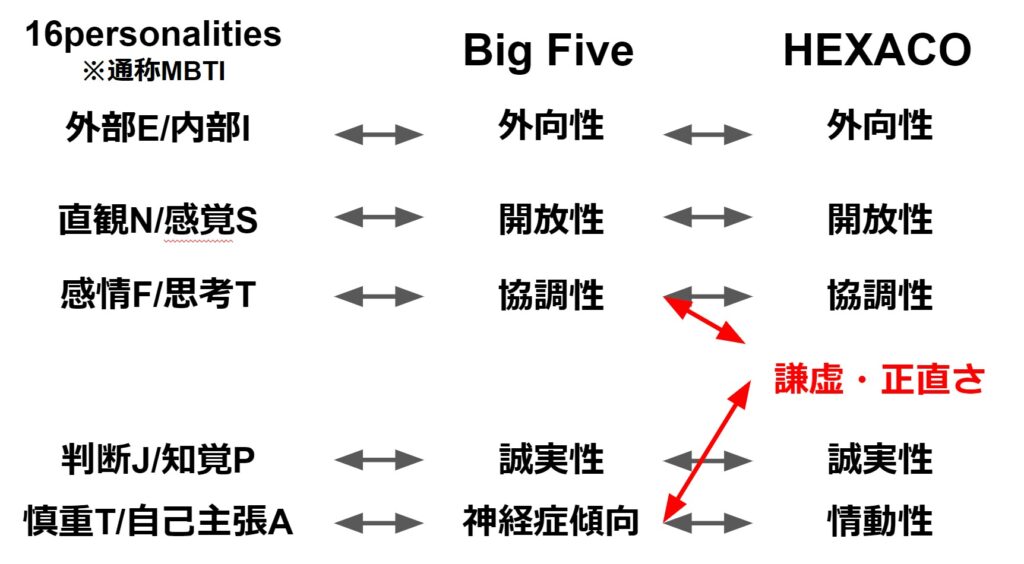
Comparison of Characteristics Between HEXACO Model and MBTI
The HEXACO model and MBTI capture personality from different perspectives.
This HEXACO is a relatively new model that measures personality through six factors.
- Honesty-Humility
- Emotionality
- Extraversion
- Agreeableness
- Conscientiousness
- Openness
In contrast, MBTI judges personality along four axes.
The HEXACO model enables a more multifaceted understanding of personality. The “Honesty-Humility” factor is particularly distinctive.
The HEXACO model has also shown its usefulness in cross-cultural comparative studies.
Finally
Everyone, has your understanding of MBTI deepened?
MBTI is an interesting tool for understanding your personality, but we’ve learned that it’s not omnipotent.
MBTI is helpful for understanding your personality tendencies, but that’s only one aspect.
Personality is complex and multifaceted, so you can’t understand everything through MBTI alone.
Therefore, it’s important not to consider MBTI results as absolute, but to regard them as a reference.
Also, MBTI has scientific limitations.
There are problems with the approach of categorizing personality into 16 types, and there are issues with reliability and validity.
So it’s necessary to not overrely on MBTI results and view them critically.
What’s important is using MBTI appropriately.
It’s crucial to understand that MBTI only shows one aspect of personality and make comprehensive judgments by combining it with other information.
May you all skillfully use MBTI and walk your own unique path in life!

Writer & Supervisor: Eisuke Tokiwa
Personality Psychology Researcher / CEO, SUNBLAZE Inc.
As a child he experienced poverty, domestic abuse, bullying, truancy and dropping out of school — first-hand exposure to a range of social problems. He spent 10 years researching these issues and published Encyclopedia of Villains through Jiyukokuminsha. Since then he has independently researched the determinants of social problems and antisocial behavior (work, education, health, personality, genetics, region, etc.) and has published 2 peer-reviewed journal articles (Frontiers in Psychology, IEEE Access). His goal is to predict the occurrence of social problems. Spiky profile (WAIS-IV).
Expertise: Personality Psychology / Big Five / HEXACO / MBTI / Prediction of Social Problems
Researcher profiles: ORCID / Google Scholar / ResearchGate
Social & Books: X (@etokiwa999) / note / Amazon Author Page