
Workplace bullying and power harassment linked to antisocial disorder traits are growing problems that affect millions of employees worldwide. Research consistently shows these incidents are not random — they are deeply connected to specific personality characteristics that can be identified, understood, and managed. This article breaks down the psychology behind toxic workplace behavior, explains the dark triad personality cluster that drives much of the harm, and provides science-backed strategies for protecting yourself and building a healthier work environment.
From understanding why certain personality types become perpetrators or victims, to exploring how servant leadership can transform an entire organization, this comprehensive guide covers everything you need to know about the personality science of workplace conflict. Whether you are a manager, HR professional, or an employee navigating a difficult situation, the insights here will give you a clearer picture of what is really happening — and what you can do about it.
Once again, personality researcher and author of Villain Encyclopedia, Tokiwa (@etokiwa999), will provide the explanation.
※We have developed the HEXACO-JP Personality Assessment! It has more scientific basis than MBTI. Tap below for details.

目次
- 1 How Personality Traits Shape Workplace Bullying and Harassment
- 2 What Is the Dark Triad Personality? Understanding Toxic Coworkers and Bosses
- 3 Personality Traits of Workplace Bullies: What Antisocial Disorder Looks Like on the Job
- 4 Who Is Most Vulnerable to Workplace Bullying — and How to Protect Yourself
- 5 Servant Leadership: The Antidote to Toxic Workplace Culture
- 6 Using Personality Assessments to Improve Workplace Fit and Reduce Conflict
- 7 Related Articles
- 8 More Related Reading
- 9 Frequently Asked Questions
- 9.1 What is the difference between workplace bullying and power harassment?
- 9.2 Can someone with dark triad personality traits change their behavior through therapy?
- 9.3 Are introverted people more likely to become targets of workplace bullying?
- 9.4 Does servant leadership work in competitive or high-pressure industries?
- 9.5 Can personality assessment results be used against employees in hiring or performance evaluations?
- 9.6 What are the safest ways to document workplace bullying or antisocial disorder behavior?
- 9.7 How can organizations proactively screen for antisocial disorder traits during hiring?
- 10 Summary: Protecting Yourself and Your Workplace from Toxic Personality Dynamics
- 11 Try Taking the Proper Personality Test “HEXACO-JP”!
- 12 Scientific Background of the 16 Types
- 13 FAQ and Important Notes
How Personality Traits Shape Workplace Bullying and Harassment
Workplace bullying and power harassment are not simply the result of bad luck or isolated bad actors — they tend to emerge from a complex interaction between individual personality traits and organizational culture. Understanding this connection is the first step toward preventing these problems at their root.
Psychological research suggests that both perpetrators and victims of workplace bullying display recognizable personality patterns. Those who engage in bullying behavior tend to score low on empathy and high on dominance-seeking tendencies, while those who are targeted frequently score high on agreeableness and struggle to assert themselves in confrontational situations.
One of the most useful scientific frameworks for understanding these differences is the Big Five personality model — a research-backed theory that describes human personality across 5 core dimensions:
- Extraversion: How sociable, assertive, and energetic a person tends to be in social settings
- Agreeableness: The degree of empathy, cooperation, and consideration a person shows toward others
- Conscientiousness: The strength of a person’s sense of responsibility, self-discipline, and goal-directedness
- Neuroticism: How sensitive a person is to stress, anxiety, and negative emotional experiences
- Openness to Experience: The level of curiosity, creativity, and openness to new ideas and situations
Among these 5 dimensions, agreeableness stands out as particularly significant in workplace conflict. Research indicates that perpetrators tend to score very low on agreeableness, making them more prone to competitive and aggressive behavior. On the other side of the equation, studies suggest that approximately 60% of bullying victims score unusually high on agreeableness — meaning their strong desire to maintain harmony makes it genuinely difficult for them to push back against unfair treatment.
Organizational factors also play a major role. Workplaces with steep power hierarchies and cultures that reward competitive behavior tend to normalize toxic conduct. This means that addressing workplace bullying requires both an individual-level understanding of personality and a broader look at the organizational environment that allows harmful behavior to thrive.
What Is the Dark Triad Personality? Understanding Toxic Coworkers and Bosses
The dark triad personality is a cluster of 3 overlapping but distinct personality traits — narcissism, Machiavellianism, and psychopathy — that research consistently links to harmful behavior in professional settings. Individuals who score high on these traits are significantly more likely to engage in workplace harassment, manipulation, and abuse of power.
Narcissism refers to an inflated sense of self-importance combined with a deep need for admiration from others. A narcissistic coworker or boss tends to view subordinates primarily as tools to enhance their own image, and they often react with intense anger or hostility when criticized or challenged. This is quite different from healthy self-confidence — narcissism involves a fragile ego that requires constant external validation.
Machiavellianism describes a cold, calculating approach to relationships in which the ends always justify the means. People high on this trait are skilled manipulators who may appear charming and trustworthy on the surface, but tend to engage in behind-the-scenes scheming, information control, and subtle forms of harassment when it serves their goals.
Psychopathy at work is characterized by a marked lack of empathy, a diminished sense of guilt or remorse, and a tendency toward impulsive or aggressive behavior. Research suggests that individuals with significant psychopathic traits make up approximately 3% of the general workforce, yet they can cause disproportionate harm to teams and organizations.
- Treating colleagues and subordinates as instruments for personal gain rather than as people
- Consistently shifting blame onto others when things go wrong
- Explosive emotional reactions, including verbal abuse and intimidation
- Projecting a likable or impressive image publicly while behaving harmfully in private
- Exploiting organizational power and authority for personal benefit
One particularly important insight from the research is that dark triad individuals often appear successful — at least in the short term. Their confidence, decisiveness, and political savvy can make them look like high performers. However, the long-term picture tends to be far less positive. Studies indicate that employees working under managers with pronounced dark triad traits experience turnover rates approximately 2.5 times higher than those with non-dark-triad bosses — a significant organizational cost that often goes unacknowledged until key talent has already left.
Learning to recognize these patterns early — rather than being charmed by surface-level impressiveness — is one of the most valuable skills any employee or HR professional can develop.
People who engage in persistent workplace bullying and power harassment tend to share a recognizable set of personality characteristics that, when understood clearly, can help organizations intervene earlier and more effectively. Many of these traits overlap with clinical descriptions of antisocial disorder and related conditions.
The most striking shared characteristic is a significantly reduced capacity for empathy. Individuals who bully others are often genuinely unable — or unwilling — to recognize the emotional impact of their actions. Because they cannot readily imagine how their behavior feels from the target’s perspective, they fail to self-correct even when the harm they cause is substantial.
Authoritarian tendencies are also common. Many perpetrators place enormous value on hierarchy and status, and they derive a sense of satisfaction — sometimes even pleasure — from exercising dominance over those with less power. Interestingly, research suggests that approximately 40% of individuals who bully others have themselves experienced bullying in the past, pointing to a complex cycle of learned behavior.
A third key characteristic is the ability to rationalize harmful behavior. Workplace bullies frequently reframe their conduct as “tough management,” “high standards,” or “necessary discipline,” which allows them to avoid feelings of guilt. Studies using the HEXACO personality model confirm that perpetrators tend to score extremely low on the Honesty-Humility dimension — a trait associated with fairness, sincerity, and avoiding exploitation of others.
- Markedly low empathy — difficulty understanding or caring about others’ emotional experiences
- An unusually strong drive for power and control over others
- Sophisticated self-justification that shields them from guilt or accountability
- Poor impulse control, especially in emotionally charged situations
- A habitual tendency to deflect responsibility and blame others
- Difficulty genuinely acknowledging or celebrating others’ successes
Another pattern worth noting is the use of displacement — a psychological defense mechanism in which frustration or stress originating from one source gets redirected toward a safer, less powerful target. Many workplace bullies are, in fact, experiencing significant stress or insecurity themselves, and they manage it by venting onto subordinates or vulnerable colleagues.
Perfectionism also appears frequently in the profiles of workplace harassers. However, this is not the productive kind of perfectionism that drives quality improvement. Rather, it tends to function as a weapon — an endlessly shifting standard used to justify criticism and control rather than to genuinely develop people.
Perhaps the most socially disruptive finding is that approximately 70% of workplace bullies are described by observers as socially charming or outwardly likable. This makes it harder for colleagues and managers to believe the accounts of those who are targeted, which delays recognition of the problem and leaves victims feeling isolated and disbelieved.
Who Is Most Vulnerable to Workplace Bullying — and How to Protect Yourself
Research suggests that certain personality tendencies increase a person’s risk of being targeted by workplace bullies — not because those qualities are flaws, but because toxic individuals specifically exploit them. Understanding your own vulnerabilities is not about self-blame; it is about equipping yourself with strategies to protect your dignity and mental health.
The single most commonly observed trait among bullying victims is unusually high agreeableness. When a desire for harmony becomes so strong that a person feels compelled to comply with unreasonable demands, it creates an opening that manipulative colleagues readily exploit. Studies suggest that approximately 80% of bullying targets describe themselves as having significant difficulty saying “no” in workplace situations — a tendency that, left unaddressed, makes the cycle of mistreatment much harder to break.
Perfectionism and a strong sense of personal responsibility are also risk factors, somewhat counterintuitively. Highly conscientious employees who care deeply about doing their jobs well are more likely to accept excessive workloads and unreasonable criticism without pushing back, because they worry that resistance might reflect poorly on their professionalism. Similarly, individuals who score high on neuroticism — meaning they tend toward anxiety and emotional sensitivity — tend to be selected as targets because their distress is visible and their reactions are predictable.
- Very high agreeableness — a strong aversion to conflict and confrontation
- Difficulty asserting needs or declining requests, even unreasonable ones
- Perfectionism and an oversized sense of personal responsibility
- Elevated anxiety and lower baseline self-confidence
- Excessive concern about others’ opinions and evaluations
- Tendency toward social isolation and reluctance to seek help
It is critical to recognize that none of these traits are inherently problematic — in healthy environments, high agreeableness, conscientiousness, and sensitivity are genuinely valuable. The issue arises when a toxic individual deliberately exploits these qualities for their own benefit.
Setting clear personal boundaries is one of the most effective first steps. This means developing an explicit internal sense of which demands are reasonable and which cross a line — and practicing communicating that distinction calmly and directly. Assertiveness training, which teaches people to express their needs and feelings without aggression or passivity, has shown meaningful results in helping targeted individuals reclaim their sense of agency.
Documenting incidents is another practical and important protective measure. Keeping a detailed private record of problematic interactions — including dates, locations, what was said or done, and whether any witnesses were present — creates a foundation for formal complaints or legal action if necessary.
Building a support network matters more than people often realize. Having trusted colleagues, a mentor, or an HR contact you can speak with prevents the isolation that bullies rely on. External resources such as employee assistance programs or labor counseling services can also provide guidance that feels safer than in-house reporting. Above all, remember that being targeted is never your fault — it reflects the perpetrator’s character, not your worth.
Servant Leadership: The Antidote to Toxic Workplace Culture
Servant leadership is a management philosophy built on the idea that the primary role of a leader is to serve the growth, well-being, and success of the people they lead — rather than to exercise authority over them. Research increasingly suggests that this approach represents one of the most powerful organizational antidotes to workplace bullying and power harassment.
Unlike traditional top-down management models that prioritize control and compliance, servant leadership builds relationships grounded in mutual trust and respect. The leader’s goal is not self-advancement through subordinates, but rather the genuine empowerment of every team member. Studies indicate that teams led by managers practicing servant leadership show approximately 45% higher employee engagement and experience roughly 30% fewer stress-related health issues — a compelling case for organizational change.
Servant leadership is not a single behavior but a cluster of interconnected practices and attitudes. Research identifies the following as its core dimensions:
- Deep listening: Genuinely attending to what team members say, including what goes unspoken
- Empathy: Understanding and acknowledging others’ emotional experiences and perspectives
- Healing: Actively working to repair damaged relationships and reduce interpersonal conflict within the team
- Awareness: Developing honest insight into one’s own strengths, biases, and blind spots
- Persuasion over coercion: Building consensus through reason and dialogue rather than using positional authority to force compliance
- Conceptual thinking: Holding a clear long-term vision while staying connected to day-to-day realities
- Foresight: Anticipating potential problems and opportunities before they fully emerge
- Stewardship: Treating the leadership role as a responsibility to the broader organization, not a personal asset
Developing these qualities begins with self-awareness. Leaders who understand their own personality tendencies — including any inclinations toward authoritarianism or low empathy — are far better positioned to make deliberate choices about how they manage. Personality assessments can be a useful starting point for this kind of self-reflection.
Servant leadership also calls for individualized management. Rather than applying a single approach to every team member, effective servant leaders take the time to understand each person’s strengths, communication preferences, and developmental needs — then adjust their style accordingly. This kind of personalized attention communicates genuine respect and dramatically reduces the conditions that allow bullying to take hold.
At the organizational level, embedding servant leadership principles into performance evaluation systems is particularly effective. When managers are assessed not only on output metrics but also on their record of developing subordinates and maintaining positive team dynamics, the incentive structure shifts in ways that make toxic behavior less rewarded and more visible.
Using Personality Assessments to Improve Workplace Fit and Reduce Conflict
When used responsibly, personality assessments offer organizations a scientifically grounded way to understand individual strengths, reduce person-job mismatch, and proactively lower the conditions that give rise to workplace conflict. Approximately 60% of organizations that have integrated personality data into their HR strategies report measurable improvements in workplace relationships.
Among the most widely used frameworks are the MBTI (Myers-Briggs Type Indicator), the Big Five model, and the HEXACO personality inventory. Each offers a different lens on individual differences, and the most useful applications tend to draw on more than one framework to build a complete picture.
The MBTI categorizes individuals into 16 distinct personality types based on preferences across 4 dimensions. For example, an ISFJ (“Defender”) type tends to be highly cooperative and team-oriented — an excellent fit for collaborative or service-focused roles, but potentially vulnerable to burnout in high-competition, low-support environments. Meanwhile, an ENTJ (“Commander”) type typically excels in leadership positions but may need targeted coaching to avoid sliding into authoritarian management patterns.
- Team composition: Pairing personality types whose strengths complement each other and whose communication styles are compatible
- Role alignment: Assigning responsibilities that leverage each individual’s natural strengths rather than forcing them against their grain
- Communication planning: Understanding how different personality types prefer to give and receive information and feedback
- Stress management: Identifying each person’s specific stress triggers so that managers can provide appropriate support
- Career development: Designing growth paths that align with each individual’s personality-driven motivations and values
The Big Five model adds valuable nuance. A person who scores very high on agreeableness may thrive in customer-facing or HR roles but find high-stakes negotiation situations genuinely draining. This is not a weakness to be corrected — it is information that enables smarter placement and more thoughtful support.
One of the most important principles to communicate when using personality assessments is that no personality profile is better or worse than another. Every type carries genuine strengths and distinct vulnerabilities. The problem is never the personality itself — it is misalignment between a person’s natural tendencies and the demands of their environment or role.
Sharing assessment results directly with employees, and helping them understand their own profiles, is also valuable in its own right. When individuals understand their own tendencies — including how they respond to stress, conflict, or uncertainty — they gain practical tools for managing their reactions and improving their relationships at work.
Finally, periodic re-assessment is worth considering. Personality is not entirely fixed — it tends to shift gradually in response to life experiences, career development, and changing circumstances. Annual or biennial assessments help organizations ensure that their understanding of individual employees remains current and that placements continue to reflect people’s actual strengths rather than outdated assumptions.
Related Articles
- How to Improve Narcissism: Explained Through the Latest Research
- What Motivates Dark Triad Individuals? How to Utilize Them at Work
- 30–60% of Dark Triad Traits Are Hereditary: Causes Explained
- Dark Tetrad Productivity: Are Toxic Personalities High Performers?
- Dark Triad by Country: How Japanese Personality Compares Globally
- How Personality Shapes Your Response to Workplace Conflict
- Want Mental Toughness? The Science of Narcissism and Resilience
- How Parent-Child Conflict Affects Adolescent Depression: New Research
- What Personality Type Is a Bully? How to Spot Them with Research
- Which Personalities Are Most Targeted at Work? Coping Strategies Explained
- The Narcissistic CEO: Pros and Cons of Dark Leadership
- Criminal Psychopathy: Types of Psychopaths Explained by Research
- Dark Triad and Job Satisfaction: Making the Most of Difficult Personalities
- Dark Empaths: People Who Are Empathetic Yet Aggressive
- What Causes the Dark Triad? Genetics, Evolution, and Development
More Related Reading
- How to Spot the Dark Triad: 3 Types of Toxic Personalities Explained
- A Psychopathic Boss Harms Employees Just by Being There: What to Do
- How to Identify the Dark Tetrad: 4 Types of Toxic Personalities
- What Personality Type Power-Harasses? How to Spot a Toxic Boss
- What Is Psychopathy? Diagnosis, Traits, and How to Deal with Psychopaths
- What Are Narcissists Like? Traits and How to Handle Them
- What Is Machiavellianism? Traits and How to Deal with Machiavellians
- How to Improve Machiavellianism: Latest Research Explained
- Destructive Leadership: Personality and Impact Explained by Research
- When a Leader Is Too Smart: Why High IQ Can Disconnect Bosses from Teams
- Toxic Parents Create Toxic Adults: Abuse and Personality Psychology
- 80% of Problem Children’s Traits Are Genetic: Child Psychopathy Research
- Transformational Leadership Personality: What Makes Organizations Succeed
- Dark Triad and IQ: Is Cunning Just a Matter of Intelligence?
- Dark Triad and Emotional Intelligence: Can Harassers Actually Empathize?
Frequently Asked Questions
What is the difference between workplace bullying and power harassment?
Workplace bullying is a broad term referring to repeated mistreatment between colleagues at any level, while power harassment specifically involves the misuse of positional authority — most commonly from a supervisor toward a subordinate. Power harassment relies on the perpetrator’s organizational rank to coerce or intimidate. Workplace bullying can occur between peers of equal standing. Both are serious violations of employee dignity, and in many countries both carry legal protections for victims. Recognizing the distinction matters for determining the most appropriate formal response.
Can someone with dark triad personality traits change their behavior through therapy?
Research suggests that dramatic personality change in individuals with pronounced dark triad traits is difficult, since these tendencies tend to be deeply rooted. That said, cognitive behavioral therapy and structured coaching can produce meaningful behavioral modification, particularly when the individual is genuinely motivated to change. External pressure alone tends to produce limited results. From an organizational standpoint, the most practical approach is careful management of role assignments and authority levels, rather than relying on the hope that treatment will resolve the issue entirely.
Are introverted people more likely to become targets of workplace bullying?
Introversion itself is not a direct risk factor for being bullied. What tends to matter more is the combination of low assertiveness and social isolation — patterns that can appear in introverts but are not exclusive to them. Introverted employees who build even a small network of trusted colleagues and develop clear communication strategies for setting limits significantly reduce their vulnerability. It is also worth noting that introversion is associated with strengths — including deep focus and reflective thinking — that are genuinely valued in many workplace settings.
Does servant leadership work in competitive or high-pressure industries?
Servant leadership tends to be effective across a wide range of industries, including high-pressure ones — though implementation may require adjustment. In competitive environments, servant leaders can maintain high performance expectations while still prioritizing team well-being and psychological safety. Research indicates that teams with high psychological safety are actually more innovative and better at managing complex challenges than teams driven primarily by fear. The key is adapting the communication style and pace of implementation to fit the specific culture, rather than applying a one-size-fits-all approach.
Can personality assessment results be used against employees in hiring or performance evaluations?
When used ethically, personality assessments are tools for supporting development and improving team fit — not instruments of discrimination. In many jurisdictions, using personality data to disadvantage employees in hiring, promotion, or termination decisions raises significant legal and ethical concerns. Best practice requires that assessment results be treated confidentially, shared with the employee themselves, and used exclusively to support growth and placement decisions. Organizations should never apply assessment results to justify adverse employment actions.
The most legally safe documentation methods include keeping a detailed personal diary or log of incidents (noting dates, times, locations, what was said or done, and any witnesses present), saving copies of problematic emails or messages, and keeping records of formal conversations with HR or management. Recording audio or video without the other party’s consent may violate privacy laws depending on your jurisdiction, so this should generally be avoided unless you have confirmed it is legal. If the behavior has caused health impacts, a medical professional’s record can also serve as important supporting evidence.
Organizations can reduce the risk of hiring individuals with pronounced antisocial disorder traits by combining structured behavioral interviews, validated personality assessments, and thorough reference checks. Behavioral interview questions that probe past responses to conflict, failure, and feedback tend to be particularly revealing. However, it is important to note that no screening process is perfectly reliable, and these traits can be masked in interview settings. Creating a culture where toxic behavior is quickly identified and consistently addressed — rather than tolerated or rewarded — remains equally important alongside careful selection processes.
Summary: Protecting Yourself and Your Workplace from Toxic Personality Dynamics
The psychology of workplace bullying and harassment is complex, but it is far from unknowable. Research consistently shows that traits associated with antisocial disorder — reduced empathy, a drive for dominance, and an absence of guilt — lie at the heart of most persistent workplace mistreatment. Understanding the dark triad personality cluster, recognizing which personality tendencies make individuals more vulnerable, and learning how servant leadership can reshape organizational culture are all genuinely actionable insights, not just abstract theory. Whether you are an employee trying to navigate a difficult environment or a manager working to build a healthier team, personality psychology gives you a clearer map of the terrain. Take the next step: reflect on the personality dynamics in your own workplace, identify where the patterns described here are showing up, and consider which of the protective or leadership strategies outlined above you are ready to put into practice today.
Try Taking the Proper Personality Test “HEXACO-JP”!
While MBTI and 16personalities are popular as “gateways to knowing yourself,” experiencing a scientifically-backed personality test is the best way to truly understand your strengths and risks.
That’s where we recommend the HEXACO assessment available in Japanese: “HEXACO-JP“.
HEXACO-JP visualizes your personality tendencies numerically based on six factors: Honesty-Humility, Emotionality, Extraversion, Agreeableness, Conscientiousness, and Openness.
By simply answering straightforward questions, you can gain helpful insights for self-understanding, relationships, and workplace communication.
If you’re curious about “What type of person am I?”, start by taking HEXACO-JP and examine yourself from a scientific perspective.
Scientific Background of the 16 Types
MBTI Overview
MBTI is a psychological theory that classifies personality into 16 types.
To begin with, MBTI is an abbreviation for Myers-Briggs Type Indicator.
MBTI classifies personality into 16 types by combining the following 4 indicators.
In other words, MBTI expresses one’s personality tendencies in 4 letters such as “ISTJ” or “ENFP”. There is a very famous similar system called 16personalities, but this is created by combining MBTI and Big Five.
Big Five Overview
One of the most prominent trait theories in personality psychology is the “Big Five”.
Big Five measures five traits: Openness, Conscientiousness, Extraversion, Agreeableness, and Neuroticism.
Also, while 16personalities and MBTI use type classification (e.g., either extraverted or introverted), a major difference is that Big Five evaluates traits on a continuous numerical scale (e.g., extraversion 3.5).
Furthermore, it has been studied for a long time, has many research papers, and extensive research has been conducted in other fields such as academic achievement, income, brain, and genetics. It can be said that Big Five has relatively stronger scientific backing.
Correlation Between MBTI, Big Five, and HEXACO
There are correlations between MBTI’s 4 indicators and Big Five’s 5 factors.
A representative study showing this correlation is the paper “The relationship between the revised NEO-Personality Inventory and the Myers-Briggs Type Indicator“.
According to this paper, the correlations between MBTI and Big Five are as follows.
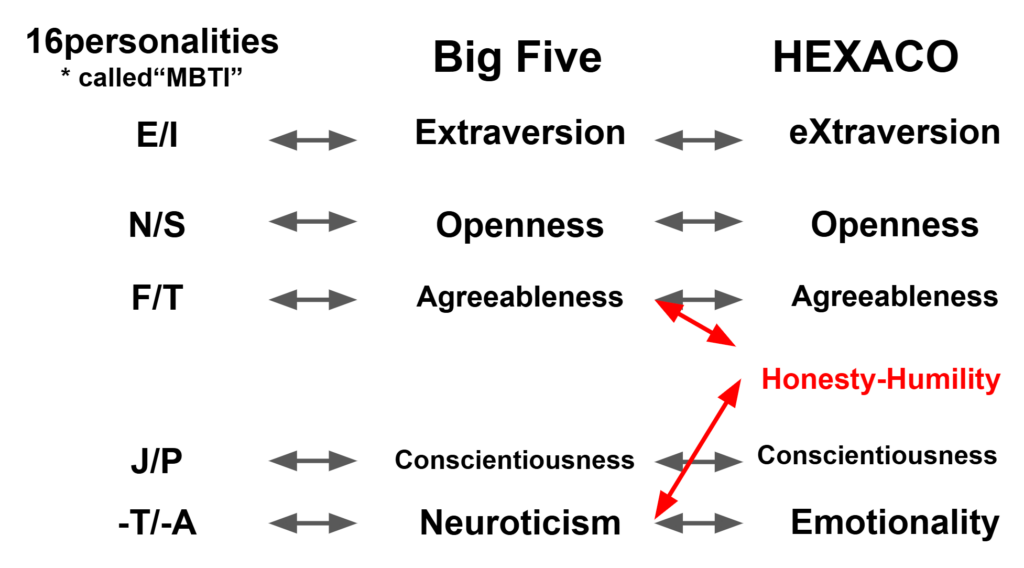
Also, in 16personalities, which was created with reference to MBTI and Big Five, neuroticism from Big Five is called “Identity“, and is classified as either Assertive or Turbulent.
On the far right is the relatively new personality assessment “HEXACO“. It is an improved version of Big Five with one additional indicator “Honesty-Humility”. Research on bullying and harassment perpetrators is active in HEXACO studies.
Since 16personalities and MBTI have weak scientific evidence, this article provides detailed explanations of 16personalities personality types based on their correlations with Big Five and HEXACO.

FAQ and Important Notes
HEXACO results differ from 16personalities (commonly known as MBTI test) or MBTI (original)
- Personality is influenced by genetics and environment, so when the environment changes, responses also change (for example, emotional responses change when you’re tired, etc.). For more details on genetics, see here.
- There are variations in responses depending on age. For more details, see here.
- Type classification is based on whether each value is 3 or above, or below 3, so values close to 3 are more likely to change results depending on how questions are asked or the environment at the time. Please look at the numerical values rather than the type.
- For MBTI (original) and 16personalities (commonly known as MBTI test), it’s unclear how much statistical processing was done at the question design stage as no research papers can be found. On the other hand, papers on Big Five and HEXACO can be easily found, and this HEXACO-JP test is based on research papers.
- While there aren’t many research papers comparing MBTI and 16personalities with everyday behaviors (academic performance, income, etc.) or with the brain and genetics, there are numerous studies on Big Five and HEXACO.
- HEXACO is a variation of Big Five elements, so they are similar but distinct. HEXACO’s Honesty-Humility is extracted from Big Five’s Agreeableness and Neuroticism.
If you have any other questions, please contact us through our inquiry form.
Personality test results are merely “hints” for your life
As mentioned earlier, personality is influenced by genetics and environment. Due to genetic influence, there is a certain range of variation, but answers can vary to some extent depending on the environment.
Also, while Big Five and HEXACO research papers conduct correlation analyses with academic performance and income, the correlation coefficients are not as large as those in natural science experiments. Correlation coefficients range from -1 to 1, but most are around -0.4 to 0.4. Of course, there are higher ones too, but they’re not 0.8 or 0.9 – they’re relatively lower in comparison.
However, since there is various research available, please think of it as “more than fortune-telling, less than natural science.” I’m not 100% denying psychology or fortune-telling.

Writer & Supervisor: Eisuke Tokiwa
Personality Psychology Researcher / CEO, SUNBLAZE Inc.
As a child he experienced poverty, domestic abuse, bullying, truancy and dropping out of school — first-hand exposure to a range of social problems. He spent 10 years researching these issues and published Encyclopedia of Villains through Jiyukokuminsha. Since then he has independently researched the determinants of social problems and antisocial behavior (work, education, health, personality, genetics, region, etc.) and has published 2 peer-reviewed journal articles (Frontiers in Psychology, IEEE Access). His goal is to predict the occurrence of social problems. Spiky profile (WAIS-IV).
Expertise: Personality Psychology / Big Five / HEXACO / MBTI / Prediction of Social Problems
Researcher profiles: ORCID / Google Scholar / ResearchGate
Social & Books: X (@etokiwa999) / note / Amazon Author Page