
Self improvement becomes significantly more effective when you understand the psychological engine driving your stress — and research suggests that roughly 70% of people in modern society experience chronic stress, yet very few know how to address it in a way that actually matches their personality. The truth is, not all stress-relief strategies work equally well for everyone. Personality psychology tells us that the way you feel, process, and recover from stress is deeply connected to your individual character traits.
This article draws on insights from personality psychology — including the Big Five personality model and related frameworks — to give you a comprehensive, science-backed roadmap for stress management, mental health tips, anxiety relief, and sustainable personal growth. Whether you tend toward introversion or extroversion, perfectionism or flexibility, there are specific, evidence-informed strategies tailored to how your mind naturally works. Let’s explore them together.
Once again, personality researcher and author of Villain Encyclopedia, Tokiwa (@etokiwa999), will provide the explanation.
※We have developed the HEXACO-JP Personality Assessment! It has more scientific basis than MBTI. Tap below for details.

目次
- 1 The Science Behind Stress and Personality
- 2 Personality-Based Self Improvement Strategies for Stress Relief
- 3 How to Build Self-Esteem and Why It Matters for Personal Growth
- 4 A Psychology-Based Approach to Building Mental Strength
- 5 Understanding Anxiety and Frustration Through the Lens of Personality Traits
- 6 Research-Backed Methods to Strengthen Stress Tolerance Over Time
- 7 Related In-Depth Articles
- 8 More Related Articles
- 9 Frequently Asked Questions
- 9.1 What is the most effective stress relief method for improving mental health?
- 9.2 How long does it take to see results from self-esteem building practices?
- 9.3 How can I manage workplace frustration more effectively based on my personality?
- 9.4 Can an anxiety-prone personality actually change, or is it fixed?
- 9.5 What are simple daily habits for building long-term stress tolerance?
- 9.6 How does understanding my Big Five personality traits help with personal growth?
- 9.7 Is resilience something you’re born with, or can it be developed through self improvement?
- 10 Summary: Match Your Strategy to Your Mind for Lasting Self Improvement
- 11 Try Taking the Proper Personality Test “HEXACO-JP”!
- 12 Scientific Background of the 16 Types
- 13 FAQ and Important Notes
The Science Behind Stress and Personality
Stress is defined as the mind and body’s response to external demands or pressures — and research consistently shows that this response varies dramatically depending on your personality traits. In other words, two people experiencing the exact same situation may react in completely different ways, not because one is “weaker,” but because their underlying psychological makeup processes the world differently.
The Big Five personality model — one of the most widely researched frameworks in personality psychology — identifies 5 key dimensions that influence how individuals experience and manage stress. Studies indicate that people who score high in neuroticism (emotional instability) tend to show stronger and more prolonged stress responses to identical situations compared to those who score lower. Meanwhile, individuals high in extraversion tend to naturally seek social support, which research suggests acts as a buffer against stress and contributes to greater resilience overall.
Interestingly, conscientiousness — the tendency to be organized, responsible, and goal-oriented — can be both a strength and a liability when it comes to stress. Highly conscientious individuals are prone to perfectionist-type stress when things don’t meet their high internal standards. On the other hand, people who score high in openness to experience tend to reframe change as opportunity rather than threat, which supports more adaptive stress responses. Understanding which of these traits is most dominant in you is the essential first step toward a genuinely personalized approach to mental wellness.
- High neuroticism: Increases stress sensitivity and the likelihood of negative emotional reactions
- High extraversion: Facilitates social support-seeking, which tends to reduce stress levels
- High conscientiousness: Can trigger perfectionist stress when reality doesn’t match expectations
- High openness: Supports adaptive coping by viewing change more positively
- High agreeableness: May reduce interpersonal conflict stress, though it can also lead to suppressing one’s own needs
The key takeaway here is that there is no single “correct” way to manage stress. What works brilliantly for one person may feel unnatural or even counterproductive for another. By identifying your dominant personality traits, you gain a powerful lens through which to choose stress management tools that are genuinely aligned with who you are — rather than borrowed from someone whose psychological makeup is entirely different from yours.
Personality-Based Self Improvement Strategies for Stress Relief
One of the most impactful self improvement strategies you can adopt is choosing stress-relief activities that match your personality type rather than copying generic advice. Personality frameworks suggest that the same activity — say, going to a social gathering — can feel energizing for one person and utterly draining for another, depending on their core traits.
For people who lean toward introversion, solitary activities tend to be the most restorative. Reading, meditation, journaling, solo walks in nature, or immersing in a personal hobby all allow introverts to recharge their mental batteries without additional social demands. Trying to force an introvert into group therapy or team exercise classes as their primary stress-relief tool often adds more pressure than it relieves.
In contrast, those who lean toward extraversion generally find that social interaction is itself a form of stress relief. Calling a friend, joining a group fitness class, or simply spending time in a lively environment can help extroverts discharge tension far more effectively than sitting alone with their thoughts. Research suggests that extroverts who isolate during stressful periods often feel worse, not better, over time.
The sensing vs. intuition dimension also plays a meaningful role. Sensing types — people who are grounded in concrete, present-moment experience — tend to benefit most from hands-on, physical activities like cooking, crafting, gardening, or structured exercise. Intuitive types, who are drawn to ideas, patterns, and possibilities, often recharge through creative pursuits, brainstorming sessions, or learning something entirely new.
- Introverts: Solo reading, meditation, journaling, quiet nature walks
- Extroverts: Social gatherings, team sports, lively conversations with trusted friends
- Sensing types: Physical hobbies, cooking, crafting, structured exercise routines
- Intuitive types: Creative projects, learning new concepts, imaginative planning
- Thinking types: Logical analysis of problems, structured problem-solving frameworks
- Feeling types: Emotional expression, empathic conversations, compassionate connection
Thinking types — those who naturally approach problems through logic — often find that breaking a stressful situation into a clear analysis reduces its emotional intensity. Simply writing out the facts, potential causes, and possible solutions can be deeply calming for this group. Feeling types, by contrast, tend to process stress most effectively through emotional expression — talking about how they feel, receiving empathy, or engaging in acts of care for others. Knowing your type means you can stop wasting energy on strategies that don’t fit and start investing in those that genuinely restore you.
How to Build Self-Esteem and Why It Matters for Personal Growth
Self-esteem is defined as the degree to which a person values and accepts themselves — and research consistently links higher self-esteem to greater stress resilience, better mental health outcomes, and more sustained personal growth over time. When self-esteem is low, even minor setbacks can feel catastrophic, creating a feedback loop where stress leads to negative self-evaluation, which generates more stress.
One of the most evidence-supported tools for building self-esteem comes from cognitive behavioral therapy (CBT): the practice of identifying and correcting cognitive distortions. Cognitive distortions are habitual patterns of thinking that skew our perception of reality — things like catastrophizing (“This one mistake will ruin everything”), black-and-white thinking (“If I’m not perfect, I’m a failure”), or mind-reading (“Everyone must think I’m incompetent”). Learning to spot these patterns and consciously replace them with more balanced thoughts has been shown to measurably improve self-perception over time.
Another highly practical approach is building self-efficacy through small wins. Self-efficacy — the belief in your ability to succeed at specific tasks — is a cornerstone concept in psychology, and research suggests it grows most reliably through direct experience of success. The key is to set goals that are achievable yet slightly challenging, complete them, and consciously acknowledge that achievement before moving to the next goal.
- Cognitive distortion check: Identify perfectionistic or catastrophic thinking patterns and reframe them with evidence-based alternatives
- Small goal-setting: Begin with clearly achievable targets and build momentum from there
- Gratitude journaling: Write down 3 genuinely positive things each evening — this trains the brain toward balanced self-perception
- Self-compassion practice: Speak to yourself with the same kindness you would offer a good friend facing the same difficulty
- Strengths identification: Systematically inventory your genuine strengths rather than focusing exclusively on areas for improvement
The gratitude journaling practice deserves special mention: studies indicate that individuals who consistently record 3 positive experiences per day — even small ones — begin to notice meaningful improvements in their overall self-perception within approximately 2 to 3 months. The mechanism isn’t wishful thinking; it’s neurological. Regularly directing attention toward positive evidence about yourself gradually recalibrates the brain’s default interpretive lens. The goal is not to deny difficulties, but to ensure your self-image is drawing on the full picture rather than selectively amplifying the negative.
A Psychology-Based Approach to Building Mental Strength
Among all self improvement strategies for mental health, building resilience — the capacity to recover from adversity — stands out as one of the most transformative. Importantly, personality psychology does not view resilience as a fixed trait you either have or don’t have. Research increasingly frames it as a learnable, trainable capacity that anyone can develop with the right approach.
Research drawing on the HEXACO personality model — an extension of the Big Five — suggests that individuals who score higher in emotional stability and openness to experience tend to recover more quickly from difficult situations. However, the crucial insight is that these dimensions can shift meaningfully through intentional practice. You don’t need to wait for your personality to change spontaneously — you can actively train toward greater stability.
Cognitive flexibility is one of the most powerful tools in this process. Cognitive flexibility refers to the ability to shift your perspective rather than becoming locked into a single interpretation of a stressful event. When you can genuinely consider multiple explanations for why something happened, or multiple pathways through a problem, your emotional response to that problem tends to become less intense and more manageable.
- Cognitive flexibility training: Practice deliberately considering at least 3 different explanations or outcomes for any stressful situation before settling on a response
- Mindfulness meditation: Regular practice — even 10 minutes daily — trains attention toward the present moment, reducing the rumination that amplifies stress
- Structured problem-solving: Break complex challenges into clearly defined steps to reduce overwhelm and build a sense of agency
- Social support network: Consciously cultivate at least 2 to 3 trusted relationships where honest conversation is possible
- Values clarification: Identify your 3 to 5 core personal values so that your daily choices are anchored in meaning rather than external pressure
Values clarification deserves particular attention as a resilience tool. Research suggests that individuals who have a clear, internalized sense of what matters most to them are significantly more capable of withstanding temporary setbacks without losing direction. When your sense of identity isn’t entirely dependent on any single outcome, failure becomes informative rather than devastating. A practical first step is simply to write down — without overthinking — the 5 things you would most regret neglecting over the course of your life. These are your values, and they are your psychological anchor in difficult times.
Understanding Anxiety and Frustration Through the Lens of Personality Traits
Effective anxiety relief and frustration management begin not with suppression, but with understanding the personality-level mechanisms that generate these emotions in the first place. Research in personality psychology has consistently identified specific trait patterns that make certain emotional experiences more likely — and understanding your own pattern is the first step toward working with it rather than against it.
Individuals high in neuroticism tend to experience anxiety in a particular way: they are more prone to anticipatory worry (dreading negative outcomes before they occur), negative forecasting (assuming the worst will happen), and difficulty disengaging from distressing thoughts. This isn’t a character flaw — it’s a neurobiological tendency that can be meaningfully managed once it’s understood. Techniques that help this group externalize and examine their worries — such as writing them down and evaluating the actual probability of each feared outcome — tend to be particularly effective.
Frustration, meanwhile, tends to be especially prevalent among individuals high in conscientiousness, particularly those with perfectionist tendencies. The mechanism is fairly straightforward: perfectionism creates an internal standard that reality consistently fails to meet, and the persistent gap between expectation and reality generates chronic irritation. Research suggests that one of the most effective interventions for this pattern is developing what psychologists call a “good enough” standard — a consciously chosen threshold below perfection that still represents genuine quality.
- High neuroticism → future anxiety: Practice writing down specific worries and evaluating the realistic probability of each outcome
- Low extraversion → social anxiety: Use gradual exposure — small, low-stakes social interactions first — to build confidence progressively
- High conscientiousness → perfectionist frustration: Define a “good enough” standard explicitly before beginning tasks, and honor it
- High agreeableness → suppressed resentment: Practice assertive communication skills so that needs can be expressed before they accumulate into frustration
- Low openness → change-related anxiety: Create structured transition plans when facing change to reduce the uncertainty that drives anxiety
For people high in agreeableness — those who naturally prioritize harmony and others’ needs — a common source of frustration is the slow accumulation of unexpressed resentment. Because these individuals tend to avoid conflict, small grievances often go unaddressed until they become significant. Learning basic assertive communication — the ability to express a need clearly and calmly without aggression — can be genuinely transformative for this group. The goal isn’t to become confrontational, but to prevent the internal buildup that makes later emotional regulation so much harder.
Research-Backed Methods to Strengthen Stress Tolerance Over Time
Stress tolerance functions much like physical fitness — it can be systematically built through progressive, appropriately dosed challenges, and it deteriorates without consistent practice. This is a well-established principle in psychological research, sometimes described as adaptive stress theory: the idea that moderate, manageable stress exposures — when followed by adequate recovery — gradually increase our capacity to handle future stressors.
The practical implication is that one of the most effective long-term self improvement strategies for mental resilience is intentionally and gradually expanding your comfort zone. This doesn’t mean throwing yourself into overwhelming situations — that typically causes regression, not growth. Instead, the evidence points toward incremental challenge: consistently engaging with experiences that are slightly outside your current comfort level, then recovering, then stepping slightly further.
Concrete examples of this might include: speaking up in a meeting when you’d normally stay quiet, trying a new skill in a low-stakes environment, navigating a new neighborhood without GPS, or committing to a 2-week exercise streak. Each of these minor challenges, completed successfully, contributes to a growing internal sense of “I can handle difficult things” — which is precisely the psychological foundation on which genuine stress tolerance is built.
- Progressive challenge: Identify 1 small action per week that sits just outside your comfort zone and commit to completing it
- Breathing techniques: Diaphragmatic breathing activates the parasympathetic nervous system within approximately 60 to 90 seconds, measurably reducing physiological stress markers
- Consistent exercise: Even 20 to 30 minutes of moderate aerobic activity, 3 to 4 times per week, has been shown to reduce baseline anxiety and increase emotional resilience
- Sleep quality improvement: Research links poor sleep to a 40% or greater reduction in emotional regulation capacity — protecting sleep is one of the highest-leverage mental health investments available
- Nutritional balance: Emerging research suggests that gut health and nutrient sufficiency influence stress hormone regulation, making dietary balance a meaningful component of overall mental resilience
It’s worth emphasizing that lifestyle factors and psychological training work synergistically, not independently. A person who is practicing mindfulness and cognitive reframing but chronically sleep-deprived or sedentary will not achieve the same results as someone who integrates all of these elements together. Research suggests that combining regular physical activity, adequate sleep, balanced nutrition, and deliberate psychological practice produces compounding benefits for stress tolerance that none of these elements can provide alone. Think of this holistic approach as your long-term infrastructure for mental wellbeing.
Related In-Depth Articles
- Happiness is 30–40% Genetic — Here’s How to Claim the Rest
- Self-Determination Theory: High Motivation Is About 50% Inherited
- How to Improve Social-Emotional Learning (SEL): The RULER Method Explained
- How to Raise Your EQ (Emotional Intelligence): Research and Paper Review
- Personality Traits of People with High EQ: A Science-Based Breakdown
- How Children Can Develop Social-Emotional Skills: Research Explained
- What Is Self-Compassion? Methods and Effects Explained Through Research
- How Mindfulness Can Improve Negative Thinking Patterns
- Self-Efficacy Is 75% Genetic: The Confidence Gap Explained
- Want a Stronger Mindset? Research Looks at Narcissism and Mental Toughness
- Money and Happiness: Does Higher Income Keep Increasing Well-Being?
- How Parent-Adolescent Conflict Affects Depression in Young People
- What Is Resilience? A Science-Based Guide to Building Mental Toughness
- Improving Humility Through Group Counseling: Research Review
- Behavioral Activation for Improving Extraversion, Conscientiousness, and Emotional Stability
More Related Articles
- Sustained Effort Can Change Extraversion, Conscientiousness, and Emotional Stability
- Apps That Help Change Extraversion, Conscientiousness, and Emotional Stability
- Self-Objectification: How Constant Social Comparison Erodes Your Identity
- Practical Examples of Self-Control Training: A Meta-Analysis Review
- Better Self-Control Links to Better Health, Grades, and Income
- OECD Findings: How Personality Connects to Skills and Abilities
- Fortune-Telling Addiction: Why Anxious People Are More Susceptible
- Personality Is 40–50% Genetic: What Research Says About Anxiety and Curiosity
- The Surprising Link Between Personality and Clothing Choices
- What Is Burnout? Personality Traits That Increase Your Risk
- Children’s EQ: How Social-Emotional Learning Works in Practice
- What Really Determines Happiness? It May Not Be What You Think
- Gender Differences in Personality: Evolution, Not Just Culture
- Do University Students Have Different Personalities by Major?
- About 40% of EQ Is Inherited — Parenting Style Has Less Impact Than You’d Think
Frequently Asked Questions
What is the most effective stress relief method for improving mental health?
Research suggests there is no single universally “best” stress relief method — effectiveness depends heavily on your personality type. Introverted individuals tend to recover best through solitary, quiet activities such as reading, meditation, or solo walks. Extroverted individuals generally benefit more from social interaction, group exercise, or lively conversation. The most important step is identifying your dominant personality traits first, then selecting strategies that align with how your mind naturally replenishes its energy. A mismatch between personality and chosen coping method can actually increase stress rather than reduce it.
How long does it take to see results from self-esteem building practices?
Results vary considerably between individuals, but many people who practice consistent self-esteem techniques — such as daily gratitude journaling, small goal completion, and cognitive distortion correction — report noticeable improvements in self-perception within approximately 2 to 3 months. The key word is “consistent”: sporadic effort tends to produce sporadic results. Research on neuroplasticity suggests that regular, repeated practice gradually reshapes the brain’s default interpretive patterns. Rather than aiming for dramatic transformation, focus on small, daily inputs and allow the cumulative effect to build over time.
How can I manage workplace frustration more effectively based on my personality?
Workplace frustration is often rooted in the gap between personal standards and external reality — a pattern particularly common among people high in conscientiousness or perfectionist tendencies. A highly effective technique for this group is to define an explicit “good enough” threshold before beginning any task, then honor that threshold rather than pushing toward an unattainable ideal. For individuals high in agreeableness who tend to suppress their needs to maintain harmony, learning basic assertive communication — expressing concerns calmly and directly — can prevent the slow accumulation of resentment that eventually becomes overwhelming frustration.
Can an anxiety-prone personality actually change, or is it fixed?
Research suggests that underlying trait-level anxiety sensitivity — associated with high neuroticism in the Big Five model — is relatively stable and has a genetic component estimated at around 40 to 50%. However, this does not mean anxiety is immovable. What can be very meaningfully improved is your relationship with anxious thoughts and your repertoire of coping responses. Techniques from cognitive behavioral therapy — such as probability evaluation and thought records — alongside regular mindfulness meditation practice have demonstrated consistent effectiveness at reducing the impact of anxiety, even when the underlying sensitivity remains partially in place.
What are simple daily habits for building long-term stress tolerance?
Research points to several high-impact daily habits for building stress tolerance: diaphragmatic breathing practice (which activates the parasympathetic nervous system within roughly 60 to 90 seconds), 20 to 30 minutes of moderate aerobic exercise, protecting sleep quality (studies link sleep deprivation to a 40% or greater reduction in emotional regulation capacity), and engaging in at least 1 small action per day that sits slightly outside your comfort zone. None of these require dramatic lifestyle overhauls — the cumulative effect of small, consistent behaviors is what the evidence most consistently supports for durable mental resilience.
How does understanding my Big Five personality traits help with personal growth?
The Big Five personality model — measuring openness, conscientiousness, extraversion, agreeableness, and neuroticism — is one of the most empirically validated tools in personality psychology. Understanding your profile helps in two concrete ways for personal growth: first, it identifies your natural strengths (e.g., high openness suggests adaptability; high conscientiousness suggests strong follow-through capacity); second, it flags your specific vulnerability patterns (e.g., high neuroticism suggests a need for proactive anxiety management strategies). This self-knowledge allows you to select growth strategies that leverage your strengths and compensate for known vulnerabilities, making your efforts significantly more efficient.
Is resilience something you’re born with, or can it be developed through self improvement?
Resilience — the capacity to recover from adversity — has both genetic and environmental components, but personality psychology firmly supports the view that it is substantially trainable. Research on behavioral activation, cognitive flexibility training, and mindfulness-based interventions all show meaningful improvements in resilience-related outcomes among participants. The most effective approach combines psychological skill-building (such as multi-perspective thinking and values clarification) with lifestyle factors (regular exercise, quality sleep, and social support). Studies suggest that even individuals starting from a relatively low resilience baseline can achieve significant improvements within 3 to 6 months of consistent, structured effort.
Summary: Match Your Strategy to Your Mind for Lasting Self Improvement
The core message of personality psychology’s approach to stress and mental wellness is both simple and profoundly practical: the most effective self improvement strategies are those built around who you actually are, not who generic advice assumes you to be. Whether you score high in neuroticism and need structured anxiety management tools, high in conscientiousness and need permission to embrace “good enough,” or anywhere else along the Big Five spectrum, there is a science-backed pathway designed for your specific psychological architecture.
From understanding the personality-stress connection, to choosing personality-matched coping activities, to building self-esteem through small wins, to training resilience through progressive challenge — every strategy covered in this article is rooted in the same foundational principle: know yourself, then act on that knowledge. Mental health tips divorced from personal context tend to produce short-lived results. Tips calibrated to your actual traits produce lasting change.
As a meaningful next step in your personal growth journey, consider exploring which of the Big Five dimensions feels most characteristic of you — and use that awareness to design your own, personalized stress management and resilience-building plan. The science is clear that personality can shift with intentional effort. Start today by identifying the 1 personality-matched strategy from this article that resonates most deeply, and commit to practicing it consistently for the next 30 days. Discover which of your traits are already working in your favor — and which ones you’re ready to begin transforming.
Try Taking the Proper Personality Test “HEXACO-JP”!
While MBTI and 16personalities are popular as “gateways to knowing yourself,” experiencing a scientifically-backed personality test is the best way to truly understand your strengths and risks.
That’s where we recommend the HEXACO assessment available in Japanese: “HEXACO-JP“.
HEXACO-JP visualizes your personality tendencies numerically based on six factors: Honesty-Humility, Emotionality, Extraversion, Agreeableness, Conscientiousness, and Openness.
By simply answering straightforward questions, you can gain helpful insights for self-understanding, relationships, and workplace communication.
If you’re curious about “What type of person am I?”, start by taking HEXACO-JP and examine yourself from a scientific perspective.
Scientific Background of the 16 Types
MBTI Overview
MBTI is a psychological theory that classifies personality into 16 types.
To begin with, MBTI is an abbreviation for Myers-Briggs Type Indicator.
MBTI classifies personality into 16 types by combining the following 4 indicators.
In other words, MBTI expresses one’s personality tendencies in 4 letters such as “ISTJ” or “ENFP”. There is a very famous similar system called 16personalities, but this is created by combining MBTI and Big Five.
Big Five Overview
One of the most prominent trait theories in personality psychology is the “Big Five”.
Big Five measures five traits: Openness, Conscientiousness, Extraversion, Agreeableness, and Neuroticism.
Also, while 16personalities and MBTI use type classification (e.g., either extraverted or introverted), a major difference is that Big Five evaluates traits on a continuous numerical scale (e.g., extraversion 3.5).
Furthermore, it has been studied for a long time, has many research papers, and extensive research has been conducted in other fields such as academic achievement, income, brain, and genetics. It can be said that Big Five has relatively stronger scientific backing.
Correlation Between MBTI, Big Five, and HEXACO
There are correlations between MBTI’s 4 indicators and Big Five’s 5 factors.
A representative study showing this correlation is the paper “The relationship between the revised NEO-Personality Inventory and the Myers-Briggs Type Indicator“.
According to this paper, the correlations between MBTI and Big Five are as follows.
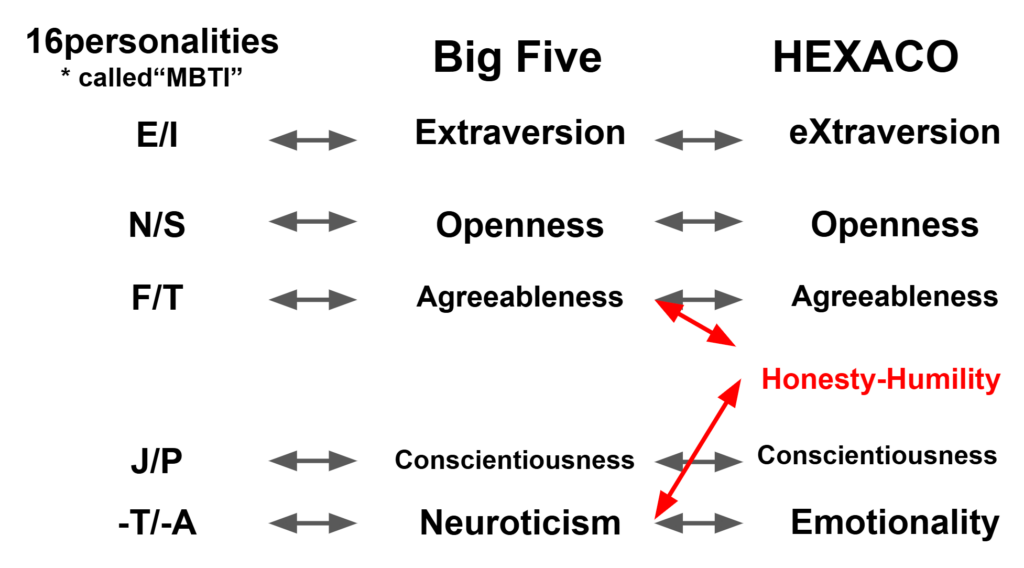
Also, in 16personalities, which was created with reference to MBTI and Big Five, neuroticism from Big Five is called “Identity“, and is classified as either Assertive or Turbulent.
On the far right is the relatively new personality assessment “HEXACO“. It is an improved version of Big Five with one additional indicator “Honesty-Humility”. Research on bullying and harassment perpetrators is active in HEXACO studies.
Since 16personalities and MBTI have weak scientific evidence, this article provides detailed explanations of 16personalities personality types based on their correlations with Big Five and HEXACO.

FAQ and Important Notes
HEXACO results differ from 16personalities (commonly known as MBTI test) or MBTI (original)
- Personality is influenced by genetics and environment, so when the environment changes, responses also change (for example, emotional responses change when you’re tired, etc.). For more details on genetics, see here.
- There are variations in responses depending on age. For more details, see here.
- Type classification is based on whether each value is 3 or above, or below 3, so values close to 3 are more likely to change results depending on how questions are asked or the environment at the time. Please look at the numerical values rather than the type.
- For MBTI (original) and 16personalities (commonly known as MBTI test), it’s unclear how much statistical processing was done at the question design stage as no research papers can be found. On the other hand, papers on Big Five and HEXACO can be easily found, and this HEXACO-JP test is based on research papers.
- While there aren’t many research papers comparing MBTI and 16personalities with everyday behaviors (academic performance, income, etc.) or with the brain and genetics, there are numerous studies on Big Five and HEXACO.
- HEXACO is a variation of Big Five elements, so they are similar but distinct. HEXACO’s Honesty-Humility is extracted from Big Five’s Agreeableness and Neuroticism.
If you have any other questions, please contact us through our inquiry form.
Personality test results are merely “hints” for your life
As mentioned earlier, personality is influenced by genetics and environment. Due to genetic influence, there is a certain range of variation, but answers can vary to some extent depending on the environment.
Also, while Big Five and HEXACO research papers conduct correlation analyses with academic performance and income, the correlation coefficients are not as large as those in natural science experiments. Correlation coefficients range from -1 to 1, but most are around -0.4 to 0.4. Of course, there are higher ones too, but they’re not 0.8 or 0.9 – they’re relatively lower in comparison.
However, since there is various research available, please think of it as “more than fortune-telling, less than natural science.” I’m not 100% denying psychology or fortune-telling.

Writer & Supervisor: Eisuke Tokiwa
Personality Psychology Researcher / CEO, SUNBLAZE Inc.
As a child he experienced poverty, domestic abuse, bullying, truancy and dropping out of school — first-hand exposure to a range of social problems. He spent 10 years researching these issues and published Encyclopedia of Villains through Jiyukokuminsha. Since then he has independently researched the determinants of social problems and antisocial behavior (work, education, health, personality, genetics, region, etc.) and has published 2 peer-reviewed journal articles (Frontiers in Psychology, IEEE Access). His goal is to predict the occurrence of social problems. Spiky profile (WAIS-IV).
Expertise: Personality Psychology / Big Five / HEXACO / MBTI / Prediction of Social Problems
Researcher profiles: ORCID / Google Scholar / ResearchGate
Social & Books: X (@etokiwa999) / note / Amazon Author Page