
Income and happiness research has produced one of the most debated questions in psychology: does earning more money actually make you happier? The answer, it turns out, is far more nuanced than a simple yes or no — and a landmark large-scale study has finally brought clarity to a decade-long scientific dispute. Understanding how money and well-being interact could change the way you think about your financial goals, your emotional health, and what it truly means to live a satisfying life.
A major study titled Income and emotional well-being: A conflict resolved tackled this question head-on by combining the efforts of researchers behind two previously contradictory findings. Using real-time emotional data from more than 33,000 participants, the study revealed something surprising: the relationship between income and happiness is not the same for everyone. For some people, more money brings dramatically more happiness. For others, the effect plateaus surprisingly early. Let’s unpack what the science actually says.
Once again, personality researcher and author of Villain Encyclopedia, Tokiwa (@etokiwa999), will provide the explanation.
※We have developed the HEXACO-JP Personality Assessment! It has more scientific basis than MBTI. Tap below for details.

目次
- 1 What Income and Happiness Research Actually Shows
- 2 The Famous “$75,000 Ceiling” — And Why It Was Incomplete
- 3 The Dataset Behind the Discovery: 1.7 Million Emotional Data Points
- 4 Income and Happiness Research Reveals 3 Distinct Patterns in People
- 5 What Money Can and Cannot Buy When It Comes to Happiness
- 6 Actionable Insights: Using These Findings in Your Own Life
- 7 Frequently Asked Questions
- 7.1 Does earning more money always make you happier?
- 7.2 Is the “$75,000 happiness ceiling” still considered accurate?
- 7.3 What is the Experience Sampling Method and why does it matter for happiness research?
- 7.4 Why do some people feel equally unhappy despite having a high income?
- 7.5 At what income level does money stop improving happiness for most people?
- 7.6 Can money buy happiness if you use it the right way?
- 7.7 What did the large-scale income and happiness study find that earlier research missed?
- 8 Summary: What Income and Happiness Research Tells Us About a Life Well Lived
What Income and Happiness Research Actually Shows
On Average, Higher Income Does Tend to Mean More Happiness
Research suggests that, on average, earning more money is genuinely linked to greater emotional well-being. The study in question used a method called Experience Sampling — a technique where participants receive notifications on their smartphones several times a day and record how they feel at that exact moment. This approach captures emotion in real time rather than relying on memory, making it significantly more accurate than traditional surveys.
The data collected from over 33,000 working adults showed a consistent pattern: as annual income rises, average happiness scores tend to rise alongside it. To put a concrete number on it, people earning around $250,000 per year reported happiness scores approximately 5 points higher on average than those earning around $20,000 per year. This finding suggests that the income happiness correlation is real and measurable — at least when you look at the overall population.
- Lower-income individuals tend to experience the most pronounced gains in emotional well-being as their earnings increase — basic needs, financial security, and freedom from stress all improve rapidly
- Middle-income individuals show a steady, gradual increase in happiness as income grows — life choices expand, stability increases, and a sense of breathing room develops
- Higher-income individuals in certain groups continue to see happiness rise, sometimes even accelerating at higher income levels
The key takeaway here is that the income happiness correlation is real and consistent when examined across a large population — but averages can hide enormous individual differences, which is where the story gets truly interesting.
The Famous “$75,000 Ceiling” — And Why It Was Incomplete
Why Earlier Research Suggested Happiness Stopped Growing at a Certain Income
For years, a widely-cited finding suggested that emotional well-being stopped improving once annual income reached approximately $75,000. This idea became enormously popular — it appeared in books, news articles, and workplace discussions around the world. The logic seemed intuitive: once your basic needs are covered and you’re comfortable, more money simply stops mattering to your moment-to-moment happiness.
However, the methodology behind that conclusion had a significant limitation. The survey used a binary response format — essentially asking people “Were you happy yesterday?” with a yes-or-no answer. While practical, this approach compresses the entire range of human emotional experience into two options. Someone who feels genuinely elated and someone who feels mildly content both answer “yes.” The tool simply could not capture the degree of happiness — only its presence or absence.
- Very happy people were lumped together regardless of how intensely they felt positive emotion, creating an artificial ceiling in the data
- Subtle differences between “somewhat happy” and “extremely happy” were invisible to the measurement tool
- High earners who were genuinely flourishing appeared indistinguishable from high earners who were merely content
In short, the earlier research did not find that happiness stops growing at $75,000 because that is universally true — it found that its measurement tool stopped being sensitive enough to detect the growth. This methodological gap is what the newer study was designed to address.
How Two Opposing Studies Were Reconciled
Rather than dismissing one study and validating the other, the researchers behind the newer work treated both findings as potentially correct — and set out to understand why they differed. The key difference was not that one team of scientists was wrong and the other was right. Instead, both studies captured a slice of reality, but used different tools, different populations, and different time periods. When those variables were accounted for, the contradiction largely resolved itself.
The resolution involved using a continuous sliding scale to measure emotional well-being — ranging from “very bad” to “very good” — rather than a simple binary. This allowed the researchers to detect small but meaningful differences in how people felt at various income levels. The result was a richer, more accurate picture of the wealth and life satisfaction relationship.
- Neither study was discarded — both contributed to the final understanding
- The contradiction stemmed from differences in measurement sensitivity, not fundamental disagreement about reality
- Collaborative analysis between research teams helped pinpoint the exact source of the discrepancy
This collaborative approach is a model for how science should work: when two credible studies disagree, the answer often lies in examining how each study asked its questions, not just what it found.
The Dataset Behind the Discovery: 1.7 Million Emotional Data Points
How Experience Sampling Captured Real-Time Happiness Across 33,000 People
One of the most remarkable aspects of this study is the sheer scale and quality of its data: approximately 1.72 million individual emotional responses collected from 33,391 working adults. Participants answered smartphone prompts about their current emotional state roughly 3 times per day over several weeks. Because responses were captured in the moment — not reconstructed from memory — the data reflects genuine, lived emotional experience rather than a retrospective impression.
Experience Sampling Method (ESM) is defined as a research technique that collects data on people’s thoughts, feelings, and behaviors in real time, typically using mobile devices to prompt responses at random or scheduled intervals throughout the day. Its strength lies in ecological validity — measuring emotions as they actually occur in daily life rather than in a laboratory or on a recall survey.
- Participant age range: 18 to 65 years old, with an average age of approximately 33
- Average annual income: approximately $106,000, spanning a wide range from very low to very high earners
- Gender balance: reasonably balanced between male and female participants
- Response frequency: roughly 3 check-ins per day per person over multiple weeks
This breadth of demographic coverage is what makes the findings so credible. With 1.72 million data points drawn from a diverse working population, the study could detect patterns that smaller or less sensitive research designs would miss entirely — including the crucial individual differences at the heart of its conclusions.
Income and Happiness Research Reveals 3 Distinct Patterns in People
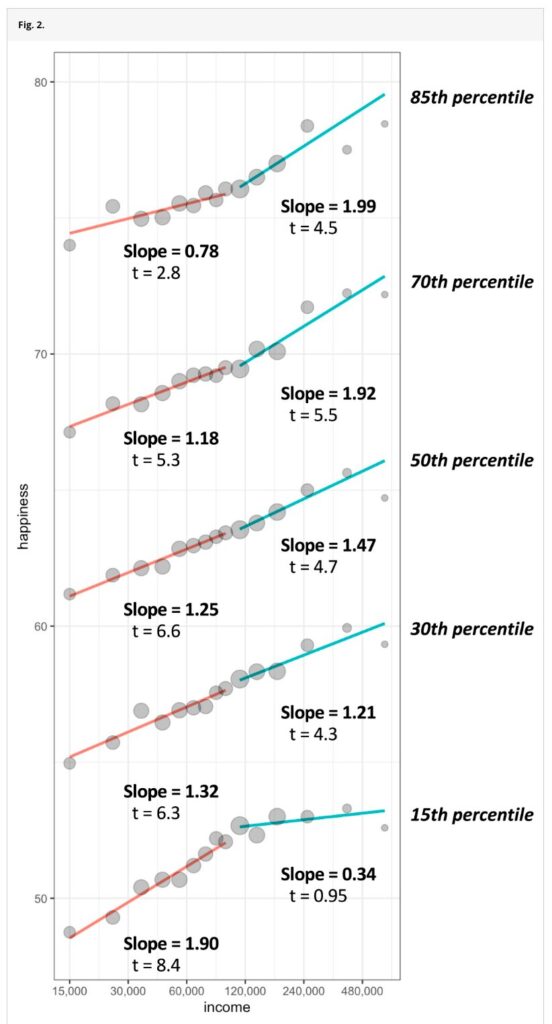
Pattern 1 — The Unhappiest People: Happiness Plateaus Around $100,000
For the roughly 15% of participants with the lowest baseline happiness levels, income does improve emotional well-being — but only up to a point of approximately $100,000 per year, after which the effect flattens significantly. This group experiences what researchers described as a “plateau” or flattening of the income-happiness curve. Below that income threshold, each additional dollar genuinely reduces stress, fear, and misery. Above it, the financial gains no longer move the emotional needle.
The reason for this pattern is theoretically important: money is highly effective at solving material problems. It can pay rent, cover medical expenses, reduce debt anxiety, and provide food security. But once those problems are resolved, the sources of suffering that remain tend to be psychological in nature — deep grief, relational conflict, trauma, or a persistent sense of meaninglessness. These are problems that financial wealth and life satisfaction improvements cannot directly address.
- Income relieves material hardship powerfully — up to the point where basic and moderate needs are covered
- Beyond that threshold, psychological suffering becomes the dominant factor in low well-being
- Issues like loneliness, grief, unresolved trauma, or low self-worth are not responsive to income increases alone
This finding carries a compassionate message: for people experiencing deep unhappiness, financial support is genuinely helpful — but it is not sufficient. Professional mental health support, strong social connections, and a sense of purpose appear to matter independently of income for this group.
Pattern 2 — The Middle Group: Steady, Gradual Gains Throughout
The largest segment of participants — those with moderate baseline happiness levels, representing roughly the 30th to 70th percentile — showed a steady, consistent increase in emotional well-being as income rose, with no obvious plateau. For this group, going from $50,000 to $100,000 per year produced meaningful happiness gains, and those gains continued as income climbed further. The relationship was not dramatic, but it was stable and real.
For this middle group, increased income tends to work through practical mechanisms: more financial cushion reduces low-grade chronic stress, more disposable income expands life choices, and greater security creates a sense of control over one’s future. These are not luxurious gains — they are the quiet, cumulative effects of not constantly worrying about money.
- Greater income expands the range of available choices — in housing, health, education, and leisure
- Financial security reduces background anxiety, freeing up mental energy for positive experiences
- A sense of economic control contributes to overall feelings of agency and well-being
For the majority of working adults, this suggests a straightforward conclusion: pursuing reasonable income growth is a legitimate strategy for gradually improving subjective well-being research outcomes over time — not as a shortcut to happiness, but as a genuine contributor to it.
Pattern 3 — The Happiest People: Happiness Accelerates at High Income Levels
Perhaps the most counterintuitive finding of the entire study is what happens to people who are already happy: for the top 30% of happiness scorers, emotional well-being does not plateau at high incomes — it actually accelerates. As annual income climbed above $100,000 for this group, happiness continued to rise, and the rate of that rise appeared to increase rather than slow down. This directly contradicts the long-held assumption that money stops mattering once you’re financially comfortable.
Why might this be? For people who are already psychologically well — who have strong relationships, clear values, good mental health, and a sense of purpose — additional income unlocks genuinely enriching experiences. It funds meaningful hobbies, reduces time spent on unwanted obligations, allows for travel, personal development, generosity, and the cultivation of deeper relationships. The financial happiness science here suggests that wealth amplifies an already positive foundation rather than creating one from scratch.
- Happy, high-earning individuals can invest in experiences that align with their deepest values and interests
- Higher income creates time flexibility — the ability to delegate unpleasant tasks and focus on what genuinely matters
- Financial freedom supports generosity and social connection, both of which are strong independent predictors of happiness
This pattern suggests that wealth and life satisfaction have a multiplicative rather than additive relationship for psychologically healthy individuals — meaning that being happy first, and wealthy second, may produce greater overall well-being than either factor alone.
What Money Can and Cannot Buy When It Comes to Happiness
The Boundary Between Financial Relief and Emotional Healing
One of the clearest lessons from this body of research is that money is a powerful tool for solving a specific category of problems — and a largely ineffective one for another category. Understanding where that boundary lies is practically important for anyone thinking about the role of income in their own well-being.
Financial hardship creates measurable psychological suffering. The stress of not being able to pay bills, the fear of medical emergencies, the exhaustion of financial precarity — these are real, well-documented sources of misery that respond directly to increased income. In that sense, money absolutely buys relief from a specific kind of pain. But above the point where basic and moderate material needs are covered, a different category of suffering tends to dominate for the least happy individuals: emotional pain rooted in interpersonal loss, unresolved trauma, feelings of worthlessness, or social isolation. These are not problems that a pay raise can touch.
- Money is effective for: eliminating poverty stress, improving physical health access, expanding life options, and reducing day-to-day financial anxiety
- Money is largely ineffective for: healing grief, building genuine intimacy, developing self-worth, or resolving deep psychological wounds
- The dividing line tends to appear around the income level where material problems are substantially resolved — suggesting the importance of non-financial well-being strategies alongside financial ones
This distinction matters enormously for how we set financial goals. Pursuing income growth to escape material hardship is a high-return strategy for well-being. Pursuing income growth as a substitute for emotional healing or human connection is likely to disappoint — regardless of how large the paycheck becomes.
Actionable Insights: Using These Findings in Your Own Life
How to Apply the Science of Money and Well-Being to Your Financial and Emotional Goals
Understanding which of the 3 income-happiness patterns most closely describes you is the first practical step. Research suggests that your baseline emotional well-being — not just your income level — determines how much financial growth will improve your life. Here is how to think about each scenario:
If you frequently feel unhappy or emotionally burdened, prioritizing income growth up to a comfortable baseline is worthwhile and evidence-based. Getting to a point of material security genuinely reduces suffering. However, if your unhappiness persists despite financial stability, the research strongly suggests that the remaining problems are not financial in nature. Investing in therapy, social support, or meaningful purpose-driven activity may offer returns that additional income simply cannot.
- If you’re in financial hardship: prioritize income stability first — the emotional benefits are real and substantial up to the point of basic security (research suggests somewhere in the range of $75,000–$100,000 annually in a U.S. context, adjusted for cost of living)
- If you’re in the middle range: gradual income growth genuinely helps — but pair it with investments in relationships, health, and activities that generate intrinsic satisfaction
- If you’re already financially comfortable and emotionally healthy: additional income may genuinely amplify your well-being when directed toward experiences, autonomy, and values-aligned spending — not just accumulation
- For everyone: identify whether your primary sources of unhappiness are material or psychological, and allocate your energy accordingly — this distinction is far more important than any income threshold
The science of financial happiness makes clear that money is neither the enemy of happiness nor its guaranteed source. It is a resource — and like any resource, its value depends entirely on what it is used for and what foundation it is built upon.
Frequently Asked Questions
Does earning more money always make you happier?
Not universally. Research indicates that higher income tends to increase happiness on average, but the effect varies significantly by individual. People with very low baseline happiness levels tend to see their well-being plateau around an annual income of approximately $100,000, while people who are already emotionally healthy may see happiness continue to rise — and even accelerate — at higher income levels. The relationship between income and happiness is real, but it is not the same for everyone.
Is the “$75,000 happiness ceiling” still considered accurate?
This idea is now considered incomplete rather than wrong. It applied to a specific measurement approach — one that used binary yes/no responses — which could not detect the full range of emotional variation among high earners. More recent research using continuous emotional scales found that many people, particularly those with high baseline happiness, continue to grow happier well beyond that income level. The ceiling likely reflects a limit of the older measurement tool, not a universal psychological truth.
What is the Experience Sampling Method and why does it matter for happiness research?
Experience Sampling Method (ESM) is a research technique that prompts participants — typically via smartphone — to report their current emotional state multiple times per day. Because it captures feelings in real time rather than relying on memory, it tends to be significantly more accurate than traditional retrospective surveys. In the income and happiness study discussed here, approximately 1.72 million data points were collected this way, enabling researchers to detect subtle emotional differences that cruder methods would have missed entirely.
Why do some people feel equally unhappy despite having a high income?
Research suggests that unhappiness above the income threshold for material security tends to have psychological rather than financial roots. Issues such as loneliness, unresolved grief, low self-worth, trauma, or a lack of meaningful purpose are not responsive to income increases. For individuals in this situation, financial improvements address only the material layer of suffering — the deeper emotional layer requires different kinds of intervention, such as social connection, therapy, or purpose-driven activity.
At what income level does money stop improving happiness for most people?
There is no single universal threshold, and the answer depends heavily on individual baseline happiness levels. Studies suggest that for the least happy individuals, the benefits of income growth tend to plateau around $100,000 per year. For those in the middle happiness range, gains continue more gradually beyond that point. For the happiest individuals, well-being may continue rising — and even accelerate — at higher incomes. Cost of living, personal values, and psychological well-being all influence where any meaningful threshold falls for a given person.
Can money buy happiness if you use it the right way?
Research in financial happiness science suggests that how money is spent matters considerably. Spending on experiences, time-saving services, and social activities tends to generate more lasting happiness than spending on material possessions. For people who are already psychologically well, higher income appears to amplify happiness when directed toward values-aligned pursuits. However, money is not a substitute for emotional health — it works best as a resource that supports, rather than creates, a positive psychological foundation.
What did the large-scale income and happiness study find that earlier research missed?
The key discovery was that the income-happiness relationship differs dramatically depending on a person’s baseline emotional well-being. Earlier research, constrained by less sensitive measurement tools, suggested a single plateau for most people. The newer study — drawing on approximately 1.72 million real-time emotional data points from over 33,000 participants — revealed at least 3 distinct patterns: early plateaus for the least happy, gradual continued growth for the middle group, and accelerating growth for those with the highest baseline happiness. This individual variation was the central finding that reconciled the earlier contradiction.
Summary: What Income and Happiness Research Tells Us About a Life Well Lived
The science is now clearer than it has ever been: income and happiness research consistently shows that money matters — but how much it matters, and for how long, depends enormously on who you are and where you’re starting from. For those in material hardship, increasing income is one of the most effective paths to reducing suffering. For those in the middle, steady financial progress offers real but modest well-being gains. And for those who are already psychologically flourishing, higher income appears to genuinely deepen happiness when channeled thoughtfully. The single most important takeaway may be this: money works best as a tool that amplifies an already healthy life — not as a replacement for one.
If this article made you think differently about where your own happiness comes from — financial, psychological, or somewhere in between — consider exploring what your personal happiness profile actually looks like. Understanding your baseline emotional well-being is the first step toward making smarter decisions about both your finances and your inner life.