Do you know about the INFJ-A type?
This is one of the indicators that represents personality, and it has a significant impact on our behavior and way of thinking.
In this article, we will explain in detail what characteristics INFJ-A people have, including aspects of health, work, and relationships.
By understanding your own and others’ personalities well, it may lead to better communication and self-understanding.
Please read while comparing with your own and your friends’ personalities.
Once again, personality researcher and author of Villain Encyclopedia, Tokiwa (@etokiwa999), will provide the explanation.
※We have developed the HEXACO-JP Personality Assessment! It has more scientific basis than MBTI. Tap below for details.

目次
- 1 Scientific Background of INFJ-A (Advocate・Assertive Type)
- 2 Scientific Explanation of INFJ-A (Advocate・Assertive Type)
- 2.1 Good Physical Health
- 2.2 Engage in Health Behaviors
- 2.3 Easily Get Along with People Who Have Both N and F Traits
- 2.4 High Quality of Friendships
- 2.5 High Couple Satisfaction
- 2.6 High Academic Achievement
- 2.7 Effective in Online Learning
- 2.8 Most Likely to Have High Intelligence IQ
- 2.9 Spirituality
- 2.10 When Using SNS, They Communicate Through Likes and Encouraging Comments
- 2.11 May actively gather information on social media
- 2.12 Properly maintains social distancing for infection control
- 2.13 Properly practices infection control measures such as handwashing
- 2.14 When a certain number are on a team, team balance improves, even better when with extroverted people
- 2.15 Capable at work, high performance
- 2.16 Relatively Common Among Athletes
- 2.17 Common Among Writers/Editors, Artists/Creators, and Counselors/Therapists
- 2.18 Children May Be Gifted
- 2.19 Excessive Pursuit of Perfectionism
- 2.20 Limiting Sweet Drinks
- 2.21 Being Health-Conscious and Preferring Vegetables, Dairy Products, and Nuts
- 2.22 Not Engaging in Bullying
- 2.23 Relatively High Self-Esteem
- 2.24 Less Likely to Regret Risk Failures, Performing Cool-Headed Risk Management
- 2.25 Common in Kyushu, Japan
- 2.26 Schwartz’s Values: Universalism, Benevolence
- 2.27 Preference for Simple or Practical Clothing
- 3 In Conclusion
Scientific Background of INFJ-A (Advocate・Assertive Type)
Overview of MBTI
MBTI is a psychological theory that classifies personality into 16 types.
In the first place, MBTI is an abbreviation for Myers-Briggs Type Indicator.
MBTI classifies personality into 16 types by combining the following 4 indicators.
In other words, MBTI expresses your personality tendencies with 4 letters such as “ISTJ” or “ENFP”. There is a very famous similar one called 16personalities, but this is different from MBTI.
Overview of Big Five
One of the most influential trait theories in personality psychology is the “Big Five.”
The Big Five measures five traits: Openness, Conscientiousness, Extraversion, Agreeableness, and Neuroticism.
Also, while 16personalities and MBTI use type classification (e.g., either extraverted or introverted), Big Five evaluates traits with continuous numerical values (e.g., extraversion 3.5), which is a major difference.
Furthermore, it has been studied for a long time, has many papers, and extensive research has been conducted in other fields such as academic ability, income, brain, and genetics. It can be said that Big Five has relatively stronger scientific backing.
Correlation Between MBTI・Big Five・HEXACO
There is a correlation between the 4 indicators of MBTI and the 5 factors of Big Five.
A representative study showing this correlation is the paper “The relationship between the revised NEO-Personality Inventory and the Myers-Briggs Type Indicator.”
According to this paper, the correlation between MBTI and Big Five is as follows.
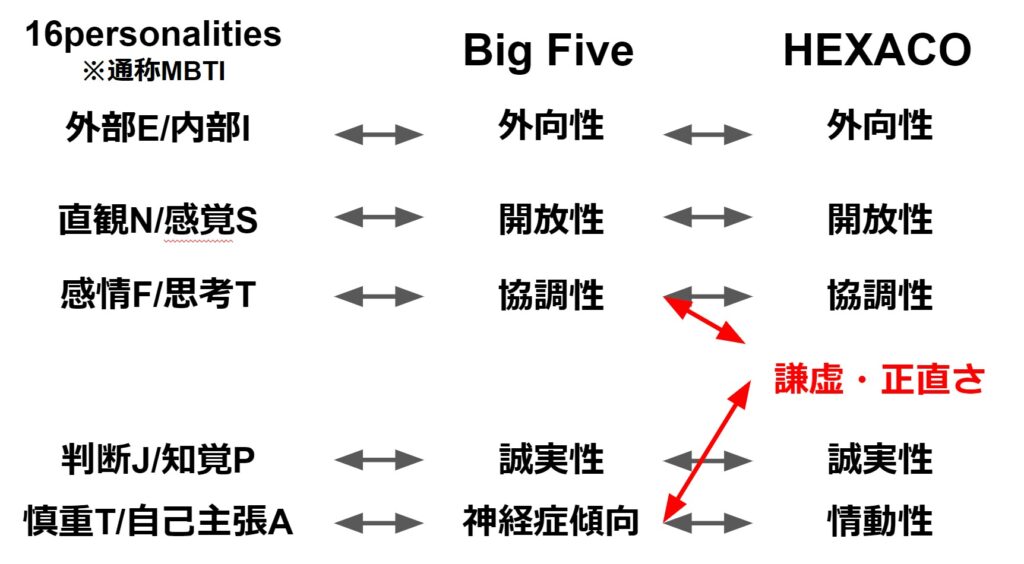
Also, in 16personalities, which was created with reference to MBTI and Big Five, the neuroticism of Big Five is called “Identity,” and is classified as either Assertive or Turbulent.
On the far right is “HEXACO,” a relatively new personality assessment. It has been improved by adding one indicator “Honesty-Humility” to Big Five.
This article will explain the personality types of 16personalities in detail based on this correlation.
Since these are originally Big Five and HEXACO research, if you want to know your personality more scientifically than MBTI or 16personalities, please take this HEXACO personality test.
What is INFJ-A (Advocate・Assertive Type)?
INFJ-A is a type with low Extraversion (I), high Openness (N), high Agreeableness (F), high Conscientiousness (J), and low Neuroticism (A) in Big Five.
- Strong intuitive and insightful abilities
- Deep empathy and understanding for others
- Idealistic vision
- Confident decisiveness
- Inner peace and stability
They deeply understand others’ emotions and aim to have a positive impact on society. They solve problems by combining creativity and analytical skills.
In interpersonal relationships, they seek deep and meaningful connections. They are open to change and challenges, and act based on their own beliefs. They have high stress tolerance and strong self-efficacy, allowing them to handle difficult situations calmly.
Scientific Explanation of INFJ-A (Advocate・Assertive Type)
Good Physical Health
INFJ-A type individuals tend to have good physical health. This is related to their high conscientiousness in the Big Five (J) and low neuroticism (-A) traits. INFJ-A individuals tend to maintain regular lifestyle habits and are good at stress management, which leads to better overall health conditions.
They tend to consciously choose healthy lifestyles, maintaining balanced diets and moderate exercise. Additionally, their high stress tolerance makes it easier for them to maintain physical and mental balance.
Please see this article for more details.
Engage in Health Behaviors
INFJ-A type individuals tend to actively engage in healthy behaviors. This is related to their high agreeableness (F) and high conscientiousness (J) traits in the Big Five. INFJ-A individuals value the health of both themselves and others, and make efforts to maintain healthy lifestyle habits.
They consciously choose healthy lifestyles including regular exercise, balanced diet, and sufficient sleep. They also have high interest in preventive medicine and are proactive about regular health checkups and vaccinations.
They are also sensitive to health-related information and tend to pay attention to new health trends and research findings.
Please see this article for more details.
Easily Get Along with People Who Have Both N and F Traits
INFJ-A type individuals tend to build friendly relationships easily with people who have both N and F traits. This is related to their high openness (N) and agreeableness (F) traits in the Big Five. INFJ-A individuals have high intuitive and emotional understanding abilities, making them easily empathize with people who have similar characteristics.
People with N and F traits often seek deep conversations and emotional connections, making them compatible with INFJ-A. They can understand each other’s values and emotions, easily building deep friendships.
Additionally, INFJ-A can sensitively perceive others’ emotions and approach them with caring attitudes, making them easily trusted by people with N and F traits.
Please see this article for more details.
High Quality of Friendships
INFJ-A type individuals tend to have high-quality friendships. This is related to their high agreeableness (F), high conscientiousness (J), and low neuroticism (-A) traits in the Big Five. INFJ-A individuals value compassion and sincerity, building friendships with stable personalities.
INFJ-A with deep understanding and empathy abilities can sensitively perceive friends’ emotions and needs, providing appropriate support. They are also highly reliable and tend to keep promises, making it easy to build long-term, stable friendships.
They also have high communication abilities and can deepen mutual understanding through dialogue with friends. As a result, INFJ-A friendships are often characterized by depth and high quality.
Please see this article for more details.
High Couple Satisfaction
INFJ-A type individuals tend to have high satisfaction in couple relationships. This is related to their high agreeableness (F), high conscientiousness (J), and low neuroticism (-A) traits in the Big Five. INFJ-A individuals build relationships with compassion and devotion, maintaining stable partnerships.
INFJ-A with high emotional understanding and empathy abilities can deeply understand their partner’s feelings and provide appropriate support. They are also sincere and highly reliable, making it easy to build long-term, stable relationships.
They also have high communication abilities and can deepen mutual understanding and solve problems through dialogue with their partners. As a result, INFJ-A couple relationships are often characterized by deep bonds and high satisfaction.
Please see this article for more details.
High Academic Achievement
People with INFJ-A type tend to have high academic achievement. This is related to the Big Five traits of high openness (N), high agreeableness (F), and high conscientiousness (J). INFJ-A individuals are curious, highly motivated to learn, and tend to seek deep understanding.
They excel at understanding complex concepts and abstract theories by leveraging their intuitive thinking and creativity (N). Additionally, their high agreeableness (F) allows them to learn effectively through group learning and discussions.
High conscientiousness (J) leads to planned and disciplined study habits, supporting continuous academic improvement. Furthermore, they tend to have high critical thinking skills and problem-solving abilities, making it easier for them to achieve excellent grades across diverse academic fields.
For more details, please see this article.
Effective in Online Learning
People with INFJ-A type tend to achieve high effectiveness in online learning. This is related to the Big Five traits of high openness (N) and high conscientiousness (J). INFJ-A individuals combine flexibility in adapting to new learning methods with high self-management abilities.
High openness (N) leads to a positive attitude toward creative learning methods and utilization of new technologies in online environments. Additionally, high conscientiousness (J) means high self-management ability and planning skills, which help maintain the autonomous learning habits necessary for online learning.
INFJ-A individuals also have high concentration abilities and can effectively utilize various online learning resources. Furthermore, their introverted (I) traits lead to a preference for focused, solitary learning environments, making them compatible with online learning.
For more details, please see this article.
Most Likely to Have High Intelligence IQ
People with INFJ-A type show the most pronounced tendency to have high intelligence IQ. This is related to the Big Five traits of high openness (N), introversion (I), and low neuroticism (-A). INFJ-A individuals excel at understanding complex concepts and engaging in abstract thinking.
High openness (N) leads to curiosity about and high comprehension of new ideas and concepts. Introverted (I) traits support deep thinking and concentration, enhancing problem-solving abilities.
Additionally, low neuroticism (-A) indicates the ability to maintain calm thinking even under stress, which works advantageously when tackling complex challenges. INFJ-A individuals have a balanced combination of logical and creative thinking, making it easier for them to demonstrate multifaceted intellectual abilities.
For more details, please see this article.
Spirituality
People with INFJ-A type tend to have high interest in spirituality. This is related to the Big Five traits of high openness (N) and high agreeableness (F). INFJ-A individuals have a strong tendency to seek meaning and purpose in life and connections with transcendent things.
High openness (N) leads to curiosity about metaphysical concepts and cosmic mysteries. Additionally, high agreeableness (F) shows a tendency to value harmony with others and nature, and overall connectedness.
INFJ-A individuals are likely to be interested in inner exploration and practices like meditation, placing importance on self-growth and spiritual evolution. They also tend to be interested in religion and philosophy, seeking deep meaning in life.
This spiritual aspect greatly influences INFJ-A worldview and values, and may be reflected in daily life and human relationships.
For more details, please see this article.
When Using SNS, They Communicate Through Likes and Encouraging Comments
When INFJ-A type people use social media, they tend to communicate through “likes” and encouraging comments. This is related to the Big Five trait of high agreeableness (F). INFJ-A individuals value compassion and empathy for others, and try to build warm relationships even online.
High agreeableness (F) leads to positive and supportive communication styles. INFJ-A individuals show empathetic reactions to others’ posts and try to maintain good human relationships online by sending messages of encouragement and support.
Additionally, INFJ-A individuals have the ability to sensitively perceive others’ emotions, so they can “like” posts at appropriate times and leave comments that encourage others. This warm communication style helps build trust relationships even online.
For more details, please see this article.
INFJ-A type individuals tend to have a high likelihood of actively utilizing social media for information gathering. This is related to their high openness (N) trait in the Big Five. INFJ-A people have strong curiosity toward new knowledge and diverse perspectives, and tend to use social media as an information source.
High openness (N) leads to interest in a wide range of topics and eagerness to explore new ideas. INFJ-A individuals follow various experts and thinkers in different fields on social media to gain the latest information and insights.
Additionally, since INFJ-A prefers intuitive thinking, they excel at integrating diverse information shared on social media to gain new insights. They are enthusiastic about collecting information from a wide range of fields including news, culture, science, and arts to expand their knowledge and worldview.
This tendency for information gathering may have positive effects on INFJ-A’s personal growth and creative activities.
Please see this article for more details.
INFJ-A type individuals tend to properly maintain social distancing for infection control. This is related to their high introversion (I) trait in the Big Five. INFJ-A people have little resistance to maintaining physical distance from others and understand the importance of infection prevention.
High introversion (I) leads to valuing alone time and personal space. Therefore, INFJ-A easily accepts the need to maintain social distance and has little resistance to practicing it.
Additionally, since INFJ-A has high consideration for others, they consciously maintain social distancing to protect not only themselves but also the health and safety of those around them.
Furthermore, through their intuitive (N) traits, they can understand information about disease spread and prevention and take appropriate actions. This attitude contributes to preventing the spread of infectious diseases and also contributes to the safety of society as a whole.
Please see this article for more details.
Properly practices infection control measures such as handwashing
INFJ-A type individuals tend to properly practice preventive measures such as handwashing for infection control. This is related to their high conscientiousness (J) trait in the Big Five. INFJ-A people have a strong sense of responsibility and take rules and recommendations regarding health and safety seriously.
High conscientiousness (J) leads to disciplined behavior and habit formation. INFJ-A excel at establishing infection prevention behaviors such as handwashing, mask wearing, and disinfection as daily habits and practicing them continuously.
Additionally, since INFJ-A has high consideration for others, they thoroughly implement infection control measures to protect not only themselves but also the health of those around them. Through their intuitive (N) traits, they can understand information about disease prevention and take appropriate actions.
This careful and responsible attitude contributes to preventing the spread of infectious diseases and helps maintain the health of society as a whole.
Please see this article for more details.
When a certain number are on a team, team balance improves, even better when with extroverted people
When INFJ-A type individuals are present in a certain number on a team, the overall team balance tends to improve. This is related to their high agreeableness (F) and high conscientiousness (J) traits in the Big Five. INFJ-A people play a role in maintaining harmony within the team and deepening understanding among members.
High agreeableness (F) alleviates conflicts within the team and promotes cooperation among members. Additionally, high conscientiousness (J) brings a sense of responsibility and reliability to the team. INFJ-A work dedicatedly toward achieving team goals and serve as role models for other members.
Furthermore, since INFJ-A has intuitive (N) insight, they can identify team challenges and potential and propose creative solutions.
By combining with extroverted people, INFJ-A’s introverted traits and extroverted traits function in a well-balanced way, enhancing team diversity and effectiveness. A synergistic effect is likely to emerge where extroverted members actively communicate ideas while INFJ-A deeply analyzes and refines them.
Please see this article for more details.
Capable at work, high performance
INFJ-A type individuals tend to demonstrate high performance at work. This is related to their high conscientiousness (J) and low neuroticism (-A) traits in the Big Five. INFJ-A people have a strong sense of responsibility, are systematic, and have high stress tolerance, making them likely to achieve excellent results in the workplace.
High conscientiousness (J) leads to a dedicated attitude toward work and systematic planning. INFJ-A excel at making steady efforts toward goal achievement, meeting deadlines, and producing high-quality results.
Low neuroticism (-A) indicates the ability to remain calm and effectively handle tasks even under stressful situations. Additionally, they can utilize their intuitive (N) insight to find creative solutions to complex problems.
Furthermore, high agreeableness (F) leads to strong teamwork and communication skills, helping to build good relationships with colleagues and supervisors. When these traits are combined, INFJ-A tends to perform excellently in many workplace environments and is likely to achieve success.
Please see this article for more details.
Relatively Common Among Athletes
INFJ-A types are relatively common among athletes. This is related to their high agreeableness (F), high conscientiousness (J), and low neuroticism (-A) traits in the Big Five. INFJ-A individuals excel in teamwork, self-discipline, and stable performance under pressure.
High agreeableness (F) is particularly important in team sports, leading to good relationship building with teammates and effective cooperation. High conscientiousness (J) supports dedication to training and planned efforts toward goal achievement.
Low neuroticism (-A) indicates high tolerance to pressure during games and competitions, leading to the ability to perform calmly in important situations.
Additionally, the intuitive (N) trait of INFJ-A helps in strategic thinking and creative play in competitions. The introverted (I) aspect enhances the ability to focus on individual skill improvement and mental preparation.
The combination of these traits makes INFJ-A types well-suited for success as athletes.
Please see this article for more details.
Common Among Writers/Editors, Artists/Creators, and Counselors/Therapists
INFJ-A types are commonly found in professions such as writers/editors, artists/creators, and counselors/therapists. This is related to their high introversion (I) trait in the Big Five. INFJ-A individuals excel in deep introspection, creativity, and empathy toward others, making them well-suited for these professions.
High introversion (I) leads to the ability to concentrate and work in quiet environments, making it easier to demonstrate talent as writers or editors. Additionally, the intuitive (N) and high agreeableness (F) traits support creativity and expressiveness as artists and creators.
Furthermore, INFJ-A’s strong empathy and insight become significant strengths in understanding and supporting others’ psychology as counselors or therapists.
In these professions, INFJ-A’s inner richness and deep understanding of others are highly valued, allowing them to maximize their abilities. Through these professions, INFJ-A individuals have a high potential to simultaneously achieve self-realization and social contribution.
Please see this article for more details.
Children May Be Gifted
INFJ-A type children have a relatively high possibility of being gifted (intellectually talented children). This is related to their high openness (N) trait in the Big Five. INFJ-A children may demonstrate abstract thinking ability, creativity, and deep insight from an early age.
High openness (N) leads to strong curiosity and understanding of new concepts and complex ideas. INFJ-A children may possess vocabulary and reading comprehension beyond their age and engage in philosophical questions and deep thinking.
Furthermore, the introverted (I) trait supports the ability to concentrate alone on learning and creative activities. The combination of these traits may lead INFJ-A children to demonstrate exceptional talent in academic, artistic, or social fields.
Please see this article for more details.
Excessive Pursuit of Perfectionism
INFJ-A types have strong perfectionist tendencies and may sometimes pursue them excessively. This is related to their high conscientiousness (J) trait in the Big Five. INFJ-A individuals set high standards and strive to achieve them, but sometimes these standards may be unrealistic.
High conscientiousness (J) leads to high responsibility and planning ability, but it can also cause excessive self-criticism and unnecessary stress. INFJ-A tends to have extremely strict evaluation standards for their work and achievements.
Additionally, the intuitive (N) and high agreeableness (F) traits strengthen the tendency to pursue ideal situations and relationships. This may cause feelings of disconnect from reality and lead to dissatisfaction or disappointment.
When perfectionism becomes excessive, risks such as delayed decision-making, excessive self-criticism, and burnout syndrome increase. For INFJ-A, it’s important to maintain moderate perfectionism while balancing self-acceptance and realistic goal setting.
While healthy perfectionism can be a driving force for growth, it’s important to recognize that excessive pursuit may negatively impact mental and physical health.
Please see this article for more details.
Limiting Sweet Drinks
People with the INFJ-A type tend to limit sweet drinks. This is related to the high agreeableness (F) trait in the Big Five. INFJ-A individuals have high health consciousness and tend to value the well-being of themselves and others, so they try to avoid unhealthy habits.
High agreeableness (F) leads to sensitivity to social norms and health-related recommendations. INFJ-A individuals recognize the negative health effects of excessive sweet drink consumption (such as obesity and increased risk of diabetes) and tend to avoid them.
Additionally, high conscientiousness (J) leads to self-discipline in maintaining healthy lifestyle habits. INFJ-A individuals value long-term health benefits over temporary satisfaction and can consciously limit their intake of sweet drinks.
However, this tendency varies among individuals and does not apply to all INFJ-A types. Healthy lifestyle habits are greatly influenced by personal choices and environment.
Please see this article for more details.
Being Health-Conscious and Preferring Vegetables, Dairy Products, and Nuts
People with the INFJ-A type tend to be health-conscious and prefer nutritionally rich foods such as vegetables, dairy products, and nuts. This is related to the high conscientiousness (J) and high agreeableness (F) traits in the Big Five. INFJ-A individuals have high self-management abilities and prioritize long-term health maintenance.
High conscientiousness (J) leads to the ability to maintain a planned and disciplined diet. INFJ-A individuals tend to consciously choose nutritionally balanced meals and continue healthy eating habits.
High agreeableness (F) also leads to consideration for others and the environment, and may result in a preference for sustainable and ethical food choices.
However, this tendency varies among individuals and may change depending on cultural background and personal preferences.
Please see this article for more details.
Not Engaging in Bullying
People with the INFJ-A type have a strong tendency not to engage in bullying. This is related to the high agreeableness (F), high conscientiousness (J), and low neuroticism (-A) traits in the Big Five. INFJ-A individuals have high empathy for others, value fairness, and are mentally stable, so they tend to avoid bullying behavior.
High agreeableness (F) leads to the ability to understand others’ emotions and interact with compassion. INFJ-A individuals are sensitive to others’ pain and suffering and deeply recognize the negative effects of bullying.
High conscientiousness (J) shows a tendency to value moral behavioral standards and take responsible actions. INFJ-A individuals strongly recognize that bullying is ethically wrong and avoid such behavior.
Low neuroticism (-A) means high self-esteem and less likely to feel the need to put others down. INFJ-A individuals do not need to rely on bullying to confirm their own worth.
Please see this article for more details.
Relatively High Self-Esteem
People with the INFJ-A type tend to have relatively high self-esteem. This is related to the high conscientiousness (J) and low neuroticism (-A) traits in the Big Five. INFJ-A individuals have deep self-understanding, value inner values, and have high mental stability, making it easier to develop healthy self-esteem.
High conscientiousness (J) leads to efforts toward goal achievement and maintenance of self-discipline, and these experiences bring confidence and improved self-evaluation. INFJ-A individuals tend to recognize their abilities and growth and view them positively.
Low neuroticism (-A) shows high resistance to stress and negative emotions, which helps maintain a stable self-image. INFJ-A individuals are less likely to fall into self-criticism and have a high ability to recognize and accept their strengths.
Additionally, the intuitive (N) and high agreeableness (F) traits lead to deep understanding and empathy for oneself and others, which supports healthy self-acceptance and building good relationships with others.
The high self-esteem of INFJ-A is not mere self-centered confidence, but is based on understanding of self and others, respect for inner values, and commitment to continuous self-growth.
Please see this article for more details.
Less Likely to Regret Risk Failures, Performing Cool-Headed Risk Management
People with the INFJ-A type tend to be less likely to regret taking risks even if they fail, and they perform cool-headed risk management. This is related to the high openness (N), high conscientiousness (J), and low neuroticism (-A) traits in the Big Five. INFJ-A individuals view new experiences as valuable, systematically evaluate risks, and have a high ability to accept failures as learning opportunities.
High openness (N) leads to a positive attitude toward new experiences and challenges. INFJ-A individuals value the potential growth and learning opportunities that can be gained by taking risks.
High conscientiousness (J) shows careful and systematic risk management abilities. INFJ-A individuals conduct thorough preparation and analysis before taking risks and try to predict outcomes as much as possible.
Low neuroticism (-A) means high tolerance for failure. INFJ-A tends to view failure not as a denial of personal worth, but as an opportunity for growth.
By combining these traits, INFJ-A has the ability to calmly assess risks, have the courage to take on challenges when necessary, and even when they fail, learn from it and move forward.
However, this tendency may change depending on individual experience and environment, and does not apply equally to all INFJ-A individuals.
Please see this article for more details.
Common in Kyushu, Japan
There appears to be a tendency for INFJ-A type people to be more common in Japan’s Kyushu region. This may be related to the high openness (N) and high agreeableness (F) traits of Big Five personality factors, and their connection to the cultural and social characteristics of the Kyushu region. The characteristics of INFJ-A may have a certain affinity with Kyushu’s regional nature.
High openness (N) indicates flexibility toward new experiences and ways of thinking. Kyushu has historically had active exchanges with the outside world and a background of accepting diverse cultures, which may align with this open-minded characteristic.
High agreeableness (F) indicates a tendency to value human relationships and cherish harmony. Kyushu is generally said to have a warm-hearted culture that values community bonds, and this trait may align with INFJ-A’s agreeableness.
Please see this article for more details.
Schwartz’s Values: Universalism, Benevolence
INFJ-A type people tend to value “universalism” and “benevolence” in Schwartz’s theory of values. This is related to their high openness (N) and high agreeableness (F) traits in the Big Five. INFJ-A people value the welfare of all people and protection of the natural environment, and cherish compassion and understanding toward others.
High openness (N) leads to a broad perspective and emphasis on universal values. INFJ-A tends to have high interest in humanity as a whole and the global environment, beyond individuals or specific groups. This aligns with the value of “universalism.”
High agreeableness (F) leads to compassion and understanding toward others, and emphasis on harmonious relationships. This is closely related to the value of “benevolence.” INFJ-A tends to value others’ happiness as much as their own and take compassionate actions.
Based on these values, INFJ-A often has strong interest in fields such as social justice, environmental protection, and human rights advocacy. These values may also greatly influence INFJ-A’s daily decisions, actions, and career choices.
However, it should be noted that the priority of values may change depending on individual experience and cultural background.
Please see this article for more details.
Preference for Simple or Practical Clothing
INFJ-A type people tend to prefer simple or practical clothing. This is related to their high introversion (I) and high openness (N) traits in the Big Five. INFJ-A people value inner qualities and tend to prioritize functionality and comfort over appearance.
High introversion (I) leads to a tendency to prefer clothing that avoids excessive attention and gives a modest impression. INFJ-A often prefers calm, simple styles rather than choosing flashy clothing as a means of self-expression.
High openness (N) leads to valuing the balance between creativity and practicality. INFJ-A tends to prefer timeless designs that are not influenced by trends, or versatile clothing that can be used in various situations.
Additionally, high conscientiousness (J) leads to valuing planning and efficiency, which influences the choice of practical clothing. INFJ-A tends to choose functional and comfortable clothing suitable for daily life and work.
However, this is merely a general tendency, and clothing choices may vary greatly depending on individual preferences, environment, and cultural background. It should also be noted that there are INFJ-A individuals who enjoy self-expression through fashion.
Please see this article for more details.
In Conclusion
INFJ-A type people have very unique characteristics. You might have friends, seniors, or juniors like this among you.
INFJ-A people have deep thinking ability and strong empathy, and try to understand the people around them well.
They tend to achieve high results in study and work, and particularly demonstrate their abilities in creative fields or jobs that help people.
They also pay attention to their health and strive for a balanced lifestyle. In human relationships, they value deep bonds and strongly oppose unfair acts such as bullying.
They prefer simple and practical clothing, valuing comfort over flashiness. They also have strong interest in making the world a better place, such as environmental protection and social justice.
The tendencies introduced are originally from Big Five and HEXACO research, so if you want to understand personality more scientifically than MBTI or 16personalities, please try this HEXACO personality test.

Writer & Supervisor: Eisuke Tokiwa
Personality Psychology Researcher / CEO, SUNBLAZE Inc.
As a child he experienced poverty, domestic abuse, bullying, truancy and dropping out of school — first-hand exposure to a range of social problems. He spent 10 years researching these issues and published Encyclopedia of Villains through Jiyukokuminsha. Since then he has independently researched the determinants of social problems and antisocial behavior (work, education, health, personality, genetics, region, etc.) and has published 2 peer-reviewed journal articles (Frontiers in Psychology, IEEE Access). His goal is to predict the occurrence of social problems. Spiky profile (WAIS-IV).
Expertise: Personality Psychology / Big Five / HEXACO / MBTI / Prediction of Social Problems
Researcher profiles: ORCID / Google Scholar / ResearchGate
Social & Books: X (@etokiwa999) / note / Amazon Author Page