
Low self-esteem Japan research has uncovered a striking pattern: over the past several decades, Japanese people — especially younger generations — have shown a measurable decline in how positively they view themselves. But what is driving this shift? A growing body of evidence suggests that the answer lies not just in culture or economics, but in detectable changes in personality traits themselves. Understanding this connection offers a rare window into the psychological evolution of an entire society.
Self-esteem is defined as the degree to which a person holds a positive evaluation of themselves — their sense of worth, capability, and belonging. When self-esteem erodes across an entire population, the effects ripple into mental health, productivity, and social cohesion. One of the most illuminating tools for tracking these changes in Japan is the YG Personality Test (Yatabe-Guilford), a standardized psychological assessment that has been used in Japanese research for over 70 years. A landmark meta-analysis drawing on data collected between 1954 and 2012 reveals just how dramatically Japanese personality profiles have shifted — and what those shifts tell us about self-worth in modern Japan.
Once again, personality researcher and author of Villain Encyclopedia, Tokiwa (@etokiwa999), will provide the explanation.
※We have developed the HEXACO-JP Personality Assessment! It has more scientific basis than MBTI. Tap below for details.

目次
- 1 What Is the YG Personality Test? A Tool for Tracking Low Self-Esteem Japan Research
- 2 The Research: How Personality Traits Have Changed Across Japanese Generations
- 3 Rising Neuroticism Trends in Japan: What Emotional Instability Means for Self-Worth
- 4 Declining Dominance and Carefree Optimism: How Lost Confidence Connects to Self-Esteem Cultural Differences
- 5 How Personality Traits and Self-Worth Interact: Key Correlations From the Data
- 6 Age Differences in Personality Profiles: What Changes From Adolescence to Adulthood
- 7 Actionable Insights: What This Research Means for Building Healthier Self-Esteem
- 8 Frequently Asked Questions
- 8.1 What does “low self-esteem” actually mean in psychological terms?
- 8.2 Why does Japan consistently rank low in international self-esteem comparisons?
- 8.3 What is the YG Personality Test and why is it useful for this kind of research?
- 8.4 How are neuroticism and self-esteem connected?
- 8.5 Does self-esteem naturally improve as people get older?
- 8.6 What personality traits are most associated with healthy self-esteem?
- 8.7 Is the decline in Japanese self-esteem reversible?
- 9 Summary: What the Evidence Tells Us — and What to Do With It
What Is the YG Personality Test? A Tool for Tracking Low Self-Esteem Japan Research
The YG Personality Test is one of the most widely used personality assessment tools in Japanese psychology research, measuring 12 distinct personality sub-scales in a single instrument. Originally adapted from the Guilford personality inventories, the test was refined for Japanese populations and has since been administered in schools, universities, clinical settings, and corporate environments across the country. Because it has been used consistently over such a long period, it offers an unusually rich dataset for tracking generational change.
Each of the 12 sub-scales captures a different dimension of personality. Together, they paint a comprehensive portrait of how a person tends to think, feel, and behave. The scales are:
- Depression — tendency toward low mood and pessimism
- Cyclothymia — tendency toward mood fluctuation and emotional instability
- Inferiority feelings — tendency to feel less capable or worthy than others
- Nervousness — susceptibility to anxiety and stress
- Lack of objectivity — difficulty seeing things from a detached perspective
- Lack of cooperativeness — tendency toward social friction or non-conformity
- Aggression — tendency toward assertive or confrontational behavior
- General activity — level of energy and enthusiasm for action
- Carefree disposition — degree of relaxed, easygoing optimism
- Thinking extraversion — preference for abstract, logical, and reflective thought
- Dominance — tendency to take charge and lead others
- Social extraversion — comfort and enjoyment in social interactions
Because these scales have been measured consistently across decades, researchers can use the YG data to identify not just individual personality profiles, but broader societal trends. This makes the test particularly valuable for studying how cultural shifts, economic pressures, and generational change intersect with psychological well-being.
The Research: How Personality Traits Have Changed Across Japanese Generations
A large-scale cross-temporal meta-analysis compiled data from 245 separate samples, drawn from 95 published papers, covering the period from 1954 to 2012 — with a combined total of over 50,000 participants. This kind of study, known as a cross-temporal meta-analysis, pools the results of many independent studies over time and applies statistical methods to identify consistent patterns of change. The sheer scale of the data makes the findings particularly compelling.
Rather than simply looking at whether scores went up or down in a straight line, the researchers tested for curvilinear patterns — meaning that traits may have risen and then fallen, or fallen and then risen, at different points in history. This more nuanced approach revealed that most of the 12 YG sub-scales did not follow a simple trajectory. Instead, they showed complex curves that appear to reflect the social and economic turbulence Japan experienced across the latter half of the 20th century and into the 21st.
Among the most consistent findings were these key directional trends in recent decades:
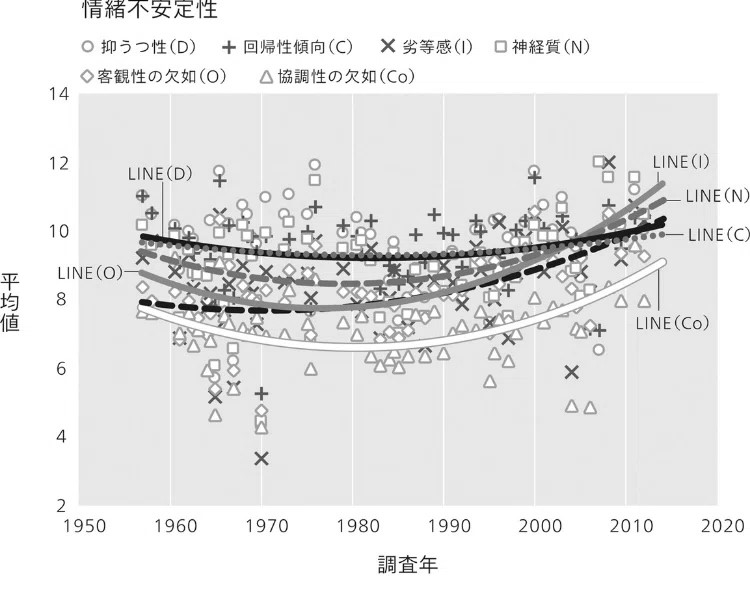
- Traits associated with emotional instability (neuroticism trends Japan) showed a clear upward trend in recent years
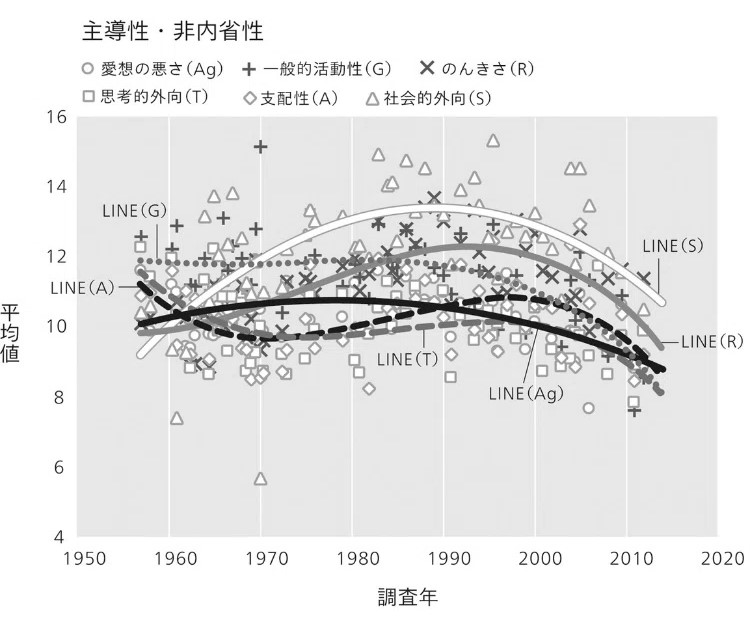
- Traits associated with assertiveness and carefree optimism showed a downward trend
- Most changes followed curvilinear patterns rather than simple linear increases or decreases
- The study covered a span of approximately 58 years, making it one of the longest-running personality trend analyses conducted in Japan
The fact that changes were curvilinear rather than linear suggests that personality trends in Japan have been shaped by multiple overlapping forces — economic booms and recessions, shifts in social values, and generational cohort effects — rather than by any single cause.
Rising Neuroticism Trends in Japan: What Emotional Instability Means for Self-Worth
The most significant finding from the research is that traits associated with emotional instability — collectively referred to as neuroticism — have increased substantially in Japan over recent decades. Neuroticism is a broad personality dimension that encompasses a cluster of related tendencies: a predisposition toward negative emotions, sensitivity to stress, difficulty managing anxiety, and a tendency to ruminate on perceived failures or shortcomings.
In the YG framework, 6 of the 12 sub-scales are understood to reflect emotional instability:
- Depression — scores on this scale have risen, indicating more people experience persistent low mood
- Cyclothymia — mood swings and emotional unpredictability have become more common
- Inferiority feelings — more people report feeling less capable or worthy compared to others
- Nervousness — anxiety and stress sensitivity have increased across the population
- Lack of objectivity — difficulty stepping back from one’s own emotional reactions has grown
- Lack of cooperativeness — social friction and difficulty fitting into group settings have increased
The rise of these traits is directly relevant to the question of self-esteem. Research consistently shows that higher emotional instability is associated with lower self-worth — people who experience more anxiety, more self-doubt, and more mood volatility tend to hold more negative views of themselves. As these neuroticism-related scores have climbed in Japan, it suggests that the psychological conditions that undermine self-esteem have become more prevalent across the population.
This does not mean that every Japanese person is struggling. These are population-level averages, and individual variation remains enormous. But the directional trend is consistent and statistically meaningful — and it aligns with independent research showing that self-esteem scores among Japanese youth have declined over the same period.
Declining Dominance and Carefree Optimism: How Lost Confidence Connects to Self-Esteem Cultural Differences
While emotional instability has been rising, 2 key personality traits associated with confidence and psychological resilience have declined significantly — dominance and carefree disposition. Understanding why these traits matter helps explain why Japan’s self-esteem trends diverge from those seen in many Western nations, and points toward the role of self-esteem cultural differences in shaping psychological outcomes.
In the YG framework, dominance refers to the tendency to take charge in situations, assert one’s opinions, and exercise leadership. It is not about aggression — rather, it reflects a healthy confidence in one’s own judgment and a willingness to influence the environment. Carefree disposition refers to a relaxed, optimistic outlook — the ability to not take setbacks too seriously and to maintain a generally positive mood.
Both of these traits serve as psychological buffers. When a person has a strong sense of their own ability to influence outcomes (dominance) and a naturally optimistic baseline (carefree disposition), they are better equipped to maintain self-esteem even under pressure. The decline of these traits in Japan over recent decades may help explain why the population has become more vulnerable to self-doubt.
From a cultural perspective, this is particularly interesting. In collectivist societies like Japan, cultural norms have traditionally discouraged the open expression of self-confidence and individual assertiveness — values associated with dominance. Humility and deference to the group are socially rewarded. This cultural context may have suppressed dominance-related traits across the population over time, contributing to the pattern the research identifies.
- Collectivism and self-esteem are linked in complex ways — cultural pressure to suppress self-assertion may inadvertently lower self-worth
- Declining carefree optimism suggests that Japanese society has become more anxious and less psychologically resilient over time
- The combination of rising neuroticism and declining dominance creates conditions particularly unfavorable for healthy self-esteem development
It is important to note that neither dominance nor carefree disposition is universally “good” in every context. Excessive dominance can be socially harmful, and excessive carefree optimism can lead to poor risk assessment. The concern here is not about these traits being inherently positive, but about their decline removing psychological resources that help people maintain a stable sense of self-worth.
How Personality Traits and Self-Worth Interact: Key Correlations From the Data
Beyond tracking how traits have changed over time, the research also sheds light on which specific personality characteristics are most strongly associated with high or low self-esteem — providing a clearer picture of the psychological mechanisms at work.
Thinking Extraversion: The Trait Most Positively Linked to Self-Esteem
Research suggests that thinking extraversion — the tendency toward abstract reasoning, logical analysis, and reflective thought — shows a positive correlation with self-esteem. People who score highly on this scale tend to be intellectually curious, able to examine their own thinking critically, and comfortable with complexity. These qualities may support self-esteem in several ways:
- The ability to think objectively about oneself reduces vulnerability to distorted negative self-perceptions
- Strong analytical skills create a sense of personal competence, which feeds into self-worth
- High intellectual curiosity is often associated with a growth mindset — viewing challenges as opportunities rather than threats
- The capacity to articulate one’s own thoughts and values clearly strengthens a stable sense of identity
Understanding this connection is practically useful. Activities that build logical reasoning, encourage reflective thinking, and cultivate intellectual engagement may not just improve cognitive skills — they may also help strengthen self-esteem over time.
Nervousness and Inferiority: The Traits Most Negatively Linked to Self-Esteem
At the opposite end, nervousness and inferiority feelings are among the traits most negatively correlated with self-esteem. People who score highly on these scales tend to worry frequently, compare themselves unfavorably to others, lack confidence in their own abilities, and be highly sensitive to criticism or perceived judgment from others. The research indicates these traits are not just symptoms of low self-esteem — they appear to actively reinforce and perpetuate it.
Additional YG sub-scales that show negative correlations with self-esteem include depression, cyclothymia, lack of objectivity, and lack of cooperativeness — all of which cluster within the broader emotional instability dimension. Together, these findings suggest a coherent picture: the higher a person’s overall neuroticism profile, the lower their likely self-esteem. Given that neuroticism trends in Japan have been moving upward, this helps explain why population-level self-esteem has declined in parallel.
Age Differences in Personality Profiles: What Changes From Adolescence to Adulthood
One of the most practically useful dimensions of the research is its analysis of how personality profiles differ across age groups — specifically comparing junior high and high school students, university students, and working adults. These differences have direct implications for how self-esteem develops (or fails to develop) at different life stages.
Emotional Instability Tends to Decrease With Age
Research findings suggest that scores on emotional instability-related scales tend to be higher in younger age groups and lower in adults. This pattern is consistent with developmental psychology research from other countries, which generally finds that neuroticism declines as people move from adolescence into adulthood. The likely explanation is that life experience gradually equips people with more effective emotional regulation strategies, a clearer sense of identity, and greater confidence in their ability to navigate challenges.
For younger people, this finding offers some reassurance: the heightened emotional volatility and self-doubt that often accompany the teenage years and early adulthood are not necessarily permanent. However, it also underscores the importance of providing adequate psychological support during these high-vulnerability periods — when self-esteem is most fragile and the risk of developing lasting negative self-perceptions is greatest.
Objectivity and Cooperativeness Tend to Improve as People Get Older
The research also indicates that scores on “lack of objectivity” and “lack of cooperativeness” tend to be higher among junior high and high school students compared to university students and adults. In practical terms, this means that the ability to see situations from multiple perspectives and to work collaboratively with others appears to improve as people gain experience and maturity.
Both of these qualities are relevant to self-esteem. A person who can view themselves more objectively is less likely to catastrophize setbacks or over-identify with failures. A person who cooperates effectively with others tends to experience more positive social feedback, which contributes to a stronger sense of belonging and self-worth. The age-related improvement in these traits suggests that social and educational environments that actively cultivate perspective-taking and collaborative skills may support healthier self-esteem development in young people.
Actionable Insights: What This Research Means for Building Healthier Self-Esteem
While the population-level trends identified in this research are sobering, they also point toward specific, evidence-informed strategies for protecting and building self-esteem — both at the individual level and within educational and organizational settings.
1. Build Reflective Thinking Skills Deliberately
Since thinking extraversion correlates positively with self-esteem, activities that develop analytical and reflective capacities are worth prioritizing. This includes practices like journaling, structured debate, reading broadly across disciplines, and learning to examine one’s own assumptions. Why it works: reflective thinking helps people form a more accurate, nuanced self-image — reducing the distorted negative self-perceptions that fuel low self-esteem. How to practice it: set aside even 10 minutes daily for structured reflection — writing down one thing you reasoned through well, or one assumption you challenged.
2. Recognize Nervousness and Inferiority Feelings as Patterns, Not Facts
Because nervousness and inferiority feelings are personality tendencies rather than objective truths, it is possible to create some psychological distance from them. Cognitive reframing techniques — recognizing that “I feel inferior” is a feeling state rather than a factual assessment — can interrupt the automatic link between these traits and low self-esteem. Why it works: research consistently shows that identifying and naming emotional patterns reduces their influence on behavior and self-perception. How to practice it: when a feeling of inferiority arises, try labeling it explicitly (“I notice I’m having an inferiority feeling right now”) rather than treating it as a direct reflection of reality.
3. Actively Cultivate Small Expressions of Healthy Assertiveness
Given that dominance has declined in the Japanese population, gently building assertiveness — the healthy, non-aggressive version of dominance — may help counteract the trend. This does not mean becoming domineering; it means practicing expressing one’s opinions clearly, setting boundaries, and taking ownership of decisions. Why it works: each small act of healthy self-assertion sends a signal to the brain that one’s thoughts and preferences have value, gradually reinforcing self-worth. How to practice it: start with low-stakes situations — expressing a preference when asked, volunteering an opinion in a small group — and gradually expand from there.
4. Support Young People During Peak Vulnerability Windows
Since emotional instability is highest during adolescence and early adulthood, and self-esteem generational change has been most pronounced in younger cohorts, targeted support during these years matters most. Schools, families, and communities can contribute by creating environments where young people receive genuine, specific positive feedback — not generic praise, but recognition of real effort and real growth. Why it works: specific positive feedback builds a more accurate and stable positive self-image, which research suggests is more resilient than self-esteem built on vague reassurances. How to practice it: replace “good job” with “I noticed you kept working at that even when it got difficult” — specificity makes the feedback more credible and more lasting.
Frequently Asked Questions
What does “low self-esteem” actually mean in psychological terms?
In psychology, self-esteem refers to the overall evaluation a person holds of their own worth and capabilities. Low self-esteem means a person tends to view themselves negatively — doubting their abilities, feeling unworthy of positive outcomes, and being highly sensitive to criticism. It is distinct from humility, which involves accurate self-assessment. Research suggests that chronically low self-esteem is associated with higher rates of anxiety, depression, and social withdrawal, making it a meaningful indicator of psychological well-being.
Why does Japan consistently rank low in international self-esteem comparisons?
Studies indicate that cultural factors play a significant role. Japan’s collectivist social values emphasize humility, group harmony, and self-restraint, which can suppress the outward expression of self-confidence. Additionally, cultural norms may lead Japanese respondents to genuinely internalize lower self-evaluations rather than simply reporting modesty. Research on self-esteem cultural differences suggests that these patterns reflect both genuine psychological tendencies and culturally shaped response styles — making Japan an important case study in how culture shapes psychological outcomes.
What is the YG Personality Test and why is it useful for this kind of research?
The YG Personality Test (Yatabe-Guilford Personality Inventory) is a standardized psychological assessment tool developed for Japanese populations, measuring 12 personality sub-scales including depression, nervousness, dominance, and social extraversion. It is useful for cross-temporal research because it has been administered consistently in Japan since the 1950s, producing a comparable dataset spanning over half a century. This makes it possible to track genuine generational shifts in personality traits across Japanese society, rather than relying on snapshots from a single time period.
How are neuroticism and self-esteem connected?
Neuroticism — a personality dimension characterized by emotional instability, anxiety sensitivity, and negative mood tendencies — is one of the strongest known predictors of low self-esteem. People with high neuroticism tend to interpret ambiguous situations negatively, ruminate on perceived failures, and hold persistently critical views of themselves. Research suggests the relationship is bidirectional: high neuroticism makes it harder to build self-esteem, while low self-esteem can amplify neurotic responses. The rise of neuroticism trends in Japan is therefore considered directly relevant to the documented decline in population-level self-worth.
Does self-esteem naturally improve as people get older?
Research suggests it often does, at least partly. Emotional instability-related traits — which strongly predict low self-esteem — tend to decline from adolescence through adulthood, while objectivity and cooperativeness tend to improve. This is consistent with broader developmental research showing that personality stabilizes and neuroticism decreases across the adult lifespan. However, this pattern describes averages across populations, not guaranteed outcomes for individuals. Environmental factors, social support, and deliberate psychological skills-building all influence whether and how much a person’s self-esteem improves over time.
What personality traits are most associated with healthy self-esteem?
Based on the YG Personality Test data and related research, thinking extraversion, social extraversion, and dominance tend to show positive correlations with self-esteem, while depression, nervousness, inferiority feelings, and cyclothymia show negative correlations. The single strongest protective factor appears to be thinking extraversion — the capacity for logical, reflective, and analytical thought — which may support self-esteem by enabling more accurate and stable self-evaluations. Developing these cognitive skills may be one of the most effective routes to building durable self-worth.
Is the decline in Japanese self-esteem reversible?
Research on personality change indicates that while traits are relatively stable, they are not fixed — both individuals and populations can shift over time in response to changing environments, values, and experiences. The declines observed in Japanese self-esteem and the concurrent rises in emotional instability reflect conditions that have built up over decades, but they are not irreversible. Targeted interventions in education, mental health support, and social values — particularly those that encourage healthy self-expression within Japan’s collectivist framework — have the potential to support a gradual upward shift in self-worth across generations.
Summary: What the Evidence Tells Us — and What to Do With It
The picture that emerges from this body of research is nuanced but consistent. Low self-esteem Japan research reveals that the psychological shifts occurring in Japanese society are not random or superficial — they are deeply embedded in measurable changes in personality traits that have been tracked over more than half a century. Neuroticism has risen, optimism and assertiveness have declined, and younger generations are navigating these pressures at their most psychologically vulnerable. Yet the same research also reveals clear levers for change: building reflective thinking, recognizing emotional patterns without being controlled by them, and creating social environments that allow for healthy self-expression alongside collectivist values.
Understanding where you sit within these personality dimensions is a meaningful first step. If you are curious about how your own profile of emotional stability, thinking style, and social orientation compares to these population trends, exploring a structured personality assessment can give you a concrete, personalized starting point — and help you identify exactly which areas of your psychological life most deserve your attention.