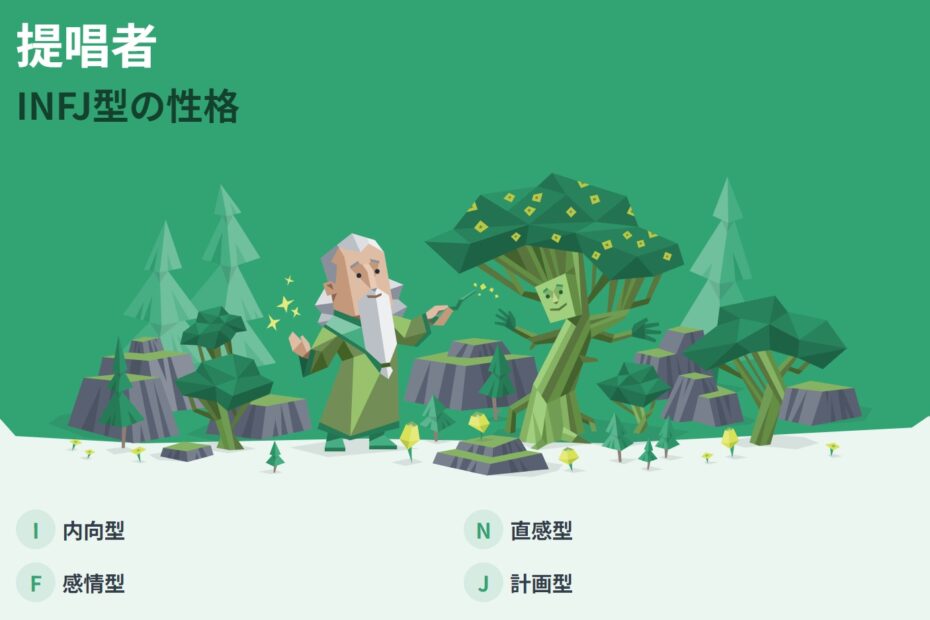
Do you know about the personality type called INFJ? It’s one of the 16personalities (16-type personality test) types.
INFJ refers to people who are introverted, intuitive, feeling, and judging types.
INFJs are said to make up only about 1-3% of the world’s population, making them very rare personality types.
Generally, INFJ people are considered to have excellent insight, are idealistic, and passionate.
On the other hand, they are also said to be sensitive to criticism and have perfectionist tendencies.
INFJ-specific characteristics can be seen in romance, friendships, parenting, and careers.
From here, we will provide detailed explanations about INFJ strengths and weaknesses, as well as their tendencies and improvement strategies.
We will also touch on other types that are compatible with INFJs and the scientific basis of personality assessment, so please check it out until the end.
Once again, personality researcher and author of Villain Encyclopedia, Tokiwa (@etokiwa999), will provide the explanation.
※We have developed the HEXACO-JP Personality Assessment! It has more scientific basis than MBTI. Tap below for details.

※This article is written based on a translation of the 16personalities official English site.
The video version of this article is available here!
目次
- 1 INFJ Strengths and Weaknesses
- 2 INFJ (Advocate) A and T Types
- 3 INFJ Romance Relationship Tendencies and Improvement Strategies
- 4 INFJ Friendship Tendencies and Improvement Strategies
- 5 INFJ Parenting Tendencies and Improvement Strategies
- 6 INFJ Career Tendencies and Improvement Strategies
- 7 INFJ Work Tendencies and Improvement Strategies
- 8 Types Compatible with INFJs
- 9 INFJ Summary
- 10 Supplement
- 10.1 The downside of 16personalities: “Weak scientific backing”
- 10.2 The good points of 16personalities: “Large amount of response data and fame”
- 10.3 Differences between 16personalities and other personality tests: “MBTI”
- 10.4 Differences between 16personalities and other personality assessments: “Big Five”
- 10.5 Differences between 16personalities and other personality assessments: “HEXACO”
INFJ Strengths and Weaknesses
INFJ Strengths
The greatest strength of this type lies in their high level of insight.
This type is said to be a personality type that can deeply understand people’s emotions and motivations.
INFJs are also idealists who spare no effort to change things for the better.
The main strengths of INFJs are as follows:
- High insight and ability to understand people’s emotions and motivations
- Idealistic, seeking to change things for the better
- Passionate and spare no effort for their goals
- Creative and able to generate new ideas
- Honest and dislike lying
In this way, INFJs have excellent qualities in various aspects such as understanding others, creativity, and honesty.
By leveraging these strengths, INFJs can demonstrate great advantages in situations like relationships and careers.
However, we must not forget that INFJs also have weaknesses.
In the next section, let’s take a detailed look at INFJ weaknesses.
INFJ Weaknesses
The greatest weakness of this type is probably their sensitivity to criticism.
Because INFJs have strong values and beliefs, they become shocked when these are denied.
Also, INFJs tend to be perfectionistic, so they may struggle with the gap between their ideals and reality.
The main weaknesses of INFJs are as follows:
- Sensitive to criticism and shocked when their values are denied
- Difficulty opening up and unable to confide their troubles
- Perfectionist and struggle with the gap between ideals and reality
- Tend to avoid mundane things, lacking concrete actions to realize ideals
- Prone to burnout syndrome
In this way, INFJs have weaknesses to overcome such as sensitivity to criticism and perfectionism.
Recognizing these weaknesses and dealing with them appropriately will lead to INFJ growth.
However, it’s important not to focus only on weaknesses but also to utilize strengths.
By maintaining balance, INFJs should be able to live more fulfilling lives.
INFJ (Advocate) A and T Types
INFJ-A (Assertive Type)
Idealistic mediators. They confidently understand others’ emotions and guide people with deep insight. They are creative and excel at intuitive problem-solving.
They have strong convictions and act according to their values. They devotedly serve others while maintaining clear boundaries.
They have the ability to understand complex concepts and view things from a big-picture perspective. They value privacy and emphasize inner growth. In relationships, they seek deep bonds and value sincerity. They have a strong desire to contribute to social improvement.
For more details, please see this article.
INFJ-T (Turbulent Type)
Idealistic mediators, but also have self-critical aspects. They excel at understanding others’ emotions but sometimes feel anxious about their own judgment.
They have creative and intuitive problem-solving abilities, but sometimes hesitate to make decisions due to seeking perfection. They have strong convictions but constantly question whether they are correct.
They dedicate themselves to others, but tend to become overly self-sacrificing. They have the ability to understand complex concepts, but sometimes lack confidence in their own ideas. They seek deep bonds in human relationships, but fear being rejected.
INFJ Romance Relationship Tendencies and Improvement Strategies
Romance Tendencies
The greatest characteristic of INFJ romance is seeking “deep, meaningful relationships.”
INFJs cannot be satisfied with superficial relationships and value deep bonds with their partners.
Also, since INFJs tend to act based on intuition, they may be seeking fateful encounters.
The main tendencies of INFJ romance are as follows.
- Seeking deep, meaningful relationships
- Valuing deep bonds with partners
- Tendency to act based on intuition
- Seeking fateful encounters
- Due to high ideals, easily becoming dissatisfied with real partners
In this way, INFJs show strong idealistic tendencies in romance as well.
While these tendencies can lead to building wonderful partnerships, problems can also arise from the gap with reality.
In the next section, let’s look at problems that can occur in INFJ romance and improvement strategies for them.
When Romance Becomes Problematic and Improvement Strategies
The most problematic aspect of INFJ romance is likely the “gap between ideals and reality.”
Because INFJs are idealistic, they easily notice the flaws of their real partners and end up harboring dissatisfaction.
Also, since INFJs are sensitive to criticism, they may overreact to feedback from their partners.
To improve these problems, the following strategies can be considered.
- Accept the gap between ideals and reality
- Love your partner as they are, including their flaws
- Don’t be overly sensitive to criticism, receive it calmly
- Strive for open communication with your partner
- When necessary, seek third-party opinions
Problems in romance often stem from INFJ’s idealism and sensitivity to criticism.
It’s important to be aware of these tendencies and handle them appropriately.
By balancing ideals with reality and valuing communication with partners, INFJs should be able to build fulfilling romantic relationships.
INFJ Friendship Tendencies and Improvement Strategies
Friendship Tendencies
The greatest characteristic of INFJ friendships is seeking “deep, meaningful relationships.”
INFJs cannot be satisfied with superficial relationships and value deep bonds with friends.
Also, since INFJs tend to seek people with the same values and beliefs as themselves, choosing friends may take time.
The main tendencies of INFJ friendships are as follows.
- Seeking deep, meaningful relationships
- Valuing deep bonds with friends
- Seeking people with the same values and beliefs as themselves
- Taking time to choose friends
- Valuing relationships with a few close friends
In this way, INFJs tend to prioritize quality in friendships as well.
While these tendencies can lead to building wonderful friendships bound by deep connections, they may also experience difficulties in choosing friends.
In the next section, let’s look at problems that can occur in INFJ friendships and improvement strategies for them.
When Friendships Become Problematic and Improvement Strategies
The most problematic aspect of INFJ friendships is likely the “gap with ideal friend images.”
INFJs harbor dissatisfaction with real friendships because they seek friends with the same values and beliefs as themselves too much.
Also, since INFJs tend to value relationships with a few close friends, it may be difficult to broaden the scope of friendships.
To improve these problems, the following strategies can be considered.
- Accept the gap with ideal friend images
- Recognize the diversity of friends and enjoy differences in values
- Actively build new friendships
- Make an effort to maintain regular communication with friends
- When necessary, confide your worries to friends
Problems in friendships often seem to stem from INFJ’s idealism and tendency to cherish a small number of close friends.
It’s important to be aware of these tendencies and deal with them appropriately.
By balancing ideals with reality and actively engaging in new friendships, INFJs should be able to build more fulfilling friendships.
INFJ Parenting Tendencies and Improvement Strategies
Parenting Tendencies
The greatest characteristics of INFJ parenting are “high ideals” and “devoted love.”
INFJs strongly desire to raise their children to be independent, good human beings, but tend to demand too much perfection.
Additionally, INFJs pour devoted love into their children and try to prioritize their children’s happiness above all else.
The main tendencies of INFJ parenting are as follows.
- Wish to raise children to be independent, good human beings
- Tend to demand too much perfection from children
- Pour devoted love into children
- Prioritize children’s happiness above all else
- Respect children’s individuality and emotions
In this way, INFJs demonstrate idealism and devoted love in parenting as well.
While these tendencies lead to wonderful parenting that supports children’s growth, perfectionism can sometimes put pressure on children.
In the next section, let’s look at potential problems in INFJ parenting and improvement strategies.
When Parenting Becomes Problematic and Improvement Strategies
The most problematic aspects of INFJ parenting are likely “perfectionism” and “overprotectiveness.”
INFJs may become unable to respect their children’s autonomy due to demanding too much perfection from them.
Additionally, INFJs may become overprotective due to prioritizing their children’s happiness above all else.
To improve these problems, the following measures can be considered.
- Let go of perfectionism and watch over children’s growth
- Respect children’s autonomy and give them appropriate freedom
- Maintain proper distance with children to avoid being overprotective
- Consult others about parenting concerns
- When necessary, seek advice from professionals
Problems in parenting often seem to stem from INFJ’s perfectionism and devoted love going too far.
It’s important to be aware of these tendencies and deal with them appropriately.
By letting go of perfectionism and respecting children’s autonomy, INFJs should be able to practice better parenting.
INFJ Career Tendencies and Improvement Strategies
Career Tendencies
The greatest characteristic of INFJ careers lies in seeking “meaningful work.”
INFJs cannot be satisfied with just monetary rewards alone and tend to seek work that can contribute to society.
Additionally, INFJs tend to choose work that aligns with their values, so career selection may take time.
The main tendencies of INFJ careers are as follows.
- Seek meaningful work
- Look for work that can contribute to society
- Choose work that aligns with their values
- Career selection takes time
- Prefer work where they can demonstrate creativity
In this way, INFJs tend to emphasize meaning and values in their careers as well.
While these tendencies lead to building wonderful, fulfilling careers, they may also struggle with gaps between ideals and real work.
In the next section, let’s look at potential problems in INFJ careers and improvement strategies.
When Careers Become Problematic and Improvement Strategies
The most problematic aspect of INFJ careers is likely the “gap between ideals and reality.”
INFJs may become dissatisfied with real work due to seeking meaningful work too intensely.
Additionally, when INFJs feel that work doesn’t align with their values, it may be difficult to maintain motivation.
To improve these issues, the following measures can be considered.
- Accept the gap between ideals and reality
- Find meaning in real-world work
- Balance values with work
- Flexibly modify career plans
- When necessary, consider changing jobs
Career problems often seem to stem from INFJ’s idealism and pursuit of values. It’s important to be aware of these tendencies and address them appropriately.
By balancing ideals with reality and flexibly modifying career plans, INFJs should be able to build more fulfilling careers.
INFJ Work Tendencies and Improvement Strategies
Work Tendencies
The greatest characteristics of INFJ’s work style are probably “independence” and “creativity.” INFJs prefer environments where they can work at their own pace and dislike being bound by detailed instructions or rules.
Also, since INFJs tend to prefer work that allows them to exercise creativity, they may not be suited for routine work. The main work tendencies of INFJs are as follows.
- Prefer highly independent environments
- Dislike being bound by detailed instructions or rules
- Prefer work that allows creativity to flourish
- Not suited for routine work
- Seek environments where they can work at their own pace
In this way, INFJs tend to value independence and creativity in their work as well.
While these tendencies can lead to wonderful environments where INFJs can maximize their abilities, they may also feel a mismatch with real-world work.
In the next section, let’s look at problems that can occur in INFJ’s work and improvement strategies for them.
When Work Becomes Problematic and Improvement Strategies
The most problematic issues in INFJ’s work are probably “stress” and “burnout syndrome.”
INFJs tend to feel stress easily in environments where they cannot work at their own pace, which can lead to decreased motivation.
Also, since INFJs tend to be perfectionists, they may become too absorbed in their work and burn out. To improve these problems, the following measures can be considered.
- Learn stress management methods
- Balance work and personal life
- Let go of perfectionism and find appropriate compromise points
- Communicate with colleagues and build cooperative relationships
- When necessary, consult with supervisors
Work-related problems often seem to stem from INFJ’s independence and perfectionism.
It’s important to be aware of these tendencies and address them appropriately.
By learning stress management methods and balancing work with personal life, INFJs should be able to lead more fulfilling work lives.
Types Compatible with INFJs
Compatible Types, People with N
INFJs are most compatible with intuitive (N) types. Since INFJs tend to prefer exploring abstract concepts and possibilities, they are said to easily connect with others who are also intuitive types.
In particular, they may be compatible with the following types of people.
- ENFP (Campaigner)
- ENTP (Debater)
- INFP (Mediator)
- INTP (Logician)
These types, like INFJs, are intuitive and tend to value creativity and possibilities. Therefore, they can enjoy deep conversations with INFJs and build relationships where they can stimulate each other.
However, just because you have good compatibility doesn’t mean you’ll get along well with all intuitive types. Since there are individual differences, there are things you won’t know until you actually interact with them.
Compatible types, people with F included
INFPs are likely to be compatible with feeling types (F).
Since INFPs tend to make judgments based on emotions and values, they are said to easily empathize with fellow feeling types.
In particular, they may be compatible with the following types of people.
- ENFP (Adventurer)
- INFJ (Advocate)
- ENFJ (Protagonist)
- ISFJ (Protector)
These types of people, like INFPs, are feeling types and tend to value human relationships and personal values.
Therefore, they should be able to build relationships with INFPs where they can understand each other’s feelings.
However, just because you have good compatibility doesn’t mean you’ll get along well with all feeling types.
Since there are individual differences, there are things you won’t know until you actually interact with them.
INFJ Summary
INFJs are a very unique personality type that combines insight with idealism.
Their strengths include the insight to deeply understand people’s emotions, idealism that seeks to change things for the better, and passion that spares no effort for their purposes.
On the other hand, their weaknesses include being sensitive to criticism, being perfectionistic, and being prone to struggling with disconnection from reality.
INFJs show unique tendencies in various situations such as romance, friendships, child-rearing, and careers. They seek deep, meaningful relationships and their idealistic side often comes out strongly.
Sometimes they may struggle with the gap between ideals and reality, but they can overcome this by finding balance.
INFJs demonstrate their abilities in environments where they can exercise independence and creativity. It’s important to pay attention to stress management and maintain a balance between work and private life.
Also, while they are said to be compatible with intuitive types (N) and judging types (J), there are individual differences, so it’s important to actually interact with people.
By understanding INFJ characteristics and developing their strengths while facing their weaknesses, INFJs should be able to live more fulfilling lives.
Please cherish your authentic self while building good relationships with the people around you.
Supplement
The downside of 16personalities: “Weak scientific backing”
16personalities (16-type personality test) can be said to have challenges in terms of scientific evidence.
First, there are few peer-reviewed papers, and academic backing is insufficient.
Also, questions remain about the statistical processing methods.
The point of classifying traits into types rather than continuous numerical values is also problematic from the perspective of scientific validity.
Furthermore, the current situation is that sufficient evidence has not been presented regarding the relationships between personality and academic ability, income, brain function, genetic factors, etc.
The good points of 16personalities: “Large amount of response data and fame”
On the other hand, 16personalities (16-type personality test) also has significant advantages.
The first is that it has accumulated vast amounts of response data. Since many people participate in 16personalities assessments, the reliability of the data might be high.
Also, it has penetrated considerably among the general public, such as Korean idols taking and spreading it, and it gaining attention in dating matching apps.
This point can be said to be an advantage that the 16personalities personality test has over other personality tests.
Differences between 16personalities and other personality tests: “MBTI”
16personalities (16-type personality test) is created based on MBTI (Myers-Briggs Type Indicator) and Big Five.
Strictly speaking, 16personalities and MBTI are different things.
MBTI is a personality assessment tool developed based on Jung’s psychological typology.
16personalities adopts the four MBTI indicators (E Extroversion-I Introversion, S Sensing-N Intuition, T Thinking-F Feeling, J Judging-P Perceiving) while adding an Identity (A and T) indicator and establishing its own unique questions and evaluation criteria.
However, it has weak scientific backing similar to 16personalities, including the lack of basis for dichotomous thinking.
Differences between 16personalities and other personality assessments: “Big Five”
Big Five is one of the most prominent trait theories in personality psychology.
Big Five measures five traits: openness, conscientiousness, extroversion, agreeableness, and neuroticism.
Another major difference is that while Big Five evaluates traits on a continuous numerical scale (e.g., extroversion 3.5), 16personalities and MBTI use type classification (e.g., either extroverted or introverted).
Furthermore, it has been studied for a long time with many research papers, and extensive research has been conducted in other fields such as academic achievement, income, brain, and genetics. Big Five can be said to have relatively stronger scientific backing.
For reference, there are also papers showing the correlation between four Big Five factors and MBTI.
Differences between 16personalities and other personality assessments: “HEXACO”
HEXACO (HEXACO Personality Inventory) is a six-dimensional personality model that extends the Big Five.
HEXACO measures six traits: honesty-humility, emotionality, extroversion, agreeableness, conscientiousness, and openness.
By adding the dimension of honesty-humility to the Big Five, it attempts to capture a broader range of personality traits, including dark (and bright) personality traits.
Like Big Five, this also has relatively stronger scientific backing compared to 16personalities and MBTI, including a larger number of research papers.

Writer & Supervisor: Eisuke Tokiwa
Personality Psychology Researcher / CEO, SUNBLAZE Inc.
As a child he experienced poverty, domestic abuse, bullying, truancy and dropping out of school — first-hand exposure to a range of social problems. He spent 10 years researching these issues and published Encyclopedia of Villains through Jiyukokuminsha. Since then he has independently researched the determinants of social problems and antisocial behavior (work, education, health, personality, genetics, region, etc.) and has published 2 peer-reviewed journal articles (Frontiers in Psychology, IEEE Access). His goal is to predict the occurrence of social problems. Spiky profile (WAIS-IV).
Expertise: Personality Psychology / Big Five / HEXACO / MBTI / Prediction of Social Problems
Researcher profiles: ORCID / Google Scholar / ResearchGate
Social & Books: X (@etokiwa999) / note / Amazon Author Page