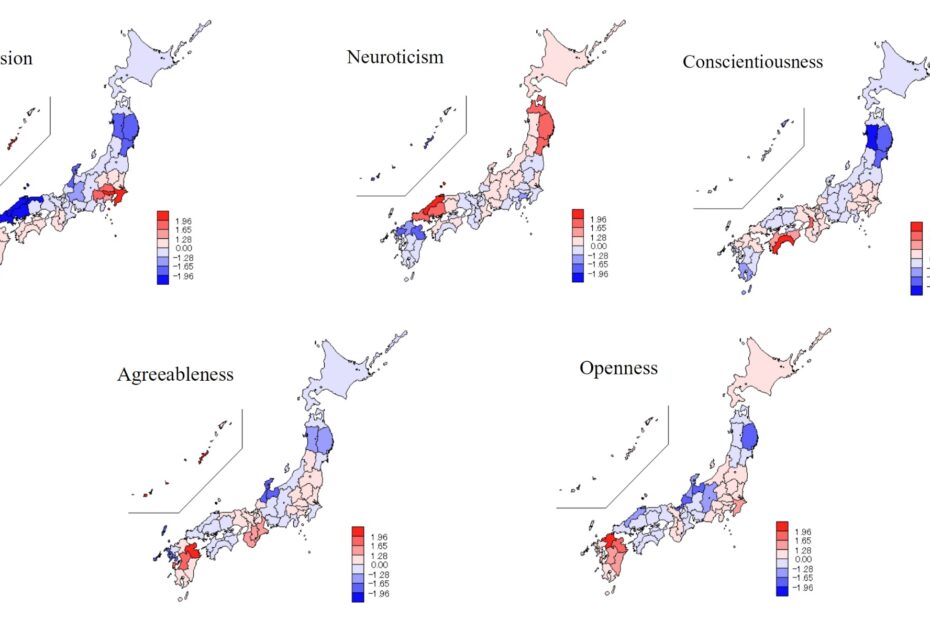
What kind of differences exist in the personalities of prefectural residents?
This paper “Examination of Regional Differences in Big Five Personality in Japan” scientifically analyzes differences in prefectural residents’ personalities regarding the five basic personality traits of humans, including extraversion and agreeableness.
This research by Waseda University researchers, based on large-scale data, shows which regions have more of each personality type on a map of Japan.
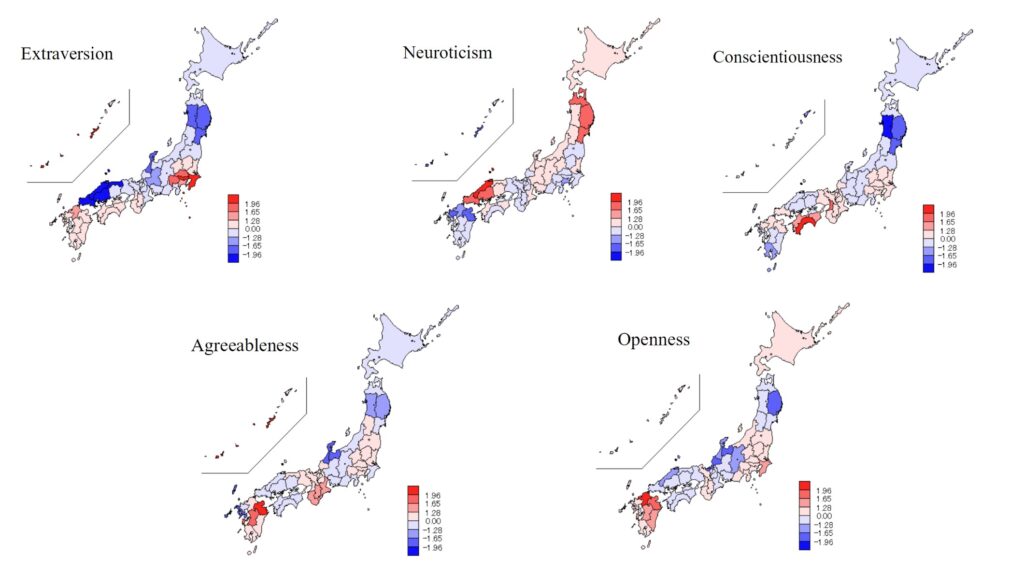
For example, it was found that extraverted people are numerous in the Tokyo metropolitan area and Okinawa, while neurotic tendencies are high in the Tohoku and Chugoku regions.
This article explains why such regional differences occur and how they affect our lives in a way that’s easy to understand even for high school students.
Understanding personality differences by region might help you find hints for building richer human relationships.
Once again, personality researcher and author of Villain Encyclopedia, Tokiwa (@etokiwa999), will provide the explanation.
※We have developed the HEXACO-JP Personality Assessment! It has more scientific basis than MBTI. Tap below for details.

目次
- 1 Overview of Prefectural Resident Personality Diagnosis
- 2 Details of Prefectural Residents’ Personality Traits
- 2.1 Metropolitan Area Personality Assessment: Outstanding Extroversion and Openness
- 2.2 Tohoku Region Personality Assessment: Low Conscientiousness and Neurotic Tendencies
- 2.3 Kyushu Region Personality Assessment: A Region with High Agreeableness and Openness
- 2.4 Okinawa Personality Assessment: High Agreeableness and Extroversion
- 2.5 Hokuriku Region Personality Assessment: Low Agreeableness and Its Factors
- 2.6 Chugoku Region Personality Assessment: Low Extroversion and High Neuroticism
- 3 Prefectural Personality Assessment: The Relationship with Social Culture
- 3.1 Regional Culture Shapes the Personality Traits of Prefectural Residents
- 3.2 Correlation Between Economic Activities and Personality Traits of Prefectural Residents
- 3.3 Historical Background and Personality Formation of Prefectural Residents
- 3.4 Regional Industries and Personality Assessment of Prefectural Residents
- 3.5 The Relationship Between Education and Prefectural Residents’ Personality
- 4 How to Utilize Prefectural Residents’ Personality Assessment
- 4.1 Prefectural Residents’ Personality: Application to Educational Programs
- 4.2 Using Prefectural Residents’ Personality Traits in Regional Policy
- 4.3 Using Prefectural Personality Diagnosis in Corporate Strategy
- 4.4 Individual Career Choices and Prefectural Personality Diagnosis
- 4.5 Research Applications of Prefectural Personality Diagnosis
- 5 Future Prospects in Prefectural Personality Assessment
- 6 In Conclusion
Overview of Prefectural Resident Personality Diagnosis
What are the Big Five Personality Traits?
The Big Five personality traits are five basic dimensions that represent human personality.
These are widely used as a model to broadly explain individual behavior and psychological characteristics.
Specifically, they consist of the following five traits.
- Extraversion: Shows whether someone is sociable or introverted.
- Agreeableness: Represents the degree of cooperativeness toward others.
- Conscientiousness: Evaluates whether someone is organized or unplanned.
- Neuroticism: Measures emotional stability.
- Openness: Shows receptiveness to new experiences.
Now, these traits have a major influence on how individuals think and behave.
For example, people high in extraversion often excel at parties and gatherings, while people high in openness tend to be interested in artistic and creative activities.
Furthermore, these traits are important not only for individuals but also for groups and society.
People high in agreeableness value cooperation in teams, making them valuable in work and projects.
On the other hand, people high in neuroticism tend to feel stress easily, and managing this can sometimes be challenging.
Thus, the Big Five personality traits are a very effective tool for understanding our personalities.
In particular, because they help with self-understanding and building relationships with others, they are applied not only in psychology but also in education and human resource management in the workplace.
The Influence of Regionality on Prefectural Residents’ Personalities
The influence that regionality has on individual personality formation is considered to be significant.
This is because the culture and customs shared in a particular region are reflected in the personalities of the people who live there.
Specifically, the following factors can be cited.
- Cultural background: The history and culture of each region influence residents’ values and behavioral patterns.
- Social environment: The closeness of regional communities and the presence or absence of social support affect agreeableness and extraversion.
- Economic situation: Whether a region’s level of economic development is high or low can change conscientiousness and neurotic tendencies.
- Educational opportunities: The richness of educational environments leads to fostering openness and conscientiousness.
For example, economic challenges faced by a region can increase residents’ stress levels and affect neurotic tendencies.
Also, in regions where educational opportunities are abundant, residents tend to have higher openness.
Next, let’s look at how these factors affect personality. In regions rich in cultural background, the region-specific events and customs unique to that area are observed to enhance residents’ agreeableness and extraversion.
This is because having many opportunities to work together naturally fosters a tendency to value cooperation with others.
Furthermore, the influence that regionality has on individual personalities also affects how that person feels and reacts.
Personalities formed by regionality have a major influence on that person’s life choices and sense of well-being.
This is a map of Japan from this paper, color-coded by prefecture × Big Five traits.
Details of Prefectural Residents’ Personality Traits
Metropolitan Area Personality Assessment: Outstanding Extroversion and Openness
In the metropolitan area, extroversion and openness are recognized as particularly outstanding characteristics.
This is because the metropolitan area is a place of diverse culture and active exchange, creating an environment where residents are sociable and readily accept new ideas and different cultures.
This is prominently manifested in the following aspects.
- Multicultural influence: Many people gather from both domestic and international locations, resulting in frequent contact with various cultures.
- Abundance of social opportunities: There are many events and meetings, providing rich opportunities for people to interact.
- Information accessibility: New information gathers easily, and there’s a tendency to be at the forefront of trends.
For example, the frequent hosting of international festivals and business events in the metropolitan area fosters residents’ extroversion and enhances their openness to diverse values.
Additionally, the development of media and the internet makes it possible to constantly encounter new information, further promoting openness.
Furthermore, while metropolitan area residents tend to be exposed to high stress in busy and highly competitive living environments, by managing this stress well, they maintain strong extroversion while keeping an open attitude toward various cultures and ideas.
Metropolitan area residents combine extroversion and openness, with these characteristics nurtured through multicultural and active social environments.
Such an environment influences not only individual personalities but also collective behavioral patterns, forming the dynamism of the entire region.
Tohoku Region Personality Assessment: Low Conscientiousness and Neurotic Tendencies
In the Tohoku region, characteristics of low conscientiousness and high neurotic tendencies are observed.
This is because past economic difficulties and the effects of natural disasters run deep, with these experiences influencing residents’ personalities.
Specifically, the following factors are cited.
- Economic difficulties: Industrial decline and decreased job opportunities have elevated stress levels throughout the region.
- Impact of natural disasters: Experiences with disasters such as earthquakes and tsunamis have affected residents’ anxiety and stress.
- Harsh climate: Cold, long winters force indoor activities and reduce social opportunities.
As an example, it is pointed out that harsh climate and economic constraints limit people’s activities, leading to decreased conscientiousness.
Additionally, anxiety about an uncertain future contributes to strengthening neurotic tendencies.
Furthermore, while these factors promote the closeness of regional communities, they also strengthen traditional values and customs by limiting external exchanges.
Such an environment is thought to strengthen residents’ tendency to seek psychological stability, forming introverted personality traits.
Tohoku region residents maintain strong local communities while facing harsh natural environments and economic challenges.
This region-specific personality assessment shows how these people are coping with these difficulties, and indicates a situation requiring deep understanding and support.
Kyushu Region Personality Assessment: A Region with High Agreeableness and Openness
The Kyushu region is evaluated as an area with particularly high agreeableness and openness.
This is because the region’s warm climate and rich natural environment foster active interaction among residents and a sense of community. The main reasons are listed below.
- Warm climate: The mild climate throughout the year promotes outdoor activities and local events.
- Rich nature: Close relationships with nature open residents’ hearts and nurture a spirit that values cooperation with others.
- Historical background: The history as a center of trade has strengthened attitudes of accepting different cultures.
For example, there are abundant activities that involve the entire community, such as local festivals and collaborative agricultural work. These activities serve as the foundation for local residents to cooperate with each other and build strong bonds.
Additionally, the diverse cultural background of the Kyushu region fosters an open attitude toward new ideas and different cultures, becoming a factor that enhances the region’s openness.
Furthermore, the Kyushu region has a thriving tourism industry, with many tourists visiting from both domestic and international locations.
Such an environment increases opportunities for residents to come into contact with different cultures, further strengthening their openness.
The agreeableness and openness of the Kyushu region are rooted in the region’s natural environment and cultural background.
These characteristics improve the quality of life for local residents and make Kyushu an attractive place to live.
This region’s personality assessment reflects its warm community and open hearts.
Okinawa Personality Assessment: High Agreeableness and Extroversion
Okinawa is known as a region with high agreeableness and extroversion.
This is because the island’s culture and climate have shaped the open and friendly personalities of its residents.
The following elements contribute to these characteristics.
- Climate Influence: The warm climate throughout the year promotes outdoor social activities and increases opportunities for people to interact.
- Island Culture: A strong sense of community and a culture of mutual support throughout the local society is deeply rooted.
- Historical Background: A history where many cultures intersect has enhanced extroversion and adaptability to new cultures.
For example, in Okinawa’s traditional events and festivals, the local community comes together to prepare and implement them.
Through this, residents naturally cooperate and foster relationships of mutual assistance.
Additionally, an environment susceptible to external influences such as the presence of U.S. military bases has shaped residents’ extroversion and receptiveness to foreign cultures.
Furthermore, people in Okinawa often work in the tourism industry, and through daily interactions with many tourists, naturally outgoing and open personalities are fostered.
This is an essential characteristic for building good relationships with tourists.
Okinawa’s agreeableness and extroversion are supported by its warm climate and rich cultural background.
These personality traits are attractive elements for people visiting Okinawa and symbolize the strength and openness of the local community.
Okinawa’s personality assessment shows how people in this region cooperate with each other and challenge new things.
Hokuriku Region Personality Assessment: Low Agreeableness and Its Factors
In the Hokuriku region, relatively low agreeableness can be observed.
This is because the harsh winter climate and geographical isolation create an environment that limits people’s interactions with others.
The following points influence this region’s personality characteristics.
- Harsh Winter Climate: Long, harsh winters cause people to tend to stay home, limiting social activities.
- Geographical Isolation: The terrain surrounded by mountains makes exchange with external regions difficult.
- Historical Background: The need for self-sufficient living has fostered strong independence.
For example, due to heavy snowfall in winter, people spend long periods at home, which can weaken ties with the local community.
Also, because transportation is relatively poor, the physical distance from other regions and urban areas becomes significant.
Furthermore, people in the Hokuriku region have developed self-reliant strength to overcome challenges posed by nature.
This can lead to a tendency to believe in one’s own strength rather than cooperating with others.
The low agreeableness in the Hokuriku region is due to harsh natural environment and geographical conditions, which foster independence among local people and limit contact with the outside world.
This regional characteristic shows how people in the Hokuriku region adapt to their environment and demonstrate individual abilities.
Chugoku Region Personality Assessment: Low Extroversion and High Neuroticism
The Chugoku region is generally characterized by low extroversion and high neuroticism.
This is because social and economic factors unique to this region influence the personality formation of residents.
The main influencing factors are listed below.
- Economic Fluctuations: Industrial changes and employment instability heighten residents’ anxiety.
- Geographical Characteristics: Mountainous terrain prone to isolation limits extroverted activities.
- Historical Background: Difficult historical circumstances have formed a conservative and introverted society.
For example, economic uncertainty and anxiety about the future contribute to strengthening people’s neurotic tendencies.
Additionally, the geographically isolated environment reduces opportunities for interaction with outsiders, which leads to low extroversion.
Furthermore, people in the Chugoku region often tend to develop introverted and self-protective personalities due to harsh natural conditions and historical trials.
While this promotes close bonds within the community, it also influences the tendency to take cautious attitudes toward new people and situations.
The personality assessment of the Chugoku region highlights how the regional environment and history influence residents’ personalities.
These personality traits are deeply rooted in regional culture and lifestyle, serving as important indicators for understanding personality differences by region.
Prefectural Personality Assessment: The Relationship with Social Culture
Regional Culture Shapes the Personality Traits of Prefectural Residents
Regional culture shapes the personality of the people living there. Culture consists of local customs, beliefs, values, and other elements, which are reflected in the personality of residents.
The main factors are listed below.
- Festivals and events: Regional annual events foster cooperation and extroversion.
- Regional beliefs: Religious content influences people’s emotional expression and interpersonal relationships.
- Traditional lifestyles: Agriculture-centered regions may increase diligence, while commerce-centered regions may increase extroversion.
For example, festivals and traditional events that differ by region strengthen ties with local communities and teach the importance of acting collectively.
This naturally develops cooperation among residents of that region.
Additionally, in regions where religious activities are active, those teachings may form introspective personalities and tolerance in individuals.
Furthermore, lifestyle directly influences people’s daily activities, which can manifest in personality traits.
For example, in regions where agriculture is thriving, values that cherish harmony with nature are reflected, and diligence may increase.
Regional culture greatly influences the personality traits of people raised in that region and is deeply involved in individual behavior and interpersonal relationships.
Personality differences rooted in culture manifest as regional individuality and as individual behavioral patterns.
Correlation Between Economic Activities and Personality Traits of Prefectural Residents
Economic activities are important factors that influence regional personality traits.
In particular, the region’s main industries and types of employment greatly influence residents’ personalities. The main influencing factors are listed below.
- Type of industry: Regions with thriving technology industries increase openness, while agricultural regions increase diligence.
- Employment stability: In regions with stable employment, residents’ neurotic tendencies may decrease.
- Economic prosperity: In economically prosperous regions, extroversion and cooperation tend to be more easily fostered.
For example, in regions where IT companies and startups gather, new ideas and challenges are constantly required, which increases openness and creativity.
Also, in regions where tourism is thriving, there are many opportunities to interact with many people, so extroversion develops.
Additionally, economic stability contributes to improving people’s quality of life and maintaining mental health. This generally leads to lower neurotic tendencies and more positive personalities.
In regions where economic activities are active and diverse, the personalities of people working there may also become diversified.
This is because the unique demands and stress levels of various occupations are reflected in residents’ personalities.
There is a close correlation between economic activities and personality traits of prefectural residents.
How a region’s economy develops plays an important role in personality formation of people in that region, and different collections of personalities are formed in each region.
Historical Background and Personality Formation of Prefectural Residents
Historical background deeply influences the personality traits of prefectural residents.
Historical events and long traditions experienced by a region often influence residents’ behavioral patterns and psychology.
The main factors that have this influence are listed below.
- Effects of war and disasters: Past wars and natural disasters influence regional community cooperation and neurotic tendencies.
- Long history of trade: Regions with active trade tend to foster extroversion and openness.
- Cultural heritage: Regions with rich cultural heritage form proud attitudes and unique social norms.
For example, in regions that have experienced many natural disasters in the past, solidarity among residents strengthens, and a culture of mutual assistance may take root.
Also, in regions that were historically trading ports, contact with diverse cultures has been observed to increase residents’ openness.
Furthermore, the unique traditions and festivals that a region possesses form the identity of the people living there, which is also reflected in their personalities.
For example, in regions where traditional performing arts and crafts thrive, precise personalities that pay attention to detail develop.
Personality traits formed by historical background are deeply connected with regional identity.
These backgrounds create unique personality patterns for each region and influence residents’ behavior and interpersonal relationships.
Regional Industries and Personality Assessment of Prefectural Residents
Industries rooted in regions are one of the factors that influence the personality traits of people living there.
Depending on the type of industry, the required skills and working styles differ, which is reflected in residents’ personality formation. The main points are shown below.
- Regions with thriving manufacturing: Precision and patience are required, increasing diligence and conscientiousness.
- Agriculture-centered regions: Living in harmony with natural rhythms fosters planning and cooperation skills.
- Service industry-focused regions: Interpersonal skills and extroversion are valued, and these traits are strengthened.
For example, in industrial areas where daily tasks are repeatedly performed, many people can be observed to have resistance to routine work along with high concentration abilities.
Additionally, in regions where tourism thrives, interaction with people from various backgrounds is required, which contributes to improving extroversion and adaptability.
Moreover, when a region’s industries are diversified, the people who grow up there develop diverse personality traits.
This is because the abilities and behavioral patterns required across different industries have multifaceted influences on people’s personalities.
Understanding the relationship between regional industries and personality is important for grasping the cultural and community characteristics of that region.
The personality traits formed by industries are deeply connected to the lifestyle and social interactions of regional residents, manifesting as the individuality of that region.
The Relationship Between Education and Prefectural Residents’ Personality
Education has a significant impact on the personality traits of prefectural residents.
The content and methods of education, as well as how accessible education is, directly influence people’s personality formation.
Below are specific influencing factors:
- Education accessibility rate: In regions where educational opportunities are widely provided, openness and intellectual curiosity are nurtured.
- Educational content: In regions where creative education is emphasized, creativity and flexibility tend to increase.
- Educational policies: In regions with educational policies that emphasize competition, personalities with strong competitive spirit and self-assertion may be formed.
For example, educational programs that emphasize academics and arts promote students’ creative thinking and openness to new ideas.
Also, in schools where physical education and sports are emphasized, competitive spirit and teamwork are often cultivated.
Furthermore, the quality of education and the expansion of educational access also contribute to the socioeconomic development of the entire region.
In regions with well-developed education, residents become more well-informed and develop diverse perspectives, increasing the openness of society as a whole.
Understanding the relationship between regional personality and education is an important factor that directly affects regional future development and individual happiness.
The personality traits that education nurtures become the foundation for community strength and prosperity, serving as the key to improving the quality of life for each individual resident.
How to Utilize Prefectural Residents’ Personality Assessment
Prefectural Residents’ Personality: Application to Educational Programs
Educational programs can be utilized for personality development suited to the region.
By understanding the personality traits of prefectural residents and designing educational curricula tailored to them, it’s possible to maximize residents’ potential.
Below are key points on how educational programs contribute to personality development:
- Curriculum design based on regional characteristics: Education tailored to regional industries and culture promotes the strengthening of related personality traits.
- Introduction of diverse educational methods: Group activities and project-based learning are effective for developing cooperation and leadership.
- Educational programs tailored to individual needs: Education that responds to each student’s personality and talents maximizes individual growth.
For example, in regions where technological innovation is advancing, strengthening STEM (Science, Technology, Engineering, Mathematics) education can cultivate problem-solving abilities and critical thinking skills.
Also, in regions rich in arts and culture, education emphasizing creative expression contributes to improving students’ artistic sense and sensitivity.
Furthermore, aiming to develop skill sets that meet community needs through educational programs leads to sustainable regional development.
This makes it possible to cultivate human resources to solve region-specific problems and improve the quality of life for the entire region.
The application of educational programs to regions is an important means of shaping that region’s future.
Community-based education becomes the key to forming residents’ personalities and contributing to regional society’s development.
Using Prefectural Residents’ Personality Traits in Regional Policy
It is desirable to formulate regional policies taking into consideration the personality traits of the region.
By understanding the personality traits of prefectural residents and developing policies based on them, more effective social intervention becomes possible.
Below are specific methods for this:
- Policy development based on regional characteristics: Community events for regions with high extroversion, industrial development strategies for regions with high conscientiousness.
- Employment creation leveraging personality traits: Increasing job types that match regional personality traits improves resident satisfaction and productivity.
- Education-linked policies: Promote educational programs suited to regional personality characteristics and cultivate human resources to support future regional development.
For example, in regions with particularly high cooperativeness, policies that encourage environmental protection projects and joint ventures that the entire community works together on are effective.
This encourages residents to strengthen their unity even further and actively participate in activities that benefit the entire region.
Also, in regions with high neuroticism tendencies, introducing policies that strengthen mental health support and programs for stress management can lead to significant improvements in residents’ quality of life.
Incorporating personality characteristics into regional policies is an important strategy for maximizing policy effectiveness and improving residents’ quality of life.
By understanding regional personality characteristics and developing policies suited to them, it becomes possible for regional residents to live happier and more productive lives.
Using Prefectural Personality Diagnosis in Corporate Strategy
By incorporating personality diagnosis into corporate strategy, organizational efficiency and effectiveness can be significantly improved.
Understanding employee personality characteristics and organizing appropriate roles and teams based on them is very effective for increasing workplace productivity and satisfaction.
The following shows methods for utilizing personality diagnosis.
- Role assignment based on aptitude: Assign optimal duties considering employee personalities.
- Team composition optimization: Maximize collaboration effectiveness by forming teams considering personality compatibility.
- Employee motivation improvement: Enhance work motivation through approaches suited to individual personalities.
For example, employees with high extroversion may be suited for customer service or sales, and by placing them in such roles, their abilities can be maximized.
On the other hand, employees with high introversion are often suited for duties requiring intensive individual work, such as research and development or data analysis.
Furthermore, through personality diagnosis, each employee’s strengths and weaknesses can be clearly understood, leading to individual career path design and personal growth support.
Strategic utilization of personality diagnosis by companies is the key to maximizing workforce potential and improving overall organizational performance.
By understanding employee personalities and providing suitable environments, workplace satisfaction and productivity improve, contributing to organizational success.
Individual Career Choices and Prefectural Personality Diagnosis
Utilizing personality diagnosis for individual career choices leads to improved self-realization and job satisfaction.
By understanding one’s own personality, it becomes possible to choose occupations and industries suited to one’s aptitude, which contributes to long-term career success.
The following shows the application of personality diagnosis to career selection.
- Occupation selection suited to aptitude: Choose optimal occupations based on individual personality characteristics.
- Career path planning: Set long-term career goals using personality diagnosis.
- Improved job satisfaction: Job fulfillment and satisfaction increase by pursuing occupations suited to one’s personality.
As an example, people with high openness enjoy challenging new things, so creative occupations or environments with much change are suitable.
On the other hand, people with high conscientiousness are more likely to succeed in occupations requiring planning ability and sense of responsibility.
Furthermore, by understanding one’s strengths and weaknesses through personality diagnosis, it becomes possible to acquire skills suited to them and make career adjustments.
This makes it possible to enhance career satisfaction and improve the quality of one’s entire professional life.
Utilizing personality diagnosis in career selection is an effective means for maximizing individual potential and achieving fulfillment in professional life.
By understanding one’s personality and choosing suitable occupational environments, it becomes possible to build a happier and more productive career.
Research Applications of Prefectural Personality Diagnosis
Research on personality diagnosis is very effective in understanding individual aptitude and psychological health.
As research in this field advances, more precise and individualized psychological interventions become possible, contributing to improvements in people’s quality of life.
The following shows the main directions in which personality diagnosis research is expanding.
- Development of new diagnostic tools: More accurate and user-friendly personality diagnosis tools are developed.
- Cross-cultural comparative research: Research how personality is expressed in different cultures.
- Genetic factor research: Gain deeper understanding of genetic factors in personality formation.
For example, personality diagnosis tools utilizing AI technology can analyze individual personalities more quickly and accurately than conventional approaches, so they have the potential to be utilized in personalized psychotherapy and career consulting.
Also, through international research, the influence that different cultural backgrounds have on individual personality characteristics can be analyzed, deepening understanding of psychology from a global perspective.
Furthermore, as genetic research advances and provides insights into how specific personality traits are inherited, approaches to individual behavior and health will become more evidence-based.
By expanding personality assessment research, not only psychological theories but also the scope of practical applications will greatly broaden.
This is expected to contribute to supporting better lives for individuals and improving the welfare of society as a whole.
Future Prospects in Prefectural Personality Assessment
Technological Advances and Possibilities in Personality Assessment
Technological advances in personality assessment increase opportunities to deepen understanding of individuals and provide more appropriate support.
Modern technology, particularly the evolution of artificial intelligence (AI), is greatly expanding the accuracy and scope of use of personality assessment. The main impacts of technological progress are shown below.
- AI-powered personality analysis: Uses machine learning to generate accurate personality profiles from large amounts of data.
- Real-time personality assessment: Analyzes personality traits in real-time from daily behaviors through wearable devices and apps.
- Individualized feedback and guidance: Uses AI to provide behavior improvement suggestions and mental support tailored to individuals.
For example, smartphone applications could analyze users’ behavioral patterns and, based on that information, diagnose individual personality traits and provide advice tailored to daily conditions.
Also, in business settings, AI-powered personality assessment might be used to determine employee aptitude and assist with more appropriate job placement and team building.
Furthermore, in medical and psychotherapy fields, customized treatment plans based on patients’ personality assessments could be developed to enhance treatment effectiveness.
Technological advances in personality assessment enable more individualized support and improve understanding and response to difficulties each person faces.
This progress will promote individualized approaches in many fields and greatly contribute to improving individual happiness and quality of life.
Predicting Future Changes in Prefectural Personality Differences
Predicting future changes in regional personality differences is important for understanding social changes and implementing countermeasures.
By analyzing how economic, cultural, and environmental changes affect regional personality traits, we can effectively support future regional development.
The main points of change prediction are shown below.
- Demographic changes: Migration and changes in birth rates affect regional personality traits.
- Impact of economic development: Regional economic growth or decline may bring changes to residents’ personalities.
- Increased cultural exchange: Contact with different cultures through globalization may add new elements to regional personalities.
For example, in regions where the technology industry is thriving, adaptability and openness to new technology may be required, and changes in prefectural residents’ personalities might be observed.
Also, in economically developed regions, increased extroversion and competitiveness are expected.
Furthermore, increased international migration is thought to enhance cultural diversity within regions, which could become a factor promoting residents’ cooperativeness and flexibility.
Predicting changes in regional personality differences is essential for understanding future social structures and formulating appropriate education and policies.
This enables effective responses to potential challenges regions may face and improves residents’ quality of life.
Japan’s Positioning Through International Comparison
Understanding Japan’s personality traits through international comparison is useful for clarifying Japan’s characteristics in a global context.
Comparing personality traits with other countries is an important means of understanding how differences in cultural, economic, and social backgrounds affect people’s personalities.
The main benefits of international comparison are shown below.
- Clarification of cultural characteristics: Comparison with other countries reveals Japan’s unique cultural characteristics.
- Promotion of international cooperation: Understanding different countries’ personality traits promotes international cooperation and exchange.
- Adaptation to global challenges: Understanding personality traits in an international context serves as a reference when considering responses to global challenges.
For example, Japan’s high cooperativeness and conscientiousness are said to contribute to success in teamwork and precision engineering, but by conducting international comparisons, we can understand how these traits differ from other countries.
Also, since many occupations in other countries require higher extroversion, it’s possible to analyze how Japanese people’s introverted characteristics function in international business settings.
Furthermore, international comparison is also useful for identifying areas for improvement in Japanese education and business strategies.
For example, introducing educational programs to enhance extroversion or emphasizing interpersonal skills in international business could be considered.
Japan’s positioning through international comparison becomes an important foundation for understanding Japan from a global perspective and formulating strategies Japan should take in future international cooperation and economic activities.
This will clarify the role Japan should play in the international community and its countermeasures, enabling the building of more effective international relationships.
Personality Geography as a New Research Field
Personality geography is a new research field that explores how geographical factors influence personality formation.
This field aims to elucidate the causes of different personality traits by region and understand how they affect culture and society.
The following shows the main research themes of personality geography.
- Relationship between geographical characteristics and personality traits: Analyzes the impact of specific geographical environments such as mountainous regions and coastal areas on residents’ personalities.
- Interaction between regional culture and personality: Investigates how region-specific cultures are reflected in residents’ personalities.
- Relationship between socioeconomic factors and personality: Explores how economic development, education levels, industrial structure, etc. affect personality.
For example, in island regions like Okinawa, close relationships with nature and strong community bonds are said to enhance cooperativeness and extroversion.
Also, in regions that have historically been centers of trade, adaptability to different cultures and openness are thought to be fostered.
Furthermore, personality geography can also be applied in the fields of urban planning and regional development.
By understanding the personality traits of prefectural residents, we can design more livable urban environments and formulate strategies to revitalize local communities.
Personality geography provides important insights that support sustainable development of local communities by exploring how geographical, cultural, and social factors influence people’s personalities.
The development of this research field is expected to enable more specific and effective regional policy formulation, contributing to the happiness of local residents and the prosperity of local communities.
In Conclusion
Through this article, we have considered the personality traits of prefectural residents throughout Japan and their backgrounds.
The personality traits of prefectural residents that differ by region are formed by various factors including the culture, history, and economy of each region.
By using personality assessments, we can understand these differences more deeply and utilize them for education and policies that leverage each region’s characteristics, as well as for individual career choices.
Additionally, understanding the personality traits of each region leads to deepening our understanding of other regions and cultures, and to having a broader perspective.
In our own lives as well, accepting the personalities of ourselves and others and building environments and relationships suited to them will be the key to a more fulfilling social life.
With this knowledge, I hope that all of you will become bridges of mutual understanding and cooperation in your interactions with various people both within and outside Japan.
Let us expect that new initiatives that leverage the personality traits of prefectural residents will contribute not only to individual growth but also to the prosperity of local communities as a whole.
For those who want to take the advanced version of Big Five, HEXACO psychological test, click here!

Writer & Supervisor: Eisuke Tokiwa
Personality Psychology Researcher / CEO, SUNBLAZE Inc.
As a child he experienced poverty, domestic abuse, bullying, truancy and dropping out of school — first-hand exposure to a range of social problems. He spent 10 years researching these issues and published Encyclopedia of Villains through Jiyukokuminsha. Since then he has independently researched the determinants of social problems and antisocial behavior (work, education, health, personality, genetics, region, etc.) and has published 2 peer-reviewed journal articles (Frontiers in Psychology, IEEE Access). His goal is to predict the occurrence of social problems. Spiky profile (WAIS-IV).
Expertise: Personality Psychology / Big Five / HEXACO / MBTI / Prediction of Social Problems
Researcher profiles: ORCID / Google Scholar / ResearchGate
Social & Books: X (@etokiwa999) / note / Amazon Author Page