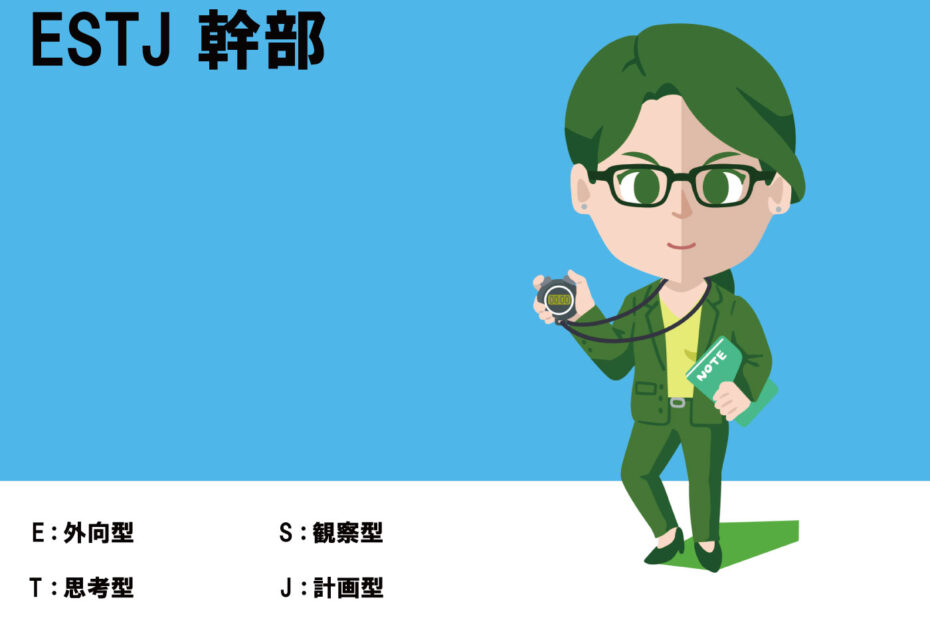
ESTJ love personality is defined by a powerful sense of responsibility, unwavering loyalty, and a deeply practical approach to romance. If you have ever wondered what it truly feels like to date — or be — an ESTJ, this article breaks down the psychology behind their relationship style, what makes them such reliable partners, and where they may need to grow to build truly lasting connections.
ESTJs (Extraverted, Sensing, Thinking, Judging) are often described as the “executives” of the MBTI world — organized, direct, and goal-oriented. In love, these same qualities show up in striking ways. They tend to take romance seriously, commit fully, and demonstrate affection through concrete actions rather than flowery words. Understanding this personality type’s love style can help both ESTJs and their partners build stronger, more fulfilling bonds.
Once again, personality researcher and author of Villain Encyclopedia, Tokiwa (@etokiwa999), will provide the explanation.
※We have developed the HEXACO-JP Personality Assessment! It has more scientific basis than MBTI. Tap below for details.

目次
- 1 Characteristics and Tendencies of ESTJ (The Executive)
- 2 ESTJ Love Personality: Are They Close to the Ideal Partner?
- 3 What Psychology Research Says About ESTJ Relationship Traits
- 4 ESTJ Partner Strengths: What They Bring to a Relationship
- 5 ESTJ Emotional Expression: Where Challenges Tend to Arise
- 6 Actionable Advice for ESTJs and Their Partners
- 7 Scientific Background of the 16 Types
- 8 Try Taking the Proper Personality Test “HEXACO-JP”!
- 9 FAQ and Important Notes
- 10 Frequently Asked Questions
- 10.1 What is the ESTJ love personality like in a relationship?
- 10.2 Who is most compatible with an ESTJ in romance?
- 10.3 Do ESTJs struggle with expressing emotions in relationships?
- 10.4 What are the biggest strengths an ESTJ brings to a romantic relationship?
- 10.5 How does the Big Five personality model relate to ESTJ relationships?
- 10.6 Can an ESTJ change their love style to be more emotionally expressive?
- 10.7 Is the ESTJ personality type rare in romantic relationships?
- 11 Summary: Building on the ESTJ Love Personality
Characteristics and Tendencies of ESTJ (The Executive)
ESTJ is a type that excels in execution and leadership.
They value proceeding with things efficiently and maintaining order.
They are realistic with a strong sense of responsibility and have a trustworthy personality.
They demonstrate leadership within organizations and groups.
The characteristics and tendencies of ESTJ are as follows.
- They make plans and execute them steadily.
- They value following rules and discipline.
- They make quick decisions and proceed with things efficiently.
- They are realistic and demonstrate strong practical abilities.
- They bring people together and provide direction.
On the other hand, lacking flexibility can easily lead to conflicts.
Disregarding others’ emotions can lead to misunderstandings.
Being too hasty for results can sometimes exhaust those around them.
Being conscious of cooperation leads to smooth progress.
ESTJ is a reliable presence that supports organizational stability.
They can accumulate achievements through responsibility and execution.
They can make calm judgments even in difficult situations.
Balancing leadership with consideration leads to growth.
ESTJ Love Personality: Are They Close to the Ideal Partner?
Research suggests that ESTJs tend to display several qualities commonly associated with being an ideal romantic partner. Their strong sense of duty, consistency, and willingness to put in effort means they rarely leave a partner feeling neglected in practical terms. They keep their promises, show up when it counts, and actively work toward a stable future together.
When we look at ESTJ relationship traits through a psychological lens, a clear picture emerges. Here are 4 core characteristics that shape how ESTJs typically approach love:
- High sense of responsibility: ESTJs tend to see themselves as a dependable pillar in the relationship. They take their role as a partner seriously and rarely back away from commitments.
- Love expressed through action: Rather than verbal affirmations, ESTJs often show affection by doing — planning dates, solving problems for a partner, providing financial stability, or handling responsibilities so the other person doesn’t have to.
- Reserved emotional expression: Because ESTJs rely heavily on logic over feeling, they may appear emotionally distant even when they care deeply. This can sometimes lead to misunderstandings with more emotionally expressive partners.
- A tendency to assert their own views: ESTJs have strong opinions and a clear sense of how things “should” be done. Without awareness, this can tip into controlling behavior that strains ESTJ compatibility with more free-spirited types.
The key takeaway is that ESTJs are, at their core, genuinely devoted partners. However, they tend to thrive most in relationships where both parties openly communicate expectations. When ESTJs pair their natural leadership with warmth and flexibility, they become the kind of partners others genuinely rely on and feel safe with.
What Psychology Research Says About ESTJ Relationship Traits
To understand the ESTJ love personality more deeply, it helps to look at what psychological research says about personality and relationship satisfaction. One of the most widely used frameworks in this area is the Big Five (Five-Factor Model) of personality, which measures five broad traits: Conscientiousness, Agreeableness, Extraversion, Openness to Experience, and Emotional Stability (Neuroticism reversed).
Research consistently points to 2 traits in particular as the strongest predictors of romantic satisfaction:
- High Conscientiousness: People who are organized, disciplined, and follow through on their commitments tend to report higher relationship satisfaction — both for themselves and for their partners. This maps closely onto the ESTJ’s “J” (Judging) preference and their strong sense of duty.
- High Agreeableness: Empathetic, warm, and cooperative individuals tend to build more harmonious partnerships. In MBTI terms, this aligns more closely with “F” (Feeling) types — an area where ESTJs, as “T” (Thinking) types, may naturally find more room to grow.
A landmark meta-analysis supporting these findings is: Malouff, J. M. et al. (2010) “The Five-Factor Model of personality and relationship satisfaction of intimate partners: A meta-analysis“ — which demonstrated that individuals high in both Conscientiousness and Agreeableness report significantly greater romantic satisfaction. This research suggests that while ESTJs’ conscientiousness is already a natural asset in love, actively developing their agreeableness and emotional expressiveness could meaningfully elevate their relationship quality.
ESTJ Partner Strengths: What They Bring to a Relationship
ESTJs bring a distinctive and genuinely valuable set of strengths to romantic relationships that many partners deeply appreciate over time. While their style of love may look different from more emotionally expressive personality types, it tends to be consistent, grounding, and built for the long term.
Here are some of the most notable ESTJ partner strengths in a relationship context:
- Reliability and follow-through: When an ESTJ makes a commitment, they honor it. Partners can count on them to be present, to remember important dates, and to follow through on promises — a quality that builds deep trust over time.
- Financial and practical stability: ESTJs tend to be responsible with resources and highly organized in daily life. This often translates into a sense of security in the partnership, especially when planning a future together.
- Clear communication of expectations: ESTJs are typically direct about what they need and what they expect. While this can feel blunt at first, it eliminates much of the guesswork that plagues other MBTI love styles.
- Steady, long-term commitment: ESTJs rarely enter relationships casually. When they choose a partner, they tend to be all-in — which is particularly compatible with personality types who value security and consistency.
In short, the ESTJ’s love language might best be described as “acts of service and structured loyalty.” They may not write poems, but they will fix the problem, show up on time, and build something solid together.
ESTJ Emotional Expression: Where Challenges Tend to Arise
One of the most commonly reported friction points in ESTJ relationships is the gap between their internal feelings and their outward emotional expression. ESTJ emotional expression tends to be understated — not because they don’t feel deeply, but because their natural preference is to process situations logically rather than emotionally.
This can create approximately 3 recurring challenges:
- Partners feeling emotionally unseen: A partner who craves verbal affirmation or emotional vulnerability may interpret the ESTJ’s reserved style as indifference, even when the ESTJ is genuinely invested in the relationship.
- Conflict resolution becoming a debate: ESTJs tend to approach disagreements as problems to be solved logically. This can inadvertently invalidate a partner’s feelings, turning emotional conversations into argument-like exchanges.
- High standards creating pressure: ESTJs often hold themselves — and their partners — to high standards. While this comes from a place of genuine care and ambition, it can occasionally feel critical or demanding rather than loving.
Research on personality type romance consistently shows that emotional attunement — the ability to recognize and respond to a partner’s emotional state — is one of the strongest predictors of long-term relationship satisfaction. For ESTJs, developing this skill is less about changing who they are and more about adding a new layer of intentional warmth to their already considerable relationship toolkit.
Actionable Advice for ESTJs and Their Partners
Understanding the ESTJ love personality is only valuable if it leads to real, practical improvements in how you connect with a partner. Whether you are an ESTJ yourself or someone in a relationship with one, the following strategies tend to produce meaningful results.
For ESTJs: Lean Into Emotional Openness
ESTJs do not need to become a different personality type to be more emotionally available. Small, consistent habits can make a significant difference. Try setting aside time each week to ask your partner open-ended questions about how they are feeling — and resist the urge to immediately offer solutions. Simply listening and validating is often what a partner needs most. Why it works: Studies suggest that partners who feel emotionally heard report up to 30–40% higher relationship satisfaction, even when practical problems remain unsolved.
For ESTJs: Practice Flexibility in Expectations
ESTJs tend to have a clear vision of how things should work — in life and in love. While this is an asset, it can inadvertently communicate to a partner that they are not “enough.” Practice consciously acknowledging when a partner does something differently but still effectively. How to do it: The next time your partner handles a situation in a way that differs from your preference, pause before commenting and ask yourself: “Did it work? Did it matter?” If the answer is yes and yes, consider letting it go.
For Partners of ESTJs: Decode the Love Language
If you are in a relationship with an ESTJ, learning to recognize their unique expression of love can transform how you experience the relationship. When they fix something in your home, research the best option for a problem you mentioned in passing, or show up early to something important to you — these are declarations of love in ESTJ’s native language. Acknowledging and appreciating these acts out loud (“I really noticed and appreciated that”) tends to encourage more of the same behavior.
Scientific Background of the 16 Types
MBTI Overview
MBTI is a psychological theory that classifies personality into 16 types.
To begin with, MBTI is an abbreviation for Myers-Briggs Type Indicator.
MBTI classifies personality into 16 types by combining the following 4 indicators.
In other words, MBTI expresses one’s personality tendencies in 4 letters such as “ISTJ” or “ENFP”. There is a very famous similar system called 16personalities, but this is created by combining MBTI and Big Five.
Big Five Overview
One of the most prominent trait theories in personality psychology is the “Big Five”.
Big Five measures five traits: Openness, Conscientiousness, Extraversion, Agreeableness, and Neuroticism.
Also, while 16personalities and MBTI use type classification (e.g., either extraverted or introverted), a major difference is that Big Five evaluates traits on a continuous numerical scale (e.g., extraversion 3.5).
Furthermore, it has been studied for a long time, has many research papers, and extensive research has been conducted in other fields such as academic achievement, income, brain, and genetics. It can be said that Big Five has relatively stronger scientific backing.
Correlation Between MBTI, Big Five, and HEXACO
There are correlations between MBTI’s 4 indicators and Big Five’s 5 factors.
A representative study showing this correlation is the paper “The relationship between the revised NEO-Personality Inventory and the Myers-Briggs Type Indicator“.
According to this paper, the correlations between MBTI and Big Five are as follows.
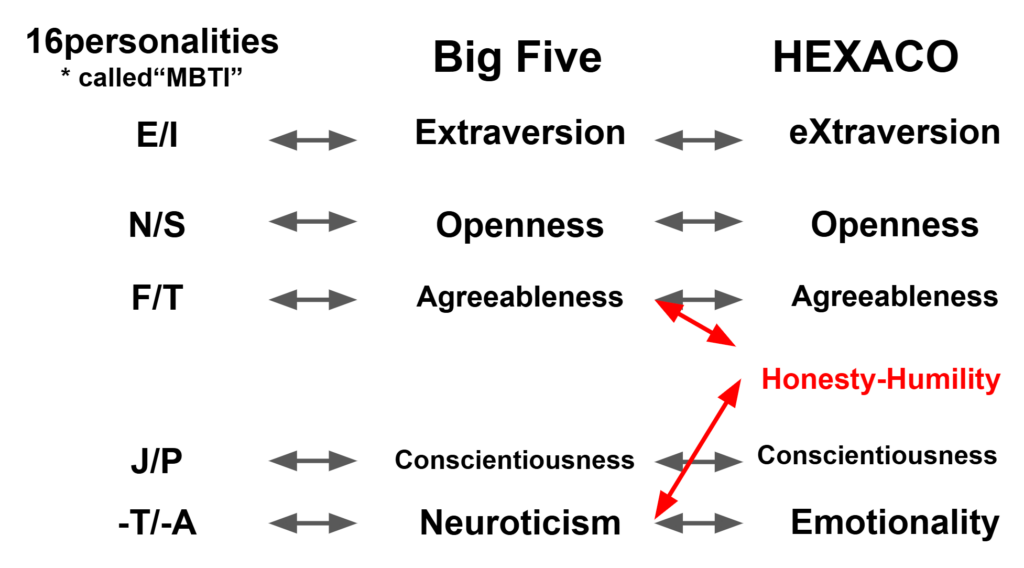
Also, in 16personalities, which was created with reference to MBTI and Big Five, neuroticism from Big Five is called “Identity“, and is classified as either Assertive or Turbulent.
On the far right is the relatively new personality assessment “HEXACO“. It is an improved version of Big Five with one additional indicator “Honesty-Humility”. Research on bullying and harassment perpetrators is active in HEXACO studies.
Since 16personalities and MBTI have weak scientific evidence, this article provides detailed explanations of 16personalities personality types based on their correlations with Big Five and HEXACO.
Try Taking the Proper Personality Test “HEXACO-JP”!
While MBTI and 16personalities are popular as “gateways to knowing yourself,” experiencing a scientifically-backed personality test is the best way to truly understand your strengths and risks.
That’s where we recommend the HEXACO assessment available in Japanese: “HEXACO-JP“.
HEXACO-JP visualizes your personality tendencies numerically based on six factors: Honesty-Humility, Emotionality, Extraversion, Agreeableness, Conscientiousness, and Openness.
By simply answering straightforward questions, you can gain helpful insights for self-understanding, relationships, and workplace communication.
If you’re curious about “What type of person am I?”, start by taking HEXACO-JP and examine yourself from a scientific perspective.

FAQ and Important Notes
HEXACO results differ from 16personalities (commonly known as MBTI test) or MBTI (original)
- Personality is influenced by genetics and environment, so when the environment changes, responses also change (for example, emotional responses change when you’re tired, etc.). For more details on genetics, see here.
- There are variations in responses depending on age. For more details, see here.
- Type classification is based on whether each value is 3 or above, or below 3, so values close to 3 are more likely to change results depending on how questions are asked or the environment at the time. Please look at the numerical values rather than the type.
- For MBTI (original) and 16personalities (commonly known as MBTI test), it’s unclear how much statistical processing was done at the question design stage as no research papers can be found. On the other hand, papers on Big Five and HEXACO can be easily found, and this HEXACO-JP test is based on research papers.
- While there aren’t many research papers comparing MBTI and 16personalities with everyday behaviors (academic performance, income, etc.) or with the brain and genetics, there are numerous studies on Big Five and HEXACO.
- HEXACO is a variation of Big Five elements, so they are similar but distinct. HEXACO’s Honesty-Humility is extracted from Big Five’s Agreeableness and Neuroticism.
If you have any other questions, please contact us through our inquiry form.
Personality test results are merely “hints” for your life
As mentioned earlier, personality is influenced by genetics and environment. Due to genetic influence, there is a certain range of variation, but answers can vary to some extent depending on the environment.
Also, while Big Five and HEXACO research papers conduct correlation analyses with academic performance and income, the correlation coefficients are not as large as those in natural science experiments. Correlation coefficients range from -1 to 1, but most are around -0.4 to 0.4. Of course, there are higher ones too, but they’re not 0.8 or 0.9 – they’re relatively lower in comparison.
However, since there is various research available, please think of it as “more than fortune-telling, less than natural science.” I’m not 100% denying psychology or fortune-telling.

Writer & Supervisor: Eisuke Tokiwa
Personality Psychology Researcher / CEO, SUNBLAZE Inc.
As a child he experienced poverty, domestic abuse, bullying, truancy and dropping out of school — first-hand exposure to a range of social problems. He spent 10 years researching these issues and published Encyclopedia of Villains through Jiyukokuminsha. Since then he has independently researched the determinants of social problems and antisocial behavior (work, education, health, personality, genetics, region, etc.) and has published 2 peer-reviewed journal articles (Frontiers in Psychology, IEEE Access). His goal is to predict the occurrence of social problems. Spiky profile (WAIS-IV).
Expertise: Personality Psychology / Big Five / HEXACO / MBTI / Prediction of Social Problems
Researcher profiles: ORCID / Google Scholar / ResearchGate
Social & Books: X (@etokiwa999) / note / Amazon Author Page
Frequently Asked Questions
What is the ESTJ love personality like in a relationship?
The ESTJ love personality is characterized by loyalty, practicality, and a strong sense of commitment. ESTJs tend to express affection through actions — providing stability, keeping promises, and actively problem-solving for their partners. They approach romance seriously and are less likely to enter casual relationships. While they may not be the most verbally expressive partners, their consistency and reliability tend to build deep, lasting trust over time.
Who is most compatible with an ESTJ in romance?
ESTJ compatibility tends to be strongest with personality types who value structure, reliability, and clear communication. Types such as ISTJ and ISFJ — who share the Sensing and Judging preferences — often report harmonious relationships with ESTJs. More feeling-oriented types like INFP or ENFP can create a complementary dynamic, though these pairings may require more conscious effort around emotional communication and flexibility to thrive long-term.
Do ESTJs struggle with expressing emotions in relationships?
Yes, ESTJ emotional expression tends to be one of their most common relationship challenges. ESTJs naturally process experiences through logic rather than emotion, which can make them appear distant or unfeeling even when they are genuinely invested in their partner. Research on personality type romance suggests that ESTJs who consciously practice active listening and verbal affirmation tend to report significantly higher relationship satisfaction for both themselves and their partners.
What are the biggest strengths an ESTJ brings to a romantic relationship?
Key ESTJ partner strengths include exceptional reliability, financial and practical stability, direct communication, and long-term commitment. ESTJs rarely walk away from a relationship at the first sign of difficulty — they tend to work through problems methodically and view the partnership as something worth investing in. For partners who value dependability and security, an ESTJ’s steadfast nature can be an enormous asset in building a lasting relationship.
How does the Big Five personality model relate to ESTJ relationships?
The Big Five model measures personality through 5 traits: Conscientiousness, Agreeableness, Extraversion, Openness, and Emotional Stability. Research — including a widely cited meta-analysis — suggests that high Conscientiousness and Agreeableness are the strongest predictors of romantic satisfaction. ESTJs naturally score high in Conscientiousness, which is a strong foundation. However, they may benefit from intentionally developing Agreeableness — the warmth and empathy dimension — to further enhance their relationship quality.
Can an ESTJ change their love style to be more emotionally expressive?
Research on personality and behavior suggests that while core personality traits are relatively stable, specific behavioral habits — such as emotional expression — can be developed with intentional practice. ESTJs do not need to abandon their logical nature to become better romantic partners. Small, consistent actions like asking about a partner’s feelings, pausing before problem-solving, and offering verbal appreciation can meaningfully improve ESTJ relationship dynamics without requiring a fundamental personality change.
Is the ESTJ personality type rare in romantic relationships?
ESTJs are not among the rarest MBTI types — they represent approximately 8–12% of the general population, with a slightly higher prevalence among men than women. In romantic relationships, their straightforward and structured approach to love can stand out in a positive way, particularly for partners who have experienced unpredictability in past relationships. Their directness and stability tend to be qualities that partners come to deeply appreciate over the long term.
Summary: Building on the ESTJ Love Personality
The ESTJ love personality is one defined by genuine dedication, practical devotion, and an enduring commitment to building something real with a partner. Their natural strengths — reliability, follow-through, and clear communication — provide a remarkably solid foundation for long-term romance. At the same time, research suggests that ESTJs who invest in emotional expressiveness and flexibility tend to experience the most fulfilling partnerships. The gap between a good ESTJ relationship and a truly great one often comes down to just a few intentional habits layered on top of their already impressive strengths. If you are curious about how your own personality type shapes your approach to love and relationships, explore your full MBTI profile to discover which of your natural traits are already working in your favor — and where a little growth could open up something even better.