ISTJ love personality traits are defined by something rare in modern dating: genuine reliability, quiet devotion, and a commitment that runs deeper than words. If you have ever wondered why the ISTJ in your life shows love through actions rather than declarations, psychology offers a clear and fascinating explanation.
Research grounded in personality science suggests that the traits most closely associated with the ISTJ type — high conscientiousness, steady loyalty, and a preference for long-term planning — are the same traits consistently linked to greater relationship satisfaction. This article unpacks what that means in practice, what challenges ISTJs typically face in romance, and how to build a lasting bond with — or as — an ISTJ.
Once again, personality researcher and author of Villain Encyclopedia, Tokiwa (@etokiwa999), will provide the explanation.
※We have developed the HEXACO-JP Personality Assessment! It has more scientific basis than MBTI. Tap below for details.

目次
- 1 ISTJ (The Inspector) Characteristics and Tendencies
- 2 ISTJ Love Personality Traits: Are They the Ideal Partner?
- 3 What Personality Research Says About ISTJ Compatibility and Relationship Satisfaction
- 4 How ISTJs Express Love: Understanding Introverted Sensing Love Patterns
- 5 Scientific Background of the 16 Types
- 6 ISTJ Partner Strengths and Common Relationship Challenges
- 7 Try Taking the Proper Personality Test “HEXACO-JP”!
- 8 Actionable Advice: How ISTJs Can Build Stronger, More Fulfilling Relationships
- 9 FAQ and Important Notes
- 10 Frequently Asked Questions
- 10.1 What are the most defining ISTJ love personality traits?
- 10.2 Who is most compatible with an ISTJ in a romantic relationship?
- 10.3 Why do ISTJs struggle to express emotions in relationships?
- 10.4 Does being an ISTJ mean you will be unhappy in love?
- 10.5 How should a partner of an ISTJ interpret their behavior in a relationship?
- 10.6 What is the biggest relationship weakness of the ISTJ type?
- 10.7 Can ISTJs become more emotionally expressive over time?
- 11 Summary: The Quiet Depth of ISTJ Love
ISTJ (The Inspector) Characteristics and Tendencies
ISTJ is a type that excels in responsibility and stability.
They tend to approach things realistically and systematically.
They value rules and procedures and are the backbone of organizations.
Their persistent attitude toward solving problems is a distinctive characteristic.
The characteristics and tendencies of ISTJ are as follows:
- They keep promises and rules, building trust.
- They carefully check details to prevent errors.
- They make plans and execute them steadily.
- They make careful judgments and prioritize stability.
- They demonstrate solid and practical abilities.
On the other hand, lacking flexibility can make it difficult to adapt to change.
They tend to prefer conventional methods over new approaches.
Their limited emotional expression can sometimes lead to misunderstandings.
Growth is encouraged by broadening their perspective.
ISTJ can take on honest and trusted roles.
Their stability-seeking attitude provides reassurance to those around them.
They can accumulate achievements through long-term effort.
ISTJ Love Personality Traits: Are They the Ideal Partner?
Among the 16 MBTI types, ISTJs tend to rank as one of the most dependable and committed romantic partners. This is not because they are the most expressive or spontaneous — quite the opposite. The ISTJ’s romantic appeal comes from their unwavering sense of duty, their refusal to make promises they cannot keep, and their natural instinct to build something stable and lasting with the person they love.
Understanding the ISTJ relationship style means recognizing that love, for them, is a serious long-term investment rather than an exciting short-term thrill. They tend to enter relationships slowly and carefully, but once committed, they are extraordinarily loyal. Where other types might chase novelty, the ISTJ finds meaning in consistency and reliability.
- Actions over words: ISTJs tend to show affection through practical gestures — showing up on time, remembering important dates, handling responsibilities so their partner doesn’t have to worry.
- Promise-keeping as love language: For an ISTJ, breaking a commitment is nearly unthinkable. Keeping their word is one of the primary ways they communicate that a relationship matters to them.
- Reserved emotional expression: ISTJs often struggle to articulate feelings verbally, which can lead partners to misread their level of investment or warmth.
- Preference for stability: They tend to dislike sudden changes in relationship dynamics and feel most secure in predictable, structured partnerships.
The potential weakness in this profile is clear: a partner who needs frequent verbal reassurance or spontaneous romantic gestures may feel emotionally underfed. The ISTJ’s challenge — and opportunity — is to recognize that warmth, when expressed even in small ways, multiplies the effect of their already-solid reliability. Adding occasional emotional openness to their natural steadiness brings them remarkably close to what many people describe as an ideal partner.
What Personality Research Says About ISTJ Compatibility and Relationship Satisfaction
The psychological traits that define ISTJs overlap significantly with the personality dimensions that research associates with higher relationship satisfaction. To understand why, it helps to look at the Big Five personality model — one of the most widely used frameworks in personality psychology. The Big Five describes human personality across 5 dimensions: conscientiousness, agreeableness, extraversion, openness to experience, and emotional stability (also called neuroticism in its low form).
Research suggests that 2 of these dimensions are especially strong predictors of romantic satisfaction:
- High conscientiousness: People who score high here tend to be disciplined, organized, and follow through on commitments — core ISTJ characteristics. Studies indicate these individuals are more likely to invest consistently in their relationships over time.
- High agreeableness: Warm, cooperative, and empathetic individuals tend to create more harmonious partnerships. In MBTI terms, this maps loosely onto the “F” (Feeling) dimension — an area where ISTJs, as “T” (Thinking) types, sometimes need to develop intentional habits.
A notable meta-analysis — Malouff et al. (2010), “The Five-Factor Model of personality and relationship satisfaction of intimate partners” — synthesized findings across multiple studies and concluded that conscientiousness and agreeableness are the 2 strongest personality predictors of relationship satisfaction for both partners. This finding is directly relevant to understanding ISTJ emotional expression in love: their high conscientiousness is already a relationship asset, and consciously cultivating agreeableness and emotional openness tends to round out their romantic profile significantly.
How ISTJs Express Love: Understanding Introverted Sensing Love Patterns
The ISTJ’s dominant cognitive function — Introverted Sensing — shapes their romantic expression in ways that are often misunderstood but deeply meaningful once recognized. Introverted Sensing is a function that stores and organizes personal memories and past experiences, using them as a reliable framework for present decisions. In love, this translates into a very specific, memory-rich way of caring.
An ISTJ partner tends to remember the little things — the restaurant where you had your first date, the exact way you take your coffee, the anniversary you mentioned once in passing three months ago. These introverted sensing love patterns are not accidental. They are an expression of how seriously the ISTJ takes the relationship. They catalog meaningful shared experiences and use them to demonstrate that they are paying close, sustained attention.
In practical terms, ISTJ emotional expression often looks like this:
- Quietly handling a task the partner mentioned finding stressful
- Preparing for a shared event with meticulous care and attention to detail
- Staying consistent during difficult periods rather than withdrawing
- Referencing past shared memories to show ongoing emotional investment
Partners who understand these patterns tend to experience much greater ISTJ compatibility, because they recognize that the absence of grand romantic gestures does not signal a lack of feeling — it signals a different, quieter form of depth.
Scientific Background of the 16 Types
MBTI Overview
MBTI is a psychological theory that classifies personality into 16 types.
To begin with, MBTI is an abbreviation for Myers-Briggs Type Indicator.
MBTI classifies personality into 16 types by combining the following 4 indicators.
In other words, MBTI expresses one’s personality tendencies in 4 letters such as “ISTJ” or “ENFP”. There is a very famous similar system called 16personalities, but this is created by combining MBTI and Big Five.
Big Five Overview
One of the most prominent trait theories in personality psychology is the “Big Five”.
Big Five measures five traits: Openness, Conscientiousness, Extraversion, Agreeableness, and Neuroticism.
Also, while 16personalities and MBTI use type classification (e.g., either extraverted or introverted), a major difference is that Big Five evaluates traits on a continuous numerical scale (e.g., extraversion 3.5).
Furthermore, it has been studied for a long time, has many research papers, and extensive research has been conducted in other fields such as academic achievement, income, brain, and genetics. It can be said that Big Five has relatively stronger scientific backing.
Correlation Between MBTI, Big Five, and HEXACO
There are correlations between MBTI’s 4 indicators and Big Five’s 5 factors.
A representative study showing this correlation is the paper “The relationship between the revised NEO-Personality Inventory and the Myers-Briggs Type Indicator“.
According to this paper, the correlations between MBTI and Big Five are as follows.
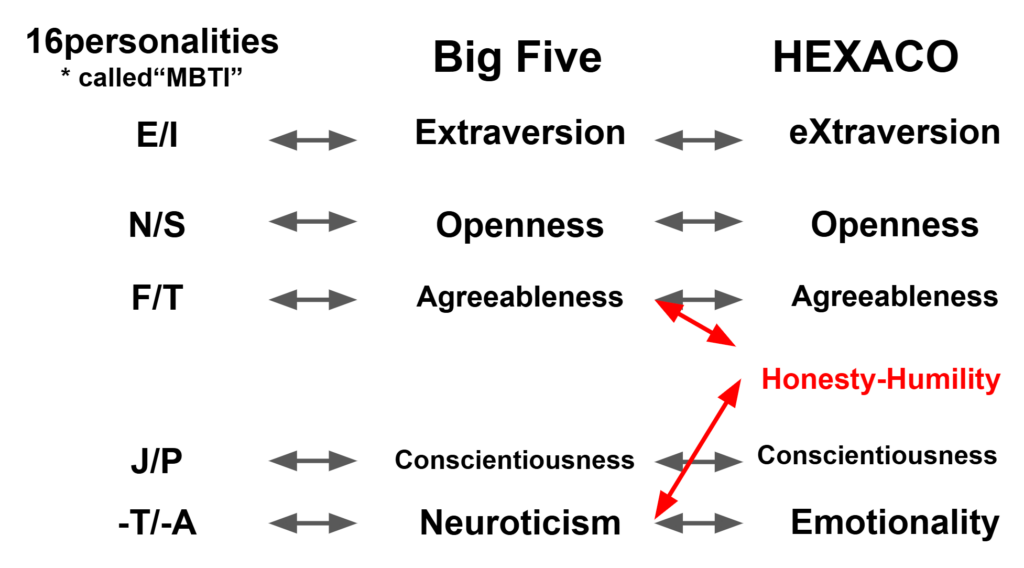
Also, in 16personalities, which was created with reference to MBTI and Big Five, neuroticism from Big Five is called “Identity“, and is classified as either Assertive or Turbulent.
On the far right is the relatively new personality assessment “HEXACO“. It is an improved version of Big Five with one additional indicator “Honesty-Humility”. Research on bullying and harassment perpetrators is active in HEXACO studies.
Since 16personalities and MBTI have weak scientific evidence, this article provides detailed explanations of 16personalities personality types based on their correlations with Big Five and HEXACO.
ISTJ Partner Strengths and Common Relationship Challenges
ISTJs bring approximately 3 major strengths to romantic relationships, each backed by both personality research and practical observation. However, each strength also carries a corresponding challenge worth understanding.
Strength 1: Reliability and Trustworthiness
ISTJs are among the most reliable MBTI types in relationships. They follow through on commitments, show up when they say they will, and rarely make promises they cannot keep. This creates a foundation of trust that many partners find deeply reassuring — especially in long-term relationships where day-to-day consistency matters more than dramatic gestures. The challenge: this reliability can sometimes tip into rigidity. When life requires flexibility or spontaneous emotional support, ISTJs may struggle to adapt quickly.
Strength 2: Long-Term Commitment Focus
Unlike types that thrive on romantic excitement, ISTJs tend to evaluate relationships through a long-term lens. They ask, implicitly or explicitly: “Is this someone I can build a stable life with?” This orientation means they are unlikely to treat relationships casually and are naturally invested in making things work over time. The challenge: the early stages of dating can feel slow or overly cautious to more spontaneous partners who interpret the ISTJ’s measured pace as disinterest.
Strength 3: Practical Acts of Love
ISTJs express care by solving problems, managing logistics, and taking on responsibilities that reduce their partner’s stress. Research on love languages suggests that “acts of service” is among the most practically impactful forms of love expression — and ISTJs tend to naturally excel here. The challenge: partners whose primary love language is “words of affirmation” may not automatically connect these practical acts to emotional affection, creating a perception gap that requires conscious communication on both sides.
Try Taking the Proper Personality Test “HEXACO-JP”!
While MBTI and 16personalities are popular as “gateways to knowing yourself,” experiencing a scientifically-backed personality test is the best way to truly understand your strengths and risks.
That’s where we recommend the HEXACO assessment available in Japanese: “HEXACO-JP“.
HEXACO-JP visualizes your personality tendencies numerically based on six factors: Honesty-Humility, Emotionality, Extraversion, Agreeableness, Conscientiousness, and Openness.
By simply answering straightforward questions, you can gain helpful insights for self-understanding, relationships, and workplace communication.
If you’re curious about “What type of person am I?”, start by taking HEXACO-JP and examine yourself from a scientific perspective.
Actionable Advice: How ISTJs Can Build Stronger, More Fulfilling Relationships
Understanding ISTJ love personality traits is only useful if it leads to concrete improvements in how ISTJs relate to their partners. The following advice is grounded in the personality research discussed above and focuses on leveraging existing ISTJ strengths while intentionally developing the areas most likely to create friction.
- Verbalize appreciation more often — and explain why it works: ISTJs naturally show love through actions, but research on relationship communication suggests that verbal affirmation significantly boosts a partner’s sense of security. The goal is not to fake emotional expressiveness, but to translate existing feelings into brief, specific statements. For example: “I really appreciate how you handled that situation” is more effective than silence, even when the ISTJ’s actions already show care.
- Build a small ritual of emotional check-ins: Because ISTJs value routine, a structured approach to emotional communication tends to work better than open-ended “let’s talk about feelings” conversations. Setting aside 10 minutes each week to ask a partner “How are you feeling about us lately?” gives both parties a reliable outlet without feeling overwhelming.
- Leverage conscientiousness in relationship maintenance: Research indicates conscientiousness is a top predictor of relationship satisfaction. ISTJs can actively channel this strength by treating relationship health as a responsibility — scheduling quality time, planning thoughtful gestures in advance, and proactively addressing small tensions before they grow.
- Develop tolerance for ambiguity and change: Studies suggest that relationship longevity often depends on both partners’ ability to adapt. ISTJs who practice small, intentional steps outside their comfort zone — trying a new date activity, adjusting plans gracefully — tend to experience fewer conflicts rooted in rigidity.
- Communicate your love logic to your partner: Many misunderstandings in ISTJ relationships stem from partners not realizing that quiet reliability is the ISTJ’s primary love expression. Simply explaining this tendency — “When I handle tasks for you, that’s how I show I care” — can transform a partner’s perception and dramatically reduce emotional distance.

FAQ and Important Notes
HEXACO results differ from 16personalities (commonly known as MBTI test) or MBTI (original)
- Personality is influenced by genetics and environment, so when the environment changes, responses also change (for example, emotional responses change when you’re tired, etc.). For more details on genetics, see here.
- There are variations in responses depending on age. For more details, see here.
- Type classification is based on whether each value is 3 or above, or below 3, so values close to 3 are more likely to change results depending on how questions are asked or the environment at the time. Please look at the numerical values rather than the type.
- For MBTI (original) and 16personalities (commonly known as MBTI test), it’s unclear how much statistical processing was done at the question design stage as no research papers can be found. On the other hand, papers on Big Five and HEXACO can be easily found, and this HEXACO-JP test is based on research papers.
- While there aren’t many research papers comparing MBTI and 16personalities with everyday behaviors (academic performance, income, etc.) or with the brain and genetics, there are numerous studies on Big Five and HEXACO.
- HEXACO is a variation of Big Five elements, so they are similar but distinct. HEXACO’s Honesty-Humility is extracted from Big Five’s Agreeableness and Neuroticism.
If you have any other questions, please contact us through our inquiry form.
Personality test results are merely “hints” for your life
As mentioned earlier, personality is influenced by genetics and environment. Due to genetic influence, there is a certain range of variation, but answers can vary to some extent depending on the environment.
Also, while Big Five and HEXACO research papers conduct correlation analyses with academic performance and income, the correlation coefficients are not as large as those in natural science experiments. Correlation coefficients range from -1 to 1, but most are around -0.4 to 0.4. Of course, there are higher ones too, but they’re not 0.8 or 0.9 – they’re relatively lower in comparison.
However, since there is various research available, please think of it as “more than fortune-telling, less than natural science.” I’m not 100% denying psychology or fortune-telling.
Frequently Asked Questions
What are the most defining ISTJ love personality traits?
The most defining ISTJ love personality traits tend to be reliability, quiet loyalty, and a preference for showing affection through actions rather than words. ISTJs typically approach relationships with a long-term mindset, take their commitments very seriously, and express care through practical gestures like handling responsibilities or remembering important details. While they may seem emotionally reserved compared to Feeling types, research suggests their high conscientiousness is one of the strongest predictors of sustained relationship satisfaction.
Who is most compatible with an ISTJ in a romantic relationship?
ISTJ compatibility tends to be strongest with partners who value stability, respect personal space, and appreciate quiet consistency over dramatic emotional displays. Types that share the ISTJ’s preference for structure — such as ESTJ or ISFJ — often experience natural compatibility. However, research indicates personality compatibility is less important than communication quality and mutual respect. An ISTJ willing to develop emotional expressiveness can build fulfilling relationships with a wide range of personality types.
Why do ISTJs struggle to express emotions in relationships?
ISTJs tend to struggle with emotional expression because their dominant cognitive function — Introverted Sensing — is oriented toward practical memory and lived experience rather than outward emotional communication. Additionally, as a Thinking (T) type, ISTJs naturally prioritize logic and objective problem-solving over verbal emotional processing. This is not indifference — research on MBTI love traits suggests ISTJs feel deeply but express those feelings through actions, reliability, and practical support rather than frequent verbal declarations.
Does being an ISTJ mean you will be unhappy in love?
Not at all. Research consistently shows that high conscientiousness — one of the core ISTJ partner strengths — is among the top predictors of relationship satisfaction for both the individual and their partner. ISTJs who also develop emotional openness and communication skills tend to build exceptionally stable, long-lasting relationships. The key is recognizing that their natural love style is valid, while remaining willing to adapt their expression to meet a partner’s emotional needs.
How should a partner of an ISTJ interpret their behavior in a relationship?
Partners of ISTJs benefit most from understanding that introverted sensing love patterns mean reliability and practical care are the primary love language of the ISTJ. If an ISTJ handles a stressful task for you, remembers an important date, or stays consistent during a difficult period, these are significant emotional expressions — not just habits. Misreading this behavior as emotional distance is one of the most common sources of conflict in ISTJ relationships, and simple open conversations about love languages can resolve it quickly.
What is the biggest relationship weakness of the ISTJ type?
The most commonly noted relationship weakness in ISTJs is a tendency toward emotional reservation that can leave partners feeling unseen or emotionally unmet. Their preference for stability can also manifest as resistance to change, which may create friction when a relationship needs to evolve. Research on MBTI love traits suggests that ISTJs who proactively develop habits of verbal affirmation and emotional check-ins — even briefly — experience significantly fewer relationship conflicts tied to this pattern.
Can ISTJs become more emotionally expressive over time?
Yes. Personality research indicates that while core traits like conscientiousness remain relatively stable, emotional expression behaviors are learned skills that can be developed with intentional practice. ISTJs who recognize the value of verbal affirmation and build small, structured habits around emotional communication — such as brief weekly check-ins with their partner — tend to become meaningfully more expressive over time without compromising their authentic personality. Growth in this area tends to improve both their own relationship satisfaction and their partner’s.
Summary: The Quiet Depth of ISTJ Love
At their core, ISTJ love personality traits represent something increasingly rare: a form of romantic devotion that is built on action, sustained through consistency, and grounded in genuine long-term commitment. Research on the Big Five personality model reinforces what many ISTJ partners already know intuitively — that conscientiousness and reliability are not lesser forms of love, but foundational ones. The ISTJ’s greatest romantic challenge is not learning to feel more, but learning to let those feelings become visible. When they do, the combination of steadfast loyalty and growing emotional warmth tends to create partnerships that are both deeply secure and genuinely fulfilling. If you have recognized yourself — or someone you love — in this profile, explore which specific relationship patterns resonate most and use that self-awareness as a starting point for deeper connection.

Writer & Supervisor: Eisuke Tokiwa
Personality Psychology Researcher / CEO, SUNBLAZE Inc.
As a child he experienced poverty, domestic abuse, bullying, truancy and dropping out of school — first-hand exposure to a range of social problems. He spent 10 years researching these issues and published Encyclopedia of Villains through Jiyukokuminsha. Since then he has independently researched the determinants of social problems and antisocial behavior (work, education, health, personality, genetics, region, etc.) and has published 2 peer-reviewed journal articles (Frontiers in Psychology, IEEE Access). His goal is to predict the occurrence of social problems. Spiky profile (WAIS-IV).
Expertise: Personality Psychology / Big Five / HEXACO / MBTI / Prediction of Social Problems
Researcher profiles: ORCID / Google Scholar / ResearchGate
Social & Books: X (@etokiwa999) / note / Amazon Author Page