
Personal growth at work is not just about working harder — research suggests it starts with understanding who you already are. Have you ever sat at your desk thinking, “Maybe this job just isn’t for me”? That nagging feeling of misalignment is more common than you might think, and personality psychology offers a remarkably practical way to address it. By examining your own character traits through frameworks like the Big Five personality traits or the HEXACO model, you can gain an objective map of your strengths, your blind spots, and the environments where you are most likely to thrive.
This complete guide explores how personality psychology applies directly to your career — from choosing the right job in the first place, to improving daily workplace relationships, maintaining job motivation, and developing a leadership style that feels authentic rather than forced. Every section is grounded in scientific research and written to be immediately actionable, whether you are a student choosing a first career, a professional feeling stuck, or a manager trying to get the best from a diverse team.
Once again, personality researcher and author of Villain Encyclopedia, Tokiwa (@etokiwa999), will provide the explanation.
※We have developed the HEXACO-JP Personality Assessment! It has more scientific basis than MBTI. Tap below for details.

目次
- 1 How Your Personality Shapes Your Work Performance and Satisfaction
- 2 The Big Five Personality Traits and Career Fit: What Science Tells Us
- 3 Using Personality Insights to Improve Workplace Relationships
- 4 Personality-Driven Strategies for Sustaining Job Motivation
- 5 The Science of Leadership Styles and Personality
- 6 Personality-Based Career Planning: Finding Your Optimal Career Path
- 7 Actionable Advice: Putting Personality Psychology to Work
- 8 Frequently Asked Questions
- 8.1 What should I do if my personality assessment suggests I am in the wrong career?
- 8.2 Can understanding personality traits really improve difficult workplace relationships?
- 8.3 Why does job motivation vary so much between people with similar skills?
- 8.4 Do you need to be extroverted to be an effective leader?
- 8.5 How can I use my personality profile to evaluate a potential new employer before accepting a job offer?
- 8.6 Can personality traits change over time, or are they fixed for life?
- 8.7 Which personality model is most useful for career planning — Big Five or HEXACO?
- 9 Summary: Turn Self-Knowledge Into Career Momentum
- 10 Related In-Depth Articles
- 11 More Related In-Depth Articles
- 12 Try Taking the Proper Personality Test “HEXACO-JP”!
- 13 Scientific Background of the 16 Types
- 14 FAQ and Important Notes
How Your Personality Shapes Your Work Performance and Satisfaction
Research suggests that personality traits account for approximately 60% of the variation in job performance and workplace satisfaction. In other words, choosing a career without understanding your own character could cut your chances of long-term success roughly in half. This single insight makes personality-based career planning one of the most evidence-backed investments you can make in your professional life.
Personality influences work through 2 primary channels: cognitive style and core values. Cognitive style refers to the habitual way you process information and arrive at decisions — some people think in structured, step-by-step sequences, while others prefer to jump between ideas and spot big-picture patterns. Core values, on the other hand, determine what you consider important and worth pursuing. When your cognitive style and values clash with your work environment, chronic stress almost inevitably follows, regardless of how competent you are.
Consider a few concrete illustrations of this mismatch effect:
- Extroverted individuals tend to gain energy from social interaction and typically perform well in teamwork-heavy roles such as sales, public relations, or client-facing positions.
- Introverted individuals tend to do their best thinking in quieter, more independent settings — making research, technical writing, programming, or specialist consulting well-suited environments.
- Those with higher neuroticism (emotional instability) may find it harder to maintain peak performance in high-pressure, chaotic workplaces, and may benefit from roles with more predictability.
- People high in Openness to Experience often report the greatest satisfaction in creative, innovative roles that reward curiosity and novel thinking.
- Highly conscientious individuals typically excel in structured environments where rule-following, scheduling, and meticulous quality control are prized.
Beyond individual job roles, personality also interacts powerfully with organizational culture. An innovative, flat-hierarchy startup tends to reward high Openness and moderate Agreeableness, while a traditional, process-driven institution often values high Conscientiousness and adherence to established procedures. This means that even 2 people in the same job title — say, project manager — can thrive at one company and struggle at another, purely because of the cultural fit dimension. Understanding this nuance is the foundation of smart career fit assessment.
The Big Five Personality Traits and Career Fit: What Science Tells Us
The Big Five model is widely regarded as the most scientifically validated framework for predicting occupational suitability, with some studies indicating accuracy rates of over 80% when matching personality profiles to career outcomes. Understanding where you fall on each of the 5 dimensions gives you a remarkably clear picture of the work environments where you are likely to feel engaged and effective.
The Big Five personality traits — also called the OCEAN model — are Openness to Experience, Conscientiousness, Extraversion, Agreeableness, and Neuroticism. Each dimension exists on a spectrum, and your unique combination of scores creates a personality “fingerprint” that can be compared against the demands of different careers. The HEXACO model extends this framework by adding a 6th dimension — Honesty-Humility — which research suggests is particularly useful for predicting ethical conduct and counterproductive workplace behavior.
Here is how each Big Five dimension tends to map onto broad career categories:
- High Extraversion: Sales, marketing, teaching, human resources, hospitality, event management — roles that involve frequent, energizing social contact.
- Low Neuroticism (high emotional stability): Emergency medicine, surgery, crisis management, senior leadership — roles requiring calm judgment under intense pressure.
- High Openness: Research and development, design, the arts, strategy consulting, entrepreneurship — roles that reward imagination and tolerance of ambiguity.
- High Conscientiousness: Accounting, law, quality assurance, project management, logistics — roles where precision, reliability, and discipline directly drive results.
- High Agreeableness: Nursing, social work, counseling, teaching, and team leadership — roles centered on empathy, cooperation, and the well-being of others.
One critical insight is that no single trait is universally “better” than another. What matters is the fit between your overall profile and your job environment. For example, an introverted person with high Openness may produce exceptional work as an independent researcher or writer — an environment that would frustrate a highly extroverted individual craving social stimulation. Conversely, someone high in both Extraversion and Conscientiousness tends to be a natural fit for roles that blend team leadership with disciplined project execution.
Personality traits also interact with each other. A combination of high Openness and low Conscientiousness, for instance, can produce bursts of brilliant creativity alongside a tendency to struggle with deadlines — something important to account for in workplace personality assessments. This is why evaluating the full profile, rather than a single isolated trait, produces the most useful guidance for personality-based career planning.
Using Personality Insights to Improve Workplace Relationships
Studies indicate that roughly 75% of workplace stress originates from interpersonal conflict, and that understanding personality compatibility can prevent up to 90% of common colleague disputes before they escalate. Personality psychology does not just help you pick the right job — it equips you with a practical framework for navigating the human side of work every single day.
The first step toward better workplace relationships is observation. By paying attention to how a colleague or manager habitually communicates, makes decisions, and responds to stress, you can make reasonable inferences about their personality profile. You do not need to administer a formal test — behavioral cues are often enough to guide your approach. Once you have a rough sense of someone’s dominant traits, you can tailor your communication style to reduce friction and build genuine rapport.
- Working with extroverted colleagues: Engage them in face-to-face conversations, include them in brainstorming sessions, and give them opportunities to present ideas publicly — this is where they generate their best energy.
- Working with introverted colleagues: Offer information in advance so they can prepare, prefer written communication for non-urgent matters, and respect their need for uninterrupted focus time.
- Working with highly open individuals: Signal your openness to new ideas, invite creative proposals, and avoid shutting down unconventional suggestions too quickly.
- Working with highly conscientious individuals: Honor every commitment you make to them, provide structured and documented information, and avoid last-minute changes whenever possible.
- Supporting colleagues with higher neuroticism: Provide clear, predictable expectations, offer non-critical feedback, and create a psychologically safe environment where mistakes are treated as learning opportunities rather than failures.
It is equally important to reflect on how your own personality traits affect those around you. A person with very high Openness, for example, may unintentionally unsettle more conservative colleagues by introducing too much change too quickly. In such cases, presenting new ideas incrementally and explicitly acknowledging the value of existing structures can smooth the transition considerably.
Perhaps the most powerful reframe in personality-informed relationship management is moving from seeing differences as “problems” to seeing them as complementary strengths. A team that includes both a highly systematic, conscientious planner and a spontaneous, open-minded creative is arguably better equipped to handle complex projects than a team of identical personalities. Research on team composition consistently supports the view that personality diversity, when well-managed, enhances both productivity and overall job satisfaction — a genuine win for everyone involved.
Personality-Driven Strategies for Sustaining Job Motivation
Research suggests that job motivation varies significantly by personality type, and that aligning motivational strategies with individual traits can improve productivity by approximately 40%. Rather than applying a one-size-fits-all approach, personality psychology gives you a personalized toolkit for keeping your drive strong over the long term.
At the core of personality-based motivation theory is a simple observation: what energizes one person can drain another. Extroverted individuals tend to be motivated by external recognition — praise from peers, visible career advancement, and opportunities to influence others. Introverted individuals, by contrast, often derive their deepest satisfaction from private mastery — growing their expertise, solving intellectually demanding problems, and seeing the tangible results of their independent effort. Neither source of motivation is superior; they are simply different engines that require different types of fuel.
- High Extraversion: Seek out team-based goals, volunteer for presentation opportunities, build professional networks, and celebrate shared wins with colleagues.
- High Introversion: Protect blocks of uninterrupted deep work, set personal mastery milestones, and choose projects that allow meaningful independent contribution.
- High Openness: Look for novel challenges, request rotation across different projects, pursue continuous learning, and pitch creative experiments to management.
- High Conscientiousness: Set clear, measurable goals with explicit timelines, use progress-tracking tools, and take on roles that carry tangible responsibility and accountability.
- High Agreeableness: Seek roles with a clear helping mission, celebrate contributions to the team, and cultivate a harmonious, supportive team environment around you.
Goal-setting strategies should also be calibrated to personality. Individuals with higher neuroticism tend to benefit most from breaking large goals into small, immediately achievable milestones — each small win provides a confidence boost that sustains forward momentum. People high in Openness, on the other hand, often feel more energized by ambitious, open-ended challenges that allow for exploration and creative problem-solving along the way.
Stress recovery is another dimension where personality matters enormously. Extroverted people typically recharge by talking through problems with trusted colleagues or engaging in collaborative activities after a tough day. Introverted people generally recover more effectively through solitary activities — reading, a quiet walk, or simply time alone to process their thoughts. Personal growth at work accelerates when you stop fighting your natural recovery style and instead design your daily routine around it. This kind of self-aware, intentional approach to energy management is one of the most underrated career strategies available.
The Science of Leadership Styles and Personality
Research indicates that effective leadership is not one-size-fits-all — the right leadership style is deeply shaped by personality, and leaders who operate in alignment with their natural traits tend to generate up to 65% higher satisfaction scores among their teams. This finding challenges the outdated assumption that only bold, outwardly dominant personalities make great leaders.
Leadership is broadly defined as the ability to influence others toward a shared goal. For decades, conventional wisdom assumed that strong leadership required high extraversion and assertiveness. Modern personality research tells a more nuanced story: different personality profiles support different, equally effective leadership approaches. The key is matching your leadership style to your genuine character, rather than performing a role that does not fit.
- Transformational leadership — inspiring and motivating through vision — tends to suit individuals with high Openness and high Extraversion, who naturally communicate enthusiasm and generate new ideas.
- Servant leadership — placing the team’s needs first — is a natural fit for those high in Agreeableness and Conscientiousness, who instinctively prioritize others’ well-being and deliver on their commitments reliably.
- Transactional leadership — managing through clear expectations and structured reward systems — tends to work well for highly conscientious individuals who appreciate systems and measurable outcomes.
- Coaching leadership — developing individual team members through guided growth — benefits from a balance of Agreeableness and Openness, as it requires both empathy and intellectual flexibility.
- Visionary leadership — setting a compelling long-term direction — is most effective when anchored in high Openness combined with low Neuroticism, ensuring the leader can hold a steady course through uncertainty.
Introverted leaders often bring underappreciated strengths to the table. Studies suggest they tend to make more carefully considered decisions, listen more attentively to team members, and inspire a particular type of quiet trust that builds over time. In teams of proactive, self-starting employees, introverted leaders frequently outperform more extroverted counterparts precisely because they create space for others to contribute rather than dominating the conversation.
The single most important advice for any aspiring leader is this: avoid forcing yourself into a leadership mold that contradicts your fundamental nature. The energy spent performing an inauthentic style is energy stolen from actual leadership. Instead, identify the style that aligns with your personality profile, develop it deliberately, and build a team whose collective strengths compensate for areas where your personality naturally leaves gaps. This is the essence of psychologically informed, sustainable leadership — and it represents a powerful pathway for personal growth at any career stage.
Personality-Based Career Planning: Finding Your Optimal Career Path
Research suggests that personality-informed career decisions are associated with approximately 50% higher long-term job satisfaction and an average 30% reduction in the number of career changes people make over their working lives. Rather than relying on trial and error — which can cost years of frustration — scientific personality assessment offers a more efficient route to finding work that genuinely fits.
Effective career assessment evaluates 3 intersecting factors simultaneously: your interests, your skills, and your personality traits. Of these, personality is arguably the most predictive of sustained satisfaction, because it determines not just what you can do, but what kind of environment will sustain your energy and engagement over years and decades. Tools grounded in the Big Five or HEXACO model can reveal whether you are more likely to flourish in a structured versus flexible environment, a competitive versus collaborative culture, or a people-centered versus task-centered role.
- Technical and engineering careers: Research points to a combination of high Openness (for problem-solving) and high Conscientiousness (for precision), with Agreeableness in the moderate range.
- Sales and marketing: High Extraversion paired with high Openness tends to support performance in roles that require persuasion, creative pitching, and building client relationships.
- Human resources and education: A balance of Agreeableness and Extraversion seems important here, supporting both empathetic listening and confident group facilitation.
- Research and academia: High Openness combined with low Neuroticism tends to predict resilience through the slow, iterative nature of research work.
- Management and executive leadership: High Conscientiousness and moderate-to-high Extraversion tend to appear consistently in profiles of successful senior leaders across industries.
Personality insights are also invaluable when you are considering a career change. Before committing to a new industry or role, you can use your personality profile to evaluate whether the target environment’s culture, pace, and interpersonal demands align with your natural style. For example, a person high in Agreeableness who is considering a move into a highly competitive sales environment would be well-advised to prioritize companies with team-based, collaborative sales cultures rather than individually ranked, commission-driven ones.
Finally, personality-based insights also guide skill development strategy. Rather than trying to become equally competent in all areas, the most efficient approach is to invest heavily in skills that amplify your existing personality strengths, while building just enough capability in your weaker areas to avoid critical gaps. This targeted approach to development is faster, more motivating, and more likely to lead to true professional distinction. Viewed this way, personality assessment is not a one-time career quiz — it is a living guide for lifelong, intentional career development and personal growth.
Actionable Advice: Putting Personality Psychology to Work
Understanding your personality profile is only valuable if it translates into concrete changes. The following strategies are organized around the key challenges people face at work, with an explanation of why each approach is effective and how to begin practicing it.
1. Take a Validated Personality Assessment
Start with a scientifically grounded tool based on the Big Five or HEXACO model rather than informal quizzes. These assessments produce results that are replicable and backed by decades of research. Why it works: A reliable baseline gives you objective data to work from, reducing self-serving bias. How to practice: After completing an assessment, write down 3 traits where your score surprised you, and reflect on how those traits have played out in recent work situations.
2. Map Your Traits to Your Current Role
Create a simple 2-column list: on the left, your top 3 personality strengths; on the right, the demands of your current job. Why it works: Visualizing alignment (or misalignment) makes it easier to identify the specific sources of stress or dissatisfaction rather than experiencing them as a vague, diffuse sense of wrongness. How to practice: Review the list with a trusted colleague or mentor who knows both you and your work environment well.
3. Customize Your Communication Style for Each Colleague
Based on your observations of colleagues’ behavioral patterns, make small, intentional adjustments to how you communicate with each person. Why it works: Meeting people in their preferred communication mode reduces misunderstanding and builds trust faster than any team-building exercise. How to practice: Pick 1 colleague this week and try one specific adjustment — for example, sending a detailed written summary to a highly conscientious manager rather than an impromptu verbal update.
4. Design Your Workday Around Your Energy Patterns
Schedule your most demanding cognitive tasks during the part of the day when your personality type typically peaks in focus and energy. Why it works: Introverts often do their best deep work in morning solitude; extroverts may find collaborative afternoon sessions more productive. How to practice: For 2 weeks, track your energy levels hourly using a simple 1–5 scale, then compare the pattern to your personality profile to identify your optimal productivity windows.
5. Build a Complementary Team or Support Network
Identify 2 or 3 people whose personality strengths compensate for your natural limitations, and intentionally cultivate those relationships. Why it works: No single personality profile is perfect for every challenge. Research on team diversity consistently shows that complementary personality combinations outperform homogeneous teams on complex tasks. How to practice: If you are high in Openness but low in Conscientiousness, proactively collaborate with a detail-oriented colleague on projects where follow-through is critical.
Frequently Asked Questions
What should I do if my personality assessment suggests I am in the wrong career?
A personality assessment result is best understood as one useful data point, not a final verdict. Before concluding that you need to change careers entirely, first analyze which specific elements of your current role feel misaligned. In many cases, adjusting your responsibilities, requesting a role change within the same organization, or shifting to a team with a different culture can resolve the mismatch without a full career pivot. If deeper changes are needed, use your personality profile to research roles and industries where people with similar trait combinations tend to report high satisfaction.
Can understanding personality traits really improve difficult workplace relationships?
Research suggests that a significant proportion of workplace conflict stems from mismatched communication styles rather than genuine incompatibility of values or goals. By observing a colleague’s behavioral patterns and making informed inferences about their personality profile, you can adapt your approach in practical ways — such as giving a highly introverted colleague advance notice before meetings, or providing a very conscientious supervisor with structured, well-documented updates. These small adjustments tend to reduce friction noticeably and build trust over time, even in relationships that previously felt stuck.
Why does job motivation vary so much between people with similar skills?
Skill level and motivation are driven by different psychological mechanisms. Motivation is closely tied to personality — specifically, whether your current work environment and task type align with what your personality profile finds intrinsically rewarding. An extroverted person who spends the majority of their day on solo data entry may have strong technical skills but still experience low motivation because the environment is misaligned with their social drive. Identifying this mismatch and making even modest adjustments to task mix or collaboration opportunities can noticeably restore engagement.
Do you need to be extroverted to be an effective leader?
No — research consistently shows that multiple personality profiles can produce highly effective leadership, and that introverted leaders often outperform extroverted ones in specific contexts. Introverted leaders tend to listen more carefully, make more deliberate decisions, and create space for team members to contribute their own ideas. What matters most is whether your leadership style is authentic to your personality and appropriate for your team’s needs. Forcing yourself to perform an extroverted, high-energy style when your natural strengths lie in thoughtful analysis tends to reduce rather than improve leadership effectiveness.
How can I use my personality profile to evaluate a potential new employer before accepting a job offer?
Before accepting any offer, gather information about the company’s culture, management style, and typical work pace through targeted interview questions, employee review platforms, and if possible, informal conversations with current employees. Then compare what you learn against your personality profile: Does the environment value the traits you score highest in? Does it demand traits that you find naturally draining? Requesting a workplace tour or informational interview with a potential future colleague can provide additional behavioral clues. This due diligence significantly reduces the risk of repeating a poor fit in your next role.
Can personality traits change over time, or are they fixed for life?
Research on personality stability indicates that core traits are relatively consistent throughout adulthood, though gradual shifts — particularly increases in Conscientiousness and Agreeableness — tend to occur naturally as people age and accumulate life experience. Deliberate behavioral change is possible: you can learn skills and adopt habits that allow you to function effectively even in environments that do not perfectly match your profile. However, studies suggest that trying to fundamentally suppress your core traits generates sustained stress. The more productive strategy is to find environments that align with your natural style and practice adaptive behaviors for the situations where flexibility is genuinely required.
Which personality model is most useful for career planning — Big Five or HEXACO?
Both models are scientifically robust and useful for career planning. The Big Five (OCEAN) framework is more widely used in occupational research and provides strong predictions of job performance across a broad range of industries. The HEXACO model adds a 6th dimension — Honesty-Humility — which research indicates is particularly valuable for predicting ethical work behavior and identifying candidates at lower risk of counterproductive actions such as deception or exploitation of colleagues. For general career fit assessment, Big Five is a reliable starting point; HEXACO is especially informative when leadership integrity and organizational citizenship behavior are central concerns.
Summary: Turn Self-Knowledge Into Career Momentum
Personality psychology is not about labeling yourself or setting limits on what you can achieve. It is about working smarter — understanding the specific conditions where you naturally flourish and deliberately engineering more of those conditions into your professional life. Whether you apply the Big Five personality traits to evaluate a new job opportunity, use the HEXACO model to reflect on your ethical leadership style, or simply pay closer attention to the communication preferences of your colleagues, the insights are immediately usable. Personal growth in your career accelerates dramatically when you stop guessing and start building on a clear, science-backed understanding of who you are.
Ready to take the next step? Explore the related articles below to discover which specific personality traits predict success in your field, how workplace relationships shift when personality is taken seriously, and what research says about matching your character to a career that energizes rather than exhausts you. Your personality profile is not a limitation — it is the clearest roadmap to a career worth showing up for.
Related In-Depth Articles
- Personality Traits That Lead to Voluntary Resignation — Research Explained
- Follower Personality: Which Employees Are Most Compatible with Leaders?
- Does Education Raise Income? Twin Studies Across 7 Countries Compared
- Organizational Commitment: Which Personalities Show Company Loyalty?
- Dark Triad Motivation at Work — How to Manage These Personalities
- Job Crafting: Which Personalities Reshape Their Work and Relationships?
- Self-Determination Theory: High Motivation Is About 50% Hereditary
- What Jobs and Environments Suit Introverts? Research Explained
- Dark Tetrad Productivity: Are “Dark” Personalities High Performers?
- Academic Performance and Job Success: An Analysis by Role and Industry
- What Makes Coaching Effective — and Who Doesn’t Respond to It?
- Personality Traits Behind Strong Communication Skills — Research Explained
- Which Personalities Perform Better While Working Remotely?
- Personality Traits Linked to Workplace Bullying — and How to Respond
- What Is an Introverted Personality? Specific Strengths Based on Research
More Related In-Depth Articles
- How to Find Your Ideal Job Using Personality Tests — Big Five Research
- Build Humility with a Workbook for Better Relationships — Research Explained
- Dark Triad Job Satisfaction: Making the Most of These Personalities
- Apps That Change Extraversion, Conscientiousness, and Emotionality — Research
- Can Your Life Be Predicted? Factors Influencing Income and Behavior
- Do Workplace Connections Boost Productivity? Research on Social Bonding
- How Accurate Are Personality Tests in Hiring? Research Says: Surprisingly So
- Workplace Connections and Performance: Research on Well-Liked Employees
- Better Self-Control Improves Health, Academic Performance, and Income
- Psychopathic Managers Harm Teams Just by Being Present — Research and Coping Strategies
- The Personality of Workplace Harassers — How to Spot Them Using Research
- Why Does Work Addiction Happen? Personality and Other Causes Explained
- Organizational Citizenship Behavior: Which Personalities Go Beyond Their Role?
- What Personality Traits Are Linked to High Motivation? Research Explained
- Income Heritability Reaches 60% with Age — Early Life Is Shaped by Environment
Try Taking the Proper Personality Test “HEXACO-JP”!
While MBTI and 16personalities are popular as “gateways to knowing yourself,” experiencing a scientifically-backed personality test is the best way to truly understand your strengths and risks.
That’s where we recommend the HEXACO assessment available in Japanese: “HEXACO-JP“.
HEXACO-JP visualizes your personality tendencies numerically based on six factors: Honesty-Humility, Emotionality, Extraversion, Agreeableness, Conscientiousness, and Openness.
By simply answering straightforward questions, you can gain helpful insights for self-understanding, relationships, and workplace communication.
If you’re curious about “What type of person am I?”, start by taking HEXACO-JP and examine yourself from a scientific perspective.
Scientific Background of the 16 Types
MBTI Overview
MBTI is a psychological theory that classifies personality into 16 types.
To begin with, MBTI is an abbreviation for Myers-Briggs Type Indicator.
MBTI classifies personality into 16 types by combining the following 4 indicators.
In other words, MBTI expresses one’s personality tendencies in 4 letters such as “ISTJ” or “ENFP”. There is a very famous similar system called 16personalities, but this is created by combining MBTI and Big Five.
Big Five Overview
One of the most prominent trait theories in personality psychology is the “Big Five”.
Big Five measures five traits: Openness, Conscientiousness, Extraversion, Agreeableness, and Neuroticism.
Also, while 16personalities and MBTI use type classification (e.g., either extraverted or introverted), a major difference is that Big Five evaluates traits on a continuous numerical scale (e.g., extraversion 3.5).
Furthermore, it has been studied for a long time, has many research papers, and extensive research has been conducted in other fields such as academic achievement, income, brain, and genetics. It can be said that Big Five has relatively stronger scientific backing.
Correlation Between MBTI, Big Five, and HEXACO
There are correlations between MBTI’s 4 indicators and Big Five’s 5 factors.
A representative study showing this correlation is the paper “The relationship between the revised NEO-Personality Inventory and the Myers-Briggs Type Indicator“.
According to this paper, the correlations between MBTI and Big Five are as follows.
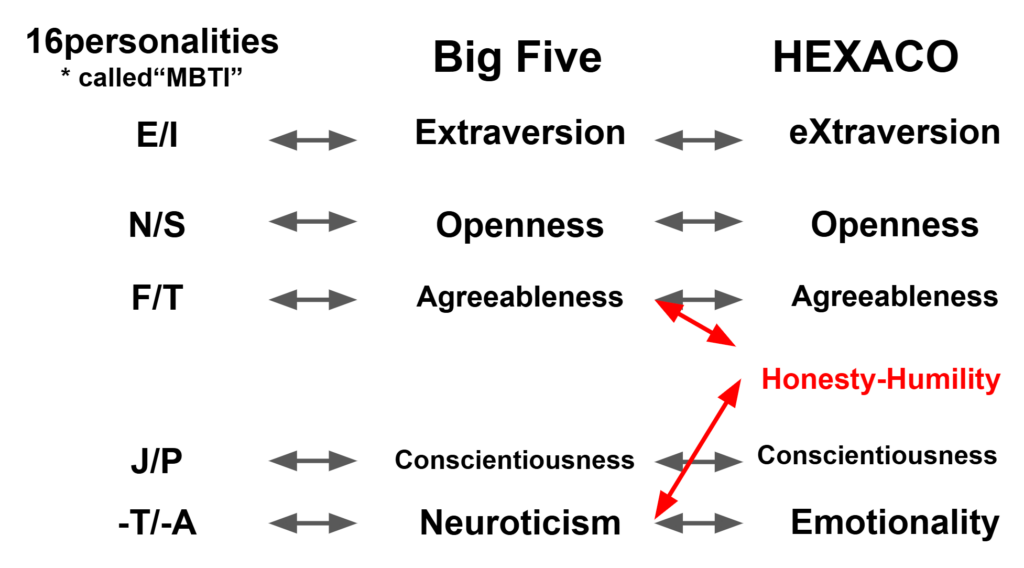
Also, in 16personalities, which was created with reference to MBTI and Big Five, neuroticism from Big Five is called “Identity“, and is classified as either Assertive or Turbulent.
On the far right is the relatively new personality assessment “HEXACO“. It is an improved version of Big Five with one additional indicator “Honesty-Humility”. Research on bullying and harassment perpetrators is active in HEXACO studies.
Since 16personalities and MBTI have weak scientific evidence, this article provides detailed explanations of 16personalities personality types based on their correlations with Big Five and HEXACO.

FAQ and Important Notes
HEXACO results differ from 16personalities (commonly known as MBTI test) or MBTI (original)
- Personality is influenced by genetics and environment, so when the environment changes, responses also change (for example, emotional responses change when you’re tired, etc.). For more details on genetics, see here.
- There are variations in responses depending on age. For more details, see here.
- Type classification is based on whether each value is 3 or above, or below 3, so values close to 3 are more likely to change results depending on how questions are asked or the environment at the time. Please look at the numerical values rather than the type.
- For MBTI (original) and 16personalities (commonly known as MBTI test), it’s unclear how much statistical processing was done at the question design stage as no research papers can be found. On the other hand, papers on Big Five and HEXACO can be easily found, and this HEXACO-JP test is based on research papers.
- While there aren’t many research papers comparing MBTI and 16personalities with everyday behaviors (academic performance, income, etc.) or with the brain and genetics, there are numerous studies on Big Five and HEXACO.
- HEXACO is a variation of Big Five elements, so they are similar but distinct. HEXACO’s Honesty-Humility is extracted from Big Five’s Agreeableness and Neuroticism.
If you have any other questions, please contact us through our inquiry form.
Personality test results are merely “hints” for your life
As mentioned earlier, personality is influenced by genetics and environment. Due to genetic influence, there is a certain range of variation, but answers can vary to some extent depending on the environment.
Also, while Big Five and HEXACO research papers conduct correlation analyses with academic performance and income, the correlation coefficients are not as large as those in natural science experiments. Correlation coefficients range from -1 to 1, but most are around -0.4 to 0.4. Of course, there are higher ones too, but they’re not 0.8 or 0.9 – they’re relatively lower in comparison.
However, since there is various research available, please think of it as “more than fortune-telling, less than natural science.” I’m not 100% denying psychology or fortune-telling.

Writer & Supervisor: Eisuke Tokiwa
Personality Psychology Researcher / CEO, SUNBLAZE Inc.
As a child he experienced poverty, domestic abuse, bullying, truancy and dropping out of school — first-hand exposure to a range of social problems. He spent 10 years researching these issues and published Encyclopedia of Villains through Jiyukokuminsha. Since then he has independently researched the determinants of social problems and antisocial behavior (work, education, health, personality, genetics, region, etc.) and has published 2 peer-reviewed journal articles (Frontiers in Psychology, IEEE Access). His goal is to predict the occurrence of social problems. Spiky profile (WAIS-IV).
Expertise: Personality Psychology / Big Five / HEXACO / MBTI / Prediction of Social Problems
Researcher profiles: ORCID / Google Scholar / ResearchGate
Social & Books: X (@etokiwa999) / note / Amazon Author Page