
Big five career prediction — the idea that your personality profile can reliably point you toward the right career — is no longer just a theory. A large-scale study analyzing social media language data found that personality traits and personal values can predict a person’s occupation with up to nearly 80% accuracy. Whether you are questioning your current career path or simply curious about what work might suit you best, understanding how the Big Five personality traits connect to occupational fit could be one of the most useful insights you encounter.
A research team in the United States published a study titled “Social media-predicted personality traits and values can help match people to their ideal jobs”, which examined the Twitter posts of over 1.5 million users to explore how language patterns reveal personality — and how those personalities cluster around specific professions. The findings suggest that your words, even casual social media posts, may reflect deeper tendencies that connect you to certain types of work. Let’s break down exactly what was found and what it means for you.
Once again, personality researcher and author of Villain Encyclopedia, Tokiwa (@etokiwa999), will provide the explanation.
※We have developed the HEXACO-JP Personality Assessment! It has more scientific basis than MBTI. Tap below for details.

目次
- 1 How Researchers Used Twitter Data to Predict Career Fit
- 2 The Big Five Personality Traits and the 5 Core Values Used in the Study
- 3 Big Five Career Prediction: Which Personality Profiles Match Which Jobs?
- 4 How Accurate Is AI Personality Analysis for Career Prediction?
- 5 Practical Guidance: How to Use Your Personality Profile to Find Better Career Fit
- 6 Frequently Asked Questions
- 6.1 Can personality tests really predict which career is right for me?
- 6.2 What is the Big Five personality model and why is it used for occupational assessment?
- 6.3 Why did adding personal values improve career prediction accuracy?
- 6.4 Why do some professions, like medicine and library science, show diverse personality profiles?
- 6.5 Does being a high performer in your field require a stronger match to that field’s typical personality profile?
- 6.6 How is the AI-generated Vocation Map useful for someone considering a career change?
- 6.7 How accurate is AI analysis of social media language for measuring personality?
- 7 Summary: What the Science of Personality and Career Fit Means for You
How Researchers Used Twitter Data to Predict Career Fit
Analyzing 1.5 Million Users to Uncover Personality Patterns
By processing tweets from over 1.5 million users, researchers were able to extract measurable personality and values scores directly from the language people naturally use online. The study identified each user’s occupation from their public profile, then used linguistic analysis tools to generate personality and values scores. After filtering for data quality, the final working dataset included 128,279 individuals across an impressive 3,513 different occupations — making this one of the most comprehensive personality-and-career studies ever conducted.
The key insight is that people do not need to fill out a formal personality questionnaire for researchers to learn about their traits. The everyday words they choose — even in a 280-character tweet — appear to carry meaningful psychological signals. This approach allowed the team to go far beyond the small sample sizes typical of traditional personality research and draw conclusions across an enormous range of job types.
What makes this data-driven approach particularly compelling is its scale and breadth:
- Scale: Over 1.5 million Twitter profiles were initially included, representing a genuine cross-section of the working population rather than a narrow convenience sample.
- Occupational diversity: With 3,513 job titles covered, the study captures far more nuance than studies limited to a handful of broad career categories.
- Passive measurement: Because participants were not self-reporting in a test context, their language use is considered a more natural reflection of personality than answers given in a formal setting.
- Dual dimensions: Both personality traits and personal values were measured, allowing researchers to see how each independently — and jointly — predicts career outcomes.
In short, this study demonstrates that the way you express yourself in everyday writing is not random — it tends to mirror who you are, and who you are tends to align with the kind of work you do.
The Big Five Personality Traits and the 5 Core Values Used in the Study
What Are the Big Five Personality Traits?
The Big Five personality traits are a widely accepted framework in personality psychology that describes human character along 5 measurable dimensions. Rather than placing people into fixed “types,” the Big Five model treats each trait as a spectrum — everyone sits somewhere on the scale from low to high for each dimension. This makes it one of the most flexible and scientifically validated tools for understanding personality differences.
The 5 traits used in this study are:
- Openness to Experience: How curious, creative, and receptive to new ideas a person tends to be. High scorers often enjoy novelty and abstract thinking; low scorers typically prefer routine and the familiar.
- Conscientiousness: How organized, goal-directed, and disciplined a person tends to be. High scorers are often described as reliable and hardworking; low scorers may be more spontaneous and flexible.
- Extraversion: How sociable, energetic, and outward-focused a person tends to be. High scorers gain energy from social interaction; low scorers (introverts) often prefer quieter, more solitary environments.
- Agreeableness: How cooperative, empathetic, and trusting a person tends to be. High scorers are compassionate and team-oriented; low scorers may be more competitive or skeptical.
- Neuroticism: How prone to emotional instability, anxiety, or stress a person tends to be. High scorers may experience negative emotions more frequently; low scorers tend to be emotionally resilient and calm.
Because everyone has a unique combination of scores across all 5 dimensions, the Big Five creates a rich personality “fingerprint” that can be compared across thousands of individuals. In this study, that fingerprint was derived not from a questionnaire but from the language patterns embedded in each person’s tweets.
The 5 Core Personal Values Also Measured
Alongside the Big Five traits, the study also measured 5 fundamental personal values — the things each person tends to prioritize most deeply in life. Values differ from personality traits in an important way: while traits describe how you typically behave, values describe what you believe is worth pursuing. Together, traits and values paint a much fuller picture of a person than either dimension alone.
The 5 core values used in this research are:
- Helping Others (Benevolence): A drive to support, care for, and improve the welfare of people around you. People who score high here often feel most fulfilled when their work directly helps others.
- Tradition: A respect for established customs, institutions, and long-standing ways of doing things. High scorers tend to value stability and continuity over change.
- Enjoying Life (Hedonism): A priority placed on personal pleasure, fun, and positive experiences. This value reflects how much a person centers their choices around their own enjoyment and wellbeing.
- Achieving Success: A focus on personal accomplishment, ambition, and meeting goals. High scorers are often motivated by recognition, advancement, and measurable results.
- Excitement and Stimulation: A preference for novelty, adventure, and varied experiences. People with high scores here tend to seek out risk, change, and excitement in their daily lives.
Research suggests that your dominant values shape not just which career you choose, but how satisfied you feel once you are in it. A person who deeply values helping others but works in a role with zero human contact is likely to feel unfulfilled, regardless of pay or prestige. The study used both personality traits and values together to build the most accurate possible picture of person-to-career fit.
Big Five Career Prediction: Which Personality Profiles Match Which Jobs?
Specific Career Profiles Found in the Research
One of the most striking findings of the study is that distinct personality profiles tend to cluster around specific occupations — and the more successful a person is within their field, the more pronounced those traits tend to be. This is not about stereotyping entire professions, but rather about recognizing statistically consistent tendencies across thousands of real-world workers.
Some of the specific occupational personality patterns found in the data include:
- Programmers and Researchers: Tended to score high in Openness to Experience but lower in Agreeableness and Conscientiousness compared to average. This suggests a profile oriented toward intellectual curiosity and independent thinking rather than strict routines or collaborative teamwork.
- Tennis Players: Showed the opposite pattern — relatively low Openness, but high Conscientiousness and Agreeableness. This reflects the disciplined, methodical practice habits and respectful sportsmanship that competitive athletics often demands.
- Architects and Chief Information Officers (CIOs): Scored lower in both Openness and Neuroticism, but higher in Agreeableness — suggesting calm, structured, and cooperative working styles suited to long-horizon planning and stakeholder management.
- Librarians and Physicians: Showed notably diverse personality profiles, indicating that these professions attract a wide range of personality types — possibly because they encompass many different specialties and working environments within the same job title.
A particularly compelling detail: within a given profession, the most accomplished individuals tended to show the most “typical” personality profile for that career. For example, top-ranked software developers were more likely than average developers to display the high-Openness, lower-Agreeableness pattern. Professional tennis players showed stronger Conscientiousness scores than amateur tennis players. This suggests that personality-career alignment may not just influence whether you enter a field, but how far you advance within it.
The AI-Generated Vocation Map: Visualizing Career Clusters
To make the relationship between personality and occupation visually intuitive, the research team created an AI-generated “Vocation Map” that automatically groups similar jobs together based on their shared personality and values profiles.
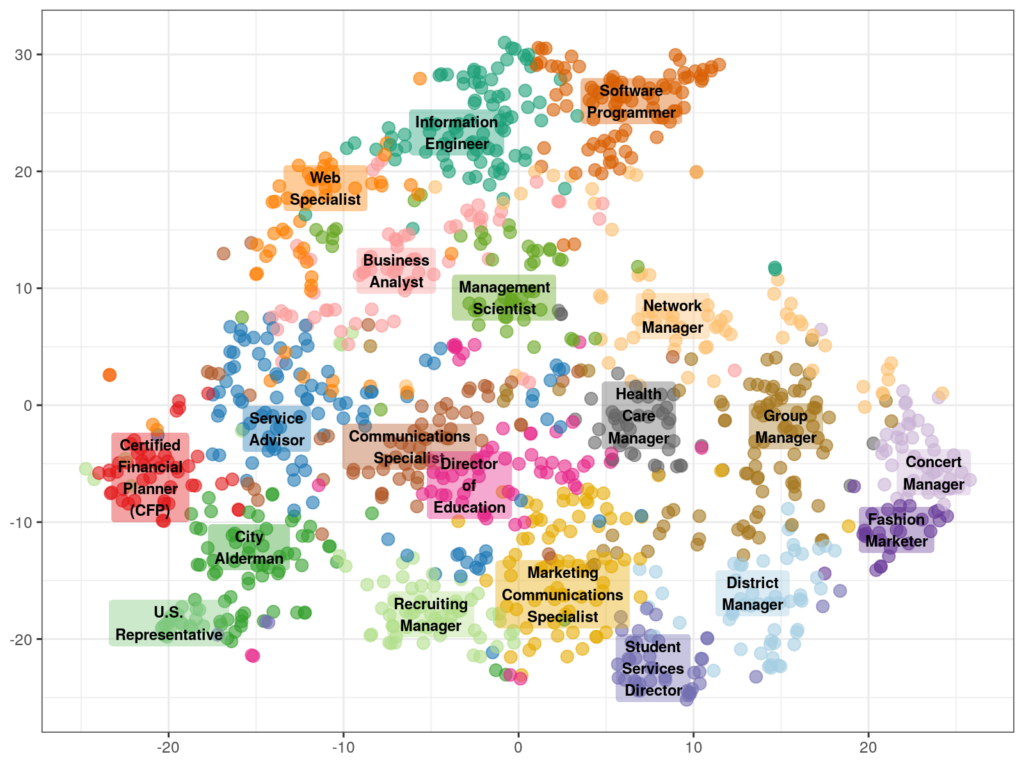
The map was built using a 4-step process:
- Profile Creation: For each of the 3,513 occupations, the researchers calculated the median personality and values scores across all workers in that role, creating a single representative “personality fingerprint” for each job.
- Automated Clustering: Using a technique called Partitioning Around Medoids (PAM), the algorithm automatically grouped occupations with similar fingerprints together — without any human labeling or subjective judgment.
- Representative Job Identification: Within each cluster, the algorithm identified a central “medoid” — the single job whose profile best represents the entire group.
- 2D Visualization: All occupations were then plotted on a two-dimensional map, with related jobs positioned close together and unrelated ones placed further apart.
The resulting map showed recognizable, intuitive groupings. Technology-oriented occupations clustered together in one region, while music, fashion, arts, and education roles formed a separate cluster in another. This visual layout has practical applications: if your current job sits in one cluster, nearby jobs on the map represent careers where your existing skills and personality strengths are likely to transfer well — a potentially powerful tool for anyone considering a career change.
How Accurate Is AI Personality Analysis for Career Prediction?
IBM Watson’s Language-Based Personality Scoring: Approximately 90% Accuracy
The personality scores used in the study were not generated by a traditional self-report questionnaire — they were calculated by an IBM Watson AI system that reads linguistic patterns in text and infers personality from them. This is a meaningful distinction because self-report tests can be influenced by how a person wants to be perceived, whereas language-based analysis captures how a person naturally expresses themselves.
When the IBM Watson scores were compared against traditional self-reported personality questionnaire results, the system showed impressive alignment:
- Big Five traits: An average absolute error of approximately 12%, meaning the AI’s predictions were correct about 88% of the time on average.
- Core personal values: An average absolute error of approximately 11%, representing roughly 89% accuracy against self-reported values scores.
In other words, the AI system could read a person’s tweets and predict their personality profile with close to 90% accuracy compared to what that same person would report on a formal test. This level of precision is remarkable given that the tweets were never written with personality assessment in mind. It suggests that our authentic voice — the language we use when we are simply sharing thoughts or opinions — carries a consistent and measurable psychological signature.
The implication is significant for anyone thinking about personality-based career guidance: the underlying data informing these predictions is not arbitrary. It is derived from the naturally occurring language patterns of hundreds of thousands of real professionals, cross-validated against established psychological measures. This gives the approach a level of scientific grounding that goes beyond typical online career quizzes.
Personality Alone Predicts Career at Over 70% — Adding Values Pushes It to Nearly 80%
When the research team directly tested how well personality and values data could predict a person’s actual occupation, the results were striking: personality traits alone achieved over 70% accuracy, while combining personality with values data pushed prediction rates to nearly 80%.
To test this, the team split a dataset of 9,550 individuals into training and testing groups. Five different machine learning methods were applied to the training data — including Random Forest and XGBoost — and every single approach achieved consistently high prediction accuracy when tested on the held-out sample. The consistency across multiple independent algorithms makes the finding especially robust.
Key takeaways from the prediction accuracy results:
- Personality data alone: Achieved greater than 70% accuracy in predicting a person’s actual occupation from their Big Five scores.
- Personality + values combined: Pushed accuracy to nearly 80%, demonstrating that values add meaningful predictive information beyond what personality alone captures.
- Multiple algorithms, consistent results: All 5 machine learning methods tested produced similarly high accuracy rates, ruling out the possibility that the results were a fluke of any single analytical approach.
- Real-world validation: The predictions were compared against the actual, self-reported occupations of the test participants — not hypothetical scenarios — making the accuracy figures directly meaningful.
Research suggests the reverse logic is equally valid: if personality and values can reliably predict which career someone is in, it means careers genuinely attract — and may reinforce — particular personality profiles. Every profession, in some sense, has a characteristic psychological “shape.” Understanding that shape for careers you find interesting could help you evaluate whether your own profile is a strong match before investing years in a new direction.
Practical Guidance: How to Use Your Personality Profile to Find Better Career Fit
3 Strengths to Leverage and 3 Pitfalls to Avoid
Understanding the connection between your personality and career is only useful if you translate it into concrete action. Based on the research findings, here are evidence-informed strategies for using Big Five career prediction insights effectively.
Strengths to actively leverage:
- High Openness? Seek roles that reward creativity and intellectual exploration. Research shows that high-Openness individuals tend to thrive in environments where they are encouraged to question assumptions, experiment with new methods, and work across disciplines. Roles in research, design, technology, and the arts tend to align well. The “why it works” is straightforward: when your environment rewards the curiosity that comes naturally to you, engagement and performance both improve.
- High Conscientiousness? Pursue roles where precision, reliability, and follow-through are valued. Highly conscientious people often excel in professions that require meeting exacting standards — engineering, accounting, medicine, law, and competitive sports all showed strong Conscientiousness profiles in the study. The key is finding roles where being thorough is recognized as an asset, not a bottleneck. Practice this by setting structured personal milestones alongside any formal performance targets.
- High Agreeableness + strong Helping Others values? Prioritize people-centered work. The data suggests that individuals who score high in both Agreeableness and the Benevolence value tend to cluster in caregiving, teaching, counseling, and community-focused roles. When your work allows you to make a tangible positive difference for others, it tends to feel intrinsically meaningful rather than merely transactional.
Pitfalls to watch out for:
- Do not mistake personality fit for a guarantee of success. The study predicted career with up to nearly 80% accuracy — which also means roughly 20% of cases did not follow the expected pattern. Skills, experience, effort, opportunity, and context all matter enormously. Use personality data as one useful input, not the final verdict.
- Avoid ignoring your values when chasing status or salary. The research found that values added approximately 10 percentage points of predictive accuracy on top of personality alone. A role that matches your Big Five profile but conflicts with your core values — say, a “Helping Others” person in a purely competitive sales environment — is likely to produce dissatisfaction even if you perform well.
- Be cautious about assuming you need a complete career overhaul. The Vocation Map showed that similar careers cluster closely together. If you feel misaligned in your current role, the best fit may be a lateral move within the same cluster — a shift in focus rather than a full reinvention. This is less disruptive and allows you to carry forward the skills and relationships you have already built.
Frequently Asked Questions
Can personality tests really predict which career is right for me?
Research suggests they can offer meaningful guidance. The study described here found that Big Five personality scores alone predicted a person’s actual occupation with over 70% accuracy, rising to nearly 80% when personal values were added. While personality data is not a definitive answer, it is a scientifically grounded starting point that goes well beyond generic career quizzes. Think of it as one strong signal among several that should inform your decision.
What is the Big Five personality model and why is it used for occupational assessment?
The Big Five personality model is a framework used widely in personality psychology that describes character across 5 dimensions: Openness to Experience, Conscientiousness, Extraversion, Agreeableness, and Neuroticism. It is favored for occupational personality assessment because each trait is measured on a continuous spectrum rather than forcing people into rigid “types,” making it more accurate and nuanced. Decades of research across different cultures and professions have validated its usefulness for predicting work behavior and career outcomes.
Why did adding personal values improve career prediction accuracy?
Personality traits describe how you tend to behave, while personal values describe what you believe is worth pursuing in life. These are related but distinct. A person might be highly conscientious (a personality trait) but motivated by helping others rather than personal achievement (a values dimension). The study found that adding the 5 core values — Benevolence, Tradition, Hedonism, Achievement, and Stimulation — provided approximately 10 percentage points of additional predictive accuracy beyond personality alone, suggesting that both dimensions capture something the other misses.
Why do some professions, like medicine and library science, show diverse personality profiles?
Professions with wide internal diversity — such as physicians and librarians — tend to encompass many distinct roles and specializations under a single job title. A surgeon, a psychiatrist, and a pediatrician are all “doctors” but may operate in very different environments requiring different interpersonal styles. Similarly, a research librarian and a children’s librarian face quite different daily demands. When a broad job category contains many sub-roles, the personality data naturally spreads across a wider range, making the overall profile less distinctive than more narrowly defined occupations.
Does being a high performer in your field require a stronger match to that field’s typical personality profile?
The study’s findings suggest this may be the case. Within both software development and professional tennis, the most accomplished individuals showed more pronounced versions of the personality profiles typical for their profession than average practitioners did. This indicates that personality-career alignment may influence not just entry into a field, but advancement within it. However, this is a correlation rather than a strict rule — exceptional skill, opportunity, and work ethic also play substantial roles in determining success.
How is the AI-generated Vocation Map useful for someone considering a career change?
The Vocation Map clusters occupations by their shared personality and values profiles, placing similar jobs near each other on a two-dimensional layout. If you are considering a career change, looking at jobs that are geographically close to your current occupation on the map can reveal options where your existing personality strengths, skills, and working style are likely to transfer naturally. This is especially useful for identifying lateral moves that feel significantly more fulfilling without requiring a complete restart of your professional life.
Studies indicate a high level of accuracy. The IBM Watson system used in this research showed an average absolute error of approximately 12% for Big Five trait scores and 11% for values scores when compared against traditional self-report questionnaire results — translating to roughly 88–89% accuracy overall. Because social media language is produced naturally rather than in a test context, it may in some ways be a less biased reflection of personality than formal self-assessments, where people may consciously or unconsciously present an idealized version of themselves.
Summary: What the Science of Personality and Career Fit Means for You
The research discussed in this article offers a compelling, data-backed case for taking your personality seriously as a career planning tool. By analyzing the language of over 128,000 Twitter users across 3,513 occupations, scientists found that personality traits and personal values are consistently linked to specific career paths — and that these links are strong enough for AI models to predict a person’s actual job with nearly 80% accuracy. The Big Five dimensions of Openness, Conscientiousness, Extraversion, Agreeableness, and Neuroticism each carry distinct implications for which working environments tend to bring out the best in a person. Adding the lens of personal values — what you most deeply want from your life and work — sharpens the picture further.
Importantly, this research does not suggest that personality is destiny. It suggests that self-knowledge is a competitive advantage. Knowing whether you lean toward curiosity or structure, toward helping others or achieving personal goals, toward excitement or tradition, gives you a more honest map of where you are likely to thrive. If you have been wondering whether your current career path is truly the right fit — or simply curious about what the science of big five career prediction might reveal about your own professional potential — exploring your Big Five profile alongside your core values is a meaningful and well-evidenced place to start. Discover how your own personality fingerprint aligns with the careers where people like you tend to flourish.