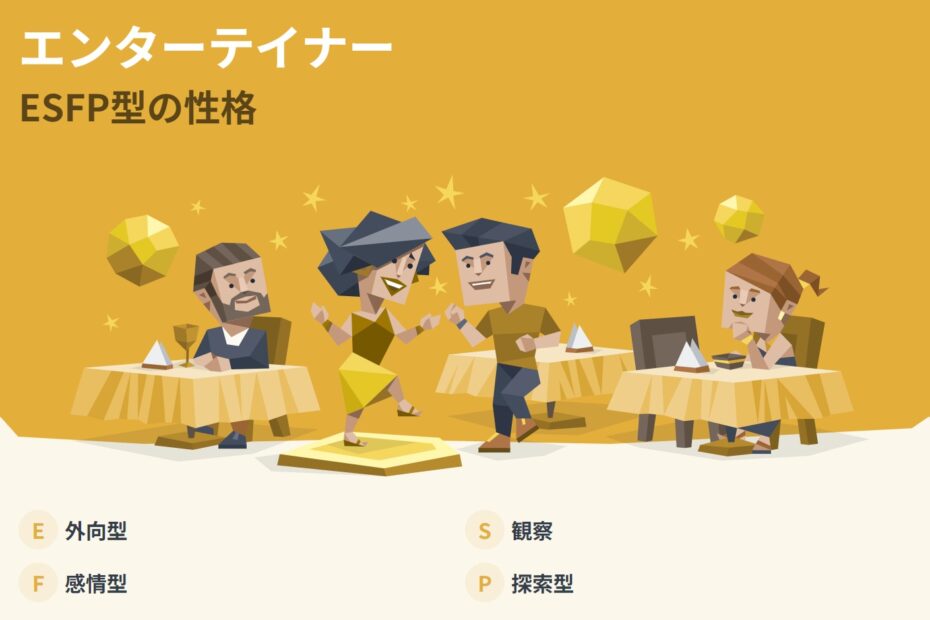
Do you know the ESFP-T type?
This is one of the indicators that represents personality, and it has a great impact on our behavior and way of thinking.
In this article, we will explain in detail what characteristics ESFP-T people have, including their health, work, and relationships.
By understanding your own and others’ personalities well, it may lead to better communication and self-understanding.
Please read this while comparing it with your own and your friends’ personalities.
Once again, personality researcher and author of Villain Encyclopedia, Tokiwa (@etokiwa999), will provide the explanation.
※We have developed the HEXACO-JP Personality Assessment! It has more scientific basis than MBTI. Tap below for details.

目次
- 1 Scientific Background of ESFP-T (Entertainer – Turbulent Type)
- 2 Scientific Explanation of ESFP-T (Entertainer – Turbulent Type)
- 2.1 Easily Gets Along with People Who Have Both S and F Traits
- 2.2 Making New Friends
- 2.3 Neuroticism May Decrease with Psychotherapy
- 2.4 Has Many Friends on Social Media
- 2.5 Posts Updates and Photos on Social Media, Especially Many Emotional Posts
- 2.6 When Using Social Media, Communicates Through Likes and Encouraging Comments
- 2.7 Engage in altruistic activities such as volunteering
- 2.8 Prefer salty, sour, and greasy foods due to stress
- 2.9 Prefer fast food, ice cream, chocolate, and cocoa
- 2.10 Tend to have relatively poor sleep quality
- 2.11 Prone to smoking
- 2.12 Prone to Gambling
- 2.13 Prone to Internet Addiction
- 2.14 In the case of men, prone to becoming cheated-on husbands
- 2.15 Prone to Early Death
- 2.16 Prone to Right-Wing Authoritarianism (RWA) ideology
- 2.17 Practicing mindfulness reduces neurotic tendencies
- 2.18 Engaging in Emotion-Focused Coping
- 2.19 High Neuroticism Leads to Risk Bias
- 2.20 Common in Japan’s Tohoku Region
- 2.21 Schwartz’s Values: Hedonism, Benevolence
- 2.22 Investment Behavior: Herd Behavior
- 3 Conclusion
Scientific Background of ESFP-T (Entertainer – Turbulent Type)
Overview of MBTI
MBTI is a psychological theory that classifies personalities into 16 types.
To begin with, MBTI is an abbreviation for Myers-Briggs Type Indicator.
MBTI classifies personalities into 16 types by combining the following four indicators.
In other words, MBTI expresses your personality tendencies in four letters such as “ISTJ” or “ENFP”. There is a very famous similar one called 16personalities, but this is different from MBTI.
Overview of Big Five
One of the most influential trait theories in personality psychology is the “Big Five.”
The Big Five measures five traits: Openness, Conscientiousness, Extraversion, Agreeableness, and Neuroticism.
Also, while 16personalities and MBTI use type classification (e.g., either extraverted or introverted), the Big Five evaluates traits with continuous numerical values (e.g., extraversion 3.5), which is a major difference.
Furthermore, it has been studied for a long time, has many research papers, and has been extensively researched in other fields such as academic ability, income, brain, and genetics. It can be said that the Big Five has relatively stronger scientific backing.
Correlation Between MBTI, Big Five, and HEXACO
There is a correlation between MBTI’s four indicators and the Big Five’s five factors.
A representative study showing this correlation is the paper “The relationship between the revised NEO-Personality Inventory and the Myers-Briggs Type Indicator.”
According to this paper, the correlation between MBTI and Big Five is as follows.
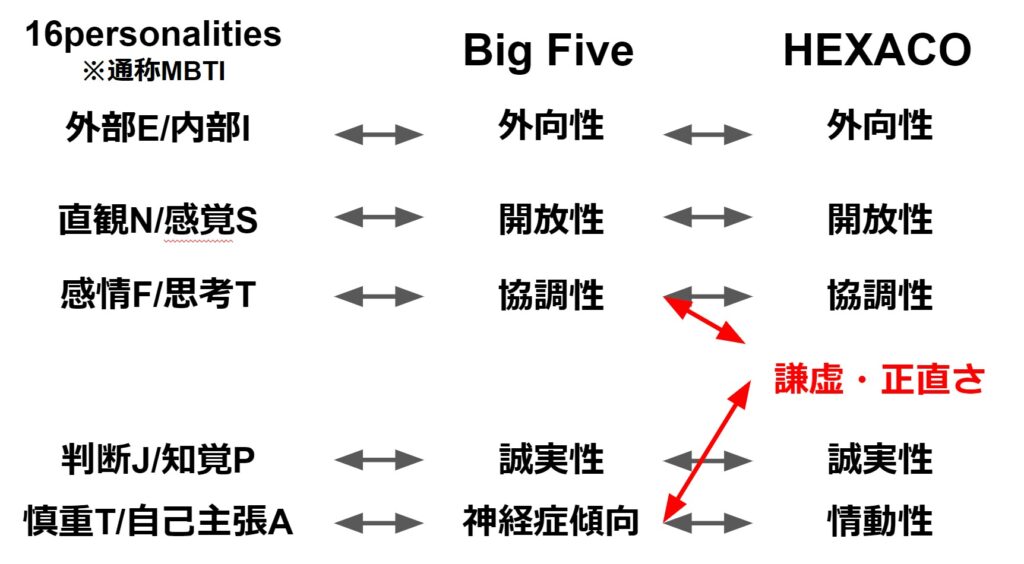
Also, in 16personalities, which was created with reference to MBTI and Big Five, the neuroticism of Big Five is called “Identity” and is classified as either Assertive or Turbulent.
On the far right is “HEXACO,” a relatively new personality assessment. It has been improved by adding one indicator “Honesty-Humility” to the Big Five.
This article will provide a detailed explanation of 16personalities’ personality types based on this correlation.
Since it is originally research on Big Five and HEXACO, if you want to know your personality more scientifically than MBTI or 16personalities, please try this HEXACO personality test.
What is ESFP-T (Entertainer – Turbulent Type)?
ESFP-T is a type with high extraversion (E), low openness (S), high agreeableness (F), low conscientiousness (P), and high neuroticism (T) in the Big Five. Characteristics:
- High sociability and sensitivity
- Self-doubt and need for approval
- Deep empathy for others
- Sensitivity to social evaluation
- Internal conflicts and self-exploration
They enjoy the present moment and find joy in interacting with people around them, but they also feel anxious about their actions and decisions.
They learn through practical experience, but sometimes hesitate to express themselves due to fear of failure. In interpersonal relationships, they approach others with warmth and compassion, but are sensitive to criticism and rejection from others.
They are open to change and new experiences, but tend to feel stressed by uncertainty. This internal conflict becomes the driving force for continuous self-understanding and growth.
Scientific Explanation of ESFP-T (Entertainer – Turbulent Type)
Easily Gets Along with People Who Have Both S and F Traits
ESFP-T type people have Sensing (S) and Feeling (F) characteristics. For this reason, they tend to naturally become close with people who also have S and F traits. In the Big Five, this indicates low openness (S) and high agreeableness (F).
ESFP-T people value concrete experiences and are sensitive to people’s emotions. This balanced personality allows them to build good relationships with a wide range of people.
Please see this article for more details.
Making New Friends
ESFP-T types have an Extraverted (E) personality. This indicates high extraversion in the Big Five.
ESFP-T people enjoy meeting new people and actively try to build friendly relationships. They are sociable and energetic, so they can easily make friends even in new environments.
ESFP-T, who gain vitality from interacting with people, are always looking for new friendship opportunities.
Please see this article for more details.
Neuroticism May Decrease with Psychotherapy
The “-T” in ESFP-T type is an element added by 16personalities, indicating high neuroticism. This is related to high neuroticism in the Big Five.
ESFP-T people tend to be prone to stress and anxiety. However, by receiving psychotherapy, they may be able to better manage these emotions and reduce their neurotic tendencies.
Please see this article for more details.
Has Many Friends on Social Media
ESFP-T types, due to their Extraverted (E) personality, tend to actively interact on social media as well. This reflects their high extraversion in the Big Five.
ESFP-T people tend to have many friends on social media. They enjoy connecting with new people and actively interact online as well.
Social media becomes a place for self-expression and socializing for ESFP-T, providing opportunities to build many friendships.
Please see this article for more details.
Posts Updates and Photos on Social Media, Especially Many Emotional Posts
ESFP-T types have Extraverted (E) and emotional (-T) characteristics, which are reflected in their behavior on social media. In the Big Five, this indicates high extraversion and high neuroticism.
ESFP-T people tend to actively share their lives and emotions on social media. They frequently post about daily events and photos, and particularly like to express their emotions.
This tendency is a manifestation of their desire to connect with others and their desire to express emotions outwardly.
Please see this article for more details.
When Using Social Media, Communicates Through Likes and Encouraging Comments
ESFP-T types have extraverted (E) and feeling (F) characteristics, which manifest in their communication methods on social media. In the Big Five, this indicates high extraversion and agreeableness.
ESFP-T individuals actively interact with others on social media. They tend to show warm support by giving “likes” and writing encouraging comments.
Such behavior reflects the sociability and empathy of ESFP-T individuals, demonstrating their attitude of trying to build good relationships even online.
Please see this article for more details.
Engage in altruistic activities such as volunteering
ESFP-T types have extraverted (E) and feeling (F) characteristics, which lead to participation in altruistic activities. In the Big Five, this indicates high extraversion and agreeableness.
ESFP-T individuals tend to actively participate in activities that help others, such as volunteer work. They enjoy interacting with people while being sensitive to others’ emotions.
This combination leads ESFP-T to find joy in social contribution activities and actively engage with their community.
Please see this article for more details.
Prefer salty, sour, and greasy foods due to stress
The “-T” in ESFP-T type indicates high neuroticism, which affects eating behavior during stress. In the Big Five, this reflects high neuroticism.
ESFP-T individuals tend to be stress-sensitive, and during such times, they tend to prefer salty, sour, and greasy foods. These foods have temporary mood-improving effects, making them likely to be chosen as a means of stress relief.
However, this tendency can lead to health problems, so caution is needed.
Please see this article for more details.
Prefer fast food, ice cream, chocolate, and cocoa
ESFP-T types have extraverted (E) characteristics, which also influence their food preferences. In the Big Five, this indicates high extraversion.
ESFP-T individuals tend to prefer convenient and stimulating foods such as fast food, ice cream, chocolate, and cocoa. These foods provide immediate satisfaction and are easy to share in social settings.
This food preference is related to ESFP-T’s active and pleasure-seeking personality. However, health considerations are also necessary.
Please see this article for more details.
Tend to have relatively poor sleep quality
ESFP-T types have perceiving (P) and high neuroticism (-T) characteristics, which can affect sleep quality. In the Big Five, this indicates low conscientiousness (P) and high neuroticism (-T).
ESFP-T individuals tend to prefer flexible and free lifestyles, which can make it difficult to establish regular bedtimes. Additionally, high neuroticism can cause anxiety and stress to reduce sleep quality.
Due to these factors, ESFP-T tends to have relatively poor sleep quality.
Please see this article for more details.
Prone to smoking
ESFP-T types have extraverted (E) and high neuroticism (-T) characteristics, which can influence smoking behavior. In the Big Five, this indicates high extraversion and high neuroticism.
ESFP-T individuals tend to start smoking easily in social situations. Additionally, high neuroticism can make them more likely to choose smoking as a means of stress relief.
The combination of extraversion and vulnerability to stress becomes a factor that increases smoking risk for ESFP-T.
Please see this article for more details.
Prone to Gambling
ESFP-T types have perceiving (P) and high neurotic tendencies (-T) characteristics, which can influence gambling behavior. In the Big Five, this indicates low conscientiousness (P) and high neuroticism (-T).
ESFP-T individuals tend to seek stimulation and new experiences, which may lead to an interest in gambling. Additionally, due to their high neurotic tendencies, they may be more likely to turn to gambling for stress relief and thrills.
Please see this article for more details.
Prone to Internet Addiction
ESFP-T types have perceiving (P) and high neurotic tendencies (-T) characteristics, which can influence internet usage behavior. In the Big Five, this indicates low conscientiousness (P) and high neuroticism (-T).
ESFP-T individuals prefer flexible and free lifestyles and tend to be easily attracted to stimulating online content. Additionally, due to their high neurotic tendencies, they may excessively use the internet for stress relief and mood changes.
The combination of these factors may increase the risk of internet addiction for ESFP-T types.
Please see this article for more details.
In the case of men, prone to becoming cheated-on husbands
The “-T” in ESFP-T indicates high neurotic tendencies, which can affect interpersonal relationships. In the Big Five, this reflects high neuroticism.
ESFP-T men have large emotional fluctuations and may not be able to adequately meet their partner’s needs. Additionally, anxiety and lack of confidence may affect relationship stability.
Due to these factors, ESFP-T men may have a higher risk of their partners seeking emotional connections elsewhere. However, it’s important to note that this is a general tendency and individual differences exist.
Please see this article for more details.
Prone to Early Death
ESFP-T types have perceiving (P) and high neurotic tendencies (-T) characteristics, which may affect health and lifespan. In the Big Five, this indicates low conscientiousness (P) and high neuroticism (-T).
ESFP-T individuals tend to have low planning abilities and are prone to impulsive behavior. Additionally, high neurotic tendencies can increase stress and anxiety, potentially having negative effects on health.
The combination of these factors may make it difficult to maintain healthy lifestyle habits, potentially increasing the risk of early death. However, this tendency can change through individual effort and environmental factors.
Please see this article for more details.
Prone to Right-Wing Authoritarianism (RWA) ideology
The sensing (S) characteristics of ESFP-T types may be related to certain political tendencies. In the Big Five, this indicates low openness.
ESFP-T individuals tend to prefer concrete and realistic thinking, which may lead to supporting traditional values and existing social structures. Therefore, they may be prone to holding Right-Wing Authoritarianism (RWA) ideology.
However, this is a general tendency and may vary greatly depending on individual experience, education, and environment. Political beliefs are complex and are not determined by a single personality trait alone.
Please see this article for more details.
Yes, please allow me to continue.
Practicing mindfulness reduces neurotic tendencies
ESFP-T individuals tend to be prone to anxiety and stress, but mindfulness practice may be an effective countermeasure. Mindfulness cultivates a mental state that focuses awareness on the present moment and accepts it without judgment.
Through this practice, ESFP-T individuals can better manage their emotions and soften their reactions to stress. As a result, neurotic tendencies may decrease, potentially allowing them to maintain a more stable mental state.
Please see this article for more details.
Engaging in Emotion-Focused Coping
The “-T” in ESFP-T type indicates high neuroticism, which affects stress coping methods. In the Big Five model, this reflects high neuroticism.
ESFP-T individuals tend to engage in emotion-focused coping when facing stress. This is a method that focuses on managing the emotions triggered by stress.
For example, they try to improve their mood through conversations with friends, listening to music, or exercising. While this method is effective for short-term mood improvement, it may not lead to fundamental problem resolution.
High Neuroticism Leads to Risk Bias
The “-T” in ESFP-T type indicates high neuroticism, which affects risk perception. In the Big Five model, this reflects high neuroticism.
ESFP-T individuals tend to overestimate situational risks due to their strong anxiety and worry. This tendency can lead to being overly cautious about new experiences and opportunities, or worrying more than necessary.
This risk bias can influence decision-making and behavior, potentially causing them to miss opportunities for growth and experience.
Please see this article for more details.
Common in Japan’s Tohoku Region
ESFP-T type has perceiving (P) and high neuroticism (-T) characteristics, which may be related to regional distribution. In the Big Five model, this indicates low conscientiousness (P) and high neuroticism (-T).
In Japan’s Tohoku region, ESFP-T type individuals appear to be relatively common. This regional characteristic may be the result of various factors including cultural background, environmental factors, and historical influences.
However, it’s important to note that this is a statistical tendency and individual differences are significant. Additionally, further research is needed regarding the relationship between personality types and regions.
Please see this article for more details.
Schwartz’s Values: Hedonism, Benevolence
ESFP-T type has extroverted (E), sensing (S), feeling (F), and perceiving (P) characteristics, which leads to emphasizing hedonism and benevolence in Schwartz’s theory of values.
ESFP-T individuals tend to enjoy life and pursue pleasure. This aligns with the value of “hedonism.” At the same time, they tend to value good relationships with others and interact with compassion. This reflects the value of “benevolence.”
These values are closely related to ESFP-T’s sociable and emotionally rich personality traits.
Please see this article for more details.
Investment Behavior: Herd Behavior
ESFP-T type has extroverted (E) and high neuroticism (-T) characteristics, which can influence investment behavior. In the Big Five model, this indicates high extraversion and high neuroticism.
ESFP-T individuals are sociable and sensitive to others’ opinions and actions. In investment situations, this trait tends to manifest as “herd behavior.” In other words, they are easily influenced by the trends of surrounding investors and tend to jump on popular investments.
Additionally, due to high neuroticism, they may overreact to market fluctuations and tend to make emotional decisions.
Please see this article for more details.
Conclusion
ESFP-T type individuals are sociable and emotionally rich personalities.
They are good at making new friends and actively interact on social media. They enjoy helping people and are proactive in volunteer activities.
However, they are prone to stress, which can affect their food preferences and sleep quality. They also have higher risks for smoking, gambling, and internet addiction.
The tendencies introduced are originally from Big Five and HEXACO research, so if you want to understand personality more scientifically than MBTI or 16personalities, please try this HEXACO personality test.

Writer & Supervisor: Eisuke Tokiwa
Personality Psychology Researcher / CEO, SUNBLAZE Inc.
As a child he experienced poverty, domestic abuse, bullying, truancy and dropping out of school — first-hand exposure to a range of social problems. He spent 10 years researching these issues and published Encyclopedia of Villains through Jiyukokuminsha. Since then he has independently researched the determinants of social problems and antisocial behavior (work, education, health, personality, genetics, region, etc.) and has published 2 peer-reviewed journal articles (Frontiers in Psychology, IEEE Access). His goal is to predict the occurrence of social problems. Spiky profile (WAIS-IV).
Expertise: Personality Psychology / Big Five / HEXACO / MBTI / Prediction of Social Problems
Researcher profiles: ORCID / Google Scholar / ResearchGate
Social & Books: X (@etokiwa999) / note / Amazon Author Page