Do you know the ENTJ-T type?
This is one of the indicators that represents personality, and it has a significant impact on our behavior and way of thinking.
In this article, we will explain in detail what characteristics ENTJ-T people have, including aspects of health, work, and relationships.
By understanding your own and others’ personalities well, it may lead to better communication and self-understanding.
Please read while comparing with your own and your friends’ personalities.
Once again, personality researcher and author of Villain Encyclopedia, Tokiwa (@etokiwa999), will provide the explanation.
※We have developed the HEXACO-JP Personality Assessment! It has more scientific basis than MBTI. Tap below for details.

目次
- 1 Scientific Background of ENTJ-T (Commander・Turbulent Type)
- 2 Scientific Explanation of ENTJ-T (Commander – Turbulent Type)
- 2.1 Tend to Get Along Well with People Who Have Both N and T
- 2.2 Making New Friends
- 2.3 Effective at Online Learning
- 2.4 Relatively High Possibility of Having High IQ
- 2.5 Possibility of Reducing Neuroticism Through Psychotherapy
- 2.6 Has Many Friends on Social Media
- 2.7 Posts Updates and Photos on Social Media, Particularly Many Emotional Posts
- 2.8 Likely to Actively Gather Information on Social Media
- 2.9 Properly Follows Infection Prevention Measures Like Hand Washing
- 2.10 High learning goal orientation (setting goals and learning in work)
- 2.11 In children, there’s a possibility of being gifted
- 2.12 Common among HSPs
- 2.13 Prone to leaving jobs or retiring
- 2.14 Excessive Pursuit of Perfectionism
- 2.15 Preference for Salty, Sour, and Fatty Foods Due to Stress
- 2.16 Preference for Fast Food, Ice Cream, Chocolate, Cocoa, Meat, Biscuits, Cake, and Cookies
- 2.17 Health-Conscious Preference for Vegetables, Dairy Products, and Nuts; Even More Health-Conscious with Lower Neurotic Tendencies
- 2.18 Prone to drinking alcohol
- 2.19 Prone to smoking
- 2.20 Prone to divorce
- 2.21 For women, prone to becoming wives who are cheated on.
- 2.22 For men, they tend to become husbands who are cheated on.
- 2.23 Prone to hoarding behavior
- 2.24 Prone to having Social Dominance Orientation (SDO) ideology
- 2.25 Prone to workplace bullying
- 2.26 Possibility of Narcissism
- 2.27 Mindfulness Practice Reduces Neuroticism
- 2.28 Employing Emotion-Focused Coping
- 2.29 Attempts Relatively Calm Risk Management, but High Neuroticism Creates Risk Bias
- 2.30 Common in Japan’s Hokuriku and Metropolitan Areas
- 2.31 Schwartz’s Values: Power, Achievement, Stimulation, Self-Direction
- 2.32 Particular About Clothing
- 2.33 Investment Behavior: Herd Behavior
- 3 In Conclusion
Scientific Background of ENTJ-T (Commander・Turbulent Type)
Overview of MBTI
MBTI is a psychological theory that classifies personality into 16 types.
MBTI is an abbreviation for Myers-Briggs Type Indicator.
MBTI classifies personality into 16 types by combining the following four indicators.
In other words, MBTI expresses one’s personality tendencies with four letters such as “ISTJ” or “ENFP”. There is a very famous similar system called 16personalities, but this is different from MBTI.
Overview of Big Five
One of the most influential trait theories in personality psychology is the “Big Five.”
Big Five measures five traits: Openness, Conscientiousness, Extraversion, Agreeableness, and Neuroticism.
Also, while 16personalities and MBTI use type classification (e.g., either extraverted or introverted), Big Five evaluates traits with continuous numerical values (e.g., extraversion 3.5), which is a major difference.
Furthermore, it has been studied for a long time, has many research papers, and extensive research has been conducted in other fields such as academic ability, income, brain, and genetics. Big Five can be said to have relatively stronger scientific backing.
Correlation between MBTI, Big Five, and HEXACO
There are correlations between MBTI’s 4 indicators and Big Five’s 5 factors.
A representative study showing this correlation is the paper “The relationship between the revised NEO-Personality Inventory and the Myers-Briggs Type Indicator“.
According to this paper, the correlation between MBTI and Big Five is as follows.
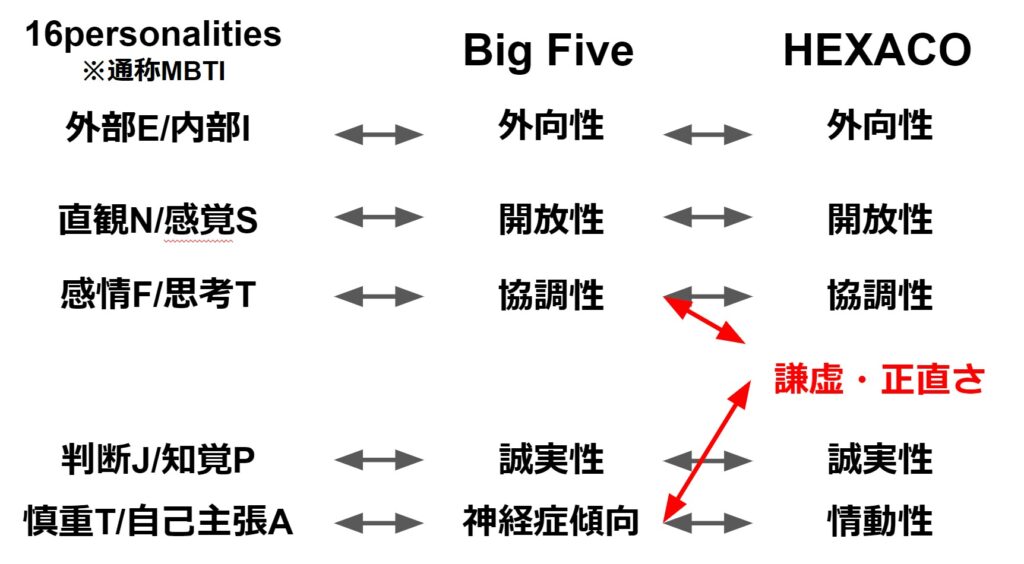
Also, in 16personalities, which was created based on MBTI and Big Five, the neuroticism of Big Five is called “Identity“, and is classified as either Assertive or Turbulent.
On the far right is “HEXACO“, a relatively new personality assessment. It has been improved by adding one indicator “Honesty-Humility” to Big Five.
This article provides detailed explanations of 16personalities personality types based on these correlations.
Since these are originally Big Five and HEXACO studies, if you want to know your personality more scientifically than MBTI or 16personalities, please try this HEXACO personality test.
What is ENTJ-T (Commander・Turbulent Type)?
ENTJ-T is a type with high Extraversion (E), high Openness (N), low Agreeableness (T), high Conscientiousness (J), and high Neuroticism (T) in Big Five. Characteristics:
- Strong goal orientation and ambition
- Self-critical perfectionism
- Strategic thinking and analytical ability
- Anxiety about leadership
- Continuous desire for self-improvement
They set high goals and work diligently toward achieving them. However, they may also have doubts about their own abilities and decisions. They drive projects forward using critical thinking and creativity, but fear of failure can sometimes make decision-making time-consuming.
In interpersonal relationships, they strive to prioritize efficiency while also trying to be considerate of others’ emotions. They tend to feel pressure easily, but this can also become a driving force for growth.
Scientific Explanation of ENTJ-T (Commander – Turbulent Type)
Tend to Get Along Well with People Who Have Both N and T
ENTJ-T is a type that combines logical thinking (T) with intuitive ideas (N). Therefore, they have high affinity with people who also possess NT characteristics and tend to get along well with them.
ENTJs are characterized by high openness (N) and low agreeableness (T) in the Big Five. This makes them prefer interactions with people who explore new ideas and enjoy logical discussions.
ENTJ-T individuals seek intellectual stimulation and are likely to form deep bonds with people who have similar thought processes. Friendships of this type can promote mutual growth and lead to creative collaborative relationships.
For more details, please see this article.
Making New Friends
ENTJ-Ts excel at making new friends due to their extraverted (E) personality trait. People of this type tend to be sociable and active, actively engaging with others.
In the Big Five, this indicates high extraversion. ENTJ-T individuals are open to new environments and people, often giving an energetic impression.
They confidently initiate conversations and enjoy discussing interesting topics. Additionally, they tend to demonstrate leadership, often taking central roles in group activities and events, which leads to building new friendships.
ENTJ-T individuals tend to enjoy new encounters in various situations and build extensive networks.
For more details, please see this article.
Effective at Online Learning
ENTJ-T is a type that tends to demonstrate high effectiveness in online learning due to their intuitive (N) and judging (J) traits.
This type tends to have high openness (N) and high conscientiousness (J) in the Big Five. These characteristics indicate high adaptability to new learning methods and strong self-management abilities.
ENTJ-T individuals are skilled at understanding abstract concepts and grasping learning content from a big-picture perspective. Additionally, due to their high planning abilities and goal-oriented nature, they can effectively utilize the flexibility of online learning while efficiently progressing through their studies.
They prefer self-directed learning styles and tend to actively utilize various online resources. Due to these characteristics, ENTJ-Ts are likely to achieve high results in online learning environments.
For more details, please see this article.
Relatively High Possibility of Having High IQ
ENTJ-T types tend to have intuitive (N) thinking, which is associated with the relatively high possibility of having high IQ.
In the Big Five, high openness (N) is linked to intellectual curiosity and abstract thinking ability. ENTJ-T individuals tend to excel at understanding complex concepts and generating new ideas.
This type excels in logical thinking and problem-solving abilities, and can analyze things from multiple perspectives. Additionally, their high learning motivation and constant attitude toward absorbing new knowledge also contribute to improving intellectual abilities.
ENTJ-T individuals excel at abstract thinking and strategic planning, and these skills may lead to high scores on intelligence measurements such as IQ tests.
However, it’s important to note that IQ is only one aspect of intelligence and should not be used to comprehensively judge an individual’s abilities or success.
For more details, please see this article.
Possibility of Reducing Neuroticism Through Psychotherapy
ENTJ-T types have high neuroticism (-T) characteristics. However, there’s a possibility that this tendency can be reduced by receiving psychotherapy.
In the Big Five, high neuroticism is associated with emotional instability and sensitivity to stress. ENTJ-T individuals may sometimes be prone to stress and anxiety due to their high goal-setting and perfectionist tendencies.
Psychotherapy provides an opportunity to learn effective methods for dealing with these emotions and thought patterns. Techniques such as cognitive behavioral therapy may be particularly effective as they are compatible with ENTJ-T’s logical thinking (T).
Through therapy, by improving stress management skills and emotional regulation abilities, ENTJ-T individuals may be able to better utilize their strengths while reducing neurotic tendencies.
This can lead to achieving a more stable emotional state and greater stress tolerance.
Please see this article for more details.
Has Many Friends on Social Media
ENTJ-T types tend to build active social networks on social media due to their extraverted (E) personality traits.
In the Big Five, high extraversion is associated with sociability and energy. ENTJ-T individuals tend to actively communicate online and enjoy connecting with new people.
They confidently express themselves and enjoy discussing interesting topics. Additionally, their tendency toward leadership and intellectual dialogue may lead them to be active in online communities and groups.
ENTJ-T individuals often build extensive networks through social media and use them as platforms for information and opinion exchange. Their attractive personality and proactivity contribute to building friendships online.
However, it’s important to note that having many friends doesn’t necessarily correlate with the quality of those relationships.
Please see this article for more details.
Posts Updates and Photos on Social Media, Particularly Many Emotional Posts
ENTJ-T types tend to actively express themselves on social media due to their extraverted (E) and high neurotic tendency (-T) characteristics.
In the Big Five, high extraversion and high neuroticism are associated with sociability and emotional expression. ENTJ-T individuals have little resistance to sharing their experiences and emotions with others, and actually prefer connecting with others through this means.
They confidently post updates and photos about themselves and tend to actively share their successes, challenges, and daily events. Particularly due to their high neurotic tendencies, they tend to make many emotional posts.
ENTJ-T individuals may be seeking stress relief and empathy by expressing their emotions and thoughts on social media. They may also deepen self-understanding or gain support through feedback and reactions from others.
However, excessive self-disclosure carries risks, so it’s important to maintain appropriate moderation.
Please see this article for more details.
Likely to Actively Gather Information on Social Media
ENTJ-T types tend to actively gather information through social media due to their intuitive (N) characteristics.
In the Big Five, high openness (N) is associated with interest in new information and experiences. ENTJ-T individuals are highly likely to constantly seek new knowledge and perspectives, using social media as an important tool for this purpose.
They prefer to track the latest information and trends on various topics and constantly update their knowledge and skills. They tend to broadly collect news, industry trends, and specialized knowledge from diverse information sources on social media.
ENTJ-T individuals excel at analyzing collected information and interpreting it from a big-picture perspective. They also often use this information for personal growth and goal achievement, or as material for dialogue with others.
However, it’s important to pay attention to the reliability and bias of information and maintain critical thinking.
Please see this article for more details.
Properly Follows Infection Prevention Measures Like Hand Washing
ENTJ-T types tend to take infection prevention and other health management seriously due to their high judging (J) characteristics.
In the Big Five, high conscientiousness (J) is associated with responsibility and planning. ENTJ-T individuals tend to recognize infection prevention measures like hand washing as important tasks and execute them reliably.
Because they prefer logical thinking, they like to understand the scientific basis for infection prevention measures and act based on that understanding. Additionally, due to their high planning ability, they are skilled at incorporating regular hand washing and disinfection into their daily routines.
ENTJ-T individuals have high self-management abilities and actively practice behaviors for maintaining health. Furthermore, they may leverage their leadership qualities to encourage appropriate infection prevention measures among those around them.
However, perfectionist tendencies may lead to excessive nervousness, so it’s important to strive for balanced responses.
Please see this article for more details.
High learning goal orientation (setting goals and learning in work)
ENTJ-T types tend to have high learning goal orientation due to their intuitive (N) and thinking (T) characteristics.
In the Big Five, high openness (N) and low agreeableness (T) are associated with curiosity for new knowledge and self-directed learning styles. ENTJ-T individuals tend to set clear goals in work and personal growth and actively pursue learning toward those goals.
They have a long-term perspective and value self-improvement. They are enthusiastic about acquiring new skills and deepening specialized knowledge, maintaining a constant attitude of continuous learning.
ENTJ-T individuals prefer efficient learning methods and often take systematic approaches to achieve their goals. They also tend to find joy in applying what they’ve learned to practice and producing results.
This learning goal orientation can greatly contribute to career development and personal growth, but care must be taken not to lose flexibility at times.
Please see this article for more details.
In children, there’s a possibility of being gifted
Children with ENTJ-T type are considered to have a relatively high possibility of being gifted (intellectually talented children) due to their intuitive (N) characteristics.
In the Big Five, high openness (N) is related to creativity and intellectual curiosity. ENTJ-T children tend to excel in abstract thinking and understanding complex concepts, which overlap with characteristics of giftedness.
They may demonstrate precocious language abilities and logical thinking skills, and tend to prefer intellectual conversations and activities beyond their age. They also often show high leadership and goal orientation, displaying active attitudes toward learning and problem-solving.
ENTJ-T children have broad interests and may present deep questions and original ideas. However, being gifted doesn’t necessarily mean excelling in all areas. Social and emotional development may not always align with intellectual abilities.
While ENTJ-T children have a high possibility of being gifted, individual children’s characteristics are diverse, and proper evaluation by specialists is important. Also, regardless of whether they are gifted or not, it’s essential to respect the child’s individuality and interests and support balanced growth.
Please see this article for more details.
Common among HSPs
ENTJ-T types are considered to have a relatively high possibility of being HSP (Highly Sensitive Person) due to their intuitive (N) and high neuroticism (-T) characteristics.
In the Big Five, high openness (N) and high neuroticism (-T) are related to sensitivity to environment and stimuli. ENTJ-T individuals tend to sensitively perceive subtle changes and atmospheres in their surroundings, which overlaps with HSP characteristics.
They possess deep thinking ability and rich sensitivity, excelling in processing complex information. At the same time, they may react strongly to environmental stimuli and sometimes feel excessive stress or fatigue.
ENTJ-T individuals with HSP traits may experience enhanced intuition and creativity while being more sensitive to excessive stimulation or pressure.
However, since being HSP varies greatly among individuals, proper evaluation by specialists is necessary. Also, understanding HSP traits and practicing appropriate self-care is important.
Please see this article for more details.
Prone to leaving jobs or retiring
ENTJ-T types may have a tendency to leave jobs or retire more easily under certain conditions due to their extraverted (E), intuitive (N), and thinking (T) characteristics.
In the Big Five, high extraversion (E), high openness (N), and low agreeableness (T) are related to proactivity toward new opportunities and strong independence. ENTJ-T individuals value self-growth and goal achievement, and tend to seek change when they feel their current environment doesn’t fulfill these needs.
They may actively consider career changes in pursuit of challenging environments or self-realization opportunities. Also, they value positions where they can demonstrate leadership or environments where they can realize their vision, so they may consider changing jobs when these aren’t available.
ENTJ-T individuals tend to have long-term perspectives and think strategically about their career paths. Therefore, they may be more likely to decide to leave their current job if there are better opportunities or growth prospects.
However, frequent job changes can potentially affect careers, so careful consideration is necessary. Also, this tendency can vary greatly depending on individual values and circumstances.
Please see this article for more details.
Excessive Pursuit of Perfectionism
ENTJ-T types have strong judging (J) characteristics, which means they have strong perfectionist tendencies and may sometimes pursue perfectionism excessively.
In the Big Five, high conscientiousness (J) is associated with a strong will to achieve goals and setting high standards. ENTJ-T individuals tend to have high expectations for themselves and those around them, constantly seeking the best results.
They pay attention to details in work and personal projects, constantly seeking room for improvement. While this attitude often leads to excellent results, it can sometimes create excessive stress and dissatisfaction.
ENTJ-T individuals may set standards that are too high for themselves and others, and when these are not achieved, they may experience strong disappointment and frustration. Also, in pursuing perfection, their decisions and actions may sometimes be delayed.
While this perfectionist tendency can be a driving force for success, it can also cause psychological burden and tension in interpersonal relationships. A balanced approach and sometimes accepting the concept of “good enough” is important.
Please see this article for more details.
Preference for Salty, Sour, and Fatty Foods Due to Stress
ENTJ-T types have high neurotic tendencies (-T) characteristics, so they may tend to prefer specific foods, especially salty, sour, and fatty foods, when under stress.
In the Big Five, high neuroticism is associated with sensitivity to stress. ENTJ-T individuals are prone to experiencing high stress levels, and as part of their stress coping mechanisms, they may gravitate toward specific foods.
Salty, sour, and fatty foods are often recognized as “comfort foods” and may provide temporary mood improvement and a sense of security. These foods can stimulate the brain’s reward system and provide short-term stress relief effects.
ENTJ-T individuals may tend to try to regulate their emotions through these foods in stressful situations. However, this coping method only has temporary effects and may lead to health problems in the long term.
For stress management, it’s important to find healthier alternatives (exercise, meditation, hobbies, etc.). Also, maintaining a balanced diet while seeking professional support when necessary may be effective.
Please see this article for more details.
Preference for Fast Food, Ice Cream, Chocolate, Cocoa, Meat, Biscuits, Cake, and Cookies
ENTJ-T types have extroverted (E) and intuitive (N) characteristics, so they may tend to prefer fast food, sweets, and high-calorie foods.
In the Big Five, high extraversion (E) and high openness (N) are associated with a tendency to seek new experiences and stimulating tastes. ENTJ-T individuals may prefer fast food that can be easily consumed in their busy lives, or sweets that provide immediate satisfaction.
They often have energetic and active lifestyles, and high-calorie foods may feel attractive as energy sources. They may also choose these foods as a means of stress relief and mood change.
ENTJ-T individuals tend to enjoy exploring new flavors and textures, and may show interest in various fast foods and sweets. However, considering the health implications, it’s important to maintain a balanced diet.
Preferences for these foods vary greatly among individuals, so they don’t necessarily apply to all ENTJ-T types.
Please see this article for more details.
Health-Conscious Preference for Vegetables, Dairy Products, and Nuts; Even More Health-Conscious with Lower Neurotic Tendencies
ENTJ-T types have high judging (J) characteristics, so they tend to be conscious about health management. In particular, they may prefer nutritionally rich foods such as vegetables, dairy products, and nuts.
In the Big Five, high conscientiousness (J) is associated with planning ability and self-management skills. ENTJ-T individuals tend to value long-term health maintenance and strive for nutritionally balanced eating habits.
They are good at actively collecting health-related information and putting it into practice. They understand the nutritional value of each food – vitamins and minerals from vegetables, calcium from dairy products, healthy fats and proteins from nuts – and consciously try to consume them.
ENTJ-T individuals can be said to have a high ability to view healthy eating habits as part of self-management and practice them continuously. However, when neurotic tendencies (-T) are high, they may go to extreme dietary restrictions due to excessive anxiety about health, so balance is important.
When neurotic tendencies are low, they are more likely to approach health management with a calmer attitude and maintain a healthy diet with flexibility.
Please see this article for more details.
Prone to drinking alcohol
ENTJ-T types may have a tendency to drink alcohol easily due to their extroverted (E), thinking (T), and high neuroticism (-T) traits.
In the Big Five, high extraversion (E) is associated with sociability and stimulus-seeking, while low agreeableness (T) may be related to using alcohol as a stress relief method. Additionally, high neuroticism (-T) can be associated with drinking as a means to reduce stress and anxiety.
ENTJ-T individuals may be prone to alcohol consumption in social situations or drinking for stress relief. Their active lifestyle and high stress levels may become factors that promote drinking behavior.
Furthermore, their goal-oriented nature and perfectionist tendencies may sometimes create excessive tension or anxiety, leading them to choose alcohol as a means to alleviate these feelings.
However, drinking habits are influenced by many factors including personal values, environment, and cultural background, so this doesn’t apply to all ENTJ-T individuals. It’s important to maintain healthy drinking habits and seek professional advice when necessary.
Please see this article for more details.
Prone to smoking
ENTJ-T types may have a tendency to smoke easily due to their extroverted (E) and high neuroticism (-T) traits.
In the Big Five, high extraversion (E) is associated with openness to new experiences and stimulation, while high neuroticism (-T) can be related to smoking as a stress coping mechanism.
ENTJ-T individuals may be prone to smoking in social situations or for stress relief. Their active lifestyle and high stress levels may become factors that promote smoking behavior.
Furthermore, their goal-oriented nature and perfectionist tendencies may sometimes create excessive tension or anxiety, leading them to choose smoking as a means to alleviate these feelings.
While some people may feel that smoking provides temporary stress relief or improved concentration, serious adverse health effects have been scientifically proven.
However, smoking habits are influenced by many factors including personal values, environment, and cultural background, so this doesn’t apply to all ENTJ-T individuals. It’s important to maintain healthy lifestyle habits and seek smoking cessation support when necessary.
Please see this article for more details.
Prone to divorce
ENTJ-T types may have a tendency toward divorce under certain conditions due to their extroverted (E), intuitive (N), thinking (T), and high neuroticism (-T) traits.
In the Big Five, high extraversion (E), high openness (N), low agreeableness (T), and high neuroticism (-T) may influence the maintenance of relationships.
ENTJ-T individuals tend to have strong independence and prioritize self-actualization and personal growth. This may sometimes create differences in values or mismatched expectations with their partners.
Additionally, their direct communication style and high goal-setting may become factors that create friction with their partners. High neuroticism may increase stress and anxiety in relationships.
However, divorce is the result of complex factors, and many elements beyond individual personality type influence it, including communication skills, shared values, and mutual understanding.
For ENTJ-T individuals to build stable relationships, it’s important to increase self-awareness, maintain open communication with their partners, and respect each other’s differences. Utilizing professional support such as couples counseling when necessary may also be effective.
Please see this article for more details.
For women, prone to becoming wives who are cheated on.
ENTJ-T women may have an increased possibility of being cheated on under certain circumstances due to their extroverted (E), thinking (T), and high neuroticism (-T) traits.
In the Big Five, low agreeableness (T) is associated with difficulty in emotional connection with partners, and high neuroticism (-T) may increase stress and anxiety, potentially affecting relationships.
ENTJ-T women tend to have strong independence and goal-orientation, focusing on career and personal growth. This may sometimes lead to insufficient time with their partners or lack of emotional connection.
Additionally, their direct communication style and high expectations may put pressure on their partners. High neuroticism may increase anxiety and tension in relationships.
However, infidelity is a complex issue influenced by many factors beyond individual personality type, including relationship quality, communication, trust, and shared values.
For ENTJ-T women to maintain stable relationships, it’s important to recognize the importance of emotional connection, value time with their partners, and practice open and caring communication. Seeking professional support such as couples counseling when necessary may also be effective.
Please see this article for more details.
For men, they tend to become husbands who are cheated on.
ENTJ-T men have high neurotic tendencies (-T) characteristics, so the possibility of being cheated on may increase under certain circumstances.
In the Big Five, high neurotic tendencies (-T) may increase stress and anxiety in relationships, making it difficult to form stable bonds with partners.
ENTJ-T men often have high goal-oriented and perfectionist tendencies, which may lead them to prioritize work and career over relationships with their partners. As a result, emotional connection and intimacy may be lacking, potentially causing partner dissatisfaction.
Additionally, their direct communication style and high expectations may cause stress to their partners. High neurotic tendencies can create excessive worry and anxiety, potentially bringing tension to relationships.
However, infidelity is a complex issue, and many factors influence it, including not only individual personality types but also relationship quality, communication, trust, and shared values.
For ENTJ-T men to maintain stable relationships, it’s important to recognize the importance of emotional connection, value time with their partners, and strive for open and compassionate communication. It’s also crucial to maintain an appropriate work-life balance and pay sufficient attention to relationships.
Please see this article for more details.
Prone to hoarding behavior
ENTJ-T types have intuitive (N) and high neurotic tendency (-T) characteristics, so they may be prone to hoarding behavior under certain circumstances.
In the Big Five, high openness (N) is associated with sensitivity to future possibilities and potential risks, while high neurotic tendencies (-T) may be associated with overreaction to anxiety and stress.
ENTJ-T individuals are skilled at making forward-looking plans and are sensitive to potential problems and shortages. This may lead to behavior where they try to secure more supplies than necessary during crisis situations or uncertain times.
Additionally, their perfectionist tendencies and high goal-setting may create excessive obsession with “being sufficiently prepared.” High neurotic tendencies may amplify anxiety and panic, potentially promoting hoarding behavior.
However, hoarding behavior is greatly influenced by individual judgment, sense of social responsibility, and specific circumstances, so it doesn’t apply to all ENTJ-Ts.
For ENTJ-T individuals to balance appropriate preparedness with overreaction, it’s important to strive for calm judgment based on objective information and consider the interests of society as a whole. Finding healthy ways to cope with anxiety and stress may also be effective.
Please see this article for more details.
Prone to having Social Dominance Orientation (SDO) ideology
ENTJ-T types have thinking (T) characteristics, so they may be prone to having Social Dominance Orientation (SDO) ideology.
In the Big Five, low agreeableness (T) may be associated with affinity for hierarchical social structures and competitive worldviews.
ENTJ-T individuals tend to value logical thinking and goal achievement, and tend to emphasize efficiency and meritocracy. This may lead to recognizing the necessity of hierarchy and order in society and positively viewing social status differences based on ability and achievement.
Additionally, their leadership orientation and high goal-setting may increase interest in social influence and power. SDO ideology may have high affinity with these tendencies.
However, the degree of SDO is influenced by many factors including individual values, educational background, and cultural influences, so it doesn’t apply to all ENTJ-Ts.
For ENTJ-T individuals to balance fairness and social justice, it’s important to understand diverse perspectives and experiences and develop empathy. It’s also crucial to critically examine one’s own values and beliefs and consider the interests of society as a whole.
Please see this article for more details.
Prone to workplace bullying
ENTJ-T types have extroverted (E), intuitive (N), and thinking (T) characteristics, so they may be prone to becoming targets of workplace bullying under certain circumstances.
In the Big Five, high extroversion (E), high openness (N), and low agreeableness (T) may influence relationships with others and workplace positioning.
ENTJ-T individuals tend to stand out with confident attitudes, direct communication styles, and proposals for innovative ideas. This may sometimes attract jealousy or resentment from colleagues or supervisors.
Additionally, their high goal-setting and perfectionist tendencies may put pressure on others or disrupt team harmony. High neurotic tendencies (-T) may increase sensitivity to stress and criticism, potentially making the impact of bullying more serious.
However, workplace bullying is a complex issue influenced by many factors including not only individual personality types but also workplace environment, organizational culture, and management systems.
For ENTJ-T individuals to build positive relationships in the workplace, it’s important to increase self-awareness, develop empathy for others, and understand the importance of teamwork. Improving communication skills and having an attitude that respects workplace diversity may also be effective. When encountering bullying, it’s important to seek appropriate reporting and professional support.
Please see this article for more details.
Possibility of Narcissism
ENTJ-T types may exhibit narcissistic tendencies under certain circumstances due to their extroverted (E), intuitive (N), and thinking (T) characteristics.
In the Big Five model, high extroversion (E) and low agreeableness (T) can be associated with self-centered behavior and lack of empathy for others.
ENTJ-T individuals may possess characteristics that overlap with narcissism, such as a confident attitude, strong leadership orientation, and high goal setting. Their logical thinking and achievement orientation can sometimes lead to overestimating their own abilities and importance.
Additionally, their direct communication style and high expectations may be perceived as a lack of consideration for others. High neuroticism (-T) may lead to hypersensitivity to criticism and high need for approval.
Please refer to this article for more details.
Mindfulness Practice Reduces Neuroticism
ENTJ-T types have high neuroticism (-T) characteristics, but this tendency may be reduced through mindfulness practice.
In the Big Five model, high neuroticism is associated with sensitivity to stress and anxiety. ENTJ-T individuals often experience excessive stress and anxiety due to their high goal setting and perfectionist tendencies.
Mindfulness is a psychological technique that involves focusing attention on the present moment and observing experiences with an accepting attitude without judgment. This practice may provide the following benefits for ENTJ-T individuals:
- Stress reduction: Alleviates daily anxiety and tension.
- Emotional regulation: Improves ability to cope with strong emotions.
- Enhanced concentration: Cultivates the ability to focus on the present moment.
- Deepened self-awareness: Increases awareness of thought and emotional patterns.
- Improved flexibility: Reduces fixed ideas and attachments, enhancing adaptability.
By practicing mindfulness, ENTJ-T individuals may reduce neuroticism and achieve more stable emotional states and higher stress tolerance. This may enable them to demonstrate their strengths more effectively and achieve personal and professional success more easily.
However, since the effects of mindfulness vary greatly among individuals, continuous practice and seeking professional guidance when necessary is important.
Please refer to this article for more details.
Employing Emotion-Focused Coping
ENTJ-T types may tend to employ emotion-focused coping as a stress management method due to their high neuroticism (-T) characteristics.
In the Big Five model, high neuroticism is associated with the intensity of stress and emotional reactions. ENTJ-T individuals tend to experience high stress levels and emotional fluctuations easily.
Emotion-focused coping is a coping method that focuses on regulating emotions arising from stressful situations rather than directly solving the problem. Reasons why ENTJ-T individuals may use this method include:
- Dealing with strong emotions: To alleviate anxiety and impatience arising from high goal setting and perfectionism.
- Stress reduction: To reduce stress in situations where direct problem-solving is difficult.
- Improved self-awareness: To understand their own emotional patterns and cope more effectively.
- Enhanced emotional regulation skills: To improve long-term stress management abilities.
By employing emotion-focused coping, ENTJ-T individuals may enhance emotional stability under stressful situations and be able to approach challenges more effectively.
However, maintaining balance with problem-solving coping is important. Selecting appropriate coping strategies according to the situation and seeking professional support when necessary may also be effective.
Attempts Relatively Calm Risk Management, but High Neuroticism Creates Risk Bias
ENTJ-T types may show complex attitudes toward risk management due to their combination of high judging (J) characteristics and high neuroticism (-T).
In the Big Five model, high conscientiousness (J) is associated with planning and cautiousness, while high neuroticism (-T) is associated with anxiety and hypersensitivity.
ENTJ-T individuals may show the following risk management tendencies:
- Calm analysis: They attempt to analyze risks objectively using logical thinking (T).
- Planned approach: They make forward-looking plans (J) and try to prepare for potential risks.
- Excessive vigilance: Due to neuroticism (-T), they may tend to overestimate risks.
- Perfectionist tendencies: Due to high standard setting (J), they may react excessively to even minor risks.
Please see this article for more details.
Common in Japan’s Hokuriku and Metropolitan Areas
While there is said to be a tendency for ENTJ-T types to be more common in Japan’s Hokuriku region and metropolitan areas, this information requires careful interpretation.
The relationship between regional characteristics and personality types is a complex issue influenced by various factors, making generalization difficult. However, the following factors may have an influence:
- Urban characteristics: Large cities like the metropolitan area have competitive, goal-oriented environments that may have affinity with ENTJ-T characteristics.
- Cultural influences: Traditional values and work ethics of the Hokuriku region may partially overlap with ENTJ-T characteristics.
- Economic structure: The industrial structure and economic characteristics of these regions may provide environments that attract or nurture ENTJ-T type individuals.
- Educational system: Regional educational policies and environments may foster ENTJ-T characteristics.
However, these are based on speculation, and due to significant individual differences and changes over time, generalization should be avoided. Additionally, such regional tendencies need to be supported by large-scale scientific research.
ENTJ-T individuals have the potential to leverage their strengths and achieve success while adapting to their environment in any region. Individual qualities, effort, and specific environmental factors are considered more important than regional characteristics.
Please see this article for more details.
Schwartz’s Values: Power, Achievement, Stimulation, Self-Direction
ENTJ-T types may tend to value power, achievement, stimulation, and self-direction in Schwartz’s value theory.
- Power:
ENTJ-T values exercising leadership and having influence. They tend to place value on gaining social status and prestige. - Achievement:
They have high goal-setting and strong desire for success. They place importance on gaining social recognition through personal competence and success. - Stimulation:
They tend to seek new challenges and changes. They avoid boredom and prefer exciting, varied lives. - Self-Direction:
They have strong independence and value self-determination and freedom. They dislike constraints on their thoughts and actions.
These values are related to ENTJ-T’s extraverted (E), intuitive (N), thinking (T), and judging (J) characteristics. However, the priority of values may change depending on individual experiences and environment.
ENTJ-T individuals may achieve personal growth and social success by recognizing these values and utilizing them while maintaining balance. At the same time, it’s important to understand and respect others’ different values.
Please see this article for more details.
Particular About Clothing
ENTJ-T types may tend to be particular about clothing due to their extraverted (E) and intuitive (N) characteristics.
However, the degree of clothing preferences varies greatly among individuals and changes depending on environment, profession, and personal values. For ENTJ-T individuals, clothing may function as a means of self-expression while also serving as a tool for achieving goals.
While being particular about clothing can express confidence and professionalism, it’s also important to avoid excessive obsession and maintain flexible responses according to the situation.
Please see this article for more details.
Investment Behavior: Herd Behavior
ENTJ-T types may show tendencies toward herd behavior (being easily influenced by others’ words and actions) in investment behavior due to their extraverted (E) and high neurotic tendencies (-T) characteristics.
- Social influence:
Due to their extraverted personality, they are sensitive to others’ opinions and actions, and tend to be easily influenced by surrounding investment trends. - FOMO (Fear of Missing Out):
Due to high neurotic tendencies, they have strong anxiety about missing investment opportunities and become more likely to follow others’ investment behaviors. - Confirmation bias:
While having confidence in their own judgment, they may overestimate others’ success stories and act based on them. - Short-term thinking:
Stress and anxiety from neurotic tendencies may cause them to focus more on short-term profits and losses rather than long-term perspectives. - Fluctuating risk perception:
Risk perception may fluctuate greatly depending on surrounding opinions and market atmosphere. - Information overload:
Due to their extroverted nature, they gather a lot of information, but this can conversely confuse their judgment and make them prone to relying on others’ opinions.
For more details, please see this article.
In Conclusion
People with ENTJ-T type tend to demonstrate leadership and work hard toward achieving goals. However, they also have aspects of seeking perfection too much and being prone to stress.
People with this personality like to challenge new things and express their thoughts clearly. Sometimes they may struggle to consider others’ feelings, but this can be improved with effort.
Understanding your own personality is helpful for choosing future career paths and building relationships. However, this is just a tendency, and everyone is different. Please continue to grow while cherishing your individuality.
The tendencies introduced are originally based on Big Five and HEXACO research, so if you want to know your personality more scientifically than MBTI or 16personalities, please try this HEXACO personality test.