Do you know about the INTJ-T type?
This is one of the indicators that represents personality, and it has a significant impact on our behavior and way of thinking.
In this article, we will explain in detail what characteristics INTJ-T people have, including their health, work, and interpersonal relationships.
Getting to know your own and others’ personalities well may lead to better communication and self-understanding.
Please read this while comparing it with your own and your friends’ personalities.
Once again, personality researcher and author of Villain Encyclopedia, Tokiwa (@etokiwa999), will provide the explanation.
※We have developed the HEXACO-JP Personality Assessment! It has more scientific basis than MBTI. Tap below for details.

目次
- 1 The Scientific Background of INTJ-T (Architect – Turbulent)
- 2 Scientific Explanation of INTJ-T (Architect – Turbulent Type)
- 2.1 Tend to get along well with people who have both N and T traits
- 2.2 Online learning shows effectiveness
- 2.3 Slightly more likely to have high IQ, becomes even higher when neuroticism is reduced
- 2.4 Psychotherapy may increase extraversion and reduce neuroticism
- 2.5 Possibility of actively gathering information on social media
- 2.6 Properly maintaining social distance as an infection prevention measure
- 2.7 Properly performing hand washing and other infection prevention measures
- 2.8 High learning goal orientation (setting goals and learning in work)
- 2.9 Relatively common among scientists, even more common with lower neuroticism
- 2.10 Common among writers/editors, artists/creators, counselors/therapists
- 2.11 In the case of children, there is a possibility of being gifted
- 2.12 Common among HSPs
- 2.13 Excessive perfectionism
- 2.14 Preference for salty, acidic, and fatty foods due to stress
- 2.15 Health-conscious preference for vegetables, dairy products, and nuts; even more health-conscious when neuroticism is low
- 2.16 In the case of men, they tend to become husbands who are cheated on
- 2.17 Prone to hoarding behavior
- 2.18 Prone to holding Social Dominance Orientation (SDO) ideology
- 2.19 Practicing mindfulness reduces neuroticism
- 2.20 Engages in emotion-focused coping
- 2.21 They attempt relatively calm risk management, but their high neuroticism causes them to have biases toward risks
- 2.22 Common in Japan’s Hokuriku and Chugoku regions
- 2.23 Preference for simple and practical clothing
- 3 Finally
The Scientific Background of INTJ-T (Architect – Turbulent)
Overview of MBTI
MBTI is a psychological theory that classifies personalities into 16 types.
In the first place, MBTI is an abbreviation for Myers-Briggs Type Indicator.
MBTI classifies personalities into 16 types by combining the following four indicators.
In other words, MBTI expresses one’s personality tendencies in four letters such as “ISTJ” or “ENFP”. As something similar, there is the very famous 16personalities, but this is different from MBTI.
Overview of Big Five
One of the most influential trait theories in personality psychology is the “Big Five.”
The Big Five measures five traits: Openness, Conscientiousness, Extraversion, Agreeableness, and Neuroticism.
Also, a major difference is that while 16personalities and MBTI use type classification (for example, either extraverted or introverted), the Big Five evaluates traits as continuous numerical values (for example, extraversion 3.5).
Furthermore, it has been studied for a long time, has many research papers, and extensive research has been conducted in other fields such as academic ability, income, brain, and genetics. It can be said that the Big Five has relatively stronger scientific backing.
Correlation Between MBTI, Big Five, and HEXACO
There is a correlation between MBTI’s 4 indicators and Big Five’s 5 factors.
A representative study showing this correlation is the paper “The relationship between the revised NEO-Personality Inventory and the Myers-Briggs Type Indicator.”
According to this paper, the correlation between MBTI and Big Five is as follows.
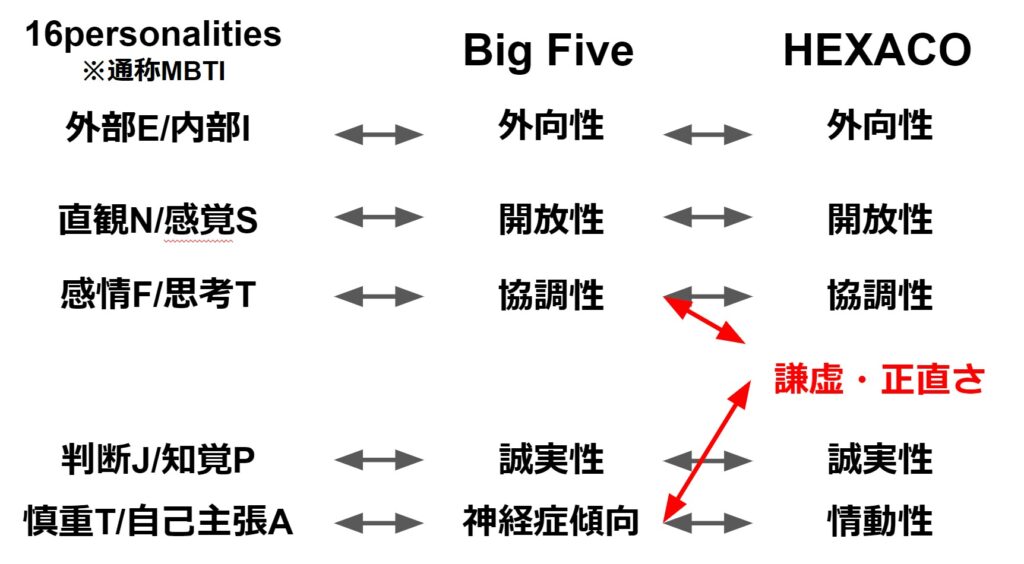
Also, in 16personalities, which was created with reference to MBTI and Big Five, the Big Five’s neuroticism is called “Identity,” and it classifies whether one is Assertive or Turbulent.
On the far right is the relatively new personality assessment “HEXACO.” It has been improved by adding one indicator, “Honesty-Humility,” to the Big Five.
This article will provide a detailed explanation of 16personalities personality types based on these correlations.
Since these were originally Big Five and HEXACO research, if you want to understand personality more scientifically than MBTI or 16personalities, please try this HEXACO personality assessment.
What is INTJ-T (Architect – Turbulent)?
INTJ-T is a type with low extraversion (I), high openness (N), low agreeableness (T), high conscientiousness (J), and high neuroticism (T) in Big Five terms. Characteristics:
- Perfectionist tendencies
- Self-critical and introspective
- Stress from uncertainty
- High analytical and creative abilities
- Continuous desire for self-improvement
They constantly seek the best results and sometimes question their own abilities. They solve problems using critical thinking and creativity, but decision-making can take time. They are cautious in interpersonal relationships and it takes time to build trust. While they fear failure, they also have the ability to view it as a learning opportunity.
Scientific Explanation of INTJ-T (Architect – Turbulent Type)
Tend to get along well with people who have both N and T traits
INTJ-T individuals tend to have high affinity with people who also have N and T characteristics. This is because they share the traits of high openness (N) and low agreeableness (T) in the Big Five model. INTJ-T people value logical thinking and new ideas, so they easily connect with those who have similar thinking styles.
Such relationships can stimulate each other’s intellectual curiosity, leading to deep discussions and creative problem-solving. However, since associating only with similar types might narrow one’s perspective, it’s important to maintain balance.
For more details, please see this article.
Online learning shows effectiveness
INTJ-T individuals may achieve high effectiveness in online learning. This is related to their high openness (N) and high conscientiousness (J) traits in the Big Five model.
INTJ-T people are motivated to learn new knowledge and concepts, and have high self-management abilities, making them well-adapted to the high degree of freedom and self-paced learning style of online education. Additionally, their introverted (I) tendency allows them to concentrate and study effectively in comfortable environments like home.
However, due to their high neuroticism (-T), they need to be careful not to fall into excessive perfectionism. It’s important to proceed with learning while remembering to take appropriate breaks and maintain self-affirmation.
For more details, please see this article.
Slightly more likely to have high IQ, becomes even higher when neuroticism is reduced
INTJ-T individuals tend to have higher intelligence quotient (IQ) than average. This is mainly related to their high openness (N) trait in the Big Five model. INTJ-T people excel at handling abstract concepts and complex problems, and tend to actively incorporate new ideas and information.
However, high neuroticism (-T) may hinder the expression of this intellectual ability. Strong anxiety and self-doubt can sometimes prevent them from fully demonstrating their original capabilities.
By reducing neuroticism, they can think more calmly and logically, approach problem-solving more effectively, and consequently increase the likelihood of achieving higher scores on IQ tests and similar assessments.
For more details, please see this article.
Psychotherapy may increase extraversion and reduce neuroticism
When INTJ-T individuals receive psychotherapy, changes in personality traits may occur. Particularly, effects may be seen on introversion (I) and high neuroticism (-T).
Through psychotherapy, as self-understanding deepens and communication skills improve, they may become capable of more extraverted behavior. Also, by learning methods to cope with anxiety and self-doubt, neuroticism may decrease, leading to greater mental stability.
However, this doesn’t fundamentally change one’s personality, but rather can be seen as a process of learning to better understand and utilize one’s traits. It would be a good opportunity to complement weak areas while maintaining the strengths of INTJ-T.
For more details, please see this article.
INTJ-T individuals tend to utilize social media as an important tool for information gathering. This is related to their high openness (N) trait in the Big Five model.
INTJ-T people have a strong interest in acquiring new knowledge and insights, and social media becomes a rich information source that satisfies these needs. They track the latest discussions on various topics and expert opinions, constantly trying to update their knowledge.
However, due to their introverted (I) tendency, they tend to focus more on receiving and analyzing information rather than actively posting on social media. Also, due to high neuroticism (-T), they may feel excessive anxiety about the reliability of information and the accuracy of their interpretations.
Balanced information gathering and occasionally sharing one’s own opinions are also important.
For more details, please see this article.
INTJ-T individuals have a strong tendency to maintain appropriate social distance as an infection prevention measure. This is primarily due to their introverted (I) characteristics.
INTJ-T people naturally tend to prefer maintaining physical distance from others. For them, social distancing is a natural behavior, and having a clear reason such as infection prevention allows them to engage in this behavior more actively.
Additionally, their preference for logical thinking (T) leads to understanding and practicing the importance of scientifically-based infection prevention measures. Their high neuroticism (-T) also serves as a factor that heightens vigilance against infection risks and promotes more cautious behavior.
However, it’s important to avoid excessive isolation and maintain appropriate social interaction through online means and other methods.
Please see this article for more details.
Properly performing hand washing and other infection prevention measures
INTJ-T individuals tend to reliably execute basic preventive measures such as hand washing as infection prevention strategies. This is primarily due to their high conscientiousness (J) trait from the Big Five.
INTJ-T people tend to be methodical and pay attention to details. In infection prevention as well, they try to strictly adhere to detailed points such as the frequency and method of hand washing and thorough disinfection.
Additionally, their preference for logical thinking (T) allows them to understand the scientific basis of infection prevention and act based on that understanding. Their high neuroticism (-T) also serves as motivation to heighten vigilance against infection risks and take more cautious preventive measures.
However, it’s important to maintain balance to avoid excessive anxiety or compulsive behaviors.
Please see this article for more details.
High learning goal orientation (setting goals and learning in work)
INTJ-T individuals tend to have high learning goal orientation. This is related to their high openness (N) and low agreeableness (T) traits from the Big Five.
INTJ-T people have a strong interest in acquiring new knowledge and skills, constantly seeking self-growth. They prefer to set clear goals at work and systematically advance their learning toward those goals.
Due to their emphasis on logical thinking (T), they try to systematize the learning process and efficiently absorb knowledge. Also, due to their introverted (I) tendency, they prefer self-directed learning styles.
However, due to their high neuroticism (-T), they need to be careful not to fall into excessive perfectionism or self-criticism. It’s important to build sustainable learning habits without forgetting appropriate rest and self-affirmation.
Please see this article for more details.
Relatively common among scientists, even more common with lower neuroticism
The INTJ-T personality type is relatively common among scientists. This is because their high openness (N) and low agreeableness (T) traits from the Big Five have high affinity with scientific thinking and research activities.
INTJ-T people excel at understanding complex concepts and analyzing them logically. Additionally, their strong interest in new ideas and theories (N) and objective, critical thinking (T) are essential elements for scientific inquiry.
However, high neuroticism (-T) can sometimes bring stress to research activities. When neuroticism is low, they can engage in long-term research with a more stable mental state, further enhancing their aptitude as scientists.
Their introverted (I) characteristics can also be said to be suitable for research activities that require deep thinking and concentration.
Please see this article for more details.
Common among writers/editors, artists/creators, counselors/therapists
INTJ-T individuals tend to be commonly found in professions such as writers/editors, artists/creators, and counselors/therapists. This is primarily due to their introverted (I) characteristics.
Introverted people prefer to think deeply in quiet environments and concentrate on creative work. As writers and editors, they excel at expressing complex concepts through words. As artists and creators, they can combine their unique perspective with logical thinking (T) to produce innovative works.
As counselors and therapists, they can utilize their deep insight and analytical thinking (N) to understand clients’ problems and propose solutions.
However, due to their high neuroticism (-T), stress management and self-care are important. Additionally, improving communication skills in these professions is also crucial.
Please see this article for more details.
In the case of children, there is a possibility of being gifted
INTJ-T type children can be said to have a relatively high possibility of being gifted (intellectually talented children). This is mainly related to the high openness (N) trait of the Big Five.
INTJ-T children are often excellent at abstract thinking and understanding complex concepts, and may show intellectual curiosity and learning abilities beyond their age. They have a strong interest in absorbing new ideas and information, and tend to analyze problems from their own unique perspective.
Additionally, the preference for logical thinking (T) trait can also lead to talent in mathematics and science fields. Due to their introverted (I) tendency, they prefer to think deeply alone and may immerse themselves in unique research or creative activities.
However, due to their high neuroticism (-T), they may also be prone to excessive self-criticism and anxiety. Understanding and appropriate support from those around them is important.
Please see this article for more details.
Common among HSPs
INTJ-T people can be said to have a relatively high possibility of being HSP (Highly Sensitive Person). This is mainly related to the high openness (N) and high neuroticism (-T) traits.
HSPs are sensitive to environmental stimuli and tend to engage in deep internal processing. INTJ-T people similarly tend to carefully observe and deeply analyze information from their surroundings. Their high openness (N) leads to heightened sensitivity to various stimuli.
Additionally, their introverted (I) trait also matches HSP characteristics of preferring deep thinking and introspection in quiet environments. High neuroticism (-T) also overlaps with HSP characteristics of being sensitive to environmental changes and stress.
However, not all INTJ-Ts are HSPs. It’s important to understand individual differences and deepen self-understanding.
Please see this article for more details.
Excessive perfectionism
INTJ-T people often display strong perfectionist tendencies. This is mainly due to the combination of high conscientiousness (J) and high neuroticism (-T) traits of the Big Five.
INTJ-T people set high standards and strive to achieve them. They tend to pay attention to details and are not satisfied until everything reaches an ideal state. While this perfectionism serves as a driving force for producing high-quality results, it can also lead to excessive stress and self-criticism.
The trait of valuing logical thinking (T) also strengthens the tendency to analyze problems from all angles and pursue optimal solutions. However, when this pursuit goes too far, it can potentially lead to delays in decision-making and action, or burnout syndrome.
It’s important to maintain balance and accept the concept of “good enough.”
Please see this article for more details.
Preference for salty, acidic, and fatty foods due to stress
INTJ-T people tend to prefer salty, acidic, and fatty foods when feeling stressed. This is mainly related to the high neuroticism (-T) trait.
When feeling stressed, the body seeks things that can provide comfort and pleasure. Salty, acidic, and fatty foods have the effect of temporarily improving mood, making them easily chosen as a means of stress relief.
INTJ-T people are prone to chronic stress due to their high self-demands and perfectionist tendencies, and may rely on food as a stress coping method. Additionally, due to their preference for logical thinking (T), they may tend to seek “immediate” solutions in their food choices as well.
However, attention must be paid to the health effects of these eating habits. It’s important to find healthy methods of stress management.
Please see this article for more details.
Health-conscious preference for vegetables, dairy products, and nuts; even more health-conscious when neuroticism is low
INTJ-T people tend to have an interest in healthy eating and prefer nutritious foods such as vegetables, dairy products, and nuts. This is mainly due to the high conscientiousness (J) trait of the Big Five.
INTJ-T people have high long-term planning abilities and self-management skills, and understand the importance of maintaining health. They think logically (T) about nutritional balance and health effects of food, pursuing an optimal diet.
Vegetables, dairy products, and nuts are rich in nutrients such as vitamins, minerals, and healthy fats, and are helpful for overall health maintenance, making them favored by INTJ-T people.
When neuroticism is low, the tendency to pay even more attention to health becomes stronger. This is because consistent healthy habits can be maintained without being swayed by anxiety and stress.
However, remember not to forget to maintain balance and sometimes cherish meals for enjoyment.
For more details, please see this article.
In the case of men, they tend to become husbands who are cheated on
INTJ-T type men statistically tend to have a relatively high possibility of being cheated on. This is mainly due to the combination of introverted (I) and high neuroticism (-T) characteristics.
INTJ-T men tend to value deep thinking and personal time, and may neglect emotional connections and communication with their partners. Also, due to their characteristic of valuing logical thinking (T), they tend to lack emotional support and empathy.
High neuroticism (-T) can lead to anxiety and self-doubt, creating lack of confidence and excessive vigilance. These factors may negatively affect relationships with partners.
However, it’s important to note that this is a general tendency and individual differences are significant. Open communication and mutual understanding are important for improving relationships.
For more details, please see this article.
Prone to hoarding behavior
INTJ-T people tend to engage in hoarding behavior during crisis situations. This is mainly due to the combination of high openness (N) and high neuroticism (-T) characteristics.
INTJ-T people excel at analyzing situations and predicting future possibilities (N). In crisis situations, they tend to envision worst-case scenarios and try to prepare for them. At the same time, due to high neuroticism (-T), they are sensitive to anxiety and uncertainty, making them prone to taking actions to reduce these feelings.
Also, their preference for logical thinking (T) may lead them to justify hoarding as a “rational” countermeasure. High conscientiousness (J) also contributes to their attitude of not neglecting preparation.
However, it’s important to consider the impact this tendency has on society as a whole and maintain a balance between appropriate preparation and calm judgment.
For more details, please see this article.
Prone to holding Social Dominance Orientation (SDO) ideology
INTJ-T people tend to hold Social Dominance Orientation (SDO) ideology. This is mainly related to their low agreeableness (T) characteristic.
SDO refers to the tendency to view social hierarchies and inequalities positively, believing that some groups should be superior to other groups. INTJ-T people value logical thinking (T) and tend to emphasize efficiency and meritocracy, so they may easily empathize with such ways of thinking.
Also, being introverted (I) and having self-sufficient aspects, they tend to prioritize individual or small group interests over social harmony. While their high openness (N) characteristic may lead them to question existing social structures, they may tend to try to “optimize” them rather than transform them.
However, this is a general tendency and varies greatly depending on individual values and experiences. It’s important to understand the importance of diversity and deeply contemplate fairness.
For more details, please see this article.
Practicing mindfulness reduces neuroticism
When INTJ-T people practice mindfulness, their neuroticism may decrease. This is mainly because it has effects that work on their high neuroticism (-T) characteristic.
Mindfulness is a practice that cultivates a state of mind that focuses attention on the present moment and accepts it without judgment. INTJ-T people often tend to overthink future possibilities and problems, but mindfulness helps soften this thought pattern and focus on the present.
Also, for INTJ-T people who have introverted (I) characteristics, mindfulness is a practice method that harmonizes easily with self-introspection. Due to their high openness (N), they are likely to be interested in mindfulness as a new experience.
Regular mindfulness practice can lead to stress reduction, anxiety relief, and improved emotional control, potentially resulting in decreased neuroticism.
For more details, please see this article.
Engages in emotion-focused coping
INTJ-T people tend to engage in emotion-focused coping as a method of dealing with stress. This is mainly related to their high neuroticism (-T) characteristic.
Emotion-focused coping refers to a method of dealing with stressful situations by focusing on the emotions and psychological reactions caused by the situation, rather than the problem itself. INTJ-T individuals, with their high self-awareness and introspective tendencies, are sensitive to their own emotional states and try to regulate them.
Their introverted (I) trait also strengthens their tendency to focus on their inner selves. Additionally, being high in openness (N), they are proactive in exploring new ways to understand and manage emotions.
However, by also developing problem-solving coping skills, they will be able to deal with stress more effectively. A balanced approach is important.
They attempt relatively calm risk management, but their high neuroticism causes them to have biases toward risks
INTJ-T individuals try to take a relatively calm approach to risk management, but at the same time, their high neuroticism tends to create biases toward risks.
Due to their high conscientiousness (J) trait, INTJ-T individuals strive for planned and careful risk management. Also, their tendency to prefer logical thinking (T) makes them try to analyze risks objectively.
However, their high neuroticism (-T) causes them to focus excessively on potential threats and negative outcomes, leading to a tendency to overestimate risks. This can interfere with calm judgment and sometimes lead to excessive cautiousness or delays in decision-making.
Their high openness (N) trait helps them consider various possibilities, but it may also increase anxiety about unexpected risks.
For balanced risk assessment, it’s important to distinguish between objective data and subjective anxiety, and to incorporate others’ opinions as well.
Please see this article for more details.
Common in Japan’s Hokuriku and Chugoku regions
The INTJ-T personality type tends to be relatively common in Japan’s Hokuriku and Chugoku regions. This suggests that regional culture and environment may influence individual personality formation.
Their introverted (I) and thoughtful characteristics may have high compatibility with the traditional values and lifestyles of these regions. Also, their tendency to prefer logical thinking (T) may be related to the industrial structure and educational environment of these regions.
The natural environment and climate of Hokuriku and Chugoku regions may also be factors that foster an introspective and planned (J) lifestyle. Furthermore, the historical and cultural backgrounds of these regions may influence the formation of high openness (N) and neuroticism (-T).
However, it should be noted that this is a general tendency and individual differences are significant. Also, further research is needed on the relationship between regionality and personality.
Please see this article for more details.
Preference for simple and practical clothing
INTJ-T individuals tend to prefer simple and practical clothing. This is related to their personality traits and several factors.
Due to their introverted (I) trait, INTJ-T individuals prefer modest and simple styles rather than flashy clothing that draws attention. Also, their tendency to value logical thinking (T) makes them prioritize functionality and practicality in clothing, avoiding unnecessary decorations.
Their high openness (N) trait sometimes leads to the exploration of original styles, but in most cases, this is expressed in the form of sophisticated minimalism.
Their high conscientiousness (J) makes them prefer an organized appearance and choose clean, simple clothing. Also, their high neuroticism (-T) may make them prefer manageable wardrobes that cause less stress in clothing selection.
However, this is a general tendency and may vary depending on individual preferences and environment.
Please see this article for more details.
Finally
INTJ-T individuals are good at thinking about various ideas in their heads and enjoy analyzing things logically. They prefer working with concentration in quiet environments and love learning new things. However, they also have tendencies to seek perfection too much or become prone to worry.
In relationships, they tend to get along well with people who have similar ways of thinking, but they may sometimes struggle with emotional communication.
What’s important is to make use of your strengths while also paying attention to your weaknesses and maintaining balance. Understanding your own personality well will lead to a more fulfilling school life and future career choices.
The tendencies introduced are originally from Big Five and HEXACO research, so if you want to know your personality more scientifically than MBTI or 16personalities, please try this HEXACO personality test.

Writer & Supervisor: Eisuke Tokiwa
Personality Psychology Researcher / CEO, SUNBLAZE Inc.
As a child he experienced poverty, domestic abuse, bullying, truancy and dropping out of school — first-hand exposure to a range of social problems. He spent 10 years researching these issues and published Encyclopedia of Villains through Jiyukokuminsha. Since then he has independently researched the determinants of social problems and antisocial behavior (work, education, health, personality, genetics, region, etc.) and has published 2 peer-reviewed journal articles (Frontiers in Psychology, IEEE Access). His goal is to predict the occurrence of social problems. Spiky profile (WAIS-IV).
Expertise: Personality Psychology / Big Five / HEXACO / MBTI / Prediction of Social Problems
Researcher profiles: ORCID / Google Scholar / ResearchGate
Social & Books: X (@etokiwa999) / note / Amazon Author Page