Do you know about the ESTP-A type?
This is one of the indicators that represents personality, and it greatly influences our behavior and way of thinking.
In this article, we will explain in detail what characteristics people with ESTP-A have, including aspects related to health, work, and interpersonal relationships.
By better understanding your own personality and that of those around you, it may lead to better communication and self-understanding.
Please try reading while comparing it with your own personality and that of your friends.
Once again, personality researcher and author of Villain Encyclopedia, Tokiwa (@etokiwa999), will provide the explanation.
※We have developed the HEXACO-JP Personality Assessment! It has more scientific basis than MBTI. Tap below for details.

目次
- 1 Scientific Background of ESTP-A (Entrepreneur・Assertive Type)
- 2 Scientific Explanation of ESTP-A (Entrepreneur, Assertive Type)
- 2.1 Tend to get along well with people who have both S and T traits
- 2.2 Making new friends
- 2.3 Have many friends on social media
- 2.4 Prone to obesity
- 2.5 Prefer fast food, ice cream, chocolate, cocoa; avoid meat
- 2.6 Prone to right-wing authoritarianism (RWA) ideology, prone to social dominance orientation (SDO) ideology
- 2.7 Common among bullying perpetrators
- 2.8 Common among cyberbullying perpetrators
- 2.9 Possibility of psychopathy
- 2.10 Common among monster employees
- 2.11 Relatedness needs in self-determination theory are easily satisfied
- 2.12 Common in Japan’s Hokuriku Region
- 2.13 Schwartz Values: Power, Achievement, Hedonism
- 3 In Conclusion
Scientific Background of ESTP-A (Entrepreneur・Assertive Type)
Overview of MBTI
MBTI is a psychological theory that classifies personality into 16 types.
To begin with, MBTI is an abbreviation for Myers-Briggs Type Indicator.
MBTI classifies personality into 16 types by combining the following four indicators.
In other words, MBTI expresses one’s personality tendencies with four letters such as “ISTJ” or “ENFP”. There is a very famous similar system called 16personalities, but this is different from MBTI.
Overview of Big Five
One of the most influential trait theories in personality psychology is the “Big Five.”
The Big Five measures five traits: Openness, Conscientiousness, Extraversion, Agreeableness, and Neuroticism.
Also, while 16personalities and MBTI use type classification (e.g., either extraverted or introverted), the Big Five evaluates traits with continuous numerical values (e.g., extraversion 3.5), which is a major difference.
Furthermore, it has been studied for a long time, has many research papers, and extensive research has been conducted in other fields such as academic performance, income, brain, and genetics. It can be said that the Big Five has relatively stronger scientific backing.
Correlation between MBTI, Big Five, and HEXACO
There are correlations between MBTI’s four indicators and the Big Five’s five factors.
A representative study showing this correlation is the paper “The relationship between the revised NEO-Personality Inventory and the Myers-Briggs Type Indicator.”
According to this paper, the correlations between MBTI and the Big Five are as follows.
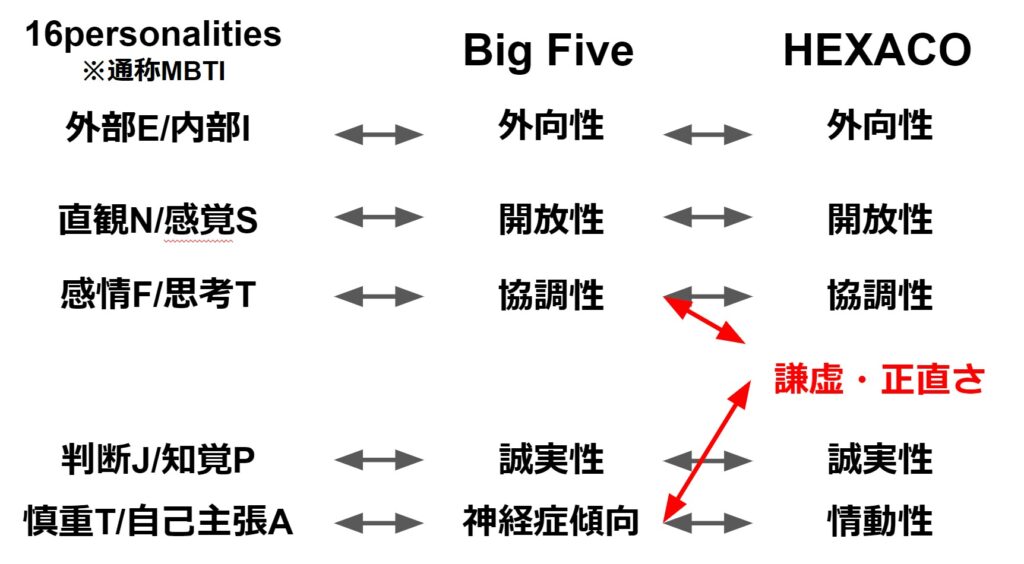
Also, in 16personalities, which was created with reference to MBTI and the Big Five, Neuroticism from the Big Five is called “Identity” and is classified as either Assertive or Turbulent.
On the far right is the relatively new personality assessment called “HEXACO.” It has been improved by adding one indicator “Honesty-Humility” to the Big Five.
This article will explain the personality types of 16personalities in detail based on these correlations.
Since this is originally research on the Big Five and HEXACO, if you want to understand personality more scientifically than MBTI or 16personalities, please try this HEXACO personality assessment.
What is ESTP-A (Entrepreneur・Assertive Type)?
ESTP-A is a type with high Extraversion (E), low Openness (S), low Agreeableness (T), low Conscientiousness (P), and low Neuroticism (A) in the Big Five.
- High adaptability and problem-solving ability
- Action-oriented and adventurous spirit
- Realistic and practical thinking
- Confident risk-taking
- Strong sociability and influence
They make the most of the present moment, quickly grasping situations and taking action. They value practical experience and solve problems efficiently.
In interpersonal relationships, they demonstrate attractive communication skills and draw people to them. They welcome change and new challenges, and have high stress tolerance, allowing them to respond calmly even in crisis situations. They have strong self-efficacy and believe in their own abilities.
Scientific Explanation of ESTP-A (Entrepreneur, Assertive Type)
Tend to get along well with people who have both S and T traits
People with ESTP-A type tend to have high affinity with people who similarly possess S and T characteristics. This is because they easily share realistic and logical thinking. In the Big Five, they have characteristics of low openness (S) and low agreeableness (T).
ESTP-A people value concrete facts and experiences, and prefer logical judgments. Therefore, they naturally become close with people who have similar values.
This tendency may influence relationship building in work and daily life. Please see this article for more details.
Making new friends
People with ESTP-A type are good at making new friends. This is due to their high extraversion (E) characteristic in the Big Five.
They are sociable and actively try to engage with new environments and people. With their energetic and talkative personality, they can enjoy conversations with people they meet for the first time without hesitation.
Additionally, because they tend to be action-oriented and enjoy adventure, they are also good at building friendships through new experiences. This trait is helpful for building broad human relationships. Please see this article for more details.
People with ESTP-A type tend to actively interact on social media as well. This is related to their high extraversion (E) characteristic.
They actively communicate not only in the real world but also online. Due to their personality that enjoys new encounters and information exchange, they tend to make many friends and acquaintances on social media as well.
Additionally, social media with its immediacy and strong visual elements is probably compatible with the sensing (S) and action-oriented characteristics of ESTP-A. This trait works advantageously for online network building. Please see this article for more details.
Prone to obesity
People with ESTP-A type are said to be prone to obesity. This may be related to their behavioral patterns and lifestyle habits.
ESTP-A tends to prefer enjoying the present moment rather than planning. This trait may make it difficult to maintain regular eating habits and exercise routines.
Additionally, due to their personality that seeks new experiences and stimulation, they may have many opportunities to try various foods or enjoy dining out. These factors combined may create challenges in weight management. Please see this article for more details.
Prefer fast food, ice cream, chocolate, cocoa; avoid meat
People with ESTP-A type tend to prefer fast food and sweets. This is related to their high extraversion (E) and low neuroticism (-A) characteristics.
They tend to prefer foods that provide immediate satisfaction, and are likely attracted to the convenience of fast food and the pleasurable aspects of sweet things.
Additionally, due to their personality that seeks new tastes and experiences, they may enjoy trying various types of fast food and confections.
On the other hand, the tendency to avoid meat may be surprising. This may vary depending on individual preferences and health consciousness. It’s important to note that food preferences vary greatly among individuals, so this cannot be generalized. Please see this article for more details.
People with ESTP-A type are said to be prone to right-wing authoritarianism (RWA) and social dominance orientation (SDO) ideologies. This is related to their sensing (S) and thinking (T) characteristics.
They prefer realistic and logical thinking, and tend to value existing order and hierarchy.
For this reason, they may easily support traditional values and social structures, and may easily empathize with ideologies that emphasize authority and power relationships.
However, this is merely a tendency, and it may vary greatly depending on individual values and experiences. Additionally, such ideologies are socially sensitive topics, and it is important to respect individual beliefs and backgrounds. Please see this article for more details.
Common among bullying perpetrators
It has been pointed out that ESTP-A type people tend to become bullying perpetrators. This is related to their Sensing (S), Thinking (T), Perceiving (P) characteristics, and low neuroticism (-A).
They are action-oriented and tend to seek immediate results. They also prioritize logic over emotion and may have relatively low empathy for others’ feelings.
These characteristics may sometimes lead to lack of consideration for others or aggressive behavior.
However, this tendency is merely statistical, and not all ESTP-As engage in bullying. Individual moral values and educational environment greatly influence this.
For bullying prevention, developing empathy and appropriate education are important. Please see this article for more details.
Common among cyberbullying perpetrators
ESTP-A type people are said to have a tendency to become cyberbullying perpetrators. This is related to their Thinking (T) and Perceiving (P) characteristics.
They prefer logical thinking and tend to seek immediate reactions. Online environments create emotional distance more easily than face-to-face interactions, and this characteristic may lead to aggressive behavior. Additionally, the P trait of emphasizing process over results may lead to insufficient consideration of the consequences of actions.
However, this is merely a tendency, and not all ESTP-As engage in cyberbullying. Appropriate digital literacy education and fostering empathy in online environments are important. Please see this article for more details.
Possibility of psychopathy
There are suggestions that ESTP-A type people may show tendencies toward psychopathy. This is related to their Thinking (T), Perceiving (P) characteristics and low neuroticism (-A).
They tend to prioritize logic over emotion and prefer immediate judgment over planning. Their characteristic of being stress-resistant and less prone to anxiety (-A) may also sometimes lead to low empathy for others.
However, this is merely one aspect of personality traits, and psychopathy is a complex mental state. Not all ESTP-As have psychopathic tendencies.
Individual upbringing and values greatly influence this. Appropriate psychological education and ethical development are important. Please see this article for more details.
Common among monster employees
There are suggestions that ESTP-A type people tend to become so-called “monster employees.” This is related to their Thinking (T) and Perceiving (P) characteristics.
They emphasize logical thinking and tend to seek immediate results. This characteristic may sometimes lead to prioritizing their own judgment over organizational rules or consideration for others.
Additionally, the P trait of preferring flexibility may sometimes make them poorly suited to strict workplace discipline.
However, this is merely a tendency, and not all ESTP-As become problem employees.
Developing appropriate communication skills and efforts to improve organizational adaptability are important. Please see this article for more details.
Relatedness needs in self-determination theory are easily satisfied
ESTP-A type people tend to easily satisfy relatedness needs in self-determination theory. This is related to their high extraversion (E) and low neuroticism (-A) characteristics.
They are sociable and enjoy interacting with new people. This characteristic makes it easy for them to build various relationships and feel connected to those around them.
Additionally, their stress-resistant and socially adaptable (-A) characteristics also help in building good relationships.
This tendency may have a positive impact on relationship satisfaction in both work and personal life. Please see this article for more details.
Common in Japan’s Hokuriku Region
There appears to be a tendency for ESTP-A type individuals to be more common in Japan’s Hokuriku region. This may be particularly related to their thinking (T) characteristics.
The Hokuriku region is traditionally known as an area where straightforward and diligent temperaments are valued. ESTP-A’s logical thinking and practical approach may harmonize well with such regional values.
However, this is a statistical tendency, and individual differences and changes over time are likely significant. Additionally, the relationship between personality types and regional characteristics is complex, with various factors at play.
It’s important not to overgeneralize such tendencies and to respect individual diversity. For more details, please refer to this article.
Schwartz Values: Power, Achievement, Hedonism
ESTP-A type individuals tend to value “power,” “achievement,” and “hedonism” in Schwartz’s theory of values. This is related to their extraverted (E), thinking (T), and perceiving (P) characteristics.
They value social status and success (power, achievement) and place importance on personal success and the demonstration of abilities. Additionally, their tendency to seek new experiences and stimulation leads them to cherish enjoyment and sensory pleasures (hedonism).
ESTP-A’s action-oriented nature and tendency to seek immediate satisfaction are thought to be connected to these values. However, since values are shaped by individual experiences and environments, not all ESTP-As hold the same values. For more details, please refer to this article.
In Conclusion
ESTP-A type individuals have very unique characteristics.
They are sociable and skilled at making new friends. They are likely active on social media and have many friends.
Due to their action-oriented nature and love for adventure, they tend to enjoy various experiences. However, this characteristic can sometimes lead to difficulties in health management, so caution is needed.
ESTP-A individuals prefer logical thinking and tend to make realistic judgments.
While this leads to success at work and school, it can sometimes result in insufficient consideration for others’ emotions.
What’s important is to leverage your strengths while being mindful of your weaknesses. It’s crucial to build good relationships with those around you while cherishing your authenticity.
The tendencies introduced are originally from Big Five and HEXACO research, so if you want to understand your personality more scientifically than through MBTI or 16personalities, please try this HEXACO personality assessment.

Writer & Supervisor: Eisuke Tokiwa
Personality Psychology Researcher / CEO, SUNBLAZE Inc.
As a child he experienced poverty, domestic abuse, bullying, truancy and dropping out of school — first-hand exposure to a range of social problems. He spent 10 years researching these issues and published Encyclopedia of Villains through Jiyukokuminsha. Since then he has independently researched the determinants of social problems and antisocial behavior (work, education, health, personality, genetics, region, etc.) and has published 2 peer-reviewed journal articles (Frontiers in Psychology, IEEE Access). His goal is to predict the occurrence of social problems. Spiky profile (WAIS-IV).
Expertise: Personality Psychology / Big Five / HEXACO / MBTI / Prediction of Social Problems
Researcher profiles: ORCID / Google Scholar / ResearchGate
Social & Books: X (@etokiwa999) / note / Amazon Author Page