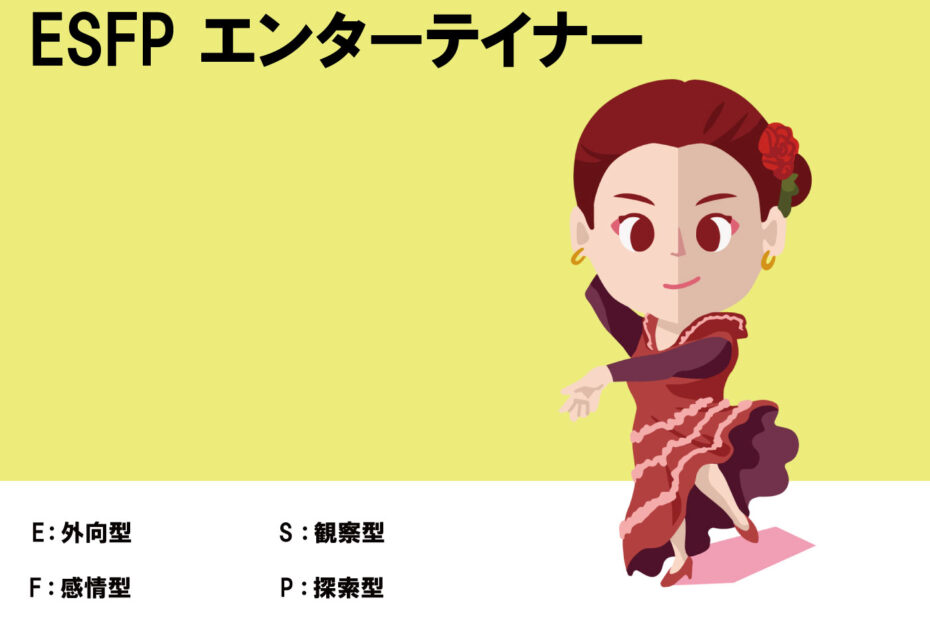
ESFP love compatibility traits reveal one of the most warm-hearted, expressive romantic styles found in the MBTI system. If you have ever dated someone who lights up every room, showers you with spontaneous affection, and makes ordinary moments feel like celebrations, there is a good chance that person was an ESFP. Understanding how this personality type experiences love can help both ESFPs and their partners build deeper, more lasting connections.
Drawing on psychological research — including the well-established Big Five personality model — this article explores the ESFP romantic style in detail: their natural strengths as partners, the challenges they tend to face, which personality types they mesh with best, and practical strategies for making love last. Whether you identify as an ESFP or are simply curious about MBTI love traits, read on for a comprehensive, evidence-informed guide.
Once again, personality researcher and author of Villain Encyclopedia, Tokiwa (@etokiwa999), will provide the explanation.
※We have developed the HEXACO-JP Personality Assessment! It has more scientific basis than MBTI. Tap below for details.

目次
- 1 ESFP (Entertainer) Characteristics and Tendencies
- 2 ESFP Love Compatibility Traits: What Makes Them Natural Romantics
- 3 The Psychology Behind ESFP Romantic Style: What Research Tells Us
- 4 ESFP Emotional Expression: Strengths and Blind Spots in Love
- 5 Try Taking the Proper Personality Test “HEXACO-JP”!
- 6 ESFP Partner Compatibility: Which Types Tend to Click?
- 7 Scientific Background of the 16 Types
- 8 Actionable Advice for ESFPs: How to Make Love Last
- 9 FAQ and Important Notes
- 10 Frequently Asked Questions
- 10.1 What are the core ESFP love compatibility traits?
- 10.2 Which MBTI types are most compatible with ESFP?
- 10.3 How does an ESFP express love in a relationship?
- 10.4 What are the biggest weaknesses of ESFPs in romantic relationships?
- 10.5 What does the Big Five research say about ESFP-style personalities in love?
- 10.6 Can ESFPs maintain long-term committed relationships?
- 10.7 How can a partner of an ESFP best support the relationship?
- 11 Summary: Embracing the ESFP Way of Loving
ESFP (Entertainer) Characteristics and Tendencies
ESFP is a type overflowing with brightness and sociability.
They are skilled at entertaining people and livening up situations.
They value present experiences and live actively.
They are flexible with high adaptability and don’t fear change.
The characteristics and tendencies of ESFP are as follows.
- They enjoy interacting with people and approach them in a friendly manner.
- They energize their surroundings with a bright atmosphere.
- They prefer sensory stimulation and new experiences.
- They excel at learning through actual action.
- They adapt flexibly to their environment and find enjoyment.
On the other hand, they have a tendency to become impulsive.
They struggle with making long-term plans.
When they escape from reality, issues tend to be postponed.
Being conscious of self-management leads to stability.
ESFP has the charm to attract people.
They enliven many situations with their sociability and action-oriented nature.
They share enjoyment with those around them and build human relationships.
They can lead a fulfilling life by making use of their brightness.
ESFP Love Compatibility Traits: What Makes Them Natural Romantics
ESFPs tend to rank among the most naturally romantic personalities in the MBTI framework. Their full name — Extraverted, Sensing, Feeling, Perceiving — hints at why: they are outwardly energetic, grounded in sensory experience, emotionally driven, and refreshingly spontaneous. In relationships, these 4 core traits combine to create a partner who is affectionate, fun-loving, and deeply attuned to a partner’s emotional state in the present moment.
The ESFP personality in relationships is best understood through several defining patterns:
- Openly expressive affection: ESFPs rarely hide their feelings. They show love through tangible actions — surprise dates, physical touch, enthusiastic words of encouragement — rather than waiting for the “right moment.”
- Talent for creating joy: Because they are wired to seek and share positive experiences, ESFPs tend to be highly skilled at keeping romance alive with humor, playfulness, and shared adventures.
- Emotional generosity: They genuinely delight in a partner’s happiness. Seeing someone they love smile is, for many ESFPs, its own reward.
- Present-moment focus: ESFPs live fully in the now, which makes dates with them feel immersive and attentive — they are rarely distracted by yesterday’s worries or tomorrow’s plans.
In short, the ESFP ideal partner experience is one of warmth, laughter, and consistent emotional presence. Research suggests that this kind of responsive, emotionally available behavior correlates positively with relationship satisfaction for both partners.
The Psychology Behind ESFP Romantic Style: What Research Tells Us
To understand ESFP partner compatibility on a deeper level, it helps to look at what personality psychology says about love and satisfaction. The most widely used scientific model is the Big Five (also called OCEAN), which describes personality along 5 dimensions: Openness, Conscientiousness, Extraversion, Agreeableness, and Neuroticism (emotional stability). While MBTI and the Big Five are different systems, they overlap in meaningful ways.
Research consistently points to 2 traits that predict higher relationship satisfaction:
- Agreeableness (warmth and cooperativeness): People who score high here tend to be empathetic, considerate, and conflict-averse — qualities that ESFPs typically demonstrate through their Feeling (F) preference.
- Conscientiousness (self-discipline and reliability): Partners who are dependable and follow through on commitments report greater mutual satisfaction. This is an area where ESFPs — with their Perceiving (P) preference — may need to put in extra effort.
In MBTI terms, the “F” (Feeling) dimension aligns closely with high Agreeableness, while the “J” (Judging) dimension maps onto Conscientiousness. This suggests that ESFPs have a natural advantage in emotional warmth but may benefit from consciously developing follow-through and reliability. The following meta-analysis provides the scientific backbone for this understanding:
Malouff et al. (2010), The Five-Factor Model of personality and relationship satisfaction of intimate partners: A meta-analysis — This study found that higher Conscientiousness and Agreeableness in either partner significantly predicted greater relationship satisfaction across multiple samples.
ESFP Emotional Expression: Strengths and Blind Spots in Love
ESFP emotional expression is vivid, immediate, and hard to miss — but it also comes with at least 3 recurring challenges that can strain relationships if left unaddressed. Being aware of both sides helps ESFPs channel their natural gifts more effectively and protect their partnerships from predictable pitfalls.
Core Strengths
- High emotional availability: ESFPs are typically present and responsive during emotional conversations, making partners feel genuinely heard.
- Conflict de-escalation: Their natural warmth and humor often help defuse tense moments before they escalate.
- Acts of service and quality time: ESFPs tend to express love through experiences and gestures rather than just words, which many partners find deeply meaningful.
Recurring Challenges
- Mood variability: ESFPs can be prone to emotional swings. When excitement fades, they may seem distant or restless, which partners can misread as loss of interest.
- Avoidance of heavy topics: Because they prioritize enjoyment, ESFPs sometimes sidestep serious conversations about the future, finances, or conflict — areas that require uncomfortable but necessary discussion.
- Novelty-seeking: A constant craving for new experiences can create instability if not consciously balanced with the comfort and routine that long-term relationships require.
Understanding these tendencies does not mean ESFPs are poor partners — far from it. It simply means that, like all personality types, they grow most in love when they lean into their strengths while actively working on their growth edges.
Try Taking the Proper Personality Test “HEXACO-JP”!
While MBTI and 16personalities are popular as “gateways to knowing yourself,” experiencing a scientifically-backed personality test is the best way to truly understand your strengths and risks.
That’s where we recommend the HEXACO assessment available in Japanese: “HEXACO-JP“.
HEXACO-JP visualizes your personality tendencies numerically based on six factors: Honesty-Humility, Emotionality, Extraversion, Agreeableness, Conscientiousness, and Openness.
By simply answering straightforward questions, you can gain helpful insights for self-understanding, relationships, and workplace communication.
If you’re curious about “What type of person am I?”, start by taking HEXACO-JP and examine yourself from a scientific perspective.
ESFP Partner Compatibility: Which Types Tend to Click?
When it comes to ESFP partner compatibility, balance tends to matter more than similarity. While ESFPs can build meaningful relationships with virtually any MBTI type, certain pairings tend to produce especially harmonious or especially challenging dynamics.
High-Compatibility Pairings
- ISFJ and ESFJ: These Feeling-Judging types tend to bring the warmth ESFPs crave along with a grounding reliability that complements the ESFP’s spontaneity. The combination of emotional depth and practical stability can feel like the best of both worlds.
- ISTP and ESTP: Sensing-Perceiving types share the ESFP’s love of present-moment experience and hands-on engagement, making for naturally energetic, low-drama connections.
- ENFP: Both types are enthusiastic, emotionally expressive, and novelty-seeking. This pairing tends to produce high-energy, creative relationships — though both partners may need to consciously develop consistency.
Potentially Challenging Pairings
- INTJ and INFJ: Intuitive-Judging types often want structured, future-oriented communication that can feel heavy or abstract to the present-focused ESFP. These pairings can work beautifully, but require significant mutual adaptation — roughly 2 to 3 times more intentional communication effort than average-compatible pairs, based on relationship counseling observations.
- ENTJ: The ENTJ’s drive for efficiency and long-term planning may clash with the ESFP’s preference for living in the moment, creating friction around decisions and priorities.
It is worth emphasizing that compatibility is never determined solely by type. Individual maturity, shared values, and communication skills consistently outweigh personality labels when it comes to lasting love.
Scientific Background of the 16 Types
MBTI Overview
MBTI is a psychological theory that classifies personality into 16 types.
To begin with, MBTI is an abbreviation for Myers-Briggs Type Indicator.
MBTI classifies personality into 16 types by combining the following 4 indicators.
In other words, MBTI expresses one’s personality tendencies in 4 letters such as “ISTJ” or “ENFP”. There is a very famous similar system called 16personalities, but this is created by combining MBTI and Big Five.
Big Five Overview
One of the most prominent trait theories in personality psychology is the “Big Five”.
Big Five measures five traits: Openness, Conscientiousness, Extraversion, Agreeableness, and Neuroticism.
Also, while 16personalities and MBTI use type classification (e.g., either extraverted or introverted), a major difference is that Big Five evaluates traits on a continuous numerical scale (e.g., extraversion 3.5).
Furthermore, it has been studied for a long time, has many research papers, and extensive research has been conducted in other fields such as academic achievement, income, brain, and genetics. It can be said that Big Five has relatively stronger scientific backing.
Correlation Between MBTI, Big Five, and HEXACO
There are correlations between MBTI’s 4 indicators and Big Five’s 5 factors.
A representative study showing this correlation is the paper “The relationship between the revised NEO-Personality Inventory and the Myers-Briggs Type Indicator“.
According to this paper, the correlations between MBTI and Big Five are as follows.
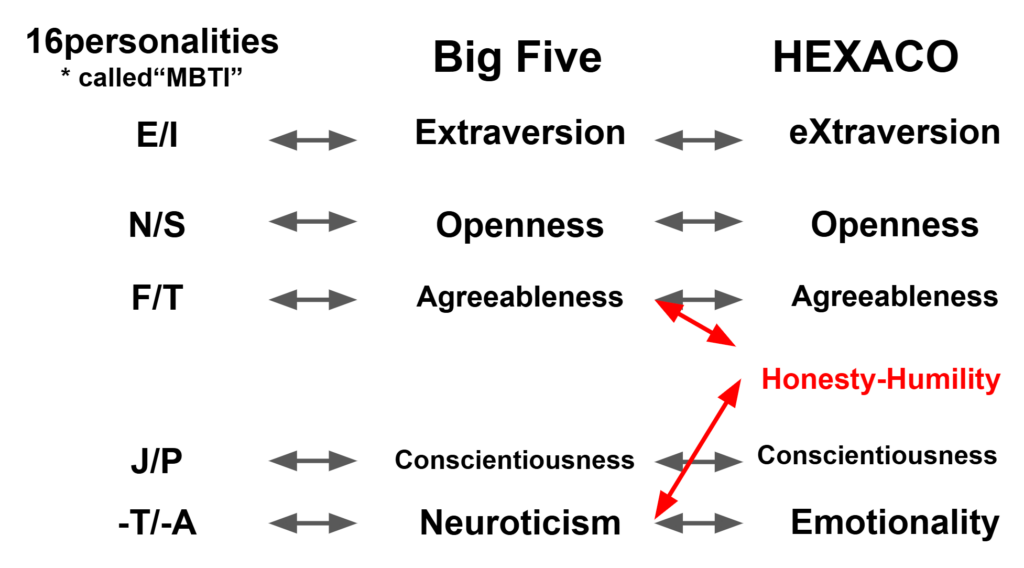
Also, in 16personalities, which was created with reference to MBTI and Big Five, neuroticism from Big Five is called “Identity“, and is classified as either Assertive or Turbulent.
On the far right is the relatively new personality assessment “HEXACO“. It is an improved version of Big Five with one additional indicator “Honesty-Humility”. Research on bullying and harassment perpetrators is active in HEXACO studies.
Since 16personalities and MBTI have weak scientific evidence, this article provides detailed explanations of 16personalities personality types based on their correlations with Big Five and HEXACO.
Actionable Advice for ESFPs: How to Make Love Last
MBTI love traits only matter if they translate into real-world behavior. For ESFPs, the goal is not to change their fundamental nature — their warmth and expressiveness are genuine gifts — but to add a few deliberate habits that create the safety and consistency long-term partnerships need.
- Schedule “slow” moments together: Why it works: Calm, routine experiences build emotional security. How to practice: Once a week, plan something low-key — a shared meal, a quiet walk — without trying to make it “exciting.” Let connection happen without performance.
- Have at least 1 serious conversation per month: Why it works: Avoiding difficult topics creates unresolved tension that erodes trust over time. How to practice: Pick a regular check-in (e.g., monthly “relationship review” over coffee) to discuss finances, future goals, or any lingering concerns.
- Follow through on small commitments: Why it works: Research links Conscientiousness — reliability in everyday actions — to long-term relationship satisfaction. How to practice: If you say you will call, call. If you commit to a plan, keep it. Small reliability compounds into deep trust.
- Communicate your need for novelty openly: Why it works: Partners who understand the ESFP’s need for stimulation can help provide it constructively, reducing the risk of restlessness turning into distance. How to practice: Say directly, “I’m craving something new — want to try [activity] together?” rather than simply disengaging.

FAQ and Important Notes
HEXACO results differ from 16personalities (commonly known as MBTI test) or MBTI (original)
- Personality is influenced by genetics and environment, so when the environment changes, responses also change (for example, emotional responses change when you’re tired, etc.). For more details on genetics, see here.
- There are variations in responses depending on age. For more details, see here.
- Type classification is based on whether each value is 3 or above, or below 3, so values close to 3 are more likely to change results depending on how questions are asked or the environment at the time. Please look at the numerical values rather than the type.
- For MBTI (original) and 16personalities (commonly known as MBTI test), it’s unclear how much statistical processing was done at the question design stage as no research papers can be found. On the other hand, papers on Big Five and HEXACO can be easily found, and this HEXACO-JP test is based on research papers.
- While there aren’t many research papers comparing MBTI and 16personalities with everyday behaviors (academic performance, income, etc.) or with the brain and genetics, there are numerous studies on Big Five and HEXACO.
- HEXACO is a variation of Big Five elements, so they are similar but distinct. HEXACO’s Honesty-Humility is extracted from Big Five’s Agreeableness and Neuroticism.
If you have any other questions, please contact us through our inquiry form.
Personality test results are merely “hints” for your life
As mentioned earlier, personality is influenced by genetics and environment. Due to genetic influence, there is a certain range of variation, but answers can vary to some extent depending on the environment.
Also, while Big Five and HEXACO research papers conduct correlation analyses with academic performance and income, the correlation coefficients are not as large as those in natural science experiments. Correlation coefficients range from -1 to 1, but most are around -0.4 to 0.4. Of course, there are higher ones too, but they’re not 0.8 or 0.9 – they’re relatively lower in comparison.
However, since there is various research available, please think of it as “more than fortune-telling, less than natural science.” I’m not 100% denying psychology or fortune-telling.
Frequently Asked Questions
What are the core ESFP love compatibility traits?
ESFPs tend to be warm, expressive, spontaneous, and highly attuned to a partner’s emotional state in the present moment. Their core love compatibility traits include generous affection, a talent for creating joyful experiences, and strong empathy. However, they may struggle with consistency, long-term planning, and avoiding difficult conversations — areas that benefit from conscious development. Overall, ESFPs are often described as among the most naturally loving and fun partners in the MBTI system.
Which MBTI types are most compatible with ESFP?
ESFPs tend to connect well with ISFJ, ESFJ, ISTP, ESTP, and ENFP types. Feeling-Judging types (like ISFJ) offer emotional warmth plus the grounding reliability that complements ESFP spontaneity. Sensing-Perceiving types (like ISTP) share the ESFP’s love of present-moment engagement. That said, compatibility ultimately depends on individual maturity and communication skills far more than on type alone — any two types can build a strong relationship with sufficient self-awareness and effort.
How does an ESFP express love in a relationship?
ESFPs typically express love through actions and experiences rather than words alone. Common expressions include planning surprise outings, physical affection, enthusiastic verbal encouragement, and creating shared memories. They are present-focused partners who make the people they love feel seen and celebrated in the moment. Because they are highly sensory and emotionally responsive, their love language often blends acts of service, quality time, and physical touch in naturally integrated ways.
What are the biggest weaknesses of ESFPs in romantic relationships?
Research and relationship observations suggest that ESFPs face at least 3 recurring challenges in love: mood variability that partners can misread as disinterest, a tendency to avoid serious or future-focused conversations, and a craving for novelty that can create instability if unmanaged. These tendencies are not fatal flaws — they become problematic mainly when left unacknowledged. ESFPs who develop greater consistency and willingness to engage with difficult topics tend to experience significantly stronger long-term relationship satisfaction.
What does the Big Five research say about ESFP-style personalities in love?
The Big Five model — measuring Openness, Conscientiousness, Extraversion, Agreeableness, and Neuroticism — maps onto MBTI in useful ways. Research, including a widely cited meta-analysis by Malouff and colleagues, found that high Agreeableness and high Conscientiousness predict greater relationship satisfaction. ESFPs naturally score high on Agreeableness (via their Feeling preference) but may score lower on Conscientiousness (via their Perceiving preference). This suggests ESFPs’ emotional warmth is a built-in advantage, while reliability is a learnable growth area.
Can ESFPs maintain long-term committed relationships?
Absolutely — and many do so with great success. While ESFPs are often associated with spontaneity and novelty-seeking, these traits do not prevent long-term commitment. What matters most is that the ESFP (and their partner) develop communication habits that address future planning and conflict resolution. ESFPs who consciously balance their natural vibrancy with moments of calm intimacy, consistent follow-through, and openness to difficult conversations tend to build relationships that are both exciting and deeply secure.
How can a partner of an ESFP best support the relationship?
Partners of ESFPs thrive when they communicate their need for stability and seriousness directly rather than expecting the ESFP to intuit it. Since ESFPs respond strongly to positive emotional cues, framing requests warmly and constructively tends to be more effective than criticism. Joining the ESFP in fun, experiential activities builds trust and goodwill — creating a relational “credit” that makes harder conversations easier. Partners who appreciate the ESFP’s emotional generosity while gently encouraging more depth often find a highly rewarding, balanced dynamic.

Writer & Supervisor: Eisuke Tokiwa
Personality Psychology Researcher / CEO, SUNBLAZE Inc.
As a child he experienced poverty, domestic abuse, bullying, truancy and dropping out of school — first-hand exposure to a range of social problems. He spent 10 years researching these issues and published Encyclopedia of Villains through Jiyukokuminsha. Since then he has independently researched the determinants of social problems and antisocial behavior (work, education, health, personality, genetics, region, etc.) and has published 2 peer-reviewed journal articles (Frontiers in Psychology, IEEE Access). His goal is to predict the occurrence of social problems. Spiky profile (WAIS-IV).
Expertise: Personality Psychology / Big Five / HEXACO / MBTI / Prediction of Social Problems
Researcher profiles: ORCID / Google Scholar / ResearchGate
Social & Books: X (@etokiwa999) / note / Amazon Author Page
Summary: Embracing the ESFP Way of Loving
At their best, ESFPs bring an irreplaceable energy to romantic relationships — a genuine, generous warmth that makes partners feel cherished and alive. Their ESFP love compatibility traits include vibrant emotional expression, a gift for creating joy, and an empathetic presence that most personality types find deeply attractive. The science supports this: high Agreeableness, which ESFPs naturally tend toward, is one of the strongest predictors of relationship satisfaction found in psychological research.
Growth for ESFPs lies not in suppressing their radiant nature, but in adding the complementary habits — reliability, depth, and a willingness to sit with the uncomfortable — that transform a thrilling connection into a lasting one. Love, for the ESFP, is already a superpower. With a little intentional practice, it becomes an enduring one.
Curious whether your own personality traits align with what makes love last? Explore your full MBTI profile and discover which of your romantic strengths are already working for you — and which ones are ready to grow.