ISFP love personality traits are defined by quiet warmth, deep empathy, and a genuine desire to care for the people they cherish. If you have ever dated someone who showed love through small, thoughtful gestures rather than grand declarations, there is a good chance you were with an ISFP. Known in MBTI circles as the “Adventurer” personality type, ISFPs tend to bring a rare combination of sensitivity and authenticity to romantic relationships — qualities that psychological research consistently links to long-term relationship satisfaction.
This article draws on personality psychology and the Big Five model of human character to explore how ISFPs experience love, what makes them exceptional partners, where they sometimes struggle, and what both ISFPs and their partners can do to build a lasting, trusting bond. Whether you identify as an ISFP or are in a relationship with one, understanding these dynamics can meaningfully improve your connection.
Once again, personality researcher and author of Villain Encyclopedia, Tokiwa (@etokiwa999), will provide the explanation.
※We have developed the HEXACO-JP Personality Assessment! It has more scientific basis than MBTI. Tap below for details.

目次
- 1 Characteristics and Tendencies of ISFP (The Adventurer)
- 2 ISFP Love Personality Traits: Can They Be the Ideal Partner?
- 3 The Psychology Behind ISFP Romantic Compatibility
- 4 How ISFPs Express Love Differently Than Other MBTI Types
- 5 Try Taking the Proper Personality Test “HEXACO-JP”!
- 6 Common Challenges ISFPs Face in Relationships
- 7 Scientific Background of the 16 Types
- 8 Actionable Advice for ISFPs in Love
- 9 FAQ and Important Notes
- 10 Frequently Asked Questions
- 10.1 What are the main ISFP love personality traits in a relationship?
- 10.2 Who is most compatible with an ISFP romantically?
- 10.3 Why do ISFPs pull away when they are hurt?
- 10.4 Are ISFPs loyal in long-term relationships?
- 10.5 How can an ISFP get better at expressing feelings verbally?
- 10.6 What is the adventurer personality love style?
- 10.7 Do ISFPs fall in love quickly or slowly?
- 11 Summary: Quiet Love, Lasting Connection
Characteristics and Tendencies of ISFP (The Adventurer)
ISFPs are types equipped with kindness and sensitivity.
They cherish their values and live with integrity.
They express emotions richly and possess artistic sensibility.
They value peace and provide a sense of security to those around them.
The characteristics and tendencies of ISFPs are as follows.
- They are considerate of others and act with kindness.
- They show deep interest in beauty and nature.
- They prefer freedom and dislike constraints.
- They value sensory experiences.
- They interact with people with a gentle attitude.
On the other hand, they struggle with making future plans.
They can be easily swayed by emotions and may appear unstable.
They may be misunderstood because they don’t clearly communicate their opinions.
Being conscious of self-assertion leads to stability.
ISFPs provide reassurance to people through warmth and flexibility.
ISFP Love Personality Traits: Can They Be the Ideal Partner?
ISFPs tend to be exceptionally well-suited as romantic partners, primarily because of their high emotional sensitivity and deeply caring nature. Rather than relying on words or theatrical gestures, they express love through presence — remembering a partner’s favorite food, noticing a shift in mood before a word is spoken, or simply sitting close during a difficult moment. This style of affection may be quieter than what some people expect, but it is often profoundly felt.
Research on the ISFP personality type suggests at least 4 recurring characteristics that shape how they behave in romantic relationships:
- Strong emotional attunement — ISFPs tend to pick up on a partner’s feelings intuitively, often before the partner has articulated them out loud.
- Authenticity and ease — They rarely put on a performance; what a partner sees is genuinely who they are, which builds deep trust over time.
- Deep but internalized love — ISFPs feel emotions intensely, yet may struggle to verbalize those feelings, which can occasionally leave partners guessing.
- Tendency to withdraw when hurt — When emotionally wounded, an ISFP’s first instinct is often to retreat inward rather than confront the issue directly.
The key tension for ISFPs in love is the gap between how deeply they feel and how little they communicate those feelings verbally. When this gap grows too wide, misunderstandings can arise — a partner may interpret silence as indifference when it is actually the opposite. The good news is that even small efforts to express feelings in words can dramatically strengthen an ISFP relationship. Their quiet thoughtfulness, once understood by a partner, becomes one of the most enduring foundations a couple can share.
The Psychology Behind ISFP Romantic Compatibility
To understand ISFP romantic compatibility on a scientific level, it helps to look at personality research beyond MBTI — specifically the Big Five model, which psychologists widely regard as one of the most empirically supported frameworks for understanding human character. The Big Five describes personality along 5 dimensions: conscientiousness, agreeableness, extraversion, openness to experience, and emotional stability (also called low neuroticism).
Studies examining which personality profiles are associated with higher romantic satisfaction consistently highlight 2 traits in particular:
- High agreeableness — People who are warm, cooperative, and empathetic tend to report significantly greater relationship satisfaction, both for themselves and their partners.
- High conscientiousness — People who are reliable, self-disciplined, and follow through on commitments similarly show stronger long-term relationship outcomes.
In MBTI terms, these Big Five traits map most closely onto the “F” (Feeling) and “J” (Judging) dimensions. ISFPs carry the “F” dimension strongly, meaning their natural agreeableness and empathy give them a genuine psychological advantage in relationships. Research supports this: a landmark meta-analysis by Malouff and colleagues found that higher agreeableness and conscientiousness in partners were among the strongest predictors of relationship satisfaction. You can explore this research further in the related article below.
How ISFPs Express Love Differently Than Other MBTI Types
One of the most important things to understand about ISFP love style is that it operates on a fundamentally different wavelength than more expressive personality types — and recognizing that difference prevents a lot of unnecessary conflict. Compare ISFPs to, say, an ENFJ (the “Protagonist”) or an ESFJ (the “Consul”): those types tend to verbalize affection frequently, plan elaborate romantic gestures, and actively seek verbal reassurance in return. An ISFP in relationships, by contrast, demonstrates love through actions and attentive presence.
This distinction matters because partners from more verbally expressive types may initially misread an ISFP’s quietness as emotional distance. In reality, studies on love languages suggest that people express and receive love in genuinely different ways — and the ISFP’s preferred channel tends to lean heavily toward acts of service and quality time rather than words of affirmation. Understanding this dynamic can transform how partners interpret each other’s behavior.
- With an INTJ or ISTJ partner: Shared appreciation for quiet depth and loyalty can create a very stable bond, though both parties may need to consciously practice verbal openness.
- With an ENFP or ENTP partner: The adventurer personality love style can be beautifully complemented by a partner who brings energy and spontaneity, as long as the ISFP’s need for calm downtime is respected.
- With another ISFP: Deeply harmonious emotionally, but both partners may need to work at conflict resolution, since neither type naturally gravitates toward direct confrontation.
Across all pairings, the ISFP partner traits of empathy, loyalty, and authenticity tend to be assets. The variable is whether both people understand and respect how those traits are actually expressed.
Try Taking the Proper Personality Test “HEXACO-JP”!
While MBTI and 16personalities are popular as “gateways to knowing yourself,” experiencing a scientifically-backed personality test is the best way to truly understand your strengths and risks.
That’s where we recommend the HEXACO assessment available in Japanese: “HEXACO-JP“.
HEXACO-JP visualizes your personality tendencies numerically based on six factors: Honesty-Humility, Emotionality, Extraversion, Agreeableness, Conscientiousness, and Openness.
By simply answering straightforward questions, you can gain helpful insights for self-understanding, relationships, and workplace communication.
If you’re curious about “What type of person am I?”, start by taking HEXACO-JP and examine yourself from a scientific perspective.
Common Challenges ISFPs Face in Relationships
Even the most naturally empathetic personality type faces recurring challenges in love, and for ISFPs, the most common difficulties tend to cluster around emotional communication and conflict avoidance. Understanding these patterns is not about labeling ISFPs as flawed — it is about giving them (and their partners) a map of the terrain so they can navigate it more skillfully.
Research on avoidant and sensitive personality styles suggests that individuals who feel deeply but express little are at higher risk of a specific cycle: they experience hurt or frustration, pull inward, and their partner — sensing the withdrawal but not understanding the cause — escalates attempts to reconnect, which the ISFP then experiences as pressure, leading to further withdrawal. Recognizing this loop is the first step to breaking it.
- Difficulty verbalizing needs: ISFPs may expect partners to intuitively sense what they need, leading to unspoken disappointment when that does not happen.
- Over-accommodation: Their strong desire to avoid conflict can lead ISFPs to suppress their own preferences for too long, then feel quietly resentful.
- Vulnerability to criticism: Because ISFPs invest their authentic selves in relationships, critical remarks — even mild ones — can land much harder than the speaker intended.
- Difficulty with long-term planning: As spontaneous, present-focused individuals, ISFPs may find conversations about the far future (finances, living arrangements, life goals) draining or anxiety-inducing.
None of these challenges is insurmountable. In many cases, simply naming the pattern out loud — “I tend to go quiet when I’m hurt, not because I don’t care, but because I need time to process” — can completely reframe how a partner interprets the behavior and open the door to much healthier communication.
Scientific Background of the 16 Types
MBTI Overview
MBTI is a psychological theory that classifies personality into 16 types.
To begin with, MBTI is an abbreviation for Myers-Briggs Type Indicator.
MBTI classifies personality into 16 types by combining the following 4 indicators.
In other words, MBTI expresses one’s personality tendencies in 4 letters such as “ISTJ” or “ENFP”. There is a very famous similar system called 16personalities, but this is created by combining MBTI and Big Five.
Big Five Overview
One of the most prominent trait theories in personality psychology is the “Big Five”.
Big Five measures five traits: Openness, Conscientiousness, Extraversion, Agreeableness, and Neuroticism.
Also, while 16personalities and MBTI use type classification (e.g., either extraverted or introverted), a major difference is that Big Five evaluates traits on a continuous numerical scale (e.g., extraversion 3.5).
Furthermore, it has been studied for a long time, has many research papers, and extensive research has been conducted in other fields such as academic achievement, income, brain, and genetics. It can be said that Big Five has relatively stronger scientific backing.
Correlation Between MBTI, Big Five, and HEXACO
There are correlations between MBTI’s 4 indicators and Big Five’s 5 factors.
A representative study showing this correlation is the paper “The relationship between the revised NEO-Personality Inventory and the Myers-Briggs Type Indicator“.
According to this paper, the correlations between MBTI and Big Five are as follows.
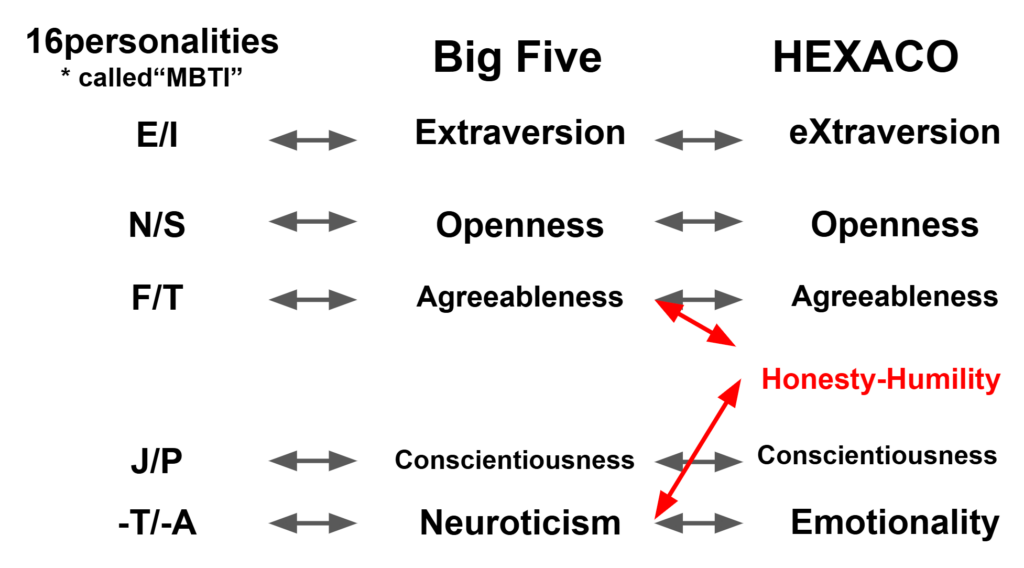
Also, in 16personalities, which was created with reference to MBTI and Big Five, neuroticism from Big Five is called “Identity“, and is classified as either Assertive or Turbulent.
On the far right is the relatively new personality assessment “HEXACO“. It is an improved version of Big Five with one additional indicator “Honesty-Humility”. Research on bullying and harassment perpetrators is active in HEXACO studies.
Since 16personalities and MBTI have weak scientific evidence, this article provides detailed explanations of 16personalities personality types based on their correlations with Big Five and HEXACO.
Actionable Advice for ISFPs in Love
For ISFPs who want to build deeper, more resilient romantic relationships, the most impactful changes tend to involve stretching slightly beyond the comfort zone of silent care — not to become someone different, but to make the love that is already there more visible to a partner. Here are 5 evidence-informed strategies:
- Practice “micro-disclosure” daily: Rather than attempting a big emotional conversation, try sharing one small feeling each day — “I felt really happy when you texted me this afternoon.” Small, consistent disclosures build emotional intimacy far more effectively than occasional breakthroughs. This works because it lowers the stakes of vulnerability.
- Develop a “repair signal”: Agree with your partner on a low-pressure signal that means “I need time alone right now, but I am not pulling away from us.” This prevents the withdrawal-pursuit cycle described above. Even a simple phrase like “I need an hour, then let’s talk” changes everything.
- Lean into your natural strengths: Your attentiveness, creativity, and sensitivity are genuinely rare. Use them deliberately — plan a date around something your partner mentioned months ago, or write a short note when words in person feel too exposed. These acts carry enormous weight.
- Set a boundary before you reach your limit: Because ISFPs tend to accommodate, they often only speak up when already at capacity. Practice stating a preference early — “I’d actually love a quiet evening tonight” — before the need becomes urgent. This prevents resentment from accumulating quietly.
- Reframe conflict as care: ISFPs often avoid disagreement because they associate it with harm. Research on healthy relationships consistently shows that the ability to raise and resolve disagreements is a marker of relationship strength, not weakness. Framing conflict as “this matters enough to talk about” can make it feel less threatening.

FAQ and Important Notes
HEXACO results differ from 16personalities (commonly known as MBTI test) or MBTI (original)
- Personality is influenced by genetics and environment, so when the environment changes, responses also change (for example, emotional responses change when you’re tired, etc.). For more details on genetics, see here.
- There are variations in responses depending on age. For more details, see here.
- Type classification is based on whether each value is 3 or above, or below 3, so values close to 3 are more likely to change results depending on how questions are asked or the environment at the time. Please look at the numerical values rather than the type.
- For MBTI (original) and 16personalities (commonly known as MBTI test), it’s unclear how much statistical processing was done at the question design stage as no research papers can be found. On the other hand, papers on Big Five and HEXACO can be easily found, and this HEXACO-JP test is based on research papers.
- While there aren’t many research papers comparing MBTI and 16personalities with everyday behaviors (academic performance, income, etc.) or with the brain and genetics, there are numerous studies on Big Five and HEXACO.
- HEXACO is a variation of Big Five elements, so they are similar but distinct. HEXACO’s Honesty-Humility is extracted from Big Five’s Agreeableness and Neuroticism.
If you have any other questions, please contact us through our inquiry form.
Personality test results are merely “hints” for your life
As mentioned earlier, personality is influenced by genetics and environment. Due to genetic influence, there is a certain range of variation, but answers can vary to some extent depending on the environment.
Also, while Big Five and HEXACO research papers conduct correlation analyses with academic performance and income, the correlation coefficients are not as large as those in natural science experiments. Correlation coefficients range from -1 to 1, but most are around -0.4 to 0.4. Of course, there are higher ones too, but they’re not 0.8 or 0.9 – they’re relatively lower in comparison.
However, since there is various research available, please think of it as “more than fortune-telling, less than natural science.” I’m not 100% denying psychology or fortune-telling.
Frequently Asked Questions
What are the main ISFP love personality traits in a relationship?
ISFPs in relationships tend to show love through actions, attentive presence, and quiet consistency rather than verbal declarations. Their core romantic traits include high emotional sensitivity, deep loyalty, a preference for authenticity over performance, and a strong desire to care for their partner’s well-being. Research suggests these qualities — especially high agreeableness — are among the most reliable predictors of relationship satisfaction for both partners involved.
Who is most compatible with an ISFP romantically?
ISFP romantic compatibility tends to be strongest with partners who appreciate quiet depth and do not require constant verbal reassurance. Personality types that offer complementary energy — such as ENFPs who bring enthusiasm without overwhelming an ISFP’s need for calm — often pair well. Partners who understand that ISFP silence typically signals reflection rather than disconnection tend to report much more satisfying relationships with this type.
Why do ISFPs pull away when they are hurt?
ISFPs tend to withdraw when emotionally hurt because they are highly sensitive and need time and space to internally process intense feelings before they can speak about them. This is not avoidance in the dismissive sense — it is a coping mechanism rooted in their deeply introverted feeling function. Without an explicit “repair signal” agreed upon with their partner, this withdrawal can be misread as rejection, which is why open communication about this pattern is especially important for ISFPs.
Are ISFPs loyal in long-term relationships?
Yes, ISFPs are generally considered among the more loyal MBTI personality types in committed relationships. Their deep emotional investment and strong personal value system mean they tend to take commitment seriously. Studies on agreeableness and relationship behavior suggest that people with the empathetic, harmony-oriented profile typical of ISFPs are less likely to engage in relationship-undermining behaviors and more likely to prioritize their partner’s well-being over time.
How can an ISFP get better at expressing feelings verbally?
Research on emotional communication suggests that gradual, low-stakes practice is more effective than attempting large emotional disclosures all at once. For ISFPs, a practical approach is “micro-disclosure” — sharing one small, genuine feeling each day in a low-pressure context. Over approximately 2 to 4 weeks, this tends to lower the internal anxiety around verbal vulnerability and makes deeper conversations feel more natural and less overwhelming.
What is the adventurer personality love style?
The “Adventurer” is the informal MBTI nickname for the ISFP personality type. In love, the adventurer personality love style is characterized by spontaneity, sensory attentiveness, deep emotional care, and a preference for showing rather than telling. ISFPs bring creativity and genuine warmth to relationships and often excel at creating memorable, meaningful shared experiences — though they may need encouragement to verbalize the depth of feeling behind those gestures.
Do ISFPs fall in love quickly or slowly?
ISFPs tend to fall in love more gradually than highly extroverted or spontaneous types. Because they value authenticity so deeply, they typically need time to feel safe enough to open up emotionally. However, once an ISFP does form a deep romantic attachment, that love tends to be remarkably steady and enduring. Rushing an ISFP into commitment before trust is established usually has the opposite effect of what is intended.
Summary: Quiet Love, Lasting Connection
The defining strength of ISFP love personality traits is not loudness — it is depth. ISFPs tend to love with a quiet, consistent sincerity that, once understood by a partner, becomes one of the most stabilizing forces a relationship can have. Psychology supports what many ISFP partners discover intuitively: high agreeableness, emotional attunement, and genuine care are among the strongest foundations for lasting romantic satisfaction. The primary growth edge for ISFPs is bridging the gap between how much they feel and how much they communicate — and even small, deliberate steps in that direction can transform a relationship. If you recognized yourself or your partner in these patterns, explore your full MBTI love profile and discover which of your personality strengths you may not be using to their full potential in your relationship.

Writer & Supervisor: Eisuke Tokiwa
Personality Psychology Researcher / CEO, SUNBLAZE Inc.
As a child he experienced poverty, domestic abuse, bullying, truancy and dropping out of school — first-hand exposure to a range of social problems. He spent 10 years researching these issues and published Encyclopedia of Villains through Jiyukokuminsha. Since then he has independently researched the determinants of social problems and antisocial behavior (work, education, health, personality, genetics, region, etc.) and has published 2 peer-reviewed journal articles (Frontiers in Psychology, IEEE Access). His goal is to predict the occurrence of social problems. Spiky profile (WAIS-IV).
Expertise: Personality Psychology / Big Five / HEXACO / MBTI / Prediction of Social Problems
Researcher profiles: ORCID / Google Scholar / ResearchGate
Social & Books: X (@etokiwa999) / note / Amazon Author Page