ENFJ love personality traits place this type among the most devoted and emotionally intelligent partners in the MBTI framework. If you have ever wondered why ENFJs are so often described as the “ideal lover,” the answer lies in a fascinating combination of deep empathy, sincere commitment, and an almost instinctive ability to sense what the people they care about need most.
Drawing on research in personality psychology — including studies grounded in the well-established Big Five model — this article breaks down exactly how ENFJ relationships psychology works, what makes this type shine in romance, and what pitfalls they should watch out for. Whether you are an ENFJ yourself or simply curious about MBTI ENFJ personality in love, read on for a clear, science-informed guide.
Once again, personality researcher and author of Villain Encyclopedia, Tokiwa (@etokiwa999), will provide the explanation.
※We have developed the HEXACO-JP Personality Assessment! It has more scientific basis than MBTI. Tap below for details.

目次
- 1 Characteristics and Tendencies of ENFJ (The Protagonist)
- 2 What Makes ENFJ Love Personality Traits Stand Out?
- 3 The Psychology Behind ENFJ Empathy in Love
- 4 ENFJ Romantic Compatibility: Who Do ENFJs Pair Well With?
- 5 The Shadow Side: When ENFJ Dedication Becomes a Weakness
- 6 Actionable Relationship Advice for ENFJs
- 7 Try Taking the Proper Personality Test “HEXACO-JP”!
- 8 Scientific Background of the 16 Types
- 9 FAQ and Important Notes
- 10 Frequently Asked Questions
- 10.1 What are the most defining ENFJ love personality traits?
- 10.2 Who is the ideal partner for an ENFJ?
- 10.3 Do ENFJs fall in love quickly?
- 10.4 What are the biggest weaknesses of ENFJs in relationships?
- 10.5 How does ENFJ empathy in love differ from other personality types?
- 10.6 Is the ENFJ personality type rare, and does that affect their love life?
- 10.7 Can ENFJs have healthy long-term relationships?
- 11 Summary: Building on Your ENFJ Love Personality Traits
Characteristics and Tendencies of ENFJ (The Protagonist)
ENFJs are types who guide people and value harmony.
They are sensitive to the emotions of those around them and are skilled at encouraging others.
They have a strong sense of responsibility and work hard toward their goals.
They bring out results through cooperation with others.
The characteristics and tendencies of ENFJs are as follows.
- They believe in people’s potential and support their growth.
- They build relationships with a bright attitude.
- They positively seek solutions even in difficult situations.
- They demonstrate the ability to unite entire teams.
- They have the power of action to connect ideals to reality.
On the other hand, they sometimes become exhausted from serving others too much.
They are easily swayed by emotions and sometimes become self-sacrificing.
Prioritizing others too much can cause them to lose sight of themselves.
They become stable by being aware of their own limits.
ENFJs tend to become trusted leaders.
They draw out people’s motivation and create results together.
Their sincere attitude gives many people a sense of security.
Their ability to envision the future with others is a great attraction.
What Makes ENFJ Love Personality Traits Stand Out?
Among all 16 MBTI types, ENFJs tend to be the ones most naturally oriented toward nurturing a partner’s happiness. This is not mere sentiment — it is a behavioral pattern rooted in how ENFJs process emotion and social information. Their dominant cognitive function is Extraverted Feeling (Fe), which means they are constantly attuned to the emotional atmosphere around them and feel a genuine pull to respond to it constructively.
In practical terms, this shows up in at least 4 consistent relationship behaviors:
- Joyful support: ENFJs tend to find real fulfillment in helping a partner grow, solve problems, or simply feel better after a hard day. Supporting others is not a chore for them — it is energizing.
- Reliable commitment: They take promises seriously. An ENFJ partner typically keeps their word, follows through on plans, and builds trust through consistent, honest behavior over time.
- Emotional attentiveness: ENFJs are quick to notice subtle shifts in a partner’s mood, often picking up on unspoken stress or sadness before the partner has even articulated it themselves.
- Risk of over-giving: Because they are so focused on the other person, ENFJs can sometimes give more than they receive, leading to emotional exhaustion if the pattern goes unchecked.
In short, ENFJ partner traits are defined by what researchers might call “supportive love” — a style of relating that prioritizes the partner’s well-being while expressing affection through action rather than just words. This tends to make them deeply trusted and deeply appreciated in long-term relationships.
The Psychology Behind ENFJ Empathy in Love
ENFJ empathy in love is not simply being “nice” — it is a sophisticated, almost automatic process of reading social and emotional cues. Personality psychology offers a useful lens for understanding this. The Big Five model describes human personality along 5 dimensions: Conscientiousness, Agreeableness, Extraversion, Openness, and Neuroticism (emotional stability). Research suggests that people who score high on Agreeableness and Conscientiousness tend to report significantly higher relationship satisfaction — and ENFJs, by the logic of their type, tend to embody both of these traits.
High Agreeableness means a person is naturally cooperative, warm, and sensitive to others’ feelings — classic ENFJ territory. High Conscientiousness means they are dependable, organized, and self-disciplined, which maps closely onto the “J” (Judging) dimension of MBTI. When you combine these 2 qualities in a romantic context, you get a partner who is both emotionally responsive and practically reliable — a rare and valuable combination.
Furthermore, ENFJs’ strong Extraversion means they are typically comfortable expressing affection openly. They do not leave partners guessing about how they feel. This transparency reduces anxiety in the relationship and tends to create a secure emotional base for both people involved.
A key meta-analysis — Malouff et al. (2010), The Five-Factor Model of personality and relationship satisfaction of intimate partners — found that high Conscientiousness and Agreeableness were the strongest personality-based predictors of relationship satisfaction. This scientific finding helps explain why ENFJ romantic compatibility tends to be high across a wide range of partner types.
ENFJ Romantic Compatibility: Who Do ENFJs Pair Well With?
ENFJs are broadly compatible with many types, but they tend to thrive with partners who value emotional depth and mutual growth. Because ENFJs invest so heavily in the relationship, they do best with someone who is willing to reciprocate that investment — not necessarily in the same way, but with equal sincerity.
Types that tend to complement ENFJs well include introverted Feeling types (INFPs, ISFPs) who offer deep emotional authenticity, and grounded Sensing-Judging types (ISFJs, ISTJs) who provide the practical stability ENFJs sometimes lack. That said, MBTI compatibility is never a simple formula — individual values, communication habits, and life goals play an equally important role.
What ENFJs genuinely need from a partner can be summarized in 3 core areas:
- Emotional reciprocity: ENFJs give a great deal; they need to feel that their partner also makes an effort to understand and care for them.
- Respect for their values: ENFJs tend to have strong ethical convictions. A partner who dismisses or repeatedly contradicts these values is likely to create lasting friction.
- Space for honest communication: ENFJs express feelings openly and need a partner who can engage with that openness rather than shut it down.
Comparing ENFJs with other “Feeling” types like INFJs or ENFPs, ENFJs are generally more outwardly expressive and action-oriented in their love. Where an INFJ might show love through quiet understanding, an ENFJ tends to show it through visible acts of care and vocal encouragement. This makes their affection very tangible — which most partners find reassuring.
The Shadow Side: When ENFJ Dedication Becomes a Weakness
One of the most important — and often overlooked — aspects of ENFJ relationships psychology is the risk of self-neglect. Because ENFJs are so driven to prioritize their partner’s happiness, they can fall into a pattern of consistently placing their own needs last. Over time, this self-sacrificing tendency can lead to emotional burnout, resentment, or a loss of individual identity within the relationship.
Research on relationship well-being consistently shows that sustainable partnerships require both people to have their needs met. A relationship where one person always gives and the other always receives is inherently unbalanced, regardless of how much love is present. ENFJs, in particular, should watch for these 3 warning signs:
- Chronic fatigue or emotional depletion: Feeling consistently drained after interactions with a partner is a signal that the giving and receiving ratio is out of balance.
- Suppressing personal opinions to avoid conflict: ENFJs may sometimes agree with a partner even when they disagree internally, prioritizing harmony over honesty. This erodes authenticity over time.
- Losing sight of personal goals: If an ENFJ’s own ambitions, hobbies, or friendships have gradually faded because the relationship consumed all their energy, recalibration is needed.
The good news is that awareness alone tends to be a powerful corrective. ENFJs who recognize this pattern can make small, deliberate adjustments — such as scheduling personal time or practicing saying “I need this too” — without compromising the warmth and generosity that make them such wonderful partners in the first place.
Actionable Relationship Advice for ENFJs
Understanding your strengths and blind spots is only valuable if you can translate that knowledge into concrete habits. Here are 5 evidence-informed strategies for ENFJs who want to build and sustain deeply fulfilling relationships:
- Communicate your needs explicitly. ENFJs are excellent at reading others but sometimes assume their partners can read them too. Stating your needs clearly — rather than hinting or hoping — reduces misunderstandings and invites the reciprocity ENFJs deserve. How to practice: Once a week, share one thing you need from the relationship, no matter how small.
- Build in intentional self-care routines. Because ENFJs recharge by connecting with others, they may not notice how much energy they have spent until they hit a wall. Why it works: Scheduled self-care is not selfish — it keeps the emotional “tank” full so you can give sustainably. Aim for at least 30 minutes per day of purely personal activity.
- Use your empathy directionally. Rather than absorbing a partner’s stress as your own problem to fix, practice being a compassionate witness. How to practice: Try saying “That sounds really hard — I’m here with you” instead of immediately jumping to solutions.
- Celebrate disagreement as intimacy. ENFJs’ drive for harmony can make conflict feel threatening. However, research suggests that couples who can disagree respectfully tend to build deeper trust. How to practice: When you notice yourself about to suppress an opinion, pause and share it kindly instead.
- Leverage your natural leadership in the relationship. ENFJs often inspire the people around them. Use this quality to set positive relationship norms — initiating meaningful conversations, planning shared experiences, and modeling the vulnerability you want from a partner.
Try Taking the Proper Personality Test “HEXACO-JP”!
While MBTI and 16personalities are popular as “gateways to knowing yourself,” experiencing a scientifically-backed personality test is the best way to truly understand your strengths and risks.
That’s where we recommend the HEXACO assessment available in Japanese: “HEXACO-JP“.
HEXACO-JP visualizes your personality tendencies numerically based on six factors: Honesty-Humility, Emotionality, Extraversion, Agreeableness, Conscientiousness, and Openness.
By simply answering straightforward questions, you can gain helpful insights for self-understanding, relationships, and workplace communication.
If you’re curious about “What type of person am I?”, start by taking HEXACO-JP and examine yourself from a scientific perspective.
Scientific Background of the 16 Types
MBTI Overview
MBTI is a psychological theory that classifies personality into 16 types.
To begin with, MBTI is an abbreviation for Myers-Briggs Type Indicator.
MBTI classifies personality into 16 types by combining the following 4 indicators.
In other words, MBTI expresses one’s personality tendencies in 4 letters such as “ISTJ” or “ENFP”. There is a very famous similar system called 16personalities, but this is created by combining MBTI and Big Five.
Big Five Overview
One of the most prominent trait theories in personality psychology is the “Big Five”.
Big Five measures five traits: Openness, Conscientiousness, Extraversion, Agreeableness, and Neuroticism.
Also, while 16personalities and MBTI use type classification (e.g., either extraverted or introverted), a major difference is that Big Five evaluates traits on a continuous numerical scale (e.g., extraversion 3.5).
Furthermore, it has been studied for a long time, has many research papers, and extensive research has been conducted in other fields such as academic achievement, income, brain, and genetics. It can be said that Big Five has relatively stronger scientific backing.
Correlation Between MBTI, Big Five, and HEXACO
There are correlations between MBTI’s 4 indicators and Big Five’s 5 factors.
A representative study showing this correlation is the paper “The relationship between the revised NEO-Personality Inventory and the Myers-Briggs Type Indicator“.
According to this paper, the correlations between MBTI and Big Five are as follows.
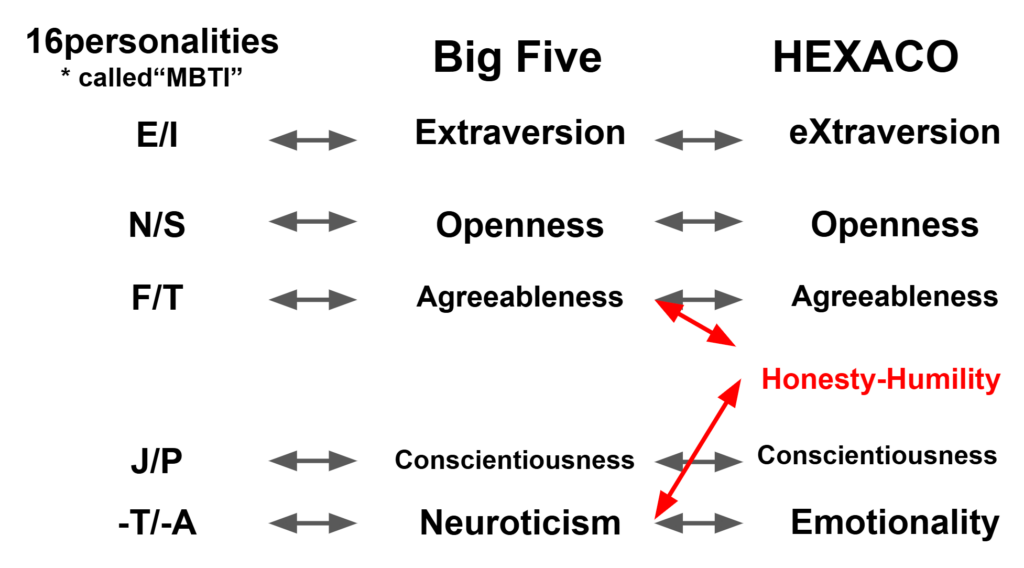
Also, in 16personalities, which was created with reference to MBTI and Big Five, neuroticism from Big Five is called “Identity“, and is classified as either Assertive or Turbulent.
On the far right is the relatively new personality assessment “HEXACO“. It is an improved version of Big Five with one additional indicator “Honesty-Humility”. Research on bullying and harassment perpetrators is active in HEXACO studies.
Since 16personalities and MBTI have weak scientific evidence, this article provides detailed explanations of 16personalities personality types based on their correlations with Big Five and HEXACO.

FAQ and Important Notes
HEXACO results differ from 16personalities (commonly known as MBTI test) or MBTI (original)
- Personality is influenced by genetics and environment, so when the environment changes, responses also change (for example, emotional responses change when you’re tired, etc.). For more details on genetics, see here.
- There are variations in responses depending on age. For more details, see here.
- Type classification is based on whether each value is 3 or above, or below 3, so values close to 3 are more likely to change results depending on how questions are asked or the environment at the time. Please look at the numerical values rather than the type.
- For MBTI (original) and 16personalities (commonly known as MBTI test), it’s unclear how much statistical processing was done at the question design stage as no research papers can be found. On the other hand, papers on Big Five and HEXACO can be easily found, and this HEXACO-JP test is based on research papers.
- While there aren’t many research papers comparing MBTI and 16personalities with everyday behaviors (academic performance, income, etc.) or with the brain and genetics, there are numerous studies on Big Five and HEXACO.
- HEXACO is a variation of Big Five elements, so they are similar but distinct. HEXACO’s Honesty-Humility is extracted from Big Five’s Agreeableness and Neuroticism.
If you have any other questions, please contact us through our inquiry form.
Personality test results are merely “hints” for your life
As mentioned earlier, personality is influenced by genetics and environment. Due to genetic influence, there is a certain range of variation, but answers can vary to some extent depending on the environment.
Also, while Big Five and HEXACO research papers conduct correlation analyses with academic performance and income, the correlation coefficients are not as large as those in natural science experiments. Correlation coefficients range from -1 to 1, but most are around -0.4 to 0.4. Of course, there are higher ones too, but they’re not 0.8 or 0.9 – they’re relatively lower in comparison.
However, since there is various research available, please think of it as “more than fortune-telling, less than natural science.” I’m not 100% denying psychology or fortune-telling.

Writer & Supervisor: Eisuke Tokiwa
Personality Psychology Researcher / CEO, SUNBLAZE Inc.
As a child he experienced poverty, domestic abuse, bullying, truancy and dropping out of school — first-hand exposure to a range of social problems. He spent 10 years researching these issues and published Encyclopedia of Villains through Jiyukokuminsha. Since then he has independently researched the determinants of social problems and antisocial behavior (work, education, health, personality, genetics, region, etc.) and has published 2 peer-reviewed journal articles (Frontiers in Psychology, IEEE Access). His goal is to predict the occurrence of social problems. Spiky profile (WAIS-IV).
Expertise: Personality Psychology / Big Five / HEXACO / MBTI / Prediction of Social Problems
Researcher profiles: ORCID / Google Scholar / ResearchGate
Social & Books: X (@etokiwa999) / note / Amazon Author Page
Frequently Asked Questions
What are the most defining ENFJ love personality traits?
ENFJs tend to be deeply empathetic, verbally expressive, and action-oriented in love. Their most defining traits include a strong drive to support their partner’s growth, consistent reliability in keeping promises, and an almost intuitive sensitivity to emotional shifts. Research grounded in the Big Five model suggests these patterns align closely with high Agreeableness and Conscientiousness — 2 of the strongest personality predictors of long-term relationship satisfaction.
Who is the ideal partner for an ENFJ?
ENFJs tend to thrive with partners who offer emotional authenticity and reciprocate effort in the relationship. Types such as INFP, ISFP, INFJ, and ISFJ are frequently cited as compatible because they balance ENFJ’s expressive warmth with either deep inner feeling or steady practicality. That said, no single type is universally ideal — shared values, communication style, and mutual respect matter far more than a type match alone.
Do ENFJs fall in love quickly?
ENFJs tend to be emotionally open and are often drawn to deep connection from early in a relationship. Because their dominant function (Extraverted Feeling) naturally orients toward others, they may develop strong feelings relatively quickly. However, ENFJs also value sincerity and long-term commitment, which means they generally approach love seriously rather than casually, and they invest most deeply once trust is established.
What are the biggest weaknesses of ENFJs in relationships?
The most commonly noted ENFJ relationship challenge is over-giving — prioritizing a partner’s needs so consistently that their own emotional well-being is neglected. This can lead to burnout, suppressed opinions, and a gradual loss of personal identity. Additionally, ENFJs’ strong desire for harmony may cause them to avoid necessary conflict, which can allow small issues to grow unaddressed. Awareness of these tendencies is the first and most effective step toward addressing them.
How does ENFJ empathy in love differ from other personality types?
Unlike INFJs, who tend to express empathy through quiet, internalized understanding, ENFJs typically show empathy through outward action — organizing support, voicing encouragement, and actively problem-solving on a partner’s behalf. Compared to ENFPs, who are similarly warm but more spontaneous, ENFJs tend to be more structured and consistent in how they express care. This makes their empathy very visible and reliable, which most partners find deeply reassuring.
Is the ENFJ personality type rare, and does that affect their love life?
ENFJs represent approximately 2–3% of the general population, making them one of the less common MBTI types. This relative rarity can sometimes make ENFJs feel misunderstood — particularly their intensity of feeling and strong value-driven approach to relationships. However, the same qualities that make ENFJs uncommon also make them highly valued as partners. Their combination of emotional depth and practical reliability is genuinely distinctive.
Can ENFJs have healthy long-term relationships?
Yes — and when ENFJs actively manage their tendency to over-give, they tend to build some of the most stable and emotionally rich long-term partnerships among all MBTI types. Research suggests that the personality traits ENFJs naturally express — high Agreeableness, Conscientiousness, and Extraversion — are associated with sustained relationship satisfaction. The key is balancing their deep generosity with an equal commitment to their own emotional needs.
Summary: Building on Your ENFJ Love Personality Traits
ENFJ love personality traits represent a genuinely powerful foundation for meaningful, lasting relationships. The combination of empathy, reliability, expressive warmth, and value-driven commitment tends to make ENFJs among the most trusted and cherished partners across all personality types. Research in personality psychology consistently supports the idea that the core qualities ENFJs embody — high Agreeableness and Conscientiousness — are directly linked to higher relationship satisfaction for both partners.
At the same time, the healthiest version of ENFJ love is one where self-care and self-expression are valued alongside devotion to a partner. When ENFJs give themselves the same thoughtful attention they so readily offer others, their relationships tend to flourish in a way that is sustainable, authentic, and deeply fulfilling for everyone involved.
Curious about how your own personality traits show up in the way you love? Explore your MBTI type in depth and discover which of your natural strengths are shaping your relationships right now.