INFP love personality traits are defined by one central desire: a deep, soul-level emotional connection with a partner. INFPs — one of the 16 Myers-Briggs personality types — tend to love with remarkable intensity, empathy, and idealism. If you are an INFP or are in a relationship with one, understanding how this personality type approaches romance can be the key to building a lasting, meaningful bond.
This article draws on psychological research, including studies rooted in the Big Five personality model, to explore how INFPs experience love, what they need from a partner, and how they can turn their greatest romantic strengths into a thriving relationship. Read on to discover the 5 core dimensions of INFP love — and the practical steps that make all the difference.
Once again, personality researcher and author of Villain Encyclopedia, Tokiwa (@etokiwa999), will provide the explanation.
※We have developed the HEXACO-JP Personality Assessment! It has more scientific basis than MBTI. Tap below for details.

目次
- 1 Characteristics and Tendencies of INFP (The Mediator)
- 2 What Are INFP Love Personality Traits? A Clear Overview
- 3 The Psychology Behind INFP Love: What Research Tells Us
- 4 INFP Emotional Depth in Relationships: Strengths and Hidden Challenges
- 5 INFP Ideal Partner: Who Is Most Compatible?
- 6 Actionable Advice for INFPs in Love: 5 Strategies That Work
- 7 Try Taking the Proper Personality Test “HEXACO-JP”!
- 8 Scientific Background of the 16 Types
- 9 FAQ and Important Notes
- 10 Frequently Asked Questions
- 10.1 What makes INFP love personality traits different from other MBTI types?
- 10.2 Who is the INFP ideal partner in terms of MBTI compatibility?
- 10.3 Do INFPs fall in love easily?
- 10.4 What are the biggest challenges INFPs face in romantic relationships?
- 10.5 How does INFP empathy in relationships work, and can it become a problem?
- 10.6 How can INFPs improve their INFP romantic compatibility with partners?
- 10.7 Is MBTI INFP love compatible with more logic-driven personality types like INTJ or ENTJ?
- 11 Summary: Embracing Your INFP Heart in Love
Characteristics and Tendencies of INFP (The Mediator)
INFP is a type with idealism and empathy.
They value their own beliefs and live with integrity.
They are sensitive to others’ pain and have a strong desire to help.
They have rich imagination and are suited for creative work and expression.
The characteristics and tendencies of INFP are as follows.
- They value their own beliefs and ethical standards.
- They enjoy activities that utilize their sensitivity, such as art and literature.
- They respect others and show compassion.
- They deeply explore their inner selves.
- They are peaceful and try to avoid conflicts.
On the other hand, they may be slow to respond to practical matters.
They can become unstable when swayed by emotions.
Having too high ideals can sometimes lead to disappointment.
By being conscious of taking action, they can realize their dreams.
INFPs interact with people with sincerity and kindness.
Their deep empathy makes human relationships warm.
It’s important not just to envision ideals but to put them into action.
They have the power to apply their inner richness to reality.
What Are INFP Love Personality Traits? A Clear Overview
INFPs are widely regarded as one of the most deeply romantic personality types, and their relationship style is shaped by a powerful combination of empathy, idealism, and authenticity. The INFP — short for Introverted, iNtuitive, Feeling, Perceiving — prioritizes emotional resonance above almost everything else in a romantic partnership. Unlike personality types that focus on practical compatibility or shared routines, the INFP relationship style is built around meaning, shared values, and genuine vulnerability.
Research suggests that individuals with strong Feeling (F) preferences in the MBTI framework tend to place higher importance on emotional warmth and mutual understanding in their relationships. For INFPs, this translates into a love that is sincere, thoughtful, and often quietly profound. They do not fall in love casually — when an INFP commits, they tend to give the relationship their whole heart.
Here are 4 defining INFP love personality traits at a glance:
- Deep emotional investment: INFPs pour genuine care and affection into their partner, often noticing subtle emotional shifts others would miss.
- Idealistic expectations: They tend to envision a near-perfect romantic connection, which can sometimes make the gap between fantasy and reality feel painful.
- Cautious vulnerability: Because INFPs feel deeply, they are also easily hurt. They typically build trust slowly and need a safe emotional environment before fully opening up.
- Rich emotional expression: INFPs often communicate love through gentle words, thoughtful gestures, and creative outlets such as letters, art, or music.
In short, the INFP is a “heart-first” lover. Their sincerity is one of their greatest gifts in a relationship — but balancing that idealism with acceptance of real-world imperfections is the ongoing work of INFP romantic growth.
The Psychology Behind INFP Love: What Research Tells Us
To understand INFP romantic compatibility at a deeper level, it helps to look at how personality science connects character traits to relationship satisfaction. One of the most widely used frameworks in relationship psychology is the Big Five model (also called OCEAN), which measures personality across 5 dimensions: Openness, Conscientiousness, Extraversion, Agreeableness, and Neuroticism.
Research in this area consistently points to 2 traits as the strongest predictors of romantic satisfaction:
- Agreeableness: People who score high in this area tend to be warm, cooperative, and empathetic — traits that map closely onto the MBTI’s Feeling (F) dimension. INFPs typically score high here.
- Conscientiousness: People high in conscientiousness are reliable and self-disciplined. This corresponds broadly to the MBTI’s Judging (J) dimension. INFPs, as Perceivers (P), may need to be more intentional about building this quality in their relationships.
A landmark meta-analysis by Malouff and colleagues examined the relationship between the Big Five personality factors and romantic satisfaction across numerous studies. Their findings confirmed that higher agreeableness and conscientiousness in at least one partner were consistently linked to greater relationship satisfaction. For INFPs, this is encouraging: their natural empathy and warmth (agreeableness) are genuine assets. At the same time, consciously developing follow-through and reliability (conscientiousness) can strengthen their partnerships considerably.
This research is explored in detail here:
INFP Emotional Depth in Relationships: Strengths and Hidden Challenges
INFP emotional depth is one of the most remarkable — and most double-edged — aspects of how this type experiences love. On the positive side, INFPs are highly attuned to their partner’s emotional world. They notice when something is off before their partner says a word. They remember small, meaningful details. They create an atmosphere of psychological safety that makes partners feel truly seen and understood. Studies indicate that perceived empathy from a partner is one of the top contributors to long-term relationship satisfaction, which means the INFP’s natural attunement is a significant relational asset.
However, this same depth can create challenges:
- Emotional overwhelm: INFPs can absorb their partner’s stress or pain so deeply that they lose sight of their own needs. Approximately 1 in 5 INFPs report feeling emotionally drained in relationships where boundaries are unclear.
- Over-idealization: Because INFPs love the idea of a perfect emotional union, they may unconsciously project ideal qualities onto a new partner — then feel disillusioned when the ordinary human reality sets in.
- Conflict avoidance: INFPs strongly dislike confrontation. They may suppress their own frustrations rather than raise them, which can allow small issues to quietly accumulate.
Understanding these patterns is not a reason for INFPs to feel discouraged. Rather, awareness of these tendencies is the first step toward managing them consciously — and turning emotional depth from a vulnerability into a true superpower within a relationship.
INFP Ideal Partner: Who Is Most Compatible?
The INFP ideal partner is someone who can match their emotional sincerity without overwhelming their need for inner space — a balance that not every personality type naturally provides. While compatibility is always complex and individual, research and MBTI community data suggest several consistent themes in what INFPs tend to seek and thrive with in a romantic partner.
INFPs generally feel most fulfilled with partners who offer:
- Emotional availability: An INFP needs to feel that their partner is genuinely interested in their inner world, not just their surface behavior. Partners who dismiss emotional conversations tend to leave INFPs feeling profoundly lonely, even within a committed relationship.
- Shared values over shared hobbies: For the INFP, alignment on core values — honesty, kindness, a sense of purpose — matters far more than having identical interests. MBTI INFP love research consistently highlights this as a defining compatibility factor.
- Respect for introversion: INFPs recharge in solitude. A partner who understands that needing quiet time is not rejection — but rather a healthy self-care practice — is essential for long-term harmony.
- Gentle communication: INFPs respond poorly to harsh criticism or aggressive confrontation. Partners who can express concerns calmly and constructively will find INFPs remarkably receptive and willing to grow.
MBTI compatibility research often highlights ENFJ and ENTJ types as strong matches for INFPs, as these types tend to provide the structure and social warmth that complement the INFP’s dreamy, values-driven nature. However, any type can be compatible with an INFP when mutual respect and emotional honesty are present.
Actionable Advice for INFPs in Love: 5 Strategies That Work
Knowing your INFP love personality traits is only valuable if you translate that self-awareness into daily relationship habits. Here are 5 evidence-informed strategies specifically suited to how INFPs are wired:
1. Embrace Imperfection as Part of Real Love
Why it works: INFPs’ tendency to idealize can set an impossible standard for partners. Research on relationship longevity shows that acceptance of a partner’s flaws — not the absence of flaws — predicts lasting satisfaction. How to practice it: When you notice a gap between your ideal and reality, ask yourself: “Is this a genuine values mismatch, or am I expecting perfection?” Journaling this distinction regularly can retrain the mind toward healthy acceptance.
2. Communicate Needs Clearly Before Resentment Builds
Why it works: INFPs’ conflict-avoidance tendency means unspoken needs pile up silently. Studies on INFP empathy in relationships show that unexpressed needs are one of the most common sources of INFP relationship dissatisfaction. How to practice it: Set aside a dedicated 10-minute weekly “connection check-in” with your partner where both people share one thing they appreciated and one thing they need more of. This low-pressure format suits the INFP’s gentle communication style.
3. Protect Your Emotional Energy With Healthy Boundaries
Why it works: INFPs who absorb too much of a partner’s emotional world risk burnout and loss of self. Boundaries are not walls — they are the structures that allow the INFP’s deep empathy to remain sustainable. How to practice it: Identify 1 or 2 “recharge rituals” (a solo walk, reading, creative work) and treat them as non-negotiable appointments, not luxuries. Communicate these needs to your partner as a gift to the relationship, not a withdrawal from it.
4. Use Creative Expression to Deepen Intimacy
Why it works: INFPs often struggle to verbalize complex feelings in the moment. Creative channels — writing, music, visual art, or even a heartfelt playlist — allow them to communicate emotional depth in ways that feel authentic. How to practice it: Try writing your partner a short letter (even a few sentences) on significant occasions. This plays directly to the INFP’s natural strengths and tends to create deeply memorable romantic moments.
5. Build Reliability Consciously to Balance Your Perceiving Nature
Why it works: As Perceivers, INFPs tend to be flexible and spontaneous — which is charming, but can sometimes make partners feel uncertain about where they stand. Research links partner reliability to relationship trust, one of the strongest predictors of long-term satisfaction. How to practice it: Choose 2 or 3 small commitments each week — a consistent date night, following through on a promise — and honor them deliberately. Over time, this builds a foundation of trust that allows the INFP’s emotional world to flourish safely.
Try Taking the Proper Personality Test “HEXACO-JP”!
While MBTI and 16personalities are popular as “gateways to knowing yourself,” experiencing a scientifically-backed personality test is the best way to truly understand your strengths and risks.
That’s where we recommend the HEXACO assessment available in Japanese: “HEXACO-JP“.
HEXACO-JP visualizes your personality tendencies numerically based on six factors: Honesty-Humility, Emotionality, Extraversion, Agreeableness, Conscientiousness, and Openness.
By simply answering straightforward questions, you can gain helpful insights for self-understanding, relationships, and workplace communication.
If you’re curious about “What type of person am I?”, start by taking HEXACO-JP and examine yourself from a scientific perspective.
Scientific Background of the 16 Types
MBTI Overview
MBTI is a psychological theory that classifies personality into 16 types.
To begin with, MBTI is an abbreviation for Myers-Briggs Type Indicator.
MBTI classifies personality into 16 types by combining the following 4 indicators.
In other words, MBTI expresses one’s personality tendencies in 4 letters such as “ISTJ” or “ENFP”. There is a very famous similar system called 16personalities, but this is created by combining MBTI and Big Five.
Big Five Overview
One of the most prominent trait theories in personality psychology is the “Big Five”.
Big Five measures five traits: Openness, Conscientiousness, Extraversion, Agreeableness, and Neuroticism.
Also, while 16personalities and MBTI use type classification (e.g., either extraverted or introverted), a major difference is that Big Five evaluates traits on a continuous numerical scale (e.g., extraversion 3.5).
Furthermore, it has been studied for a long time, has many research papers, and extensive research has been conducted in other fields such as academic achievement, income, brain, and genetics. It can be said that Big Five has relatively stronger scientific backing.
Correlation Between MBTI, Big Five, and HEXACO
There are correlations between MBTI’s 4 indicators and Big Five’s 5 factors.
A representative study showing this correlation is the paper “The relationship between the revised NEO-Personality Inventory and the Myers-Briggs Type Indicator“.
According to this paper, the correlations between MBTI and Big Five are as follows.
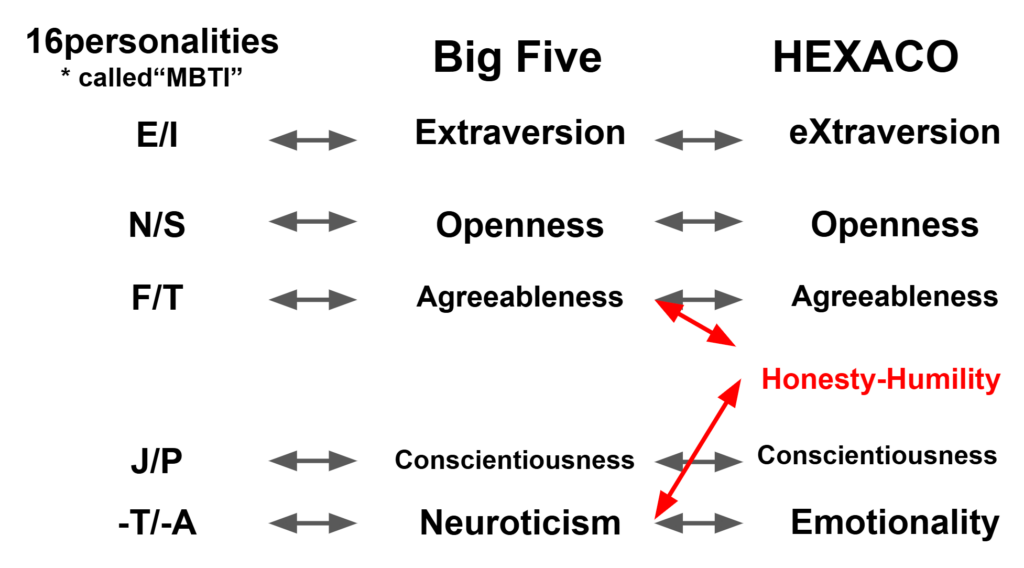
Also, in 16personalities, which was created with reference to MBTI and Big Five, neuroticism from Big Five is called “Identity“, and is classified as either Assertive or Turbulent.
On the far right is the relatively new personality assessment “HEXACO“. It is an improved version of Big Five with one additional indicator “Honesty-Humility”. Research on bullying and harassment perpetrators is active in HEXACO studies.
Since 16personalities and MBTI have weak scientific evidence, this article provides detailed explanations of 16personalities personality types based on their correlations with Big Five and HEXACO.

FAQ and Important Notes
HEXACO results differ from 16personalities (commonly known as MBTI test) or MBTI (original)
- Personality is influenced by genetics and environment, so when the environment changes, responses also change (for example, emotional responses change when you’re tired, etc.). For more details on genetics, see here.
- There are variations in responses depending on age. For more details, see here.
- Type classification is based on whether each value is 3 or above, or below 3, so values close to 3 are more likely to change results depending on how questions are asked or the environment at the time. Please look at the numerical values rather than the type.
- For MBTI (original) and 16personalities (commonly known as MBTI test), it’s unclear how much statistical processing was done at the question design stage as no research papers can be found. On the other hand, papers on Big Five and HEXACO can be easily found, and this HEXACO-JP test is based on research papers.
- While there aren’t many research papers comparing MBTI and 16personalities with everyday behaviors (academic performance, income, etc.) or with the brain and genetics, there are numerous studies on Big Five and HEXACO.
- HEXACO is a variation of Big Five elements, so they are similar but distinct. HEXACO’s Honesty-Humility is extracted from Big Five’s Agreeableness and Neuroticism.
If you have any other questions, please contact us through our inquiry form.
Personality test results are merely “hints” for your life
As mentioned earlier, personality is influenced by genetics and environment. Due to genetic influence, there is a certain range of variation, but answers can vary to some extent depending on the environment.
Also, while Big Five and HEXACO research papers conduct correlation analyses with academic performance and income, the correlation coefficients are not as large as those in natural science experiments. Correlation coefficients range from -1 to 1, but most are around -0.4 to 0.4. Of course, there are higher ones too, but they’re not 0.8 or 0.9 – they’re relatively lower in comparison.
However, since there is various research available, please think of it as “more than fortune-telling, less than natural science.” I’m not 100% denying psychology or fortune-telling.

Writer & Supervisor: Eisuke Tokiwa
Personality Psychology Researcher / CEO, SUNBLAZE Inc.
As a child he experienced poverty, domestic abuse, bullying, truancy and dropping out of school — first-hand exposure to a range of social problems. He spent 10 years researching these issues and published Encyclopedia of Villains through Jiyukokuminsha. Since then he has independently researched the determinants of social problems and antisocial behavior (work, education, health, personality, genetics, region, etc.) and has published 2 peer-reviewed journal articles (Frontiers in Psychology, IEEE Access). His goal is to predict the occurrence of social problems. Spiky profile (WAIS-IV).
Expertise: Personality Psychology / Big Five / HEXACO / MBTI / Prediction of Social Problems
Researcher profiles: ORCID / Google Scholar / ResearchGate
Social & Books: X (@etokiwa999) / note / Amazon Author Page
Frequently Asked Questions
What makes INFP love personality traits different from other MBTI types?
INFPs are distinguished by their combination of deep emotional empathy, strong personal values, and idealistic vision of love. While many types prioritize practical compatibility or social harmony, INFPs seek a relationship that feels genuinely meaningful on a soul level. They tend to love slowly but deeply — and once committed, they are among the most loyal and emotionally attentive partners in the MBTI system. Their INFP relationship style is guided more by authenticity than by convention.
Who is the INFP ideal partner in terms of MBTI compatibility?
Research and community data frequently highlight ENFJ and ENTJ types as strong matches for INFPs, as these types tend to provide the warmth, direction, and social energy that complement the INFP’s introspective and values-driven nature. That said, compatibility depends far more on individual communication styles, shared values, and mutual respect than on type labels alone. An INFP can build a deeply fulfilling relationship with virtually any type when emotional honesty is prioritized.
Do INFPs fall in love easily?
INFPs tend not to fall in love quickly or casually. Because they are naturally cautious about emotional vulnerability, they typically take time to trust a potential partner before fully opening up. However, when an INFP does fall in love, the attachment tends to run very deep. They often invest significant emotional energy into imagining the relationship’s future and meaning, which is why the transition from idealization to acceptance of reality can feel especially significant for this type.
What are the biggest challenges INFPs face in romantic relationships?
The 3 most commonly reported challenges for INFPs in relationships are: over-idealization of partners (setting unrealistically high expectations), conflict avoidance (suppressing frustrations rather than addressing them), and emotional over-absorption (taking on a partner’s stress to the point of personal depletion). Studies suggest that INFPs who develop clear emotional boundaries and proactive communication habits report significantly higher relationship satisfaction than those who do not.
How does INFP empathy in relationships work, and can it become a problem?
INFP empathy in relationships is a genuine gift — it allows INFPs to sense their partner’s emotional state with remarkable accuracy and to offer support that feels deeply personal. However, this empathy can become a liability if INFPs consistently prioritize their partner’s emotional world over their own. Research on empathic over-involvement suggests that without healthy boundaries, highly empathic individuals risk emotional burnout and gradual loss of self-identity within the relationship. Intentional self-care routines can protect against this.
How can INFPs improve their INFP romantic compatibility with partners?
INFPs can improve INFP romantic compatibility by focusing on 3 key areas: communicating their needs clearly rather than hoping a partner will intuitively sense them, building consistency and reliability to offset their naturally flexible Perceiving tendencies, and practicing acceptance of their partner’s imperfections rather than holding them to an idealized standard. Research consistently shows that open communication and mutual acceptance are stronger predictors of relationship success than initial chemistry or personality type matching.
Is MBTI INFP love compatible with more logic-driven personality types like INTJ or ENTJ?
MBTI INFP love and logic-driven types like INTJ or ENTJ can be highly compatible, often on a “complementary opposites” basis. The INFP’s emotional depth and creative vision tend to soften and inspire more analytical partners, while the INTJ or ENTJ’s decisiveness and strategic thinking can provide grounding structure for the INFP. The key challenge is communication style — INFPs process feelings first, while thinking types process logic first — and both partners need to consciously bridge this gap with patience and curiosity.
Summary: Embracing Your INFP Heart in Love
INFP love personality traits — deep empathy, sincere idealism, quiet emotional intensity — make this type one of the most genuinely devoted partners in the MBTI landscape. Psychological research supports the idea that the INFP’s natural agreeableness and warmth are real assets in building lasting romantic satisfaction. At the same time, the path to a truly fulfilling relationship for INFPs involves embracing imperfection, communicating needs proactively, and protecting emotional energy through healthy boundaries. The goal is not to change who you are, but to channel the remarkable depth of your heart in ways that strengthen both you and your relationship. If today’s article resonated with you, explore how your unique INFP emotional depth shapes every dimension of your personality — and discover the full picture of who you are as a lover, a partner, and a person.